Young Fermats · Pre-Algebra · Class 14
One-Step Equations with Multiplication and Division
Solve a one-step multiplication equation by dividing both sides by the nonzero coefficient. Solve a one-step division equation by multiplying both sides by the divisor. Then substitute your answer into the original equation to check it.
Follow the eight images in order, with five original questions after every image. Homework includes eight review questions, one per image, and 12 word problems in increasing difficulty: 20 homework questions in total. All 60 questions have blue Answer buttons with worked explanations.
Part of Young Fermats Pre-Algebra at SOMATH. Book an evaluation to discuss placement, or view the current schedule.
Before you begin, review Class 13: one-step addition and subtraction equations. This class extends the same balance principle to multiplication and division. The practice questions use different examples from the posters.
Understanding multiplication and division equations
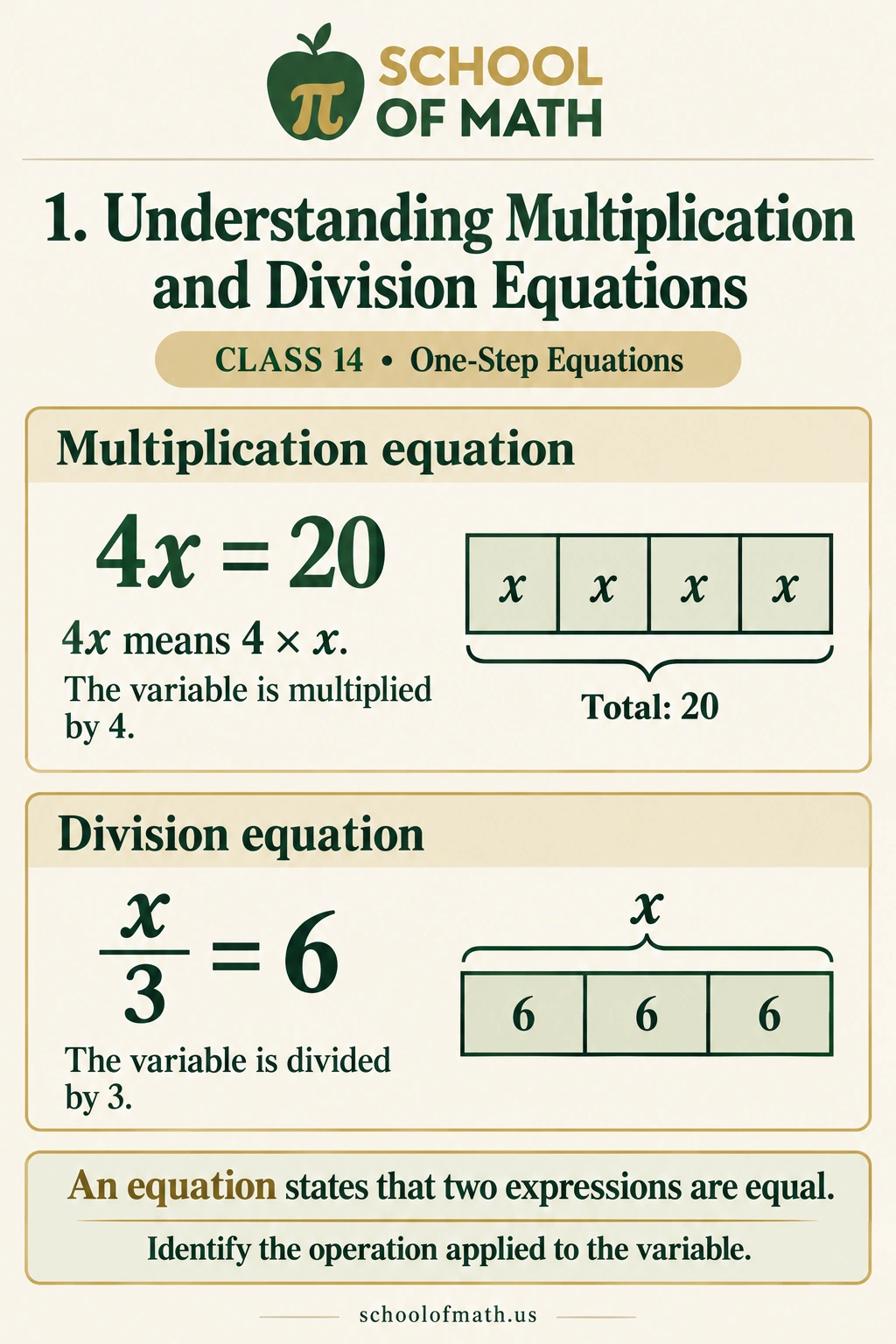
An equation says that two quantities are equal. In 6n, the variable is multiplied by 6; in n ÷ 6, the variable is divided by 6. A fraction bar also means division. Identify the operation applied to the unknown before choosing how to undo it. Reversing the two sides of an equation does not change its meaning.
Try it yourself: five questions
Q1 Practice 1 of 5
In \(6n=42\), what operation is applied to n? Find n.
Answer
\(n=7\). The variable is multiplied by 6.
- 6n means six equal groups of n, not 6 + n.
- Undo multiplication: divide both sides by 6. \(n=42\div6=7\).
- Check: \(6(7)=42\).
Q2 Practice 2 of 5
Read \(\frac{t}{8}=9\) in words, then solve.
Answer
\(t=72\). It says t divided by 8 equals 9.
- The fraction bar divides t by 8.
- Multiply both sides by 8: \(t=9(8)=72\).
- Check: \(72\div8=9\).
Q3 Practice 3 of 5
In \(11p=55\), identify the coefficient and find p.
Answer
\(p=5\). The coefficient is 11.
- The coefficient is the number multiplying the variable.
- Divide both sides by 11: \(p=55\div11=5\). Check: \(11(5)=55\).
Q4 Practice 4 of 5
Solve \(12=\frac{q}{7}\). Does having the variable on the right change the method?
Answer
\(q=84\). No; multiply both sides by 7.
- Both sides state equal values, regardless of their order.
- Multiply: \(12(7)=q\), so \(q=84\).
- Check in the original order: \(12=84\div7\).
Q5 Practice 5 of 5
For \(3x=24\) and \(\frac{y}{3}=24\), predict which unknown is larger, then solve both.
Answer
\(x=8\), \(y=72\). The unknown y is larger.
- For x, undo multiplication by dividing: \(x=24\div3=8\).
- For y, undo division by multiplying: \(y=24(3)=72\).
- Checks: \(3(8)=24\) and \(72\div3=24\). The operations, not just the numbers, matter.
Using inverse operations and keeping balance
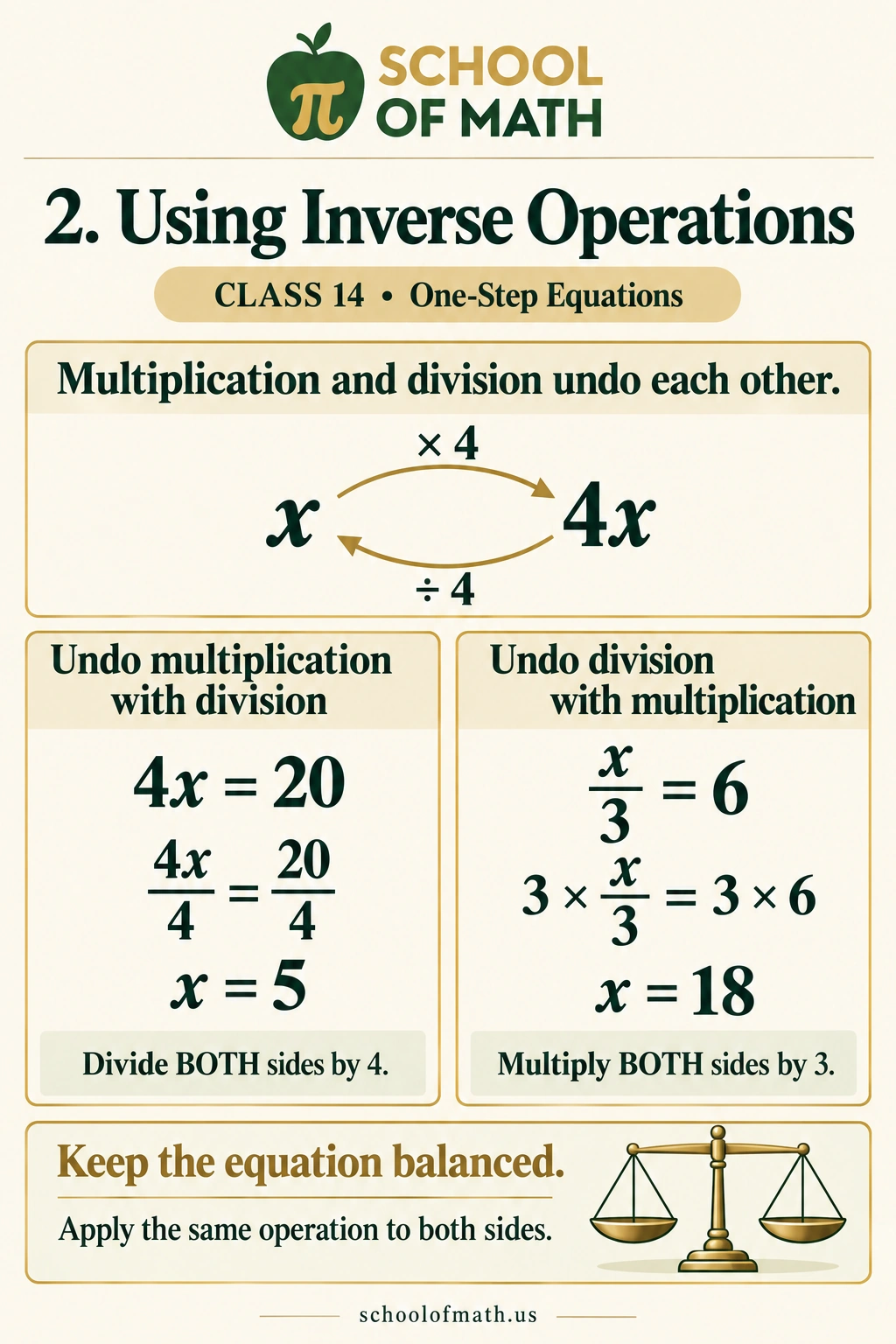
Multiplication and division undo each other. Divide both sides of ax = b by the same nonzero coefficient a. Multiply both sides of x ÷ a = b by the same nonzero divisor a. Equality is preserved only when the operation is applied to both sides. A valid operation can keep balance without immediately isolating the variable.
Try it yourself: five questions
Q6 Practice 1 of 5
Complete both blanks with the same number, then solve: \(\frac{7x}{\square}=\frac{63}{\square}\).
Answer
Use 7 in both blanks; \(x=9\).
- Divide the original equation \(7x=63\) by 7 on both sides.
- Since \(7\div7=1\), the left becomes x. The right is \(63\div7=9\).
- Check: \(7(9)=63\).
Q7 Practice 2 of 5
What operation on both sides isolates m in \(\frac{m}{9}=5\)? Solve.
Answer
Multiply both sides by 9; \(m=45\).
- Multiplication by 9 undoes division by 9.
- The right must also be multiplied: \(m=5(9)=45\). Check: \(45\div9=5\).
Q8 Practice 3 of 5
A student changes \(6k=54\) into \(k=48\) by subtracting 6. Explain the error and solve correctly.
Answer
\(k=9\). Divide by 6 rather than subtracting 6.
- 6k means 6 times k, not k + 6. Subtracting 6 does not undo multiplication.
- Divide both sides by 6: \(k=54\div6=9\).
- Check: \(6(9)=54\), whereas \(6(48)=288\).
Q9 Practice 4 of 5
Show the same operation on both sides to solve \(18=\frac{n}{4}\).
Answer
\(n=72\).
- Multiply both sides by 4: \(4(18)=4\left(\frac{n}{4}\right)\).
- This gives \(72=n\). Check: \(18=72\div4\).
Q10 Practice 5 of 5
A student divides both sides of \(8r=72\) by 2 and gets \(4r=36\). Is that valid? Is r isolated? Finish solving.
Answer
The step is valid, but r is not isolated; \(r=9\).
- Dividing both sides by the same nonzero number keeps equality true.
- There is still a coefficient of 4. Divide both sides again, now by 4: \(r=9\).
- Dividing the original equation by 8 would isolate r in one step. Check: \(8(9)=72\).
Solving multiplication equations
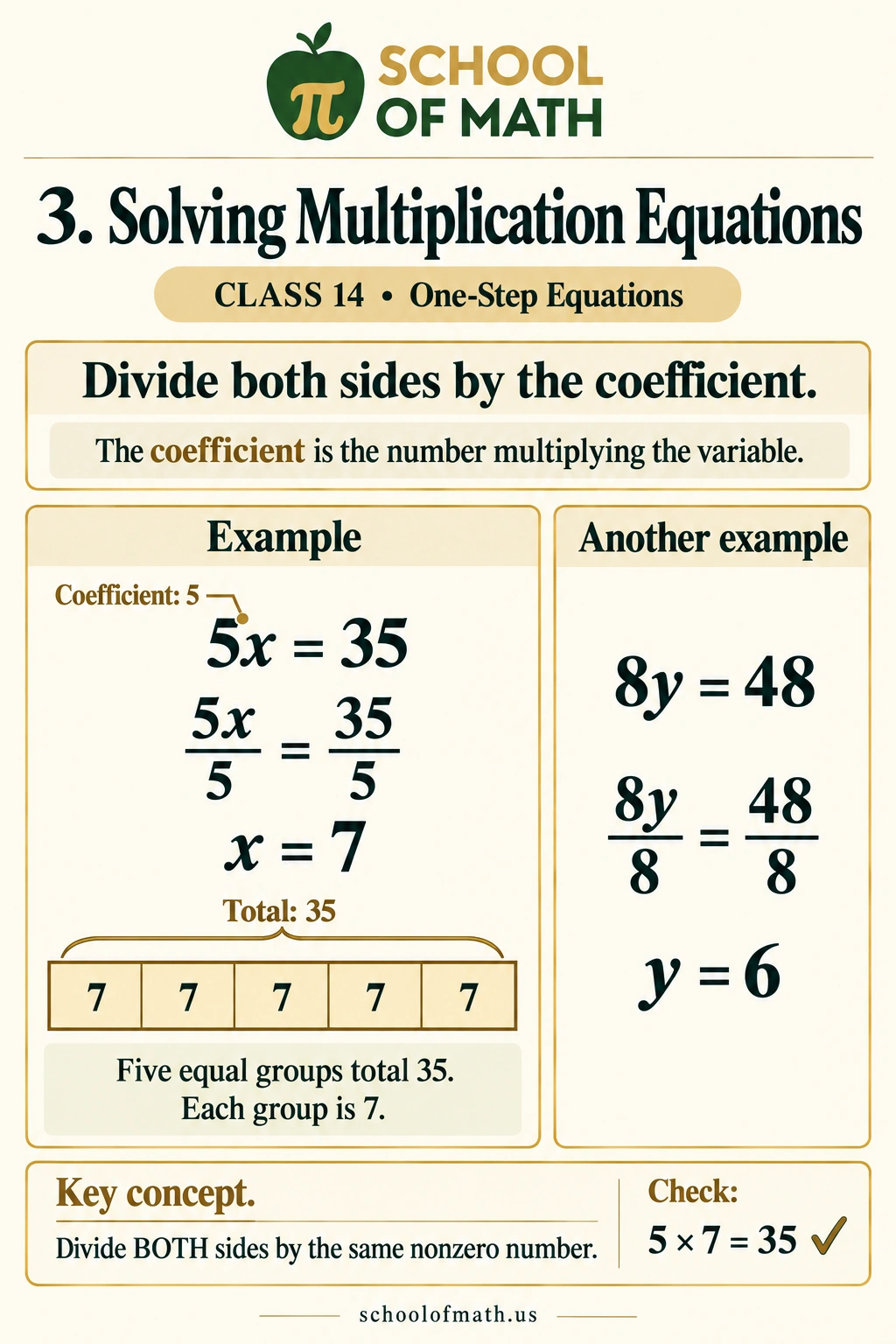
The coefficient tells you how many copies of the unknown make the total. Divide both sides by that coefficient. The answer need not be a whole number: a decimal or fraction is valid if substitution makes the original equation true. Keep exact fractions rather than rounding unnecessarily.
Try it yourself: five questions
Q11 Practice 1 of 5
Solve \(3x=27\) and check.
Answer
\(x=9\).
- Divide both sides by \(3\).
- This leaves \(x=27\div(3)=9\).
- Substitute into the original equation: \((3)(9)=27\). Both sides agree.
Q12 Practice 2 of 5
Solve \(7a=84\) and check.
Answer
\(a=12\).
- Divide both sides by \(7\).
- This leaves \(a=84\div(7)=12\).
- Substitute into the original equation: \((7)(12)=84\). Both sides agree.
Q13 Practice 3 of 5
Solve \(96=12b\) and check.
Answer
\(b=8\).
- Divide both sides by 12: \(96\div12=b\).
- Therefore \(b=8\). Check in the original order: \(96=12(8)\).
Q14 Practice 4 of 5
Solve \(14t=119\) and check.
Answer
\(t=8.5\).
- Divide both sides by \(14\).
- This leaves \(t=119\div(14)=8.5\).
- Substitute into the original equation: \((14)(8.5)=119\). Both sides agree.
Q15 Practice 5 of 5
Solve \(18p=15\) and check.
Answer
\(p=\frac{5}{6}\).
- Divide both sides by \(18\).
- This leaves \(p=15\div(18)=\frac{5}{6}\).
- Substitute into the original equation: \((18)(\frac{5}{6})=15\). Both sides agree.
Solving division equations
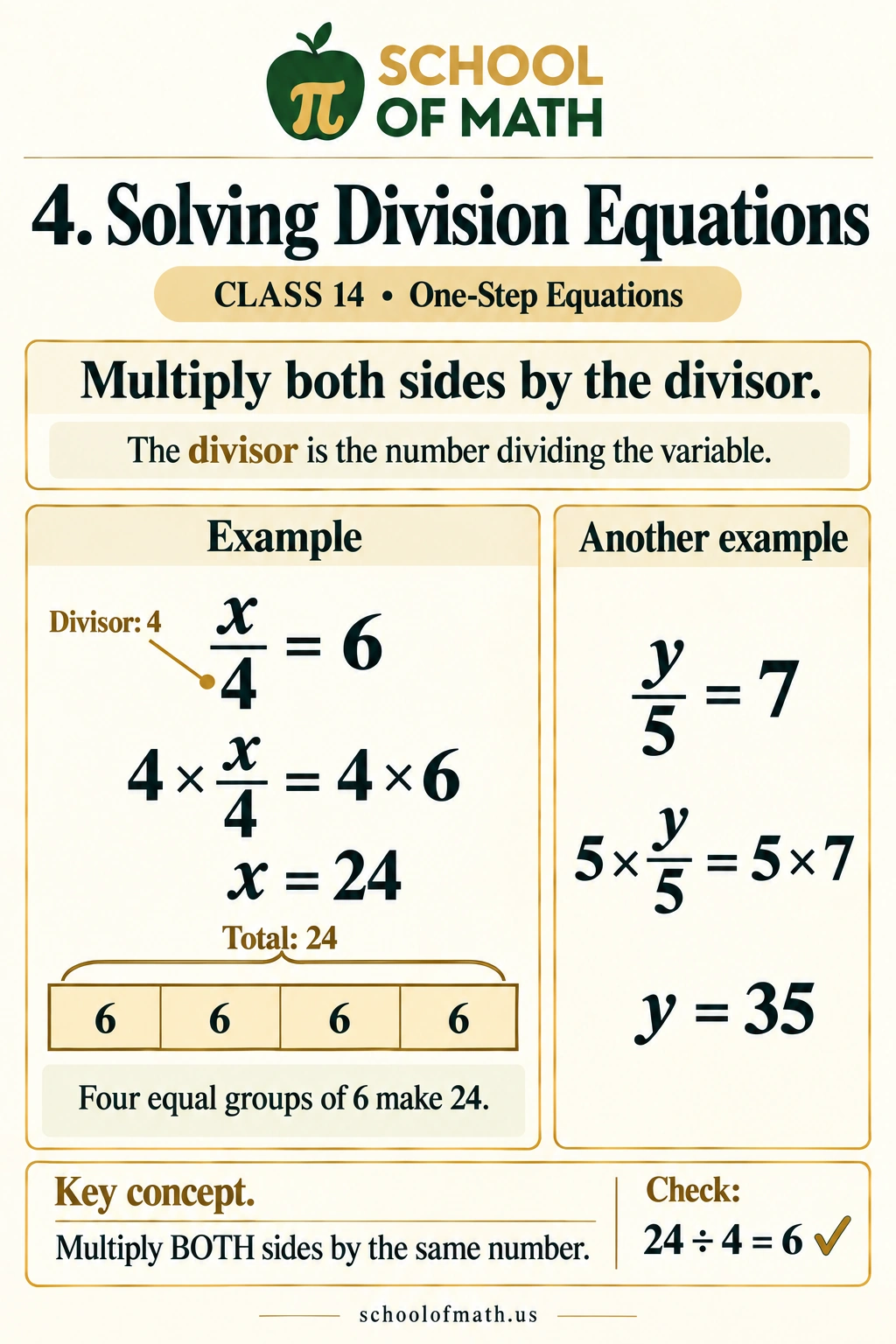
When the unknown is divided by a number, multiply both sides by that divisor. If one equal share is known, this multiplication reconstructs the total. Do not divide the right side again. A fractional or decimal right side follows exactly the same balance rule.
Try it yourself: five questions
Q16 Practice 1 of 5
Solve \(\frac{x}{6}=9\) and check.
Answer
\(x=54\).
- Multiply both sides by \(6\).
- This leaves \(x=9\times(6)=54\).
- Substitute into the original equation: \(\frac{54}{6}=9\). Both sides agree.
Q17 Practice 2 of 5
Solve \(\frac{y}{11}=8\) and check.
Answer
\(y=88\).
- Multiply both sides by \(11\).
- This leaves \(y=8\times(11)=88\).
- Substitute into the original equation: \(\frac{88}{11}=8\). Both sides agree.
Q18 Practice 3 of 5
Solve \(13=\frac{z}{5}\) and check.
Answer
\(z=65\).
- Multiply both sides by 5: \(13(5)=z\).
- Check: \(13=65\div5\).
Q19 Practice 4 of 5
Solve \(\frac{t}{8}=2.75\) and check.
Answer
\(t=22\).
- Multiply both sides by \(8\).
- This leaves \(t=2.75\times(8)=22\).
- Substitute into the original equation: \(\frac{22}{8}=2.75\). Both sides agree.
Q20 Practice 5 of 5
Solve \(\frac{p}{12}=\frac{5}{6}\) and check.
Answer
\(p=10\).
- Multiply both sides by \(12\).
- This leaves \(p=\frac{5}{6}\times(12)=10\).
- Substitute into the original equation: \(\frac{10}{12}=\frac{5}{6}\). Both sides agree.
Solving equations with negative numbers
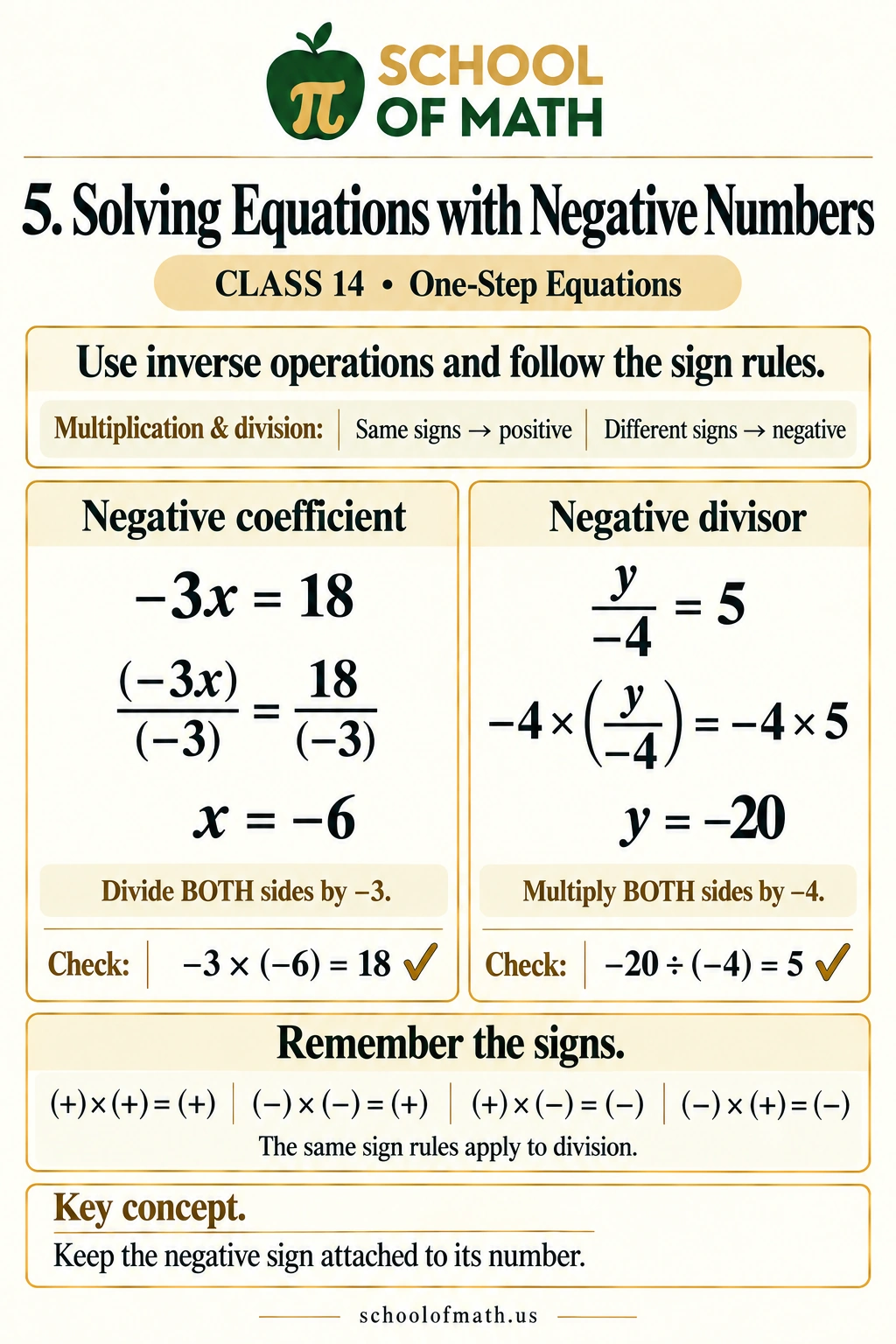
Keep the negative sign attached to its coefficient or divisor. Multiplication and division of numbers with the same sign produce a positive result; different signs produce a negative result. A lone minus sign before a variable means its coefficient is −1. Check the sign in the original equation instead of guessing it from one number.
Try it yourself: five questions
Q21 Practice 1 of 5
Solve \(-p=-13\) and explain the hidden coefficient.
Answer
\(p=13\). The coefficient is −1.
- Write −p as \((-1)p\). Divide both sides by −1.
- This gives \(p=(-13)\div(-1)=13\).
- Check: \(-(13)=-13\).
Q22 Practice 2 of 5
Solve \(-4x=28\) and check.
Answer
\(x=-7\).
- Divide both sides by \(-4\).
- This leaves \(x=28\div(-4)=-7\).
- Substitute into the original equation: \((-4)(-7)=28\). Both sides agree.
Q23 Practice 3 of 5
Solve \(9y=-63\) and check.
Answer
\(y=-7\).
- Divide both sides by \(9\).
- This leaves \(y=-63\div(9)=-7\).
- Substitute into the original equation: \((9)(-7)=-63\). Both sides agree.
Q24 Practice 4 of 5
Solve \(\frac{z}{-6}=-8\) and check.
Answer
\(z=48\).
- Multiply both sides by \(-6\).
- This leaves \(z=-8\times(-6)=48\).
- Substitute into the original equation: \(\frac{48}{-6}=-8\). Both sides agree.
Q25 Practice 5 of 5
Solve \(-12q=-9\) and check.
Answer
\(q=\frac{3}{4}\).
- Divide both sides by \(-12\).
- This leaves \(q=-9\div(-12)=\frac{3}{4}\).
- Substitute into the original equation: \((-12)(\frac{3}{4})=-9\). Both sides agree.
Solving equations with fractions and decimals
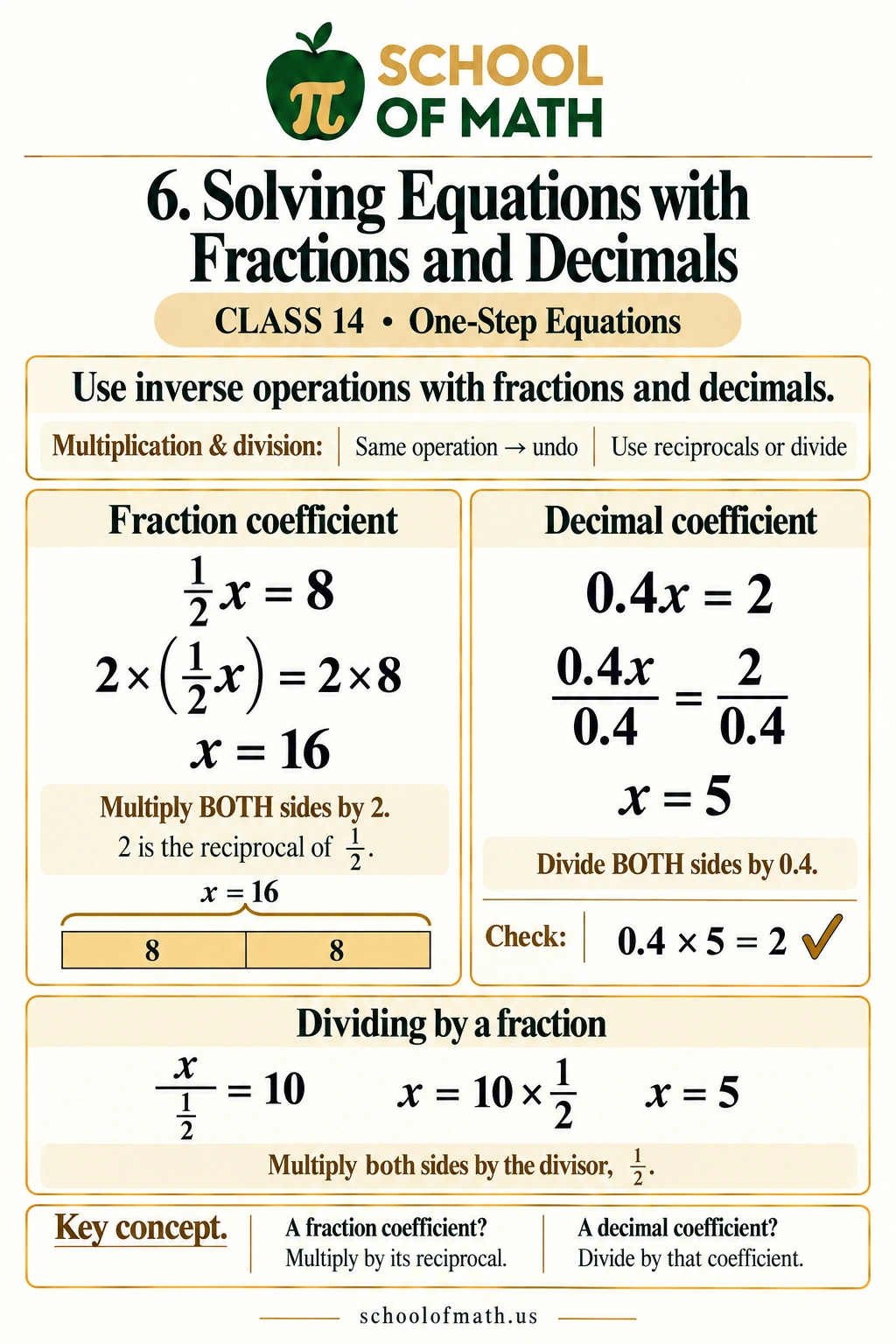
Divide by a decimal coefficient just as you would divide by a whole-number coefficient. For a nonzero fraction coefficient, multiplying by its reciprocal leaves a coefficient of 1. Distinguish a fraction multiplying the variable from a fraction dividing it: to undo division by a fraction, multiply by that fraction itself, not by its reciprocal.
Try it yourself: five questions
Q26 Practice 1 of 5
Solve \(0.3x=2.7\) and check.
Answer
\(x=9\).
- Divide both sides by \(0.3\).
- This leaves \(x=2.7\div(0.3)=9\).
- Substitute into the original equation: \((0.3)(9)=2.7\). Both sides agree.
Q27 Practice 2 of 5
Solve \(\frac23y=10\) using the reciprocal.
Answer
\(y=15\).
- The coefficient is 2/3. Its reciprocal is 3/2.
- Multiply both sides by 3/2: \(\frac32\cdot\frac23y=\frac32\cdot10\).
- The left coefficient becomes 1, so y = 15. Check: \(\frac23(15)=10\).
Q28 Practice 3 of 5
Solve \(\frac{z}{0.4}=7.5\) and check.
Answer
\(z=3\).
- Multiply both sides by \(0.4\).
- This leaves \(z=7.5\times(0.4)=3\).
- Substitute into the original equation: \(\frac{3}{0.4}=7.5\). Both sides agree.
Q29 Practice 4 of 5
Solve \(\frac58t=-\frac{15}{4}\) and check.
Answer
\(t=-6\).
- Multiply both sides by the reciprocal 8/5.
- Compute \(t=-\frac{15}{4}\cdot\frac85=-6\).
- Check: \(\frac58(-6)=-\frac{30}{8}=-\frac{15}{4}\).
Q30 Practice 5 of 5
Solve \(p\div\frac35=-\frac76\). Explain which number you multiply by.
Answer
\(p=-\frac7{10}\). Multiply both sides by 3/5.
- The variable is divided by 3/5, so multiply both sides by 3/5 to undo that division.
- \(p=-\frac76\cdot\frac35=-\frac{21}{30}=-\frac7{10}\).
- Check: \(-\frac7{10}\div\frac35=-\frac7{10}\cdot\frac53=-\frac76\).
Checking solutions and catching errors
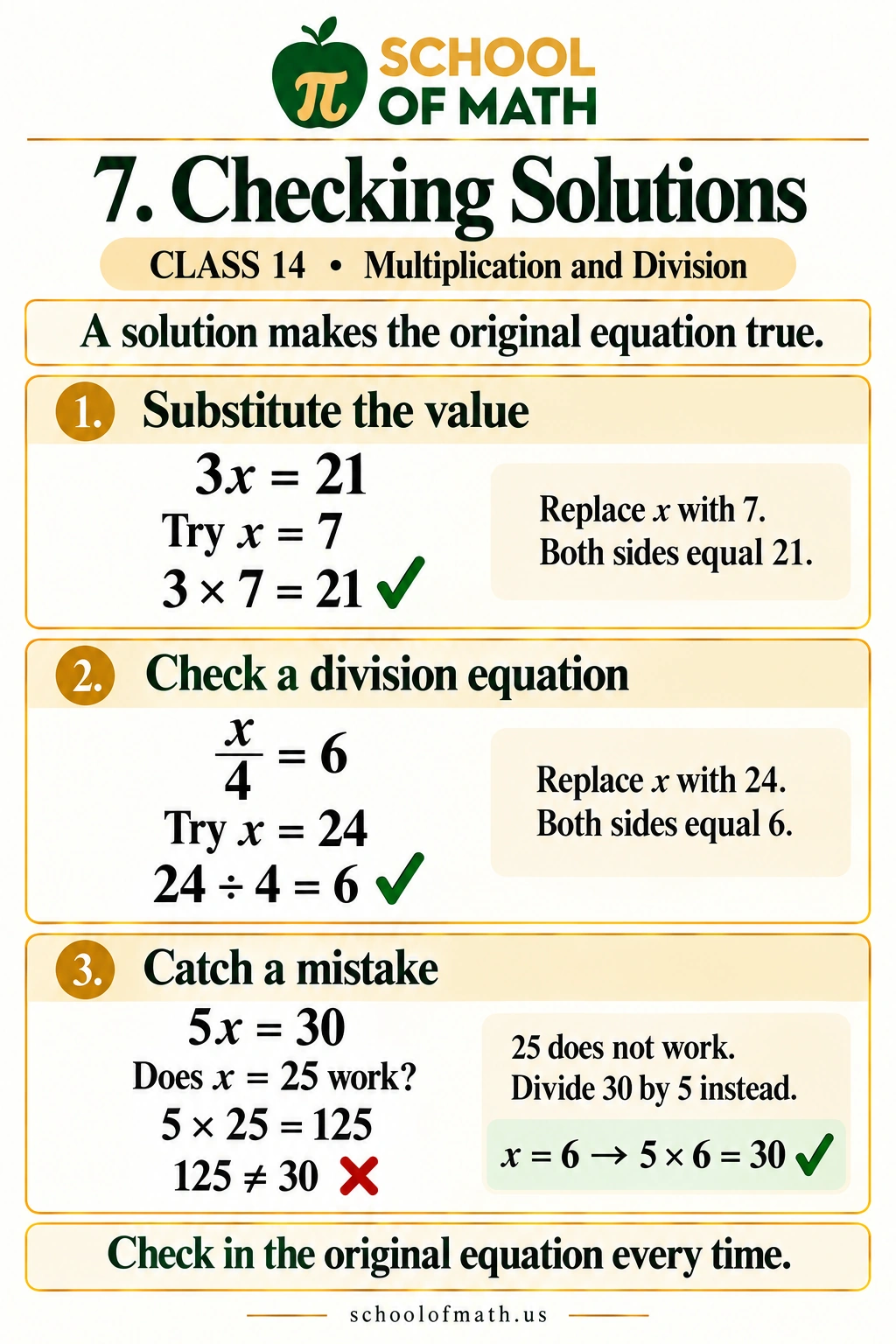
A solution must make the original equation true. Substitute the proposed value, evaluate the two sides separately, and compare. If they differ, the value is not a solution even if earlier work looked convincing. Use parentheses around negative numbers and preserve the order of division.
Try it yourself: five questions
Q31 Practice 1 of 5
Does \(x=6\) solve \(7x=42\)? Show the substitution.
Answer
Yes, \(x=6\) is a solution.
- Replace x with 6: \(7(6)=42\).
- Both sides equal 42.
Q32 Practice 2 of 5
Does \(y=36\) solve \(\frac{y}{9}=4\)? Show the substitution.
Answer
Yes, \(y=36\) is a solution.
- Compute the left side: \(36\div9=4\).
- It equals the right side, so the original equation is true.
Q33 Practice 3 of 5
A student says \(z=7\) solves \(-5z=35\). Check the claim and correct it.
Answer
No; the correct solution is \(z=-7\).
- The proposed value gives \((-5)(7)=-35\), not 35.
- Divide the original sides by −5: \(z=35\div(-5)=-7\).
- Check: \((-5)(-7)=35\).
Q34 Practice 4 of 5
Which solves \(0.6t=4.2\): \(t=7\) or \(t=0.7\)? Check both.
Answer
\(t=7\).
- For t = 7: \(0.6(7)=4.2\), so it works.
- For t = 0.7: \(0.6(0.7)=0.42\), so it does not work.
- Dividing 4.2 by 0.6 gives 7; a misplaced decimal changes the result.
Q35 Practice 5 of 5
For \(p\div\frac23=-\frac94\), Ana gets \(p=-\frac32\) and Ben gets \(p=-\frac{27}{8}\). Who is correct? Verify both values.
Answer
Ana is correct: \(p=-\frac32\).
- Ana's value: \(-\frac32\div\frac23=-\frac32\cdot\frac32=-\frac94\).
- Ben's value: \(-\frac{27}{8}\div\frac23=-\frac{81}{16}\), which is not \(-\frac94\).
- To solve, multiply both sides by the divisor 2/3: \(p=-\frac94\cdot\frac23=-\frac32\).
Writing and solving word problems
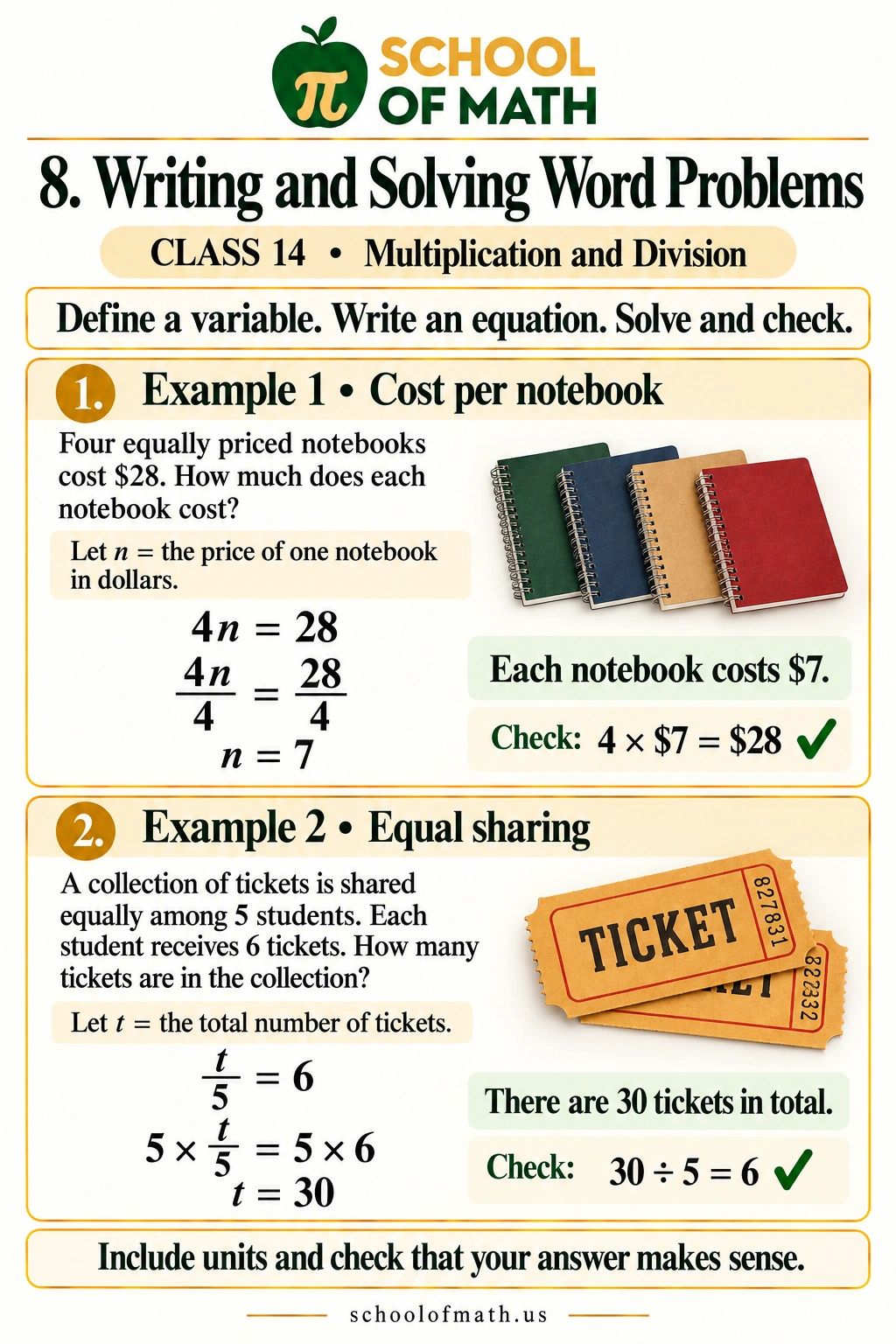
Define the unknown and its units first. Translate equal groups into multiplication or equal sharing into division. Write one equation, use the inverse operation on both sides, and check the answer against the story. A negative result can describe a loss or change, but cannot represent a negative count of physical objects.
Try it yourself: five questions
Q36 Practice 1 of 5
Six equal packs contain 54 stickers altogether. How many stickers are in each pack? Define a variable and write an equation.
Answer
9 stickers per pack; \(6s=54\).
- Let s be the number of stickers per pack.
- Divide both sides by 6: \(s=54\div6=9\).
- Check: six packs of 9 contain 54 stickers.
Q37 Practice 2 of 5
A ribbon is cut into seven equal pieces. Each piece is 4 m long. Find the original length using a division equation.
Answer
28 m; \(\frac{r}{7}=4\).
- Let r be the ribbon's total length in meters.
- Multiply both sides by 7: \(r=4(7)=28\).
- Check: \(28\div7=4\) m per piece.
Q38 Practice 3 of 5
Five equally priced bookmarks cost $13.75 in total. What does one cost? Write and solve an equation.
Answer
$2.75; \(5b=13.75\).
- Let b be one bookmark's price in dollars.
- Divide both sides by 5: \(b=13.75\div5=2.75\).
- Check: \(5(2.75)=13.75\).
Q39 Practice 4 of 5
A freezer's temperature changes by the same amount each hour. Over three hours, its total change is −15°C. What is the change per hour?
Answer
−5°C per hour; \(3c=-15\).
- Let c be the temperature change in one hour.
- Divide both sides by 3: \(c=-15\div3=-5\).
- Check: \(3(-5)=-15\)°C. The negative sign describes cooling.
Q40 Practice 5 of 5
A tank is three-fourths full and contains 18 liters. What is its full capacity? Define a variable and solve.
Answer
24 liters; \(\frac34C=18\).
- Let C be the full capacity in liters.
- Multiply both sides by 4/3: \(C=18\cdot\frac43=24\).
- Check: three-fourths of 24 is 18.
Homework review
Review multiplication and division equations, inverse operations, balance, signed numbers, fractions, decimals, solution checks, and word-problem models. Complete one review question for each image, in the same order.
R1 Review image 1 of 8
Write and solve an equation for: eight times a number is 56.
Answer
\(8n=56\), so \(n=7\).
- Multiplication is applied to n. Undo it by dividing both sides by 8.
- Check: \(8(7)=56\).
R2 Review image 2 of 8
Solve \(\frac{y}{12}=7\) and name the operation applied to both sides.
Answer
\(y=84\). Multiply both sides by 12.
- Multiplication undoes division by 12.
- Compute \(y=7(12)=84\). Check: \(84\div12=7\).
R3 Review image 3 of 8
Solve \(16x=104\) and check.
Answer
\(x=6.5\).
- Divide both sides by \(16\).
- This leaves \(x=104\div(16)=6.5\).
- Substitute into the original equation: \((16)(6.5)=104\). Both sides agree.
R4 Review image 4 of 8
Solve \(\frac{x}{15}=\frac{2}{5}\) and check.
Answer
\(x=6\).
- Multiply both sides by \(15\).
- This leaves \(x=\frac{2}{5}\times(15)=6\).
- Substitute into the original equation: \(\frac{6}{15}=\frac{2}{5}\). Both sides agree.
R5 Review image 5 of 8
Solve \(-7x=-84\) and check.
Answer
\(x=12\).
- Divide both sides by \(-7\).
- This leaves \(x=-84\div(-7)=12\).
- Substitute into the original equation: \((-7)(12)=-84\). Both sides agree.
R6 Review image 6 of 8
Solve \(0.35x=2.8\) and check.
Answer
\(x=8\).
- Divide both sides by \(0.35\).
- This leaves \(x=2.8\div(0.35)=8\).
- Substitute into the original equation: \((0.35)(8)=2.8\). Both sides agree.
R7 Review image 7 of 8
A student claims \(x=6\) solves \(x\div\frac34=8\). Is the claim correct? Show a check.
Answer
Yes, \(x=6\) is correct.
- Divide 6 by 3/4 by multiplying by 4/3.
- The result is \(6\div\frac34=6\cdot\frac43=8\), the right side.
R8 Review image 8 of 8
Two-fifths of the students in a club are 12 students. How many students are in the whole club? Write and solve an equation.
Answer
30 students; \(\frac25s=12\).
- Let s be the whole club's student count.
- Multiply both sides by 5/2: \(s=12\cdot\frac52=30\).
- Check: two-fifths of 30 is 12.
Homework word problems
These 12 word problems increase in difficulty, from equal groups to decimal and fraction relationships, error analysis, and signed rates. Define the variable, write one equation, solve, and check the units. Together with the eight review questions, they make 20 homework questions.
W1 Homework word problem 1 of 12
Five equally priced museum tickets cost $45. What is the price of one ticket? Write and solve an equation.
Answer
$9; \(5t=45\).
- Let t be the price of one ticket in dollars.
- Divide both sides by 5: \(t=45\div5=9\).
- Check: \(5(9)=45\).
W2 Homework word problem 2 of 12
A supply of markers is divided equally among nine boxes. Each box holds eight markers. How many markers are there in total? Use a division equation.
Answer
72 markers; \(\frac{m}{9}=8\).
- Let m be the total number of markers.
- Multiply both sides by 9: \(m=8(9)=72\). Check: \(72\div9=8\).
W3 Homework word problem 3 of 12
A rectangular banner has an area of 84 square feet and a length of 12 feet. Find its width using a one-step equation.
Answer
7 ft; \(12w=84\).
- Let w be the width in feet. Length × width = area.
- Divide both sides by 12: \(w=84\div12=7\).
- Check: \(12(7)=84\) square feet.
W4 Homework word problem 4 of 12
A square garden has a perimeter of 52 meters. How long is each side? Write and solve an equation.
Answer
13 m; \(4s=52\).
- Let s be the side length in meters. A square has four equal sides.
- Divide by 4 on both sides: \(s=52\div4=13\). Check: \(4(13)=52\).
W5 Homework word problem 5 of 12
Eight identical bottles hold 10 liters altogether. How much does each bottle hold? Write an equation and give a decimal answer.
Answer
1.25 liters; \(8b=10\).
- Let b be the capacity of one bottle in liters.
- Divide both sides by 8: \(b=10\div8=1.25\).
- Check: \(8(1.25)=10\) liters.
W6 Homework word problem 6 of 12
A cyclist has completed three-fourths of a route, covering 21 miles. What is the full route length?
Answer
28 miles; \(\frac34d=21\).
- Let d be the entire route length in miles.
- Multiply both sides by 4/3: \(d=21\cdot\frac43=28\).
- Check: three-fourths of 28 is 21. The full route must be longer than the completed part.
W7 Homework word problem 7 of 12
A game score changes by the same amount in six rounds. The total change is −42 points. What is the change per round? Include its sign.
Answer
−7 points per round; \(6c=-42\).
- Let c be the point change per round.
- Divide both sides by 6: \(c=-42\div6=-7\).
- Check: \(6(-7)=-42\). Each round loses 7 points.
W8 Homework word problem 8 of 12
A ribbon is cut into 14 pieces, each 0.75 m long, with no waste. Write a division equation for its original length and solve.
Answer
10.5 m; \(\frac{r}{0.75}=14\).
- Let r be the original length in meters. Dividing total length by piece length gives the number of pieces.
- Multiply both sides by 0.75: \(r=14(0.75)=10.5\).
- Check: \(10.5\div0.75=14\) pieces.
W9 Homework word problem 9 of 12
A student has read 0.15 of a book, which is 27 pages. How many pages are in the whole book? Write and solve an equation.
Answer
180 pages; \(0.15p=27\).
- Let p be the book's total number of pages.
- Divide both sides by 0.15: \(p=27\div0.15=2700\div15=180\).
- Check: \(0.15(180)=27\) pages.
W10 Homework word problem 10 of 12
A model shelf is two-thirds the length of a real shelf. The model is 3½ feet long. What is the real shelf's length? Write an equation and give an exact answer.
Answer
5¼ ft; \(\frac23L=\frac72\).
- Let L be the real shelf's length in feet. Convert 3½ to 7/2.
- Multiply both sides by 3/2: \(L=\frac72\cdot\frac32=\frac{21}{4}=5\frac14\).
- Check: \(\frac23\cdot\frac{21}{4}=\frac72\) ft, the model length.
W11 Homework word problem 11 of 12
Identical bags each weigh 1.25 kg. Together they weigh 17.5 kg. Leo subtracts 1.25 from 17.5 to find the number of bags. Explain his error, then write and solve the correct equation.
Answer
14 bags; \(1.25n=17.5\).
- Let n be the number of bags. Weight per bag × number of bags = total weight.
- Subtracting one bag's weight gives the remaining weight, not the bag count. Divide both sides by 1.25.
- \(n=17.5\div1.25=14\). Check: \(1.25(14)=17.5\) kg.
W12 Homework word problem 12 of 12
An underwater robot descends at a steady rate of 4/5 meter per minute for 7.5 minutes. Let d be its signed vertical change, with downward changes negative. Write a division equation using the rate, solve, and state both the signed change and the distance descended.
Answer
Signed change: −6 m; distance descended: 6 m; \(\frac{d}{7.5}=-\frac45\).
- Signed change divided by elapsed time equals the signed rate. Downward means the rate is −4/5 m per minute.
- Multiply both sides by 7.5: \(d=-\frac45\cdot\frac{15}{2}=-6\).
- Check: \(-6\div7.5=-\frac45\). The signed change is −6 m, but distance is the nonnegative amount 6 m.
Quick questions and answers
How do you solve a one-step multiplication equation?
Divide both sides by the nonzero coefficient multiplying the variable. For example, 7a = 84 gives a = 12. Substitute the value into the original equation to check.
How do you solve a one-step division equation?
Multiply both sides by the nonzero number dividing the variable. For example, x ÷ 6 = 9 gives x = 54.
Why must the same operation be applied to both sides?
The sides represent equal values. Applying the same valid operation to both preserves equality. Changing just one side generally changes the equation.
What changes when a coefficient is negative?
The inverse-operation rule stays the same. Divide by the entire signed coefficient and follow the sign rules. For example, −4x = 28 has x = −7.
How do fractions change the method?
A fraction coefficient can be undone by multiplying both sides by its reciprocal. If the variable is divided by a fraction, multiply both sides by that fraction instead.
What homework is included in Class 14?
There are eight review questions, one per image, and 12 increasingly challenging word problems, for 20 homework questions total. These follow 40 class practice questions. All 60 have hidden worked answers.