Pre-Algebra · Class 18
Solving and Graphing One-Variable Inequalities
Compare, solve, and graph. Read the four inequality symbols, check whether a value is a solution, draw open and closed circles on a number line, and isolate the variable with inverse operations, reversing the sign only when multiplying or dividing by a negative number.
Work through eight illustrated topics with five fresh practice questions each, followed by Homework review and Homework word problems. There are 40 practice questions and 20 homework questions, all with hidden worked answers and number-line graphs. Try each problem before opening its blue Answer control.
This is an independent topic in the Pre-Algebra rolling syllabus; earlier class attendance is not required. Review the symbols and the sign-reversal rule here, then choose a comfortable starting point. See the schedule or book an evaluation at SOMATH.
Download the student workbook (PDF)22 pages · Supplied cover, eight teaching images, all 60 questions with blank number lines for graphing · Generous blank working space · No exercise solutions
Understanding inequality symbols
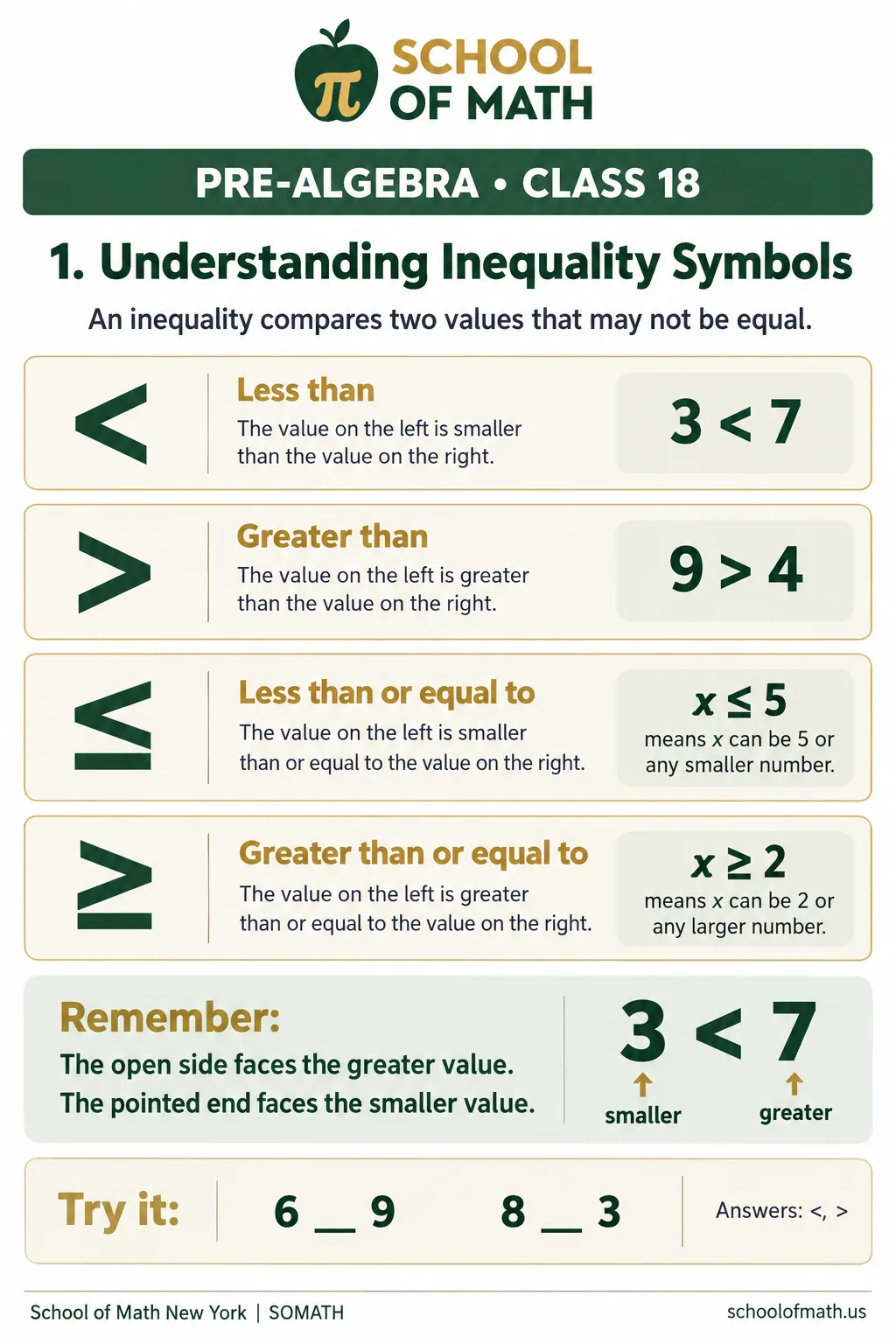
An inequality compares two values that may not be equal. The symbol \(\lt\) means less than and \(\gt\) means greater than; the open side always faces the greater value and the pointed end faces the smaller value, so \(3 \lt 7\) and \(9 \gt 4\).
The symbols \(\le\) and \(\ge\) add the possibility of equality. The statement \(x \le 5\) means \(x\) can be 5 or any smaller number, and \(x \ge 2\) means \(x\) can be 2 or any larger number. Unlike an equation, an inequality usually has many solutions.
Practice: try these five questions
Q1
Write \(\lt\) or \(\gt\) in each blank: 12 __ 15, 20 __ 8, and −3 __ −5.
Answer
\(12 \lt 15\); \(20 \gt 8\); \(-3 \gt -5\)
12 is smaller than 15, so the pointed end faces 12: \(12 \lt 15\).
20 is larger than 8, so the open side faces 20: \(20 \gt 8\).
On a number line −3 is to the right of −5, so −3 is the greater value: \(-3 \gt -5\).
Q2
Translate each sentence into symbols: “\(x\) is less than or equal to 9” and “\(y\) is greater than −2.”
Answer
\(x \le 9\) and \(y \gt -2\)
“Less than or equal to” uses the symbol with the bar underneath: \(x \le 9\). The value 9 itself is allowed.
“Greater than” without “or equal to” uses \(\gt\): \(y \gt -2\). The value −2 itself is not allowed.
Q3
Which of the values 1, 4, and 6 make the statement \(x \ge 4\) true?
Answer
4 and 6
Replace \(x\) with each value. \(1 \ge 4\) is false; \(4 \ge 4\) is true because the symbol allows equality; \(6 \ge 4\) is true.
So 4 and 6 are solutions. The boundary value 4 counts because of the “or equal to.”
Q4
Decide whether each statement is true or false, and explain: \(10 \le 10\) and \(10 \lt 10\).
Answer
\(10 \le 10\) is true; \(10 \lt 10\) is false
\(10 \le 10\) says 10 is less than or equal to 10. The two values are equal, so the statement is true.
\(10 \lt 10\) says 10 is strictly less than 10. A number is never less than itself, so the statement is false.
Q5
Write \(n \gt 15\) in words. Then give two numbers that make it true and one number that makes it false.
Answer
“\(n\) is greater than 15”; for example 16 and 20 are solutions, and 15 is not
The open side faces \(n\), so \(n\) is the greater value: “\(n\) is greater than 15.”
Any number larger than 15 works, such as 16, 20, or 15.5. The value 15 is not a solution because the symbol does not include equality, and smaller numbers such as 9 also fail.
Checking solutions
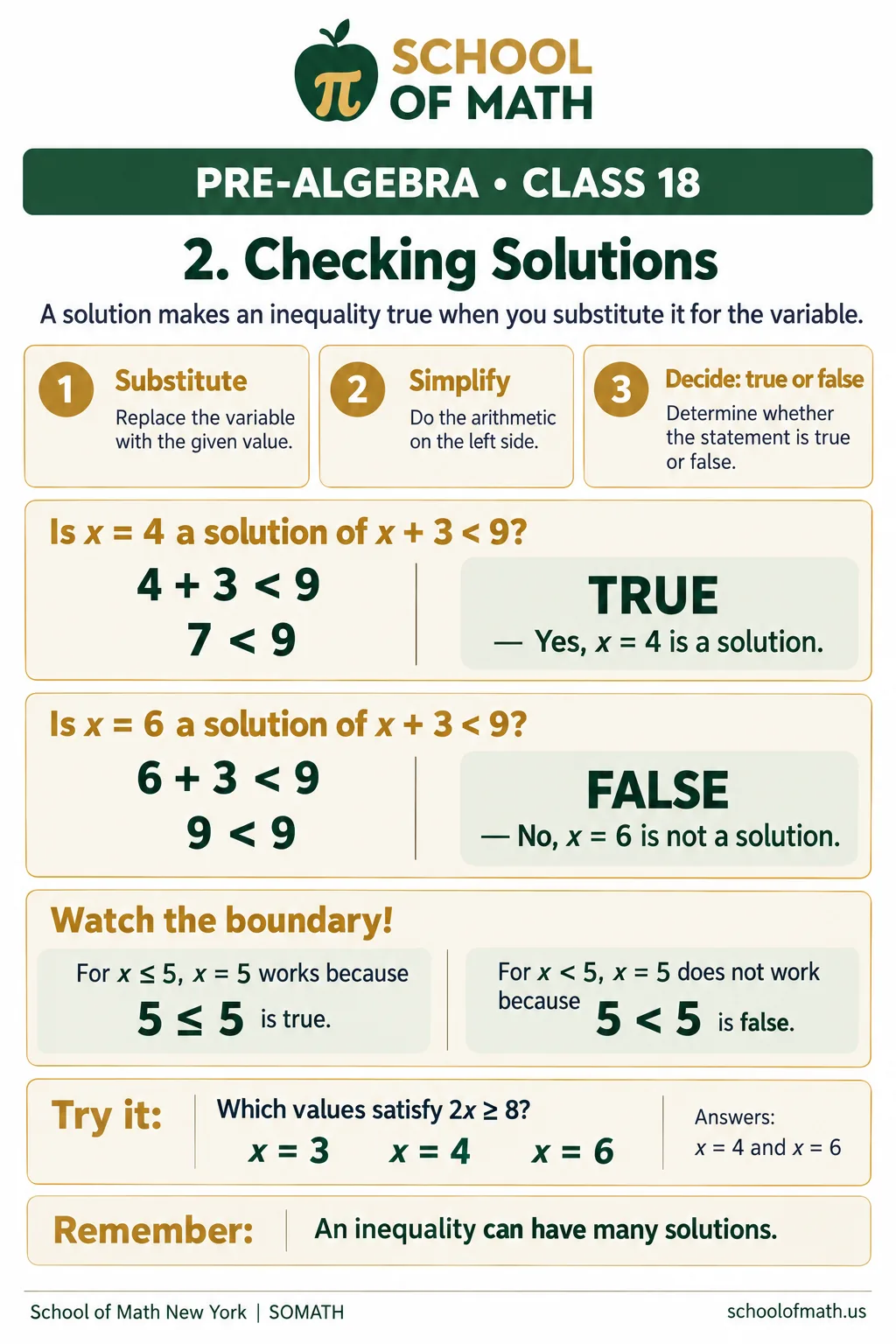
A value is a solution of an inequality when substituting it for the variable makes a true statement. Follow three steps: substitute the value, simplify the arithmetic, and decide whether the resulting comparison is true or false. For \(x + 3 \lt 9\), the value 4 gives \(7 \lt 9\), which is true, while 6 gives \(9 \lt 9\), which is false.
Watch the boundary. For \(x \le 5\), the value 5 works because \(5 \le 5\) is true; for \(x \lt 5\), the value 5 fails because \(5 \lt 5\) is false. An inequality can have many solutions, so checking one value tells you about that value only.
Practice: try these five questions
Q6
Is \(x = 5\) a solution of the inequality?
Answer
Yes: \(x = 5\) is a solution
Substitute: replace \(x\) with 5. (5) + 4 < 10
Simplify the left side: 9 < 10.
Decide: the statement is true, so \(x = 5\) is a solution.
Q7
Is \(x = 7\) a solution? Pay attention to the boundary.
Answer
Yes: \(x = 7\) is a solution
Substitute: replace \(x\) with 7. 3(7) ≥ 21
Simplify the left side: 21 ≥ 21.
Decide: the statement is true, so \(x = 7\) is a solution.
Because the symbol is \(\ge\), equality counts. The boundary value 7 is a solution.
Q8
Is \(x = 2\) a solution?
Answer
No: \(x = 2\) is not a solution
Substitute: replace \(x\) with 2. 5(2) − 1 > 9
Simplify the left side: 9 > 9.
Decide: the statement is false, so \(x = 2\) is not a solution.
The left side equals exactly 9, but the symbol \(\gt\) does not allow equality, so 2 is not a solution.
Q9
Which of the values \(x = 1\), \(x = 3\), and \(x = 5\) satisfy the inequality?
Answer
\(x = 1\) and \(x = 3\)
\(x = 1\): \(2(1) + 1 = 3\), and \(3 \le 7\) is true.
\(x = 3\): \(2(3) + 1 = 7\), and \(7 \le 7\) is true because equality is allowed.
\(x = 5\): \(2(5) + 1 = 11\), and \(11 \le 7\) is false.
So 1 and 3 are solutions, and 5 is not.
Q10
Is \(x = -4\) a solution? Be careful with the negative numbers.
Answer
Yes: \(x = -4\) is a solution
Substitute: replace \(x\) with -4. (-4) − 2 < −5
Simplify the left side: −6 < −5.
Decide: the statement is true, so \(x = -4\) is a solution.
On a number line −6 is to the left of −5, so −6 is less than −5 and the statement is true.
Graphing inequalities on a number line
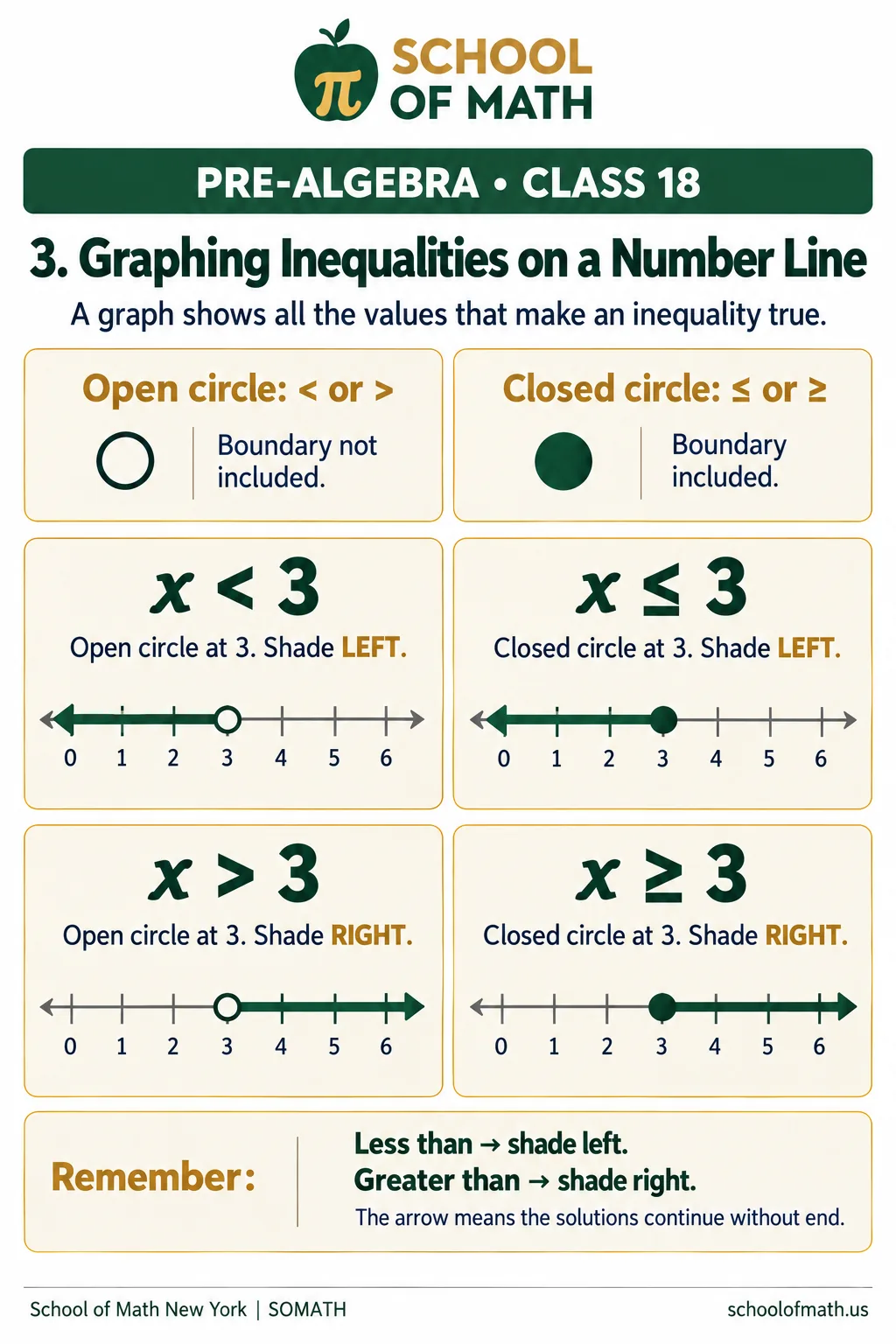
A graph shows all the values that make an inequality true. Mark the boundary with a circle: an open circle for \(\lt\) or \(\gt\), because the boundary is not included, and a closed circle for \(\le\) or \(\ge\), because the boundary is included.
Then shade the solutions. Less than means shade to the left; greater than means shade to the right. The arrow at the end of the shading shows that the solutions continue without end. For example, \(x \lt 3\) has an open circle at 3 shaded left, and \(x \ge 3\) has a closed circle at 3 shaded right.
Practice: try these five questions
Q11
Graph the inequality on a number line.
Answer
Open circle at 2; shade left
The boundary is 2. The symbol < does not include the boundary, so draw an open circle at 2.
The solutions are less than 2, so shade to the left with an arrow to show the solutions continue without end.
Check a value in the shaded region, x = 0: (0) < 2 → 0 < 2, which is true.
Q12
Graph the inequality on a number line.
Answer
Closed circle at −1; shade right
The boundary is −1. The symbol ≥ includes the boundary, so draw a closed circle at −1.
The solutions are greater than −1 or equal to it, so shade to the right with an arrow to show the solutions continue without end.
Check the boundary value, x = −1: (−1) ≥ −1 → −1 ≥ −1, which is true.
Q13
Graph the inequality on a number line.
Answer
Closed circle at 4; shade left
The boundary is 4. The symbol ≤ includes the boundary, so draw a closed circle at 4.
The solutions are less than 4 or equal to it, so shade to the left with an arrow to show the solutions continue without end.
Check the boundary value, x = 4: (4) ≤ 4 → 4 ≤ 4, which is true.
Q14
Graph the inequality on a number line.
Answer
Open circle at −3; shade right
The boundary is −3. The symbol > does not include the boundary, so draw an open circle at −3.
The solutions are greater than −3, so shade to the right with an arrow to show the solutions continue without end.
Check a value in the shaded region, x = −1: (−1) > −3 → −1 > −3, which is true.
Q15
Write the inequality shown by the graph.
Answer
\(x \le 1\)
The circle at 1 is closed, so 1 is included and the symbol is \(\le\) or \(\ge\).
The shading goes to the left, toward smaller numbers, so the solutions are less than or equal to 1: \(x \le 1\).
Check a shaded value, \(x = 0\): \(0 \le 1\) is true. Check an unshaded value, \(x = 2\): \(2 \le 1\) is false.
Solving inequalities using addition and subtraction
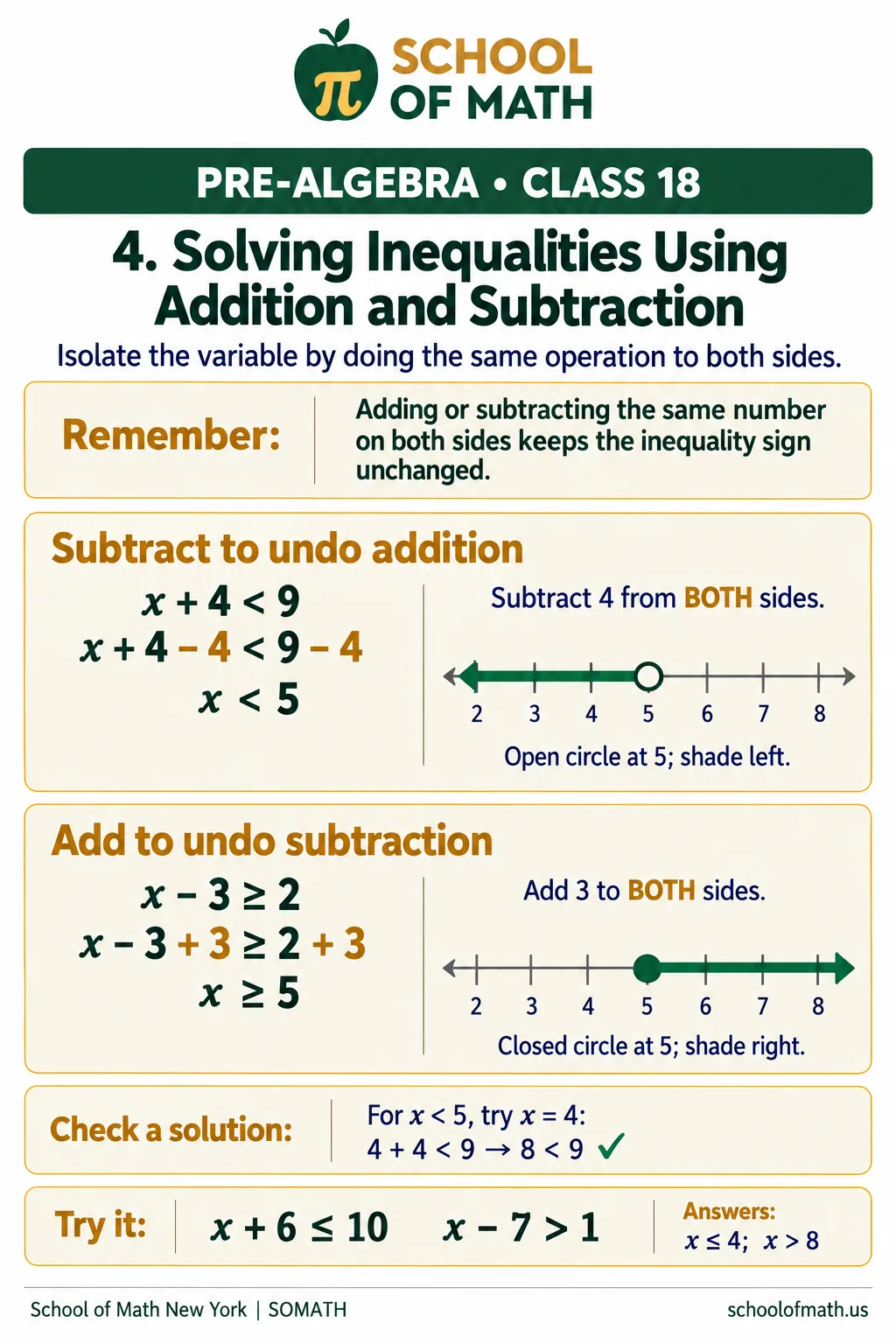
Isolate the variable by doing the same operation to both sides. Adding or subtracting the same number on both sides keeps the inequality sign unchanged. To undo addition, subtract: from \(x + 4 \lt 9\), subtracting 4 on both sides gives \(x \lt 5\). To undo subtraction, add: from \(x - 3 \ge 2\), adding 3 on both sides gives \(x \ge 5\).
After solving, graph the solution and check a value. For \(x \lt 5\), try \(x = 4\) in the original inequality: \(4 + 4 \lt 9\) gives \(8 \lt 9\), which is true. The graph has an open circle at 5 shaded left.
Practice: try these five questions
Q16
Solve and graph the solution.
Answer
\(x \lt 7\)
Subtract 5 from both sides. Adding or subtracting the same number does not change the inequality sign.
\[x \lt 7\]Check a value in the shaded region, x = 5: (5) + 5 < 12 → 10 < 12, which is true.
Graph: open circle at 7; shade left.
Q17
Solve and graph the solution.
Answer
\(x \ge 9\)
Add 6 to both sides. Adding or subtracting the same number does not change the inequality sign.
\[x \ge 9\]Check the boundary value, x = 9: (9) − 6 ≥ 3 → 3 ≥ 3, which is true.
Graph: closed circle at 9; shade right.
Q18
Solve and graph the solution.
Answer
\(x \le -5\)
Subtract 9 from both sides. Adding or subtracting the same number does not change the inequality sign.
\[x \le -5\]Check the boundary value, x = −5: (−5) + 9 ≤ 4 → 4 ≤ 4, which is true.
Graph: closed circle at −5; shade left.
Q19
Solve and graph the solution.
Answer
\(x \gt -5\)
Add 2 to both sides. Adding or subtracting the same number does not change the inequality sign.
\[x \gt -5\]Check a value in the shaded region, x = −3: (−3) − 2 > −7 → −5 > −7, which is true.
Graph: open circle at −5; shade right.
Q20
Solve and graph the solution. Notice that the variable is on the right side.
Answer
\(x \ge 6\)
The variable is on the right. Reading the comparison from the other side, 14 ≤ x + 8 means the same as x + 8 ≥ 14. Rewrite with the variable on the left; the meaning does not change.
\[x + 8 \ge 14\]Subtract 8 from both sides. Adding or subtracting the same number does not change the inequality sign.
\[x \ge 6\]Check the boundary value, x = 6: 14 ≤ (6) + 8 → 14 ≤ 14, which is true.
Graph: closed circle at 6; shade right.
Solving inequalities using multiplication and division
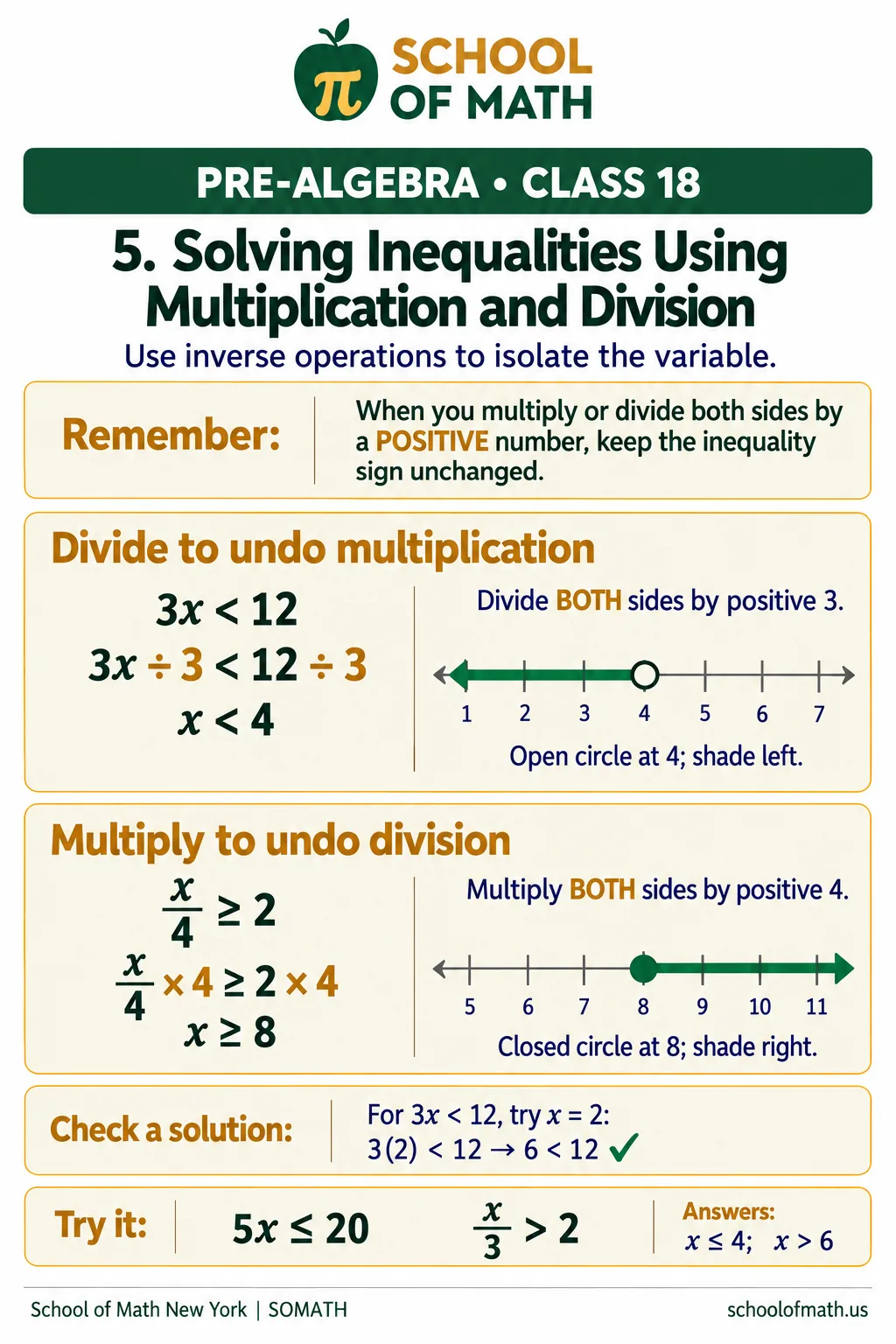
Use inverse operations to isolate the variable. When you multiply or divide both sides by a positive number, the inequality sign stays the same. To undo multiplication, divide: from \(3x \lt 12\), dividing both sides by 3 gives \(x \lt 4\). To undo division, multiply: from \(\frac{x}{4} \ge 2\), multiplying both sides by 4 gives \(x \ge 8\).
Check with a value from the shaded region. For \(3x \lt 12\), try \(x = 2\): \(3(2) \lt 12\) gives \(6 \lt 12\), which is true. If the boundary is not a whole number, such as 4.5, place the circle between the tick marks.
Practice: try these five questions
Q21
Solve and graph the solution.
Answer
\(x \lt 5\)
Divide both sides by 4. Dividing by a positive number keeps the sign unchanged.
\[x \lt 5\]Check a value in the shaded region, x = 3: 4(3) < 20 → 12 < 20, which is true.
Graph: open circle at 5; shade left.
Q22
Solve and graph the solution.
Answer
\(x \ge 15\)
Multiply both sides by 5. Multiplying by a positive number keeps the sign unchanged.
\[x \ge 15\]Check the boundary value, x = 15: (15)/5 ≥ 3 → 3 ≥ 3, which is true.
Graph: closed circle at 15; shade right.
Q23
Solve and graph the solution.
Answer
\(x \le 7\)
Divide both sides by 6. Dividing by a positive number keeps the sign unchanged.
\[x \le 7\]Check the boundary value, x = 7: 6(7) ≤ 42 → 42 ≤ 42, which is true.
Graph: closed circle at 7; shade left.
Q24
Solve and graph the solution.
Answer
\(x \gt -6\)
Multiply both sides by 2. Multiplying by a positive number keeps the sign unchanged.
\[x \gt -6\]Check a value in the shaded region, x = −4: (−4)/2 > −3 → −2 > −3, which is true.
Graph: open circle at −6; shade right.
Q25
Solve and graph the solution. The boundary is not a whole number.
Answer
\(x \le 4.5\)
Divide both sides by 2. Dividing by a positive number keeps the sign unchanged.
\[x \le 4.5\]Check a value in the shaded region, x = 4: 2(4) ≤ 9 → 8 ≤ 9, which is true.
Graph: closed circle at 4.5; shade left.
Reversing the inequality sign
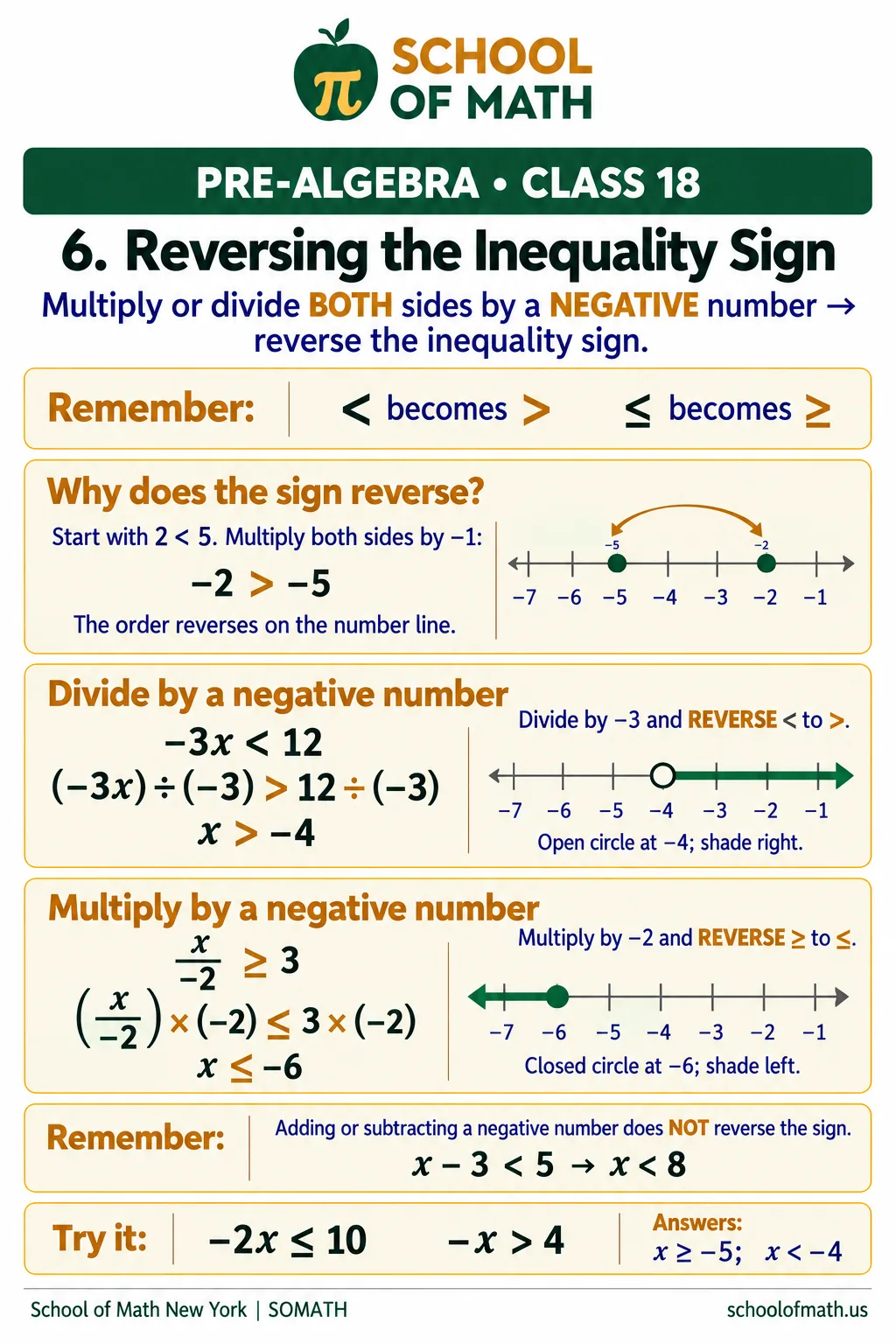
Multiplying or dividing both sides by a negative number reverses the inequality sign: \(\lt\) becomes \(\gt\) and \(\le\) becomes \(\ge\). The reason is that multiplying by a negative number flips the order on the number line. Start with \(2 \lt 5\); multiplying both sides by −1 gives \(-2\) and \(-5\), and \(-2 \gt -5\).
From \(-3x \lt 12\), divide both sides by −3 and reverse: \(x \gt -4\). From \(\frac{x}{-2} \ge 3\), multiply both sides by −2 and reverse: \(x \le -6\). Adding or subtracting a negative number does not reverse the sign: \(x - 3 \lt 5\) simply becomes \(x \lt 8\). Always check a value in the original inequality.
Practice: try these five questions
Q26
Solve and graph the solution.
Answer
\(x \gt -5\)
Divide both sides by −4. Dividing by a negative number reverses the inequality sign.
\[x \gt -5\]Check a value in the shaded region, x = −3: −4(−3) < 20 → 12 < 20, which is true.
Graph: open circle at −5; shade right.
Q27
Solve and graph the solution.
Answer
\(x \le -3\)
Divide both sides by −1. Dividing by a negative number reverses the inequality sign.
\[x \le -3\]Check the boundary value, x = −3: −(−3) ≥ 3 → 3 ≥ 3, which is true.
Graph: closed circle at −3; shade left.
Q28
Solve and graph the solution.
Answer
\(x \ge -6\)
Multiply both sides by −3. Multiplying by a negative number reverses the inequality sign.
\[x \ge -6\]Check the boundary value, x = −6: (−6)/(−3) ≤ 2 → 2 ≤ 2, which is true.
Graph: closed circle at −6; shade right.
Q29
Solve and graph the solution.
Answer
\(x \lt 3\)
Divide both sides by −5. Dividing by a negative number reverses the inequality sign.
\[x \lt 3\]Check a value in the shaded region, x = 1: −5(1) > −15 → −5 > −15, which is true.
Graph: open circle at 3; shade left.
Q30
A student solves this inequality and writes \(x \le -4\). Explain the error, give the correct solution, and graph it.
Answer
\(x \ge -4\)
The student divided both sides by −2 but kept the sign \(\le\). Dividing by a negative number must reverse the sign.
Divide both sides by −2. Dividing by a negative number reverses the inequality sign.
\[x \ge -4\]Check a value in the shaded region, x = 0: −2(0) ≤ 8 → 0 ≤ 8, which is true.
Graph: closed circle at −4; shade right.
Solving two-step inequalities
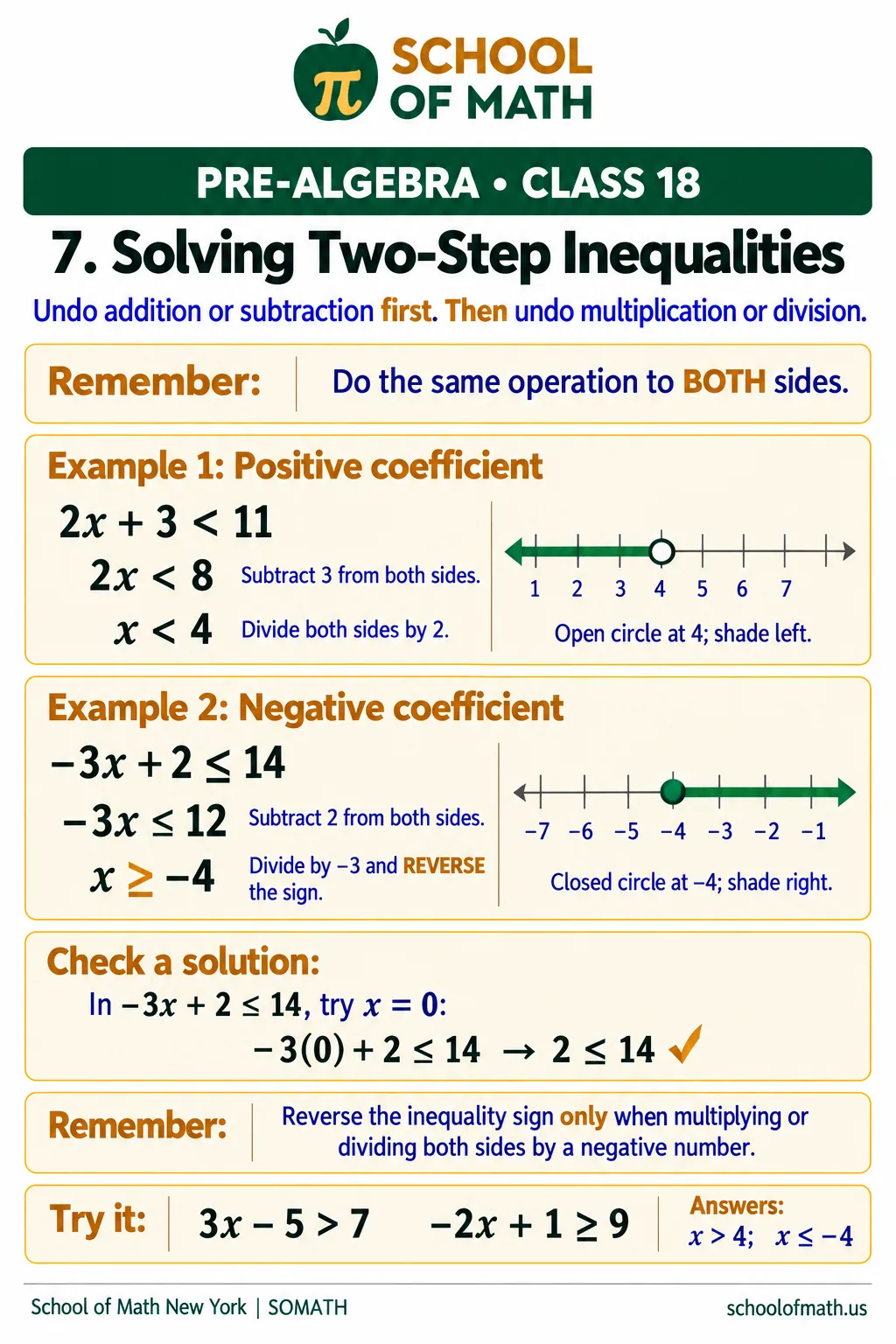
Undo addition or subtraction first, then undo multiplication or division, doing the same operation to both sides each time. For \(2x + 3 \lt 11\), subtract 3 from both sides to get \(2x \lt 8\), then divide both sides by 2 to get \(x \lt 4\).
Reverse the inequality sign only when multiplying or dividing both sides by a negative number. For \(-3x + 2 \le 14\), subtracting 2 gives \(-3x \le 12\); dividing by −3 reverses the sign: \(x \ge -4\). Check with \(x = 0\): \(-3(0) + 2 \le 14\) gives \(2 \le 14\), which is true.
Practice: try these five questions
Q31
Solve and graph the solution.
Answer
\(x \lt 5\)
Subtract 4 from both sides. Adding or subtracting the same number does not change the inequality sign.
\[3x \lt 15\]Divide both sides by 3. Dividing by a positive number keeps the sign unchanged.
\[x \lt 5\]Check a value in the shaded region, x = 3: 3(3) + 4 < 19 → 13 < 19, which is true.
Graph: open circle at 5; shade left.
Q32
Solve and graph the solution.
Answer
\(x \ge 5\)
Add 7 to both sides. Adding or subtracting the same number does not change the inequality sign.
\[2x \ge 10\]Divide both sides by 2. Dividing by a positive number keeps the sign unchanged.
\[x \ge 5\]Check the boundary value, x = 5: 2(5) − 7 ≥ 3 → 3 ≥ 3, which is true.
Graph: closed circle at 5; shade right.
Q33
Solve and graph the solution.
Answer
\(x \ge -3\)
Subtract 1 from both sides. Adding or subtracting the same number does not change the inequality sign.
\[-4x \le 12\]Divide both sides by −4. Dividing by a negative number reverses the inequality sign.
\[x \ge -3\]Check a value in the shaded region, x = 0: −4(0) + 1 ≤ 13 → 1 ≤ 13, which is true.
Graph: closed circle at −3; shade right.
Q34
Solve and graph the solution.
Answer
\(x \gt -3\)
Subtract 2 from both sides. Adding or subtracting the same number does not change the inequality sign.
\[\frac{x}{3} \gt -1\]Multiply both sides by 3. Multiplying by a positive number keeps the sign unchanged.
\[x \gt -3\]Check a value in the shaded region, x = −1: (−1)/3 + 2 > 1 → 5/3 > 1, which is true.
Graph: open circle at −3; shade right.
Q35
Solve and graph the solution. The variable term is subtracted.
Answer
\(x \gt -3\)
Subtract 5 from both sides. Adding or subtracting the same number does not change the inequality sign.
\[-2x \lt 6\]Divide both sides by −2. Dividing by a negative number reverses the inequality sign.
\[x \gt -3\]Check a value in the shaded region, x = 0: 5 − 2(0) < 11 → 5 < 11, which is true.
Graph: open circle at −3; shade right.
Inequality word problems
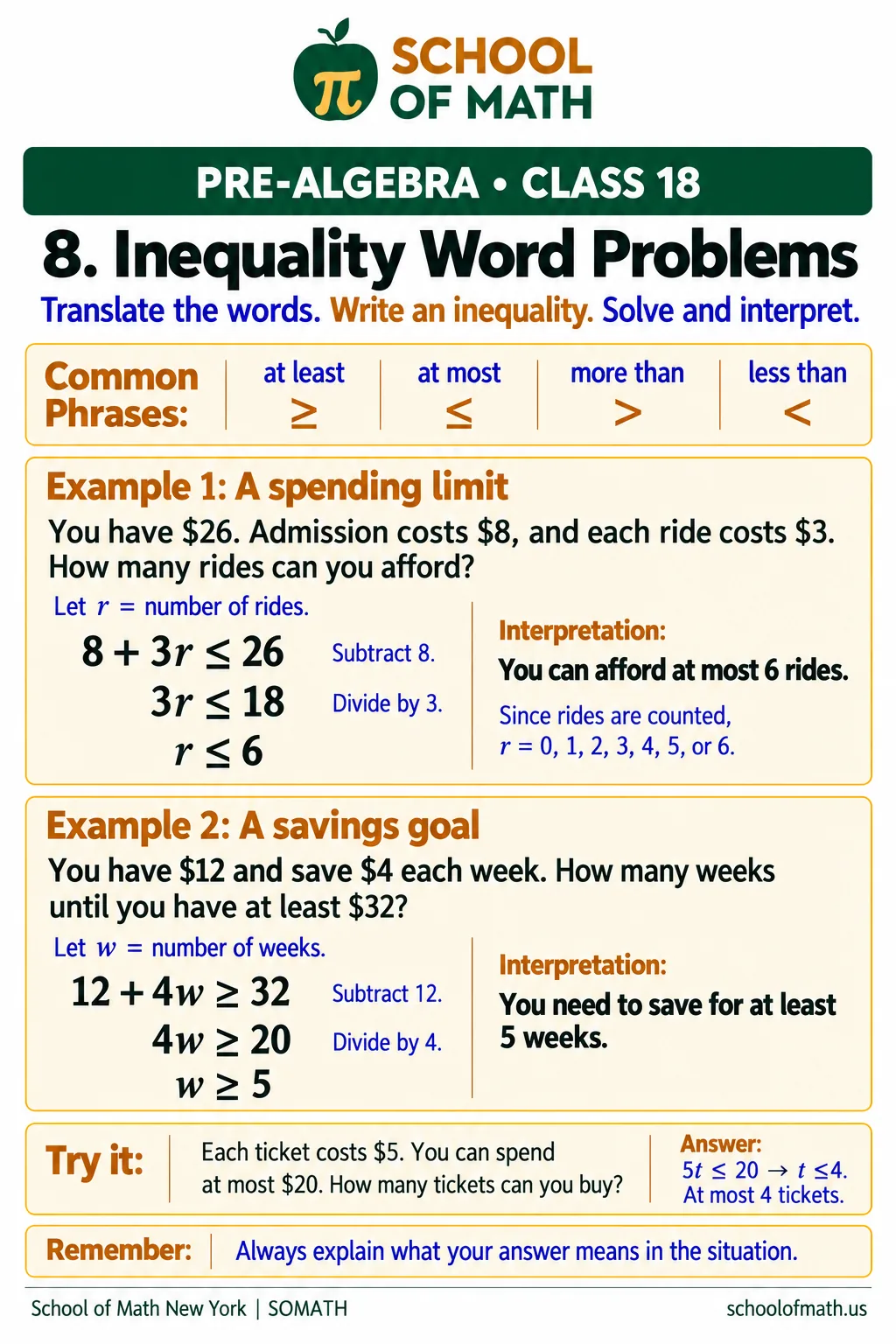
Translate the words, write an inequality, solve, and interpret. Common phrases: “at least” means \(\ge\), “at most” means \(\le\), “more than” means \(\gt\), and “less than” means \(\lt\). Define the variable first, for example let \(r\) be the number of rides.
Solve with the same steps as before, then explain what the answer means in the situation. If you have $26, admission is $8, and rides cost $3 each, then \(8 + 3r \le 26\) gives \(r \le 6\): you can afford at most 6 rides. When the variable counts objects, only whole numbers make sense, so a solution such as \(t \le 4.6\) means at most 4 whole tickets.
Practice: try these five questions
Q36
You have $30 to spend at an arcade. Entry costs $6 and each game costs $4. How many games can you play?
Answer
You can play at most 6 games, so g = 0, 1, 2, 3, 4, 5, or 6.
Let \(g\) = the number of games.
Write the inequality.
\[6 + 4g \le 30\]Subtract 6 from both sides. Adding or subtracting the same number does not change the inequality sign.
\[4g \le 24\]Divide both sides by 4. Dividing by a positive number keeps the sign unchanged.
\[g \le 6\]Check the boundary value, g = 6: 6 + 4(6) ≤ 30 → 30 ≤ 30, which is true.
Interpretation: You can play at most 6 games, so g = 0, 1, 2, 3, 4, 5, or 6.
Q37
Maya has $15 and saves $5 each week. How many weeks until she has at least $50?
Answer
Maya must save for at least 7 weeks.
Let \(w\) = the number of weeks.
Write the inequality.
\[15 + 5w \ge 50\]Subtract 15 from both sides. Adding or subtracting the same number does not change the inequality sign.
\[5w \ge 35\]Divide both sides by 5. Dividing by a positive number keeps the sign unchanged.
\[w \ge 7\]Check the boundary value, w = 7: 15 + 5(7) ≥ 50 → 50 ≥ 50, which is true.
Interpretation: Maya must save for at least 7 weeks.
Q38
A freight elevator can carry at most 800 pounds. A worker who weighs 150 pounds loads boxes that weigh 25 pounds each. How many boxes can ride with the worker?
Answer
At most 26 boxes can ride with the worker.
Let \(b\) = the number of boxes.
Write the inequality.
\[150 + 25b \le 800\]Subtract 150 from both sides. Adding or subtracting the same number does not change the inequality sign.
\[25b \le 650\]Divide both sides by 25. Dividing by a positive number keeps the sign unchanged.
\[b \le 26\]Check the boundary value, b = 26: 150 + 25(26) ≤ 800 → 800 ≤ 800, which is true.
Interpretation: At most 26 boxes can ride with the worker.
Q39
A phone plan costs $20 per month plus $3 per gigabyte of data. Jordan wants the bill to be less than $41. How many gigabytes can Jordan use?
Answer
Jordan must use fewer than 7 gigabytes; with whole gigabytes, that is at most 6.
Let \(d\) = the number of gigabytes.
Write the inequality.
\[20 + 3d \lt 41\]Subtract 20 from both sides. Adding or subtracting the same number does not change the inequality sign.
\[3d \lt 21\]Divide both sides by 3. Dividing by a positive number keeps the sign unchanged.
\[d \lt 7\]Check a value in the shaded region, d = 5: 20 + 3(5) < 41 → 35 < 41, which is true.
The boundary 7 is not allowed because 20 + 3(7) = 41 is not less than 41.
Interpretation: Jordan must use fewer than 7 gigabytes; with whole gigabytes, that is at most 6.
Q40
A class needs more than $120 for a trip. The class already has $45 and sells cookies for $3 each. How many cookies must the class sell?
Answer
The class must sell more than 25 cookies; since cookies are counted in whole numbers, at least 26 cookies.
Let \(c\) = the number of cookies.
Write the inequality.
\[45 + 3c \gt 120\]Subtract 45 from both sides. Adding or subtracting the same number does not change the inequality sign.
\[3c \gt 75\]Divide both sides by 3. Dividing by a positive number keeps the sign unchanged.
\[c \gt 25\]Check a value in the shaded region, c = 27: 45 + 3(27) > 120 → 126 > 120, which is true.
Selling exactly 25 cookies gives 45 + 3(25) = 120, which is not more than 120, so 25 is not enough.
Interpretation: The class must sell more than 25 cookies; since cookies are counted in whole numbers, at least 26 cookies.
Homework review
One review question for each topic. Show each operation applied to both sides, graph the solution, and check a value in the original inequality.
R1
Write \(\lt\) or \(\gt\) in each blank: −8 __ −2, 0 __ −1, and 3.5 __ 3.05.
Answer
\(-8 \lt -2\); \(0 \gt -1\); \(3.5 \gt 3.05\)
−8 is to the left of −2 on a number line, so \(-8 \lt -2\).
0 is to the right of −1, so \(0 \gt -1\).
3.5 = 3.50 is more than 3.05, so \(3.5 \gt 3.05\).
R2
Is \(x = 6\) a solution? Watch the boundary.
Answer
Yes: \(x = 6\) is a solution
Substitute: replace \(x\) with 6. 2(6) − 5 ≥ 7
Simplify the left side: 7 ≥ 7.
Decide: the statement is true, so \(x = 6\) is a solution.
The left side equals exactly 7, and \(\ge\) allows equality, so 6 is a solution.
R3
Graph the inequality on a number line.
Answer
Open circle at −2; shade right
The boundary is −2. The symbol > does not include the boundary, so draw an open circle at −2.
The solutions are greater than −2, so shade to the right with an arrow to show the solutions continue without end.
Check a value in the shaded region, x = 0: (0) > −2 → 0 > −2, which is true.
R4
Solve and graph the solution.
Answer
\(x \le 5\)
Add 9 to both sides. Adding or subtracting the same number does not change the inequality sign.
\[x \le 5\]Check the boundary value, x = 5: (5) − 9 ≤ −4 → −4 ≤ −4, which is true.
Graph: closed circle at 5; shade left.
R5
Solve and graph the solution.
Answer
\(x \lt 8\)
Multiply both sides by 4. Multiplying by a positive number keeps the sign unchanged.
\[x \lt 8\]Check a value in the shaded region, x = 6: (6)/4 < 2 → 1.5 < 2, which is true.
Graph: open circle at 8; shade left.
R6
Solve and graph the solution.
Answer
\(x \le -6\)
Divide both sides by −3. Dividing by a negative number reverses the inequality sign.
\[x \le -6\]Check the boundary value, x = −6: −3(−6) ≥ 18 → 18 ≥ 18, which is true.
Graph: closed circle at −6; shade left.
R7
Solve and graph the solution.
Answer
\(x \gt 4\)
Add 3 to both sides. Adding or subtracting the same number does not change the inequality sign.
\[4x \gt 16\]Divide both sides by 4. Dividing by a positive number keeps the sign unchanged.
\[x \gt 4\]Check a value in the shaded region, x = 6: 4(6) − 3 > 13 → 21 > 13, which is true.
Graph: open circle at 4; shade right.
R8
Concert tickets cost $7 each. You can spend at most $45. How many tickets can you buy?
Answer
You can buy at most 6 tickets, because 6 × 7 = 42 fits the budget and 7 × 7 = 49 does not.
Let \(t\) = the number of tickets.
Write the inequality.
\[7t \le 45\]Divide both sides by 7. Dividing by a positive number keeps the sign unchanged.
\[t \le \frac{45}{7}\]Check a value in the shaded region, t = 5: 7(5) ≤ 45 → 35 ≤ 45, which is true.
The boundary 45/7 is about 6.43, and tickets come in whole numbers.
Interpretation: You can buy at most 6 tickets, because 6 × 7 = 42 fits the budget and 7 × 7 = 49 does not.
Homework word problems
Translate each story into an inequality, solve it, and explain what the answer means. Decide whether the boundary value is allowed and whether only whole numbers make sense.
W1
Pencils cost $2 each. You can spend at most $14. How many pencils can you buy?
Answer
You can buy at most 7 pencils.
Let \(p\) = the number of pencils.
Write the inequality.
\[2p \le 14\]Divide both sides by 2. Dividing by a positive number keeps the sign unchanged.
\[p \le 7\]Check the boundary value, p = 7: 2(7) ≤ 14 → 14 ≤ 14, which is true.
Interpretation: You can buy at most 7 pencils.
W2
A roller coaster requires riders to be at least 48 inches tall. Leo is 41 inches tall. How many more inches must Leo grow to ride?
Answer
Leo must grow at least 7 more inches.
Let \(h\) = the number of inches Leo must grow.
Write the inequality.
\[41 + h \ge 48\]Subtract 41 from both sides. Adding or subtracting the same number does not change the inequality sign.
\[h \ge 7\]Check the boundary value, h = 7: 41 + (7) ≥ 48 → 48 ≥ 48, which is true.
Interpretation: Leo must grow at least 7 more inches.
W3
A bus seats 40 passengers, and 26 passengers are already on board. How many more passengers can board?
Answer
At most 14 more passengers can board.
Let \(s\) = the number of additional passengers.
Write the inequality.
\[26 + s \le 40\]Subtract 26 from both sides. Adding or subtracting the same number does not change the inequality sign.
\[s \le 14\]Check the boundary value, s = 14: 26 + (14) ≤ 40 → 40 ≤ 40, which is true.
Interpretation: At most 14 more passengers can board.
W4
Ava earns $12 per hour. How many hours must she work to earn more than $96?
Answer
Ava must work more than 8 hours; exactly 8 hours gives $96, which is not more than $96.
Let \(h\) = the number of hours.
Write the inequality.
\[12h \gt 96\]Divide both sides by 12. Dividing by a positive number keeps the sign unchanged.
\[h \gt 8\]Check a value in the shaded region, h = 10: 12(10) > 96 → 120 > 96, which is true.
Interpretation: Ava must work more than 8 hours; exactly 8 hours gives $96, which is not more than $96.
W5
A $50 gift card is used to buy books that cost $9 each. How many books can be bought?
Answer
At most 5 books can be bought, since 5 × 9 = 45 fits and 6 × 9 = 54 does not.
Let \(b\) = the number of books.
Write the inequality.
\[9b \le 50\]Divide both sides by 9. Dividing by a positive number keeps the sign unchanged.
\[b \le \frac{50}{9}\]Check a value in the shaded region, b = 4: 9(4) ≤ 50 → 36 ≤ 50, which is true.
The boundary 50/9 is about 5.56, and books are counted in whole numbers.
Interpretation: At most 5 books can be bought, since 5 × 9 = 45 fits and 6 × 9 = 54 does not.
W6
A taxi charges $4 plus $2 per mile. Sam can spend at most $18. How many miles can Sam ride?
Answer
Sam can ride at most 7 miles.
Let \(m\) = the number of miles.
Write the inequality.
\[4 + 2m \le 18\]Subtract 4 from both sides. Adding or subtracting the same number does not change the inequality sign.
\[2m \le 14\]Divide both sides by 2. Dividing by a positive number keeps the sign unchanged.
\[m \le 7\]Check the boundary value, m = 7: 4 + 2(7) ≤ 18 → 18 ≤ 18, which is true.
Interpretation: Sam can ride at most 7 miles.
W7
Nina has $28 and saves $6 each week. After how many weeks will she have at least $100?
Answer
Nina needs at least 12 weeks.
Let \(w\) = the number of weeks.
Write the inequality.
\[28 + 6w \ge 100\]Subtract 28 from both sides. Adding or subtracting the same number does not change the inequality sign.
\[6w \ge 72\]Divide both sides by 6. Dividing by a positive number keeps the sign unchanged.
\[w \ge 12\]Check the boundary value, w = 12: 28 + 6(12) ≥ 100 → 100 ≥ 100, which is true.
Interpretation: Nina needs at least 12 weeks.
W8
Diego scored 82 and 90 on two tests. What score on a third test gives him an average of at least 88?
Answer
Diego needs a score of at least 92 on the third test.
Let \(s\) = the third test score.
The average of three scores is their sum divided by 3, so the condition is \(\frac{82 + 90 + s}{3} \ge 88\). Multiply both sides by positive 3 to get \(172 + s \ge 264\).
Simplified inequality to solve.
\[172 + s \ge 264\]Subtract 172 from both sides. Adding or subtracting the same number does not change the inequality sign.
\[s \ge 92\]Check the boundary value, s = 92: 172 + (92) ≥ 264 → 264 ≥ 264, which is true.
Interpretation: Diego needs a score of at least 92 on the third test.
W9
Three times a number decreased by 7 is less than 20. What are the possible values of the number?
Answer
The number is less than 9.
Let \(n\) = the number.
Write the inequality.
\[3n - 7 \lt 20\]Add 7 to both sides. Adding or subtracting the same number does not change the inequality sign.
\[3n \lt 27\]Divide both sides by 3. Dividing by a positive number keeps the sign unchanged.
\[n \lt 9\]Check a value in the shaded region, n = 7: 3(7) − 7 < 20 → 14 < 20, which is true.
Interpretation: The number is less than 9.
W10
The temperature is 10 °C and is dropping 2 °C every hour. After how many hours will the temperature be below −4 °C?
Answer
The temperature is below −4 °C after more than 7 hours; at exactly 7 hours it is −4 °C.
Let \(h\) = the number of hours.
Write the inequality.
\[10 - 2h \lt -4\]Subtract 10 from both sides. Adding or subtracting the same number does not change the inequality sign.
\[-2h \lt -14\]Divide both sides by −2. Dividing by a negative number reverses the inequality sign.
\[h \gt 7\]Check a value in the shaded region, h = 9: 10 − 2(9) < −4 → −8 < −4, which is true.
Interpretation: The temperature is below −4 °C after more than 7 hours; at exactly 7 hours it is −4 °C.
W11
A diver is at −15 feet and descends 3 feet per minute. For safety, the diver must stay at or above −45 feet. For how many minutes can the diver keep descending?
Answer
The diver can descend for at most 10 minutes; after 10 minutes the depth is exactly −45 feet.
Let \(m\) = the number of minutes.
Write the inequality.
\[-15 - 3m \ge -45\]Add 15 to both sides. Adding or subtracting the same number does not change the inequality sign.
\[-3m \ge -30\]Divide both sides by −3. Dividing by a negative number reverses the inequality sign.
\[m \le 10\]Check the boundary value, m = 10: −15 − 3(10) ≥ −45 → −45 ≥ −45, which is true.
Interpretation: The diver can descend for at most 10 minutes; after 10 minutes the depth is exactly −45 feet.
W12
Gym A charges a flat $25 per month. Gym B charges $10 per month plus $3 per visit. For how many visits per month is Gym B cheaper than Gym A?
Answer
Gym B is cheaper for fewer than 5 visits, that is, 0 to 4 visits; at 5 visits both cost $25.
Let \(v\) = the number of visits per month.
Write the inequality.
\[10 + 3v \lt 25\]Subtract 10 from both sides. Adding or subtracting the same number does not change the inequality sign.
\[3v \lt 15\]Divide both sides by 3. Dividing by a positive number keeps the sign unchanged.
\[v \lt 5\]Check a value in the shaded region, v = 3: 10 + 3(3) < 25 → 19 < 25, which is true.
Interpretation: Gym B is cheaper for fewer than 5 visits, that is, 0 to 4 visits; at 5 visits both cost $25.
Quick questions and answers
What do the four inequality symbols mean?
\(\lt\) means less than, \(\gt\) means greater than, \(\le\) means less than or equal to, and \(\ge\) means greater than or equal to. The open side of the symbol faces the greater value.
How do I check whether a value is a solution?
Substitute the value for the variable, simplify, and decide whether the comparison is true. Boundary values are solutions only when the symbol includes “or equal to.”
When is the circle open or closed on a number-line graph?
Use an open circle for \(\lt\) and \(\gt\), because the boundary is not included, and a closed circle for \(\le\) and \(\ge\), because it is included. Shade left for less than and right for greater than.
Which operations keep the inequality sign the same?
Adding or subtracting any number on both sides, and multiplying or dividing both sides by a positive number, keep the sign unchanged.
When does the inequality sign reverse?
Only when you multiply or divide both sides by a negative number. Multiplying by a negative flips the order of numbers on the number line, so \(2 \lt 5\) becomes \(-2 \gt -5\).
How do I translate word problems into inequalities?
“At least” means \(\ge\), “at most” means \(\le\), “more than” means \(\gt\), and “less than” means \(\lt\). Define the variable, write the inequality, solve, and explain what the answer means, using whole numbers when the variable counts objects.
Is an earlier class required, and what homework is included?
No earlier attendance is required. This self-contained rolling lesson has eight supplied images, forty original practice questions, eight Homework review questions, and twelve Homework word problems, all with hidden worked answers and number-line graphs. The 22-page student workbook includes the supplied PDF-only cover, the eight teaching images, and the same sixty questions with blank working space, blank number lines for graphing, and no exercise solutions.