Pre-Algebra · Class 16 · Grades 5–6
Word Problems Modeled with One- and Two-Step Equations
A word-problem equation connects an unknown quantity to the facts in a story. Define the variable, translate the relationship, solve with inverse operations, and check that the result makes sense. One- and two-step models turn familiar situations into precise mathematical statements.
Study the eight images and try five new questions after each image. Finish with eight homework review questions and twelve homework word problems: 20 homework questions and 60 questions altogether. Try each question before selecting its blue Answer control.
Part of Pre-Algebra at SOMATH. Write a variable definition, an equation, and a final sentence with units whenever a question asks you to model and solve. View the class schedule or book a free evaluation to find the right starting point.
Download the student workbook (PDF)22 pages · Supplied cover, eight teaching images, and all 60 questions. Each image is followed by five practice questions; homework follows with up to five questions per page.Numbered pages, generous blank answer space, and no exercise solutions or writing lines.
Identifying the unknown
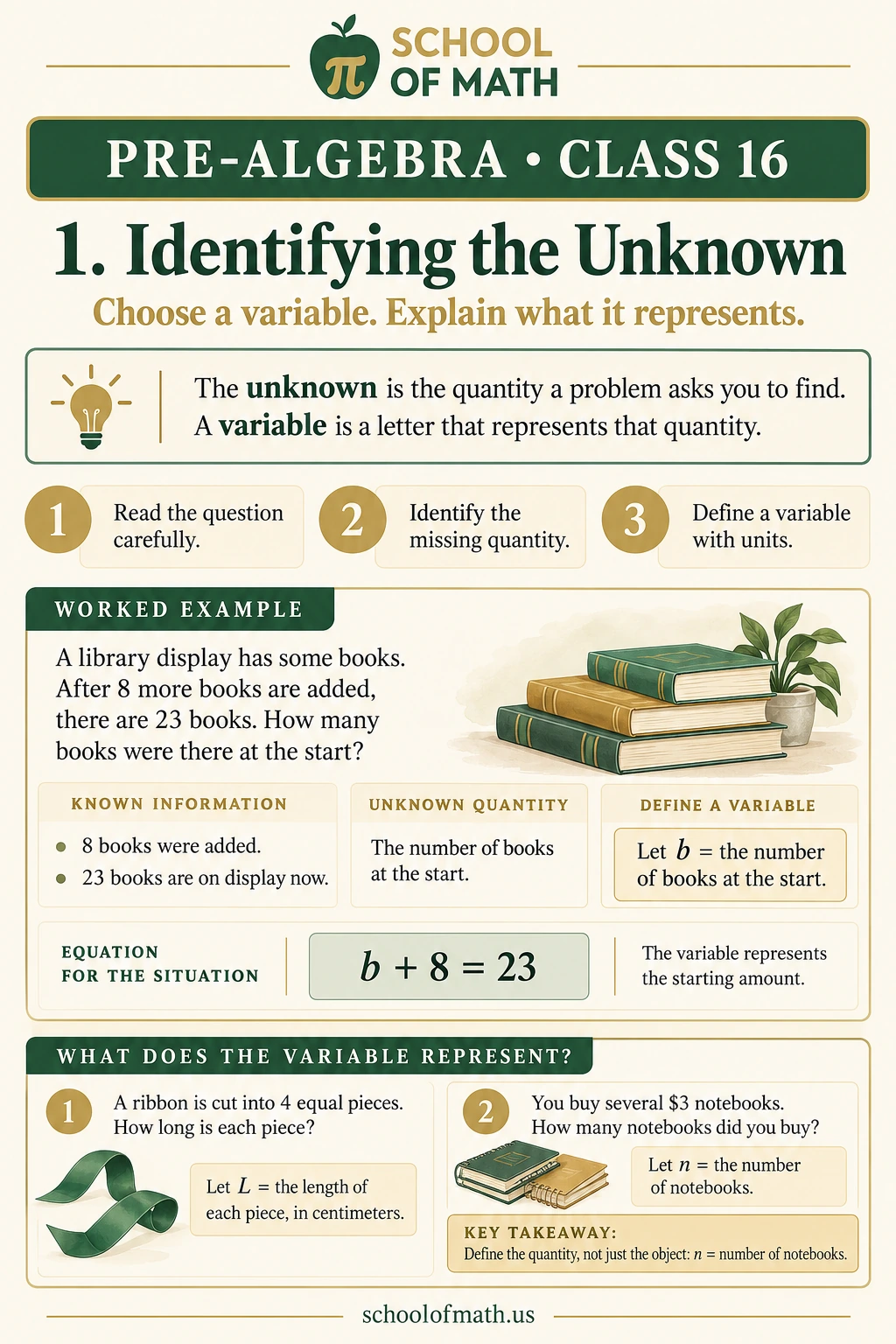
Read what the problem asks before doing arithmetic. The unknown might be a starting amount, an amount removed, the price of one item, or a number of groups.
Define a variable as a quantity with units. “Let p be the price of one ticket, in dollars” is clearer than “p is tickets.” Keep that meaning unchanged throughout the solution.
Separate the known facts from the missing quantity. You can define the unknown even before enough information is available to solve for it.
Try it yourself: five questions
Q1 Practice 1 of 5
A jar has some marbles. After 9 are added, it has 31. Define m for the question “How many marbles were in the jar at first?” Do not solve yet.
Answer
Let m be the number of marbles in the jar at first.
The unknown is the starting count, not the 9 added or the final count of 31.
Q2 Practice 2 of 5
Five identical folders cost $20. Define a variable for the price of one folder, and include its units.
Answer
Let f be the price of one folder, in dollars.
The count of folders is known. The unknown is a price, not the number of folders.
Q3 Practice 3 of 5
A rope is cut into 6 equal pieces. Each piece is 7 cm long. Define L for the original rope length.
Answer
Let L be the original length of the rope, in centimeters.
The unknown is the whole rope length. Each piece has a known length of 7 cm.
Q4 Practice 4 of 5
A box contains 52 cards. Some are given away, leaving 37. Define c for the amount given away and list the two known counts.
Answer
Let c be the number of cards given away. Known counts: 52 at first and 37 left.
The unknown is the removed amount, not the starting amount.
Q5 Practice 5 of 5
A club pays a $12 booking fee plus $4 per player. Its bill is $48. A student writes “p is the price.” Replace this with a precise variable definition for finding how many players attended.
Answer
Let p be the number of players who attended.
The fee and price per player are already known. The question asks for a count of players.
Translating words into equations
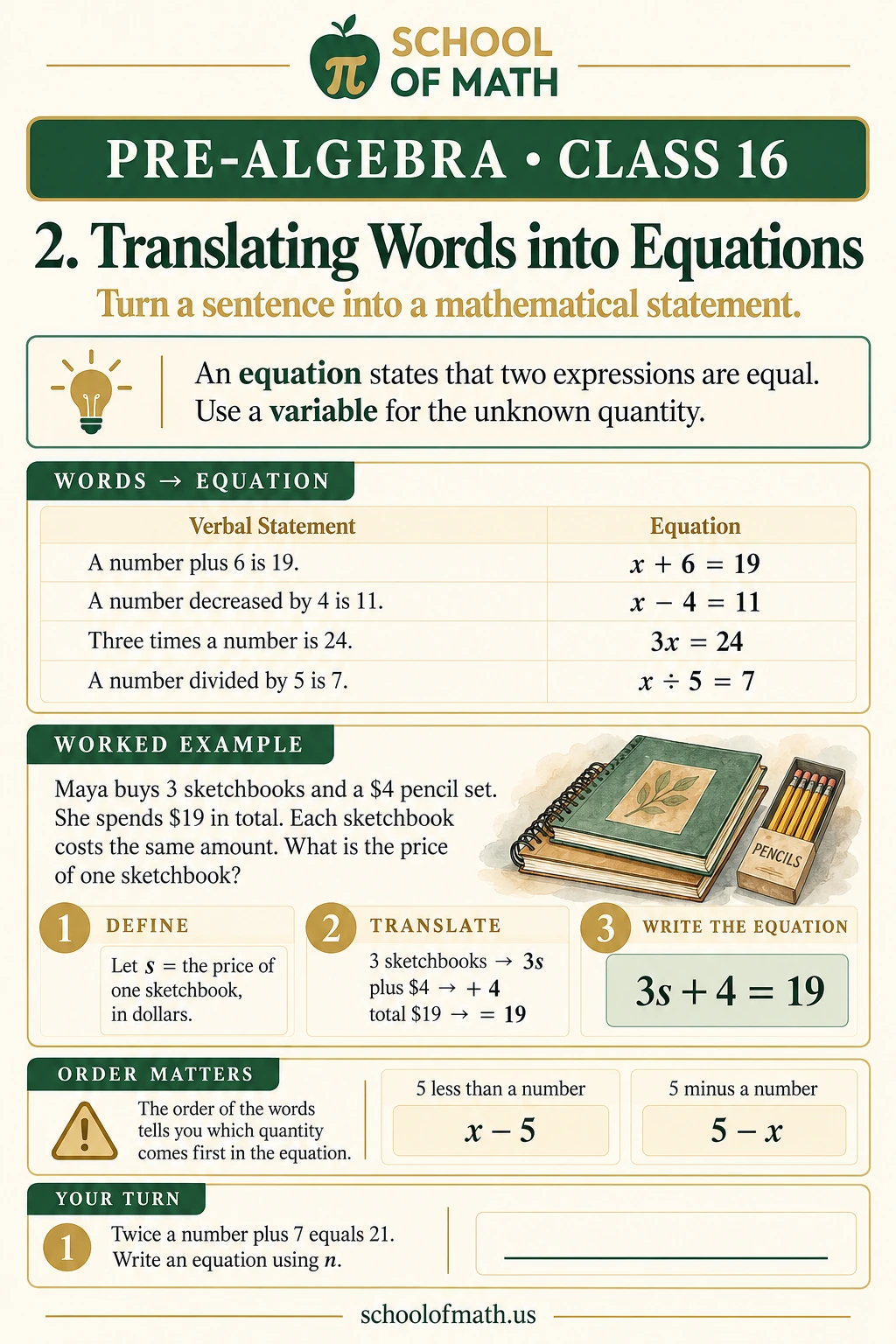
An equation states that two quantities are equal. Build each side from the relationships in the story, then use an equals sign to connect quantities with the same units.
Order matters in subtraction and division. “Seven less than n” means n − 7, while “seven minus n” means 7 − n. A keyword alone does not identify which quantity comes first.
Parentheses preserve a grouped quantity. Twice the sum of n and 4 is 2(n + 4); four more than twice n is 2n + 4. These describe different calculations.
Try it yourself: five questions
Q6 Practice 1 of 5
Write an equation using n: a number increased by 11 equals 29. Do not solve.
Answer
n + 11 = 29.
The unknown number is increased by 11. The result is equal to 29.
Q7 Practice 2 of 5
Write an equation using n: 7 less than a number is 18. Do not solve.
Answer
n − 7 = 18.
Start with the number, then remove 7. Reversing it to 7 − n changes the meaning.
Q8 Practice 3 of 5
Write an equation using n: 26 minus a number is 9. Do not solve.
Answer
26 − n = 9.
This time 26 is the starting amount and the unknown is removed.
Q9 Practice 4 of 5
A shop charges $6 for delivery plus $4 for each box. The total is $34. Define b and write an equation; do not solve.
Answer
Let b be the number of boxes. Then 4b + 6 = 34.
The boxes cost 4b dollars altogether. Add the single delivery charge, not a delivery charge for every box.
Q10 Practice 5 of 5
Write an equation for each statement: (a) twice the sum of n and 5 equals 24; (b) five more than twice n equals 24. Do not solve.
Answer
(a) 2(n + 5) = 24. (b) 2n + 5 = 24.
In (a), the entire sum is doubled. In (b), only n is doubled before 5 is added.
Addition: finding the missing part
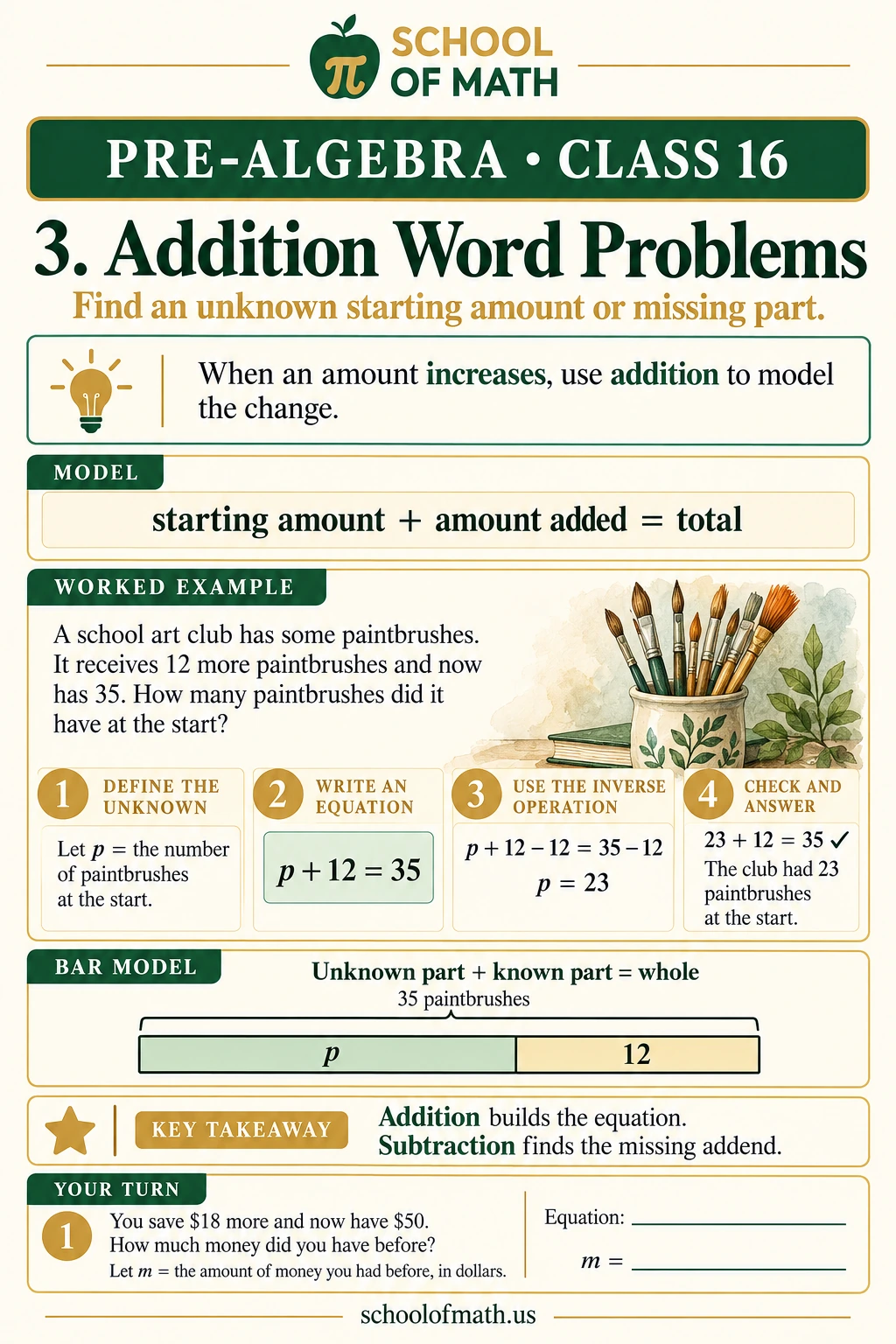
A useful model is starting amount + amount added = final amount. You can use addition to describe the situation even when subtraction is needed to find the unknown.
If x + a = b, subtract a from both sides. Keep the equation balanced; an inverse operation is applied to both sides, not just to the variable side.
Addition also joins parts of a whole. The unknown may be the amount added rather than the starting amount. Define it clearly and check the completed sum.
Try it yourself: five questions
Q11 Practice 1 of 5
A shelf gains 7 books and now holds 26. Write and solve an equation for the number it held before.
Answer
The shelf held 19 books.
Let b be the starting number of books.
Model: b + 7 = 26.
Subtract 7 from both sides: b = 26 − 7 = 19.
Check: 19 + 7 = 26 books.
Q12 Practice 2 of 5
Lena adds $16 to her savings and then has $61. Find her starting savings using an equation.
Answer
Lena started with $45.
Let m be the starting savings, in dollars.
Model: m + 16 = 61.
Subtract 16: m = 61 − 16 = 45.
Check: 45 + 16 = 61 dollars.
Q13 Practice 3 of 5
A team has 28 points and finishes with 47 after one round. How many points did it earn in that round? Write and solve an equation.
Answer
The team earned 19 points.
Let p be the points earned in the round.
Model: 28 + p = 47.
Subtract the known starting score: p = 47 − 28 = 19.
Check: 28 + 19 = 47 points.
Q14 Practice 4 of 5
After 2.75 liters of water are added, a container holds 8.5 liters. Find the original amount using an equation.
Answer
The original amount was 5.75 liters.
Let v be the original volume, in liters.
Model: v + 2.75 = 8.5.
Subtract 2.75 from both sides: v = 5.75.
Check: 5.75 + 2.75 = 8.5 liters.
Q15 Practice 5 of 5
An afternoon temperature is 9°C higher than the morning temperature. The afternoon temperature is 4°C. Find the morning temperature.
Answer
The morning temperature was −5°C.
Let t be the morning temperature, in degrees Celsius.
Model: t + 9 = 4.
Subtract 9: t = 4 − 9 = −5. A temperature can be negative.
Check: −5 + 9 = 4°C.
Subtraction: start or amount removed
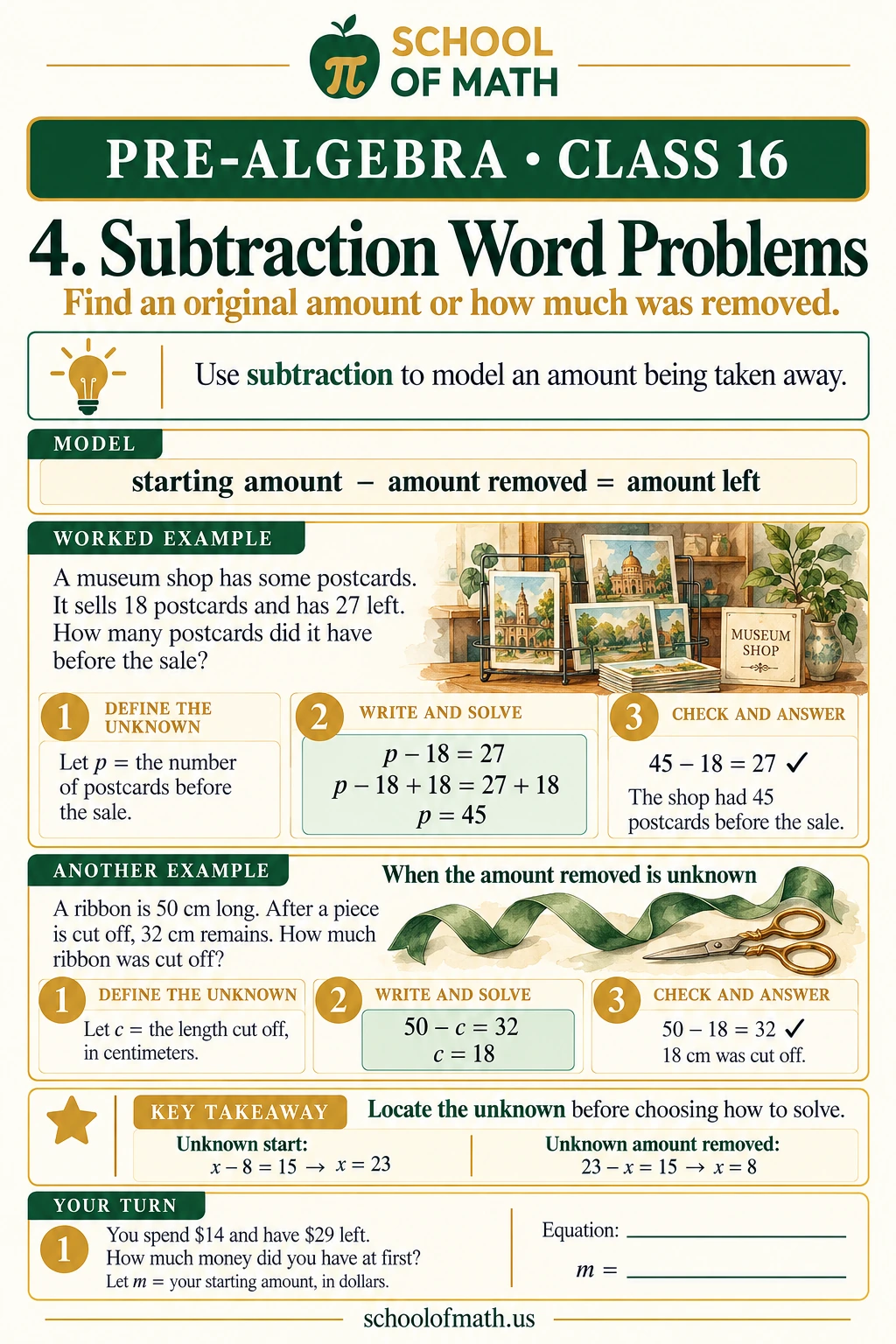
A removal model is starting amount − amount removed = amount left. Locate the unknown before selecting the operation that will isolate it.
For x − a = b, add a to both sides to recover the start. For a − x = b, the removed amount is a − b. Do not treat the two equations as if the unknown were in the same position.
A subtraction model can also describe a decrease in a measurement. Use consistent units and check that the starting, removed, and remaining quantities fit the context.
Try it yourself: five questions
Q16 Practice 1 of 5
A basket loses 11 apples and has 24 left. How many apples were in it at first? Write and solve an equation.
Answer
There were 35 apples.
Let a be the starting number of apples.
Model: a − 11 = 24.
Add 11 to both sides: a = 35.
Check: 35 − 11 = 24 apples.
Q17 Practice 2 of 5
A class begins with 63 stickers and gives some away, leaving 38. Find the number given away.
Answer
The class gave away 25 stickers.
Let g be the number given away.
Model: 63 − g = 38.
The removed part is 63 − 38 = 25. Equivalently, add g and subtract 38 on both sides.
Check: 63 − 25 = 38 stickers.
Q18 Practice 3 of 5
After a $27 purchase, Omar has $46 left. Find how much money he had before the purchase.
Answer
Omar had $73.
Let m be the starting amount, in dollars.
Model: m − 27 = 46.
Add 27: m = 46 + 27 = 73.
Check: 73 − 27 = 46 dollars.
Q19 Practice 4 of 5
A 12.5-meter cable is shortened to 8.75 meters. Write and solve an equation for the length removed.
Answer
3.75 meters were removed.
Let r be the length removed, in meters.
Model: 12.5 − r = 8.75.
Subtract the remaining length from the original: r = 12.5 − 8.75 = 3.75.
Check: 12.5 − 3.75 = 8.75 meters.
Q20 Practice 5 of 5
A freezer temperature falls by 8°C and becomes −3°C. What was its temperature before the change?
Answer
The original temperature was 5°C.
Let t be the original temperature, in degrees Celsius.
Model: t − 8 = −3.
Add 8 to both sides: t = −3 + 8 = 5.
Check: 5 − 8 = −3°C.
Multiplication: equal groups
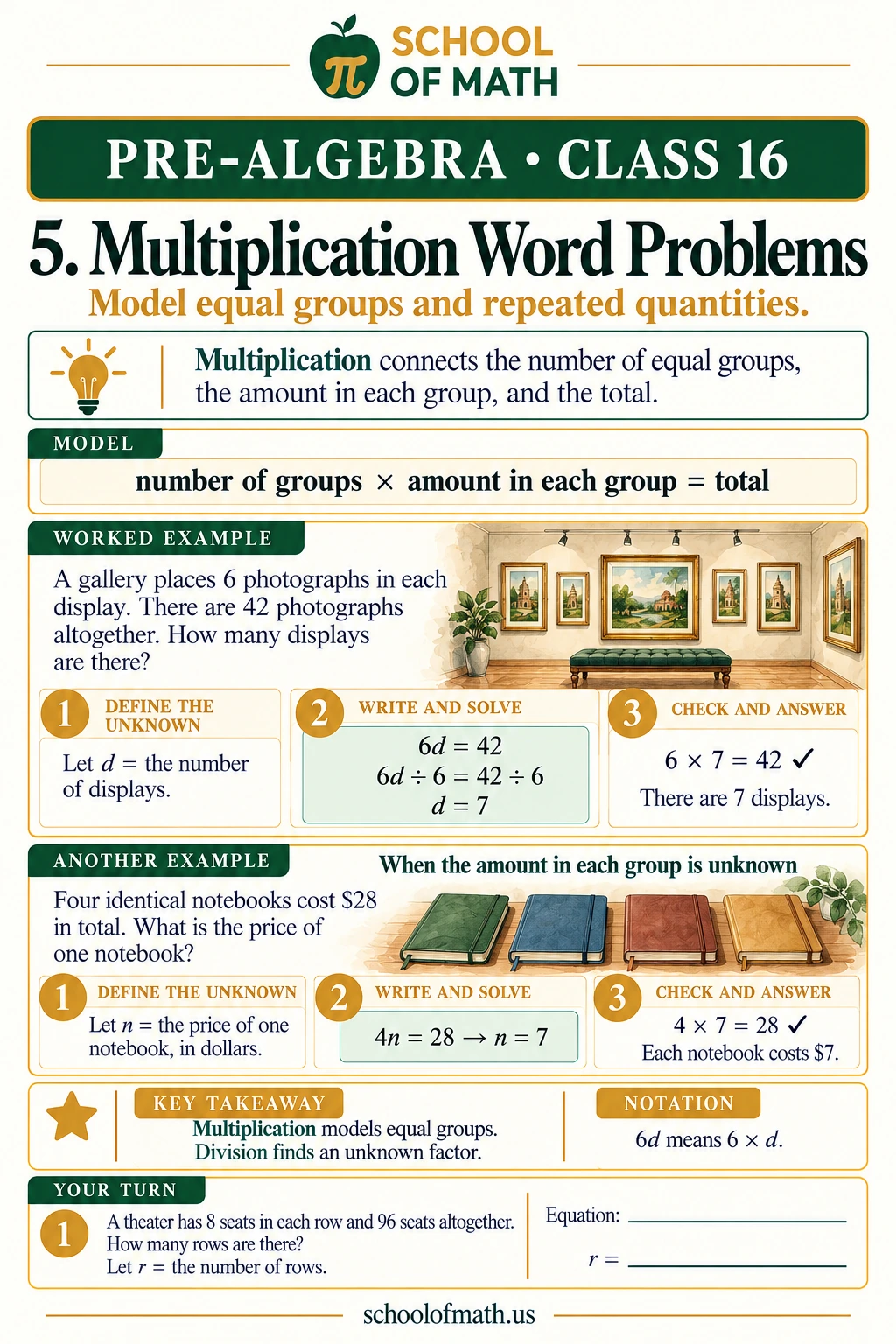
Equal groups connect three quantities: number of groups × amount per group = total. Name which factor is unknown and which quantities are given.
The notation 5p means 5 × p. If 5p = 40, dividing both sides by 5 finds the unknown factor. An equation can use multiplication even though division solves it.
For prices, state whether p is a price per item or the number of items. Whole objects need whole-number counts, but a price or length can be a decimal.
Try it yourself: five questions
Q21 Practice 1 of 5
Five bags each contain the same number of beads. There are 45 beads altogether. Find the number in each bag.
Answer
Each bag contains 9 beads.
Let b be the beads in one bag.
Model: 5b = 45.
Divide both sides by 5: b = 9.
Check: 5 × 9 = 45 beads.
Q22 Practice 2 of 5
A tray holds 7 cupcakes. A baker fills identical trays with 56 cupcakes in total. How many trays are filled?
Answer
8 trays are filled.
Let t be the number of trays.
Model: 7t = 56.
Divide 56 by 7 to find the missing number of groups.
Check: 7 × 8 = 56 cupcakes.
Q23 Practice 3 of 5
Six identical sketchpads cost $51 altogether. Find the price of one sketchpad.
Answer
One sketchpad costs $8.50.
Let p be the price of one sketchpad, in dollars.
Model: 6p = 51.
Divide both sides by 6: p = 8.5. A decimal is valid for a price.
Check: 6 × 8.50 = 51 dollars.
Q24 Practice 4 of 5
A fabric strip is 3 times as long as a 4.2-meter strip. Define L as the longer length and write and solve an equation.
Answer
The longer strip is 12.6 meters.
Let L be the longer length, in meters.
Model: L = 3 × 4.2.
Multiply the known length by 3. Here the total, not a factor, is unknown.
Check: 12.6 = 3 × 4.2 meters.
Q25 Practice 5 of 5
A rectangle has area 84 square centimeters and width 7 centimeters. Find its length using an equation.
Answer
The length is 12 cm.
Let L be the length, in centimeters.
Model: 7L = 84.
Area equals width times length. Divide both sides by 7.
Check: 7 cm × 12 cm = 84 square centimeters.
Division: equal sharing and grouping
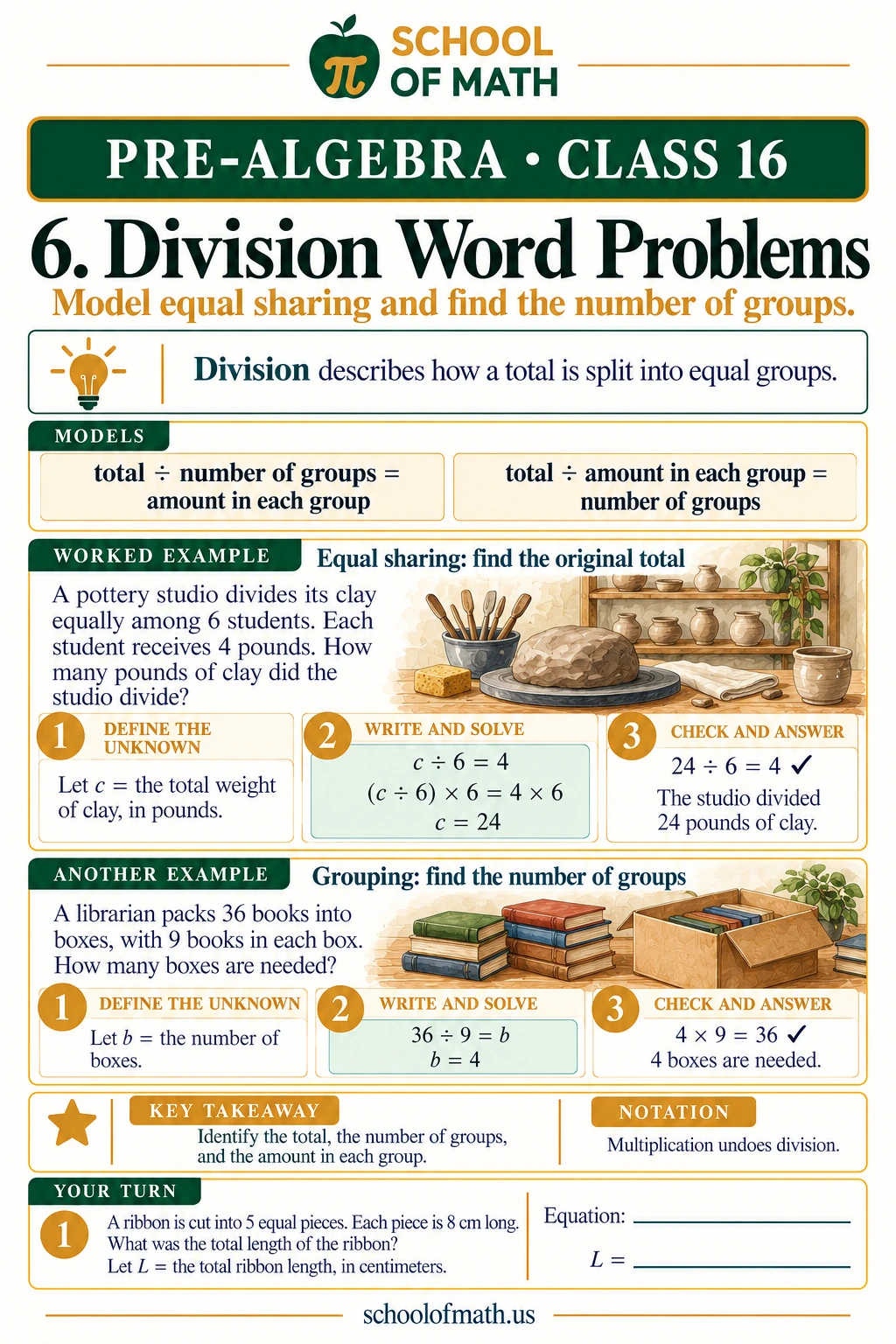
Equal sharing asks for the amount in each group: total ÷ number of groups = amount per group. Grouping asks how many equal groups fit: total ÷ amount per group = number of groups.
When the original total is unknown, an equation such as t ÷ 4 = 9 is solved by multiplying both sides by 4. When the total is known, the quotient may be the unknown.
A variable can also represent the divisor. For 48 ÷ g = 6 with a positive group count, the equivalent multiplication equation is 6g = 48. Check that division uses a nonzero divisor.
Try it yourself: five questions
Q26 Practice 1 of 5
A ribbon is divided into 7 equal pieces, each 6 cm long. Find the original length.
Answer
The original ribbon was 42 cm long.
Let L be the original length, in centimeters.
Model: L ÷ 7 = 6.
Multiply both sides by 7: L = 42.
Check: 42 ÷ 7 = 6 cm per piece.
Q27 Practice 2 of 5
A teacher shares 72 counters equally among 8 students. Find each student’s share using a division equation.
Answer
Each student receives 9 counters.
Let c be the counters per student.
Model: 72 ÷ 8 = c.
Divide the total by the number of students.
Check: 8 × 9 = 72 counters.
Q28 Practice 3 of 5
A gardener places 54 seedlings into pots, with 6 seedlings per pot. How many pots are used?
Answer
9 pots are used.
Let p be the number of pots.
Model: 54 ÷ 6 = p.
Divide by the amount in each group, not by the number of groups.
Check: 9 × 6 = 54 seedlings.
Q29 Practice 4 of 5
A 45-liter supply is shared equally among some tanks, giving each tank 5 liters. Find the number of tanks.
Answer
There are 9 tanks.
Let t be the positive number of tanks.
Model: 45 ÷ t = 5.
Multiply by t to get 45 = 5t, then divide by 5.
Check: 45 ÷ 9 = 5 liters per tank.
Q30 Practice 5 of 5
A bag of rice is shared equally among 4 families. Each receives 1.75 kg. Find the original mass of rice.
Answer
The bag contained 7 kg of rice.
Let m be the original mass, in kilograms.
Model: m ÷ 4 = 1.75.
Multiply both sides by 4: m = 7.
Check: 7 ÷ 4 = 1.75 kg per family.
Modeling two-step situations
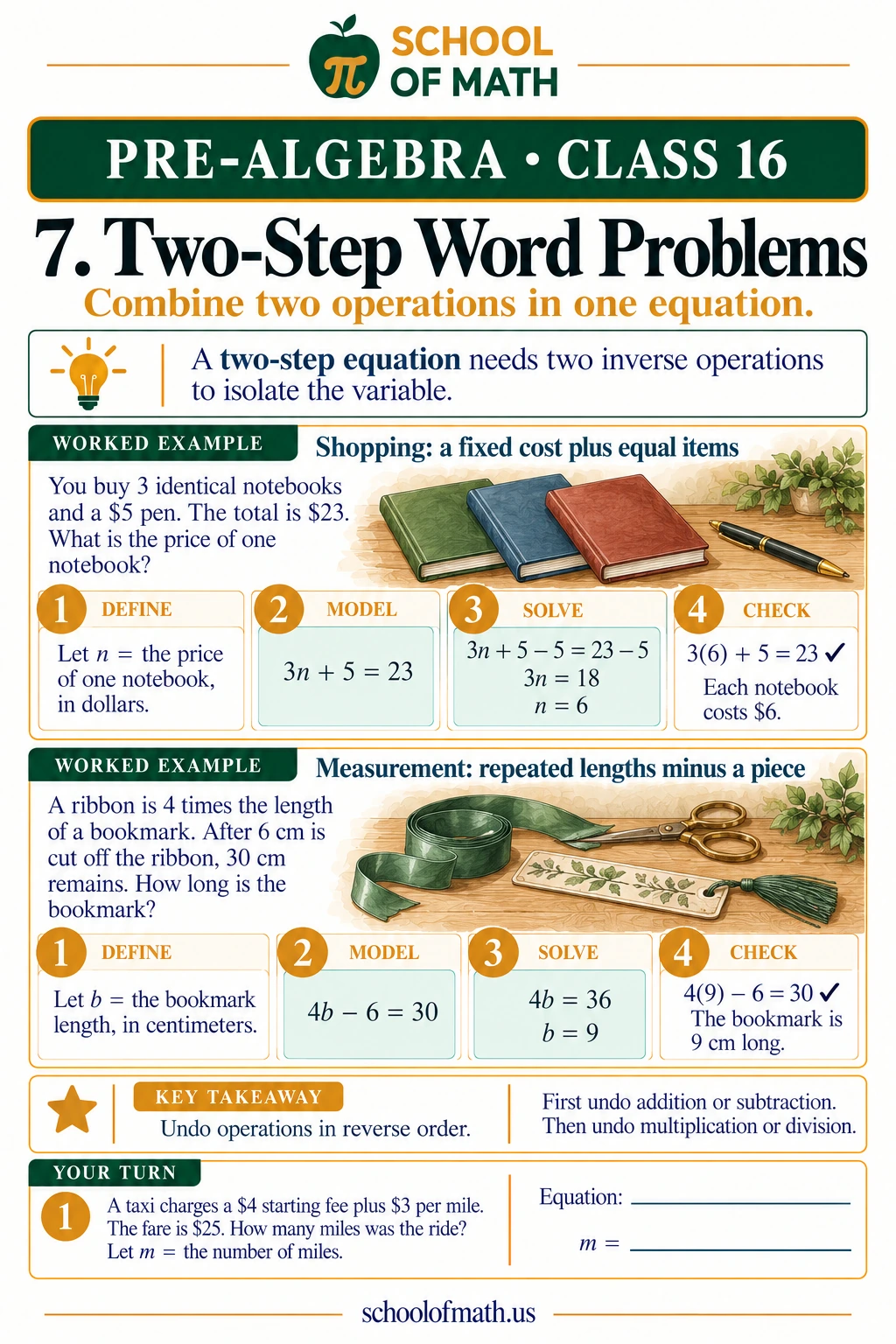
A two-step model combines two operations. A fixed cost plus repeated equal costs often gives ax + b = c; repeated lengths followed by a cut often give ax − b = c.
Undo the operations in reverse order. For ax + b = c, subtract b before dividing by a. For x ÷ a + b = c, subtract b before multiplying by a.
Read where the change occurs. Sharing a total and then adding to each share is different from changing the total before sharing. Parentheses show when an entire sum or difference must be divided.
Try it yourself: five questions
Q31 Practice 1 of 5
Four identical snack boxes and a $7 delivery fee cost $39. Find the price of one box.
Answer
Each box costs $8.
Let p be the price of one snack box, in dollars.
Model: 4p + 7 = 39.
Subtract 7 to get 4p = 32, then divide by 4.
Check: 4 × 8 + 7 = 39 dollars.
Q32 Practice 2 of 5
Five equal pieces are joined end to end. After 9 cm is trimmed off, the result is 46 cm long. Find the length of each original piece.
Answer
Each original piece was 11 cm long.
Let L be the length of each original piece, in centimeters.
Model: 5L − 9 = 46.
Add 9 to get 5L = 55; divide by 5.
Check: 5 × 11 − 9 = 46 cm.
Q33 Practice 3 of 5
A bag of counters is shared equally among 6 students. Each then receives 3 extra counters and has 11. Find the number in the original bag.
Answer
The bag originally held 48 counters.
Let c be the original total number of counters.
Model: c ÷ 6 + 3 = 11.
Subtract 3 to get c ÷ 6 = 8, then multiply by 6.
Check: 48 ÷ 6 + 3 = 11 counters per student.
Q34 Practice 4 of 5
A roll of fabric has 8 meters removed. The rest is cut into 4 equal pieces of 7 meters each. Find the original length.
Answer
The original roll was 36 meters long.
Let L be the original length, in meters.
Model: (L − 8) ÷ 4 = 7.
Multiply by 4 first: L − 8 = 28. Then add 8. The subtraction happened before sharing.
Check: (36 − 8) ÷ 4 = 7 meters per piece.
Q35 Practice 5 of 5
A bicycle rental costs $4.50 to start plus $2.75 per hour. The charge is $21, with no other fees. Find the rental time.
Answer
The bicycle was rented for 6 hours.
Let h be the rental time, in hours.
Model: 2.75h + 4.50 = 21.
Subtract 4.50 to get 2.75h = 16.50. Divide by 2.75.
Check: 2.75 × 6 + 4.50 = 21 dollars.
Checking and interpreting solutions
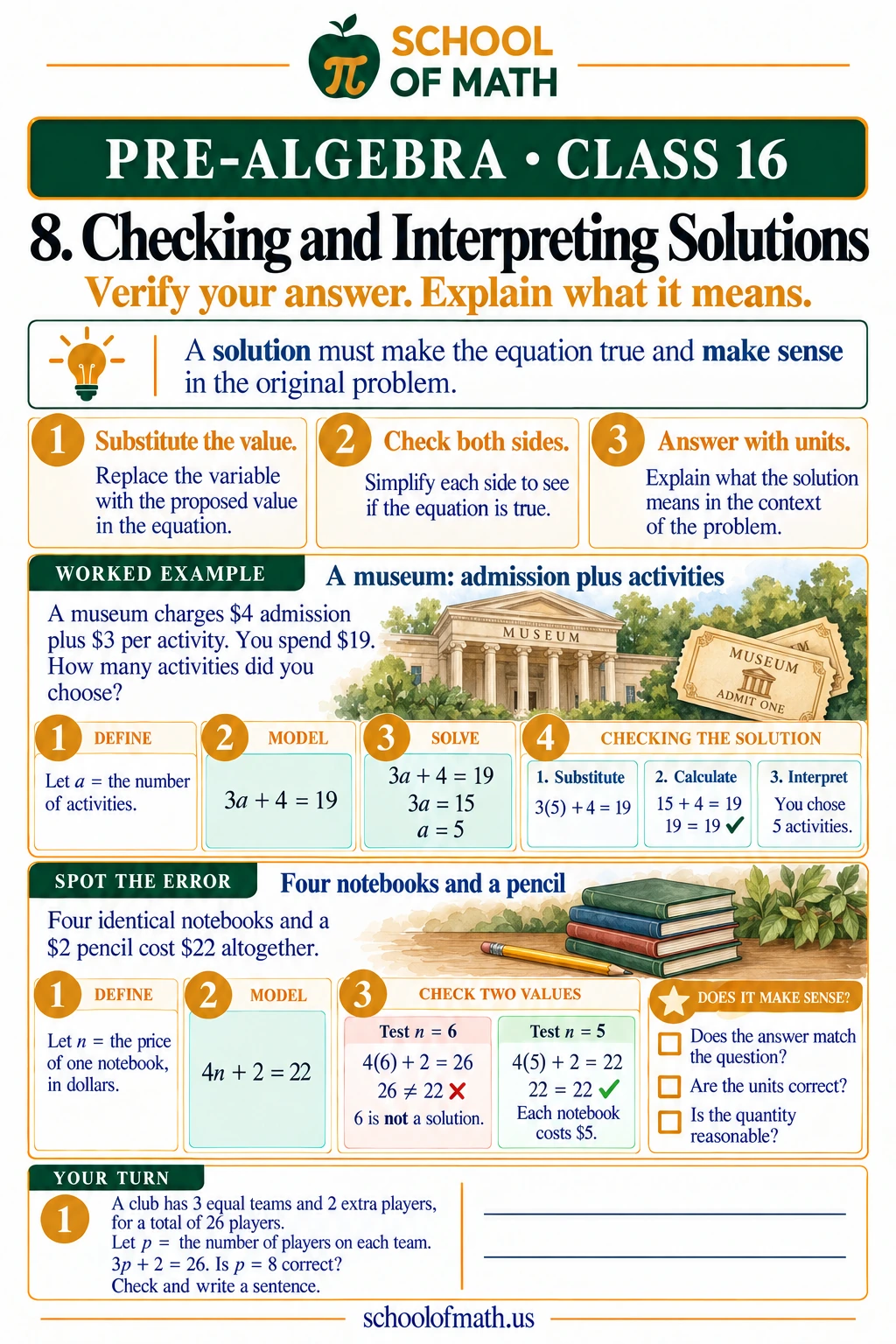
Substitute a candidate into the original equation. Calculate both sides independently. If they are different, the candidate is not a solution.
Then return to the story. Does the equation actually model it? Are the units right? Is the result a price, a length, a count, or a starting amount? A correct calculation cannot rescue an incorrect model.
Check restrictions without rounding away contradictions. A length may be 2.5 meters, but a count of indivisible teams cannot be 2.5. If the information is inconsistent, say so rather than inventing a whole-number answer.
Try it yourself: five questions
Q36 Practice 1 of 5
A ticket booth charges $5 plus $2 per game. A player spends $19. Check the claim that the player chose 7 games, and answer in a sentence.
Answer
Yes. The player chose 7 games.
Let g be the number of games.
Model: 2g + 5 = 19.
Substitute g = 7 into the original equation.
Check: 2 × 7 + 5 = 14 + 5 = 19 dollars.
Q37 Practice 2 of 5
Three identical plants and a $4 pot cost $31. A student says each plant costs $11. Check and correct the answer.
Answer
Each plant costs $9, not $11.
Let p be the price of one plant, in dollars.
Model: 3p + 4 = 31.
At p = 11, the total is 37, not 31. Subtract 4 and divide by 3 to get p = 9.
Check: 3 × 9 + 4 = 31 dollars.
Q38 Practice 3 of 5
A 20-meter cord is cut into 8 equal pieces. A student solves 8L = 20 and writes “L = 2.5 pieces.” Correct the interpretation.
Answer
Each piece is 2.5 meters long.
Let L be the length of each piece, in meters.
Model: 8L = 20.
The value is correct but the units are not. L represents a length, not a number of pieces.
Check: 8 × 2.5 = 20 meters.
Q39 Practice 4 of 5
An organizer says 3 equal teams plus 2 extra players total 24 players. Solve 3p + 2 = 24 and explain whether a whole-number team size fits.
Answer
No whole-number team size fits the information. Algebra gives p = 22/3.
Let p be the number of players per team.
Model: 3p + 2 = 24.
Subtract 2 and divide by 3. A team cannot contain 7⅓ players; rounding to 7 would give only 23 players in total.
Check: 3 × (22/3) + 2 = 24 algebraically, but 22/3 violates the whole-player condition.
Q40 Practice 5 of 5
A service charges a $9 setup fee plus $5 per hour, totaling $34. A student solves 9h + 5 = 34. Explain the modeling error and find the correct time.
Answer
The correct time is 5 hours.
Let h be the number of service hours.
Model: 5h + 9 = 34.
The $5 hourly rate is repeated; the $9 setup fee occurs once. The student reversed these roles. Subtract 9, then divide by 5.
Check: 5 × 5 + 9 = 34 dollars.
Homework review
Complete one review question for each image, in order. Identify the unknown before choosing the equation or inverse operation.
R1 Review image 1 of 8
A store starts with 80 postcards and has 53 after selling some. Define s for the unknown amount sold. Do not solve.
Answer
Let s be the number of postcards sold.
The unknown is the removed count. The known counts are 80 before and 53 after.
R2 Review image 2 of 8
Write an equation using n: 4 less than three times a number is 32. Do not solve.
Answer
3n − 4 = 32.
Multiply n by 3 first, then subtract 4.
R3 Review image 3 of 8
A reading log gains 18 minutes and now shows 65 minutes. Find the previous total.
Answer
The previous total was 47 minutes.
Let m be the previous total, in minutes.
Model: m + 18 = 65.
Subtract 18 from both sides.
Check: 47 + 18 = 65 minutes.
R4 Review image 4 of 8
A box holds 92 buttons. Some are removed, leaving 57. Find how many were removed.
Answer
35 buttons were removed.
Let b be the number removed.
Model: 92 − b = 57.
The missing removed part is 92 − 57.
Check: 92 − 35 = 57 buttons.
R5 Review image 5 of 8
Seven equal packs contain 91 cards altogether. Find the number in one pack.
Answer
Each pack has 13 cards.
Let c be the cards per pack.
Model: 7c = 91.
Divide both sides by 7.
Check: 7 × 13 = 91 cards.
R6 Review image 6 of 8
A batch of juice is shared among 5 jugs, with 2.4 liters in each. Find the original volume.
Answer
The original volume was 12 liters.
Let v be the original volume, in liters.
Model: v ÷ 5 = 2.4.
Multiply both sides by 5.
Check: 12 ÷ 5 = 2.4 liters per jug.
R7 Review image 7 of 8
Four identical craft kits and a $9 fee cost $57. Find the price of one kit.
Answer
Each kit costs $12.
Let k be the price of one kit, in dollars.
Model: 4k + 9 = 57.
Subtract 9, then divide 48 by 4.
Check: 4 × 12 + 9 = 57 dollars.
R8 Review image 8 of 8
Six equal ribbon pieces plus a 5 cm offcut total 50 cm. A student says each piece is 8 cm long. Check and correct the answer.
Answer
Each equal piece is 7.5 cm long.
Let L be each equal piece’s length, in centimeters.
Model: 6L + 5 = 50.
At L = 8, the total is 53 cm, not 50. Subtract 5 and divide by 6.
Check: 6 × 7.5 + 5 = 50 cm.
Homework word problems
These twelve problems complete the 20-question homework. Define your variable, build an equation, show the inverse operations, and check your result in the original story. Include units.
W1 Homework word problem 1 of 12
A birdwatcher records some birds, then spots 13 more. The final count is 42. Define a variable and find the first count.
Answer
The first count was 29 birds.
Let b be the first bird count.
Model: b + 13 = 42.
Subtract 13 from both sides.
Check: 29 + 13 = 42 birds.
W2 Homework word problem 2 of 12
An aquarium uses 17 liters of water from a supply and has 36 liters left. Find the initial supply.
Answer
The initial supply was 53 liters.
Let v be the initial volume, in liters.
Model: v − 17 = 36.
Add 17 to the remaining volume.
Check: 53 − 17 = 36 liters.
W3 Homework word problem 3 of 12
A volunteer packs 84 meals equally into 7 crates. Find the number of meals per crate.
Answer
Each crate holds 12 meals.
Let m be the meals per crate.
Model: 7m = 84.
Divide 84 by 7.
Check: 7 × 12 = 84 meals.
W4 Homework word problem 4 of 12
A batch of paint fills 9 identical jars with 0.6 liters each. Find the original paint volume.
Answer
The original volume was 5.4 liters.
Let v be the original volume, in liters.
Model: v ÷ 9 = 0.6.
Multiply both sides by 9.
Check: 5.4 ÷ 9 = 0.6 liters per jar.
W5 Homework word problem 5 of 12
A school buys 5 identical balls and pays a $6 delivery charge. Its total is $71. Find the price of one ball.
Answer
Each ball costs $13.
Let p be the price per ball, in dollars.
Model: 5p + 6 = 71.
Subtract 6 to get 5p = 65; divide by 5.
Check: 5 × 13 + 6 = 71 dollars.
W6 Homework word problem 6 of 12
Eight identical notebooks cost $46 after a $10 discount on the entire purchase. Find the original price of one notebook.
Answer
The original price was $7 per notebook.
Let p be the original price per notebook, in dollars.
Model: 8p − 10 = 46.
Add the discount back once: 8p = 56. Divide by 8.
Check: 8 × 7 − 10 = 46 dollars.
W7 Homework word problem 7 of 12
A bag of shells is shared among 4 children. Each then collects 5 more and has 17. Find the original number of shells in the bag.
Answer
The bag held 48 shells.
Let s be the original total number of shells.
Model: s ÷ 4 + 5 = 17.
Subtract 5 from each final share, then multiply 12 by 4.
Check: 48 ÷ 4 + 5 = 17 shells per child.
W8 Homework word problem 8 of 12
A teacher sets aside 9 markers, then divides the rest equally among 7 tables. Each table receives 6 markers. Find the original marker count.
Answer
There were 51 markers originally.
Let m be the original number of markers.
Model: (m − 9) ÷ 7 = 6.
Multiply both sides by 7, then add 9: m = 42 + 9.
Check: (51 − 9) ÷ 7 = 6 markers per table.
W9 Homework word problem 9 of 12
A taxi costs $6.25 to start and $2.50 per mile. The total is $25, with no other charges. Find the distance.
Answer
The trip was 7.5 miles.
Let d be the distance, in miles.
Model: 2.50d + 6.25 = 25.
Subtract 6.25 to get 2.50d = 18.75; divide by 2.50.
Check: 2.50 × 7.5 + 6.25 = 25 dollars.
W10 Homework word problem 10 of 12
A rectangle has width 6 cm and perimeter 34 cm. Write and solve a two-step equation for its length.
Answer
The length is 11 cm.
Let L be the length, in centimeters.
Model: 2L + 12 = 34.
There are two lengths and two widths. The widths total 12 cm. Subtract 12, then divide by 2.
Check: 2 × 11 + 2 × 6 = 34 cm.
W11 Homework word problem 11 of 12
A family buys 4 child tickets and one $18 adult ticket. It uses a $6 coupon on the whole purchase and pays $52. Combine the fixed amounts, then find the price of one child ticket.
Answer
Each child ticket costs $10.
Let c be the child ticket price, in dollars.
Model: 4c + 18 − 6 = 52.
Combine 18 − 6 = 12, giving 4c + 12 = 52. Subtract 12 and divide by 4.
Check: 4 × 10 + 18 − 6 = 52 dollars.
W12 Homework word problem 12 of 12
A 30 cm strip is to make 7 equal bookmarks with exactly 3 cm left over. A planner claims each bookmark can have a whole-number length in centimeters. Test the claim; if false, give the exact length required.
Answer
The claim is false. Each bookmark must be 27/7 cm long, not a whole number.
Let L be each bookmark’s length, in centimeters.
Model: 7L + 3 = 30.
Subtract 3 and divide by 7. A fractional length is possible, but it does not satisfy the planner’s whole-number requirement.
Check: 7 × (27/7) + 3 = 30 cm. Rounding the length would change the required leftover.
Quick questions and answers
How do I choose a variable for a word problem?
Choose a letter for the quantity the question asks you to find. State exactly what it measures and include units, such as a starting number of objects or the price of one item in dollars.
Does the operation in the story have to match the operation used to solve?
No. An addition equation such as x + 8 = 20 is solved by subtraction. A multiplication equation such as 4x = 28 is solved by division. First model the relationship, then use inverse operations.
How do I distinguish an unknown start from an unknown amount removed?
For an unknown start, use x − amount removed = amount left. For an unknown removed amount, use starting amount − x = amount left. The position of the variable changes how you isolate it.
What is the difference between equal sharing and grouping?
Equal sharing finds how much goes in each of a known number of groups. Grouping finds how many groups of a known size fit into the total. Identify the total, group count, and amount per group.
How do I solve a two-step equation?
Undo operations in reverse order while keeping both sides balanced. For ax + b = c, subtract b and divide by a. For (x − b) ÷ a = c, multiply by a and then add b.
What makes a word-problem answer valid?
It must satisfy an equation that correctly models the story and obey the context. Check by substitution, state units, and respect whole-number or nonnegative restrictions when they apply.
What practice and homework are included?
The lesson has eight teaching images, five new class questions per image, eight homework review questions, and twelve homework word problems. All 60 questions have hidden worked answers online. The 22-page student workbook includes the supplied cover, all eight teaching images, and the same 60 questions with blank answer space and no exercise solutions.