Pre-Algebra · Class 19
Functions: Tables, Graphs, and the Vertical-Line Test
One input, one output. Learn what makes a relation a function, apply rules such as \(y = 3x + 2\) to build and complete tables, turn tables into plotted points, read real-world graphs, and use the vertical-line test to decide whether a graph shows \(y\) as a function of \(x\).
Work through eight illustrated topics with five fresh practice questions each, followed by Homework review and Homework word problems. There are 40 practice questions and 20 homework questions, all with hidden worked answers, and every graph is drawn to scale. Try each problem before opening its blue Answer control.
This is an independent topic in the Pre-Algebra rolling syllabus; earlier class attendance is not required. Review the one-input-one-output rule here, then choose a comfortable starting point. See the schedule or book an evaluation at SOMATH.
Download the student workbook (PDF)22 pages · Supplied cover, eight teaching images, all 60 questions with blank coordinate grids for plotting · Generous blank working space · No exercise solutions
What is a function?
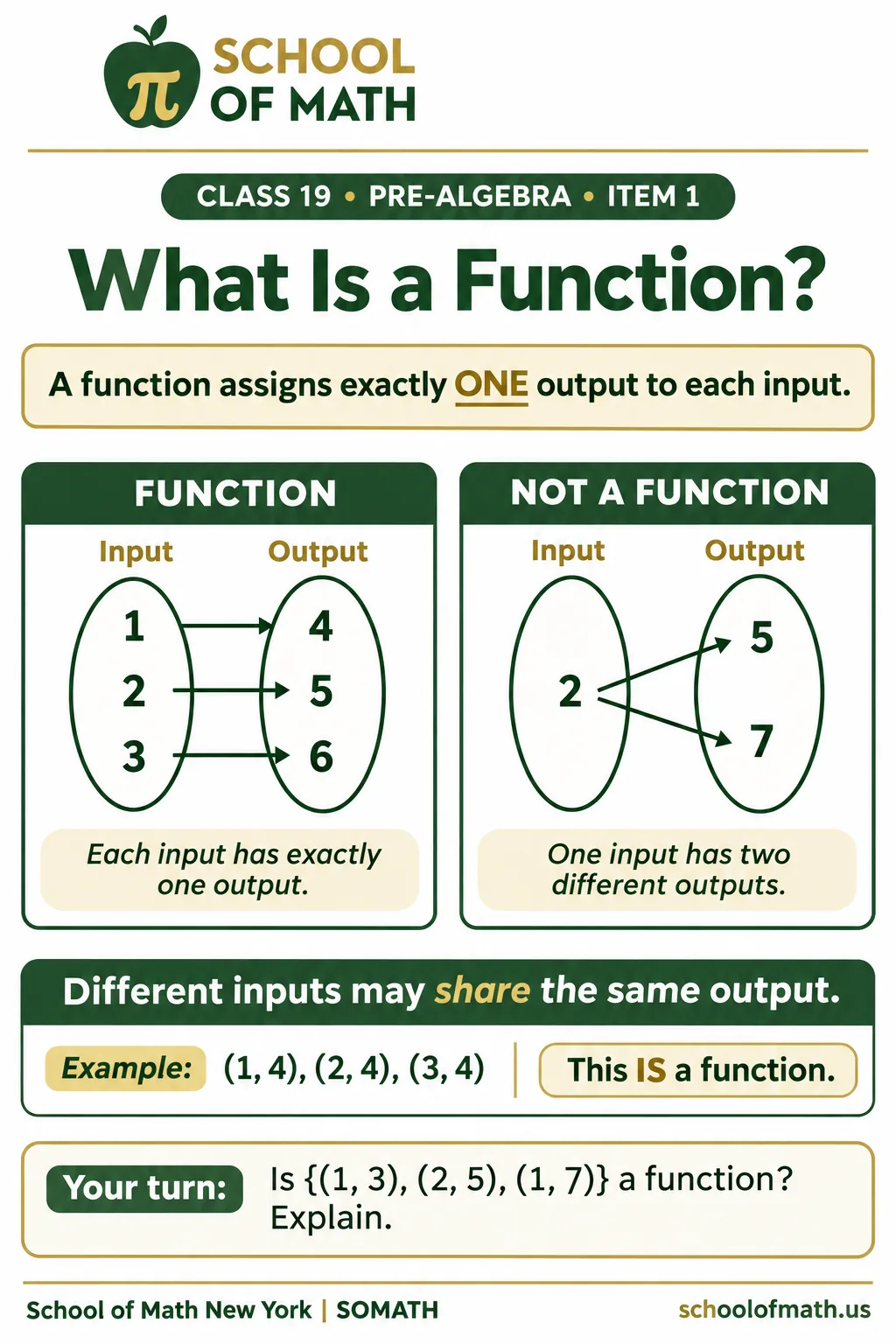
A function is a rule that assigns exactly one output to each input. In the poster the inputs 1, 2 and 3 each have one arrow, to 4, 5 and 6, so the mapping is a function. The second diagram sends the single input 2 to two different outputs, 5 and 7, so it is not a function: the input 2 cannot have two answers.
The rule is about inputs, not outputs. Different inputs are allowed to share an output, which is why (1, 4), (2, 4), (3, 4) is a function: every input still has one and only one partner. To decide, look at each input and ask “does this input ever get two different outputs?” If the answer is never, the relation is a function.
Ordered pairs are written (input, output). The “your turn” set {(1, 3), (2, 5), (1, 7)} is not a function because the input 1 appears with 3 and again with 7.
Practice: try these five questions
Q1
Is the set of ordered pairs {(2, 9), (4, 11), (6, 13)} a function? Explain.
Answer
Yes, it is a function
List the inputs (first numbers): 2, 4, 6. No input is repeated.
Each input has exactly one output: 2 → 9, 4 → 11, 6 → 13.
No input receives two different outputs, so the relation is a function.
Q2
A mapping diagram sends 5 → 1, 6 → 2 and 5 → 8. Is it a function? Why or why not?
Answer
No, it is not a function
The input 5 has two arrows: one to 1 and one to 8.
A function may give each input only one output, so 5 cannot go to both 1 and 8.
Because one input has two different outputs, the diagram does not represent a function.
Q3
Is {(0, 7), (3, 7), (8, 7), (10, 7)} a function? Explain what is repeated and whether it matters.
Answer
Yes, it is a function
The inputs are 0, 3, 8, 10; none is repeated.
The output 7 is repeated, but repeated outputs are allowed. The rule only says each input gets one output.
Every input has exactly one output, so this is a function (a constant function: every input gives 7).
Q4
Fill in the blank so the relation is not a function, then explain: {(3, 2), (7, 5), (__, 9)}.
Answer
Use 3 or 7 as the missing input, for example (3, 9)
To break the function rule, one input must have two different outputs.
Writing 3 in the blank gives (3, 2) and (3, 9): input 3 has outputs 2 and 9, so it is not a function. Writing 7 works the same way: (7, 5) and (7, 9).
Any other input, such as 4, would keep the relation a function because every input would still have one output.
Q5
A snack machine gives one snack for each button. Button A gives chips, Button B gives pretzels, Button C gives chips. Is “button → snack” a function? Would “snack → button” be a function?
Answer
Button → snack is a function; snack → button is not
Button → snack: inputs A, B, C each produce exactly one snack (A → chips, B → pretzels, C → chips). Two buttons sharing chips is fine. This is a function.
Snack → button: the input “chips” leads to two different buttons, A and C.
One input with two outputs breaks the rule, so snack → button is not a function.
Inputs, outputs and function rules
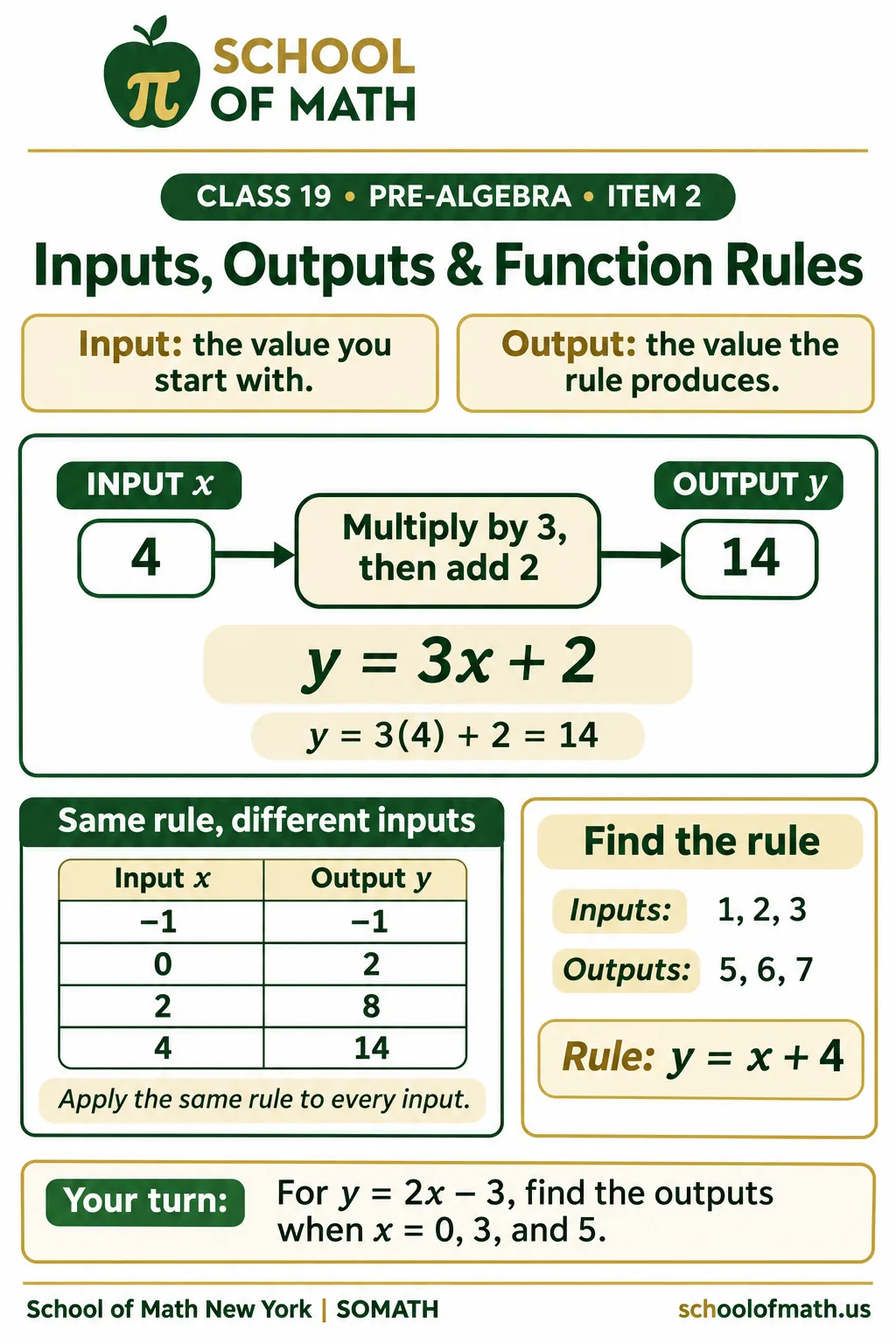
The input is the value you start with, usually written \(x\), and the output is the value the rule produces, usually written \(y\). A rule such as “multiply by 3, then add 2” is written as the equation \(y = 3x + 2\). Putting in the input 4 gives \(y = 3(4) + 2 = 14\).
The same rule is applied to every input. The poster table uses \(y = 3x + 2\) for \(x = -1, 0, 2, 4\) and produces \(-1, 2, 8, 14\). Replace \(x\) with the input, follow the order of operations, and record the output.
To find a rule from inputs and outputs, ask what happens to each input. Inputs 1, 2, 3 becoming 5, 6, 7 means each input went up by 4, so the rule is \(y = x + 4\). Always test the rule on every pair before you trust it.
Practice: try these five questions
Q6
For the rule \(y = 4x - 1\), find the outputs when \(x = 0, 2,\) and \(5\).
Answer
\(y = -1, 7, 19\)
Replace \(x\) with 0: \(y = 4(0) - 1 = 0 - 1 = -1\).
Replace \(x\) with 2: \(y = 4(2) - 1 = 8 - 1 = 7\).
Replace \(x\) with 5: \(y = 4(5) - 1 = 20 - 1 = 19\).
Q7
Write the rule “divide by 2, then add 5” as an equation. Then find the output when the input is 12.
Answer
\(y = \dfrac{x}{2} + 5\); output 11
“Divide by 2” gives \(\dfrac{x}{2}\); “then add 5” gives \(y = \dfrac{x}{2} + 5\).
Substitute \(x = 12\): \(y = \dfrac{12}{2} + 5 = 6 + 5 = 11\).
Check the order: divide first, then add. Adding first would give \((12 + 5) \div 2 = 8.5\), which is a different rule.
Q8
Inputs 2, 3, 4 produce outputs 10, 15, 20. Find the rule and write it as an equation.
Answer
\(y = 5x\)
Compare each pair: 2 → 10, 3 → 15, 4 → 20. Each output is 5 times its input.
Write the rule: \(y = 5x\).
Test every pair: \(5(2) = 10\), \(5(3) = 15\), \(5(4) = 20\). The rule works for all three.
Q9
Inputs 0, 1, 2, 3 produce outputs 6, 5, 4, 3. Find the rule.
Answer
\(y = 6 - x\)
The outputs go down by 1 each time the input goes up by 1, so the rule subtracts \(x\).
When \(x = 0\) the output is 6, so start from 6: \(y = 6 - x\).
Check: \(6 - 1 = 5\), \(6 - 2 = 4\), \(6 - 3 = 3\). All four pairs fit.
Q10
For \(y = 2x + 7\), which input gives the output 25?
Answer
\(x = 9\)
Set the output equal to 25: \(25 = 2x + 7\).
Subtract 7 from both sides: \(18 = 2x\).
Divide both sides by 2: \(x = 9\). Check: \(2(9) + 7 = 18 + 7 = 25\).
Completing function tables
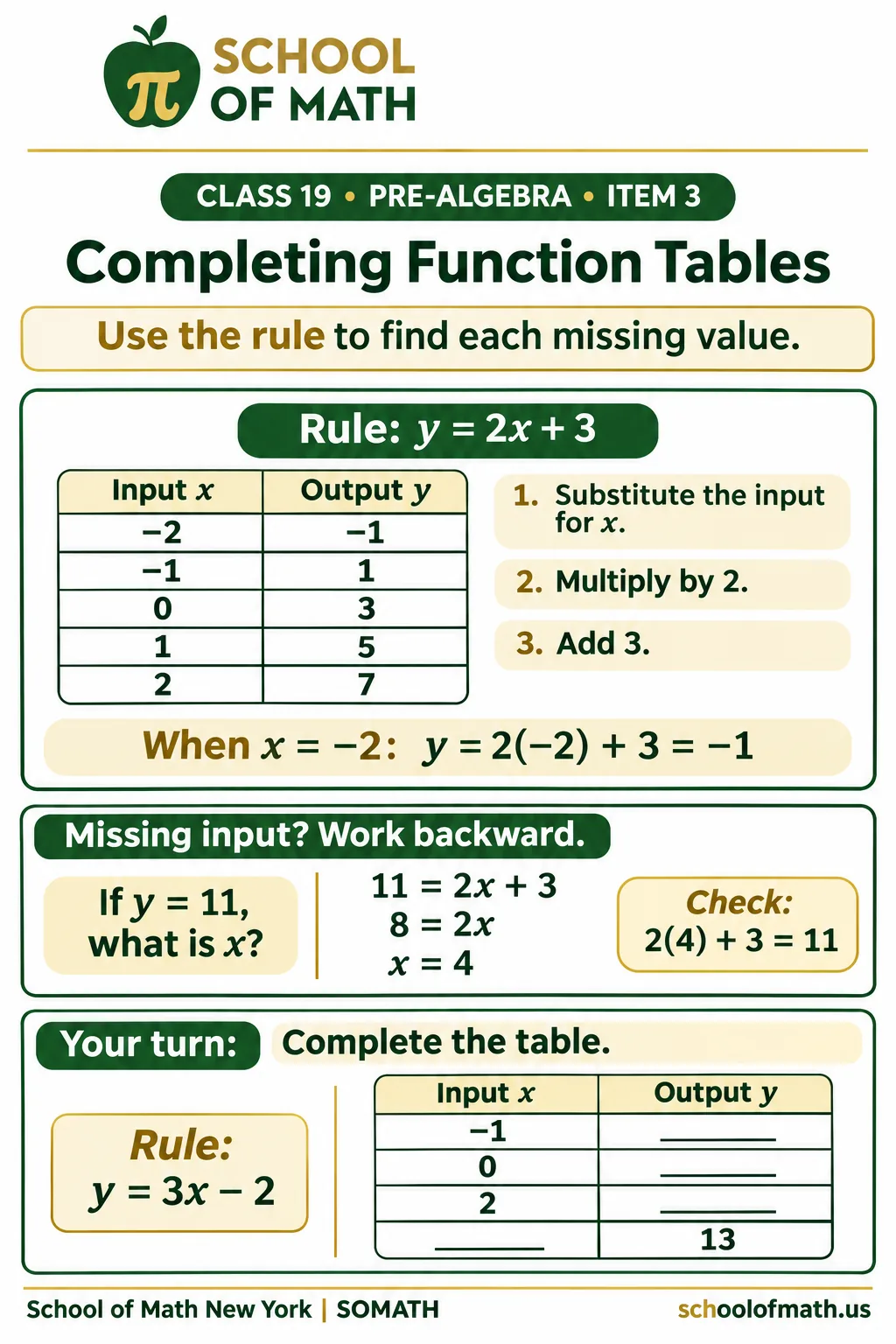
A function table lists inputs and the outputs the rule produces. To fill a missing output, substitute the input and follow the operations in order. With \(y = 2x + 3\) and \(x = -2\): multiply, \(2(-2) = -4\); then add 3, \(-4 + 3 = -1\).
A missing input is found by working backward, which is solving an equation. If \(y = 11\), write \(11 = 2x + 3\), subtract 3 to get \(8 = 2x\), and divide by 2 to get \(x = 4\). Always check by substituting: \(2(4) + 3 = 11\).
Be careful with negative inputs. Multiply the sign too: \(3(-1) - 2 = -3 - 2 = -5\). Writing each step on its own line keeps the sign errors out.
Practice: try these five questions
Q11
Complete the table for \(y = 3x - 4\) with inputs \(x = -2, 0, 1, 3\).
Answer
| Input \(x\) | Output \(y\) |
|---|---|
| −2 | −10 |
| 0 | −4 |
| 1 | −1 |
| 3 | 5 |
\(x = -2\): \(3(-2) - 4 = -6 - 4 = -10\).
\(x = 0\): \(3(0) - 4 = 0 - 4 = -4\).
\(x = 1\): \(3(1) - 4 = 3 - 4 = -1\).
\(x = 3\): \(3(3) - 4 = 9 - 4 = 5\).
Q12
For the rule \(y = 5x + 2\), the output is 27. Find the missing input.
Answer
\(x = 5\)
Write the equation with the known output: \(27 = 5x + 2\).
Undo the addition: subtract 2 from both sides, \(25 = 5x\).
Undo the multiplication: divide by 5, \(x = 5\). Check: \(5(5) + 2 = 27\).
Q13
Complete the table for \(y = -2x + 6\). One row has a missing input.
| Input \(x\) | Output \(y\) |
|---|---|
| −1 | __ |
| 2 | __ |
| 4 | __ |
| __ | −4 |
Answer
| Input \(x\) | Output \(y\) |
|---|---|
| −1 | 8 |
| 2 | 2 |
| 4 | −2 |
| 5 | −4 |
\(x = -1\): \(-2(-1) + 6 = 2 + 6 = 8\).
\(x = 2\): \(-2(2) + 6 = -4 + 6 = 2\).
\(x = 4\): \(-2(4) + 6 = -8 + 6 = -2\).
Missing input for \(y = -4\): \(-4 = -2x + 6\) → \(-10 = -2x\) → \(x = 5\). Check: \(-2(5) + 6 = -4\).
Q14
Complete the table for \(y = \dfrac{x}{4} + 1\) with inputs \(x = 0, 4, 12\), then find the input that gives \(y = 9\).
Answer
| Input \(x\) | Output \(y\) |
|---|---|
| 0 | 1 |
| 4 | 2 |
| 12 | 4 |
| 32 | 9 |
\(x = 0\): \(0 \div 4 + 1 = 1\); \(x = 4\): \(4 \div 4 + 1 = 2\); \(x = 12\): \(12 \div 4 + 1 = 4\).
For \(y = 9\): \(9 = \dfrac{x}{4} + 1\) → \(8 = \dfrac{x}{4}\) → \(x = 32\).
Check: \(32 \div 4 + 1 = 8 + 1 = 9\).
Q15
A table for \(y = 6x - 5\) shows the pair (3, 12). Is the table correct? If not, fix the output.
Answer
Not correct; the output for \(x = 3\) should be 13
Substitute \(x = 3\): \(6(3) - 5 = 18 - 5 = 13\).
The table shows 12, so the row is wrong. The correct pair is (3, 13).
Every row of a function table must follow the same rule, so recompute any row that looks off.
Identifying functions from tables
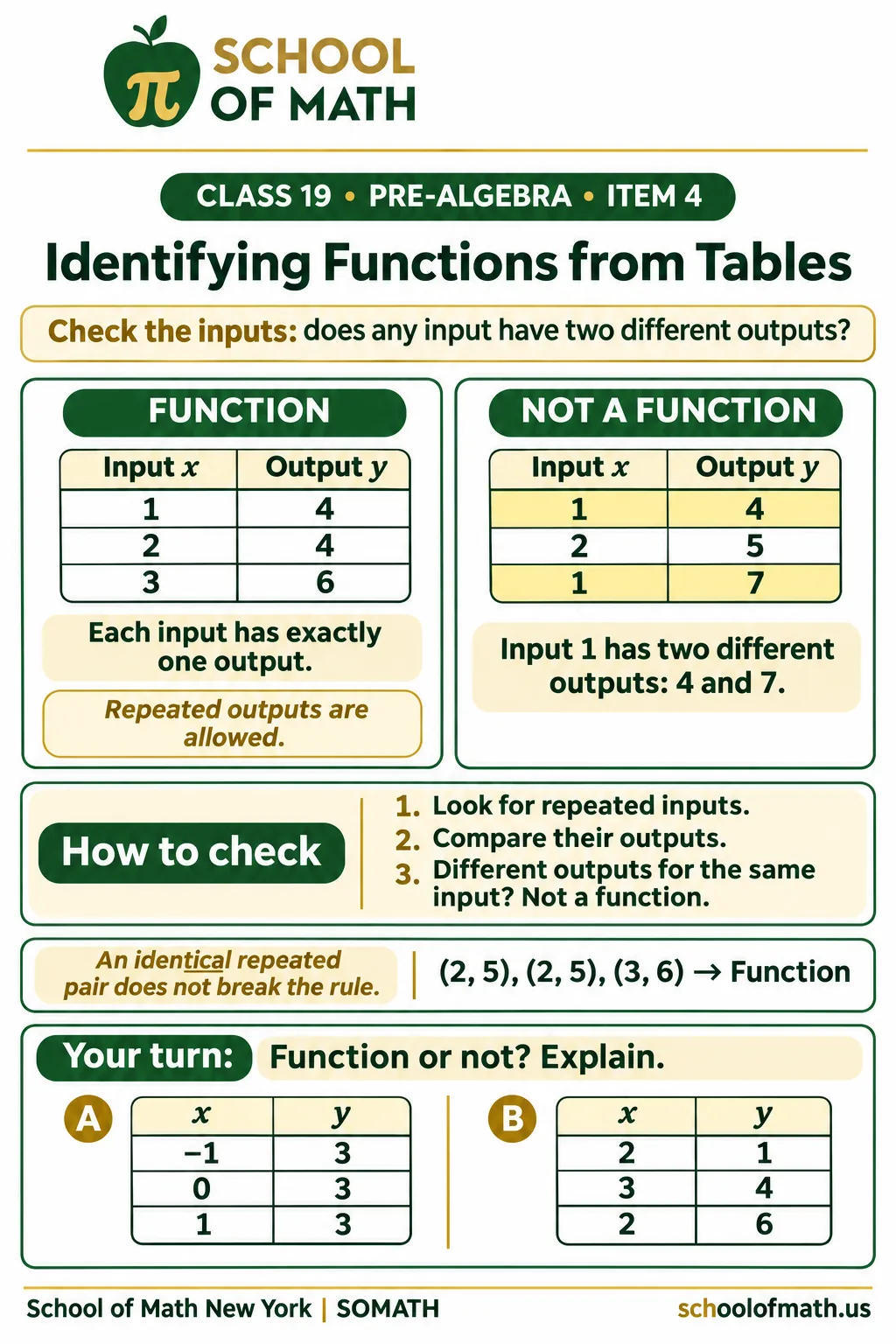
To decide whether a table is a function, check the inputs. Look for any input that appears more than once, then compare the outputs in those rows. Different outputs for the same input means the table is not a function.
Repeated outputs do not break the rule. The table 1 → 4, 2 → 4, 3 → 6 is a function even though 4 appears twice. The table 1 → 4, 2 → 5, 1 → 7 is not a function because the input 1 has two different outputs, 4 and 7.
An identical repeated pair, such as (2, 5) listed twice, does not break the rule either, because the input 2 still has only one output, 5.
Practice: try these five questions
Q16
Function or not? Explain.
| Input \(x\) | Output \(y\) |
|---|---|
| 2 | 9 |
| 4 | 9 |
| 6 | 9 |
| 8 | 9 |
Answer
Function
Inputs: 2, 4, 6, 8. No input repeats, so no input can have two outputs.
The output 9 repeats, but repeated outputs are allowed.
Each input has exactly one output, so the table is a function.
Q17
Function or not? Explain.
| Input \(x\) | Output \(y\) |
|---|---|
| 3 | 1 |
| 5 | 4 |
| 3 | 8 |
| 7 | 2 |
Answer
Not a function
The input 3 appears twice.
Compare its outputs: 3 → 1 and 3 → 8. They are different.
One input with two different outputs means the table is not a function.
Q18
Function or not? Explain.
| Input \(x\) | Output \(y\) |
|---|---|
| −4 | 6 |
| −2 | 6 |
| −4 | 6 |
| 0 | 10 |
Answer
Function
The input −4 appears twice, so compare its outputs: 6 and 6.
The repeated pair (−4, 6) is identical, so the input −4 still has only one output.
No input has two different outputs, so the table is a function.
Q19
Each row shows (student, locker number). Is “student → locker” a function? Is “locker → student” a function?
| Student | Locker |
|---|---|
| Ana | 104 |
| Ben | 117 |
| Cal | 104 |
| Dee | 120 |
Answer
Student → locker is a function; locker → student is not
Student → locker: each student (Ana, Ben, Cal, Dee) appears once with one locker. Two students sharing locker 104 only repeats an output. This is a function.
Locker → student: the input 104 leads to Ana and also to Cal, two different outputs.
Because one locker maps to two students, locker → student is not a function.
Q20
Change one output so this table becomes a function, and explain why your change works.
| Input \(x\) | Output \(y\) |
|---|---|
| 1 | 5 |
| 2 | 8 |
| 1 | 11 |
| 4 | 8 |
Answer
Change 11 to 5 (or change 5 to 11), so the input 1 has a single output
The only problem is the input 1, which has outputs 5 and 11.
Replacing 11 with 5 makes the rows (1, 5) and (1, 5): identical pairs, so input 1 has one output.
Changing an input instead (for example 1 → 3 in the third row) would also work, but the question asks for a changed output. The repeated output 8 for inputs 2 and 4 was never a problem.
From tables to graphs
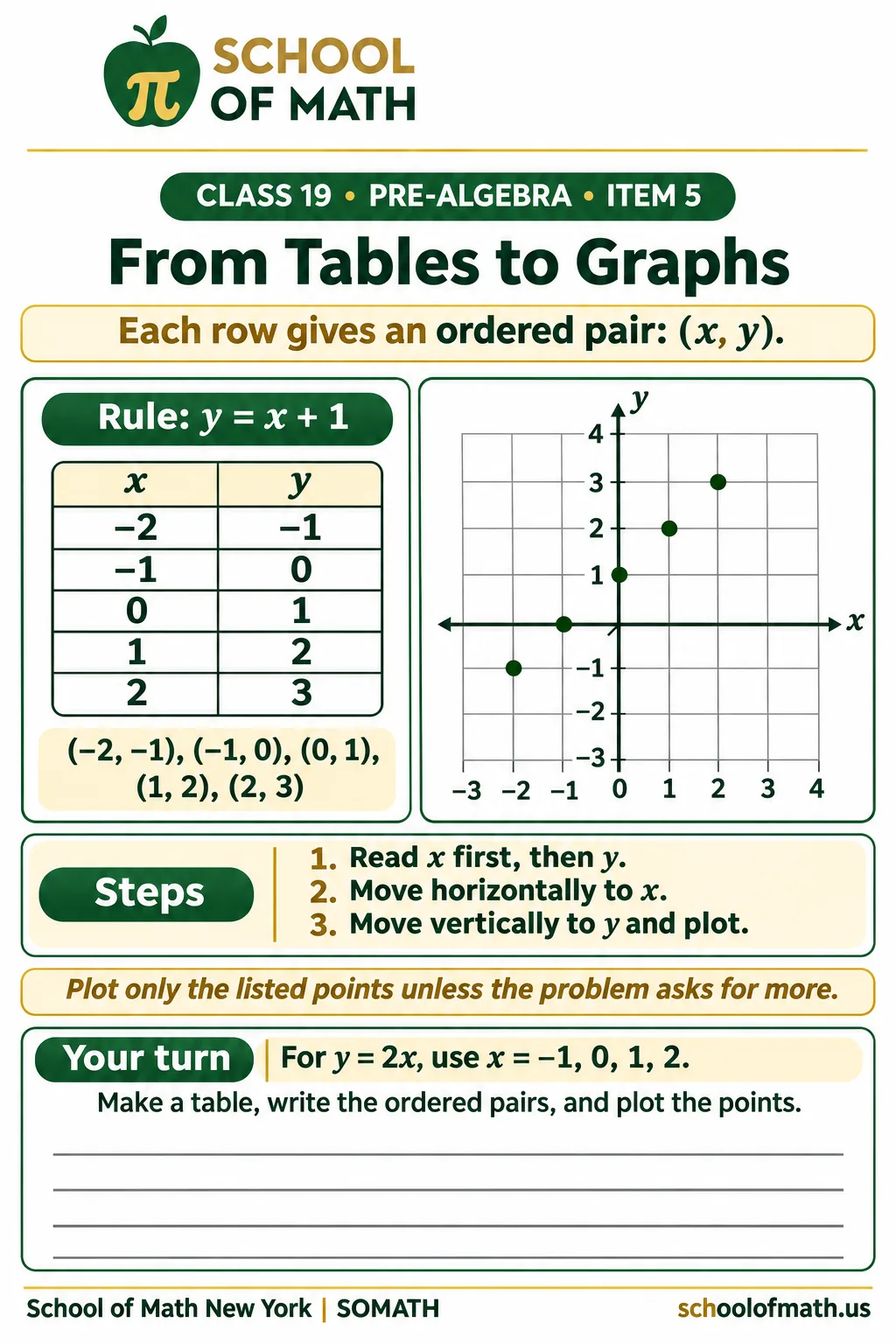
Each row of a function table is an ordered pair \((x, y)\). For \(y = x + 1\) the rows become (−2, −1), (−1, 0), (0, 1), (1, 2), (2, 3). To plot a pair, read \(x\) first and move horizontally, then move vertically to \(y\) and mark the point.
The first number always tells you how far left or right to go; the second tells you how far down or up. The pair \((-2, -1)\) is 2 units left and 1 unit down, which is not the same point as \((-1, -2)\).
Plot only the points the table lists unless the problem asks for more. A table with five rows produces five dots; connecting them is a separate decision that depends on whether in-between inputs make sense.
Practice: try these five questions
Q21
For \(y = 3x\), make a table using \(x = -1, 0, 1, 2\), write the ordered pairs, and plot the points.
Answer
| Input \(x\) | Output \(y\) |
|---|---|
| −1 | −3 |
| 0 | 0 |
| 1 | 3 |
| 2 | 6 |
Ordered pairs: (−1, −3), (0, 0), (1, 3), (2, 6)
Multiply each input by 3: \(3(-1) = -3\), \(3(0) = 0\), \(3(1) = 3\), \(3(2) = 6\).
Write each row as (input, output).
Plot each pair: for (−1, −3) move 1 left and 3 down; for (2, 6) move 2 right and 6 up. The four dots line up in a straight line through the origin.
Q22
Write the ordered pairs from this table, then plot them.
| Input \(x\) | Output \(y\) |
|---|---|
| −2 | 4 |
| 0 | 3 |
| 2 | 2 |
| 4 | 1 |
Answer
Pairs: (−2, 4), (0, 3), (2, 2), (4, 1)
Each row is (x, y): the first column is the input, the second is the output.
Plot (−2, 4): 2 left, 4 up. Plot (0, 3): stay on the \(y\)-axis, 3 up. Plot (2, 2): 2 right, 2 up. Plot (4, 1): 4 right, 1 up.
The points fall as you move right, because the output drops by 1 each time the input grows by 2.
Q23
A student plotted the pair (3, −2) by moving 3 units down and 2 units left. What went wrong, and where should the point be?
Answer
The order was reversed; the point is 3 units right and 2 units down
In (3, −2) the first number, 3, is \(x\): move 3 units to the right.
The second number, −2, is \(y\): move 2 units down.
The student treated the first number as vertical and the second as horizontal, which lands on the point (−2, −3) instead. Always read \(x\) first, then \(y\).
Q24
Use the graph to write the table of values and the rule that produced it.
Answer
| Input \(x\) | Output \(y\) |
|---|---|
| −2 | 0 |
| −1 | 1 |
| 0 | 2 |
| 1 | 3 |
| 2 | 4 |
Rule: \(y = x + 2\)
Read each dot: start at the origin, count left or right for \(x\), then up or down for \(y\). The dots are (−2, 0), (−1, 1), (0, 2), (1, 3), (2, 4).
Compare input and output in each row: the output is always 2 more than the input.
Rule: \(y = x + 2\). Check: \(-2 + 2 = 0\) and \(2 + 2 = 4\).
Q25
For \(y = 2x - 1\), a classmate plotted only (0, −1) and (2, 3) and says the table is finished. The table asked for \(x = 0, 1, 2, 3\). Complete the table and list the missing points.
Answer
| Input \(x\) | Output \(y\) |
|---|---|
| 0 | −1 |
| 1 | 1 |
| 2 | 3 |
| 3 | 5 |
Missing points: (1, 1) and (3, 5)
Compute every requested input: \(2(0) - 1 = -1\), \(2(1) - 1 = 1\), \(2(2) - 1 = 3\), \(2(3) - 1 = 5\).
The classmate skipped \(x = 1\) and \(x = 3\), so the points (1, 1) and (3, 5) are missing.
Plot all the points the problem lists; two points are not enough when four inputs were requested.
Reading function graphs
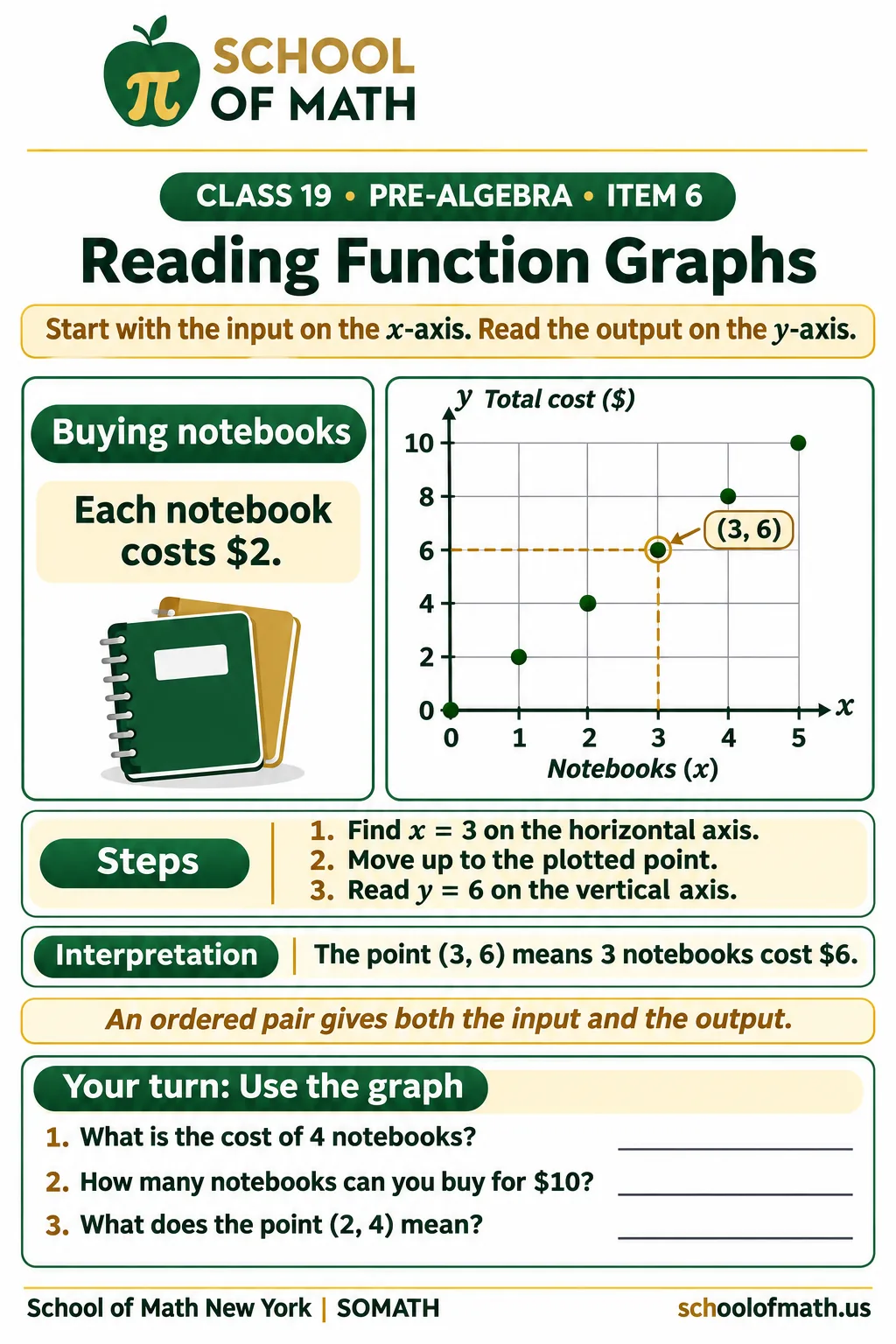
A graph in context works like a table: the input is on the horizontal axis and the output is on the vertical axis. To read an output, find the input on the \(x\)-axis, move up to the plotted point, then read across to the \(y\)-axis. In the poster, 3 notebooks at $2 each gives the point (3, 6).
To go the other way, start on the \(y\)-axis, move across to the point, then read down to the input. Every point is an ordered pair that gives both pieces of information at once, so (2, 4) means “2 notebooks cost $4.”
Always read the axis labels and the scale. Grid lines may count by 2, 3 or 5, not just by 1. The questions below use a raffle-ticket graph and a plant-growth graph.
Practice: try these five questions
Q26
Use the raffle-ticket graph. What is the total cost of 4 tickets?
Answer
$12
Find \(x = 4\) on the horizontal axis.
Move up to the plotted point and read across: the point is (4, 12).
Four tickets cost $12. Check: each ticket costs $3, and \(4 \times 3 = 12\).
Q27
Use the raffle-ticket graph above. How many tickets can you buy with $9? What rule connects tickets \(x\) and cost \(y\)?
Answer
3 tickets; \(y = 3x\)
Start at 9 on the vertical axis, move across to the point, and read down: the point is (3, 9), so $9 buys 3 tickets.
Every point fits “cost = 3 × tickets”: (1, 3), (2, 6), (5, 15).
Rule: \(y = 3x\).
Q28
Use the raffle-ticket graph above. What does the point (5, 15) mean? Is total cost a function of the number of tickets? Explain.
Answer
5 tickets cost $15; yes, it is a function
The first coordinate is the input (tickets) and the second is the output (cost), so (5, 15) means 5 tickets cost $15.
Each number of tickets has exactly one total cost; no input has two different points above it.
Because each input has one output, cost is a function of the number of tickets.
Q29
Use the plant graph. How tall was the plant at week 3, and how tall was it when it was first measured?
Answer
8 cm at week 3; 2 cm at week 0
Find \(x = 3\), move up to the point, read across: (3, 8), so the plant was 8 cm tall.
“First measured” is week 0. The point on the vertical axis is (0, 2), so the plant started at 2 cm.
Notice the scale: the vertical grid counts by 2, so read carefully.
Q30
Use the plant graph above. In which week was the plant 6 cm tall? How much did it grow each week, and what rule gives the height \(y\) after \(x\) weeks?
Answer
Week 2; 2 cm per week; \(y = 2x + 2\)
Start at 6 on the vertical axis, move across, read down: (2, 6), so week 2.
The heights 2, 4, 6, 8, 10 go up by 2 each week, so the plant grew 2 cm per week.
Start at 2 cm and add 2 cm per week: \(y = 2x + 2\). Check: \(2(4) + 2 = 10\) matches the point (4, 10).
The vertical-line test
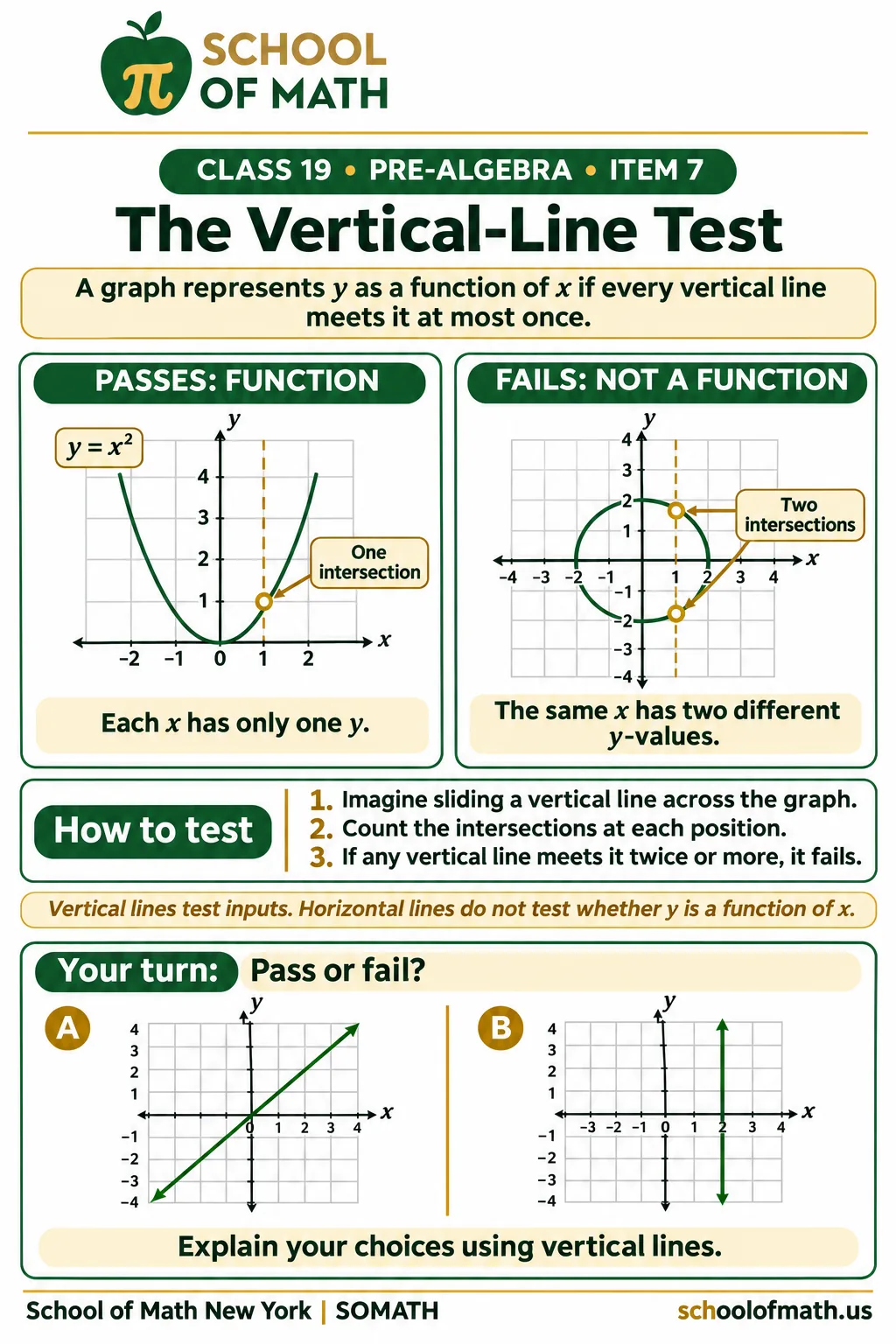
A graph shows \(y\) as a function of \(x\) when every vertical line meets the graph at most once. A vertical line stands over a single input; if it hits the graph twice, that input has two outputs, which a function does not allow.
The parabola \(y = x^2\) passes: slide a vertical line anywhere and it meets the curve once. A circle fails: the vertical line \(x = 1\) meets it at two points with different \(y\)-values. A slanted line passes; a vertical line such as \(x = 2\) fails because that one input has infinitely many outputs.
Vertical lines test inputs. Horizontal lines say nothing about whether \(y\) is a function of \(x\); a horizontal line crossing a graph many times only shows a repeated output, which is allowed.
Practice: try these five questions
Q31
Pass or fail? Explain using vertical lines.
Answer
Passes: the graph is a function
Imagine a vertical line sliding from left to right across the V.
At every position it touches the graph exactly once, including at the vertex (0, −1).
No vertical line meets the graph twice, so \(y\) is a function of \(x\).
Q32
Pass or fail? Explain using vertical lines.
Answer
Fails: not a function
Draw the vertical line \(x = 1\). It meets the curve at (1, 1) and (1, −1).
The input 1 has two different outputs, 1 and −1.
One vertical line with two intersections is enough to fail the test, so the graph is not a function. The line \(x = 4\) also hits twice, at (4, 2) and (4, −2).
Q33
Pass or fail? Explain using vertical lines.
Answer
Passes: the graph is a function
Every vertical line crosses the horizontal line \(y = -3\) exactly once.
Every input has the same output, −3, but a repeated output is allowed.
The graph passes the test; it is the constant function \(y = -3\).
Q34
Pass or fail? Explain using vertical lines.
Answer
Fails: not a function
The vertical line \(x = 1\) passes through (1, 3) and (1, −2), two points.
The vertical line \(x = 3\) also passes through two points, (3, 0) and (3, 4).
An input with two outputs fails the test, so this set of points is not a function. The other points are fine; one repeated input is enough to fail.
Q35
Pass or fail? Explain using vertical lines. Then explain why a horizontal line crossing it several times does not matter.
Answer
Passes: the graph is a function
Slide a vertical line across the zigzag. The graph goes up and down, but it never doubles back over the same \(x\)-value, so each vertical line meets it once.
The horizontal line \(y = 0\) crosses the zigzag several times. That only shows the output 0 is produced by several inputs.
Repeated outputs are allowed; only repeated inputs with different outputs break the function rule. The graph passes.
Mixed practice: function or not?
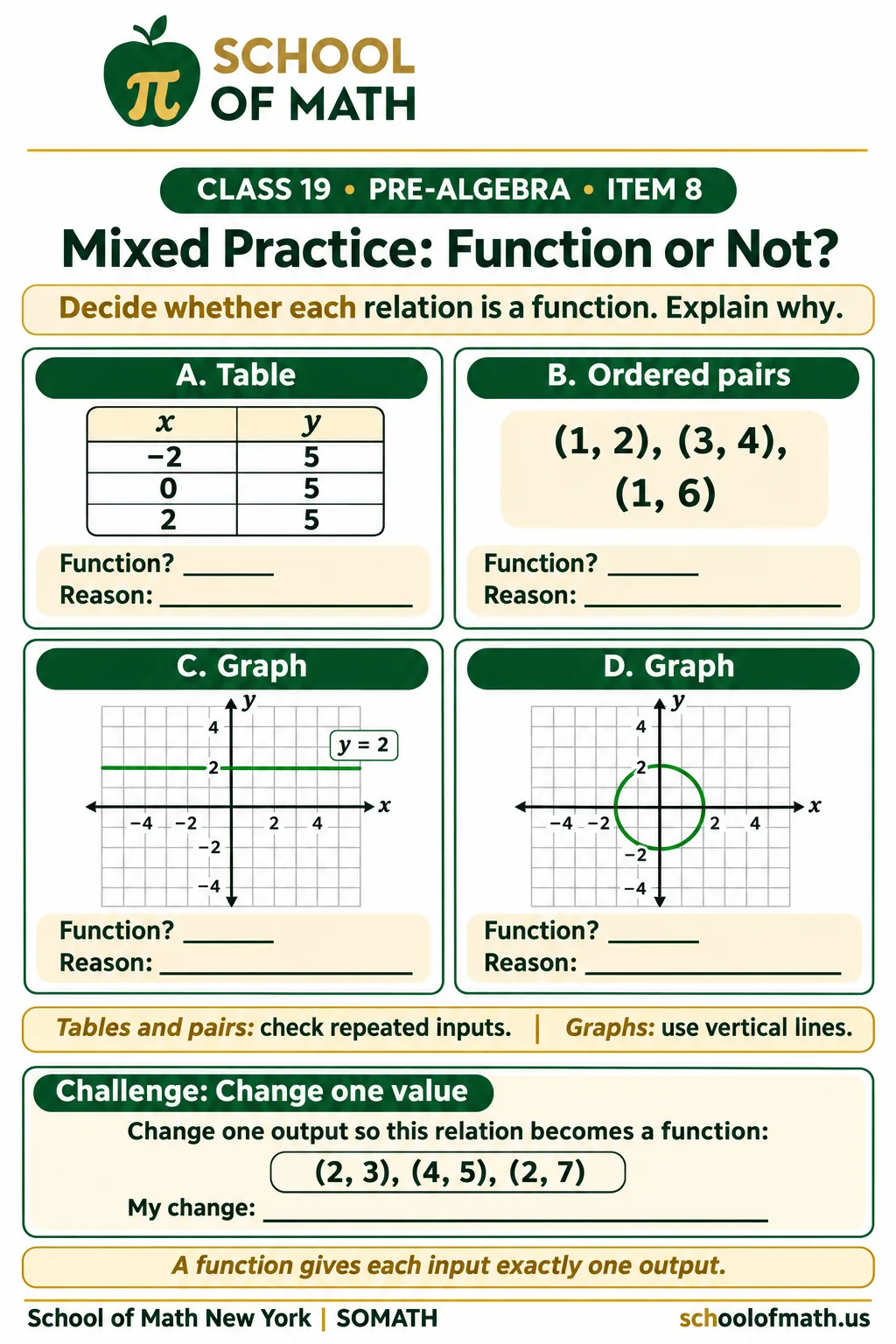
Functions can be shown as mapping diagrams, ordered pairs, tables, equations or graphs. The test is always the same question: does any input have two different outputs? For tables and ordered pairs, scan the inputs for repeats. For graphs, use vertical lines.
Repeated outputs never break the rule. A table where every output is 5 is a function, and so is the horizontal line \(y = 2\). A circle fails because a vertical line meets it twice, and (1, 2), (3, 4), (1, 6) fails because the input 1 appears with two outputs.
When a relation is not a function, one change can fix it: give the repeated input the same output in both places, or change one of the repeated inputs to a new value.
Practice: try these five questions
Q36
Table. Function or not? Explain.
| Input \(x\) | Output \(y\) |
|---|---|
| 3 | 1 |
| 5 | 1 |
| 7 | 1 |
| 9 | 1 |
Answer
Function
Inputs 3, 5, 7, 9 are all different, so each has exactly one output.
The repeated output 1 is allowed.
Function. In context, this is like a flat fee: whatever you order, you pay 1.
Q37
Ordered pairs. Function or not? Explain: (4, 2), (6, 3), (4, 8), (9, 3).
Answer
Not a function
Inputs: 4, 6, 4, 9. The input 4 appears twice.
Its outputs are 2 and 8, which are different.
The input 4 has two outputs, so the relation is not a function. The repeated output 3 for inputs 6 and 9 is not a problem.
Q38
Graph. Function or not? Explain.
Answer
Function
Use the vertical-line test: any vertical line crosses a slanted line exactly once.
For example \(x = 0\) meets the graph only at (0, 1), and \(x = 3\) only at (3, −2).
Every input has one output, so the graph is a function.
Q39
Graph. Function or not? Explain.
Answer
Not a function
The vertical line \(x = 3\) meets the sideways V at (3, 3) and (3, −3).
The input 3 has two different outputs.
The graph fails the vertical-line test, so it is not a function. Only the vertex \(x = 0\) gives a single output.
Q40
Challenge. Change one output so the relation becomes a function: (3, 1), (5, 2), (3, 6). Then describe a different single change that would also work.
Answer
Change 6 to 1, giving (3, 1), (5, 2), (3, 1); or change 1 to 6
The input 3 has two outputs, 1 and 6. Make them equal: change the 6 to 1 (or the 1 to 6). The repeated pair (3, 1) is identical, so input 3 now has one output.
A different fix changes an input instead: replace the second 3 with an unused number such as 7, giving (3, 1), (5, 2), (7, 6).
Either way the check is the same: no input is left with two different outputs.
Homework review
One review question for each topic. Show the check you used: repeated inputs for tables and pairs, substitution for rules, and vertical lines for graphs.
R1
Is {(0, 2), (1, 2), (2, 2), (3, 2)} a function? Then decide whether a mapping diagram sending 5 → 1 and 5 → 3 is a function.
Answer
The set is a function; the mapping diagram is not
In the set, the inputs 0, 1, 2, 3 are all different, so each has one output. The repeated output 2 is allowed. Function.
In the diagram, the single input 5 has two arrows, to 1 and to 3.
An input with two different outputs is not allowed, so the diagram is not a function.
R2
For \(y = 6x - 5\), find the outputs for \(x = 1, 3, 10\). Then write the rule in words.
Answer
\(y = 1, 13, 55\); “multiply by 6, then subtract 5”
\(6(1) - 5 = 1\).
\(6(3) - 5 = 18 - 5 = 13\).
\(6(10) - 5 = 60 - 5 = 55\).
The equation multiplies the input by 6 and then subtracts 5.
R3
Complete the table for \(y = 5x + 1\), including the missing input.
| Input \(x\) | Output \(y\) |
|---|---|
| −2 | __ |
| 0 | __ |
| 3 | __ |
| __ | 26 |
Answer
| Input \(x\) | Output \(y\) |
|---|---|
| −2 | −9 |
| 0 | 1 |
| 3 | 16 |
| 5 | 26 |
\(x = -2\): \(5(-2) + 1 = -10 + 1 = -9\).
\(x = 0\): \(5(0) + 1 = 1\); \(x = 3\): \(5(3) + 1 = 16\).
Missing input: \(26 = 5x + 1\) → \(25 = 5x\) → \(x = 5\). Check: \(5(5) + 1 = 26\).
R4
Function or not? Explain.
| Input \(x\) | Output \(y\) |
|---|---|
| 2 | 7 |
| 4 | 7 |
| 6 | 9 |
| 2 | 11 |
Answer
Not a function
The input 2 appears in the first and last rows.
Its outputs are 7 and 11, which are different.
One input with two different outputs means the table is not a function. The repeated output 7 for inputs 2 and 4 would have been fine on its own.
R5
For \(y = x - 2\), make a table with \(x = -1, 0, 1, 2, 3\), write the ordered pairs, and plot the points.
Answer
| Input \(x\) | Output \(y\) |
|---|---|
| −1 | −3 |
| 0 | −2 |
| 1 | −1 |
| 2 | 0 |
| 3 | 1 |
Pairs: (−1, −3), (0, −2), (1, −1), (2, 0), (3, 1)
Subtract 2 from each input: \(-1 - 2 = -3\), \(0 - 2 = -2\), \(1 - 2 = -1\), \(2 - 2 = 0\), \(3 - 2 = 1\).
Each row becomes (input, output).
Plot by reading \(x\) first (left or right), then \(y\) (down or up). The dots line up along a straight line that crosses the \(x\)-axis at (2, 0).
R6
Use the graph. How many apples are in 3 bags? How many bags hold 20 apples? What does the point (4, 16) mean?
Answer
12 apples; 5 bags; 4 bags hold 16 apples
Find \(x = 3\), move up to the point, read across: (3, 12), so 12 apples.
Start at 20 on the vertical axis, move across to the point, read down: (5, 20), so 5 bags.
The point (4, 16) pairs the input 4 bags with the output 16 apples. The rule is \(y = 4x\).
R7
Pass or fail? Decide for each graph and explain using vertical lines.
A
B
Answer
A fails (not a function); B passes (function)
Graph A: the vertical line \(x = 2\) meets the sideways V at (2, 4) and (2, −4). One input, two outputs: fails.
Graph B: every vertical line crosses the slanted line exactly once, for example \(x = 1\) only at (1, 1). Passes.
Only graph B shows \(y\) as a function of \(x\).
R8
Decide whether each relation is a function and explain: (a) the table below; (b) the pairs (−1, 0), (0, 0), (−1, 4); (c) the graph below.
| Input \(x\) | Output \(y\) |
|---|---|
| 1 | 5 |
| 2 | 6 |
| 3 | 7 |
Answer
(a) function; (b) not a function; (c) function
(a) Inputs 1, 2, 3 are different, each with one output. Function.
(b) The input −1 appears with outputs 0 and 4. Not a function.
(c) Every vertical line meets the horizontal line \(y = -1\) once. Function (every input has the output −1).
Homework word problems
Twelve problems that move from writing a rule to deciding which direction of a real relationship is a function. Define the input and output before you start, and check every answer in the original rule or graph.
W1
A taxi charges a $3 pickup fee plus $2 per mile. Write a rule for the total cost \(y\) of a ride of \(x\) miles, then find the cost of a 6-mile ride.
Answer
\(y = 2x + 3\); $15
Each mile adds $2, so the mileage cost is \(2x\). The $3 fee is added once: \(y = 2x + 3\).
Substitute \(x = 6\): \(y = 2(6) + 3 = 12 + 3 = 15\).
A 6-mile ride costs $15. Check with a table row: 1 mile costs $5, 2 miles cost $7, and so on, up by $2 each mile.
W2
Priya earns $12 per hour. Write the rule for her earnings \(y\) after \(x\) hours and complete a table for 3, 5 and 8 hours.
Answer
\(y = 12x\)Hours \(x\) Earnings ($) 3 36 5 60 8 96
Earnings are 12 times the hours: \(y = 12x\).
\(12(3) = 36\), \(12(5) = 60\), \(12(8) = 96\).
Each hour is one input with exactly one amount earned, so earnings are a function of hours.
W3
Maya is 3 years older than her brother. Let \(x\) be the brother's age and \(y\) Maya's age. Write the rule, complete the table for brother ages 5, 8 and 12, and find the brother's age when Maya is 20.
Answer
\(y = x + 3\) When Maya is 20, her brother is 17.Brother \(x\) Maya \(y\) 5 8 8 11 12 15
“3 years older” means add 3: \(y = x + 3\).
\(5 + 3 = 8\), \(8 + 3 = 11\), \(12 + 3 = 15\).
Work backward from the output 20: \(20 = x + 3\) → \(x = 17\). Check: \(17 + 3 = 20\).
W4
A gym charges a $20 joining fee plus $15 per month. Write the rule for the total cost \(y\) after \(x\) months. Find the cost of 6 months, and find how many months cost $125 in total.
Answer
\(y = 15x + 20\); $110 for 6 months; 7 months cost $125
Monthly cost \(15x\) plus the one-time fee: \(y = 15x + 20\).
Six months: \(15(6) + 20 = 90 + 20 = 110\).
Missing input: \(125 = 15x + 20\) → \(105 = 15x\) → \(x = 7\). Check: \(15(7) + 20 = 125\).
W5
In a school, each student is assigned exactly one homeroom teacher, and each teacher has about 25 students. Is “student → homeroom teacher” a function? Is “homeroom teacher → student” a function? Explain.
Answer
Student → teacher is a function; teacher → student is not
Student → teacher: each student (input) has exactly one teacher (output). Many students sharing a teacher only repeats an output. Function.
Teacher → student: one teacher (input) is matched with about 25 different students (outputs).
One input with many outputs is not a function.
W6
A florist's price list shows the cost of a bouquet by the number of roses: 6 roses cost $18, 12 roses cost $36, and 6 roses cost $21 on holidays. Is “number of roses → price” a function? Explain, and tell what extra information would make it one.
Answer
Not a function as listed; adding the date (holiday or not) to the input would make it a function
The input 6 roses appears twice with different outputs, $18 and $21.
One input with two different outputs is not a function.
If the input were “number of roses and whether it is a holiday,” then (6, regular) → 18 and (6, holiday) → 21 are different inputs, and each would have one price.
W7
A weather station records the temperature every three hours.
| Time (hour) | Temperature (°F) |
|---|---|
| 6 | 50 |
| 9 | 58 |
| 12 | 66 |
| 15 | 70 |
| 18 | 66 |
Answer
Yes; at 12 and 18; no
Each time (6, 9, 12, 15, 18) appears once with one temperature, so temperature is a function of time.
Reading the table, 66 °F appears at hour 12 and again at hour 18. Repeated outputs are allowed.
Reversing the roles, the input 66 °F would have two outputs, 12 and 18, so time is not a function of temperature.
W8
A bike shop charges $4 per hour. Use the graph to find the cost of 3 hours, the number of hours $20 buys, and the rule connecting hours and cost.
Answer
$12; 5 hours; \(y = 4x\)
Find \(x = 3\), move up, read across: (3, 12), so 3 hours cost $12.
Start at 20 on the vertical axis, move across, read down: (5, 20), so $20 buys 5 hours.
Each hour adds $4, so \(y = 4x\). Every point fits: \(4(2) = 8\), \(4(4) = 16\).
W9
The perimeter of a square is four times its side length. Write the rule for perimeter \(P\) in terms of side \(s\), complete a table for \(s = 2, 5, 9\), and find the side of a square whose perimeter is 48.
Answer
\(P = 4s\) When \(P = 48\), \(s = 12\).Side \(s\) Perimeter \(P\) 2 8 5 20 9 36
Four equal sides: \(P = 4s\).
\(4(2) = 8\), \(4(5) = 20\), \(4(9) = 36\).
Work backward: \(48 = 4s\) → \(s = 12\). Check: \(4(12) = 48\).
W10
Jordan has $40 saved and adds $10 each week. Write the rule for savings \(y\) after \(x\) weeks, make a table for weeks 0 to 4, plot the points, and find how many weeks it takes to reach $120.
Answer
\(y = 10x + 40\) 8 weeks to reach $120.Weeks \(x\) Savings ($) 0 40 1 50 2 60 3 70 4 80
Start at 40 and add 10 per week: \(y = 10x + 40\).
Week 0: 40; week 1: 50; week 2: 60; week 3: 70; week 4: 80. Plot (0, 40) on the vertical axis, then one point per week; the vertical scale counts by 20.
Missing input: \(120 = 10x + 40\) → \(80 = 10x\) → \(x = 8\). Check: \(10(8) + 40 = 120\).
W11
A class survey records height and the number of students with that height: 60 in → 3 students, 62 in → 5 students, 64 in → 3 students. Is “height → number of students” a function? Is “number of students → height” a function? Explain in context.
Answer
Height → number of students is a function; number of students → height is not
Height → students: each height (60, 62, 64) has exactly one count. Two heights sharing the count 3 only repeats an output. Function.
Students → height: the input 3 leads to two different heights, 60 in and 64 in.
Knowing “3 students” does not tell you which height, so that direction is not a function.
W12
Challenge. A drone's altitude is recorded every two seconds and graphed. Is altitude a function of time? Is time a function of altitude? Explain both answers using the graph.
Answer
Altitude is a function of time; time is not a function of altitude
Altitude as a function of time: each time has exactly one altitude, and every vertical line meets the graph once. The drone cannot be at two heights at the same moment. Function.
Time as a function of altitude: the altitude 30 m occurs at 2 s and at 4 s, and the altitude 0 m occurs at 0 s and 8 s. The input 30 m would have two outputs.
So time is not a function of altitude. Any graph of a quantity measured against time passes the vertical-line test, but reversing the roles can fail.
Quick questions and answers
What is a function in pre-algebra?
A function is a rule that assigns exactly one output to each input. Inputs are usually written x and outputs y, and each pair can be written (x, y).
Can two inputs have the same output in a function?
Yes. Repeated outputs are allowed. The rule only forbids one input having two different outputs, so (1, 4), (2, 4), (3, 4) is a function.
How do I tell whether a table is a function?
Scan the input column for repeated values. If a repeated input has different outputs, the table is not a function. If every input appears once, or repeated inputs have identical outputs, it is a function.
How do I find a missing input in a function table?
Set the rule equal to the known output and solve backward with inverse operations. For y = 2x + 3 and y = 11, write 11 = 2x + 3, subtract 3, then divide by 2 to get x = 4.
How do I plot a table on a graph?
Each row is an ordered pair (x, y). Read x first and move horizontally, then move vertically to y and mark the point. Plot only the listed points unless the problem asks for more.
What is the vertical-line test?
A graph shows y as a function of x if every vertical line meets the graph at most once. Two intersections on one vertical line mean one input has two outputs, so the graph fails. Horizontal lines do not test this.
Is an earlier class required, and what homework is included?
No earlier attendance is required. This self-contained rolling lesson has eight supplied images, forty original practice questions, eight Homework review questions, and twelve Homework word problems, all with hidden worked answers and drawn graphs. The 22-page student workbook includes the supplied PDF-only cover, the eight teaching images, and the same sixty questions with blank working space, blank coordinate grids for plotting, and no exercise solutions.