Pre-Algebra · Class 20
Linear Functions: Slope as Rate of Change
Equal steps in, equal steps out. Learn what makes a function linear, find the rate of change from tables, measure slope as rise over run and with the formula \(m = \dfrac{y_2 - y_1}{x_2 - x_1}\), recognize positive, negative, zero and undefined slope, graph lines from a point and a slope, and read slope as a real-world rate with units.
Work through eight illustrated topics with five fresh practice questions each, followed by Homework review and Homework word problems. There are 40 practice questions and 20 homework questions, all with hidden worked answers, and every graph is drawn to scale. Try each problem before opening its blue Answer control.
This is an independent topic in the Pre-Algebra rolling syllabus; earlier class attendance is not required. The only tools you need are reading a table, plotting a point and dividing signed numbers. See the schedule or book an evaluation at SOMATH.
Download the student workbook (PDF)22 pages · Supplied cover, eight teaching images, all 60 questions with blank coordinate grids for graphing · Generous blank working space · No exercise solutions
Understanding linear functions
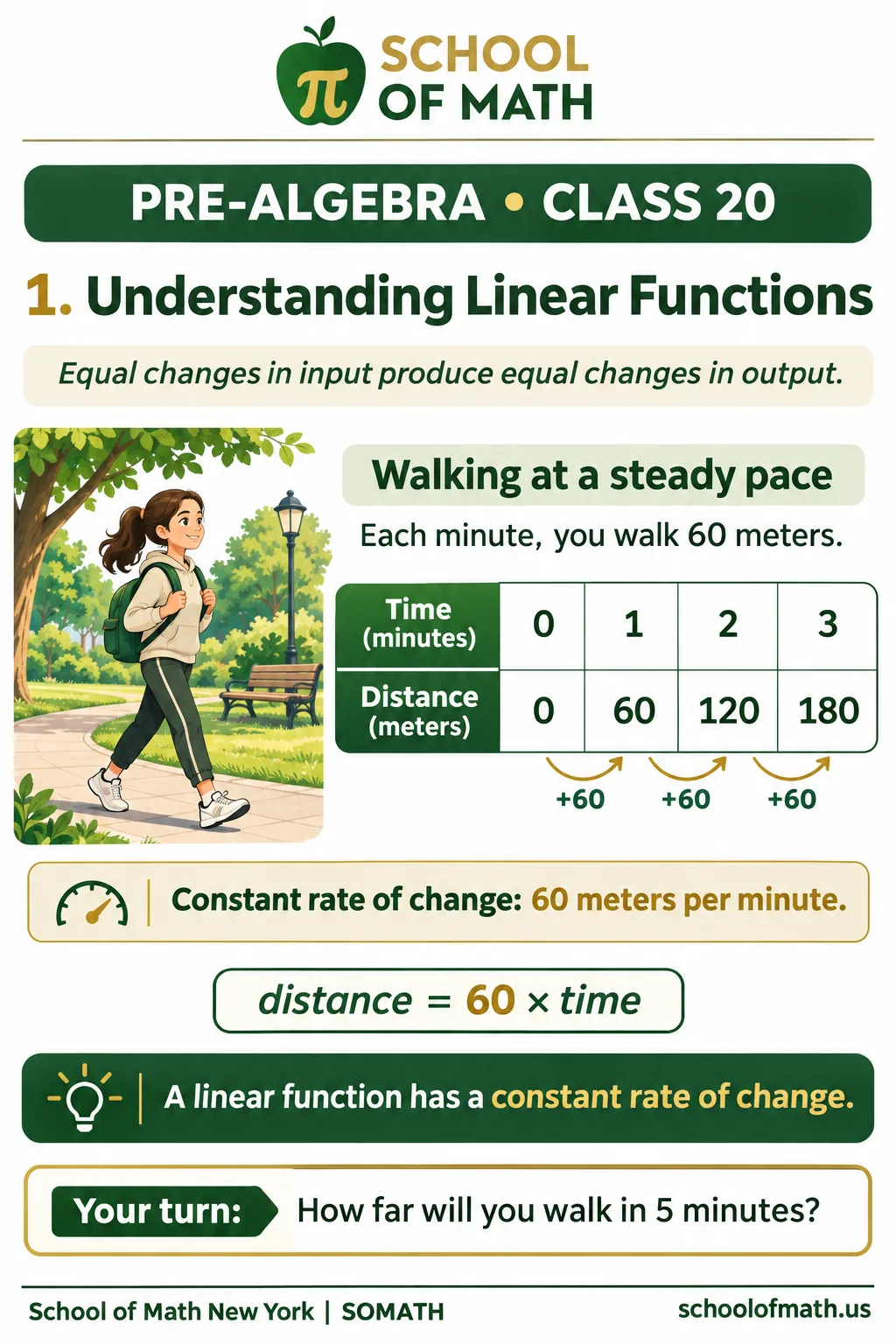
A linear function is a function whose output changes by the same amount every time the input increases by the same amount. In the poster, every extra minute of walking adds 60 meters: 0, 60, 120, 180. Those equal jumps are the signature of a linear function, and the size of the jump per one unit of input is the rate of change, here 60 meters per minute.
Because the walker starts at 0 meters and adds 60 meters per minute, the rule is \(d = 60t\), where \(t\) is time in minutes and \(d\) is distance in meters. A rule lets you jump to any input without building the whole table: the “your turn” question asks for 5 minutes, and \(d = 60(5) = 300\) meters.
To test a table for linearity, first make sure the inputs go up in equal steps (or account for unequal steps, as in the next topic), then look at the changes in the output. Equal output changes mean linear; changes that grow, shrink or switch direction mean not linear. A decreasing quantity can also be linear, as long as it decreases by the same amount each step.
Practice: try these five questions
Q1
A printer prints 25 pages each minute. Make a table for 0, 1, 2, 3 and 4 minutes, state the rate of change, and write a rule for the number of pages \(p\) after \(t\) minutes.
Answer
Pages: 0, 25, 50, 75, 100; rate 25 pages per minute; \(p = 25t\)
Start at 0 pages at 0 minutes and add 25 for each minute: 0, 25, 50, 75, 100.
Each step adds the same amount, 25 pages, so the rate of change is constant: 25 pages per minute.
Multiply the time by the rate: \(p = 25t\). Check: \(t = 4\) gives \(25(4) = 100\) pages, matching the table.
Q2
Is the table linear? If it is, state the constant rate of change.
| \(x\) | \(y\) |
|---|---|
| 0 | 5 |
| 1 | 9 |
| 2 | 13 |
| 3 | 17 |
Answer
Yes, linear; the rate of change is 4
Find each change in \(y\) as \(x\) goes up by 1: \(9 - 5 = 4\), \(13 - 9 = 4\), \(17 - 13 = 4\).
Every change is 4, so the output changes by the same amount for each equal input step.
The table is linear with rate of change 4 (y increases by 4 for each 1 added to x).
Q3
Is this table linear? Explain using the changes in \(y\).
| \(x\) | \(y\) |
|---|---|
| 0 | 1 |
| 1 | 2 |
| 2 | 4 |
| 3 | 8 |
Answer
Not linear
The inputs go up by 1 each time, so compare the output changes.
\(2 - 1 = 1\), \(4 - 2 = 2\), \(8 - 4 = 4\). The changes are 1, 2, 4.
The changes are not equal (each one doubles), so the rate of change is not constant and the table is not linear.
Q4
A swimmer swims at a steady 45 meters per minute. Write a rule for the distance \(d\) after \(t\) minutes. How far does she swim in 7 minutes? How long does 360 meters take?
Answer
\(d = 45t\); 315 meters; 8 minutes
The rate is 45 meters per minute and the distance starts at 0, so \(d = 45t\).
For 7 minutes: \(d = 45(7) = 315\) meters.
For 360 meters: \(360 = 45t\), so \(t = 360 \div 45 = 8\) minutes. Check: \(45(8) = 360\).
Q5
Snow on a roof melts steadily. Is the snow depth a linear function of time? If so, give the rate of change with units.
| Time (hours) | Snow depth (cm) |
|---|---|
| 0 | 10 |
| 1 | 8 |
| 2 | 6 |
| 3 | 4 |
Answer
Yes, linear; the rate of change is −2 centimeters per hour
Each hour the depth changes by \(8 - 10 = -2\), \(6 - 8 = -2\), \(4 - 6 = -2\).
The change is the same every hour, so the function is linear even though the depth is decreasing.
Rate of change: \(-2\) centimeters per hour, meaning the snow loses 2 cm of depth each hour.
Rate of change from tables
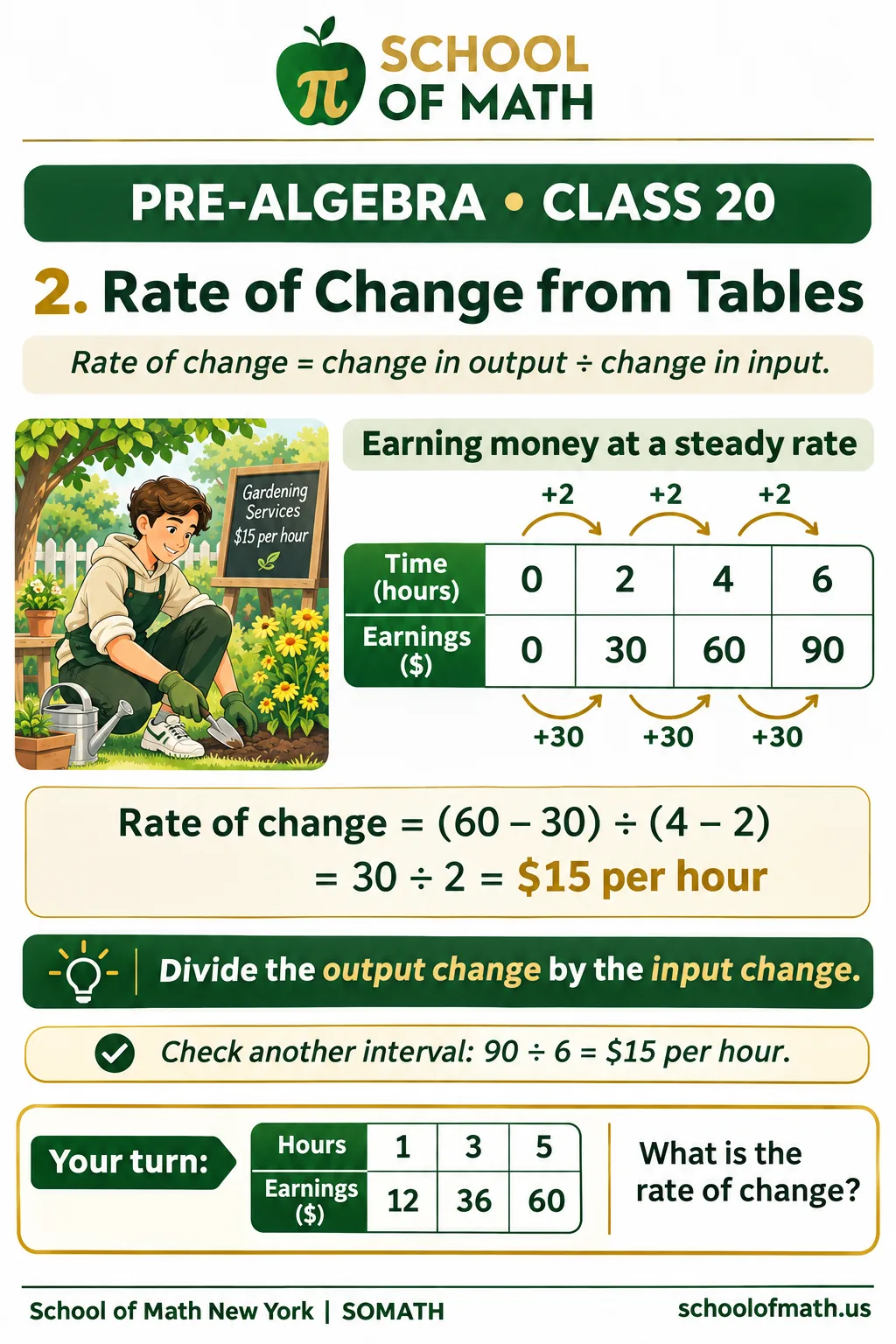
When the inputs in a table do not go up by 1, you cannot read the rate of change from a single jump. Instead divide: rate of change = change in output ÷ change in input. In the poster the hours go up by 2 and the earnings go up by 30, so the rate is \(30 \div 2 = 15\) dollars per hour. Using rows 4 and 2 hours gives the same \((60 - 30) \div (4 - 2) = 15\).
For a linear function, every pair of rows gives the same rate, so it is wise to check a second interval. The poster's check \(90 \div 6 = 15\) works because the table starts at (0, 0); when a table does not start at 0, dividing a single output by its input is a mistake, and you must use the changes.
For the “your turn” table, the hours go 1, 3, 5 (up by 2) and the earnings go 12, 36, 60 (up by 24), so the rate is \(24 \div 2 = 12\) dollars per hour. If two intervals give different rates, the table is not linear.
Practice: try these five questions
Q6
Find the rate of change of earnings per hour.
| Hours | Earnings ($) |
|---|---|
| 0 | 0 |
| 3 | 36 |
| 6 | 72 |
| 9 | 108 |
Answer
$12 per hour
The hours go up by 3 each time and the earnings go up by 36.
Rate of change \(= 36 \div 3 = 12\) dollars per hour.
Check another interval: \((108 - 36) \div (9 - 3) = 72 \div 6 = 12\). The rate is constant.
Q7
A boat rental charges the amounts below. Find the cost per hour.
| Hours | Cost ($) |
|---|---|
| 2 | 50 |
| 5 | 125 |
| 8 | 200 |
Answer
$25 per hour
Change in cost from 2 to 5 hours: \(125 - 50 = 75\) dollars. Change in time: \(5 - 2 = 3\) hours.
Rate \(= 75 \div 3 = 25\) dollars per hour.
Check: \((200 - 125) \div (8 - 5) = 75 \div 3 = 25\). Same rate, so the cost is linear.
Q8
The inputs in this table are not evenly spaced. Is the rate of change constant? If so, find it.
| Minutes | Water (liters) |
|---|---|
| 1 | 7 |
| 4 | 28 |
| 6 | 42 |
| 10 | 70 |
Answer
Yes, constant: 7 liters per minute
1 to 4 minutes: \((28 - 7) \div (4 - 1) = 21 \div 3 = 7\).
4 to 6 minutes: \((42 - 28) \div (6 - 4) = 14 \div 2 = 7\).
6 to 10 minutes: \((70 - 42) \div (10 - 6) = 28 \div 4 = 7\).
All three intervals give 7, so the rate of change is constant: 7 liters per minute.
Q9
A plant's height is recorded every two days. Find the growth rate. Then explain why \(15 \div 6\) gives the wrong answer.
| Day | Height (cm) |
|---|---|
| 0 | 3 |
| 2 | 7 |
| 4 | 11 |
| 6 | 15 |
Answer
2 centimeters per day
Change in height for each 2 days: \(7 - 3 = 4\) cm, so the rate is \(4 \div 2 = 2\) cm per day.
Check: \((15 - 7) \div (6 - 2) = 8 \div 4 = 2\).
\(15 \div 6 = 2.5\) is wrong because the plant was already 3 cm tall on day 0. Only the growth, \(15 - 3 = 12\) cm over 6 days, belongs in the rate: \(12 \div 6 = 2\).
Q10
Is this table linear? Check every interval.
| \(x\) | \(y\) |
|---|---|
| 1 | 6 |
| 2 | 10 |
| 4 | 18 |
| 5 | 23 |
Answer
Not linear
1 to 2: \((10 - 6) \div (2 - 1) = 4\).
2 to 4: \((18 - 10) \div (4 - 2) = 8 \div 2 = 4\).
4 to 5: \((23 - 18) \div (5 - 4) = 5\).
The last interval gives 5 instead of 4, so the rate is not constant and the table is not linear. (For a linear table the last output would be 22.)
Slope: rise over run
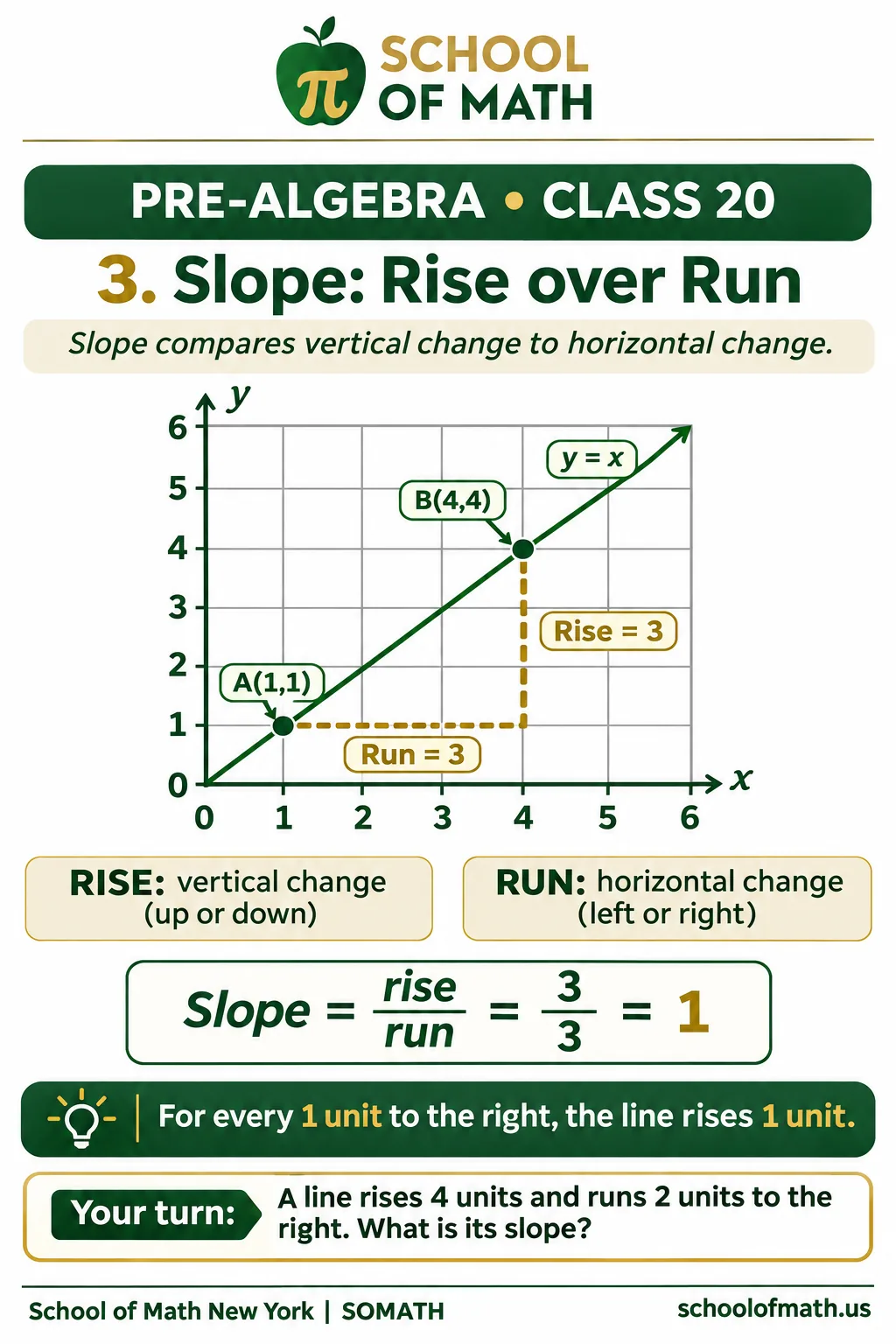
On a graph, the rate of change of a line is called its slope, written \(m\). Pick two points on the line and move from the left point to the right point. The run is the horizontal change and the rise is the vertical change. Then \(m = \dfrac{\text{rise}}{\text{run}}\).
In the poster, moving from A(1, 1) to B(4, 4) means running 3 to the right and rising 3, so \(m = \dfrac{3}{3} = 1\): for every 1 unit right, the line rises 1 unit. Any two points on the same line give the same slope, so choose points where the line crosses grid corners exactly.
Rise can be negative. If the line goes down as you move right, the rise is negative and so is the slope. The “your turn” line rises 4 and runs 2, so \(m = \dfrac{4}{2} = 2\). Always simplify the fraction; a slope like \(\dfrac{2}{4}\) is written \(\dfrac{1}{2}\).
Practice: try these five questions
Q11
A line rises 6 units while it runs 3 units to the right. What is its slope?
Answer
\(m = 2\)
Slope is rise over run: \(m = \dfrac{6}{3}\).
Simplify: \(\dfrac{6}{3} = 2\).
Meaning: for every 1 unit to the right, the line rises 2 units.
Q12
Use rise over run to find the slope of the line.
Answer
\(m = \dfrac{1}{2}\)
Use the marked points (0, 1) and (4, 3), moving left to right.
Run: from \(x = 0\) to \(x = 4\) is 4. Rise: from \(y = 1\) to \(y = 3\) is 2.
\(m = \dfrac{2}{4} = \dfrac{1}{2}\): the line rises 1 unit for every 2 units to the right.
Q13
A line rises 5 units for every 10 units of run. What is its slope? How much does it rise over a run of 4 units?
Answer
\(m = \dfrac{1}{2}\); it rises 2 units
\(m = \dfrac{5}{10} = \dfrac{1}{2}\).
Rise = slope × run, so over a run of 4 the rise is \(\dfrac{1}{2} \times 4 = 2\) units.
Check: \(\dfrac{2}{4}\) also simplifies to \(\dfrac{1}{2}\).
Q14
Find the slope of the line. Pay attention to the direction of the rise.
Answer
\(m = -1\)
Move from the left point (1, 5) to the right point (4, 2).
Run: \(4 - 1 = 3\) to the right. Rise: the line goes down from 5 to 2, so the rise is \(-3\).
\(m = \dfrac{-3}{3} = -1\): for every 1 unit right, the line falls 1 unit.
Q15
A wheelchair ramp rises 2 feet over a horizontal distance of 24 feet. What is the slope of the ramp? How many feet of run are needed for each 1 foot of rise?
Answer
\(m = \dfrac{1}{12}\); 12 feet of run per foot of rise
\(m = \dfrac{\text{rise}}{\text{run}} = \dfrac{2}{24}\).
Simplify by dividing top and bottom by 2: \(\dfrac{1}{12}\).
A slope of \(\dfrac{1}{12}\) means 1 foot up for every 12 feet across, so 12 feet of run are needed per foot of rise.
Slope between two points
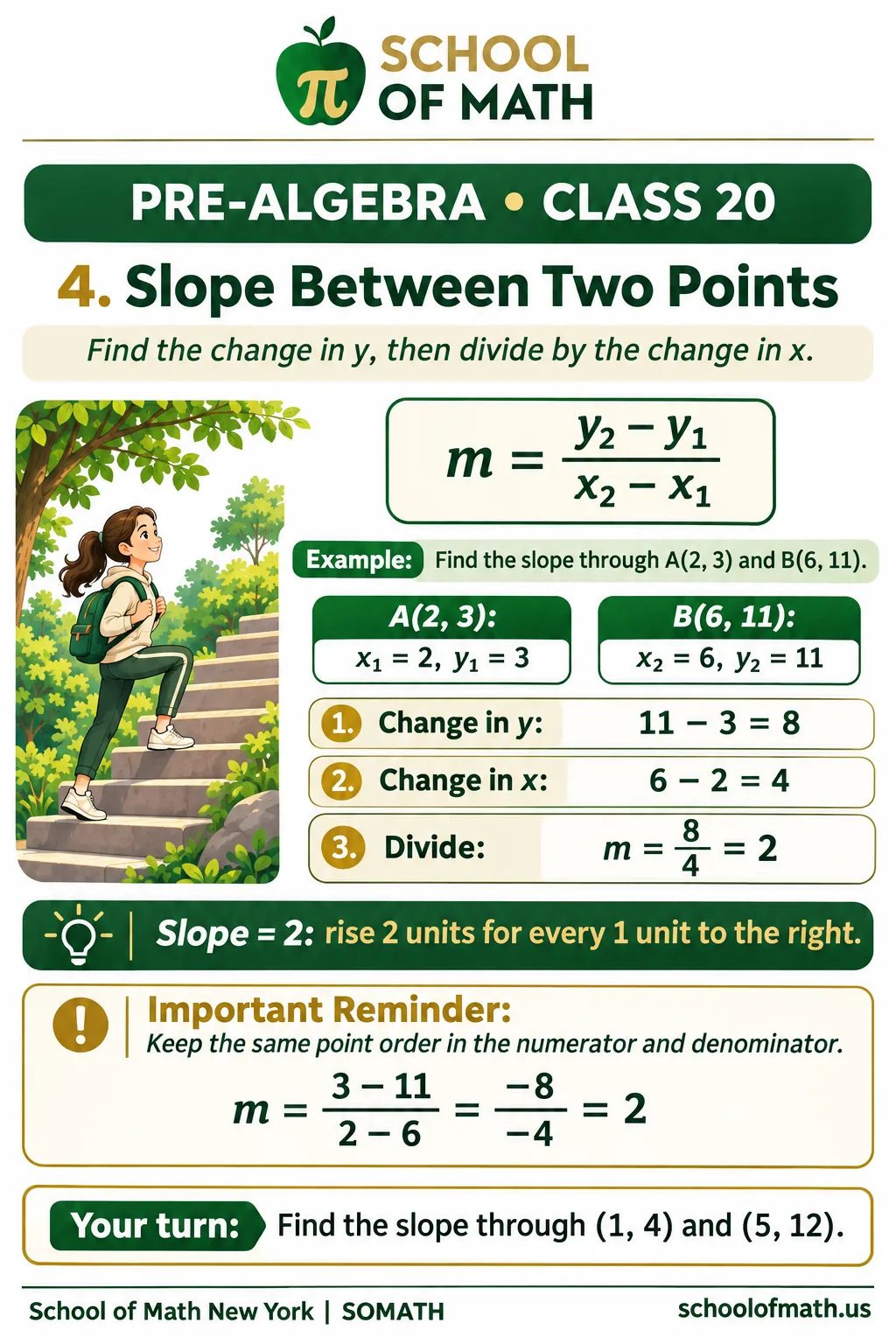
When you know two points but have no graph, use the slope formula \(m = \dfrac{y_2 - y_1}{x_2 - x_1}\). The top is the change in \(y\) (the rise) and the bottom is the change in \(x\) (the run). Label one point \((x_1, y_1)\) and the other \((x_2, y_2)\) first, then substitute.
In the poster, A(2, 3) and B(6, 11) give \(m = \dfrac{11 - 3}{6 - 2} = \dfrac{8}{4} = 2\). Starting from B instead gives \(\dfrac{3 - 11}{2 - 6} = \dfrac{-8}{-4} = 2\), the same slope. The rule is to keep the same point order on top and bottom; mixing the order flips the sign and gives a wrong answer.
Watch the signs when coordinates are negative: subtracting a negative means adding. For the “your turn” points (1, 4) and (5, 12), \(m = \dfrac{12 - 4}{5 - 1} = \dfrac{8}{4} = 2\).
Practice: try these five questions
Q16
Find the slope of the line through (3, 2) and (7, 14).
Answer
\(m = 3\)
Let \((x_1, y_1) = (3, 2)\) and \((x_2, y_2) = (7, 14)\).
Change in \(y\): \(14 - 2 = 12\). Change in \(x\): \(7 - 3 = 4\).
\(m = \dfrac{12}{4} = 3\).
Q17
Find the slope of the line through (−2, 5) and (4, −7).
Answer
\(m = -2\)
Change in \(y\): \(-7 - 5 = -12\).
Change in \(x\): \(4 - (-2) = 4 + 2 = 6\).
\(m = \dfrac{-12}{6} = -2\). The line falls 2 units for each unit to the right.
Q18
Find the slope of the line through (0, −3) and (6, 1).
Answer
\(m = \dfrac{2}{3}\)
Change in \(y\): \(1 - (-3) = 1 + 3 = 4\).
Change in \(x\): \(6 - 0 = 6\).
\(m = \dfrac{4}{6} = \dfrac{2}{3}\).
Q19
For the points (5, 9) and (1, 1), a student wrote \(m = \dfrac{9 - 1}{1 - 5} = -2\). Find the mistake and give the correct slope.
Answer
The point order was mixed; \(m = 2\)
The numerator \(9 - 1\) starts with the point (5, 9), but the denominator \(1 - 5\) starts with the point (1, 1). The order was switched.
Keep the same order: \(m = \dfrac{9 - 1}{5 - 1} = \dfrac{8}{4} = 2\).
Check with the other order: \(\dfrac{1 - 9}{1 - 5} = \dfrac{-8}{-4} = 2\). Both give 2.
Q20
Find the slope of the line through (−3, 4) and (5, 4). What kind of line is it?
Answer
\(m = 0\); a horizontal line
Change in \(y\): \(4 - 4 = 0\). Change in \(x\): \(5 - (-3) = 8\).
\(m = \dfrac{0}{8} = 0\).
Both points have \(y = 4\), so the line is the horizontal line \(y = 4\). It has no rise at all.
Types of slope
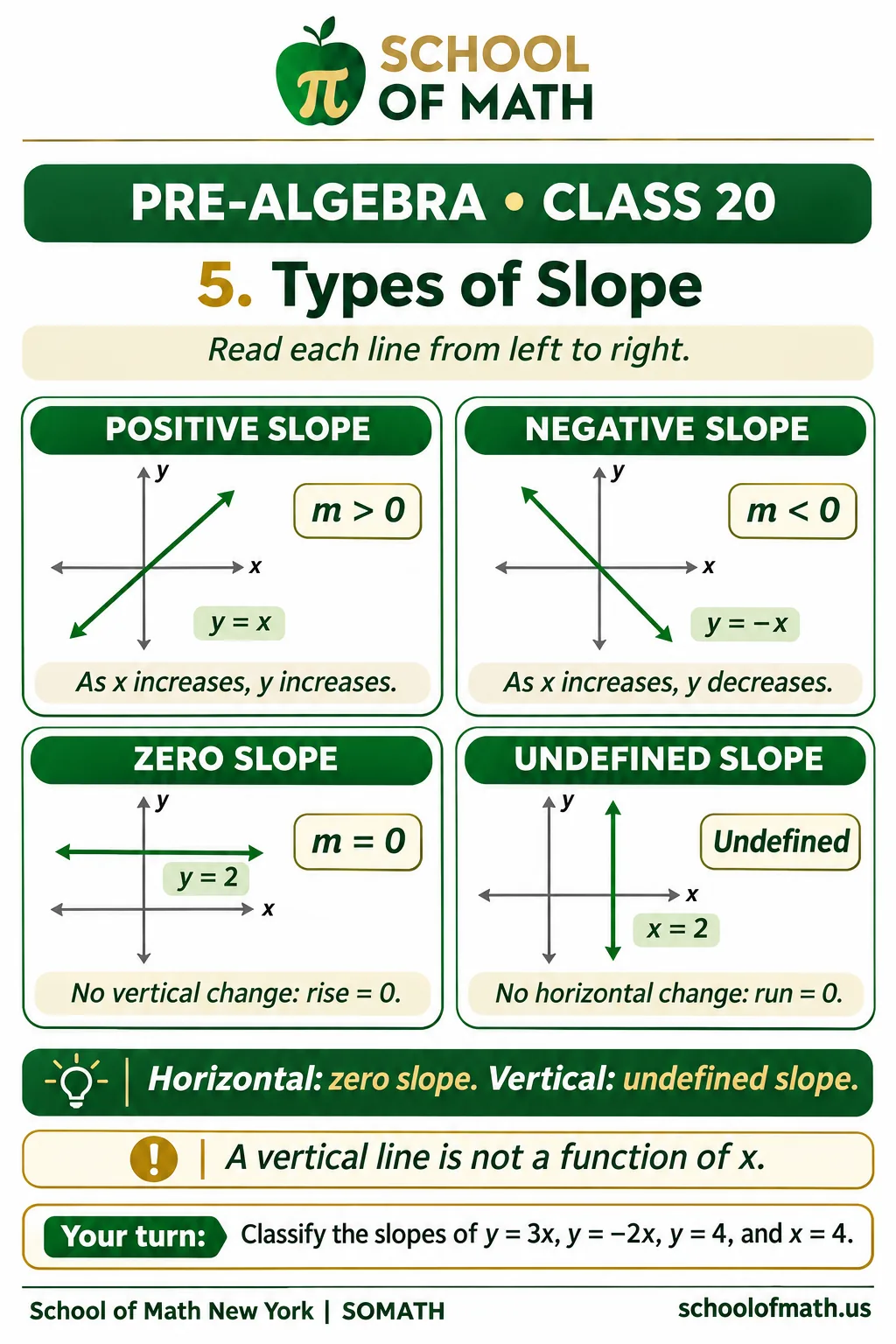
Read every line from left to right. A line that goes up has a positive slope (\(m \gt 0\)): as \(x\) increases, \(y\) increases. A line that goes down has a negative slope (\(m \lt 0\)): as \(x\) increases, \(y\) decreases.
A horizontal line such as \(y = 2\) has rise 0 for any run, so \(m = \dfrac{0}{\text{run}} = 0\): zero slope. A vertical line such as \(x = 2\) has run 0, and division by zero is not defined, so its slope is undefined. Zero slope and undefined slope are different: “zero” is a number, “undefined” means no number works.
A vertical line fails the vertical-line test, because one input (like \(x = 2\)) has infinitely many outputs, so it is not a function of \(x\). For the “your turn” list: \(y = 3x\) is positive, \(y = -2x\) is negative, \(y = 4\) is zero and \(x = 4\) is undefined. In an equation of the form \(y = mx\) or \(y = mx + b\), the number multiplying \(x\) is the slope.
Practice: try these five questions
Q21
Classify the slope of each line as positive, negative, zero or undefined: (a) a line that goes up from left to right (b) a line that goes down from left to right (c) a horizontal line (d) a vertical line
Answer
(a) positive (b) negative (c) zero (d) undefined
(a) Going up from left to right means \(y\) increases as \(x\) increases: positive slope.
(b) Going down from left to right means \(y\) decreases as \(x\) increases: negative slope.
(c) A horizontal line is flat; the rise is 0, so the slope is \(\dfrac{0}{\text{run}} = 0\): zero slope.
(d) A vertical line goes straight up and down; the run is 0, and division by zero is undefined: undefined slope.
Q22
Is the slope of the line through (1, 2) and (3, 6) positive or negative? Find its value.
Answer
Positive; \(m = 2\)
Rise (change in \(y\)): \(6 - 2 = 4\). Run (change in \(x\)): \(3 - 1 = 2\).
\(m = \dfrac{4}{2} = 2\).
Going from left to right, \(y\) goes up from 2 to 6, so the line rises and the slope is positive.
Q23
Is the slope of this line positive or negative? Find its value.
Answer
Negative; \(m = -\dfrac{3}{2}\)
Reading left to right, the line goes down, so the slope is negative.
From (−2, 4) to (2, −2): run \(= 2 - (-2) = 4\), rise \(= -2 - 4 = -6\).
\(m = \dfrac{-6}{4} = -\dfrac{3}{2}\).
Q24
Classify the slope of each graph, with time as the input: (a) a savings balance when $10 is added every week (b) the gas in a car's tank during a drive (c) the distance from home of a car parked in the garage all day.
Answer
(a) positive (b) negative (c) zero
(a) The balance goes up as time goes on: positive slope (+$10 per week).
(b) The gas goes down as the car is driven: negative slope.
(c) The distance from home stays the same at every time: horizontal graph, zero slope.
Q25
Which of the lines \(y = 7\) and \(x = 7\) is a function of \(x\)? Explain with slope and the vertical-line test.
Answer
\(y = 7\) is a function; \(x = 7\) is not
\(y = 7\) is horizontal with zero slope. Every vertical line crosses it exactly once, so each input has one output (7): it is a function.
\(x = 7\) is vertical with undefined slope. The vertical line at \(x = 7\) lies on top of it, so the input 7 has infinitely many outputs.
Therefore \(x = 7\) fails the vertical-line test and is not a function of \(x\).
Graphing lines using slope
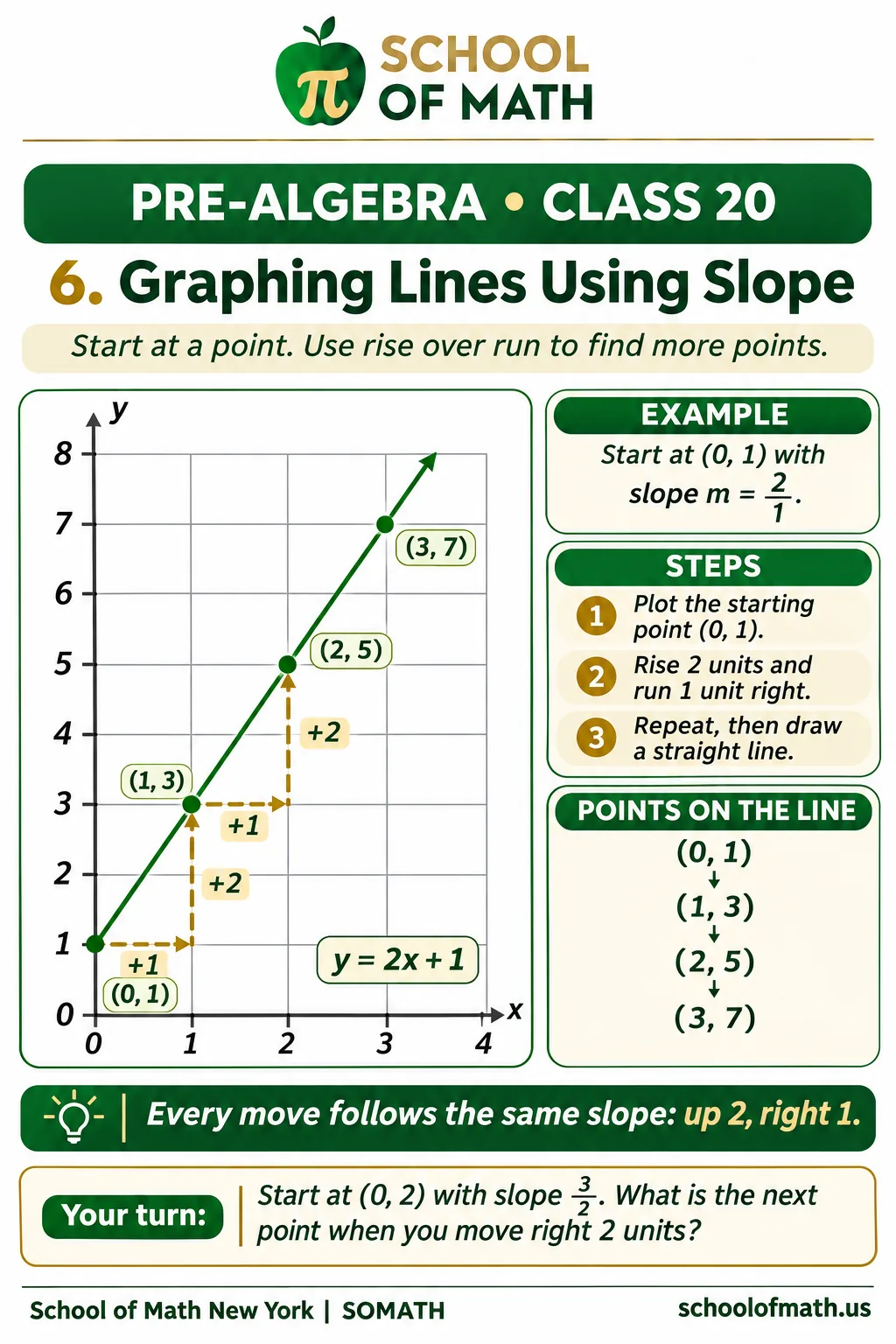
A slope is a set of directions: the top tells how far to move up (or down, if negative) and the bottom tells how far to move right. To graph a line from a starting point and a slope, plot the start, apply rise and run, plot the new point, and repeat; then join the points with a straight line and add arrows.
In the poster, the line starts at (0, 1) with \(m = \dfrac{2}{1}\): up 2, right 1 each time, giving (1, 3), (2, 5), (3, 7). Every move uses the same slope, which is why the points line up. The line is \(y = 2x + 1\); the starting value 1 is where the line crosses the \(y\)-axis.
For a fractional slope, use the denominator as the run so you land on grid corners. The “your turn” line starts at (0, 2) with slope \(\dfrac{3}{2}\): right 2 and up 3 lands on (2, 5). A negative slope such as \(-\dfrac{3}{4}\) means down 3 for every 4 right (or, equivalently, up 3 for every 4 left).
Practice: try these five questions
Q26
Start at (0, −3) and use slope 3. List the points for \(x = 1, 2, 3\), then graph the line.
Answer
(1, 0), (2, 3), (3, 6); the line \(y = 3x - 3\)
Slope 3 means \(\dfrac{3}{1}\): up 3, right 1.
From (0, −3): (1, 0), then (2, 3), then (3, 6).
Join the points with a straight line. Its rule is \(y = 3x - 3\); check \(x = 3\): \(3(3) - 3 = 6\).
Q27
Start at (0, −1) and use slope \(\dfrac{1}{2}\). Find three more points to the right and graph the line.
Answer
(2, 0), (4, 1), (6, 2)
Slope \(\dfrac{1}{2}\): up 1, right 2.
From (0, −1): (2, 0), then (4, 1), then (6, 2).
Draw the straight line through the four points. Each point is 1 higher and 2 farther right than the one before.
Q28
Start at (0, 6) and use slope −2. Find the points for \(x = 1, 2, 3\) and graph the line. Where does it cross the \(x\)-axis?
Answer
(1, 4), (2, 2), (3, 0); it crosses at (3, 0)
Slope \(-2 = \dfrac{-2}{1}\): down 2, right 1.
From (0, 6): (1, 4), (2, 2), (3, 0).
The point (3, 0) has \(y = 0\), so the line crosses the \(x\)-axis at (3, 0). The rule is \(y = -2x + 6\).
Q29
A line passes through (1, 1) with slope \(\dfrac{2}{3}\). Find two points to the right of (1, 1) and one point to its left.
Answer
Right: (4, 3) and (7, 5); left: (−2, −1)
Slope \(\dfrac{2}{3}\): up 2, right 3.
From (1, 1): (4, 3), then (7, 5).
To move left, reverse both directions: down 2, left 3. From (1, 1): (−2, −1).
Check with the slope formula: \(\dfrac{3 - (-1)}{4 - (-2)} = \dfrac{4}{6} = \dfrac{2}{3}\).
Q30
Start at (0, 3) with slope \(-\dfrac{3}{4}\). Find the points 4 and 8 units to the right. Is (−4, 6) on the same line?
Answer
(4, 0) and (8, −3); yes, (−4, 6) is on the line
Slope \(-\dfrac{3}{4}\): down 3, right 4.
From (0, 3): (4, 0), then (8, −3).
Going left reverses the move: up 3, left 4. From (0, 3) that gives (−4, 6), so yes, it is on the line.
Check: \(\dfrac{6 - 3}{-4 - 0} = \dfrac{3}{-4} = -\dfrac{3}{4}\).
Interpreting slope and its units
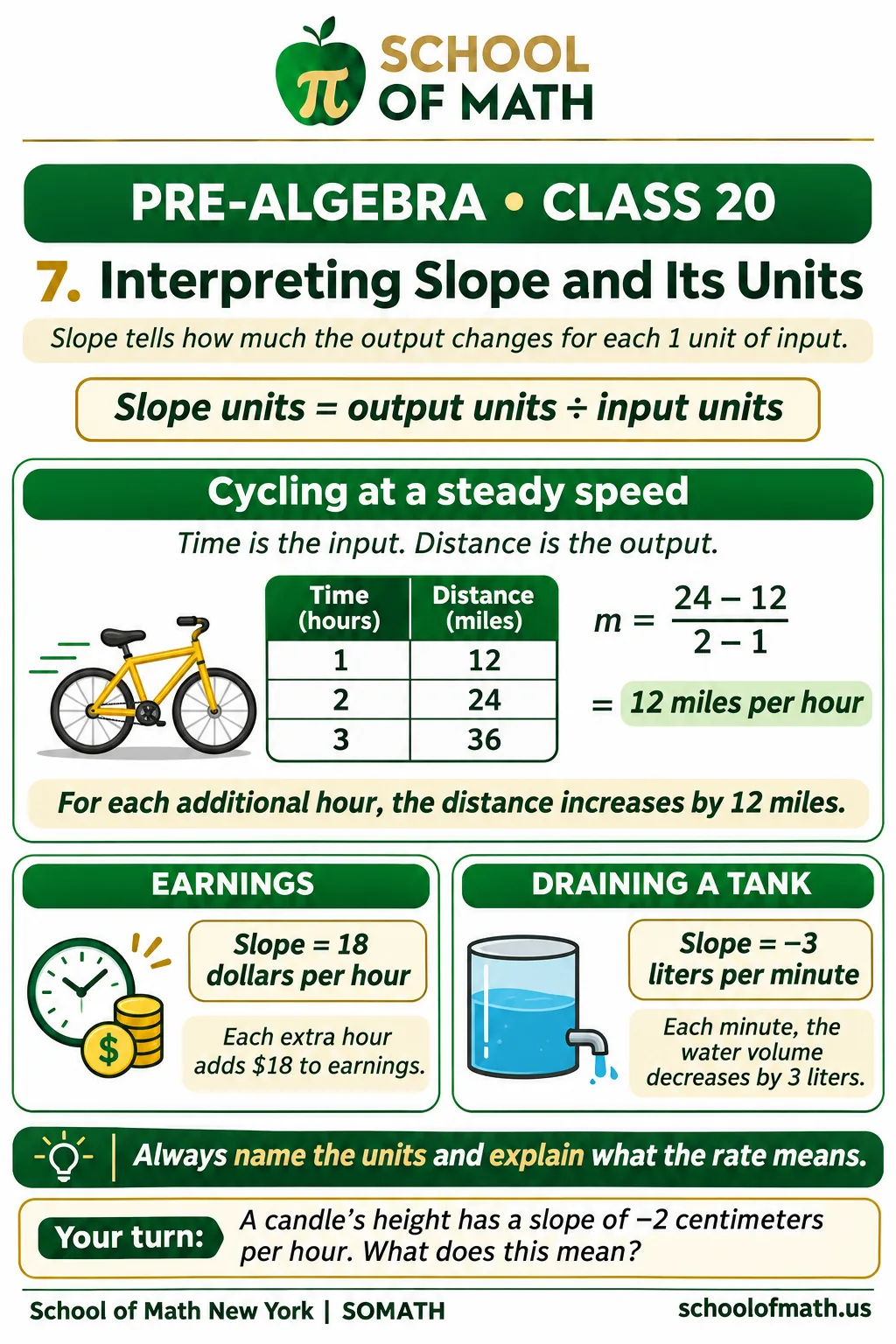
In a real situation, slope is not just a number: it carries units, and the units are always output units per input unit. For the cyclist in the poster, time (hours) is the input and distance (miles) is the output, so \(m = \dfrac{24 - 12}{2 - 1} = 12\) miles per hour.
To interpret a slope, write a sentence of the form “for each additional input unit, the output increases (or decreases) by slope output units.” A slope of 18 dollars per hour means each extra hour adds $18; a slope of \(-3\) liters per minute means the tank loses 3 liters every minute. The sign tells the direction; the units tell what is changing and against what.
The “your turn” candle has slope \(-2\) centimeters per hour: each hour it burns, the candle gets 2 cm shorter. Slope also lets you predict: change in output = slope × change in input.
Practice: try these five questions
Q31
A phone plan's total cost is shown. Find the slope with units and explain what it means.
| Months | Total cost ($) |
|---|---|
| 1 | 35 |
| 2 | 50 |
| 3 | 65 |
Answer
$15 per month
Input: months. Output: total cost in dollars.
\(m = \dfrac{50 - 35}{2 - 1} = 15\); check \(\dfrac{65 - 50}{3 - 2} = 15\).
Units: dollars ÷ months, so the slope is 15 dollars per month: each additional month adds $15 to the total cost.
Q32
A car's fuel tank is recorded during a road trip. Find the slope with units and explain it.
| Hours driven | Fuel (gallons) |
|---|---|
| 0 | 14 |
| 2 | 10 |
| 4 | 6 |
Answer
−2 gallons per hour
Input: hours driven. Output: gallons in the tank.
\(m = \dfrac{10 - 14}{2 - 0} = \dfrac{-4}{2} = -2\); check \(\dfrac{6 - 10}{4 - 2} = -2\).
The slope is \(-2\) gallons per hour: for each hour of driving, the tank loses 2 gallons.
Q33
A puppy's weight graph has slope 0.25 kilograms per week. What does this mean? How much weight does the puppy gain in 8 weeks?
Answer
It gains 0.25 kg each week; 2 kg in 8 weeks
Slope 0.25 kg per week: for each additional week, the puppy's weight increases by 0.25 kilograms (a quarter of a kilogram).
Change in output = slope × change in input = \(0.25 \times 8\).
\(0.25 \times 8 = 2\), so the puppy gains 2 kilograms in 8 weeks.
Q34
A school fundraiser graphs dollars raised (output) against tickets sold (input). The slope is 8. Give the units of the slope and interpret it. How much more money do 15 extra tickets raise?
Answer
$8 per ticket; $120 more
Units of slope = output units ÷ input units = dollars per ticket.
Interpretation: each additional ticket sold raises $8 more.
15 extra tickets: \(8 \times 15 = 120\) dollars more.
Q35
An elevator descends at a steady rate. Find the slope with units, interpret it, and find when the elevator reaches the ground (height 0).
| Time (s) | Height (m) |
|---|---|
| 0 | 60 |
| 5 | 45 |
| 10 | 30 |
Answer
−3 meters per second; ground at 20 seconds
\(m = \dfrac{45 - 60}{5 - 0} = \dfrac{-15}{5} = -3\); check \(\dfrac{30 - 45}{10 - 5} = -3\).
Units: meters per second. Each second, the elevator's height decreases by 3 meters.
From 60 m, it must drop 60 m: \(60 \div 3 = 20\) seconds. Check: \(60 - 3(20) = 0\).
Applying and comparing rates
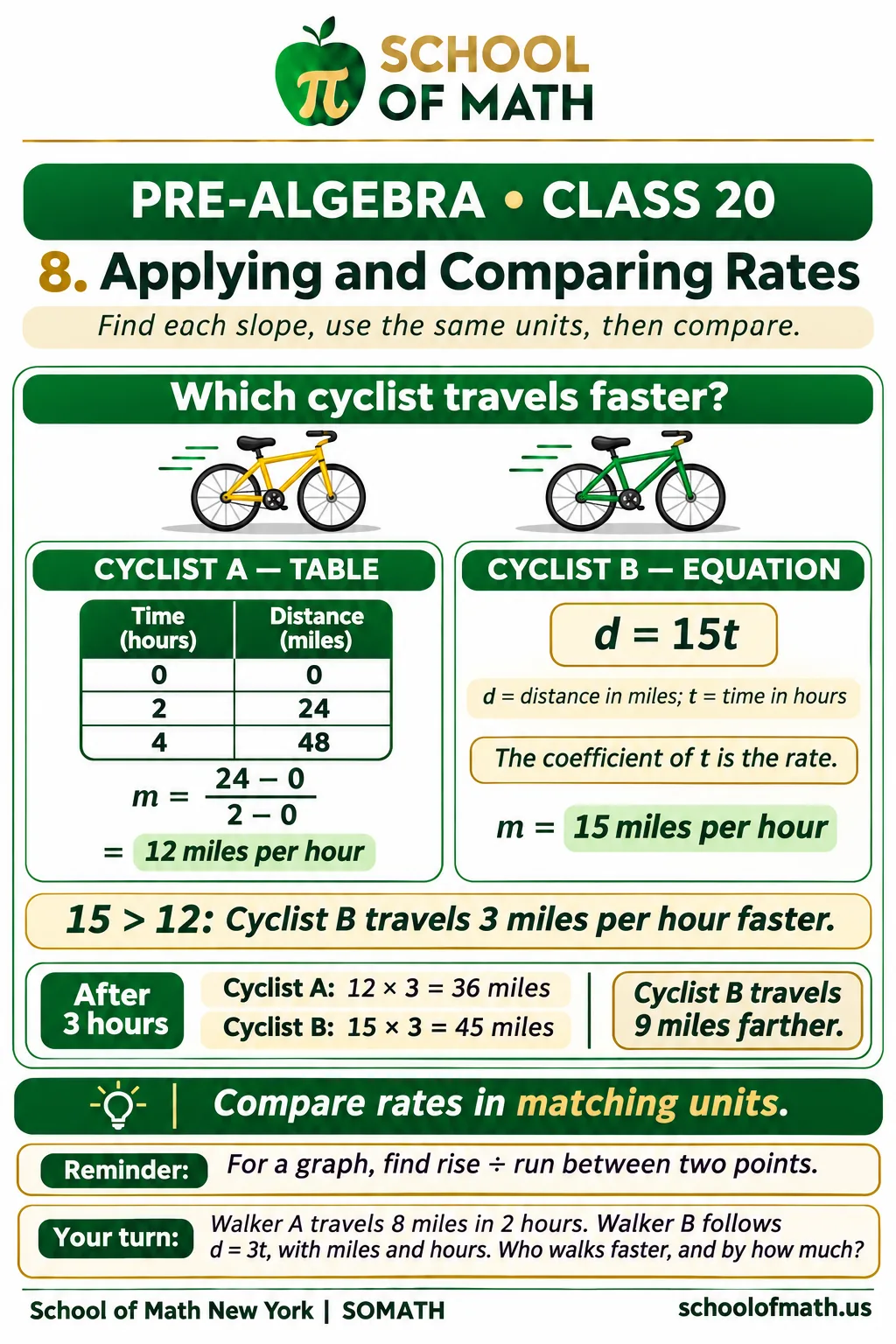
Rates can be given in different forms: a table, an equation, a graph or a sentence. To compare them, find each slope, write both in the same units, then compare. From a table or graph, compute change in output ÷ change in input; in an equation like \(d = 15t\), the coefficient of the input variable is the rate.
In the poster, Cyclist A's table gives \(\dfrac{24 - 0}{2 - 0} = 12\) miles per hour and Cyclist B's equation gives 15 miles per hour, so B is \(15 - 12 = 3\) miles per hour faster. Over 3 hours the gap grows to \(3 \times 3 = 9\) miles (45 versus 36).
If the units do not match (miles per minute versus miles per hour, or meters versus centimeters), convert first. For the “your turn” walkers, Walker A goes \(8 \div 2 = 4\) miles per hour and Walker B goes 3 miles per hour, so A is faster by 1 mile per hour.
Practice: try these five questions
Q36
Runner A's distances are in the table. Runner B follows \(d = 220t\) (meters, minutes). Who runs faster, and by how much? How far apart are they after 10 minutes?
| Time (min) | Distance (m) |
|---|---|
| 0 | 0 |
| 3 | 750 |
| 6 | 1500 |
Answer
Runner A, by 30 meters per minute; 300 meters apart
Runner A: \(\dfrac{750 - 0}{3 - 0} = 250\) meters per minute; check \(\dfrac{1500 - 750}{6 - 3} = 250\).
Runner B: the coefficient of \(t\) is 220 meters per minute.
\(250 - 220 = 30\), so A is faster by 30 meters per minute.
After 10 minutes: A runs 2,500 m and B runs 2,200 m, a gap of 300 m (\(30 \times 10\)).
Q37
Pump A fills 90 liters in 6 minutes. Pump B follows \(V = 18t\) (liters, minutes). Which pump is faster, and by how much?
Answer
Pump B, by 3 liters per minute
Pump A: \(90 \div 6 = 15\) liters per minute.
Pump B: the coefficient of \(t\) is 18 liters per minute.
\(18 - 15 = 3\), so Pump B is faster by 3 liters per minute.
Q38
Train A travels 2 miles per minute. Train B travels 100 miles per hour. Which is faster? Compare in matching units.
Answer
Train A, by 20 miles per hour
Convert Train A to miles per hour: 1 hour = 60 minutes, so \(2 \times 60 = 120\) miles per hour.
Train B: 100 miles per hour.
\(120 - 100 = 20\), so Train A is faster by 20 miles per hour. Comparing “2” with “100” directly would have been misleading.
Q39
The graph shows Ana's and Ben's savings. Whose savings grow faster? When do they have the same amount?
Answer
Ana's savings grow faster ($15 per week vs $10 per week); both have $60 at week 4
Ana: from (0, 0) to (4, 60), \(m = \dfrac{60}{4} = 15\) dollars per week.
Ben: from (0, 20) to (4, 60), \(m = \dfrac{60 - 20}{4 - 0} = \dfrac{40}{4} = 10\) dollars per week.
Ana's slope is greater, so her savings grow faster, even though Ben started with $20.
The lines cross at (4, 60): after 4 weeks each has $60. Check: \(15(4) = 60\) and \(20 + 10(4) = 60\).
Q40
Store A's notebook prices are in the table. Store B charges \(C = 1.25n\) dollars for \(n\) notebooks. Which store is cheaper per notebook, and how much do you save buying 12 notebooks there?
| Notebooks | Cost ($) |
|---|---|
| 2 | 3 |
| 4 | 6 |
| 6 | 9 |
Answer
Store B; you save $3 on 12 notebooks
Store A: \(\dfrac{6 - 3}{4 - 2} = \dfrac{3}{2} = 1.50\) dollars per notebook; check \(\dfrac{9 - 6}{6 - 4} = 1.50\).
Store B: $1.25 per notebook. B is cheaper by \(1.50 - 1.25 = 0.25\) dollars per notebook.
For 12 notebooks: A costs \(1.50 \times 12 = 18\) dollars and B costs \(1.25 \times 12 = 15\) dollars, a saving of $3.
Homework review
One review question for each topic, in the same order as the images. Show the change in output, the change in input and the units in every answer.
R1
Is the table linear? If so, write a rule and find the distance after 6 hours.
| Time (hours) | Distance (km) |
|---|---|
| 0 | 0 |
| 1 | 8 |
| 2 | 16 |
| 3 | 24 |
Answer
Yes; \(d = 8t\); 48 kilometers
Each hour the distance increases by 8: \(8 - 0 = 16 - 8 = 24 - 16 = 8\). Constant change, so linear.
Starting at 0 and adding 8 km per hour: \(d = 8t\).
After 6 hours: \(d = 8(6) = 48\) kilometers.
R2
Find the rate of change, checking both intervals.
| \(x\) | \(y\) |
|---|---|
| 2 | 9 |
| 4 | 15 |
| 7 | 24 |
Answer
3
2 to 4: \(\dfrac{15 - 9}{4 - 2} = \dfrac{6}{2} = 3\).
4 to 7: \(\dfrac{24 - 15}{7 - 4} = \dfrac{9}{3} = 3\).
Both intervals give 3, so the rate of change is constant: 3.
R3
Line P rises 9 units over a run of 6 units. Line Q falls 4 units over a run of 8 units. Find each slope.
Answer
Line P: \(\dfrac{3}{2}\); Line Q: \(-\dfrac{1}{2}\)
Line P: \(m = \dfrac{9}{6} = \dfrac{3}{2}\).
Line Q falls, so its rise is \(-4\): \(m = \dfrac{-4}{8} = -\dfrac{1}{2}\).
P goes up 3 for every 2 right; Q goes down 1 for every 2 right.
R4
Find the slope of the line through (−1, 7) and (3, −5).
Answer
\(m = -3\)
Change in \(y\): \(-5 - 7 = -12\).
Change in \(x\): \(3 - (-1) = 4\).
\(m = \dfrac{-12}{4} = -3\).
R5
Classify each slope: (a) \(y = 0.5x + 3\) (b) \(y = -4\) (c) \(x = 5\) (d) \(y = -2x\)
Answer
(a) positive (b) zero (c) undefined (d) negative
(a) Coefficient 0.5 is greater than 0: positive.
(b) Horizontal line: zero slope.
(c) Vertical line: undefined slope (and not a function of \(x\)).
(d) Coefficient \(-2\) is less than 0: negative.
R6
Start at (0, −2) with slope \(\dfrac{3}{2}\). Find the next two points to the right and graph the line.
Answer
(2, 1) and (4, 4)
Slope \(\dfrac{3}{2}\): up 3, right 2.
From (0, −2): (2, 1), then (4, 4).
Draw the straight line through (0, −2), (2, 1) and (4, 4).
R7
A pool drains with slope −40 gallons per hour. Explain the slope. If the pool holds 600 gallons, how long does it take to empty?
Answer
It loses 40 gallons each hour; 15 hours
Slope −40 gallons per hour: for each hour, the water in the pool decreases by 40 gallons.
To lose all 600 gallons: \(600 \div 40 = 15\) hours.
Check: \(600 - 40(15) = 0\).
R8
Train A's distances are in the table. Train B follows \(d = 75t\) (miles, hours). Which is faster, by how much, and how far apart are they after 4 hours?
| Time (hours) | Distance (miles) |
|---|---|
| 0 | 0 |
| 2 | 160 |
| 5 | 400 |
Answer
Train A, by 5 miles per hour; 20 miles apart
Train A: \(\dfrac{160 - 0}{2 - 0} = 80\) miles per hour; check \(\dfrac{400 - 160}{5 - 2} = \dfrac{240}{3} = 80\).
Train B: 75 miles per hour. A is faster by \(80 - 75 = 5\) miles per hour.
After 4 hours: A has gone 320 miles and B 300 miles, 20 miles apart.
Homework word problems
Twelve real-world rate problems, from direct application to a final challenge. Identify the input and output, find the slope with units, then answer the question and check it.
W1
A taxi charges $3 to start plus $2 per mile. Make a table of the total cost for 1, 2, 3 and 4 miles. What is the rate of change, and what does a 10-mile ride cost?
Answer
Costs $5, $7, $9, $11; rate $2 per mile; $23
Cost = 3 + 2 × miles: 1 mile → $5, 2 → $7, 3 → $9, 4 → $11.
Each extra mile adds $2, so the rate of change is $2 per mile. The $3 starting fee does not change the rate.
10 miles: \(3 + 2(10) = 23\) dollars.
W2
A candle 24 cm tall burns down 1.5 cm per hour. What is the slope of height versus time? How tall is it after 6 hours, and when does it burn out?
Answer
Slope −1.5 cm per hour; 15 cm; after 16 hours
The height decreases, so the slope is \(-1.5\) centimeters per hour.
After 6 hours: \(24 - 1.5(6) = 24 - 9 = 15\) cm.
Burn out when the whole 24 cm is gone: \(24 \div 1.5 = 16\) hours. Check: \(1.5 \times 16 = 24\).
W3
The temperature rises steadily from 48 °F at 7 a.m. to 66 °F at 1 p.m. Find the rate of change and the temperature at 10 a.m.
Answer
3 °F per hour; 57 °F at 10 a.m.
From 7 a.m. to 1 p.m. is 6 hours. The temperature changes \(66 - 48 = 18\) °F.
Rate \(= 18 \div 6 = 3\) degrees Fahrenheit per hour.
10 a.m. is 3 hours after 7 a.m.: \(48 + 3(3) = 57\) °F.
W4
A hiker climbs at a steady rate. After 2 hours she is at 1,400 feet of elevation; after 5 hours she is at 2,600 feet. Find her rate of climb and her starting elevation.
Answer
400 feet per hour; started at 600 feet
\(m = \dfrac{2600 - 1400}{5 - 2} = \dfrac{1200}{3} = 400\) feet per hour.
Work back 2 hours from 1,400 feet: \(1400 - 2(400) = 600\) feet at time 0.
Check at 5 hours: \(600 + 400(5) = 2600\). Correct.
W5
A phone battery drains steadily from 100% to 76% in 60 minutes. Find the rate of change, and find when the battery reaches 20%.
Answer
−0.4% per minute; at 200 minutes
\(m = \dfrac{76 - 100}{60 - 0} = \dfrac{-24}{60} = -0.4\) percent per minute.
To drop from 100% to 20% the battery loses 80 percentage points: \(80 \div 0.4 = 200\) minutes.
Check: \(100 - 0.4(200) = 100 - 80 = 20\).
W6
Gym Plan A costs $30 per month with no fee. Plan B costs a $60 joining fee plus $20 per month. Which plan's cost rises faster? After how many months do the plans cost the same?
Answer
Plan A rises faster; equal cost at 6 months ($180)
Plan A: slope $30 per month. Plan B: slope $20 per month. Plan A's total rises faster.
Set the costs equal: \(30m = 60 + 20m\), so \(10m = 60\) and \(m = 6\).
Check: \(30(6) = 180\) and \(60 + 20(6) = 180\). After 6 months, Plan A becomes the more expensive plan.
W7
On a road trip, the distance left to travel is 300 miles at the start and 180 miles after 2 hours. Find the slope with units, interpret it, and find when the family arrives.
Answer
−60 miles per hour; arrival after 5 hours
\(m = \dfrac{180 - 300}{2 - 0} = \dfrac{-120}{2} = -60\) miles per hour.
Each hour, the distance left decreases by 60 miles (the car drives 60 miles per hour).
Arrival when 0 miles are left: \(300 \div 60 = 5\) hours.
W8
A bakery uses 4.5 cups of flour for 3 batches of muffins and 12 cups for 8 batches. Find the flour per batch, and the flour needed for 14 batches.
Answer
1.5 cups per batch; 21 cups
\(m = \dfrac{12 - 4.5}{8 - 3} = \dfrac{7.5}{5} = 1.5\) cups per batch.
Check: \(4.5 \div 3 = 1.5\) and \(12 \div 8 = 1.5\), so the flour is proportional to the number of batches.
14 batches: \(1.5 \times 14 = 21\) cups.
W9
Lia reads 90 pages in 3 hours. Omar's reading graph is a line through (0, 0) and (4, 100), with hours as input and pages as output. Who reads faster, and how many more pages does that reader finish in 6 hours?
Answer
Lia, by 5 pages per hour; 30 more pages in 6 hours
Lia: \(90 \div 3 = 30\) pages per hour.
Omar: \(\dfrac{100 - 0}{4 - 0} = 25\) pages per hour.
Lia is faster by \(30 - 25 = 5\) pages per hour. In 6 hours: \(5 \times 6 = 30\) more pages (180 versus 150).
W10
Robot A moves 12 centimeters per minute. Robot B moves 6 meters per hour. Which robot is faster, and by how much in centimeters per minute?
Answer
Robot A, by 2 cm per minute
Convert Robot B: 6 meters = 600 centimeters, and 1 hour = 60 minutes.
\(600 \div 60 = 10\) centimeters per minute.
\(12 - 10 = 2\), so Robot A is faster by 2 centimeters per minute.
W11
The water in a cooler is 10 liters at 2 hours and 4 liters at 6 hours. Sam says the slope is \(\dfrac{3}{2}\). Find the correct slope and explain Sam's mistake.
Answer
\(m = -\dfrac32\) liters per hour; Sam lost the negative sign
\(m = \dfrac{4 - 10}{6 - 2} = \dfrac{-6}{4} = -\dfrac{3}{2}\).
The water decreases over time, so the slope must be negative; Sam found the right size but dropped the sign.
Meaning: the cooler loses 1.5 liters of water per hour.
W12
Challenge. A ride-share trip costs a fixed fee plus a constant rate per mile. Find the rate per mile and the fixed fee, the cost of a 20-mile ride, and the longest whole-mile ride you can afford with $40.
| Miles | Cost ($) |
|---|---|
| 2 | 9.50 |
| 5 | 17.00 |
| 9 | 27.00 |
Answer
$2.50 per mile; $4.50 fee; $54.50; 14 miles
Rate: \(\dfrac{17.00 - 9.50}{5 - 2} = \dfrac{7.50}{3} = 2.50\); check \(\dfrac{27.00 - 17.00}{9 - 5} = \dfrac{10}{4} = 2.50\) dollars per mile.
Fixed fee: remove 2 miles from the first row: \(9.50 - 2(2.50) = 4.50\) dollars.
20 miles: \(4.50 + 2.50(20) = 4.50 + 50 = 54.50\) dollars.
With $40: \(4.50 + 2.50n \le 40\) gives \(2.50n \le 35.50\), so \(n \le 14.2\). The longest whole-mile ride is 14 miles ($39.50).
Quick questions and answers
What is a linear function?
A linear function is a function with a constant rate of change: every time the input increases by the same amount, the output changes by the same amount. Its graph is a straight line.
How do I find the rate of change from a table?
Pick two rows and divide the change in output by the change in input. For a linear table every pair of rows gives the same answer, so check a second interval. Do not divide a single output by its input unless the table starts at (0, 0).
What does slope mean?
Slope is the rate of change of a line: rise over run, the vertical change divided by the horizontal change between two points, read from left to right. A slope of 2 means the line rises 2 units for every 1 unit to the right.
What is the slope formula?
For points (x1, y1) and (x2, y2), m = (y2 − y1) ÷ (x2 − x1). Keep the same point order in the numerator and denominator; for (2, 3) and (6, 11), m = 8 ÷ 4 = 2.
What is the difference between zero slope and undefined slope?
A horizontal line has zero slope because its rise is 0. A vertical line has undefined slope because its run is 0 and division by zero is not defined. A vertical line is not a function of x.
What are the units of slope?
Slope units are output units per input unit, such as miles per hour, dollars per hour or liters per minute. A slope of −3 liters per minute means the amount decreases by 3 liters each minute.
Is an earlier class required, and what homework is included?
No earlier attendance is required. This self-contained rolling lesson has eight supplied images, forty original practice questions, eight Homework review questions, and twelve Homework word problems, all with hidden worked answers and drawn graphs. The 22-page student workbook includes the supplied PDF-only cover, the eight teaching images, and the same sixty questions with blank working space, blank coordinate grids for graphing, and no exercise solutions.