Regents Geometry · Math Enrichment
Rectangular Prisms: Volume, Surface Area, Diagonals & Scale Factors — SOMATH’s Regents Geometry Guide
Volume V = lwh, surface area SA = 2(lw + lh + wh), lateral area, face and space diagonals, nets, and the k / k² / k³ scale-factor rule — the complete NY Regents Geometry topic, explained with a worked fish-tank Regents question and the SOMATH K–12 math-enrichment arc.

The short answer: a rectangular prism is a 3-D solid with six rectangular faces — three dimensions length, width, and height. Its volume is V = lwh (cubic units). Its surface area is SA = 2(lw + lh + wh) (square units). Its space diagonal — the longest straight line that fits inside — is D = √(l² + w² + h²). And under a similarity with scale factor k, edges multiply by k, surface area by k2, and volume by k3. That's the whole toolkit the NY Regents Geometry exam uses when it tests boxes, tanks, and rooms.
This post is the SOMATH Regents Geometry reference for rectangular prisms. If you're preparing for the January or June exam — or working through solids and mensuration in Common Core Geometry — the fastest way to know where you stand is a real diagnostic. Book a free 30-minute in-person evaluation at SOMATH on the Upper West Side (226 W 79th Street, 1st floor). Call (646) 668-6151 or see the weekly class schedule.
What is a rectangular prism?
A rectangular prism (also called a cuboid, or a rectangular box) is a three-dimensional solid whose six faces are all rectangles. Opposite faces are congruent and parallel, and every corner is a right angle.
Six rectangular faces, three dimensions
A rectangular prism has three edge lengths: length l, width w, and height h. The three pairs of opposite faces have areas lw, lh, and wh.
- Faces: 6 (three pairs of congruent rectangles)
- Edges: 12 (four of each length — 4 length edges, 4 width edges, 4 height edges)
- Vertices: 8 (every corner is a right angle)
A cube is the special rectangular prism where l = w = h. All the formulas below still apply — they just collapse: V = s³, SA = 6s², D = s√3.
Boxes, bricks, cereal boxes, shipping containers, rooms, and aquariums are all rectangular prisms. The Regents likes real-world containers precisely because the same three edge lengths give you volume, surface area, and diagonals — three questions from one solid.
Volume: V = lwh
Multiply the three edge lengths
V = l × w × h
Volume measures how much space the solid occupies, in cubic units (cm3, in3, ft3, m3). Multiplication is commutative, so order does not matter — 8 × 4 × 10 = 10 × 4 × 8 = 320.
Worked example. A rectangular prism has l = 9 cm, w = 6 cm, and h = 5 cm.
V = 9 × 6 × 5 = 270 cm³
The prism holds 270 cubic centimeters of space. If it were a water tank, that would be 270 mL, or 0.27 L (since 1000 cm3 = 1 L).
Volume-to-liquid conversion (the Regents shortcut)
The Regents loves fish tanks and buckets, so memorize the conversion:
- 1 cm³ = 1 mL
- 1000 cm³ = 1 L
- 1 m³ = 1000 L
To go from cubic centimeters to liters, divide by 1000. To go from cubic meters to liters, multiply by 1000. Get this conversion wrong and you'll miss a Regents Part I question by a factor of a thousand.
Surface Area: SA = 2(lw + lh + wh)
Sum the six faces (in pairs)
SA = 2(lw + lh + wh)
Because opposite faces are congruent, the six-face sum lw + lw + lh + lh + wh + wh collapses to 2(lw + lh + wh). Surface area is measured in square units.
Worked example. A rectangular prism has l = 8, w = 4, h = 10 (units in cm).
SA = 2(8 × 4 + 8 × 10 + 4 × 10)
SA = 2(32 + 80 + 40) = 2(152) = 304 cm²
You would need 304 square centimeters of wrapping paper to cover this box, ignoring overlap.
Lateral surface area: the four side faces only
Sometimes a Regents word problem asks for the four vertical faces only — the paint on the walls of a room, not the ceiling and floor; or the label around a box, not the top and bottom.
Perimeter of the base times height
LA = 2h(l + w)
The base perimeter is 2l + 2w = 2(l + w). Multiply by the height to get the four side faces. Total SA = LA + 2lw (add the top and bottom back in).
Nets: the six-rectangle unfolding
A net of a rectangular prism is a 2-D flattening of its six faces into a single sheet that folds back into the solid. Every rectangular prism has multiple valid nets, but they always contain six rectangles arranged so opposite faces are matched.
Regents Part I questions sometimes show a net and ask which prism it folds into, or the other way around. The check is always the same: identify the three pairs of congruent rectangles (lw, lh, wh) and make sure the net has exactly two of each. Then confirm the fold lines connect a length edge to a length edge, a width edge to a width edge, and so on. Nets are also the fastest way to see why surface area is 2(lw + lh + wh) — you're literally adding the areas of the six rectangles on the page.
Diagonals: face diagonal d and space diagonal D
Rectangular prisms have two kinds of diagonals: those that lie in one face, and those that cut through the interior of the solid.
Pythagorean Theorem in one face
d = √(a² + b²)
A face diagonal is the diagonal of a single rectangular face with edge lengths a and b. It is the hypotenuse of the right triangle formed by those two edges. Each rectangular prism has three distinct face-diagonal lengths — one for each pair of opposite faces.
3-D Pythagorean Theorem
D = √(l² + w² + h²)
The space diagonal connects two opposite vertices through the interior of the solid — it's the longest straight line that fits inside the prism. Apply the Pythagorean Theorem twice: once on the base to get a face diagonal √(l² + w²), then again with the height to get √((√(l²+w²))² + h²) = √(l² + w² + h²).
Worked example. A rectangular prism has l = 12, w = 5, and space diagonal D = 13. Find h.
D² = l² + w² + h²
169 = 144 + 25 + h²
h² = 0 ⇒ h = 0
The "prism" collapses to a rectangle in this edge case — a useful reminder that (5, 12, 13) is already a Pythagorean triple, so the space diagonal was really just a face diagonal. Regents problems typically substitute in a positive h, but this shows the algebra: always solve for the missing edge with the Pythagorean form.
Scale factors: the k / k2 / k3 rule
If you dilate a rectangular prism by scale factor k, every edge multiplies by k. Because area is length squared and volume is length cubed:
| Quantity | Multiplies by | Because |
|---|---|---|
| Every edge length | k |
A dilation stretches every length by k. |
| Any area (including surface area) | k² |
Area = length × length → (kl)(kw) = k²(lw). |
| Volume | k³ |
Volume = length × length × length → (kl)(kw)(kh) = k³(lwh). |
Worked example. Triple every edge of a rectangular prism (k = 3).
- Edges × 3
- Surface area × 9 (since 32 = 9)
- Volume × 27 (since 33 = 27)
This is the identical rule tested on Regents Geometry Non-Rigid Transformations (dilations) — the same theorem, applied to a solid.
Regents Geometry practice question — fish tank volume (June 2026, Q4)
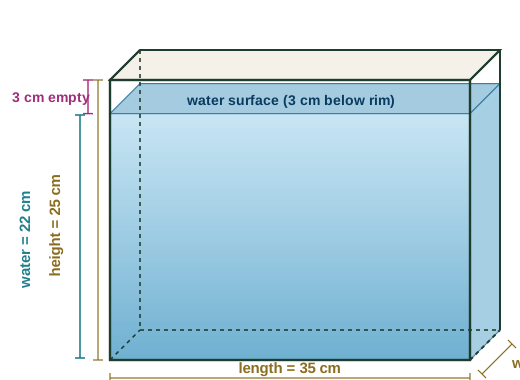
Practice — Fish tank volume (Regents Geometry, June 2026, Part I § 4)
A fish tank in the shape of a rectangular prism has dimensions 35 cm by 17 cm by 25 cm. It is filled with water to a level of 3 cm from the top. Approximately how many liters of water are in the tank?
(Note: 1000 cm3 = 1 liter)
- 10
- 13
- 15
- 17
Answer: (2) 13 liters.
Step 1 — Identify the three edge lengths. The tank has length l = 35 cm, width w = 17 cm, total height htotal = 25 cm.
Step 2 — Find the effective water height. The water level is 3 cm from the top, so the water column reaches from the bottom up to 25 − 3 = 22 cm. Use hwater = 22 cm for the volume calculation. Every Regents "fills to X from the top" phrasing is a signal to subtract from the total height first.
Step 3 — Apply V = lwh.
V = 35 × 17 × 22
V = 35 × 17 = 595
V = 595 × 22 = 13{,}090 cm³
Step 4 — Convert cubic centimeters to liters. Since 1000 cm³ = 1 L, divide by 1000:
V = 13{,}090 ÷ 1000 = 13.09 L ≈ 13 L.
The correct answer is (2) 13 liters.
Why the distractors trap real students:
- (1) 10 — a student who reads the problem too fast and uses h = 15 (subtracting 10 instead of 3, or dividing wrong), or who slips a factor of 10 somewhere in the arithmetic, lands around 10.
- (3) 15 — the classic "used the full height" trap. 35 × 17 × 25 = 14{,}875 cm³ ≈ 15 L. Any student who forgets to subtract the 3 cm of empty space picks this answer. This is why reading carefully for "from the top" / "from the bottom" is a Regents survival skill.
- (4) 17 — the width itself, sold as an answer. It's the face-value trap: a student who panics and doesn't do the multiplication may grab a number from the problem statement.
The SOMATH 4-second Regents template for prism-container questions:
- Read the problem twice — identify total dimensions vs. "filled to" or "empty" measurements.
- Draw the box, label l, w, and the effective h (subtract any empty layer).
- Multiply the three: V = lwh. Do the arithmetic left to right.
- Convert cm3 → L by dividing by 1000, and check the answer is in the right order of magnitude.
Common mistakes on rectangular prism questions
- Using the wrong formula. V = lwh is volume; SA = 2(lw + lh + wh) is surface area. Read the question carefully — "how much water fits" is volume, "how much paint / wrapping paper" is surface area.
- Forgetting to square in surface area. Some students write SA = 2(l + w + h) — that's the perimeter of nothing. Surface area needs products of edges (lw, lh, wh), not sums.
- Mixing up cubic and square units. Volume is always cubic units (cm3, in3, ft3). Surface area is always square units (cm2, in2, ft2). A Regents answer choice with the wrong units is usually a distractor.
- Confusing which edge is l, w, or h. It doesn't matter for volume (multiplication is commutative), but it does matter for lateral area (which uses only l, w, and h in a specific pattern) and for identifying which face is a base.
- Forgetting to subtract for "filled to X from the top." This is the exact trap in the June 2026 fish-tank question. Always compute the effective water height first.
- Confusing face diagonal with space diagonal. The face diagonal uses two edges. The space diagonal uses all three. If the question says "the longest line that fits inside the box," that's the space diagonal.
- Applying the wrong power in scale-factor questions. Under k: edges k, area k2, volume k3. A student who uses k2 for volume will pick the wrong Regents answer.
- Rounding too early. Do the full multiplication, then convert, then round. Rounding after the first step introduces error and shifts an answer between two Regents choices.
- Ignoring the unit conversion. The Regents will give the answer in liters or gallons even though the dimensions are in centimeters or inches. Convert cm3 → L by dividing by 1000, or in3 → gal by dividing by 231.
The rectangular prism topic at a glance
| Quantity | Formula | Units | Regents cue words |
|---|---|---|---|
| Volume | V = lwh |
cubic (cm3, in3, m3, L, gal) | "how much fits," "capacity," "how many liters," "how many cubic feet" |
| Surface area (total) | SA = 2(lw + lh + wh) |
square (cm2, in2, m2, ft2) | "wrapping paper," "cover the outside," "paint all six faces" |
| Lateral area | LA = 2h(l + w) |
square | "paint the walls," "label around the box," "sides only" |
| Face diagonal | d = √(a² + b²) |
length | "diagonal of one face," "across the top" |
| Space diagonal | D = √(l² + w² + h²) |
length | "longest line inside," "corner to opposite corner" |
| Scale factor k | edges × k, area × k², volume × k³ |
— | "dilate," "scale by," "each edge doubled/tripled" |
How this ties to earlier posts in the SOMATH Regents series
- Regents Geometry Rigid Transformations — the isometries (translation, reflection, rotation). Rigid transformations preserve volume and surface area exactly — they only move the prism, not resize it.
- Regents Geometry Non-Rigid Transformations (Dilation) — the same k / k2 / k3 scale-factor rule, worked in the 2-D setting. This post extends it to solids.
- Parallel Lines in a Triangle & the Midsegment Theorem — the proportionality theorems the Regents combines with prism questions on Part III and IV coordinate proofs.
- Sine, Cosine & Tangent — SOH-CAH-TOA — when a Regents problem asks for the angle between a space diagonal and a base, you'll combine D = √(l²+w²+h²) with trig.
- Regents Geometry June 2026 — Part II Answers & Explanations — the full worked June 2026 exam, including prism-related applications.
How SOMATH teaches rectangular prisms (K–12 arc)
- Little Newtons (grades 1–2): physical unit cubes, counting cubes to find volume, sorting real boxes by which is "bigger" — the intuitive foundation for volume.
- Kid Einsteins (grades 3–5): introduction to V = lwh in Grade 5 (Common Core 5.MD), area of composite figures, and the difference between area (square units) and volume (cubic units).
- Young Fermats (grades 5–8): surface area of prisms and cylinders, unit conversions (cm3 to mL to L), nets, and multi-step word problems — the exact substrate the Regents Geometry exam draws from.
- High-school Geometry: full theorem-and-proof treatment — space diagonal derived from the Pythagorean Theorem in three dimensions, the k / k2 / k3 scale-factor rule under similarity, and Regents Part I–IV applications like the June 2026 fish-tank question.
Our high-school Geometry teachers hold degrees from Harvard, Northwestern, Columbia, and NYU. Every SOMATH student who has taken the January or June Geometry Regents has scored proficient or higher.
Quick memory tips for the Regents
- Volume is cubic. Surface area is square. If the Regents answer choices are in cm3, you're finding volume; if they're in cm2, surface area. Match units first, then compute.
- "From the top" means subtract. Whenever a tank problem says "filled to X from the top" or "empty for X at the top," subtract from the total height to get the effective water height.
- Diagonals = Pythagoras. Face diagonal uses two edges; space diagonal uses all three. Both are just the Pythagorean Theorem, applied once or twice.
- Scale factor rule: k, k2, k3. Edges scale by k, areas by k2, volumes by k3. When the Regents says "each dimension is doubled," volume multiplies by 8, not 2.
- Convert last. Do the multiplication in the given units (usually cm3), then convert to the answer's units (usually L or gal) as the final step. Divide by 1000 for cm3 → L; divide by 231 for in3 → gal.
Book a free math enrichment evaluation
If your child is preparing for the January or June Regents Geometry — or building toward Geometry through middle-school Common Core — the fastest way to know where they stand is a real diagnostic. Book a free 30-minute in-person evaluation at SOMATH. Your child works one-on-one with a SOMATH teacher, and you receive a written diagnostic within 48 hours — specifically what your child has mastered, where the gaps are, and what to work on next. Yours to keep whether you enroll or not.
SOMATH is at 226 West 79th Street, first floor, between Broadway and Amsterdam. Phone (646) 668-6151. See our weekly class schedule or browse all courses grades 1–12.
Related reading: Parallel Lines in a Triangle & the Midsegment Theorem · Sine, Cosine & Tangent — SOH-CAH-TOA · Regents Geometry Non-Rigid Transformations · Regents Geometry Rigid Transformations · Regents Geometry June 2026 Part II Answers · Best Math Enrichment on the Upper West Side.
Free 30-minute evaluation
Ready for Regents Geometry? Let’s find out.
Book a free 30-minute one-on-one evaluation. We’ll diagnose exactly where your child stands on volume, surface area, diagonals, scale factors, and the rest of the Regents Geometry arc, and send a written summary within 48 hours — yours to keep whether you enroll or not.
Book a Free EvaluationSee if a SOMATH class is a fit for your child
We run in-person small-group classes on the Upper West Side, K–12, from Little Newtons in Grade 1 through AP Calculus, SAT Math, and Regents Geometry / Algebra in high school. Every family starts with a free 30-minute in-person evaluation and a written diagnostic within 48 hours — yours to keep whether you enroll or not.