Algebra 1 · Class 16 · Grades 7–8
Absolute-Value Equations and Inequalities: Graphing and Solving
Absolute value measures distance. Solve an absolute-value equation by isolating the bars and considering the valid cases; solve an inequality by deciding whether its solutions lie between two bounds or outside them. Check every endpoint and represent the solution on a number line.
Study the eight images and try five new questions after each image. Finish with eight homework review questions and twelve homework word problems: 20 homework questions and 60 questions altogether. Try each question before selecting its blue Answer control.
Part of Algebra 1 at SOMATH. Use algebra, substitution, and number-line sketches to justify each answer. View the class schedule or book a free evaluation to find the right starting point.
Download the student workbook (PDF)22 pages · Supplied cover, eight teaching images, and all 60 questions. Each image is followed by five practice questions; homework follows with up to five questions per page.Numbered pages, generous blank answer space, and no exercise solutions or writing lines.
Absolute value as distance
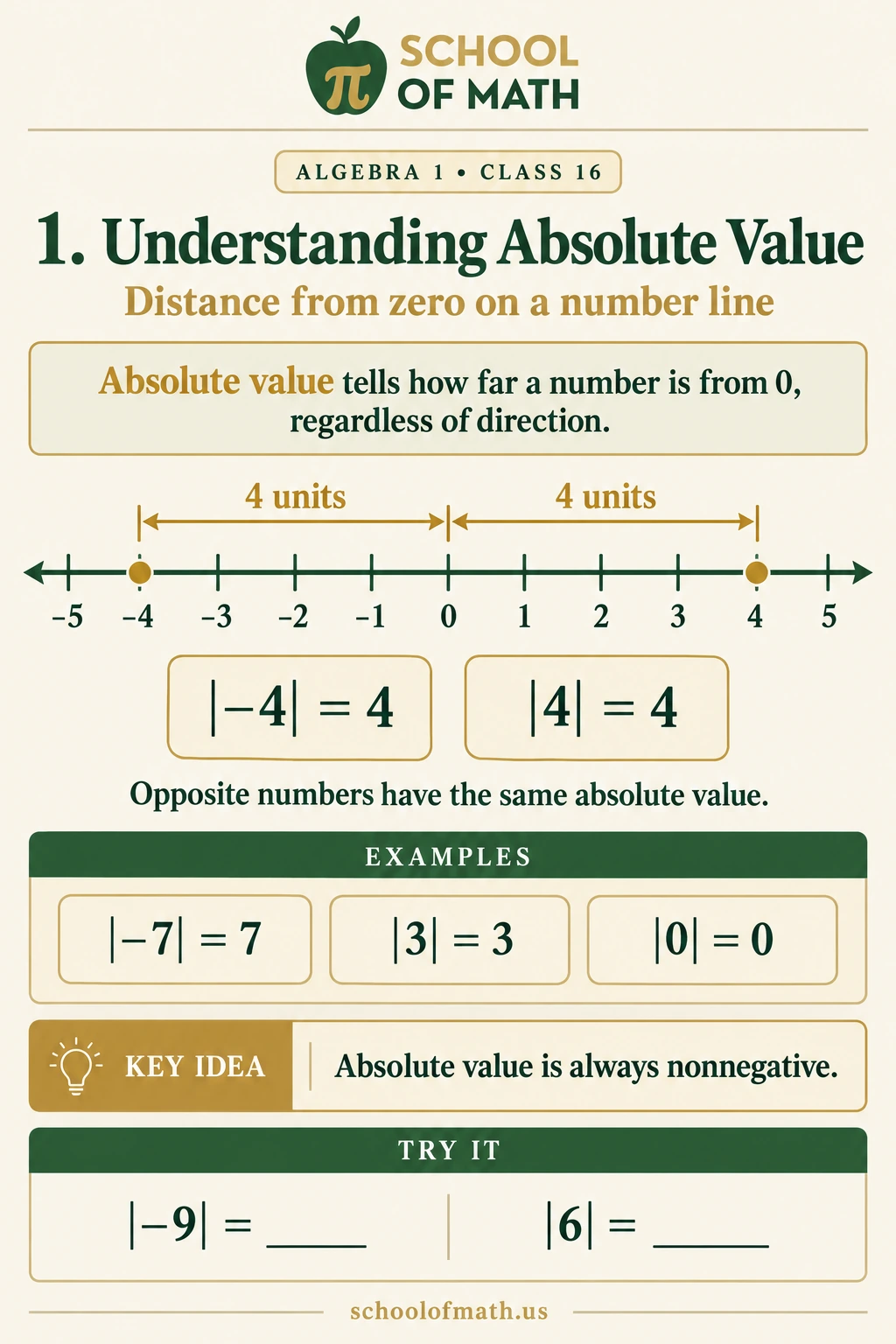
Absolute value measures distance from zero, so it is never negative. Opposite numbers have the same absolute value. Zero has distance zero from itself.
The bars apply only to what is inside them. For a real number a, |a| equals a when a ≥ 0 and equals −a when a < 0. The expression −a in the second case is positive because a is negative.
The distance between two numbers a and b is |a − b|. A point c units from zero can lie on either side when c > 0.
Try it yourself: five questions
Q1 Practice 1 of 5
Evaluate |−13| and describe the distance it represents.
Answer
13.
The point −13 is 13 units from zero.
Q2 Practice 2 of 5
Which is farther from zero, −11 or 8? By how many units?
Answer
−11 is farther by 3 units.
Their distances are 11 and 8; 11 − 8 = 3.
Q3 Practice 3 of 5
Write the two numbers exactly 12 units from zero.
Answer
−12 and 12.
Move 12 units left and 12 units right from zero.
Q4 Practice 4 of 5
Find the distance between −7 and 5.
Answer
12.
Compute |−7 − 5| = |−12| = 12 units.
Q5 Practice 5 of 5
If a < 0, simplify |a| + a. Explain without choosing a particular number.
Answer
0.
For negative a, |a| = −a. Therefore |a| + a = −a + a = 0.
Evaluating expressions
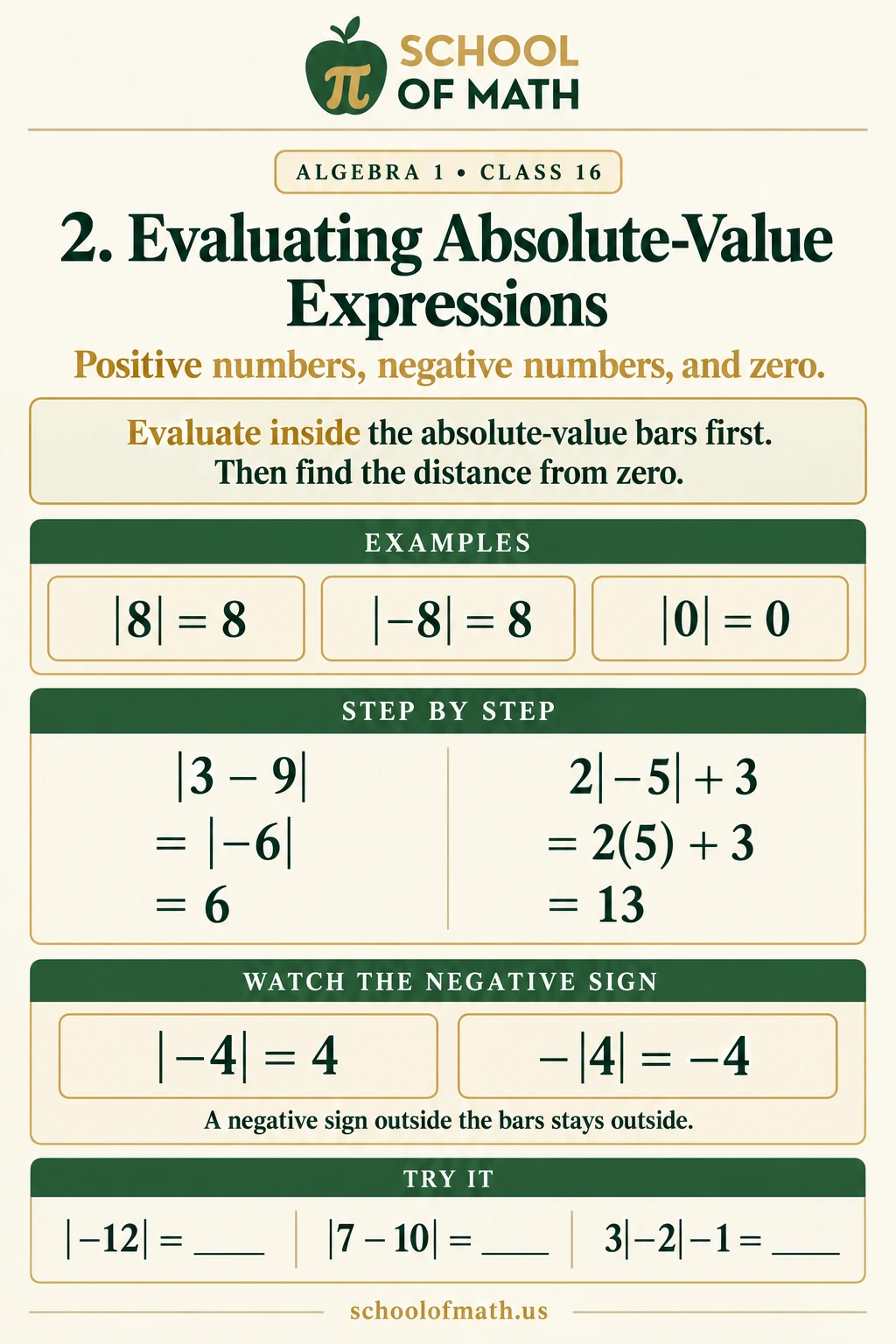
Follow the order of operations inside the absolute-value bars first. Then replace the absolute value with its nonnegative value and finish the operations outside.
A minus sign outside the bars is not removed. Thus −|a| is nonpositive, while |−a| is nonnegative. With several sets of bars, evaluate each separately.
For nested absolute values, start with the innermost bars. Treat fractions and decimals the same way as integers.
Try it yourself: five questions
Q6 Practice 1 of 5
Evaluate |8 − 15|.
Answer
7.
Subtract inside first: 8 − 15 = −7. Its absolute value is 7.
Q7 Practice 2 of 5
Evaluate −|−9| + 4.
Answer
-5.
|−9| = 9; the outside minus gives −9, then −9 + 4 = −5.
Q8 Practice 3 of 5
Evaluate 4|2 − 6| − 3.
Answer
13.
The inside equals −4. Then 4(4) − 3 = 13.
Q9 Practice 4 of 5
Evaluate |−3/2| + |1/4 − 1|.
Answer
9/4.
The two distances are 3/2 and 3/4. Add them to get 9/4.
Q10 Practice 5 of 5
Evaluate |2 − |−7|| − |3 − 8|.
Answer
0.
The nested part is |2 − 7| = 5. The other absolute value is 5, so 5 − 5 = 0.
Solving two-case equations
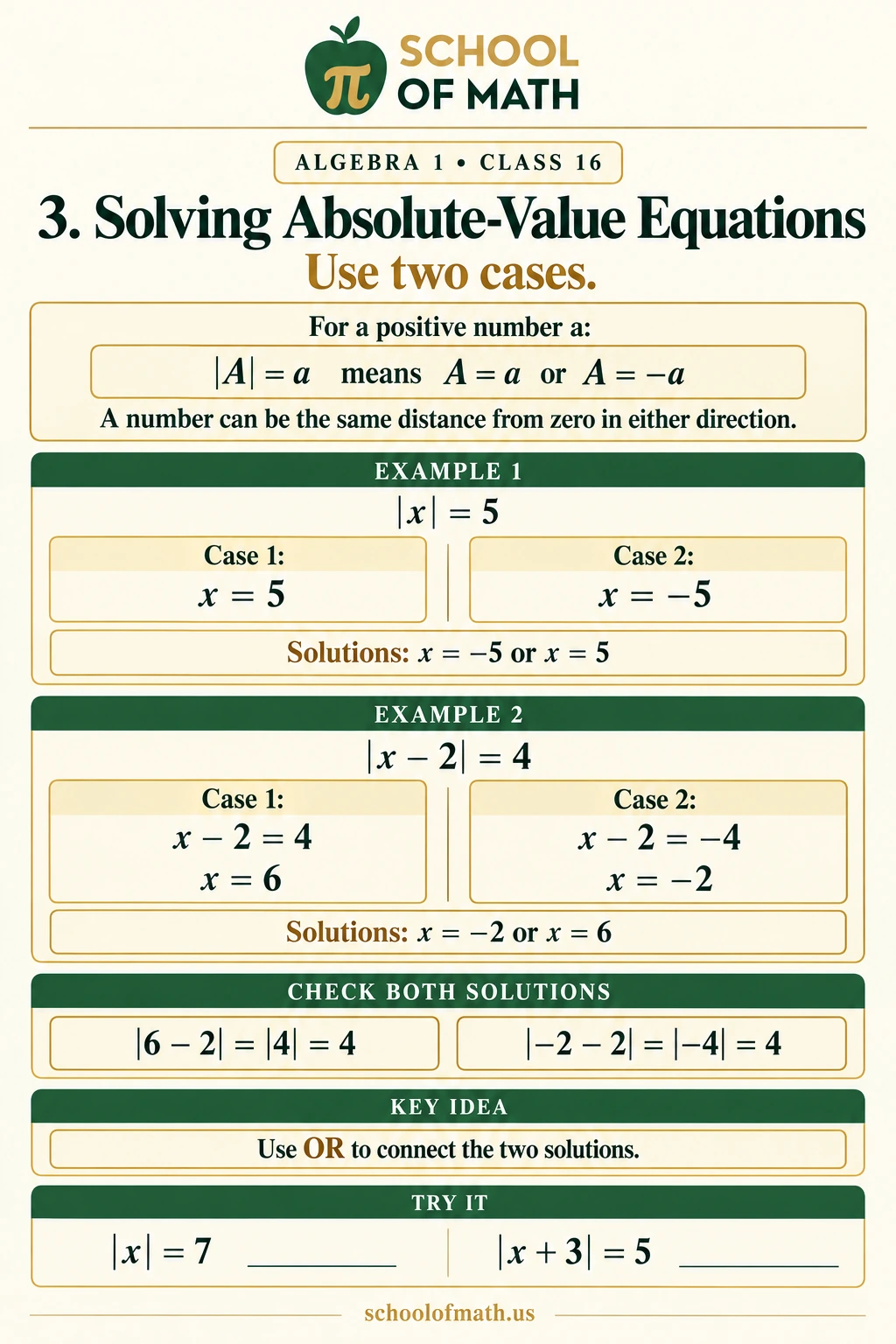
When k > 0, |A| = k means A = k or A = −k. Solve both equations; choosing just the positive case misses a possible solution.
For |x − c| = k, the solutions are c − k and c + k. They are equally far from the center c.
Substitute every candidate into the original equation. On a number line, an equation with two distinct solutions is shown by two filled points, not by shading between them.
Try it yourself: five questions
Q11 Practice 1 of 5
Solve |x| = 9.
Answer
x = -9 or x = 9.
The two cases are x = 9 and x = −9. Both have absolute value 9.
Q12 Practice 2 of 5
Solve |x + 5| = 8.
Answer
x = -13 or x = 3.
Set x + 5 = 8 or x + 5 = −8. Subtract 5 in each case.
Q13 Practice 3 of 5
Solve |x − 7| = 3 and plot the solutions.
Answer
x = 4 or x = 10.
The center is 7. Move 3 units left or right to get 4 and 10; plot two filled points only.
Q14 Practice 4 of 5
Solve |2x − 1| = 7.
Answer
x = -3 or x = 4.
2x − 1 = 7 gives x = 4; 2x − 1 = −7 gives x = −3. Substitution gives |7| or |−7|.
Q15 Practice 5 of 5
Solve |3x + 2| = 1.
Answer
x = -1 or x = -1/3.
3x + 2 = 1 gives x = −1/3. The negative case gives 3x + 2 = −1, so x = −1.
Isolating before splitting
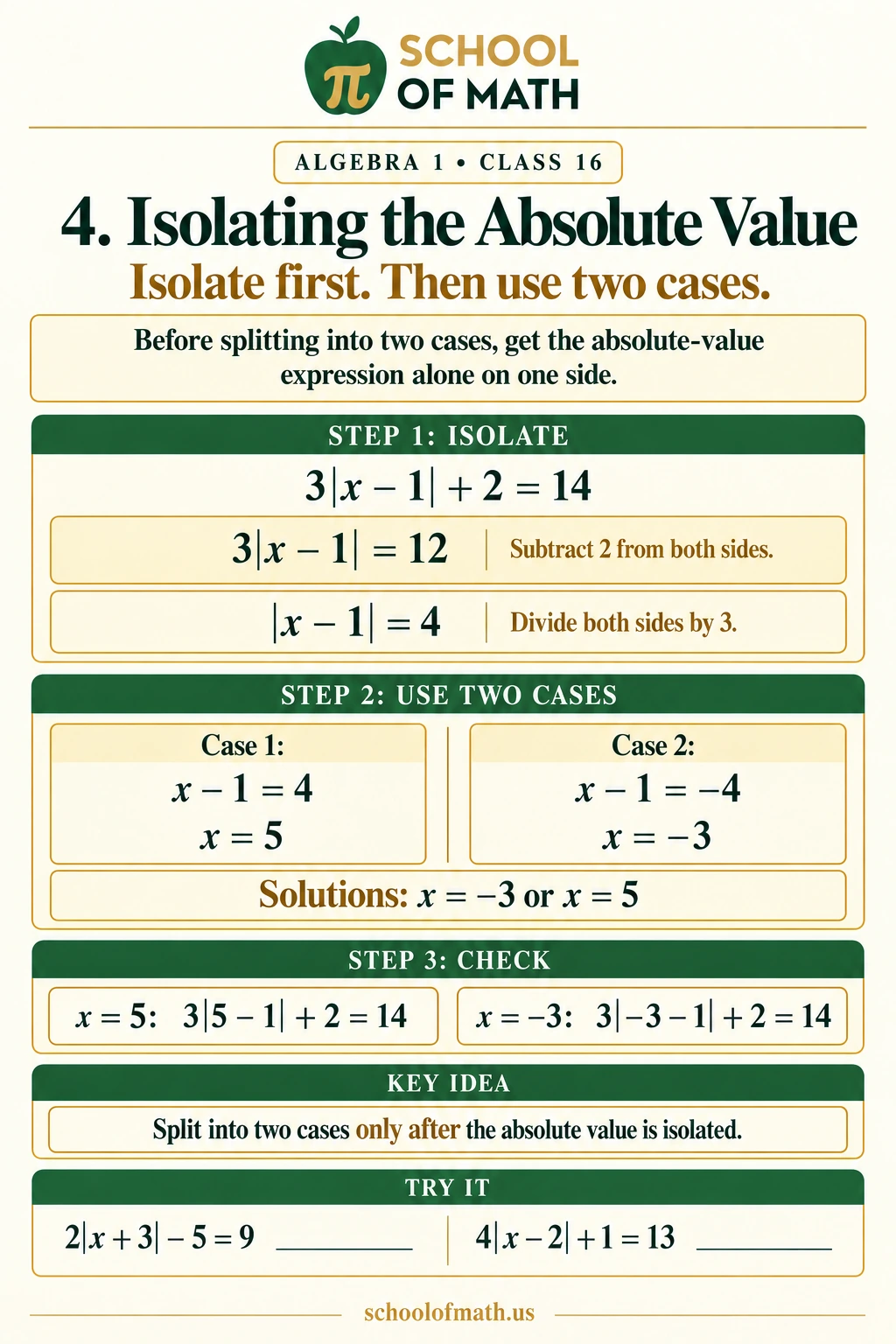
Undo addition or subtraction outside the bars, then undo the outside multiplication or division. Only split into two cases after one absolute-value expression is isolated.
Keep the complete expression inside the bars intact. For example, subtracting an outside constant is different from changing a constant inside the bars.
An outside negative coefficient is allowed. Divide by it carefully, then inspect the resulting right-hand side before solving.
Try it yourself: five questions
Q16 Practice 1 of 5
Solve |x − 5| + 4 = 10.
Answer
x = -1 or x = 11.
Subtract 4 to get |x − 5| = 6. Then x − 5 = ±6, giving −1 and 11.
Q17 Practice 2 of 5
Solve 5|x + 1| = 20.
Answer
x = -5 or x = 3.
Divide by 5. Solve x + 1 = 4 or −4; check both in the original equation.
Q18 Practice 3 of 5
Solve 2|x − 4| + 3 = 15.
Answer
x = -2 or x = 10.
Subtract 3 and divide by 2. Then x − 4 = 6 or −6. Both produce 2(6) + 3 = 15.
Q19 Practice 4 of 5
Solve 3|2x + 1| − 4 = 11.
Answer
x = -3 or x = 2.
Add 4 and divide by 3 to get |2x + 1| = 5. Solve 2x + 1 = ±5.
Q20 Practice 5 of 5
Solve 8 − 2|3x − 2| = 0.
Answer
x = -2/3 or x = 2.
Subtract 8, then divide by −2: |3x − 2| = 4. Solve 3x − 2 = 4 or −4.
No solution, one solution, and checking
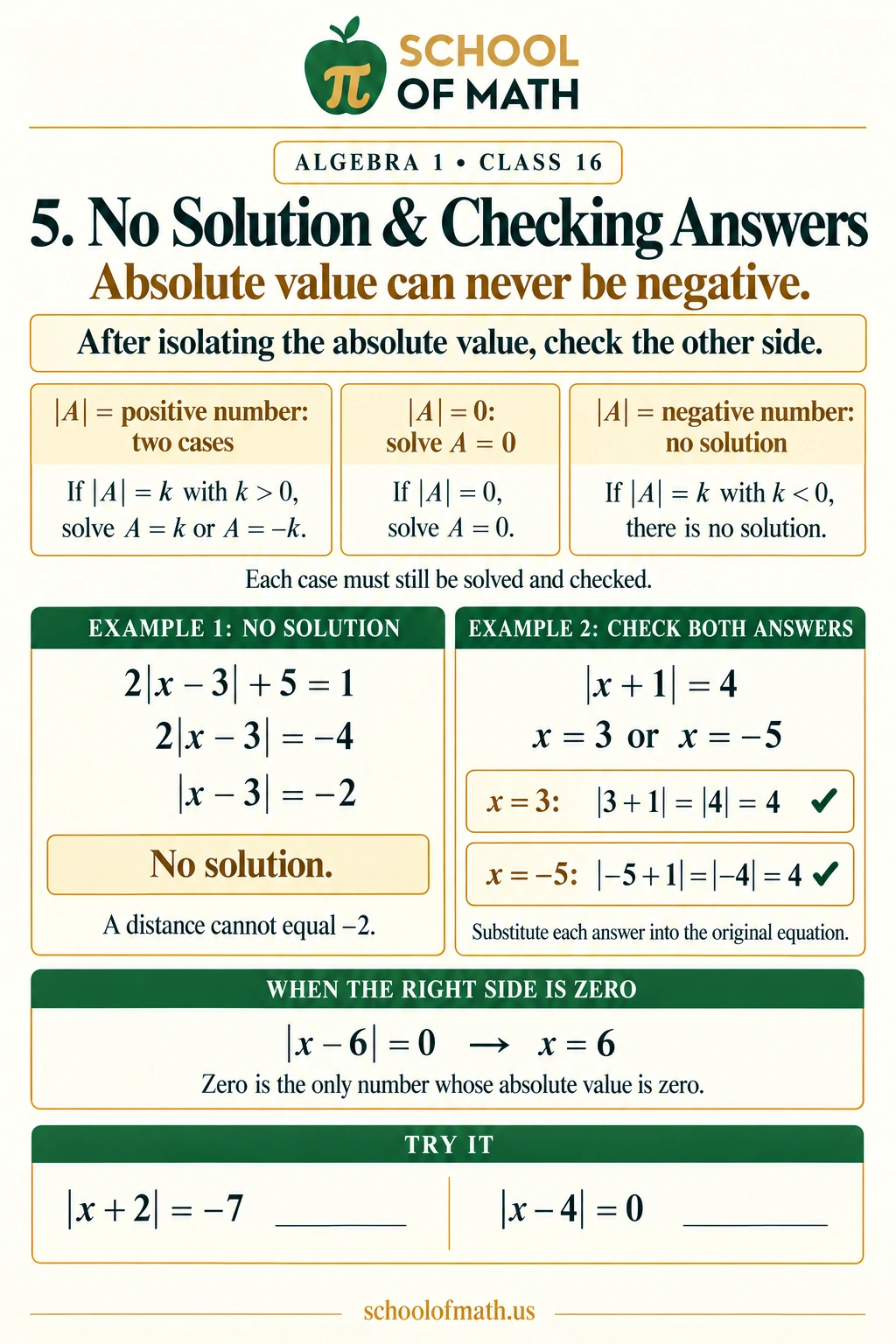
For an isolated equation |A| = k, a negative k is impossible. If k = 0, solve A = 0. If k > 0, solve the positive and negative cases.
The number of final solutions depends on the expression inside the bars. For the nonconstant linear expressions in this lesson, those three cases give zero, one, or two solutions respectively.
Check candidates in the original equation, not only in a rearranged version. An equation that looks negative on one side may still be possible before you isolate its absolute value.
Try it yourself: five questions
Q21 Practice 1 of 5
Solve |x − 9| = −4.
Answer
No solution.
A distance cannot equal −4. Do not split a negative bound into two cases.
Q22 Practice 2 of 5
Solve |2x + 8| = 0.
Answer
x = -4.
The expression inside must equal zero: 2x + 8 = 0, so x = −4.
Q23 Practice 3 of 5
Solve 4|x − 2| + 6 = 2.
Answer
No solution.
Subtract 6 and divide by 4 to obtain |x − 2| = −1. This is impossible.
Q24 Practice 4 of 5
Solve −3|x + 4| = −15.
Answer
x = -9 or x = 1.
Divide by −3 first: |x + 4| = 5. The original negative right side did not mean no solution.
Q25 Practice 5 of 5
A student says |x − 3| = 8 has solutions 11 and −11. Check both and correct the answer.
Answer
The correct solutions are −5 and 11.
For 11, |11 − 3| = 8. For −11, |−11 − 3| = 14, so it fails. The negative case is x − 3 = −8, giving x = −5.
Less than: between the bounds
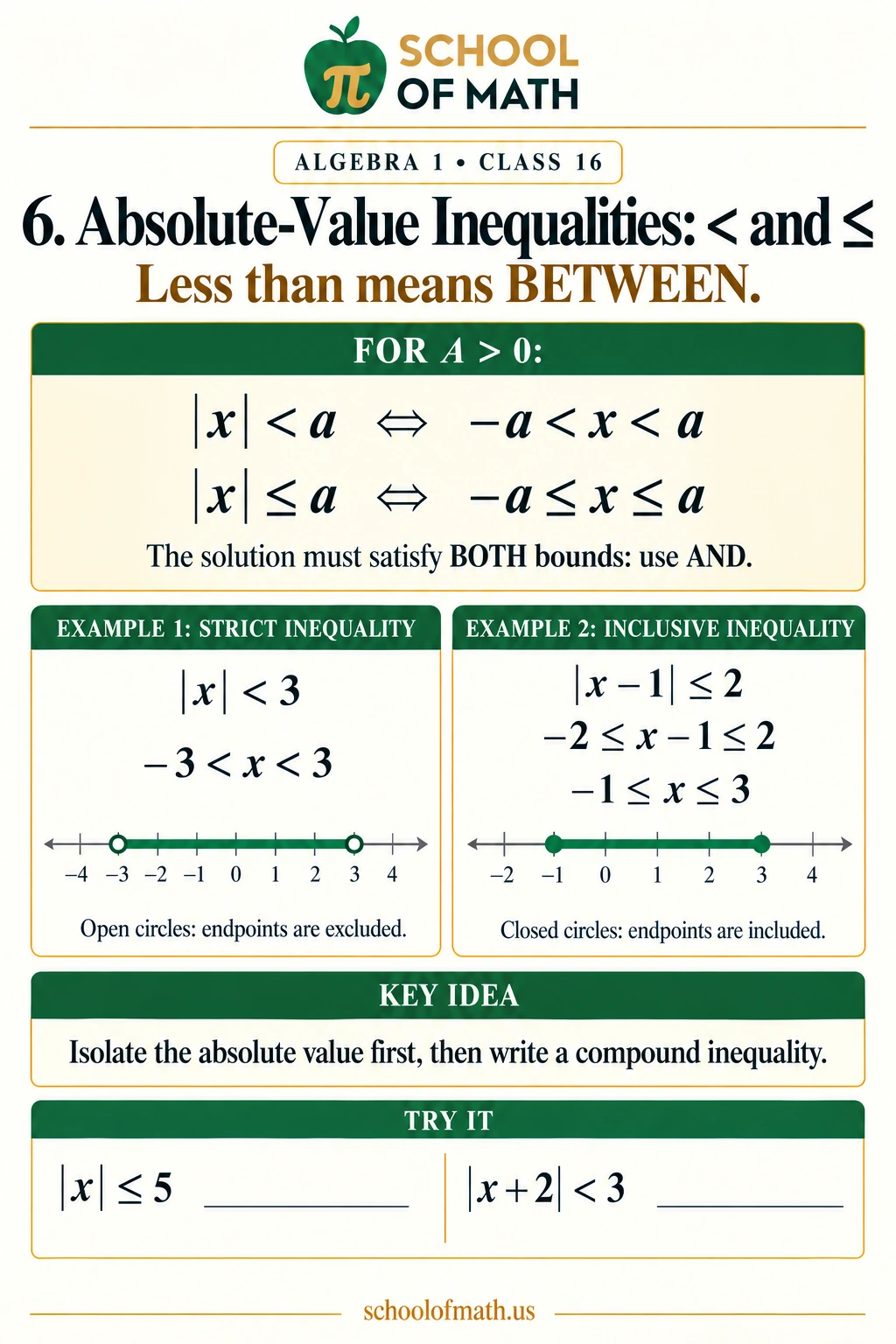
For k > 0, |A| < k means −k < A < k; use AND because both bounds must hold. Replace both signs with ≤ when the endpoints are allowed.
Solve the compound inequality by doing the same operation to all three parts. If you multiply or divide by a negative number, reverse both inequality signs.
Shade the interval between the endpoints. Open circles exclude endpoints; filled circles include them. Parentheses in interval notation mean excluded endpoints, while square brackets mean included endpoints. If the bound is zero or negative, use nonnegativity first instead of the positive-bound shortcut.
Try it yourself: five questions
Q26 Practice 1 of 5
Solve and graph |x| < 6.
Answer
-6 < x < 6.
Write −6 < x < 6. Use open circles at −6 and 6 and shade between them. Interval: (−6, 6).
Q27 Practice 2 of 5
Solve and graph |x − 4| ≤ 3.
Answer
1 ≤ x ≤ 7.
Write −3 ≤ x − 4 ≤ 3 and add 4 to all parts. Fill both endpoints and shade between them. Interval: [1, 7].
Q28 Practice 3 of 5
Solve and graph |2x + 3| < 7.
Answer
-5 < x < 2.
Write −7 < 2x + 3 < 7. Subtract 3, then divide by 2. Use open endpoints. Interval: (−5, 2).
Q29 Practice 4 of 5
Solve and graph 3|x + 1| − 2 ≤ 10.
Answer
-5 ≤ x ≤ 3.
Add 2 and divide by 3: |x + 1| ≤ 4. Then −4 ≤ x + 1 ≤ 4, so subtract 1. Interval: [−5, 3].
Q30 Practice 5 of 5
Solve and graph |5 − 2x| < 3.
Answer
1 < x < 4.
Write −3 < 5 − 2x < 3. Subtract 5: −8 < −2x < −2. Divide by −2 and reverse both signs: 4 > x > 1. Interval: (1, 4).
Greater than: outside the bounds
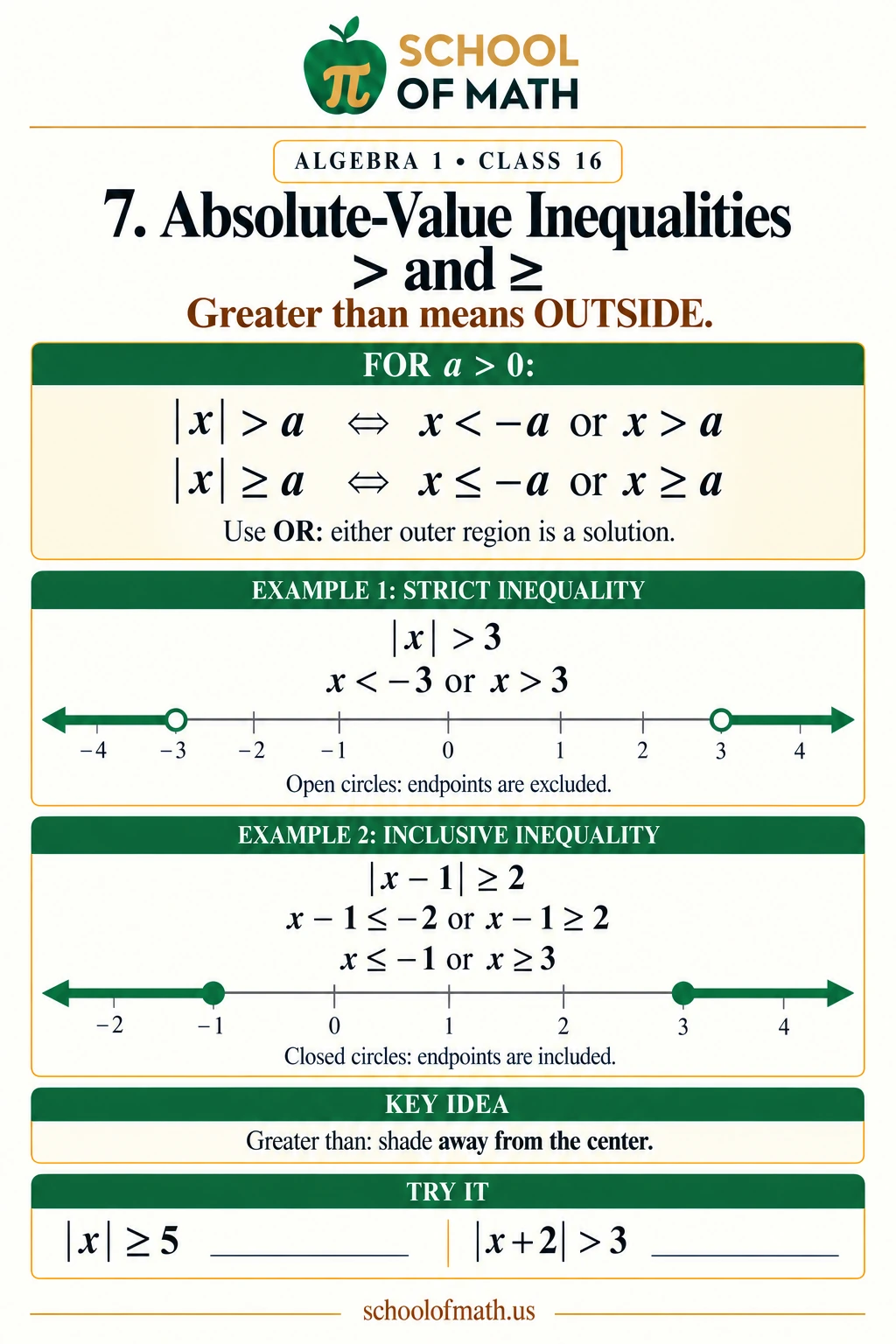
For k > 0, |A| > k means A < −k OR A > k. For ≥, include both boundary values. Shade away from the center in two separate rays.
Solve each branch independently. In interval notation, the union symbol ∪ joins the two outer intervals. Infinity is not an endpoint you can include, so always use parentheses beside infinity.
Special cases matter: |A| < 0 has no solution; |A| ≤ 0 means A = 0; |A| ≥ 0 holds for every real input where A is defined; |A| > 0 excludes the zeros of A. Any absolute value is greater than any negative number.
Try it yourself: five questions
Q31 Practice 1 of 5
Solve and graph |x| > 8.
Answer
x < -8 or x > 8.
Split into x < −8 or x > 8. Use open circles and shade outward. Intervals: (−∞, −8) ∪ (8, ∞).
Q32 Practice 2 of 5
Solve and graph |x + 4| ≥ 2.
Answer
x ≤ -6 or x ≥ -2.
Solve x + 4 ≤ −2 or x + 4 ≥ 2. Subtract 4 in each branch. Fill the endpoints and shade outward.
Q33 Practice 3 of 5
Solve and graph |3x − 6| > 9.
Answer
x < -1 or x > 5.
3x − 6 < −9 gives x < −1; 3x − 6 > 9 gives x > 5. Open endpoints; shade outward.
Q34 Practice 4 of 5
Solve and graph 2|x − 2| + 1 ≥ 11.
Answer
x ≤ -3 or x ≥ 7.
Subtract 1 and divide by 2: |x − 2| ≥ 5. Solve x − 2 ≤ −5 or x − 2 ≥ 5.
Q35 Practice 5 of 5
Solve each: (a) |x + 6| < 0; (b) |x + 6| ≥ 0; (c) |x + 6| > 0.
Answer
(a) No solution. (b) All real numbers. (c) x ≠ −6.
Absolute value is never negative and is always at least zero. It is strictly positive except when x + 6 = 0. For (c), graph an open circle at −6 and shade both directions.
Distance and tolerance
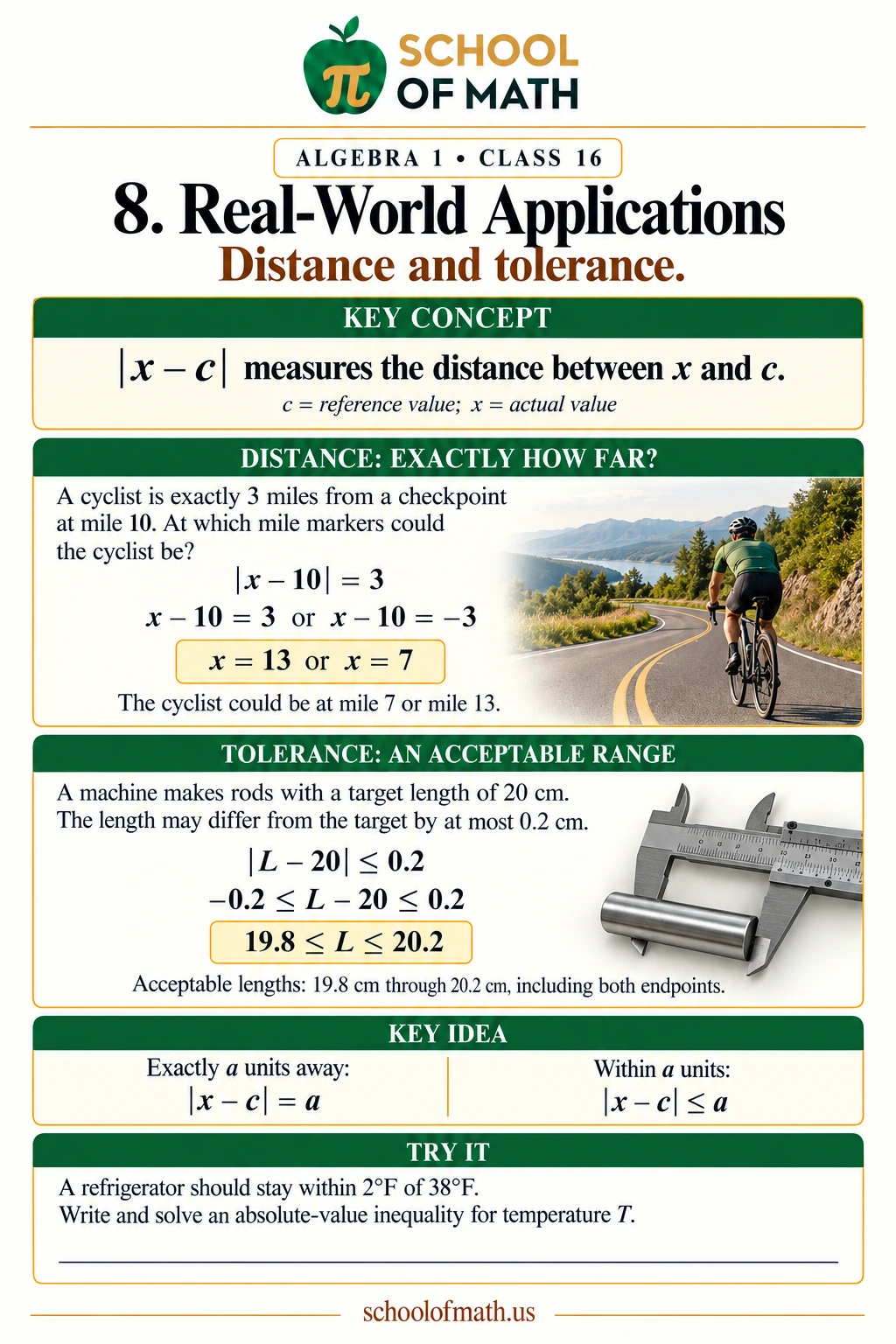
The expression |x − c| measures distance from a reference value c. Exactly r units away uses = r. At most r units away uses ≤ r. More than r units away uses > r.
A tolerance gives an acceptable range around a target. State the units and whether the endpoints are permitted. Translate the final solution back into the situation.
For an accepted interval [L, U], the center is (L + U)/2 and the tolerance is (U − L)/2. Check that contextual restrictions, such as nonnegative measurements or whole-number counts, still hold.
Try it yourself: five questions
Q36 Practice 1 of 5
A hiker is exactly 4 miles from mile marker 18. Write an equation and find both possible mile markers.
Answer
|x − 18| = 4; mile markers 14 and 22.
Solve x − 18 = 4 or −4. Both markers are 4 miles from 18.
Q37 Practice 2 of 5
A thermostat should remain within 3°C of 21°C, including the boundary temperatures. Write and solve an inequality.
Answer
|T − 21| ≤ 3; 18°C ≤ T ≤ 24°C.
“Within” includes both endpoints here. Add 21 to −3 ≤ T − 21 ≤ 3.
Q38 Practice 3 of 5
A package should weigh 500 g, with an allowed difference of at most 8 g. Is a 491 g package acceptable? Give the full accepted range.
Answer
No. The accepted range is 492 g ≤ w ≤ 508 g.
|w − 500| ≤ 8 gives 492 ≤ w ≤ 508. The package differs by |491 − 500| = 9 g, which exceeds 8 g.
Q39 Practice 4 of 5
A sensor sounds an alarm when temperature differs from 30°C by more than 5°C. Write and solve its alarm condition.
Answer
|T − 30| > 5; T < 25°C or T > 35°C.
Use two outer regions because the difference must exceed 5. Exactly 25°C and 35°C do not trigger this alarm.
Q40 Practice 5 of 5
A part is accepted when its length is between 7.85 cm and 8.15 cm, inclusive. Express the rule as one absolute-value inequality.
Answer
|L − 8| ≤ 0.15.
The midpoint is (7.85 + 8.15)/2 = 8 cm; half the width is (8.15 − 7.85)/2 = 0.15 cm. Include the endpoints.
Homework review
Complete one review question for each image, in order. Isolate the absolute value, state the cases, and check the endpoints where needed.
R1 Review image 1 of 8
Find the distance between −9 and 4, and explain why it is not negative.
Answer
13 units.
|−9 − 4| = |−13| = 13. Distance is nonnegative.
R2 Review image 2 of 8
Evaluate 2|5 − 12| − |−6|.
Answer
8.
The absolute values are 7 and 6. Then 2(7) − 6 = 8.
R3 Review image 3 of 8
Solve |x + 2| = 9.
Answer
x = -11 or x = 7.
Solve x + 2 = 9 or −9, then subtract 2.
R4 Review image 4 of 8
Solve 4|2x − 3| + 1 = 21.
Answer
x = -1 or x = 4.
Subtract 1 and divide by 4: |2x − 3| = 5. Solve 2x − 3 = ±5.
R5 Review image 5 of 8
Solve 7 − |x − 1| = 9 and explain the result.
Answer
No solution.
Subtract 7, then multiply by −1: |x − 1| = −2. No distance is negative.
R6 Review image 6 of 8
Solve and graph |2x − 4| ≤ 6.
Answer
-1 ≤ x ≤ 5.
−6 ≤ 2x − 4 ≤ 6. Add 4 and divide by 2. Fill endpoints and shade between.
R7 Review image 7 of 8
Solve and graph |2x + 4| > 8.
Answer
x < -6 or x > 2.
Solve 2x + 4 < −8 or 2x + 4 > 8. Open endpoints; shade outward.
R8 Review image 8 of 8
A bottle targets 250 mL with a tolerance of 4 mL, including both limits. Write and solve the rule.
Answer
|V − 250| ≤ 4; 246 mL ≤ V ≤ 254 mL.
Use ≤ for a difference of at most 4, then add 250 to both bounds.
Homework word problems
These twelve problems complete the 20-question homework. Define the variable, write an absolute-value model, solve it, and check units and contextual restrictions.
W1 Homework word problem 1 of 12
A submarine is at −16 m relative to sea level. How far is it from sea level?
Answer
16 m.
|−16| = 16. Its position is negative, but its distance is not.
W2 Homework word problem 2 of 12
One floor is labeled −3 and another is labeled 8. How many floor intervals separate them?
Answer
11 floor intervals.
The difference in labels is |8 − (−3)| = 11.
W3 Homework word problem 3 of 12
A treasure is exactly 6 m from a flag at position 15 m on a straight path. Find both positions.
Answer
9 m and 21 m.
|x − 15| = 6 gives x = 15 − 6 or 15 + 6.
W4 Homework word problem 4 of 12
A game awards 3 points for each unit a marker is from position 4. A player earns 18 points. Find the marker positions.
Answer
−2 and 10.
3|x − 4| = 18 becomes |x − 4| = 6. Solve x − 4 = ±6.
W5 Homework word problem 5 of 12
A room must stay within 2.5°C of 20°C, including the limits. Write the acceptable temperature interval.
Answer
17.5°C ≤ T ≤ 22.5°C.
|T − 20| ≤ 2.5 becomes −2.5 ≤ T − 20 ≤ 2.5. Add 20 throughout.
W6 Homework word problem 6 of 12
A balance accepts packets from 98 g through 102 g, inclusive. Write an absolute-value inequality and decide whether 102.1 g passes.
Answer
|w − 100| ≤ 2; 102.1 g does not pass.
The center is 100 g and the tolerance is 2 g. A 102.1 g packet differs by 2.1 g.
W7 Homework word problem 7 of 12
A runner must be less than 4 km from a station at kilometer 12. Write and graph the allowed positions x.
Answer
|x − 12| < 4; 8 < x < 16 km.
“Less than” excludes exactly 4 km away. Draw open circles at 8 and 16 and shade between.
W8 Homework word problem 8 of 12
An alarm activates when pressure is at least 7 kPa away from 50 kPa. Write and solve the condition for nonnegative pressure p.
Answer
|p − 50| ≥ 7; 0 ≤ p ≤ 43 or p ≥ 57 kPa.
The algebra gives p ≤ 43 or p ≥ 57. Apply the stated nonnegative domain to the first branch. The boundary pressures do activate the alarm.
W9 Homework word problem 9 of 12
A robot follows x = 2t + 1 meters, with time t ≥ 0 seconds. When is it exactly 5 m from position 9 m?
Answer
t = 1.5 s or 6.5 s.
|2t + 1 − 9| = 5 gives 2t − 8 = ±5. Both solutions are nonnegative and place the robot at 4 m or 14 m.
W10 Homework word problem 10 of 12
A sensor reading is R = 3t − 2 units for t ≥ 0 seconds. The safe reading differs from 10 by at most 6 units. Find the safe time interval.
Answer
2 ≤ t ≤ 6 seconds.
|3t − 2 − 10| ≤ 6 becomes −6 ≤ 3t − 12 ≤ 6. Add 12 and divide by 3. Both endpoints satisfy the time domain.
W11 Homework word problem 11 of 12
A rod must satisfy both |L − 25| ≤ 0.4 and |L − 25.2| ≤ 0.3, with lengths in centimeters. Find all accepted lengths.
Answer
24.9 cm ≤ L ≤ 25.4 cm.
The first interval is [24.6, 25.4]; the second is [24.9, 25.5]. “Both” means their intersection.
W12 Homework word problem 12 of 12
A drone moves along a straight track with x = 4t − 3 meters for 0 ≤ t ≤ 8 seconds. It is in a restricted zone when it is less than 5 m from position 13 m. Find the times outside the restricted zone, including its boundary.
Answer
0 ≤ t ≤ 2.75 or 5.25 ≤ t ≤ 8 seconds.
Outside means |(4t − 3) − 13| ≥ 5. Solve 4t − 16 ≤ −5 or ≥ 5 to get t ≤ 11/4 or t ≥ 21/4. Intersect with 0 ≤ t ≤ 8; the boundaries are allowed.
Quick questions and answers
What is absolute value?
Absolute value is distance from zero. It is always nonnegative. More generally, |x − c| is the distance between x and c.
Why do absolute-value equations have two cases?
For a positive distance k, an expression can equal k or −k and still have absolute value k. Solve both branches and check candidates in the original equation.
When is there no solution?
An isolated absolute value cannot equal a negative number. An inequality requiring an absolute value to be strictly less than zero also has no solution.
When should I use AND or OR?
For a positive bound, less-than absolute-value inequalities describe the region between two bounds and use AND. Greater-than inequalities describe the two outer regions and use OR.
How do I graph the endpoints?
Use open circles for strict inequalities and filled circles for inclusive inequalities. Shade between for less-than cases and outward for greater-than cases, after isolating the absolute value.
What changes when I divide an inequality by a negative number?
Reverse the inequality sign. If solving a three-part compound inequality, reverse both signs and then rewrite the bounds from smallest to largest.
What practice and homework are included?
The lesson has eight teaching images, five new class questions per image, eight homework review questions, and twelve homework word problems. All 60 questions have hidden worked answers online. The 22-page student workbook includes the supplied cover, all eight teaching images, and the same 60 questions with blank answer space and no exercise solutions.