Young Fermats · Algebra Ignite · Algebra 1 · Class 14
Introduction to Quadratic Equations: Solving by Factoring
To solve a quadratic equation by factoring, write one side as zero, factor the other side, and set each variable factor equal to zero. Solve the resulting linear equations, then check every answer in the original equation and in the context of the problem.
Work through eight images with five original questions after each image, increasing in difficulty. Then complete eight homework review questions and 12 homework word problems: 20 homework questions in total. All 60 questions include hidden, step-by-step answers.
Part of Young Fermats Algebra Ignite at SOMATH. Book an evaluation for placement, or see the class schedule.
Start with Class 13: factoring trinomials if you need a refresher. Here, factoring becomes a tool for solving equations. Practice uses different examples from the lesson images.
Download the student workbook (PDF) 22 pages · Cover, eight images with five practice questions each, eight homework review questions, and 12 homework word problems. Blank answer space throughout. Exercise answers are not included.
Recognizing quadratic equations
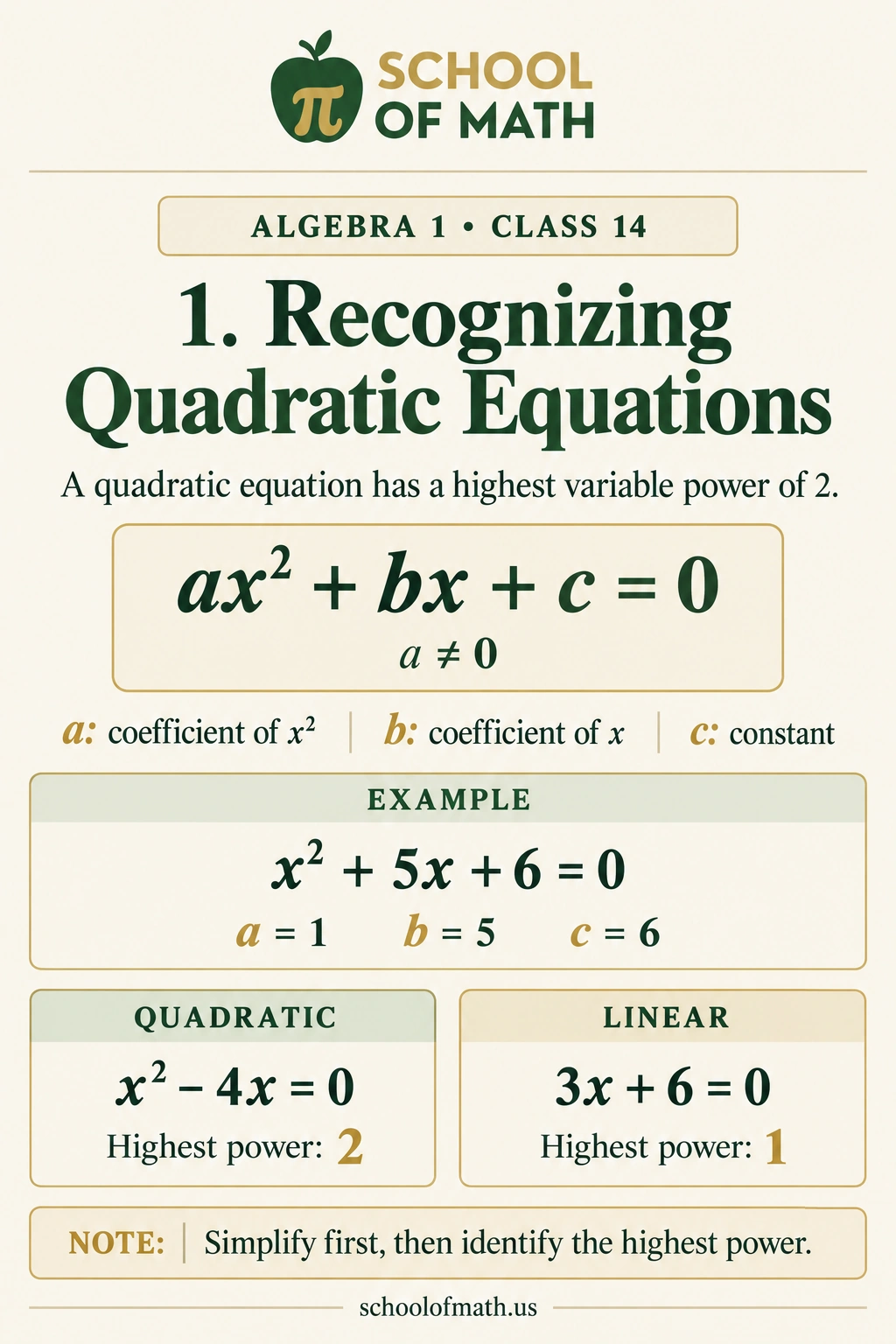
A quadratic equation becomes ax² + bx + c = 0 after simplification, with a ≠ 0. The highest remaining power of the variable is 2. Either b or c may be zero. Move terms and combine like terms before deciding: an x² term on each side may cancel. A quadratic expression alone is not an equation because it has no equality sign.
Try it yourself: five questions
Q1 Practice 1 of 5
Is \(x^2+8x+12=0\) quadratic? Identify a, b, and c.
Answer
Yes: a = 1, b = 8, c = 12.
- The equation is already in standard form.
- Its highest power is 2 and its quadratic coefficient is nonzero.
Q2 Practice 2 of 5
Classify \(5x-18=0\) as linear or quadratic. Explain.
Answer
Linear.
- The highest power of x is 1.
- There is no nonzero x² term, so this is not quadratic.
Q3 Practice 3 of 5
Is \(4x^2-36=0\) quadratic even though there is no x term? Give a, b, and c.
Answer
Yes: a = 4, b = 0, c = −36.
- Write the missing term as 0x.
- A quadratic equation does not need all three terms to be nonzero.
Q4 Practice 4 of 5
Simplify \(3x^2+2x=x^2+10\) into standard form, then identify a, b, and c.
Answer
\(2x^2+2x-10=0\); a = 2, b = 2, c = −10.
- Subtract x² + 10 from both sides.
- Combine 3x² − x² = 2x². The equation remains quadratic.
Q5 Practice 5 of 5
Is \(x(x+6)=x^2+18\) quadratic after simplification? Solve it.
Answer
No; it is linear after simplification, and x = 3.
- Expand the left side: x² + 6x = x² + 18.
- Subtract x² from both sides: 6x = 18.
- Divide by 6 to get x = 3. Check: 3(9) = 9 + 18 = 27.
Writing equations in standard form
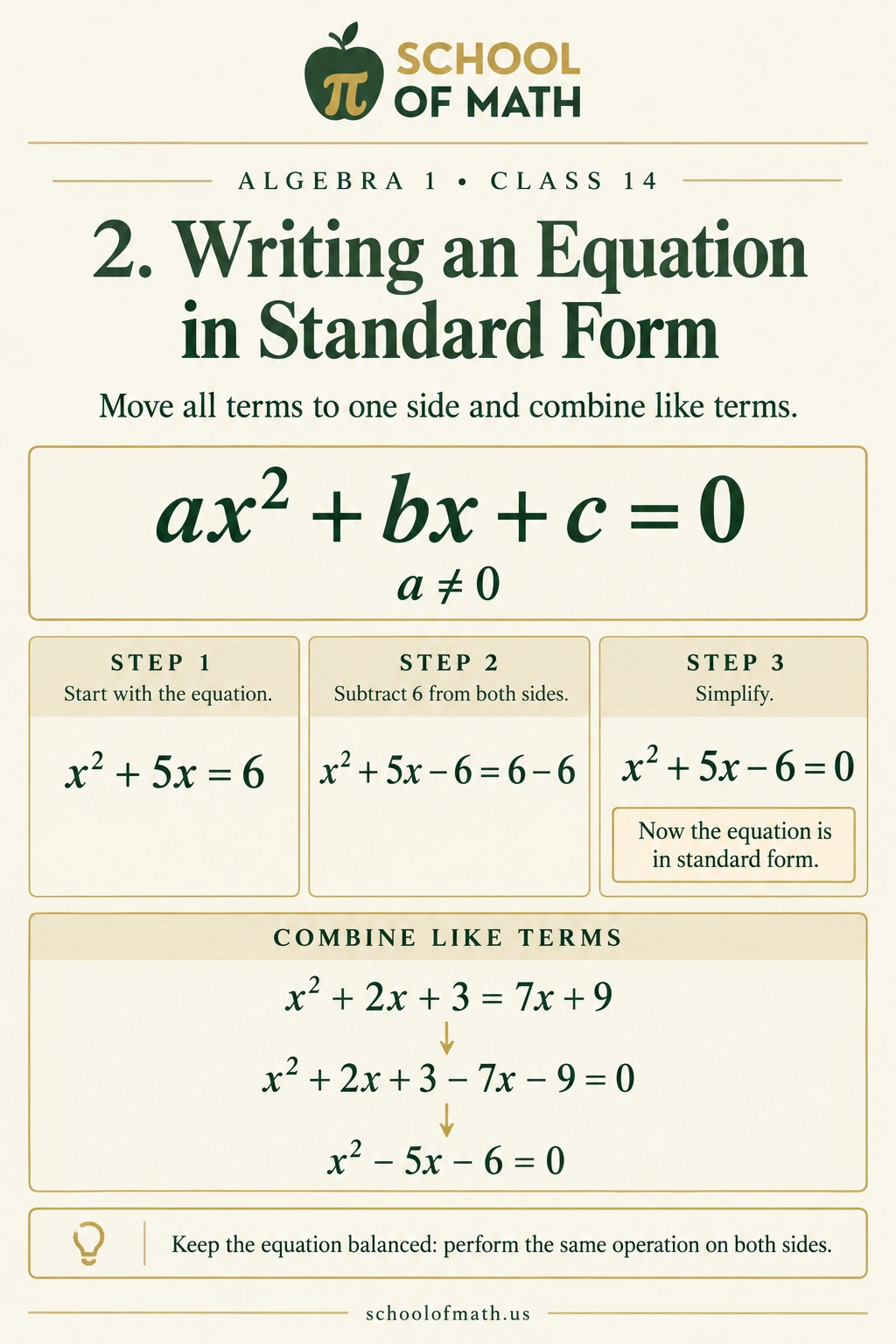
Before factoring to solve, make one side zero. Apply the same subtraction or addition to both sides, expand brackets when needed, and combine like terms. In standard form the terms are ordered by descending power. Factoring an expression is not enough: the equation must say that its product equals zero before the zero-product property applies.
Try it yourself: five questions
Q6 Practice 1 of 5
Write \(x^2+7x=18\) in standard form. Do not solve.
Answer
\(x^2+7x-18=0\).
- Subtract 18 from both sides.
- The constant moves as −18, not +18.
Q7 Practice 2 of 5
Write \(x^2=4x+21\) in standard form. Do not solve.
Answer
\(x^2-4x-21=0\).
- Subtract 4x and 21 from both sides.
- Keep the x² coefficient positive.
Q8 Practice 3 of 5
Write \(2x^2+5x+3=x+15\) in standard form. Do not solve.
Answer
\(2x^2+4x-12=0\).
- Subtract x + 15 from both sides.
- Combine 5x − x = 4x and 3 − 15 = −12. Dividing the entire equation by 2 is also valid.
Q9 Practice 4 of 5
Expand and write \(x(x+5)=24\) in standard form. Do not solve.
Answer
\(x^2+5x-24=0\).
- Distribute x: x(x + 5) = x² + 5x.
- Subtract 24 from both sides.
Q10 Practice 5 of 5
Expand both sides of \((x+2)(x+4)=3x+26\) and write standard form.
Answer
\(x^2+3x-18=0\).
- The left side expands to x² + 6x + 8.
- Subtract 3x + 26: x² + 3x − 18 = 0.
Using the zero-product property
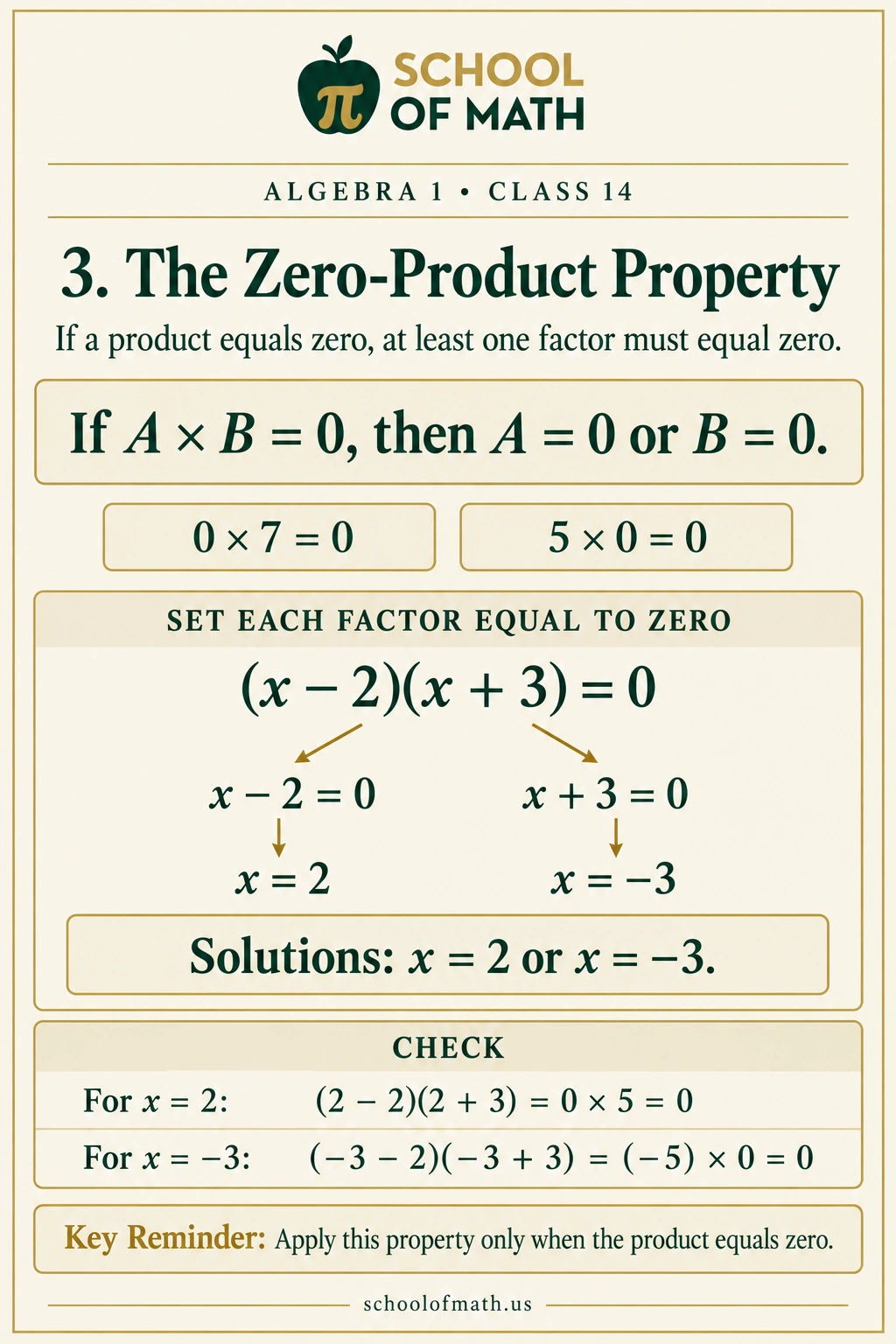
If two or more factors multiply to zero, at least one factor must be zero. Set each variable factor equal to zero separately; either equation can give a solution. A nonzero constant factor cannot equal zero. This rule does not apply directly when the product equals a nonzero number.
Try it yourself: five questions
Q11 Practice 1 of 5
Use the zero-product property to solve \((x-7)(x+4)=0\).
Answer
\(x=-4\) or \(x=7\).
- Put every term on one side: \(x^{2} - 3 x - 28=0\).
- Factor completely: \(\left(x - 7\right) \left(x + 4\right)=0\).
- Use the zero-product property: \(x - 7=0\) or \(x + 4=0\). Solve these linear equations.
- The solutions are \(x=-4\) or \(x=7\).
- Check in the original equation: \(x=-4\): \(0=0\); \(x=7\): \(0=0\).
Q12 Practice 2 of 5
Solve \(x(x+9)=0\). Do not divide by x.
Answer
\(x=-9\) or \(x=0\).
- Put every term on one side: \(x^{2} + 9 x=0\).
- Factor completely: \(x \left(x + 9\right)=0\).
- Use the zero-product property: \(x=0\) or \(x + 9=0\). Solve these linear equations.
- The solutions are \(x=-9\) or \(x=0\).
- Check in the original equation: \(x=-9\): \(0=0\); \(x=0\): \(0=0\).
Q13 Practice 3 of 5
Solve \((2x-5)(x+1)=0\). Keep fractional answers exact.
Answer
\(x=-1\) or \(x=\frac{5}{2}\).
- Put every term on one side: \(2 x^{2} - 3 x - 5=0\).
- Factor completely: \(\left(x + 1\right) \left(2 x - 5\right)=0\).
- Use the zero-product property: \(x + 1=0\) or \(2 x - 5=0\). Solve these linear equations.
- The solutions are \(x=-1\) or \(x=\frac{5}{2}\).
- Check in the original equation: \(x=-1\): \(0=0\); \(x=\frac{5}{2}\): \(0=0\).
Q14 Practice 4 of 5
Solve \((3x+2)(2x-7)=0\).
Answer
\(x=- \frac{2}{3}\) or \(x=\frac{7}{2}\).
- Put every term on one side: \(6 x^{2} - 17 x - 14=0\).
- Factor completely: \(\left(2 x - 7\right) \left(3 x + 2\right)=0\).
- Use the zero-product property: \(2 x - 7=0\) or \(3 x + 2=0\). Solve these linear equations.
- The solutions are \(x=- \frac{2}{3}\) or \(x=\frac{7}{2}\).
- Check in the original equation: \(x=- \frac{2}{3}\): \(0=0\); \(x=\frac{7}{2}\): \(0=0\).
Q15 Practice 5 of 5
A student sets each factor to zero in \((x-4)(x+2)=16\). Explain why that is invalid, then solve correctly.
Answer
\(x=-4\) or \(x=6\).
- The product equals 16, not zero, so neither factor is required to be zero. Expand and subtract 16 first.
- Put every term on one side: \(x^{2} - 2 x - 24=0\).
- Factor completely: \(\left(x - 6\right) \left(x + 4\right)=0\).
- Use the zero-product property: \(x - 6=0\) or \(x + 4=0\). Solve these linear equations.
- The solutions are \(x=-4\) or \(x=6\).
- Check in the original equation: \(x=-4\): \(16=16\); \(x=6\): \(16=16\).
Factoring out the greatest common factor
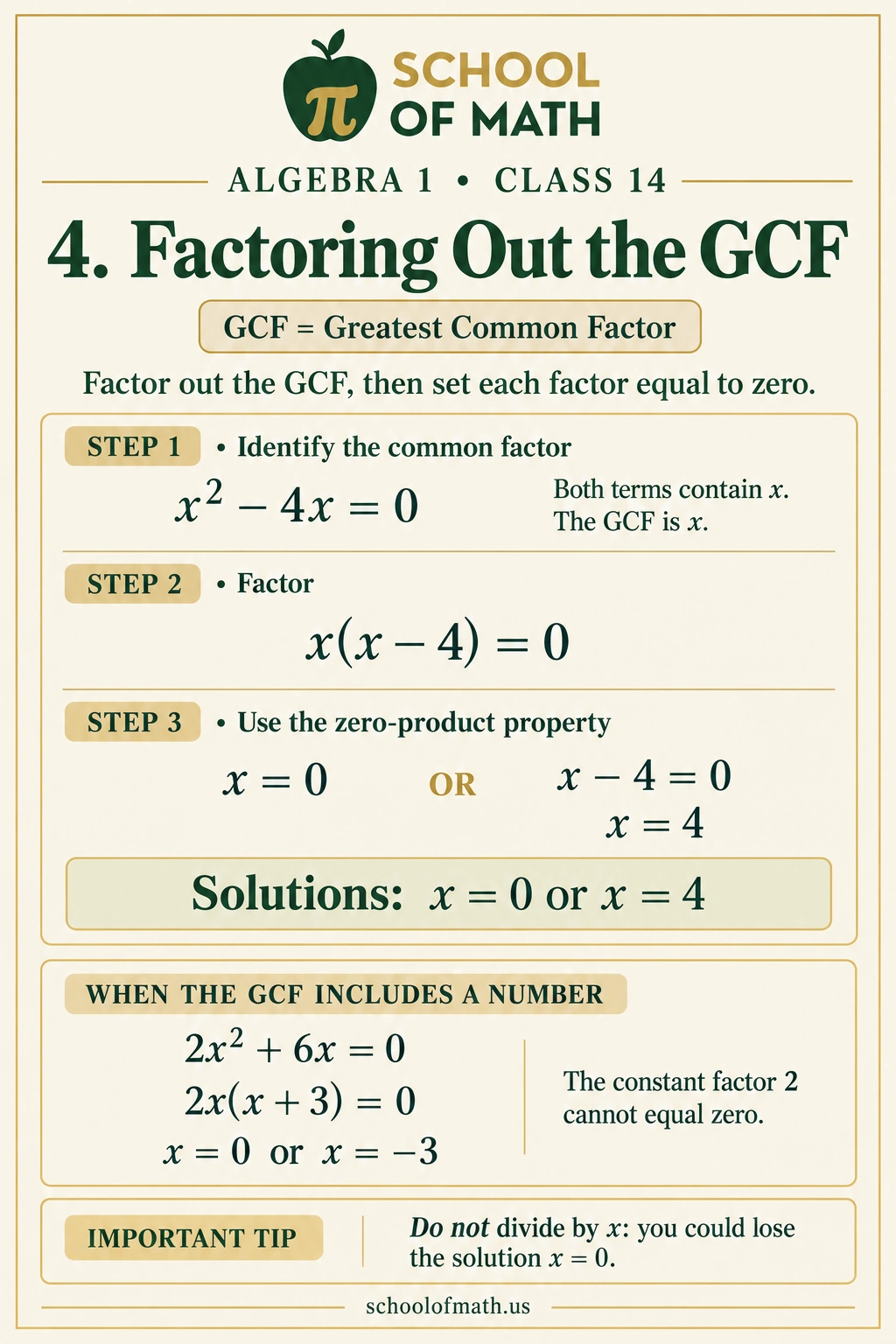
Look for a factor shared by every term before trying another pattern. In a quadratic with no constant term, x is often a common factor. Keep that x factor: dividing both sides by x would silently assume x ≠ 0 and could erase the solution x = 0. A common numerical factor can be removed safely if it is nonzero.
Try it yourself: five questions
Q16 Practice 1 of 5
Solve \(x^{2} - 7 x=0\) by factoring. Check every solution.
Answer
\(x=0\) or \(x=7\).
- Put every term on one side: \(x^{2} - 7 x=0\).
- Factor completely: \(x \left(x - 7\right)=0\).
- Use the zero-product property: \(x - 7=0\) or \(x=0\). Solve these linear equations.
- The solutions are \(x=0\) or \(x=7\).
- Check in the original equation: \(x=0\): \(0=0\); \(x=7\): \(0=0\).
Q17 Practice 2 of 5
Solve \(x^{2} + 11 x=0\) by factoring. Check every solution.
Answer
\(x=-11\) or \(x=0\).
- Put every term on one side: \(x^{2} + 11 x=0\).
- Factor completely: \(x \left(x + 11\right)=0\).
- Use the zero-product property: \(x=0\) or \(x + 11=0\). Solve these linear equations.
- The solutions are \(x=-11\) or \(x=0\).
- Check in the original equation: \(x=-11\): \(0=0\); \(x=0\): \(0=0\).
Q18 Practice 3 of 5
Solve \(3 x^{2} - 18 x=0\) by factoring. Check every solution.
Answer
\(x=0\) or \(x=6\).
- Put every term on one side: \(3 x^{2} - 18 x=0\).
- Factor completely: \(3 x \left(x - 6\right)=0\).
- Use the zero-product property: \(x - 6=0\) or \(x=0\). Solve these linear equations.
- The solutions are \(x=0\) or \(x=6\).
- Check in the original equation: \(x=0\): \(0=0\); \(x=6\): \(0=0\).
Q19 Practice 4 of 5
Solve \(4 x^{2} + 10 x=0\) by factoring. Check every solution.
Answer
\(x=- \frac{5}{2}\) or \(x=0\).
- Put every term on one side: \(4 x^{2} + 10 x=0\).
- Factor completely: \(2 x \left(2 x + 5\right)=0\).
- Use the zero-product property: \(x=0\) or \(2 x + 5=0\). Solve these linear equations.
- The solutions are \(x=- \frac{5}{2}\) or \(x=0\).
- Check in the original equation: \(x=- \frac{5}{2}\): \(0=0\); \(x=0\): \(0=0\).
Q20 Practice 5 of 5
Solve \(6 x^{2}=15 x\) by factoring. Check every solution.
Answer
\(x=0\) or \(x=\frac{5}{2}\).
- Put every term on one side: \(6 x^{2} - 15 x=0\).
- Factor completely: \(3 x \left(2 x - 5\right)=0\).
- Use the zero-product property: \(x=0\) or \(2 x - 5=0\). Solve these linear equations.
- The solutions are \(x=0\) or \(x=\frac{5}{2}\).
- Check in the original equation: \(x=0\): \(0=0\); \(x=\frac{5}{2}\): \(\frac{75}{2}=\frac{75}{2}\).
Solving trinomials by factoring
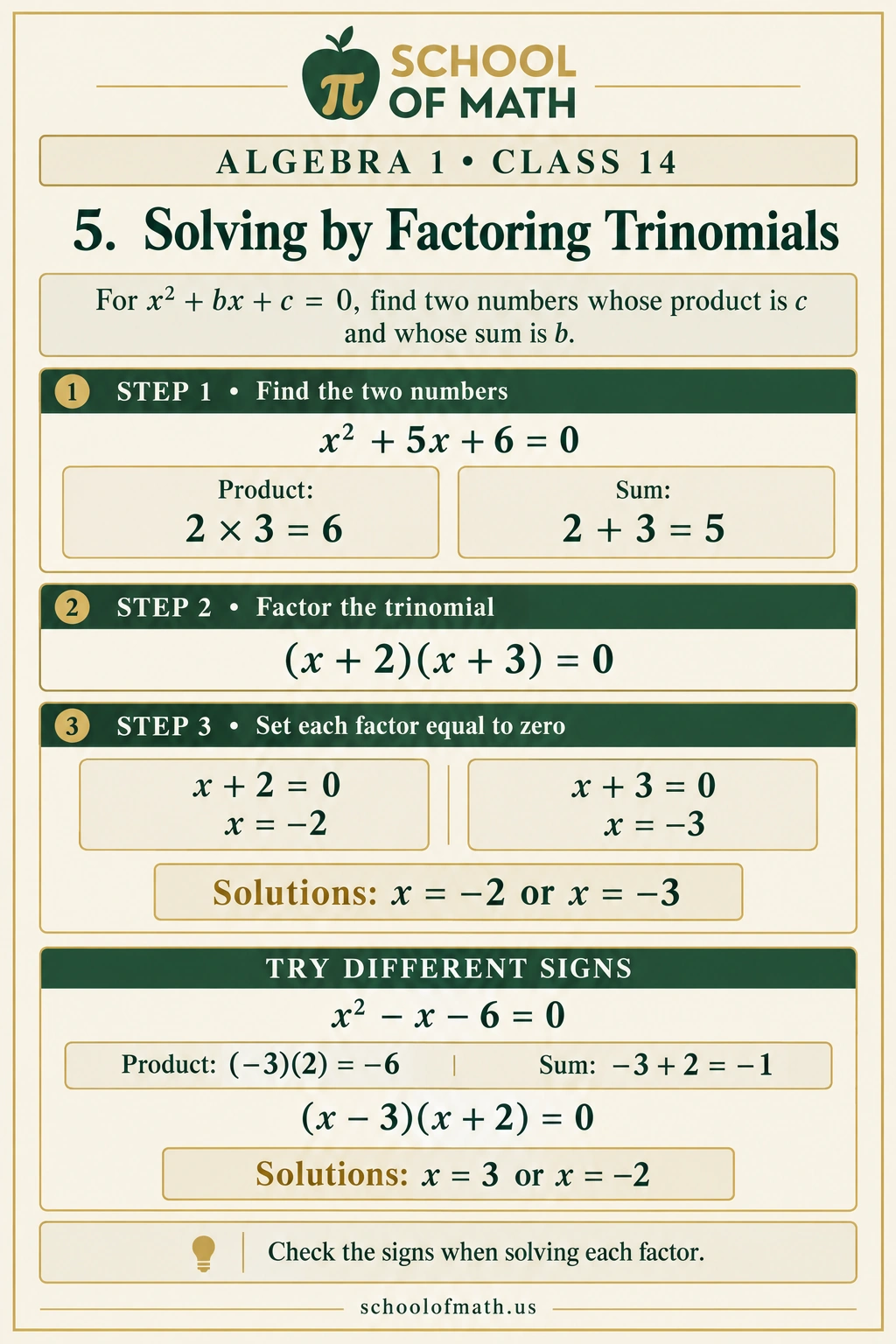
For x² + bx + c, find two numbers whose sum is b and whose product is c. A positive c means the two numbers have the same sign; b tells you which sign. A negative c means opposite signs. After writing the two factors, set each to zero and solve. The signs inside the factors are not the signs of the roots.
Try it yourself: five questions
Q21 Practice 1 of 5
Solve \(x^{2} + 9 x + 20=0\) by factoring. Check every solution.
Answer
\(x=-5\) or \(x=-4\).
- Put every term on one side: \(x^{2} + 9 x + 20=0\).
- Factor completely: \(\left(x + 4\right) \left(x + 5\right)=0\).
- Use the zero-product property: \(x + 4=0\) or \(x + 5=0\). Solve these linear equations.
- The solutions are \(x=-5\) or \(x=-4\).
- Check in the original equation: \(x=-5\): \(0=0\); \(x=-4\): \(0=0\).
Q22 Practice 2 of 5
Solve \(x^{2} - 11 x + 28=0\) by factoring. Check every solution.
Answer
\(x=4\) or \(x=7\).
- Put every term on one side: \(x^{2} - 11 x + 28=0\).
- Factor completely: \(\left(x - 7\right) \left(x - 4\right)=0\).
- Use the zero-product property: \(x - 7=0\) or \(x - 4=0\). Solve these linear equations.
- The solutions are \(x=4\) or \(x=7\).
- Check in the original equation: \(x=4\): \(0=0\); \(x=7\): \(0=0\).
Q23 Practice 3 of 5
Solve \(x^{2} + x - 30=0\) by factoring. Check every solution.
Answer
\(x=-6\) or \(x=5\).
- Put every term on one side: \(x^{2} + x - 30=0\).
- Factor completely: \(\left(x - 5\right) \left(x + 6\right)=0\).
- Use the zero-product property: \(x - 5=0\) or \(x + 6=0\). Solve these linear equations.
- The solutions are \(x=-6\) or \(x=5\).
- Check in the original equation: \(x=-6\): \(0=0\); \(x=5\): \(0=0\).
Q24 Practice 4 of 5
Solve \(x^{2} - 2 x=35\) by factoring. Check every solution.
Answer
\(x=-5\) or \(x=7\).
- Put every term on one side: \(x^{2} - 2 x - 35=0\).
- Factor completely: \(\left(x - 7\right) \left(x + 5\right)=0\).
- Use the zero-product property: \(x - 7=0\) or \(x + 5=0\). Solve these linear equations.
- The solutions are \(x=-5\) or \(x=7\).
- Check in the original equation: \(x=-5\): \(35=35\); \(x=7\): \(35=35\).
Q25 Practice 5 of 5
Solve \(2 x^{2} + 7 x + 3=0\) by factoring. Check every solution.
Answer
\(x=-3\) or \(x=- \frac{1}{2}\).
- Put every term on one side: \(2 x^{2} + 7 x + 3=0\).
- Factor completely: \(\left(x + 3\right) \left(2 x + 1\right)=0\).
- Use the zero-product property: \(x + 3=0\) or \(2 x + 1=0\). Solve these linear equations.
- The solutions are \(x=-3\) or \(x=- \frac{1}{2}\).
- Check in the original equation: \(x=-3\): \(0=0\); \(x=- \frac{1}{2}\): \(0=0\).
Solving special cases
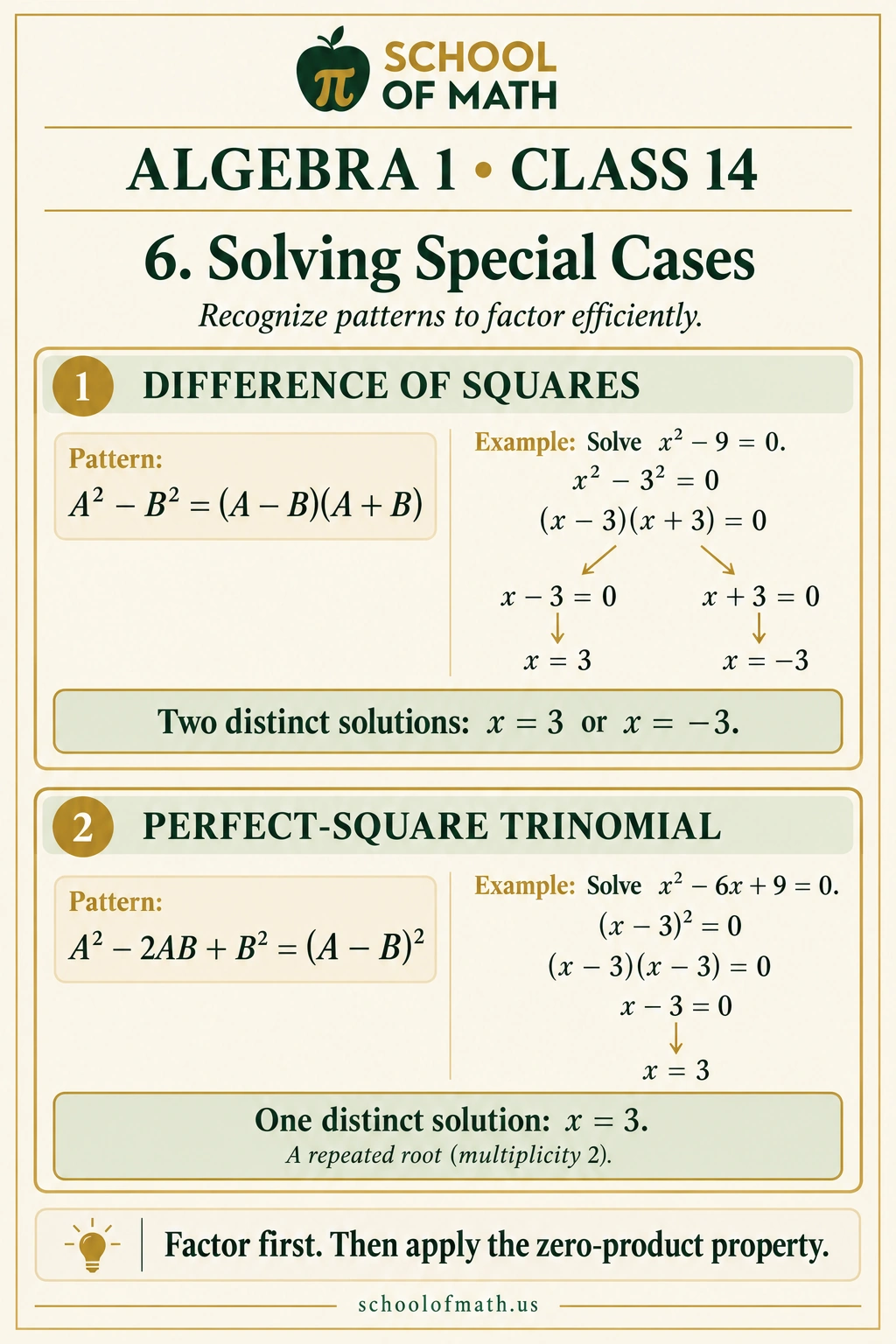
A difference of squares factors as A² − B² = (A − B)(A + B), giving opposite roots when the equation is x² − k² = 0. A perfect-square trinomial becomes one repeated factor. It has one distinct root, not two different roots. Factor a common numerical factor first when one is present.
Try it yourself: five questions
Q26 Practice 1 of 5
Solve \(x^{2} - 49=0\) by factoring. Check every solution.
Answer
\(x=-7\) or \(x=7\).
- Put every term on one side: \(x^{2} - 49=0\).
- Factor completely: \(\left(x - 7\right) \left(x + 7\right)=0\).
- Use the zero-product property: \(x - 7=0\) or \(x + 7=0\). Solve these linear equations.
- The solutions are \(x=-7\) or \(x=7\).
- Check in the original equation: \(x=-7\): \(0=0\); \(x=7\): \(0=0\).
Q27 Practice 2 of 5
Solve \(x^{2} + 10 x + 25=0\) by factoring. Check every solution.
Answer
\(x=-5\).
- Put every term on one side: \(x^{2} + 10 x + 25=0\).
- Factor completely: \(\left(x + 5\right)^{2}=0\).
- Use the zero-product property: \(x + 5=0\). Solve these linear equations.
- The solution is \(x=-5\). This is one distinct solution; the factor is repeated.
- Check in the original equation: \(x=-5\): \(0=0\).
Q28 Practice 3 of 5
Solve \(4 x^{2} - 81=0\) by factoring. Check every solution.
Answer
\(x=- \frac{9}{2}\) or \(x=\frac{9}{2}\).
- Put every term on one side: \(4 x^{2} - 81=0\).
- Factor completely: \(\left(2 x - 9\right) \left(2 x + 9\right)=0\).
- Use the zero-product property: \(2 x - 9=0\) or \(2 x + 9=0\). Solve these linear equations.
- The solutions are \(x=- \frac{9}{2}\) or \(x=\frac{9}{2}\).
- Check in the original equation: \(x=- \frac{9}{2}\): \(0=0\); \(x=\frac{9}{2}\): \(0=0\).
Q29 Practice 4 of 5
Solve \(3 x^{2} - 48=0\) by factoring. Check every solution.
Answer
\(x=-4\) or \(x=4\).
- Put every term on one side: \(3 x^{2} - 48=0\).
- Factor completely: \(3 \left(x - 4\right) \left(x + 4\right)=0\).
- Use the zero-product property: \(x - 4=0\) or \(x + 4=0\). Solve these linear equations.
- The solutions are \(x=-4\) or \(x=4\).
- Check in the original equation: \(x=-4\): \(0=0\); \(x=4\): \(0=0\).
Q30 Practice 5 of 5
Solve \(4 x^{2} - 20 x + 25=0\) by factoring. Check every solution.
Answer
\(x=\frac{5}{2}\).
- Put every term on one side: \(4 x^{2} - 20 x + 25=0\).
- Factor completely: \(\left(2 x - 5\right)^{2}=0\).
- Use the zero-product property: \(2 x - 5=0\). Solve these linear equations.
- The solution is \(x=\frac{5}{2}\). This is one distinct solution; the factor is repeated.
- Check in the original equation: \(x=\frac{5}{2}\): \(0=0\).
Checking solutions and avoiding mistakes
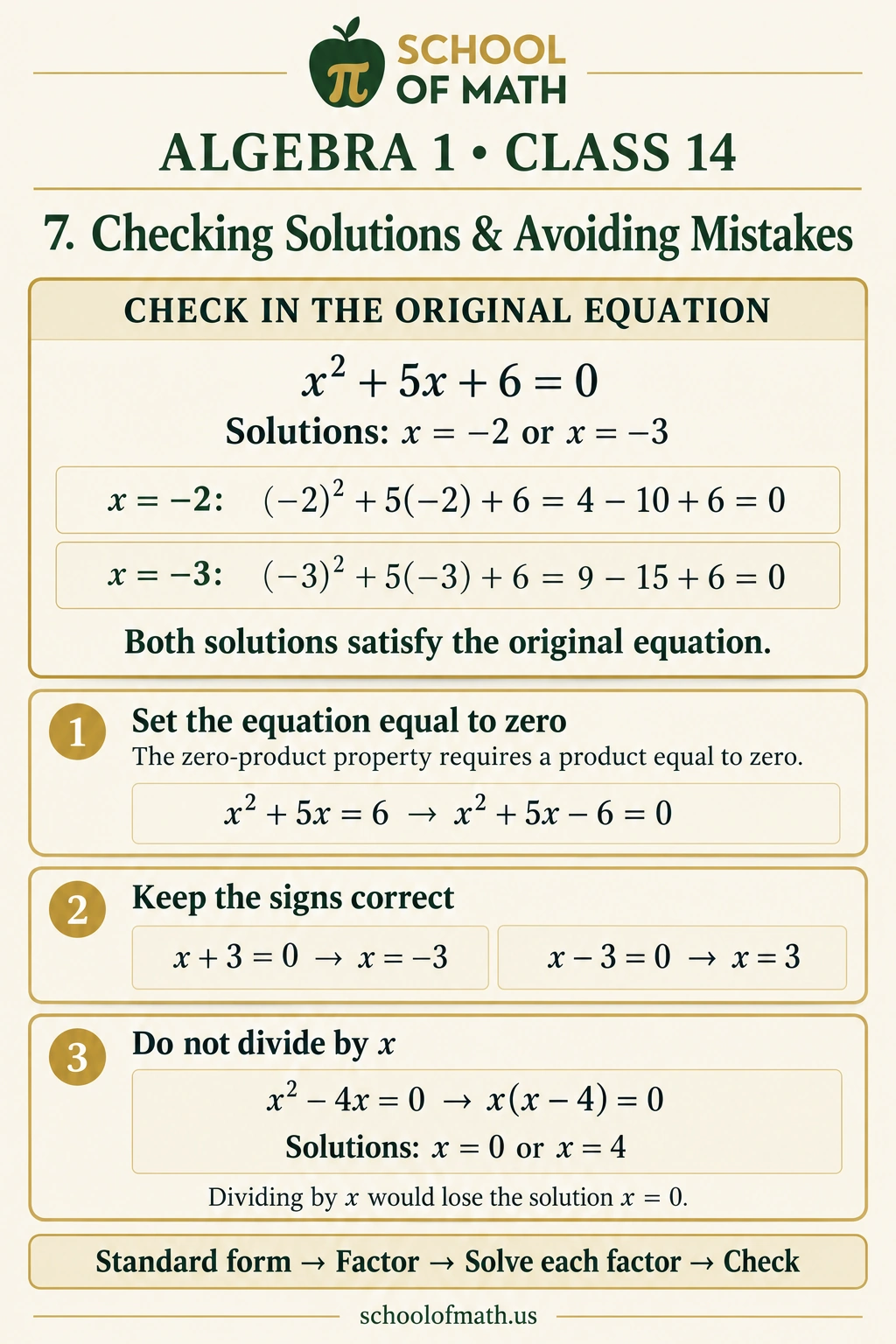
Substitute every proposed solution into the original equation, not only an intermediate step. Use parentheses around negative numbers before squaring. Common mistakes include losing x = 0 by dividing by x, using the signs in the factors as the answers, and applying the zero-product property before setting one side to zero.
Try it yourself: five questions
Q31 Practice 1 of 5
For \(x^2-3x-28=0\), test x = 7 and x = −4. Do both work?
Answer
\(x=-4\) or \(x=7\).
- Put every term on one side: \(x^{2} - 3 x - 28=0\).
- Factor completely: \(\left(x - 7\right) \left(x + 4\right)=0\).
- Use the zero-product property: \(x - 7=0\) or \(x + 4=0\). Solve these linear equations.
- The solutions are \(x=-4\) or \(x=7\).
- Check in the original equation: \(x=-4\): \(0=0\); \(x=7\): \(0=0\).
Q32 Practice 2 of 5
A student factors \(x^2+2x-15=0\) as (x + 5)(x − 3) = 0, then reports 5 and −3. Correct the solutions and check.
Answer
\(x=-5\) or \(x=3\).
- Solve each linear factor: x + 5 = 0 gives −5, while x − 3 = 0 gives 3. The reported signs were reversed.
- Put every term on one side: \(x^{2} + 2 x - 15=0\).
- Factor completely: \(\left(x - 3\right) \left(x + 5\right)=0\).
- Use the zero-product property: \(x - 3=0\) or \(x + 5=0\). Solve these linear equations.
- The solutions are \(x=-5\) or \(x=3\).
- Check in the original equation: \(x=-5\): \(0=0\); \(x=3\): \(0=0\).
Q33 Practice 3 of 5
A student divides \(5x^2-30x=0\) by x and finds only x = 6. Find the missing solution and explain.
Answer
\(x=0\) or \(x=6\).
- Dividing by x assumes x is nonzero. Factoring keeps the possible zero root.
- Put every term on one side: \(5 x^{2} - 30 x=0\).
- Factor completely: \(5 x \left(x - 6\right)=0\).
- Use the zero-product property: \(x - 6=0\) or \(x=0\). Solve these linear equations.
- The solutions are \(x=0\) or \(x=6\).
- Check in the original equation: \(x=0\): \(0=0\); \(x=6\): \(0=0\).
Q34 Practice 4 of 5
Mia changes \(x^2-8x=9\) into x² − 8x + 9 = 0. Correct the sign, factor, and check.
Answer
\(x=-1\) or \(x=9\).
- Subtracting 9 from both sides makes the constant −9, not +9.
- Put every term on one side: \(x^{2} - 8 x - 9=0\).
- Factor completely: \(\left(x - 9\right) \left(x + 1\right)=0\).
- Use the zero-product property: \(x - 9=0\) or \(x + 1=0\). Solve these linear equations.
- The solutions are \(x=-1\) or \(x=9\).
- Check in the original equation: \(x=-1\): \(9=9\); \(x=9\): \(9=9\).
Q35 Practice 5 of 5
Noah claims x = 2 or x = −5 solves \((x-2)(x+5)=18\). Explain the mistake and solve the original equation.
Answer
\(x=-7\) or \(x=4\).
- The zero-product property cannot be used while the product equals 18. The two claimed values give a product of 0, not 18.
- Put every term on one side: \(x^{2} + 3 x - 28=0\).
- Factor completely: \(\left(x - 4\right) \left(x + 7\right)=0\).
- Use the zero-product property: \(x - 4=0\) or \(x + 7=0\). Solve these linear equations.
- The solutions are \(x=-7\) or \(x=4\).
- Check in the original equation: \(x=-7\): \(18=18\); \(x=4\): \(18=18\).
Solving quadratic word problems
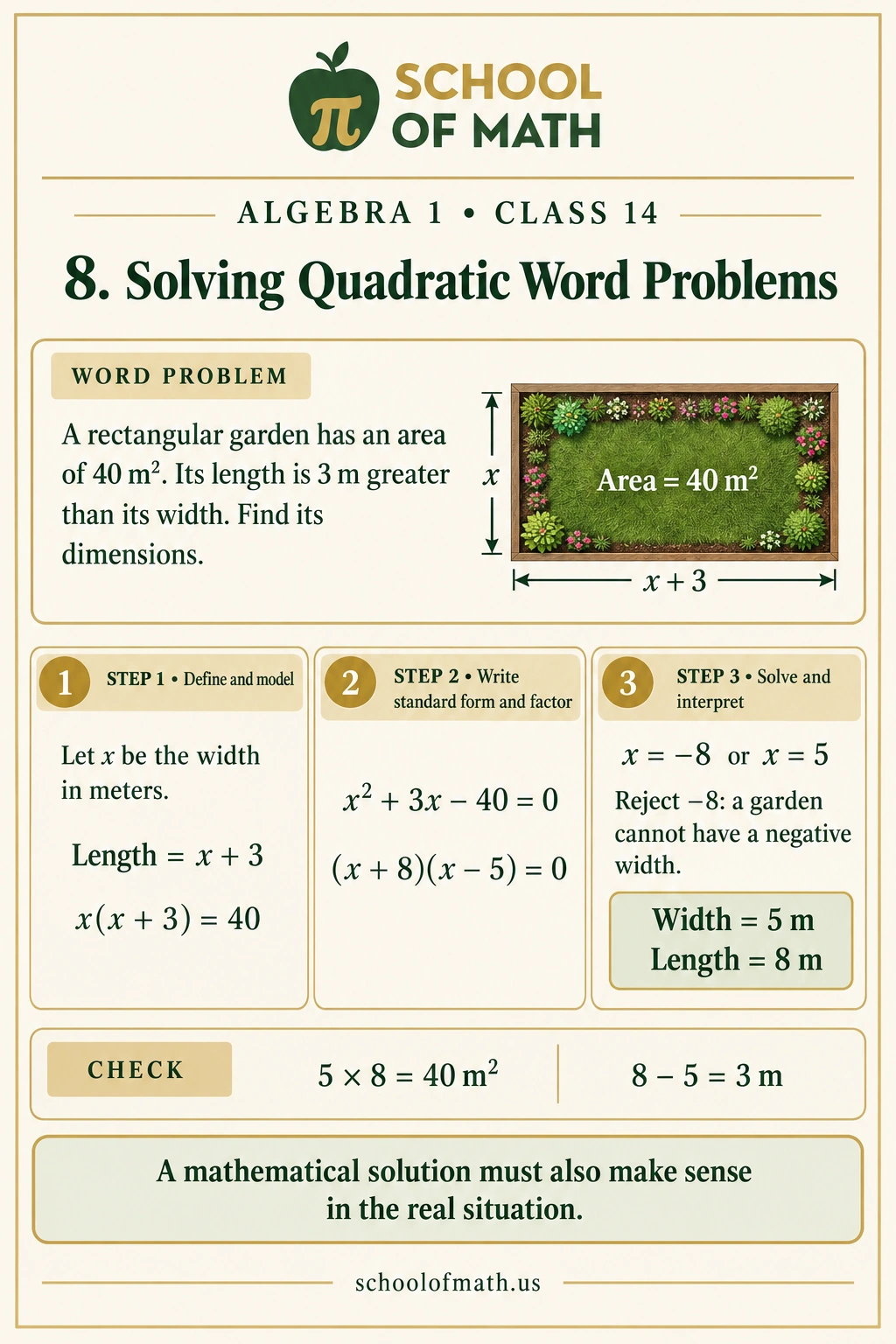
Define the unknown and express other quantities in terms of it. Build an equation from the relationship, such as length × width = area. Put the equation in standard form, factor, and find all algebraic roots. Then interpret them: a length must be positive, while a number problem might permit negative answers. Finish with units and a check of the original situation.
Try it yourself: five questions
Q36 Practice 1 of 5
A square mosaic has area 64 square inches. Let x be its side length. Write and solve an equation to find x.
Answer
The side is 8 inches.
- Let x be the side length in inches. The model is \(x^{2}=64\).
- Put every term on one side: \(x^{2} - 64=0\).
- Factor completely: \(\left(x - 8\right) \left(x + 8\right)=0\).
- Use the zero-product property: \(x - 8=0\) or \(x + 8=0\). Solve these linear equations.
- The solutions are \(x=-8\) or \(x=8\).
- Check in the original equation: \(x=-8\): \(64=64\); \(x=8\): \(64=64\).
- The roots are −8 and 8. A side length must be positive, so x = 8; 8 × 8 = 64.
Q37 Practice 2 of 5
A rectangular art board has length 2 cm more than its width and area 48 cm². Find its dimensions.
Answer
Width 6 cm; length 8 cm.
- Let x be the width; the length is x + 2. The model is \(x \left(x + 2\right)=48\).
- Put every term on one side: \(x^{2} + 2 x - 48=0\).
- Factor completely: \(\left(x - 6\right) \left(x + 8\right)=0\).
- Use the zero-product property: \(x - 6=0\) or \(x + 8=0\). Solve these linear equations.
- The solutions are \(x=-8\) or \(x=6\).
- Check in the original equation: \(x=-8\): \(48=48\); \(x=6\): \(48=48\).
- Reject x = −8. With x = 6, the length is 8 and 6 × 8 = 48.
Q38 Practice 3 of 5
Two consecutive positive integers have product 90. Find both integers.
Answer
The integers are 9 and 10.
- Let x be the smaller integer; the next is x + 1. The model is \(x \left(x + 1\right)=90\).
- Put every term on one side: \(x^{2} + x - 90=0\).
- Factor completely: \(\left(x - 9\right) \left(x + 10\right)=0\).
- Use the zero-product property: \(x - 9=0\) or \(x + 10=0\). Solve these linear equations.
- The solutions are \(x=-10\) or \(x=9\).
- Check in the original equation: \(x=-10\): \(90=90\); \(x=9\): \(90=90\).
- Reject x = −10 because the integers must be positive. Check: 9 × 10 = 90.
Q39 Practice 4 of 5
A display is 5 feet longer than it is wide. Its area is 84 square feet. Find the width and length.
Answer
Width 7 ft; length 12 ft.
- Let x be the width in feet; the length is x + 5. The model is \(x \left(x + 5\right)=84\).
- Put every term on one side: \(x^{2} + 5 x - 84=0\).
- Factor completely: \(\left(x - 7\right) \left(x + 12\right)=0\).
- Use the zero-product property: \(x - 7=0\) or \(x + 12=0\). Solve these linear equations.
- The solutions are \(x=-12\) or \(x=7\).
- Check in the original equation: \(x=-12\): \(84=84\); \(x=7\): \(84=84\).
- Reject x = −12. The positive root is 7, giving 7 × 12 = 84.
Q40 Practice 5 of 5
A photo is twice as long as it is wide. Its area is 72 cm². Find both dimensions.
Answer
Width 6 cm; length 12 cm.
- Let x be the width; the length is 2x. The model is \(2 x^{2}=72\).
- Put every term on one side: \(2 x^{2} - 72=0\).
- Factor completely: \(2 \left(x - 6\right) \left(x + 6\right)=0\).
- Use the zero-product property: \(x - 6=0\) or \(x + 6=0\). Solve these linear equations.
- The solutions are \(x=-6\) or \(x=6\).
- Check in the original equation: \(x=-6\): \(72=72\); \(x=6\): \(72=72\).
- The roots are −6 and 6. Use x = 6 for a positive width; 6 × 12 = 72.
Homework review
Review the eight lesson topics in order, with one question per image: recognizing quadratics, standard form, zero products, common factors, trinomials, special cases, checking, and modeling.
R1 Homework 1 of 8
Simplify \(5x^2-2x=2x^2+12\) into standard form. Is it quadratic? Identify a, b, and c.
Answer
\(3x^2-2x-12=0\); quadratic; a = 3, b = −2, c = −12.
- Subtract 2x² + 12 from both sides.
- Combine like terms. The remaining highest power is 2.
R2 Homework 2 of 8
Write \((x+1)(x+5)=2x+17\) in standard form without solving.
Answer
\(x^2+4x-12=0\).
- Expand: x² + 6x + 5 = 2x + 17.
- Subtract 2x + 17 from both sides.
R3 Homework 3 of 8
Solve \((2x+3)(x-8)=0\) using the zero-product property.
Answer
\(x=- \frac{3}{2}\) or \(x=8\).
- Put every term on one side: \(2 x^{2} - 13 x - 24=0\).
- Factor completely: \(\left(x - 8\right) \left(2 x + 3\right)=0\).
- Use the zero-product property: \(x - 8=0\) or \(2 x + 3=0\). Solve these linear equations.
- The solutions are \(x=- \frac{3}{2}\) or \(x=8\).
- Check in the original equation: \(x=- \frac{3}{2}\): \(0=0\); \(x=8\): \(0=0\).
R4 Homework 4 of 8
Solve \(6 x^{2} + 21 x=0\) by factoring. Check every solution.
Answer
\(x=- \frac{7}{2}\) or \(x=0\).
- Put every term on one side: \(6 x^{2} + 21 x=0\).
- Factor completely: \(3 x \left(2 x + 7\right)=0\).
- Use the zero-product property: \(x=0\) or \(2 x + 7=0\). Solve these linear equations.
- The solutions are \(x=- \frac{7}{2}\) or \(x=0\).
- Check in the original equation: \(x=- \frac{7}{2}\): \(0=0\); \(x=0\): \(0=0\).
R5 Homework 5 of 8
Solve \(x^{2} - 3 x - 40=0\) by factoring. Check every solution.
Answer
\(x=-5\) or \(x=8\).
- Put every term on one side: \(x^{2} - 3 x - 40=0\).
- Factor completely: \(\left(x - 8\right) \left(x + 5\right)=0\).
- Use the zero-product property: \(x - 8=0\) or \(x + 5=0\). Solve these linear equations.
- The solutions are \(x=-5\) or \(x=8\).
- Check in the original equation: \(x=-5\): \(0=0\); \(x=8\): \(0=0\).
R6 Homework 6 of 8
Solve \(9 x^{2} - 24 x + 16=0\) by factoring. Check every solution.
Answer
\(x=\frac{4}{3}\).
- Put every term on one side: \(9 x^{2} - 24 x + 16=0\).
- Factor completely: \(\left(3 x - 4\right)^{2}=0\).
- Use the zero-product property: \(3 x - 4=0\). Solve these linear equations.
- The solution is \(x=\frac{4}{3}\). This is one distinct solution; the factor is repeated.
- Check in the original equation: \(x=\frac{4}{3}\): \(0=0\).
R7 Homework 7 of 8
A student claims x = 7 and x = −3 solve \(x^2+4x=21\). Correct both signs and check.
Answer
\(x=-7\) or \(x=3\).
- Put every term on one side: \(x^{2} + 4 x - 21=0\).
- Factor completely: \(\left(x - 3\right) \left(x + 7\right)=0\).
- Use the zero-product property: \(x - 3=0\) or \(x + 7=0\). Solve these linear equations.
- The solutions are \(x=-7\) or \(x=3\).
- Check in the original equation: \(x=-7\): \(21=21\); \(x=3\): \(21=21\).
R8 Homework 8 of 8
A rectangular garden is 6 m longer than it is wide and has area 72 m². Find both dimensions.
Answer
Width 6 m; length 12 m.
- Let x be the width and x + 6 the length. The model is \(x \left(x + 6\right)=72\).
- Put every term on one side: \(x^{2} + 6 x - 72=0\).
- Factor completely: \(\left(x - 6\right) \left(x + 12\right)=0\).
- Use the zero-product property: \(x - 6=0\) or \(x + 12=0\). Solve these linear equations.
- The solutions are \(x=-12\) or \(x=6\).
- Check in the original equation: \(x=-12\): \(72=72\); \(x=6\): \(72=72\).
- Reject −12 as a width. Use x = 6, so length = 12; 6 × 12 = 72.
Homework word problems
These 12 problems gradually build from simple areas to consecutive integers, a surrounding path, and a revenue model. Together with the eight review questions, they make 20 homework questions. Define your variable, factor, check, and interpret your roots.
W1 Homework 1 of 12
A square tile has area 121 cm². Find its side length.
Answer
11 cm.
- Let x be the side length in centimeters. The model is \(x^{2}=121\).
- Put every term on one side: \(x^{2} - 121=0\).
- Factor completely: \(\left(x - 11\right) \left(x + 11\right)=0\).
- Use the zero-product property: \(x - 11=0\) or \(x + 11=0\). Solve these linear equations.
- The solutions are \(x=-11\) or \(x=11\).
- Check in the original equation: \(x=-11\): \(121=121\); \(x=11\): \(121=121\).
- Only x = 11 is a positive length. Check: 11² = 121.
W2 Homework 2 of 12
A rectangular rug is 1 m longer than it is wide. Its area is 30 m². Find its dimensions.
Answer
5 m by 6 m.
- Let x be the width and x + 1 the length. The model is \(x \left(x + 1\right)=30\).
- Put every term on one side: \(x^{2} + x - 30=0\).
- Factor completely: \(\left(x - 5\right) \left(x + 6\right)=0\).
- Use the zero-product property: \(x - 5=0\) or \(x + 6=0\). Solve these linear equations.
- The solutions are \(x=-6\) or \(x=5\).
- Check in the original equation: \(x=-6\): \(30=30\); \(x=5\): \(30=30\).
- Use x = 5 rather than −6. Check: 5 × 6 = 30.
W3 Homework 3 of 12
A rectangular tabletop has length 3 feet more than its width and area 54 square feet. Find its dimensions.
Answer
6 ft by 9 ft.
- Let x be the width in feet; length = x + 3. The model is \(x \left(x + 3\right)=54\).
- Put every term on one side: \(x^{2} + 3 x - 54=0\).
- Factor completely: \(\left(x - 6\right) \left(x + 9\right)=0\).
- Use the zero-product property: \(x - 6=0\) or \(x + 9=0\). Solve these linear equations.
- The solutions are \(x=-9\) or \(x=6\).
- Check in the original equation: \(x=-9\): \(54=54\); \(x=6\): \(54=54\).
- Use x = 6, not −9. Check: 6 × 9 = 54.
W4 Homework 4 of 12
Two consecutive positive integers have product 132. What are they?
Answer
11 and 12.
- Let x be the smaller integer and x + 1 the larger. The model is \(x \left(x + 1\right)=132\).
- Put every term on one side: \(x^{2} + x - 132=0\).
- Factor completely: \(\left(x - 11\right) \left(x + 12\right)=0\).
- Use the zero-product property: \(x - 11=0\) or \(x + 12=0\). Solve these linear equations.
- The solutions are \(x=-12\) or \(x=11\).
- Check in the original equation: \(x=-12\): \(132=132\); \(x=11\): \(132=132\).
- The smaller integer must be positive. Choose x = 11, not −12; 11 × 12 = 132.
W5 Homework 5 of 12
Two positive even integers differ by 2. Their product is 168. Find them.
Answer
12 and 14.
- Let x be the smaller even integer; the larger is x + 2. The model is \(x \left(x + 2\right)=168\).
- Put every term on one side: \(x^{2} + 2 x - 168=0\).
- Factor completely: \(\left(x - 12\right) \left(x + 14\right)=0\).
- Use the zero-product property: \(x - 12=0\) or \(x + 14=0\). Solve these linear equations.
- The solutions are \(x=-14\) or \(x=12\).
- Check in the original equation: \(x=-14\): \(168=168\); \(x=12\): \(168=168\).
- The positive root is 12. Both 12 and 14 are even, and 12 × 14 = 168.
W6 Homework 6 of 12
Chairs form a rectangular array. There are 4 more chairs in each row than there are rows, and 96 chairs total. Find the number of rows and chairs per row.
Answer
8 rows with 12 chairs in each row.
- Let x be the number of rows; each row has x + 4 chairs. The model is \(x \left(x + 4\right)=96\).
- Put every term on one side: \(x^{2} + 4 x - 96=0\).
- Factor completely: \(\left(x - 8\right) \left(x + 12\right)=0\).
- Use the zero-product property: \(x - 8=0\) or \(x + 12=0\). Solve these linear equations.
- The solutions are \(x=-12\) or \(x=8\).
- Check in the original equation: \(x=-12\): \(96=96\); \(x=8\): \(96=96\).
- Reject −12 rows. Check: 8 × 12 = 96 chairs.
W7 Homework 7 of 12
A rectangle is twice as long as it is wide. Its area is 98 square meters. Find its dimensions.
Answer
7 m by 14 m.
- Let x be the width in meters; length = 2x. The model is \(2 x^{2}=98\).
- Put every term on one side: \(2 x^{2} - 98=0\).
- Factor completely: \(2 \left(x - 7\right) \left(x + 7\right)=0\).
- Use the zero-product property: \(x - 7=0\) or \(x + 7=0\). Solve these linear equations.
- The solutions are \(x=-7\) or \(x=7\).
- Check in the original equation: \(x=-7\): \(98=98\); \(x=7\): \(98=98\).
- Use the positive root x = 7. Then 2x = 14 and 7 × 14 = 98.
W8 Homework 8 of 12
A number squared is 6 more than 5 times the number. Find every number that fits the description.
Answer
The numbers are −1 and 6.
- Let x be the number. Its square is x²; 6 more than 5 times it is 5x + 6. The model is \(x^{2}=5 x + 6\).
- Put every term on one side: \(x^{2} - 5 x - 6=0\).
- Factor completely: \(\left(x - 6\right) \left(x + 1\right)=0\).
- Use the zero-product property: \(x - 6=0\) or \(x + 1=0\). Solve these linear equations.
- The solutions are \(x=-1\) or \(x=6\).
- Check in the original equation: \(x=-1\): \(1=1\); \(x=6\): \(36=36\).
- No positivity condition was given, so keep both roots. Check: 1 = −5 + 6 and 36 = 30 + 6.
W9 Homework 9 of 12
A poster is 3 cm longer than twice its width. Its area is 65 cm². Find its width and length.
Answer
Width 5 cm; length 13 cm.
- Let x be the width; length = 2x + 3. The model is \(x \left(2 x + 3\right)=65\).
- Put every term on one side: \(2 x^{2} + 3 x - 65=0\).
- Factor completely: \(\left(x - 5\right) \left(2 x + 13\right)=0\).
- Use the zero-product property: \(x - 5=0\) or \(2 x + 13=0\). Solve these linear equations.
- The solutions are \(x=- \frac{13}{2}\) or \(x=5\).
- Check in the original equation: \(x=- \frac{13}{2}\): \(65=65\); \(x=5\): \(65=65\).
- The roots are 5 and −13/2. Reject the negative width. Check: 5 × 13 = 65.
W10 Homework 10 of 12
A square patio is enlarged by adding 2 m to each side length. The enlarged patio has area 81 m². Find the original side length and original area.
Answer
Original side 7 m; original area 49 m².
- Let x be the original side length. The enlarged square has side x + 2. The model is \(\left(x + 2\right)^{2}=81\).
- Put every term on one side: \(x^{2} + 4 x - 77=0\).
- Factor completely: \(\left(x - 7\right) \left(x + 11\right)=0\).
- Use the zero-product property: \(x - 7=0\) or \(x + 11=0\). Solve these linear equations.
- The solutions are \(x=-11\) or \(x=7\).
- Check in the original equation: \(x=-11\): \(81=81\); \(x=7\): \(81=81\).
- Reject x = −11. Use x = 7, so original area = 7² = 49. The enlarged side is 9 and 9² = 81.
W11 Homework 11 of 12
A 6 m by 10 m garden has a path of uniform width x around its outside. The combined garden-and-path area is 96 m². Find the path width.
Answer
The path is 1 m wide.
- The outside dimensions are 6 + 2x and 10 + 2x, because the path is on both sides. The model is \(\left(2 x + 6\right) \left(2 x + 10\right)=96\).
- Put every term on one side: \(4 x^{2} + 32 x - 36=0\).
- Factor completely: \(4 \left(x - 1\right) \left(x + 9\right)=0\).
- Use the zero-product property: \(x - 1=0\) or \(x + 9=0\). Solve these linear equations.
- The solutions are \(x=-9\) or \(x=1\).
- Check in the original equation: \(x=-9\): \(96=96\); \(x=1\): \(96=96\).
- Factoring after removing 4 gives (x + 9)(x − 1) = 0. Reject −9 m. At x = 1, the outside dimensions are 8 m by 12 m, with area 96 m².
W12 Homework 12 of 12
A club charges $20 per ticket and sells 30 tickets. For each $1 reduction, it sells 2 additional tickets. Let x be the number of $1 reductions. What ticket prices would produce $608 in revenue? Find all valid prices.
Answer
$19 or $16 per ticket.
- Let x count the $1 reductions. Price = 20 − x dollars; tickets sold = 30 + 2x. The model is \(\left(20 - x\right) \left(2 x + 30\right)=608\).
- Put every term on one side: \(- 2 x^{2} + 10 x - 8=0\).
- Factor completely: \(- 2 \left(x - 4\right) \left(x - 1\right)=0\).
- Use the zero-product property: \(x - 4=0\) or \(x - 1=0\). Solve these linear equations.
- The solutions are \(x=1\) or \(x=4\).
- Check in the original equation: \(x=1\): \(608=608\); \(x=4\): \(608=608\).
- The roots are x = 1 and x = 4, both valid reductions. Prices are $19 and $16. Check: 19 × 32 = 608 and 16 × 38 = 608.
Quick questions and answers
How do you solve a quadratic equation by factoring?
Write one side as zero, factor the other side completely, set each variable factor equal to zero, solve, and check each root in the original equation.
Why must one side equal zero?
The zero-product property applies only when a product equals zero. A product equal to 12 does not mean one of its factors is zero.
Can a quadratic have only one solution?
A perfect-square quadratic can have one distinct real solution, represented by a repeated factor. Other quadratics can have two distinct real solutions or no real solutions.
Why should I not divide by x?
If x may be zero, dividing by x can discard a valid solution. Factor out x and set each factor equal to zero instead.
Should negative solutions be rejected?
Keep negative roots in an unrestricted number problem when they satisfy the equation. Reject them only when the context requires a positive quantity, such as a physical length.
What is included in the Class 14 workbook?
Eight lesson images, 40 practice questions, eight homework review questions, and 12 homework word problems. The PDF has blank answer space; worked answers are hidden behind blue Answer buttons online.