Algebra 1 · Class 15 · Grades 7–8
Functions: Domain, Range, and Function Notation
A function assigns exactly one output to each allowed input. Its domain is the set of allowed inputs, and its range is the set of outputs it actually produces. Function notation, such as f(x), names the output for a particular input.
Work through eight images with five original practice questions after every image. Then complete eight homework review questions and twelve homework word problems: 20 homework questions and 60 questions overall. Try each question before opening its blue Answer control.
Part of Algebra 1 at SOMATH. Book a free evaluation to find your starting point, or see the class schedule.
Download the student workbook (PDF)22 pages · Cover, eight teaching images, and all 60 questions. Each image is followed by five practice questions; homework follows with up to five questions per page.Numbered pages, generous blank answer space, and no exercise solutions or writing lines.
Understanding functions
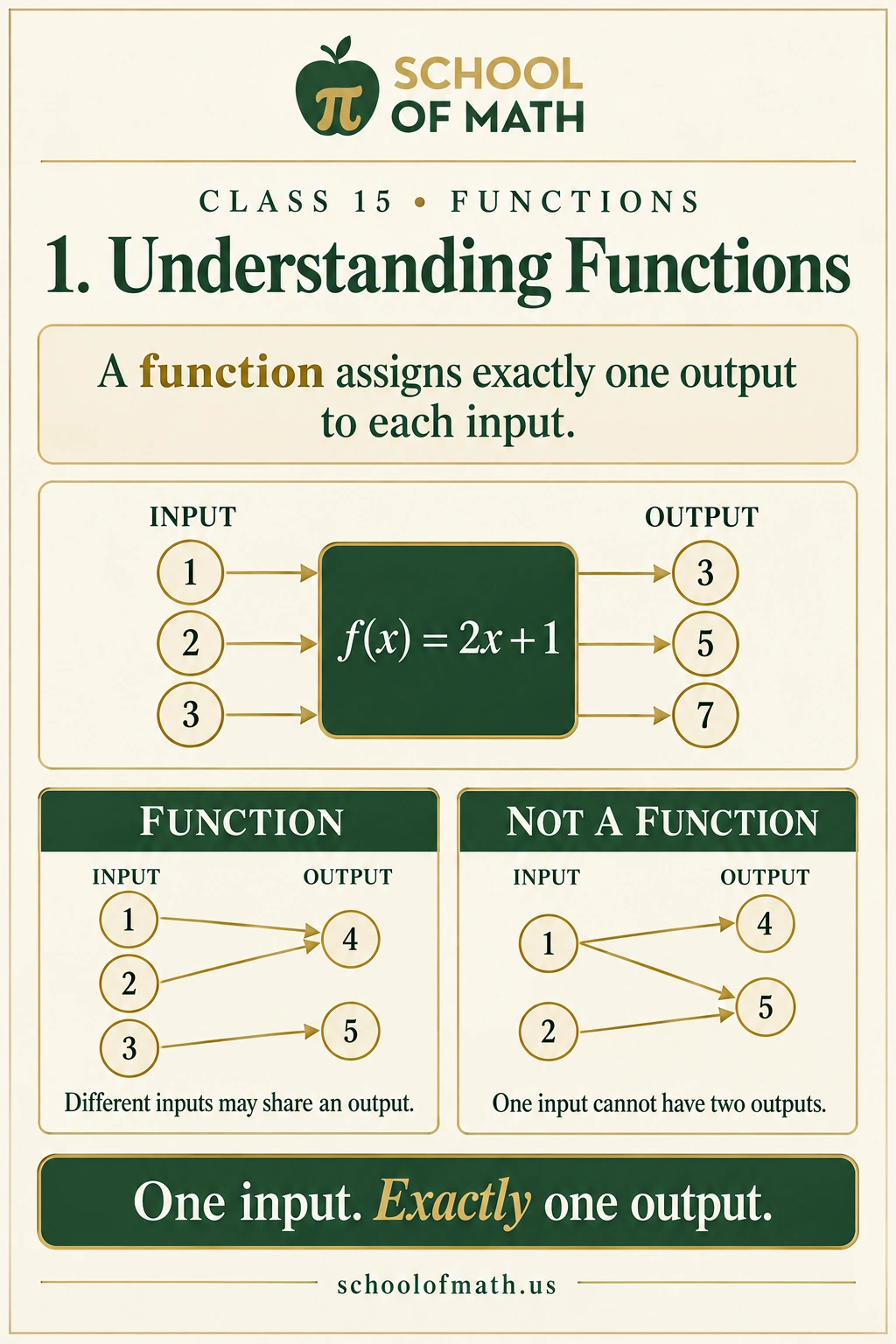
A function pairs each input in its domain with exactly one output. The input is often called x and the output y. A relation is any collection of input-output pairs; it is a function only when the one-output rule holds.
Two different inputs can have the same output. For example, a rule that squares an input gives the same output for a positive number and its negative. What is not allowed is one input having two different outputs in the same function. Think “check each input,” not “all outputs must be different.”
Try it yourself: five questions
Q1 Practice 1 of 5
A machine multiplies each input by 4 and subtracts 3. Find the outputs for inputs 0, 2, and 5. Does this rule define a function?
Answer
The outputs are −3, 5, and 17. Yes, it is a function.
- \(\displaystyle 4(0)-3=-3\), \(\displaystyle 4(2)-3=5\), and \(\displaystyle 4(5)-3=17\).
- Each allowed input produces exactly one result.
Q2 Practice 2 of 5
Does the relation (2, 7), (4, 7), (6, 7) define a function? Explain.
Answer
Yes, this relation is a function.
- Group the ordered pairs by their first coordinate.
- Every input has exactly one output. Different inputs may share an output.
Q3 Practice 3 of 5
Does the relation (3, 8), (3, 10), (5, 12) define a function? Explain.
Answer
No, this relation is not a function.
- Group the ordered pairs by their first coordinate.
- Input 3 is paired with different outputs: 8, 10.
Q4 Practice 4 of 5
A rule assigns every real-number input the output 9. Is it a function? Explain.
Answer
Yes. A constant rule is a function.
- Each input has one output, 9.
- Many inputs sharing the same output is allowed.
Q5 Practice 5 of 5
A relation contains (−2, 6) and (1, 4). Which pair can be added while keeping a function: A: (−2, 8) or B: (3, 6)? Explain.
Answer
B: (3, 6).
- The new input 3 has just one output, 6.
- Choice A would give input −2 two outputs, 6 and 8.
Identifying functions
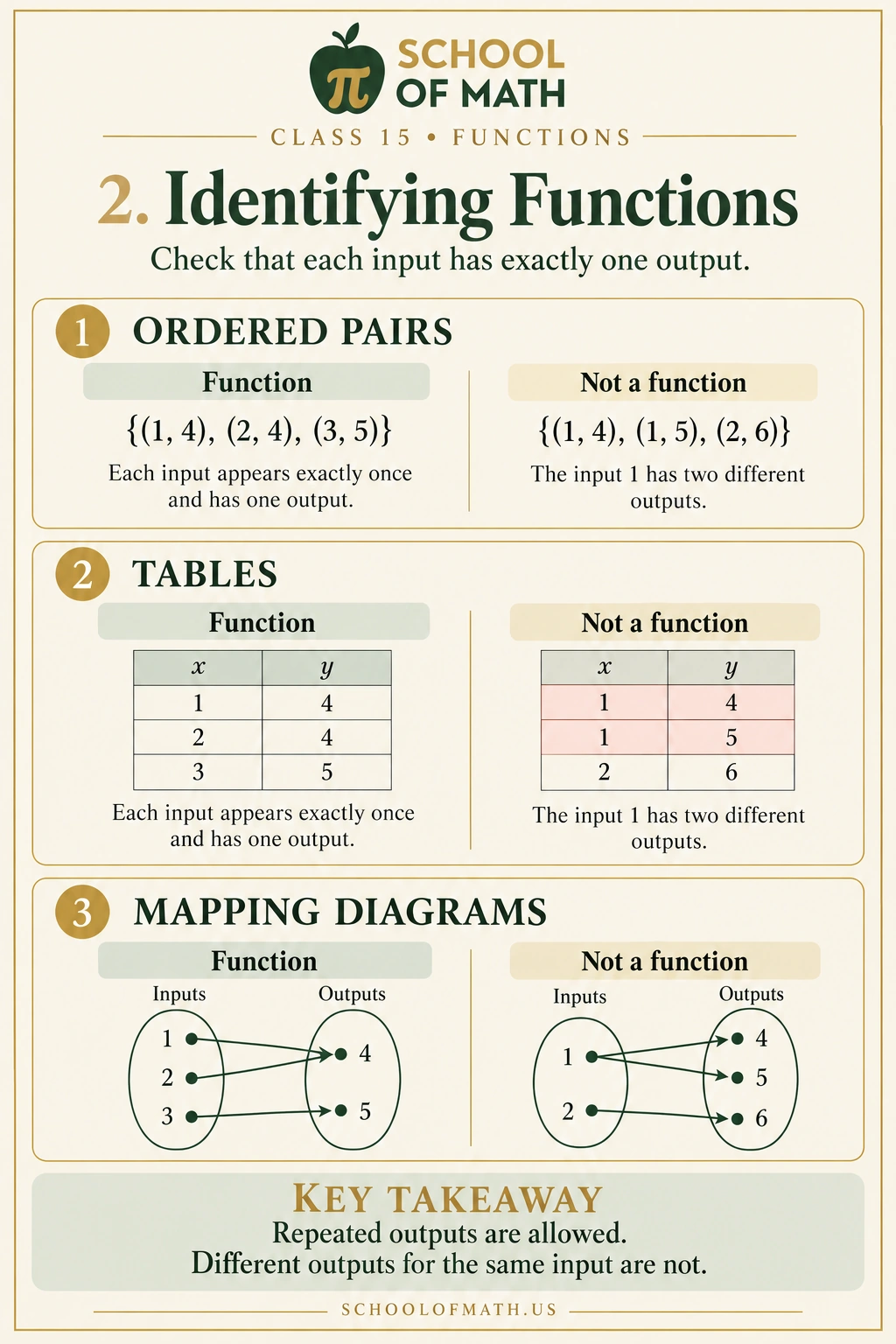
In an ordered pair (x, y), the first coordinate is the input. In a table, compare rows with the same input. If those rows have different outputs, the relation is not a function. A duplicate row repeats the same pairing and does not create a second output.
In a mapping diagram, each input in the stated domain needs exactly one arrow leaving it. Several arrows may arrive at one output. Do not confuse a function with a one-to-one function: this lesson requires one output for each input, not a different output for every input.
Try it yourself: five questions
Q6 Practice 1 of 5
Does the relation (-3, 2), (0, 2), (4, 8) define a function? Explain.
Answer
Yes, this relation is a function.
- Group the ordered pairs by their first coordinate.
- Every input has exactly one output. Different inputs may share an output.
Q7 Practice 2 of 5
Does the relation (2, -1), (5, 3), (2, 4) define a function? Explain.
Answer
No, this relation is not a function.
- Group the ordered pairs by their first coordinate.
- Input 2 is paired with different outputs: -1, 4.
Q8 Practice 3 of 5
A table has rows (1, 5), (1, 5), and (4, 9). Does it represent a function?
Answer
Yes.
- Both rows with input 1 have the same output, 5.
- A repeated identical row does not give that input two different outputs.
Q9 Practice 4 of 5
The stated domain is {2, 4, 6}. A mapping has arrows 2 → 8 and 4 → 8, but no arrow from 6. Is it a function on that stated domain?
Answer
No.
- Every input in the stated domain must have exactly one output.
- Input 6 has no output, so the mapping is incomplete.
Q10 Practice 5 of 5
A relation contains (−1, 3), (2, 7), and (k, 9). Which listed values of k keep it a function: −1, 0, 2, or 5?
Answer
k can be 0 or 5.
- Those choices are new inputs, each assigned output 9.
- Choosing −1 or 2 would give an existing input a second, different output.
The vertical line test
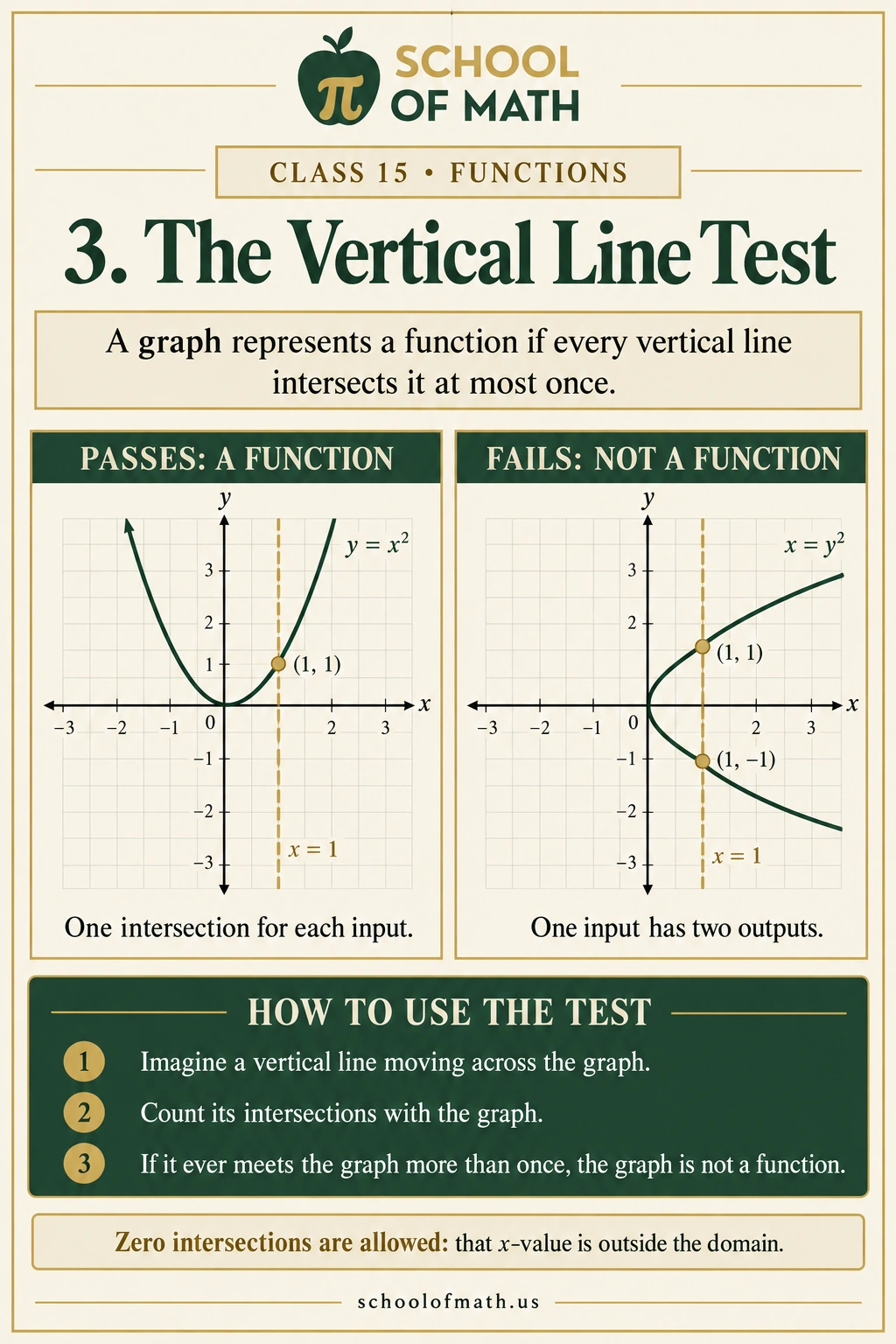
A graph represents y as a function of x if every vertical line meets the graph at most once. A vertical line fixes an x-value. Two intersections on that line would mean two y-values for the same input.
A line with no intersection is fine: that x-value is outside the graph’s domain. A horizontal line can be a function; a vertical line cannot. The test concerns all points of the relation, not just the portion visible in a drawing. For the questions below, sketch the stated graph and explain how a vertical test line behaves.
Try it yourself: five questions
Q11 Practice 1 of 5
Sketch \(\displaystyle y=x+2\). Does it represent y as a function of x?
Answer
Yes.
- For any fixed x, adding 2 gives only one y-value.
- Every vertical line intersects this sloping line exactly once.
Q12 Practice 2 of 5
Sketch \(\displaystyle y=x^2-2\). Does it pass the vertical line test?
Answer
Yes.
- This is an upward-opening parabola with vertex (0, −2).
- Each x produces exactly one y. The symmetry gives repeated outputs, not multiple outputs for one input.
Q13 Practice 3 of 5
Consider the circle \(\displaystyle x^2+y^2=4\). Use the vertical line x = 0 to decide whether y is a function of x.
Answer
No.
- At x = 0, \(\displaystyle y^2=4\), so y = 2 or y = −2.
- The vertical line x = 0 meets the circle at (0, 2) and (0, −2).
Q14 Practice 4 of 5
Sketch the vertical line x = −1. Is y a function of x?
Answer
No.
- The same input −1 occurs at infinitely many points, such as (−1, 0) and (−1, 2).
- One input has multiple outputs, so the graph fails.
Q15 Practice 5 of 5
Sketch the horizontal line y = 3. Does it pass the vertical line test? Explain why the repeated output is allowed.
Answer
Yes.
- Every vertical line meets y = 3 exactly once.
- All inputs share output 3, but each input still has only one output.
Finding the domain
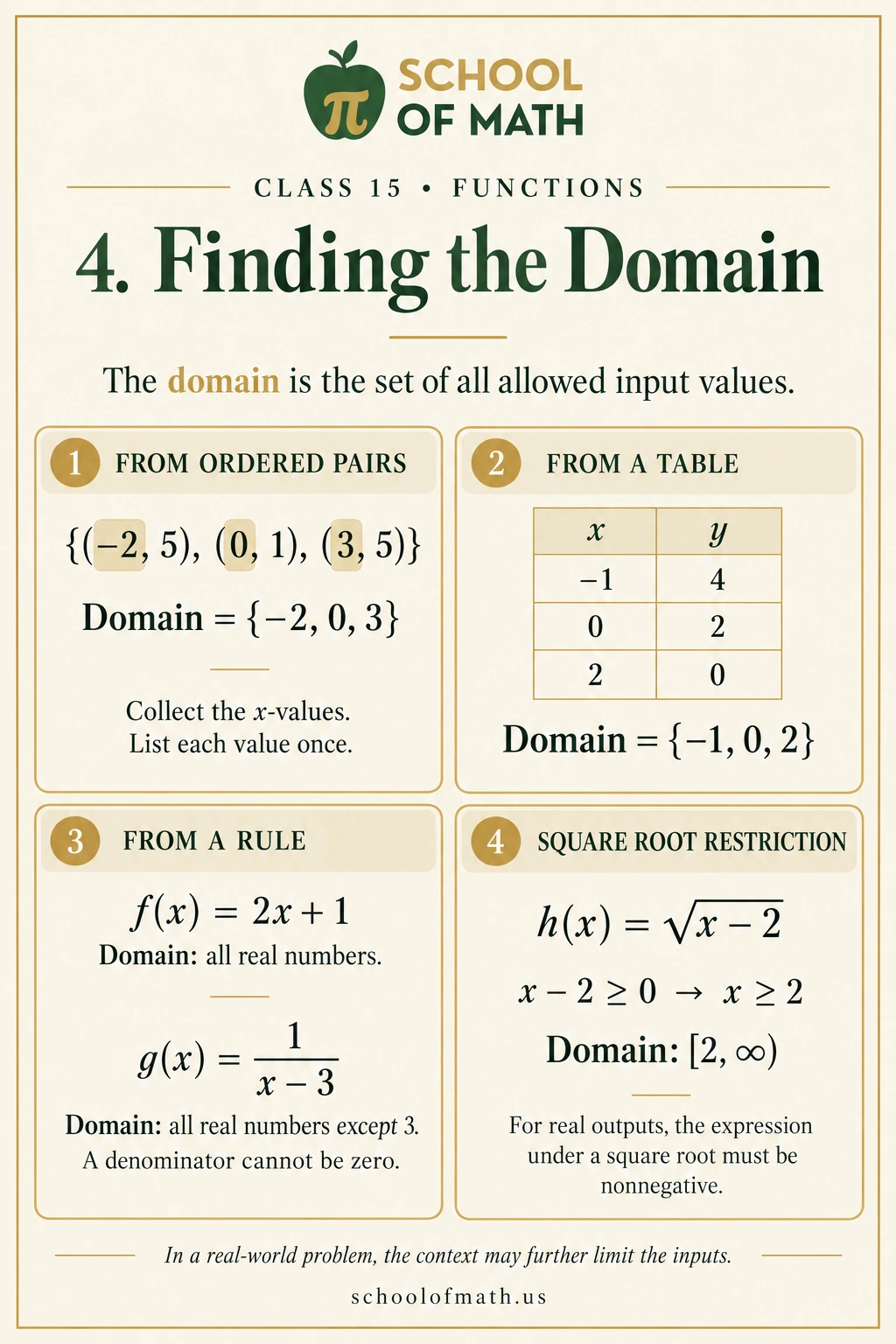
The domain is the set of allowed inputs. For a list or table, collect the x-values and list each distinct value once. For a real-valued formula with no stated restrictions, begin with all real numbers and remove any inputs where the formula is undefined.
A denominator cannot be zero. An expression inside a real square root must be nonnegative. A polynomial has no such algebraic restriction. Context can add further limits, such as whole-number ticket counts or nonnegative time.
Interval notation uses a square bracket for an included endpoint and a parenthesis for an excluded endpoint. Infinity is not a number that can be included, so it always takes a parenthesis. For example, x ≥ 4 is written [4, ∞).
Try it yourself: five questions
Q16 Practice 1 of 5
Find the domain of the relation (-4, 6), (1, 3), (5, 6).
Answer
\(\displaystyle \{-4, 1, 5\}\).
- Collect the first coordinates.
- List each distinct value once; repeated values do not create new members of a set.
Q17 Practice 2 of 5
Find the domain of \(\displaystyle f(x)=5x-8\) when no other restriction is given.
Answer
All real numbers.
- Multiplication by 5 and subtraction of 8 are defined for every real input.
- There is no denominator or square root that limits x.
Q18 Practice 3 of 5
Find the real-number domain of \(\displaystyle g(x)=\frac{2}{x+4}\).
Answer
\(\displaystyle x\ne -4\): all real numbers except −4.
- The denominator must not be zero.
- Solve \(\displaystyle x+4=0\) to find the excluded input, x = −4.
Q19 Practice 4 of 5
Find the real-number domain of \(\displaystyle h(x)=\sqrt{x-5}\). Write an inequality and an interval.
Answer
\(\displaystyle x\ge 5\), or \(\displaystyle [5,\infty)\).
- Require \(\displaystyle x-5\ge 0\).
- Adding 5 gives x ≥ 5. The endpoint is included because the square root of 0 is defined.
Q20 Practice 5 of 5
A class can order from 0 through 6 whole workbooks. If n is the number ordered, give the domain of its cost function.
Answer
\(\displaystyle \{0, 1, 2, 3, 4, 5, 6\}\).
- The count must be a whole number.
- Include 0 and 6 because the stated limits allow both; fractions of a workbook are not allowed.
Finding the range
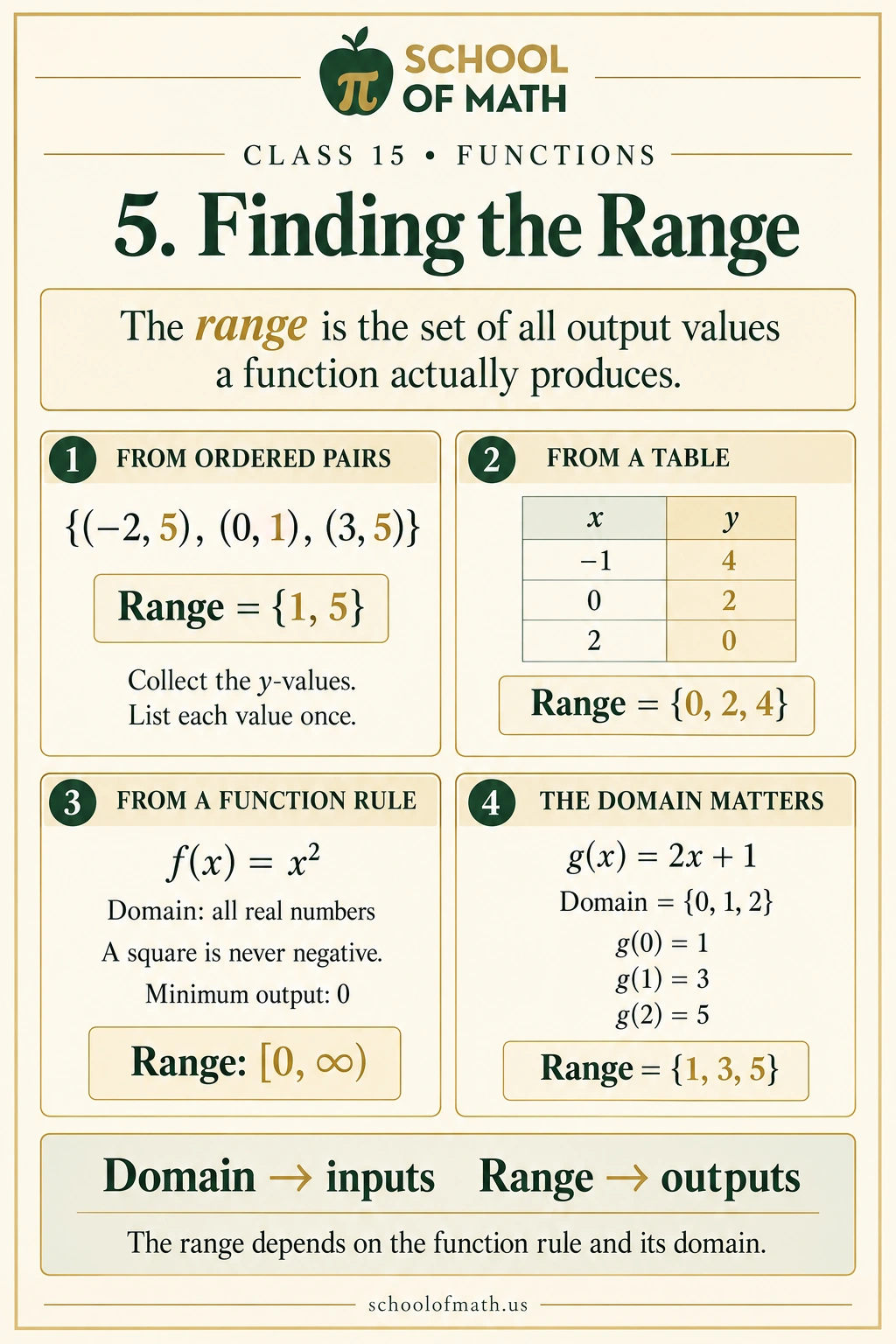
The range is the set of outputs that actually occur. For ordered pairs, collect the y-values. Remove duplicate outputs from a set. For a formula on a finite domain, evaluate every allowed input before listing the outputs.
Always use the stated domain. A quadratic on all real inputs may have an interval as its range, while the same formula on three allowed inputs has a finite range. To find a minimum or maximum, use the shape of the expression and check that the relevant input is allowed.
Try it yourself: five questions
Q21 Practice 1 of 5
Find the range of the relation (-2, 7), (0, 3), (4, 7), (6, -1).
Answer
\(\displaystyle \{-1, 3, 7\}\).
- Collect the second coordinates.
- List each distinct value once; repeated values do not create new members of a set.
Q22 Practice 2 of 5
For \(\displaystyle f(x)=3x-2\) with domain {−1, 0, 2}, find the range.
Answer
\(\displaystyle \{-5, -2, 4\}\).
- \(\displaystyle f(-1)=-5\), \(\displaystyle f(0)=-2\), and \(\displaystyle f(2)=4\).
- These are the only outputs because no other inputs are allowed.
Q23 Practice 3 of 5
Find the range of \(\displaystyle g(x)=x^2+4\) on all real inputs.
Answer
\(\displaystyle [4,\infty)\).
- A square is nonnegative, so \(\displaystyle x^2+4\ge 4\).
- The minimum 4 occurs at x = 0; every larger output is attainable.
Q24 Practice 4 of 5
Find the range of \(\displaystyle h(x)=9-x^2\) on all real inputs.
Answer
\(\displaystyle (-\infty,9]\).
- Subtracting a nonnegative square gives an output no greater than 9.
- The maximum is 9 at x = 0. The outputs decrease without bound as the size of x increases.
Q25 Practice 5 of 5
Find the range of \(\displaystyle p(x)=x^2\) when the domain is {−3, 0, 3}.
Answer
\(\displaystyle \{0, 9\}\).
- The three outputs are 9, 0, and 9.
- List 9 only once. The range is not all nonnegative numbers because the domain contains only three inputs.
Understanding function notation
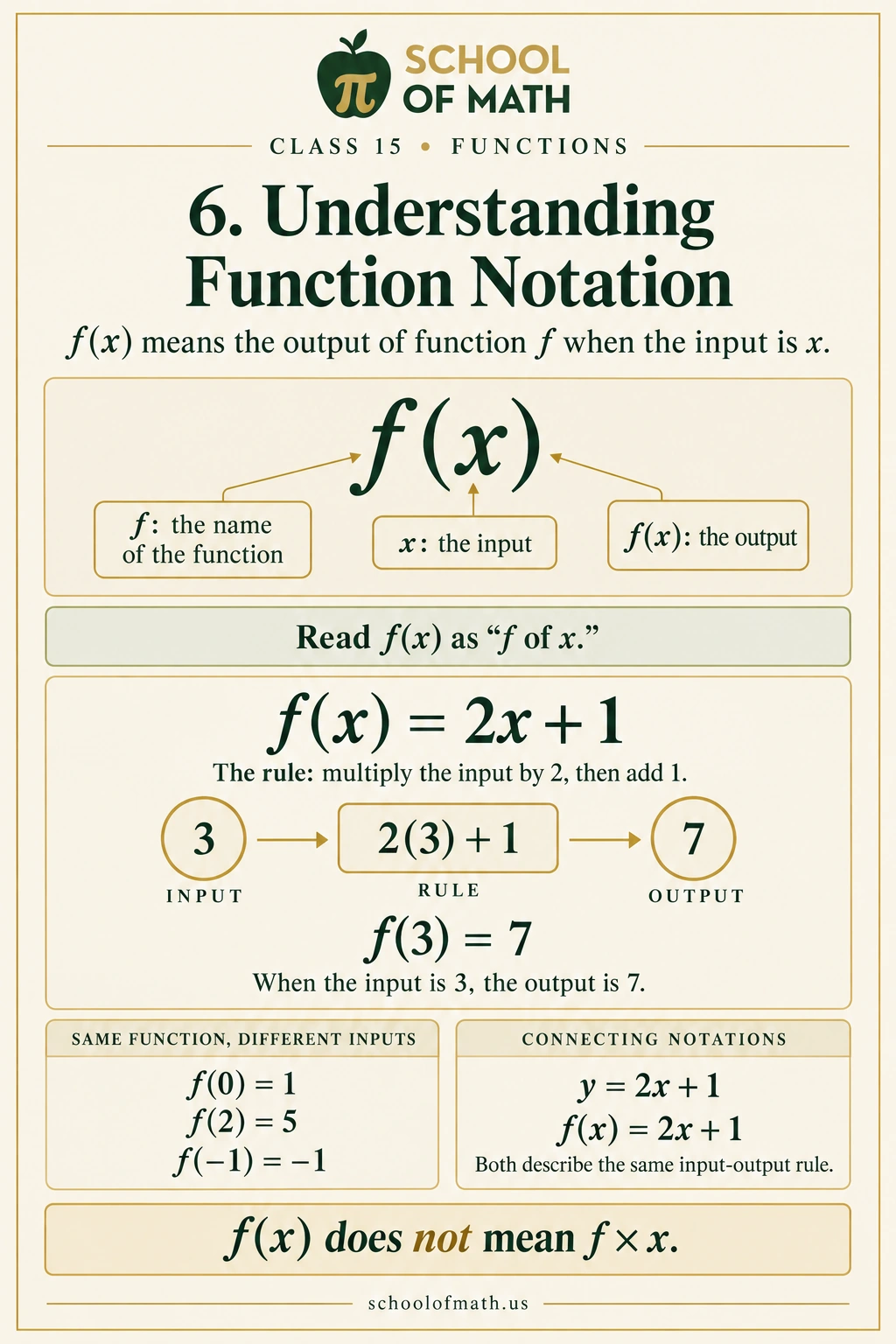
Read f(x) as “f of x.” The letter f names the function, x is its input, and the complete expression f(x) is the output. It does not mean f multiplied by x. Other letters, such as g, C, or T, can name a function.
The statement f(6) = 14 tells you that input 6 has output 14; it corresponds to the point (6, 14). Evaluating f(6) means substituting 6. Solving f(x) = 14 means finding the input or inputs that produce output 14. These are different questions.
Try it yourself: five questions
Q26 Practice 1 of 5
The statement \(\displaystyle g(4)=11\) is given. Identify the input, the output, and the corresponding ordered pair.
Answer
Input: 4. Output: 11. Ordered pair: (4, 11).
- The number inside parentheses is the input.
- The value of the whole function expression is the output.
Q27 Practice 2 of 5
Write “function p assigns input −2 the output 7” using function notation.
Answer
\(\displaystyle p(-2)=7\).
- Place the input −2 inside parentheses after p.
- Place the output 7 on the other side of the equals sign.
Q28 Practice 3 of 5
A student says h(3) means h × 3. Explain the mistake.
Answer
h(3) means the output of function h at input 3.
- Here h is the name of a rule, not a numerical factor.
- To find h(3), use the rule or the table for h.
Q29 Practice 4 of 5
Let \(\displaystyle f(x)=2x+5\). Find f(3), then solve f(x) = 3. Explain the difference.
Answer
\(\displaystyle f(3)=11\); the solution of f(x) = 3 is x = −1.
- \(\displaystyle f(3)=2(3)+5=11\). Here the input is given.
- \(\displaystyle 2x+5=3\) gives \(\displaystyle 2x=-2\) and x = −1. Here the output is given.
Q30 Practice 5 of 5
Temperature is a function of time: T(2) = 18. Time is measured in hours after noon and temperature in degrees Celsius. Interpret the statement.
Answer
At 2 PM, the temperature is 18°C.
- The input 2 means two hours after noon.
- The output 18 gives temperature, not a second time.
Evaluating functions
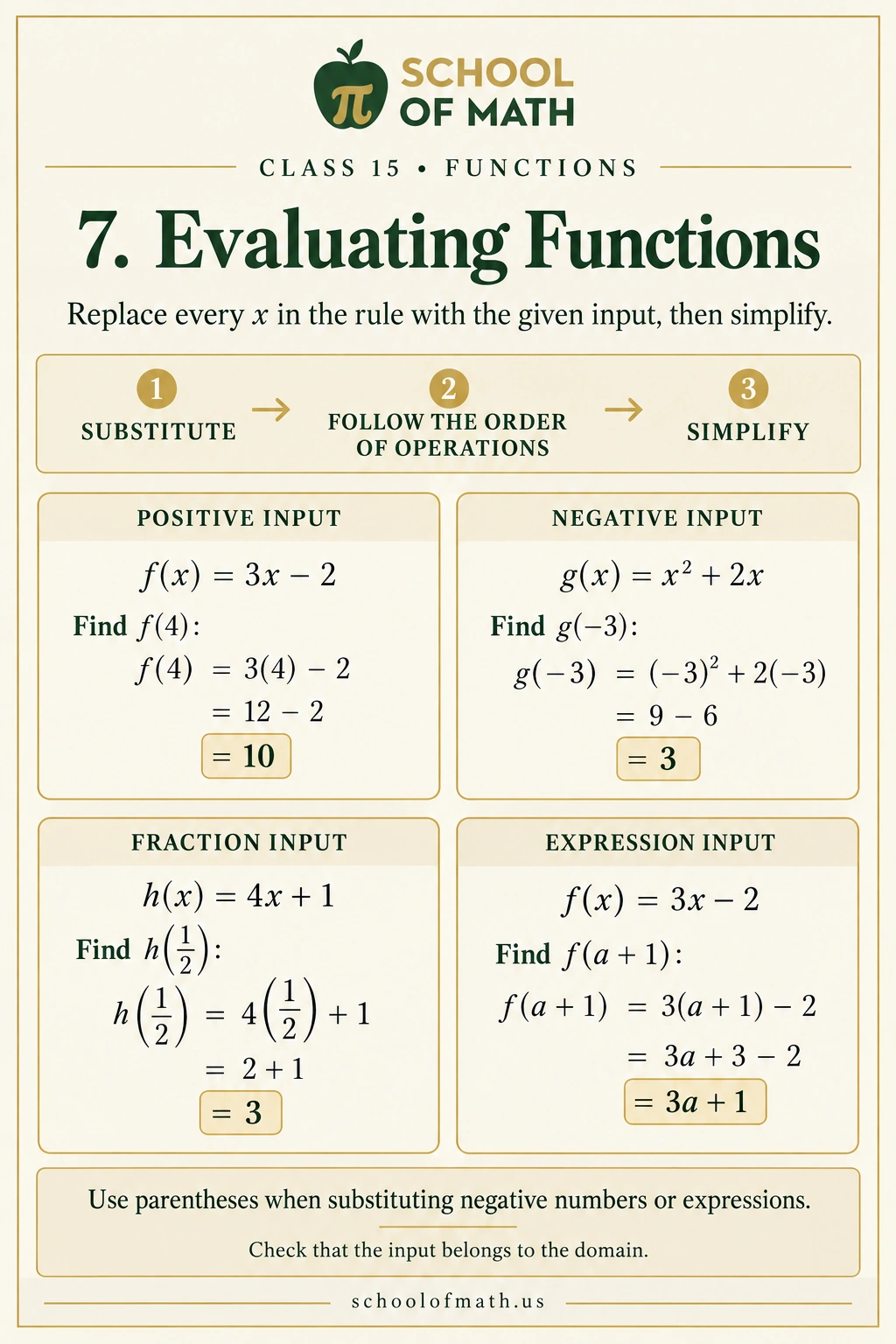
Replace every occurrence of the variable with the requested input, then follow the order of operations. Parentheses help preserve a negative input or an expression such as a − 2. In particular, the square of a negative input is positive.
Check the domain before calculating. An input that makes a denominator zero gives no defined output. For an expression input, simplify only after substituting the entire expression everywhere the original variable appears.
Try it yourself: five questions
Q31 Practice 1 of 5
For \(\displaystyle f(x)=4x-7\), find \(\displaystyle f(5)\).
Answer
\(\displaystyle f(5)=13\).
- Replace every x with \(\displaystyle 5\), using parentheses around a negative number or an expression.
- Substitute into the rule: \(\displaystyle 4(5)-7\). Simplify powers, then multiplication or division, then addition or subtraction to get \(\displaystyle 13\).
Q32 Practice 2 of 5
For \(\displaystyle g(x)=x^2-3x\), find \(\displaystyle g(-2)\).
Answer
\(\displaystyle g(-2)=10\).
- Replace every x with \(\displaystyle -2\), using parentheses around a negative number or an expression.
- Substitute into the rule: \(\displaystyle (-2)^2-3(-2)\). Simplify powers, then multiplication or division, then addition or subtraction to get \(\displaystyle 10\).
Q33 Practice 3 of 5
For \(\displaystyle h(x)=6x+2\), find \(\displaystyle h(\frac{1}{3})\).
Answer
\(\displaystyle h(\frac{1}{3})=4\).
- Replace every x with \(\displaystyle \frac{1}{3}\), using parentheses around a negative number or an expression.
- Substitute into the rule: \(\displaystyle 6(\frac{1}{3})+2\). Simplify powers, then multiplication or division, then addition or subtraction to get \(\displaystyle 4\).
Q34 Practice 4 of 5
For \(\displaystyle p(x)=2x+3\), find \(\displaystyle p(a-2)\).
Answer
\(\displaystyle p(a-2)=2 a - 1\).
- Replace every x with \(\displaystyle a-2\), using parentheses around a negative number or an expression.
- Substitute into the rule: \(\displaystyle 2(a-2)+3\). Simplify powers, then multiplication or division, then addition or subtraction to get \(\displaystyle 2 a - 1\).
Q35 Practice 5 of 5
For \(\displaystyle r(x)=\frac{10}{x-2}\), find r(7). Is r(2) defined?
Answer
r(7) = 2. r(2) is undefined.
- \(\displaystyle r(7)=\frac{10}{7-2}=\frac{10}{5}=2\).
- At x = 2 the denominator is zero. Division by zero is not defined.
Functions in real life
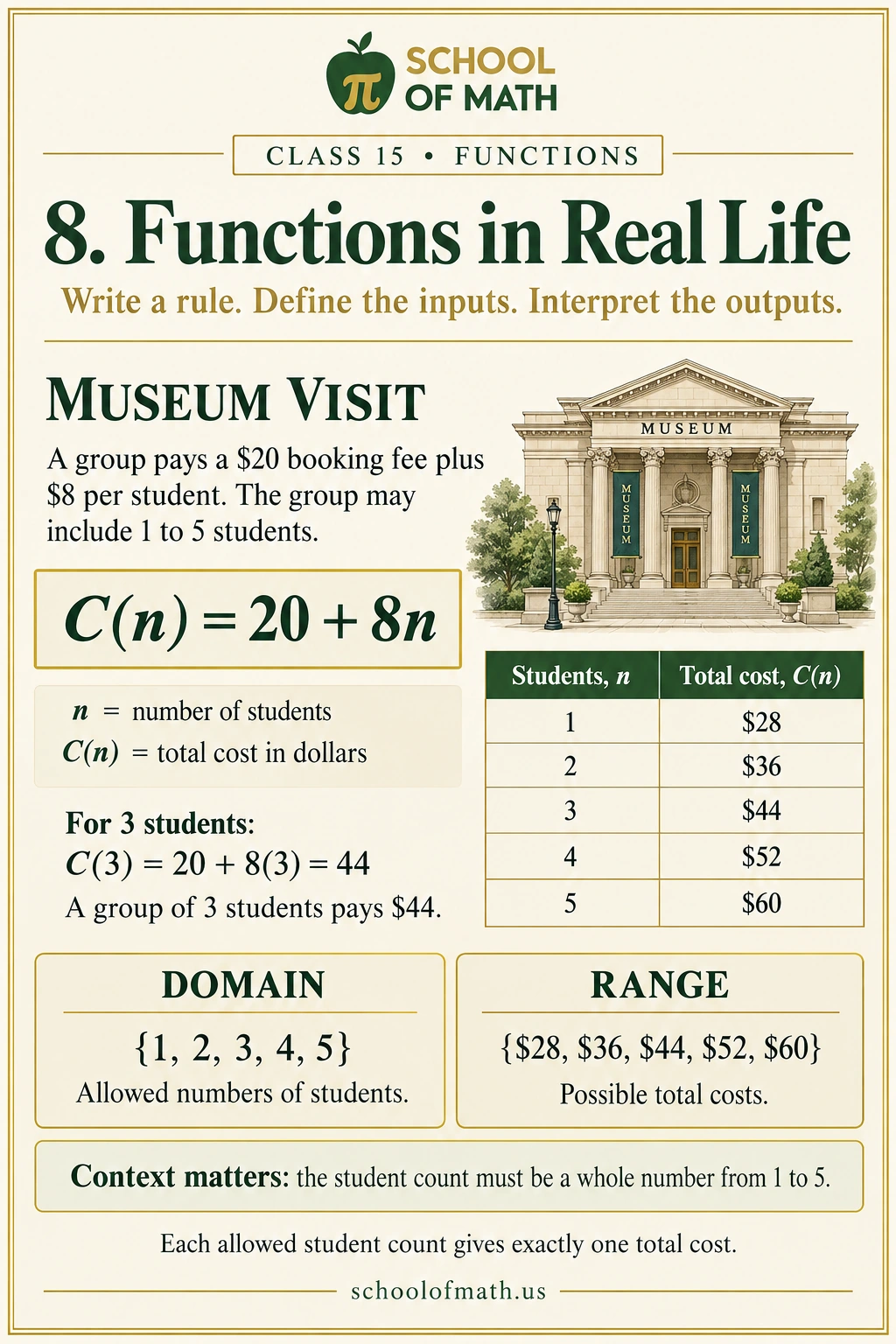
Start a model by stating what the input and output measure, including their units. A fixed fee contributes a constant; a price per item contributes a multiple of the input. Then describe exactly which inputs make sense in the situation.
Counts of people or items are usually discrete whole numbers. Time and measured length may vary continuously when the problem allows it. A domain describes all allowed inputs, not just the input you happen to substitute. Use that full domain when finding the range.
Try it yourself: five questions
Q36 Practice 1 of 5
A workshop charges a $12 setup fee plus $5 per student. Groups have 1 to 4 students. Write C(n), state the domain, and find C(3).
Answer
\(\displaystyle C(n)=12+5n\); domain {1, 2, 3, 4}; C(3) = $27.
- The $12 fee is paid once; add $5 for each of n students.
- \(\displaystyle C(3)=12+5(3)=27\). The count must be a whole number.
Q37 Practice 2 of 5
A taxi model is \(\displaystyle C(d)=6+2.5d\) dollars for distances d from 0 through 8 miles, including fractional miles. Find the domain and range.
Answer
Domain: [0, 8] miles. Range: [$6, $26].
- Distance varies continuously over the stated interval.
- The cost increases with distance, from C(0) = 6 to C(8) = 26; every intermediate cost occurs.
Q38 Practice 3 of 5
A store sells only packs of 4 pencils. Let P(n) be the number of pencils in n packs, where n is a whole number from 0 through 5. Write P(n) and list its range.
Answer
\(\displaystyle P(n)=4n\); range {0, 4, 8, 12, 16, 20} pencils.
- Multiply the number of packs by 4.
- Evaluate at n = 0, 1, 2, 3, 4, and 5; other pencil counts are not outputs of this model.
Q39 Practice 4 of 5
A tank contains \(\displaystyle V(t)=24-3t\) liters after t minutes, for 0 ≤ t ≤ 8. Find V(5), and explain why t = 9 is outside this model.
Answer
V(5) = 9 liters. The model ends at t = 8.
- Substitute: 24 − 3(5) = 9.
- The tank is empty at t = 8. Continuing to t = 9 would predict a negative volume, so that input is excluded.
Q40 Practice 5 of 5
A club charges \(\displaystyle C(n)=15+4n\) dollars for a group of 1 to 6 students. If a group pays $35, how many students are there? Check the input against the domain.
Answer
5 students.
- Solve 15 + 4n = 35: 4n = 20, so n = 5.
- 5 is an allowed whole-number input; C(5) = 15 + 20 = 35 dollars.
Homework review
Review each image in order: recognizing functions, checking representations, the vertical line test, domain, range, notation, evaluation, and real-life models. Complete one review question for each image.
R1 Review image 1 of 8
A mapping sends −4 → 6, 0 → 6, and 3 → 9. Is it a function? Explain.
Answer
Yes.
- Each input has exactly one output.
- Inputs −4 and 0 sharing output 6 does not violate the function rule.
R2 Review image 2 of 8
Does the relation (0, 2), (3, 5), (0, 8) define a function? Explain.
Answer
No, this relation is not a function.
- Group the ordered pairs by their first coordinate.
- Input 0 is paired with different outputs: 2, 8.
R3 Review image 3 of 8
The relation is \(\displaystyle x=y^2+1\). At x = 5, find the y-values. Does y define a function of x?
Answer
y = 2 or y = −2; it is not a function of x.
- Substitute x = 5: \(\displaystyle 5=y^2+1\), so \(\displaystyle y^2=4\).
- A vertical line at x = 5 has two intersections.
R4 Review image 4 of 8
Find the real-number domain of \(\displaystyle f(x)=\frac{3}{x-6}\).
Answer
All real numbers except 6.
- Require x − 6 ≠ 0.
- Therefore x ≠ 6; every other real input is allowed.
R5 Review image 5 of 8
Find the range of \(\displaystyle f(x)=x^2-1\) for domain {−2, 0, 2}.
Answer
\(\displaystyle \{-1, 3\}\).
- The outputs are 3, −1, and 3.
- List each distinct output once.
R6 Review image 6 of 8
A function contains the ordered pair (−3, 10). Write it as a statement about g and identify its input.
Answer
\(\displaystyle g(-3)=10\); the input is −3.
- The first coordinate goes inside the parentheses.
- The second coordinate is the output.
R7 Review image 7 of 8
For \(\displaystyle h(x)=x^2+2x-1\), find \(\displaystyle h(-3)\).
Answer
\(\displaystyle h(-3)=2\).
- Replace every x with \(\displaystyle -3\), using parentheses around a negative number or an expression.
- Substitute into the rule: \(\displaystyle (-3)^2+2(-3)-1\). Simplify powers, then multiplication or division, then addition or subtraction to get \(\displaystyle 2\).
R8 Review image 8 of 8
A craft session costs $9 plus $3 per student, for groups of 1 to 4 students. Write C(n) and list its domain and range.
Answer
\(\displaystyle C(n)=9+3n\); domain {1, 2, 3, 4}; range {$12, $15, $18, $21}.
- Use the fixed fee 9 and the per-student cost 3n.
- Evaluate the rule at each of the four allowed student counts.
Homework word problems
These twelve problems build from identifying inputs and outputs to creating rules, restricting domains, finding ranges, and comparing two cost functions. Include units and explain why your chosen inputs make sense.
W1 Homework word problem 1 of 12
A school assigns exactly one locker to each student. Each student is identified by a unique ID. Does the assignment from student ID to locker number define a function? Explain.
Answer
Yes.
- Use student ID as the input and locker number as the output.
- Each input has exactly one assigned output.
W2 Homework word problem 2 of 12
During the same school term, each student ID is paired with the names of all that student’s classes. One student takes math, art, and science. Is class name a function of student ID in this relation?
Answer
No.
- That one student ID is paired with at least three different class names.
- One input with multiple outputs violates the function rule.
W3 Homework word problem 3 of 12
A bakery’s function B(n) gives the total price in dollars for n muffins. Interpret B(6) = 18, including units.
Answer
Six muffins cost $18.
- The input 6 is a number of muffins.
- The output 18 is the total price in dollars, not the price of one muffin.
W4 Homework word problem 4 of 12
A photo booth charges $2 per print. A customer may buy 1, 2, 3, or 4 prints. Write P(n) and list its domain and range.
Answer
\(\displaystyle P(n)=2n\); domain {1, 2, 3, 4}; range {$2, $4, $6, $8}.
- Each allowed input is a whole-number print count.
- Multiply each count by 2 to find every possible output.
W5 Homework word problem 5 of 12
A bowling outing costs $7 for shoe rental plus $6 per game. A player may play 1 through 4 whole games. Write C(g), then find and interpret C(3).
Answer
\(\displaystyle C(g)=7+6g\); C(3) = $25.
- The rental fee is paid once and the game charge is 6g.
- For 3 games: 7 + 6(3) = 25 dollars, including shoe rental.
W6 Homework word problem 6 of 12
A theater charges a $10 booking fee plus $8 per ticket. Orders may contain 1 through 5 whole tickets. Write the cost function, give its domain, and list all possible total costs.
Answer
\(\displaystyle C(n)=10+8n\); domain {1, 2, 3, 4, 5}; range {$18, $26, $34, $42, $50}.
- Evaluate the rule at each allowed ticket count.
- The range is these five costs, not every dollar amount between $18 and $50.
W7 Homework word problem 7 of 12
A bicycle rental costs $5 plus $4 per hour and is prorated continuously. Rentals last from 0.5 through 3 hours. Write C(t), find C(1.5), and give the domain and range.
Answer
\(\displaystyle C(t)=5+4t\); C(1.5) = $11; domain [0.5, 3]; range [$7, $17].
- At 1.5 hours, 5 + 4(1.5) = 11.
- The increasing rule has endpoint costs C(0.5) = 7 and C(3) = 17. Continuous prorating allows all intermediate costs.
W8 Homework word problem 8 of 12
A candle’s height is \(\displaystyle H(t)=18-2t\) centimeters for 0 ≤ t ≤ 9 hours. Find H(4), give the range, and explain why t = 10 is not allowed.
Answer
H(4) = 10 cm; range [0, 18] cm; t = 10 is outside the model.
- Compute 18 − 2(4) = 10. Height decreases continuously from 18 to 0 cm.
- At t = 9 the candle reaches height 0. Extending the formula to t = 10 would give a negative height.
W9 Homework word problem 9 of 12
A club orders badges for $3 each plus a $6 shipping fee. An order must contain 1 through 12 whole badges. Its total is $33. Write the function and find the number ordered, checking the domain.
Answer
\(\displaystyle C(n)=6+3n\); 9 badges.
- Solve 6 + 3n = 33, giving 3n = 27 and n = 9.
- 9 is an allowed whole-number input; C(9) = 33 dollars.
W10 Homework word problem 10 of 12
A square garden has side length s meters, allowed to vary continuously from 2 through 5 meters. Write the area function A(s), find A(3.5), and give its domain and range.
Answer
\(\displaystyle A(s)=s^2\); A(3.5) = 12.25 m²; domain [2, 5] meters; range [4, 25] square meters.
- Area is side length times itself: 3.5 × 3.5 = 12.25.
- For positive sides in [2, 5], squaring increases from 4 to 25, and all intermediate areas occur.
W11 Homework word problem 11 of 12
A team rents a bus for $120 and splits the cost equally among n riders, where n is a whole number from 4 through 8. Write the per-person cost P(n), list its domain and range, and find the smallest per-person cost.
Answer
\(\displaystyle P(n)=\frac{120}{n}\); domain {4, 5, 6, 7, 8}; range {$15, $120/7, $20, $24, $30}; minimum $15.
- The respective costs for 4, 5, 6, 7, and 8 riders are 30, 24, 20, 120/7, and 15 dollars. Keep 120/7 exact; it is about $17.14.
- The largest allowed group, 8 riders, produces the smallest cost. Fractional rider counts and n = 0 are not allowed.
W12 Homework word problem 12 of 12
A school fair offers two booth plans: A(n) = 12 + 3n and B(n) = 6 + 5n dollars, where n is a whole number from 1 through 6 activities. Find the input where the costs match. Which plan is cheaper below and above that input within the domain?
Answer
They match at n = 3, costing $21. B is cheaper for n = 1 or 2; A is cheaper for n = 4, 5, or 6.
- Solve 12 + 3n = 6 + 5n: 6 = 2n, so n = 3. Both outputs are 21.
- The difference A(n) − B(n) = 6 − 2n is positive below 3 and negative above 3. The shared domain contains only whole numbers 1 through 6.
Quick questions and answers
What is a function?
A function assigns exactly one output to each input in its domain. Different inputs may share an output, but one input cannot have two different outputs.
What is the difference between domain and range?
The domain is the set of allowed inputs. The range is the set of outputs actually produced from those inputs. The range depends on both the rule and its domain.
How does the vertical line test work?
A graph represents y as a function of x if every vertical line intersects it at most once. Zero intersections are allowed for x-values outside the domain. Two intersections mean the graph fails.
What does f(x) mean?
It means the output of function f for input x. It does not mean f multiplied by x. For example, f(4) = 9 assigns output 9 to input 4.
What inputs must be excluded from a formula?
For real-valued functions, a denominator cannot be zero and the expression inside a square root cannot be negative. Context may further restrict inputs, such as whole-number counts.
What practice and homework are included?
Eight images each have five original practice questions. Homework has eight review questions and twelve word problems, for 60 questions in total. Hidden solutions are online; the 22-page workbook has the supplied cover and blank answer space.