Algebra 2 · Class 16
Radical Equations and Extraneous Solutions
Isolate the radical, solve for candidates, and prove which answers really work. Learn why squaring can create extra roots and why checking the original equation is essential.
Explore ten illustrated topics with 50 practice questions, eight Homework review questions, and twelve Homework word problems. All 70 questions include detailed working behind blue Answer controls. Solve over the real numbers and keep exact values unless a question requests rounding.
This is an independent topic in the Algebra 2 rolling syllabus; earlier class attendance is not required. Use the explanations here, try each question, then reveal the check. See the schedule or book an evaluation at SOMATH.
Download the student workbook (PDF)26 pages · Supplied cover, ten teaching images, all 70 questions · Blank working space · No exercise solutions
Recognize radical equations and restrictions
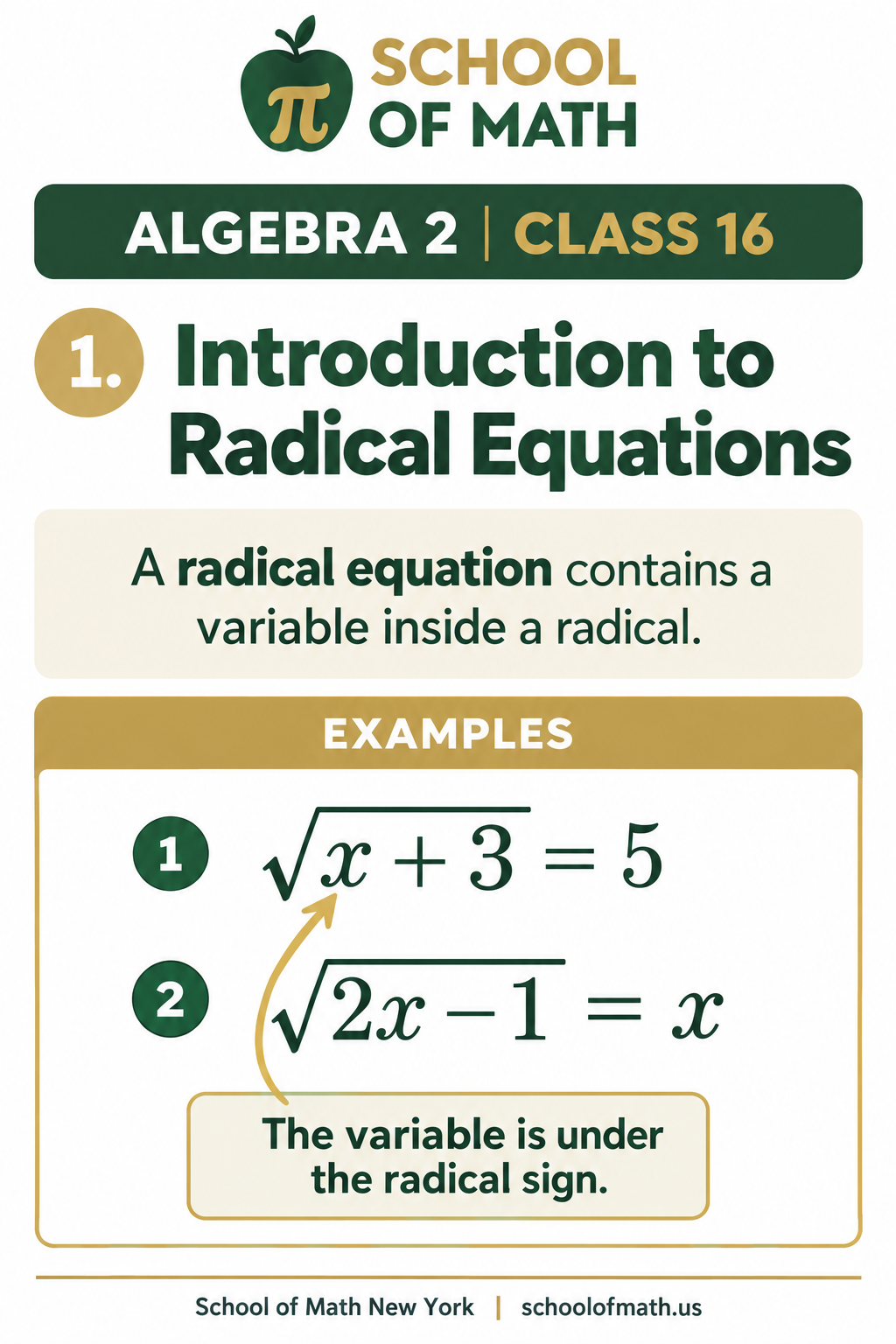
A radical equation has a variable inside a radical. For real square roots, the radicand must be nonnegative, and the principal square-root value is nonnegative. These are two different restrictions to track.
Our workflow is: state restrictions, isolate a radical, raise both sides to the appropriate power, solve for candidates, and check each candidate in the original equation. Do not assume every root of the squared equation is valid.
Practice: try these five questions
Q1
Which equation is a radical equation? Explain the role of the variable.
Answer
Only \(\sqrt{x+8}=6\) is a radical equation.
In the first equation, the unknown x appears under a square-root sign.
In the second, only the fixed number 8 is under the radical. The equation is linear in x.
Check in the original equation
A constant radical in a coefficient or constant term does not by itself make an equation radical in the unknown.
Q2
State the real-domain restriction. Also state the additional sign restriction imposed by the equation.
Answer
\(x\ge4\) is necessary for any solution.
The radicand must be nonnegative.
\[3x-6\ge0\quad\Rightarrow\quad x\ge2\]The principal square root is nonnegative, so the opposite side must be nonnegative.
\[x-4\ge0\quad\Rightarrow\quad x\ge4\]Intersect the restrictions: keep values meeting both.
\[x\ge4\]
Check in the original equation
These are necessary restrictions, not a claim that every x ≥ 4 solves the equation. A solution must also satisfy equality.
Q3
Solve over the real numbers. State the restrictions and check every candidate in the original equation.
Answer
\(x=16\)
A real square root requires a nonnegative radicand. Record the original domain.
\[-9 \leq x\]The isolated principal square root is nonnegative, so its opposite side must also be nonnegative. Combine this with the radicand restriction.
\[-9 \leq x\]Square both sides to obtain a necessary equation. Squaring may introduce candidates, so this is not yet the solution set.
\[x + 9=25\]Expand and collect terms on one side.
\[16 - x=0\]Solve the polynomial to obtain candidates, not automatically valid solutions.
\[x\in\left\{16\right\}\]
Check in the original equation
Candidate \(x=16\): Valid in the original equation.
Q4
Why is a candidate obtained by squaring not automatically a solution? Use 4 and −4 as an example.
Answer
Squaring erases sign information.
The two numbers are unequal.
\[4\ne-4\]Their squares are equal.
\[4^2=(-4)^2=16\]Thus a value may satisfy a squared equation while failing the original sign-sensitive equation. Substitute each candidate back into the original.
Check in the original equation
For example, squaring \(\sqrt{x}=-4\) gives x = 16, but the original becomes 4 = −4, which is false.
Q5
Solve over the real numbers. State the restrictions and check every candidate in the original equation.
Answer
\(x=21\)
A real square root requires a nonnegative radicand. Record the original domain.
\[- \frac{7}{2} \leq x\]The isolated principal square root is nonnegative, so its opposite side must also be nonnegative. Combine this with the radicand restriction.
\[- \frac{7}{2} \leq x\]Square both sides to obtain a necessary equation. Squaring may introduce candidates, so this is not yet the solution set.
\[2 x + 7=49\]Expand and collect terms on one side.
\[42 - 2 x=0\]Factor the polynomial; set each nonconstant factor equal to zero.
\[- 2 \left(x - 21\right)=0\]Solve the polynomial to obtain candidates, not automatically valid solutions.
\[x\in\left\{21\right\}\]
Check in the original equation
Candidate \(x=21\): Valid in the original equation.
Basic square-root equations
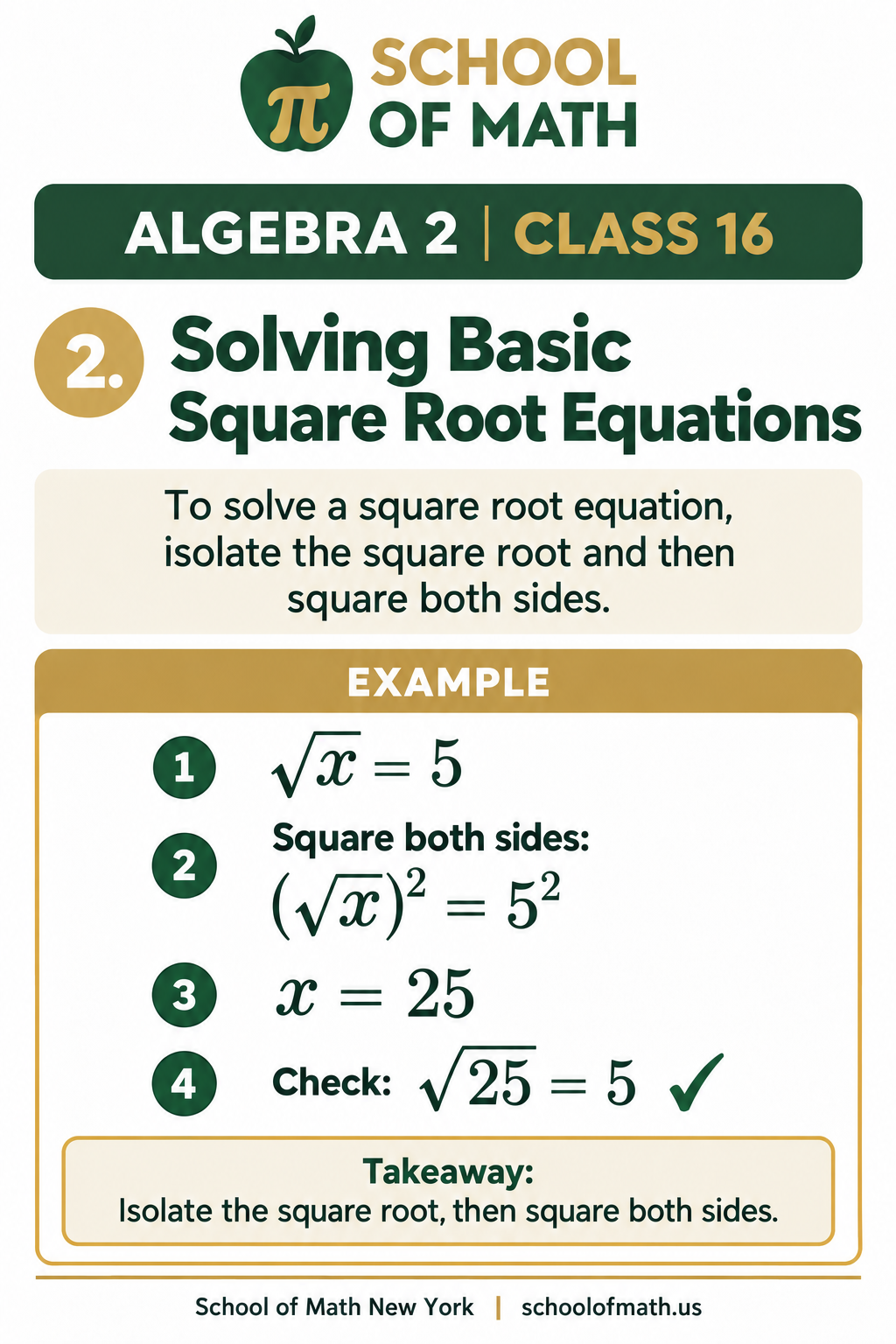
When the isolated square root equals a nonnegative constant, squaring removes the radical: \(\sqrt{A}=b\) implies \(A=b^2\). Solve the remaining equation and check the result.
Do not attach a plus-or-minus sign to a principal square root. The equation \(\sqrt{x}=7\) has \(x=49\), not \(x=\pm49\). The plus-or-minus belongs to solving an equation such as \(x^2=49\).
Practice: try these five questions
Q6
Solve over the real numbers. State the restrictions and check every candidate in the original equation.
Answer
\(x=64\)
A real square root requires a nonnegative radicand. Record the original domain.
\[0 \leq x\]The isolated principal square root is nonnegative, so its opposite side must also be nonnegative. Combine this with the radicand restriction.
\[0 \leq x\]Square both sides to obtain a necessary equation. Squaring may introduce candidates, so this is not yet the solution set.
\[x=64\]Expand and collect terms on one side.
\[64 - x=0\]Solve the polynomial to obtain candidates, not automatically valid solutions.
\[x\in\left\{64\right\}\]
Check in the original equation
Candidate \(x=64\): Valid in the original equation.
Q7
Solve over the real numbers. State the restrictions and check every candidate in the original equation.
Answer
\(x=22\)
A real square root requires a nonnegative radicand. Record the original domain.
\[6 \leq x\]The isolated principal square root is nonnegative, so its opposite side must also be nonnegative. Combine this with the radicand restriction.
\[6 \leq x\]Square both sides to obtain a necessary equation. Squaring may introduce candidates, so this is not yet the solution set.
\[x - 6=16\]Expand and collect terms on one side.
\[22 - x=0\]Solve the polynomial to obtain candidates, not automatically valid solutions.
\[x\in\left\{22\right\}\]
Check in the original equation
Candidate \(x=22\): Valid in the original equation.
Q8
Solve over the real numbers. State the restrictions and check every candidate in the original equation.
Answer
\(x=20\)
A real square root requires a nonnegative radicand. Record the original domain.
\[- \frac{1}{4} \leq x\]The isolated principal square root is nonnegative, so its opposite side must also be nonnegative. Combine this with the radicand restriction.
\[- \frac{1}{4} \leq x\]Square both sides to obtain a necessary equation. Squaring may introduce candidates, so this is not yet the solution set.
\[4 x + 1=81\]Expand and collect terms on one side.
\[80 - 4 x=0\]Factor the polynomial; set each nonconstant factor equal to zero.
\[- 4 \left(x - 20\right)=0\]Solve the polynomial to obtain candidates, not automatically valid solutions.
\[x\in\left\{20\right\}\]
Check in the original equation
Candidate \(x=20\): Valid in the original equation.
Q9
Solve over the real numbers. State the restrictions and check every candidate in the original equation.
Answer
\(x=69\)
A real square root requires a nonnegative radicand. Record the original domain.
\[-6 \leq x\]The isolated principal square root is nonnegative, so its opposite side must also be nonnegative. Combine this with the radicand restriction.
\[-6 \leq x\]Square both sides to obtain a necessary equation. Squaring may introduce candidates, so this is not yet the solution set.
\[\frac{x}{3} + 2=25\]Expand and collect terms on one side.
\[23 - \frac{x}{3}=0\]Factor the polynomial; set each nonconstant factor equal to zero.
\[- \frac{x - 69}{3}=0\]Solve the polynomial to obtain candidates, not automatically valid solutions.
\[x\in\left\{69\right\}\]
Check in the original equation
Candidate \(x=69\): Valid in the original equation.
Q10
Solve over the real numbers. State the restrictions and check every candidate in the original equation.
Answer
\(x=-1\)
A real square root requires a nonnegative radicand. Record the original domain.
\[x \leq \frac{7}{2}\]The isolated principal square root is nonnegative, so its opposite side must also be nonnegative. Combine this with the radicand restriction.
\[x \leq \frac{7}{2}\]Square both sides to obtain a necessary equation. Squaring may introduce candidates, so this is not yet the solution set.
\[7 - 2 x=9\]Expand and collect terms on one side.
\[2 x + 2=0\]Factor the polynomial; set each nonconstant factor equal to zero.
\[2 \left(x + 1\right)=0\]Solve the polynomial to obtain candidates, not automatically valid solutions.
\[x\in\left\{-1\right\}\]
Check in the original equation
Candidate \(x=-1\): Valid in the original equation.
Isolate the radical before squaring
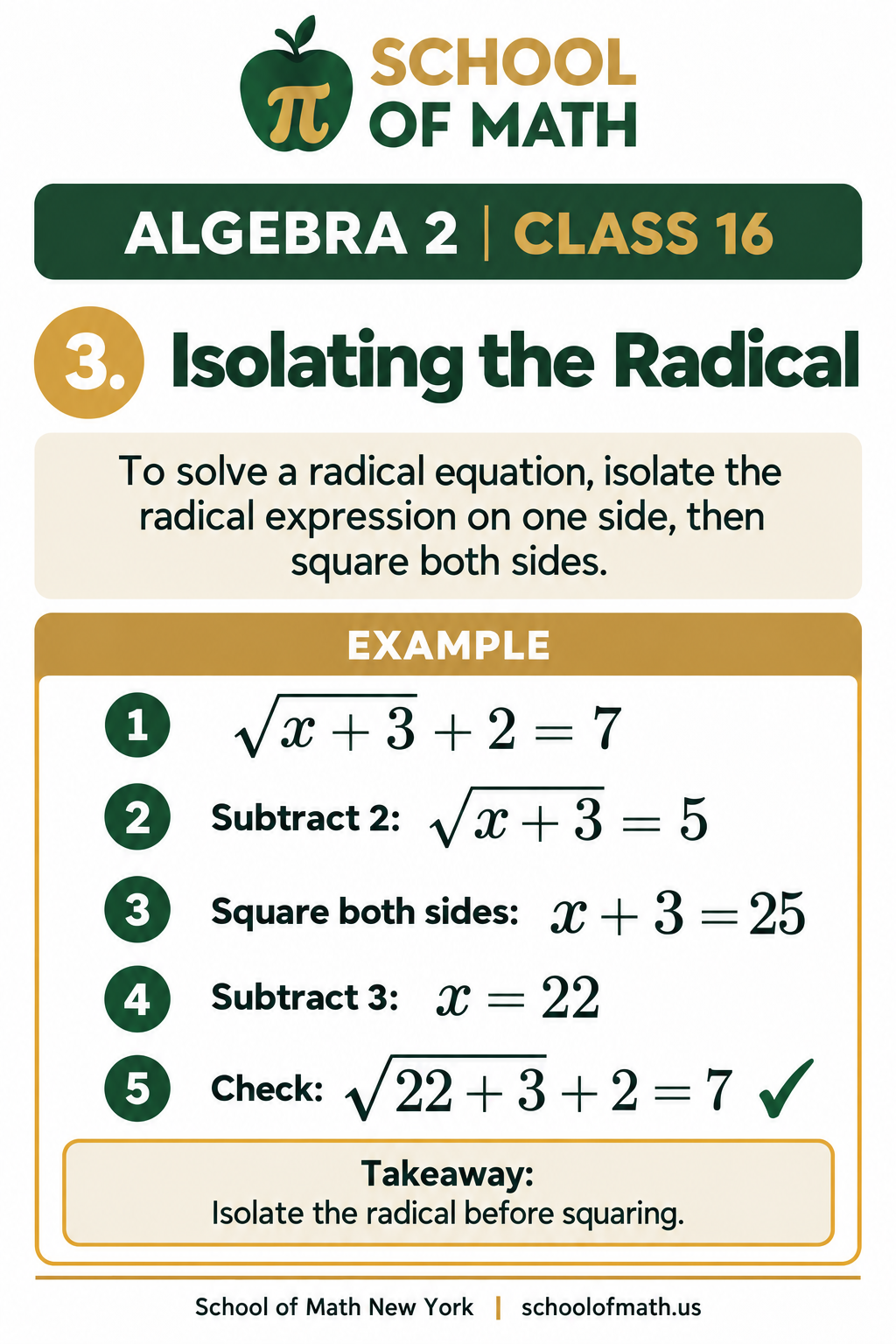
Undo operations outside the radical first. Subtract or add outside constants, then divide by the radical’s coefficient. This prevents unnecessary binomial squares.
Keep the signs when dividing by a negative coefficient. After isolation, a square root equaling a negative number proves no real solution immediately. Squaring such an equation can still produce a misleading candidate.
Practice: try these five questions
Q11
Solve over the real numbers. State the restrictions and check every candidate in the original equation.
Answer
\(x=60\)
A real square root requires a nonnegative radicand. Record the original domain.
\[-4 \leq x\]Undo the outside addition/subtraction and multiplication/division to isolate the radical before squaring.
\[\sqrt{x + 4}=8\]The isolated principal square root is nonnegative, so its opposite side must also be nonnegative. Combine this with the radicand restriction.
\[-4 \leq x\]Square both sides to obtain a necessary equation. Squaring may introduce candidates, so this is not yet the solution set.
\[x + 4=64\]Expand and collect terms on one side.
\[60 - x=0\]Solve the polynomial to obtain candidates, not automatically valid solutions.
\[x\in\left\{60\right\}\]
Check in the original equation
Candidate \(x=60\): Valid in the original equation.
Q12
Solve over the real numbers. State the restrictions and check every candidate in the original equation.
Answer
\(x=26\)
A real square root requires a nonnegative radicand. Record the original domain.
\[\frac{3}{2} \leq x\]Undo the outside addition/subtraction and multiplication/division to isolate the radical before squaring.
\[\sqrt{2 x - 3}=7\]The isolated principal square root is nonnegative, so its opposite side must also be nonnegative. Combine this with the radicand restriction.
\[\frac{3}{2} \leq x\]Square both sides to obtain a necessary equation. Squaring may introduce candidates, so this is not yet the solution set.
\[2 x - 3=49\]Expand and collect terms on one side.
\[52 - 2 x=0\]Factor the polynomial; set each nonconstant factor equal to zero.
\[- 2 \left(x - 26\right)=0\]Solve the polynomial to obtain candidates, not automatically valid solutions.
\[x\in\left\{26\right\}\]
Check in the original equation
Candidate \(x=26\): Valid in the original equation.
Q13
Solve over the real numbers. State the restrictions and check every candidate in the original equation.
Answer
\(x=26\)
A real square root requires a nonnegative radicand. Record the original domain.
\[1 \leq x\]Undo the outside addition/subtraction and multiplication/division to isolate the radical before squaring.
\[\sqrt{x - 1}=5\]The isolated principal square root is nonnegative, so its opposite side must also be nonnegative. Combine this with the radicand restriction.
\[1 \leq x\]Square both sides to obtain a necessary equation. Squaring may introduce candidates, so this is not yet the solution set.
\[x - 1=25\]Expand and collect terms on one side.
\[26 - x=0\]Solve the polynomial to obtain candidates, not automatically valid solutions.
\[x\in\left\{26\right\}\]
Check in the original equation
Candidate \(x=26\): Valid in the original equation.
Q14
Solve over the real numbers. State the restrictions and check every candidate in the original equation.
Answer
\(x=15\)
A real square root requires a nonnegative radicand. Record the original domain.
\[-1 \leq x\]Undo the outside addition/subtraction and multiplication/division to isolate the radical before squaring.
\[\sqrt{x + 1}=4\]The isolated principal square root is nonnegative, so its opposite side must also be nonnegative. Combine this with the radicand restriction.
\[-1 \leq x\]Square both sides to obtain a necessary equation. Squaring may introduce candidates, so this is not yet the solution set.
\[x + 1=16\]Expand and collect terms on one side.
\[15 - x=0\]Solve the polynomial to obtain candidates, not automatically valid solutions.
\[x\in\left\{15\right\}\]
Check in the original equation
Candidate \(x=15\): Valid in the original equation.
Q15
Solve over the real numbers. State the restrictions and check every candidate in the original equation.
Answer
\(x=6\)
A real square root requires a nonnegative radicand. Record the original domain.
\[- \frac{6}{5} \leq x\]Undo the outside addition/subtraction and multiplication/division to isolate the radical before squaring.
\[\sqrt{5 x + 6}=6\]The isolated principal square root is nonnegative, so its opposite side must also be nonnegative. Combine this with the radicand restriction.
\[- \frac{6}{5} \leq x\]Square both sides to obtain a necessary equation. Squaring may introduce candidates, so this is not yet the solution set.
\[5 x + 6=36\]Expand and collect terms on one side.
\[30 - 5 x=0\]Factor the polynomial; set each nonconstant factor equal to zero.
\[- 5 \left(x - 6\right)=0\]Solve the polynomial to obtain candidates, not automatically valid solutions.
\[x\in\left\{6\right\}\]
Check in the original equation
Candidate \(x=6\): Valid in the original equation.
A square root equal to a variable expression
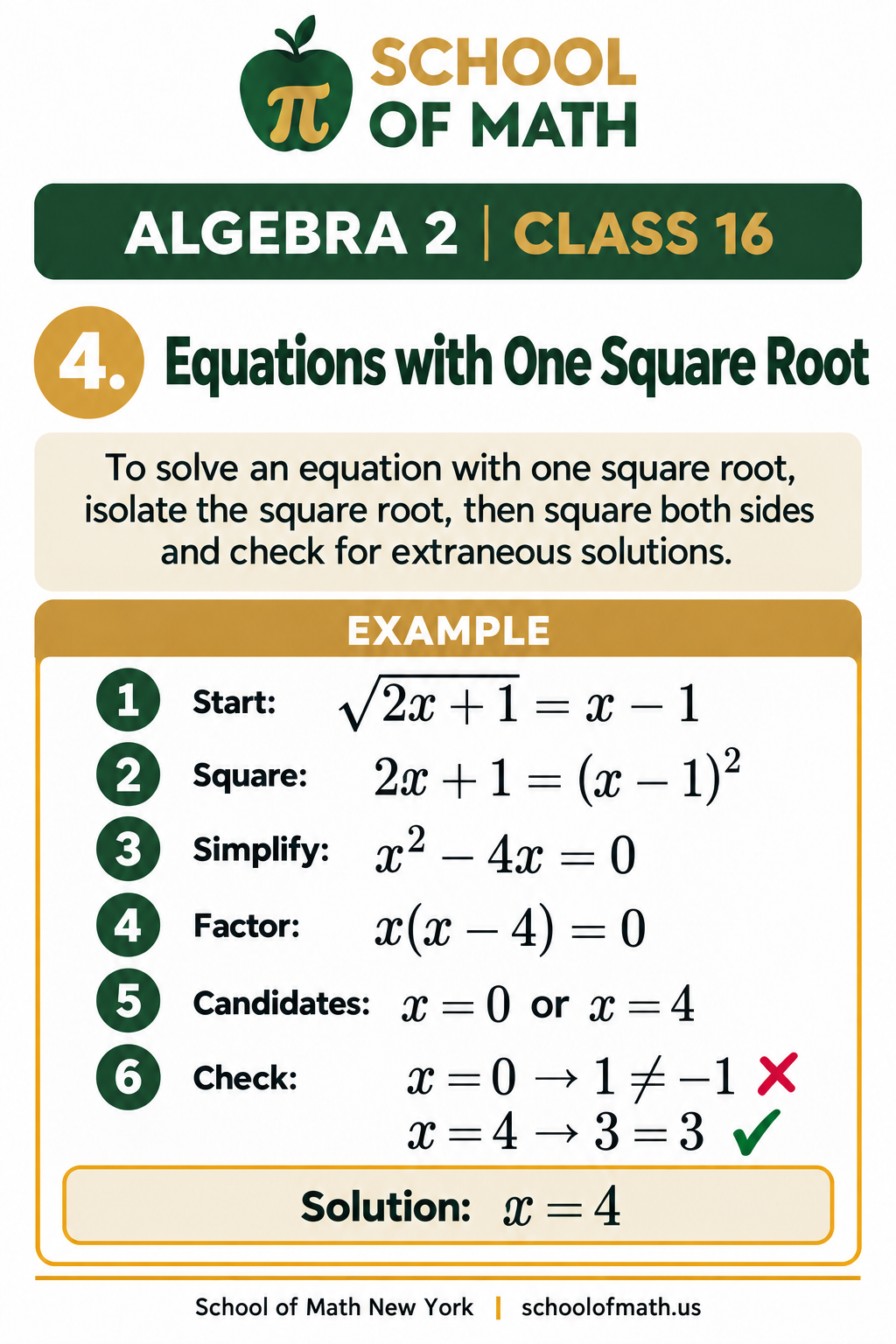
When the other side contains x, squaring often creates a quadratic equation. Expand the whole binomial: \((x-c)^2=x^2-2cx+c^2\). Omitting the middle term changes the equation.
A quadratic may produce two candidates, one candidate, or none. Some equations have two valid solutions; others have an extraneous root. Only the original equation decides which candidates survive.
Practice: try these five questions
Q16
Solve over the real numbers. State the restrictions and check every candidate in the original equation.
Answer
\(x=4\)
A real square root requires a nonnegative radicand. Record the original domain.
\[-12 \leq x\]The isolated principal square root is nonnegative, so its opposite side must also be nonnegative. Combine this with the radicand restriction.
\[0 \leq x\]Square both sides to obtain a necessary equation. Squaring may introduce candidates, so this is not yet the solution set.
\[x + 12=x^{2}\]Expand and collect terms on one side.
\[x^{2} - x - 12=0\]Factor the polynomial; set each nonconstant factor equal to zero.
\[\left(x - 4\right) \left(x + 3\right)=0\]Solve the polynomial to obtain candidates, not automatically valid solutions.
\[x\in\left\{-3, 4\right\}\]
Check in the original equation
Candidate \(x=-3\): Reject: extraneous candidate.
Candidate \(x=4\): Valid in the original equation.
Q17
Solve over the real numbers. State the restrictions and check every candidate in the original equation.
Answer
\(x=2\;\text{or}\;x=3\)
A real square root requires a nonnegative radicand. Record the original domain.
\[\frac{6}{5} \leq x\]The isolated principal square root is nonnegative, so its opposite side must also be nonnegative. Combine this with the radicand restriction.
\[\frac{6}{5} \leq x\]Square both sides to obtain a necessary equation. Squaring may introduce candidates, so this is not yet the solution set.
\[5 x - 6=x^{2}\]Expand and collect terms on one side.
\[x^{2} - 5 x + 6=0\]Factor the polynomial; set each nonconstant factor equal to zero.
\[\left(x - 3\right) \left(x - 2\right)=0\]Solve the polynomial to obtain candidates, not automatically valid solutions.
\[x\in\left\{2, 3\right\}\]
Check in the original equation
Candidate \(x=2\): Valid in the original equation.
Candidate \(x=3\): Valid in the original equation.
Q18
Solve over the real numbers. State the restrictions and check every candidate in the original equation.
Answer
\(x=2\)
A real square root requires a nonnegative radicand. Record the original domain.
\[- \frac{10}{3} \leq x\]The isolated principal square root is nonnegative, so its opposite side must also be nonnegative. Combine this with the radicand restriction.
\[-2 \leq x\]Square both sides to obtain a necessary equation. Squaring may introduce candidates, so this is not yet the solution set.
\[3 x + 10=\left(x + 2\right)^{2}\]Expand and collect terms on one side.
\[x^{2} + x - 6=0\]Factor the polynomial; set each nonconstant factor equal to zero.
\[\left(x - 2\right) \left(x + 3\right)=0\]Solve the polynomial to obtain candidates, not automatically valid solutions.
\[x\in\left\{-3, 2\right\}\]
Check in the original equation
Candidate \(x=-3\): Reject: extraneous candidate.
Candidate \(x=2\): Valid in the original equation.
Q19
Solve over the real numbers. State the restrictions and check every candidate in the original equation.
Answer
\(x=2 \sqrt{2}\)
A real square root requires a nonnegative radicand. Record the original domain.
\[- \frac{9}{2} \leq x\]The isolated principal square root is nonnegative, so its opposite side must also be nonnegative. Combine this with the radicand restriction.
\[-1 \leq x\]Square both sides to obtain a necessary equation. Squaring may introduce candidates, so this is not yet the solution set.
\[2 x + 9=\left(x + 1\right)^{2}\]Expand and collect terms on one side.
\[x^{2} - 8=0\]Use the quadratic formula when the polynomial does not factor conveniently.
\[x=\frac{-b\pm\sqrt{b^2-4ac}}{2a}\]Solve the polynomial to obtain candidates, not automatically valid solutions.
\[x\in\left\{- 2 \sqrt{2}, 2 \sqrt{2}\right\}\]
Check in the original equation
Candidate \(x=- 2 \sqrt{2}\): Reject: extraneous candidate.
Candidate \(x=2 \sqrt{2}\): Valid in the original equation.
Q20
Solve over the real numbers. State the restrictions and check every candidate in the original equation.
Answer
\(x=-1 + \sqrt{5}\)
A real square root requires a nonnegative radicand. Record the original domain.
\[- \frac{13}{4} \leq x\]The isolated principal square root is nonnegative, so its opposite side must also be nonnegative. Combine this with the radicand restriction.
\[-3 \leq x\]Square both sides to obtain a necessary equation. Squaring may introduce candidates, so this is not yet the solution set.
\[4 x + 13=\left(x + 3\right)^{2}\]Expand and collect terms on one side.
\[x^{2} + 2 x - 4=0\]Use the quadratic formula when the polynomial does not factor conveniently.
\[x=\frac{-b\pm\sqrt{b^2-4ac}}{2a}\]Solve the polynomial to obtain candidates, not automatically valid solutions.
\[x\in\left\{- \sqrt{5} - 1, -1 + \sqrt{5}\right\}\]
Check in the original equation
Candidate \(x=- \sqrt{5} - 1\): Reject: extraneous candidate.
Candidate \(x=-1 + \sqrt{5}\): Valid in the original equation.
Understand extraneous solutions
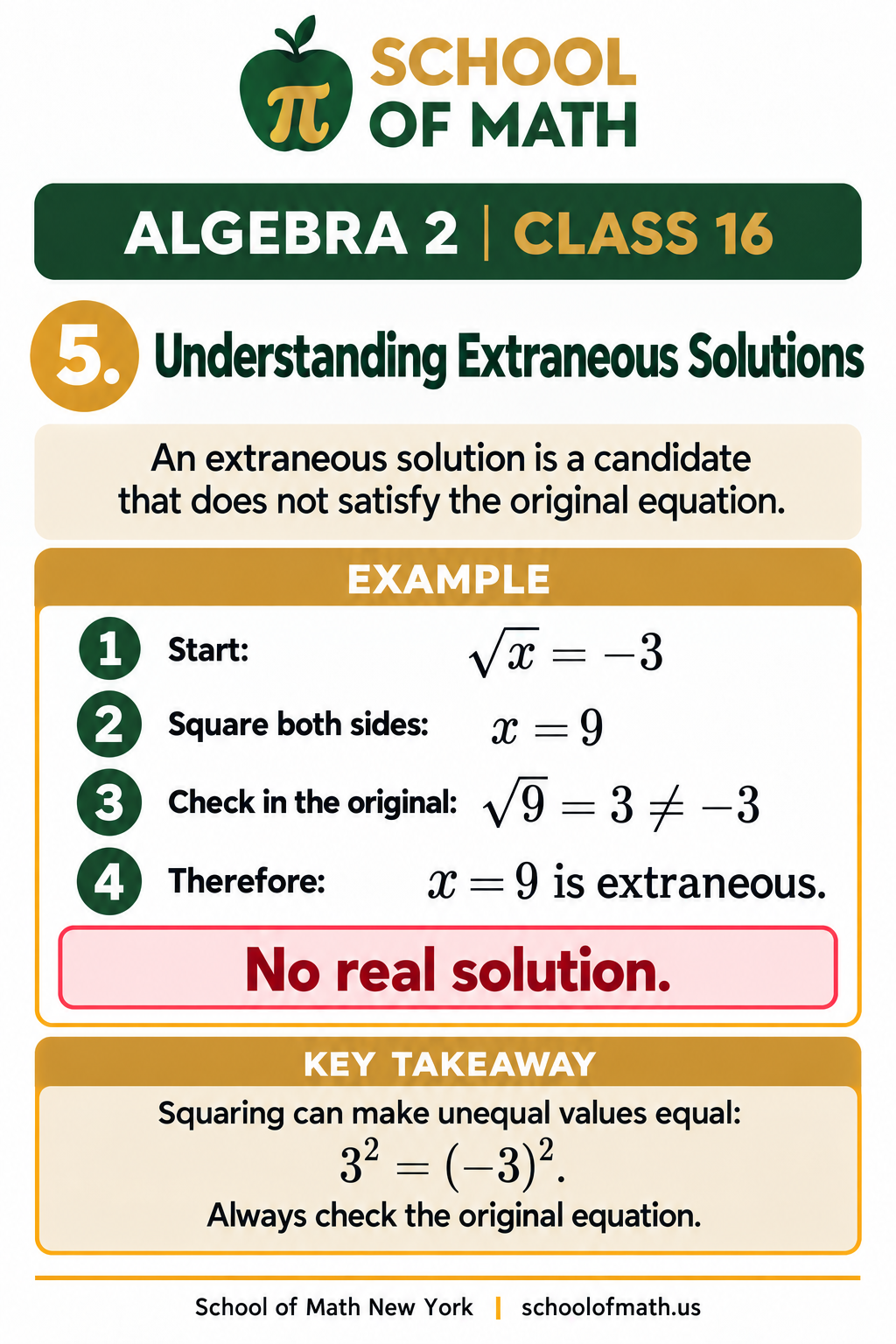
An extraneous candidate solves a transformed equation but not the original one. Squaring is a common source because positive and negative quantities can have the same square.
A candidate can fail because a radicand is negative, because an isolated square root would need to be negative, or because substitution simply gives unequal sides. Report valid solutions separately from rejected candidates.
Practice: try these five questions
Q21
Solve over the real numbers. State the restrictions and check every candidate in the original equation.
Answer
No real solution.
A real square root requires a nonnegative radicand. Record the original domain.
\[-5 \leq x\]The isolated principal square root is nonnegative, so its opposite side must also be nonnegative. Combine this with the radicand restriction.
\[\text{False}\]These necessary conditions cannot both hold. There is no real solution; any candidates obtained by squaring below must be rejected.
Square both sides to obtain a necessary equation. Squaring may introduce candidates, so this is not yet the solution set.
\[x + 5=36\]Expand and collect terms on one side.
\[31 - x=0\]Solve the polynomial to obtain candidates, not automatically valid solutions.
\[x\in\left\{31\right\}\]
Check in the original equation
Candidate \(x=31\): Reject: extraneous candidate.
Q22
Solve over the real numbers. State the restrictions and check every candidate in the original equation.
Answer
\(x=3\)
A real square root requires a nonnegative radicand. Record the original domain.
\[-6 \leq x\]The isolated principal square root is nonnegative, so its opposite side must also be nonnegative. Combine this with the radicand restriction.
\[0 \leq x\]Square both sides to obtain a necessary equation. Squaring may introduce candidates, so this is not yet the solution set.
\[x + 6=x^{2}\]Expand and collect terms on one side.
\[x^{2} - x - 6=0\]Factor the polynomial; set each nonconstant factor equal to zero.
\[\left(x - 3\right) \left(x + 2\right)=0\]Solve the polynomial to obtain candidates, not automatically valid solutions.
\[x\in\left\{-2, 3\right\}\]
Check in the original equation
Candidate \(x=-2\): Reject: extraneous candidate.
Candidate \(x=3\): Valid in the original equation.
Q23
Solve over the real numbers. State the restrictions and check every candidate in the original equation.
Answer
\(x=3\)
A real square root requires a nonnegative radicand. Record the original domain.
\[- \frac{3}{2} \leq x\]The isolated principal square root is nonnegative, so its opposite side must also be nonnegative. Combine this with the radicand restriction.
\[0 \leq x\]Square both sides to obtain a necessary equation. Squaring may introduce candidates, so this is not yet the solution set.
\[2 x + 3=x^{2}\]Expand and collect terms on one side.
\[x^{2} - 2 x - 3=0\]Factor the polynomial; set each nonconstant factor equal to zero.
\[\left(x - 3\right) \left(x + 1\right)=0\]Solve the polynomial to obtain candidates, not automatically valid solutions.
\[x\in\left\{-1, 3\right\}\]
Check in the original equation
Candidate \(x=-1\): Reject: extraneous candidate.
Candidate \(x=3\): Valid in the original equation.
Q24
Solve over the real numbers. State the restrictions and check every candidate in the original equation.
Answer
\(x=\frac{5}{2} + \frac{\sqrt{89}}{2}\)
A real square root requires a nonnegative radicand. Record the original domain.
\[-20 \leq x\]The isolated principal square root is nonnegative, so its opposite side must also be nonnegative. Combine this with the radicand restriction.
\[2 \leq x\]Square both sides to obtain a necessary equation. Squaring may introduce candidates, so this is not yet the solution set.
\[x + 20=\left(x - 2\right)^{2}\]Expand and collect terms on one side.
\[x^{2} - 5 x - 16=0\]Use the quadratic formula when the polynomial does not factor conveniently.
\[x=\frac{-b\pm\sqrt{b^2-4ac}}{2a}\]Solve the polynomial to obtain candidates, not automatically valid solutions.
\[x\in\left\{\frac{5}{2} - \frac{\sqrt{89}}{2}, \frac{5}{2} + \frac{\sqrt{89}}{2}\right\}\]
Check in the original equation
Candidate \(x=\frac{5}{2} - \frac{\sqrt{89}}{2}\): Reject: extraneous candidate.
Candidate \(x=\frac{5}{2} + \frac{\sqrt{89}}{2}\): Valid in the original equation.
Q25
Solve over the real numbers. State the restrictions and check every candidate in the original equation.
Answer
\(x=3 + \sqrt{13}\)
A real square root requires a nonnegative radicand. Record the original domain.
\[- \frac{5}{4} \leq x\]The isolated principal square root is nonnegative, so its opposite side must also be nonnegative. Combine this with the radicand restriction.
\[1 \leq x\]Square both sides to obtain a necessary equation. Squaring may introduce candidates, so this is not yet the solution set.
\[4 x + 5=\left(x - 1\right)^{2}\]Expand and collect terms on one side.
\[x^{2} - 6 x - 4=0\]Use the quadratic formula when the polynomial does not factor conveniently.
\[x=\frac{-b\pm\sqrt{b^2-4ac}}{2a}\]Solve the polynomial to obtain candidates, not automatically valid solutions.
\[x\in\left\{3 - \sqrt{13}, 3 + \sqrt{13}\right\}\]
Check in the original equation
Candidate \(x=3 - \sqrt{13}\): Reject: extraneous candidate.
Candidate \(x=3 + \sqrt{13}\): Valid in the original equation.
Check every candidate in the original equation
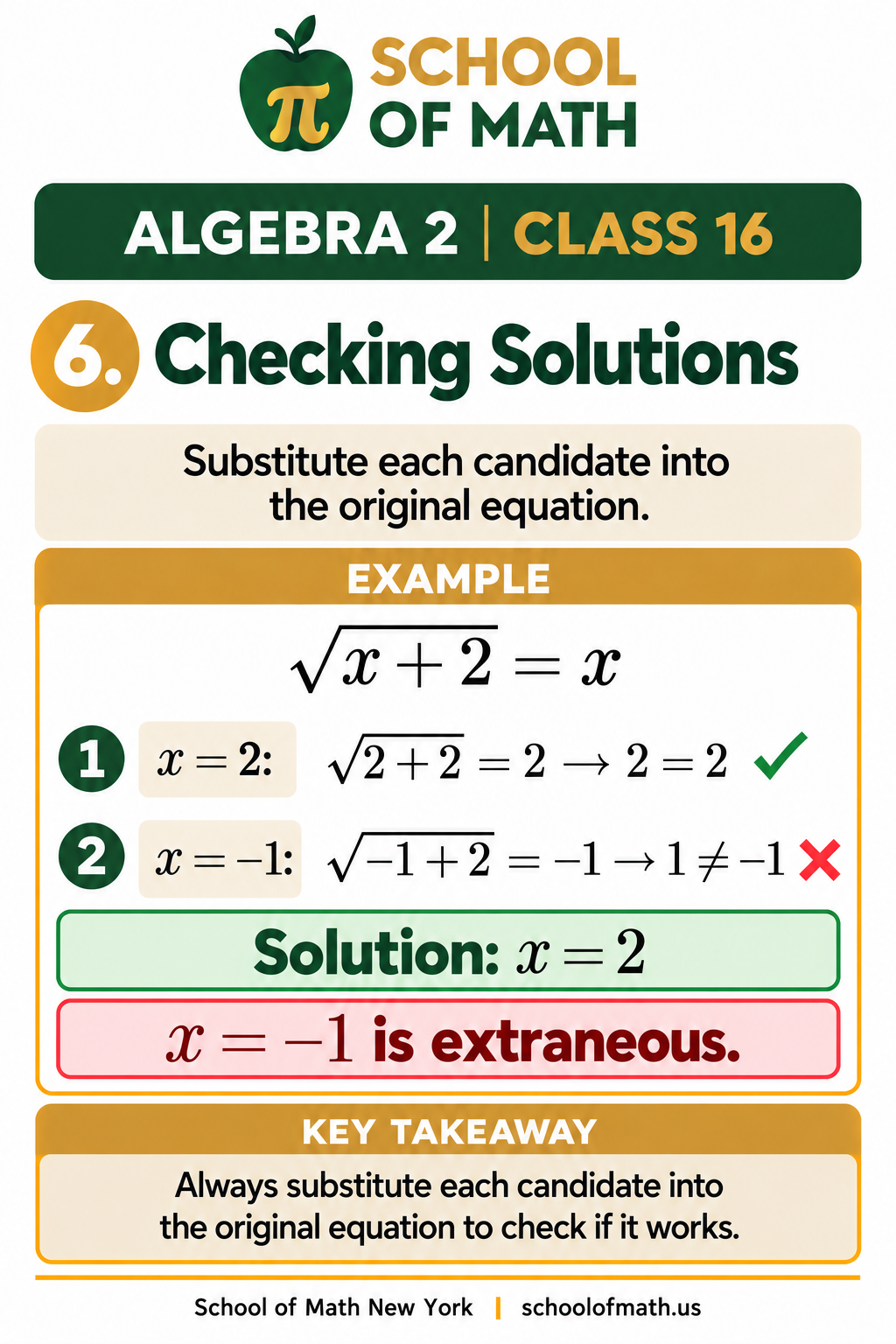
Write the original left and right sides and evaluate them independently for each candidate. It is not enough to check in the squared equation; that equation is exactly where the extra candidate may have appeared.
A negative x-value is not automatically extraneous. The radicand and the value of each side determine validity. Likewise, two candidates may both be valid, so do not automatically discard the smaller root.
Practice: try these five questions
Q26
A student lists x = −5 and x = 6. Determine which candidates solve the original equation and justify each decision.
Answer
\(x=6\)
A real square root requires a nonnegative radicand. Record the original domain.
\[-30 \leq x\]The isolated principal square root is nonnegative, so its opposite side must also be nonnegative. Combine this with the radicand restriction.
\[0 \leq x\]Square both sides to obtain a necessary equation. Squaring may introduce candidates, so this is not yet the solution set.
\[x + 30=x^{2}\]Expand and collect terms on one side.
\[x^{2} - x - 30=0\]Factor the polynomial; set each nonconstant factor equal to zero.
\[\left(x - 6\right) \left(x + 5\right)=0\]Solve the polynomial to obtain candidates, not automatically valid solutions.
\[x\in\left\{-5, 6\right\}\]
Check in the original equation
Candidate \(x=-5\): Reject: extraneous candidate.
Candidate \(x=6\): Valid in the original equation.
Q27
A student lists x = 2 and x = 5. Check both candidates in the original equation.
Answer
\(x=2\;\text{or}\;x=5\)
A real square root requires a nonnegative radicand. Record the original domain.
\[\frac{10}{7} \leq x\]The isolated principal square root is nonnegative, so its opposite side must also be nonnegative. Combine this with the radicand restriction.
\[\frac{10}{7} \leq x\]Square both sides to obtain a necessary equation. Squaring may introduce candidates, so this is not yet the solution set.
\[7 x - 10=x^{2}\]Expand and collect terms on one side.
\[x^{2} - 7 x + 10=0\]Factor the polynomial; set each nonconstant factor equal to zero.
\[\left(x - 5\right) \left(x - 2\right)=0\]Solve the polynomial to obtain candidates, not automatically valid solutions.
\[x\in\left\{2, 5\right\}\]
Check in the original equation
Candidate \(x=2\): Valid in the original equation.
Candidate \(x=5\): Valid in the original equation.
Q28
Solve and explain whether a negative value of x can be a valid solution here.
Answer
\(x=-1\;\text{or}\;x=0\)
A real square root requires a nonnegative radicand. Record the original domain.
\[-1 \leq x\]The isolated principal square root is nonnegative, so its opposite side must also be nonnegative. Combine this with the radicand restriction.
\[-1 \leq x\]Square both sides to obtain a necessary equation. Squaring may introduce candidates, so this is not yet the solution set.
\[x + 1=\left(x + 1\right)^{2}\]Expand and collect terms on one side.
\[x^{2} + x=0\]Factor the polynomial; set each nonconstant factor equal to zero.
\[x \left(x + 1\right)=0\]Solve the polynomial to obtain candidates, not automatically valid solutions.
\[x\in\left\{-1, 0\right\}\]
Check in the original equation
Candidate \(x=-1\): Valid in the original equation.
Candidate \(x=0\): Valid in the original equation.
Q29
Solve and explain why a negative candidate can survive the original-equation check.
Answer
\(x=-2\)
A real square root requires a nonnegative radicand. Record the original domain.
\[-6 \leq x\]The isolated principal square root is nonnegative, so its opposite side must also be nonnegative. Combine this with the radicand restriction.
\[-6 \leq x \wedge x \leq 0\]Square both sides to obtain a necessary equation. Squaring may introduce candidates, so this is not yet the solution set.
\[x + 6=x^{2}\]Expand and collect terms on one side.
\[x^{2} - x - 6=0\]Factor the polynomial; set each nonconstant factor equal to zero.
\[\left(x - 3\right) \left(x + 2\right)=0\]Solve the polynomial to obtain candidates, not automatically valid solutions.
\[x\in\left\{-2, 3\right\}\]
Check in the original equation
Candidate \(x=-2\): Valid in the original equation.
Candidate \(x=3\): Reject: extraneous candidate.
Q30
Find both candidates, then check each in the original equation. Do not check only the squared equation.
Answer
\(x=\frac{9}{2} + \frac{\sqrt{113}}{2}\)
A real square root requires a nonnegative radicand. Record the original domain.
\[-24 \leq x\]The isolated principal square root is nonnegative, so its opposite side must also be nonnegative. Combine this with the radicand restriction.
\[4 \leq x\]Square both sides to obtain a necessary equation. Squaring may introduce candidates, so this is not yet the solution set.
\[x + 24=\left(x - 4\right)^{2}\]Expand and collect terms on one side.
\[x^{2} - 9 x - 8=0\]Use the quadratic formula when the polynomial does not factor conveniently.
\[x=\frac{-b\pm\sqrt{b^2-4ac}}{2a}\]Solve the polynomial to obtain candidates, not automatically valid solutions.
\[x\in\left\{\frac{9}{2} - \frac{\sqrt{113}}{2}, \frac{9}{2} + \frac{\sqrt{113}}{2}\right\}\]
Check in the original equation
Candidate \(x=\frac{9}{2} - \frac{\sqrt{113}}{2}\): Reject: extraneous candidate.
Candidate \(x=\frac{9}{2} + \frac{\sqrt{113}}{2}\): Valid in the original equation.
Equations with two square roots
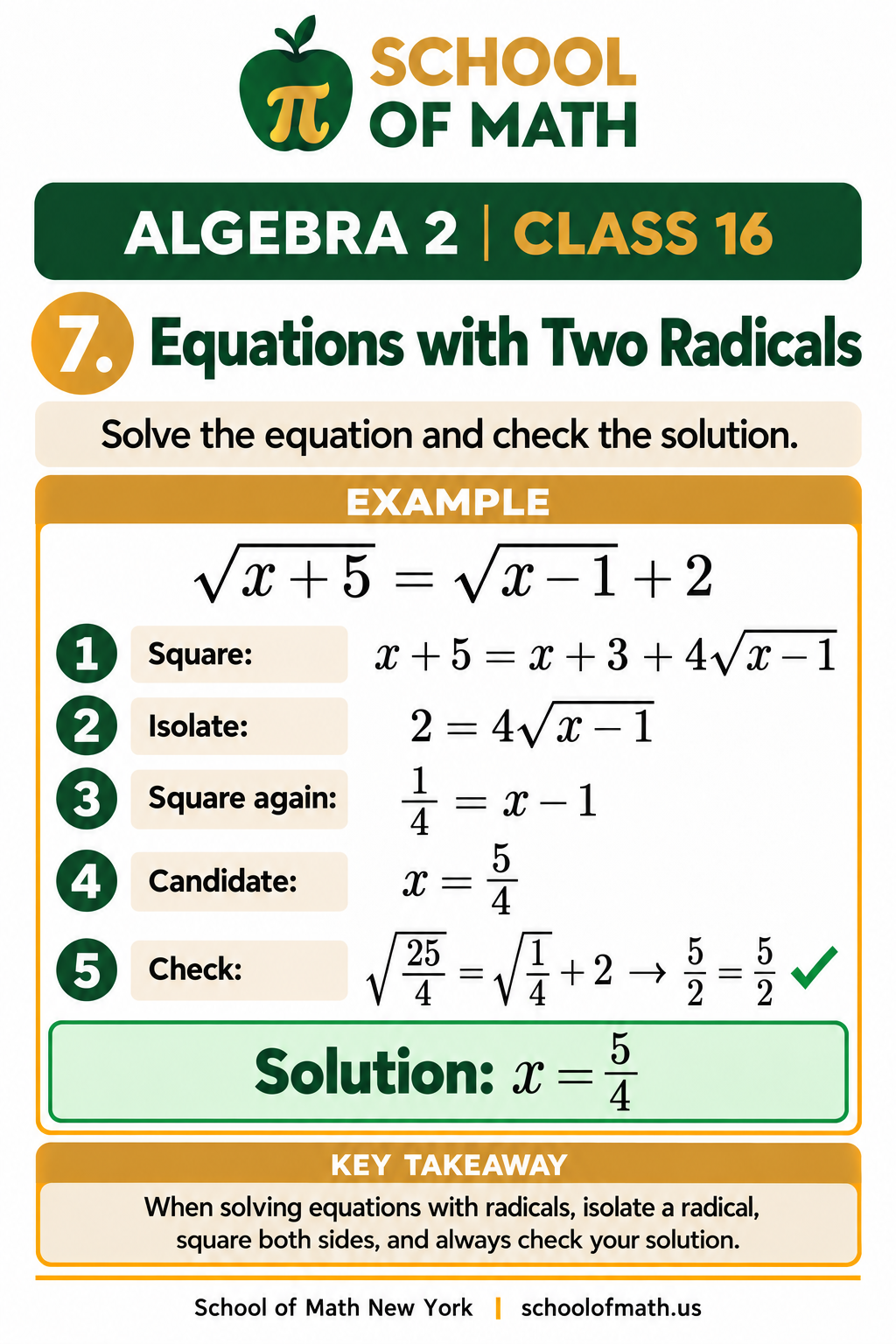
When radicals appear on both sides, isolate one radical, square the entire other side, then isolate the remaining radical and square again if necessary. The middle term of a binomial square still matters.
Both radicands must be nonnegative, and every isolated square root must have a nonnegative opposite side. Two rounds of squaring can introduce candidates at either stage, so the final check must use the original equation.
Practice: try these five questions
Q31
Solve the equation with two radicals. Show each squaring step and check all candidates.
Answer
\(x=1\)
Require both radicands to be nonnegative and intersect their domains.
\[0 \leq x\]Square the entire opposite side. Include the middle term from the binomial square.
\[x + 8=x + 4+4\sqrt{x}\]Move the nonradical terms and divide to isolate the remaining root.
\[\sqrt{x}=1\]This isolated right side must be nonnegative. Check this condition when testing candidates.
\[\text{True}\]Square a second time, then collect terms.
\[1 - x=0\]List all real candidates from the squared equation.
\[x\in\left\{1\right\}\]
Check in the original equation
\(x=1\): Valid in the original equation.
Q32
Solve the equation with two radicals. Show each squaring step and check all candidates.
Answer
\(x=6 - 4 \sqrt{3}\;\text{or}\;x=6 + 4 \sqrt{3}\)
Require both radicands to be nonnegative and intersect their domains.
\[-1 \leq x\]Square the entire opposite side. Include the middle term from the binomial square.
\[2 x + 7=x + 5+4\sqrt{x + 1}\]Move the nonradical terms and divide to isolate the remaining root.
\[\sqrt{x + 1}=\frac{x}{4} + \frac{1}{2}\]This isolated right side must be nonnegative. Check this condition when testing candidates.
\[-2 \leq x\]Square a second time, then collect terms.
\[\frac{x^{2}}{16} - \frac{3 x}{4} - \frac{3}{4}=0\]Factor the polynomial to find its candidate roots.
\[\frac{x^{2} - 12 x - 12}{16}=0\]List all real candidates from the squared equation.
\[x\in\left\{6 - 4 \sqrt{3},6 + 4 \sqrt{3}\right\}\]
Check in the original equation
\(x=6 - 4 \sqrt{3}\): Valid in the original equation.
\(x=6 + 4 \sqrt{3}\): Valid in the original equation.
Q33
Solve the equation with two radicals. Show each squaring step and check all candidates.
Answer
\(x=2\)
Require both radicands to be nonnegative and intersect their domains.
\[2 \leq x\]Square the entire opposite side. Include the middle term from the binomial square.
\[x + 7=x + 7+6\sqrt{x - 2}\]Move the nonradical terms and divide to isolate the remaining root.
\[\sqrt{x - 2}=0\]This isolated right side must be nonnegative. Check this condition when testing candidates.
\[\text{True}\]Square a second time, then collect terms.
\[2 - x=0\]List all real candidates from the squared equation.
\[x\in\left\{2\right\}\]
Check in the original equation
\(x=2\): Valid in the original equation.
Q34
Solve the equation with two radicals. Show each squaring step and check all candidates.
Answer
\(x=\frac{64}{25}\)
Require both radicands to be nonnegative and intersect their domains.
\[0 \leq x\]Isolate one square root on the left.
\[\sqrt{x + 9}=5-\sqrt{x}\]Square the entire opposite side. Include the middle term from the binomial square.
\[x + 9=x + 25-10\sqrt{x}\]Move the nonradical terms and divide to isolate the remaining root.
\[\sqrt{x}=\frac{8}{5}\]This isolated right side must be nonnegative. Check this condition when testing candidates.
\[\text{True}\]Square a second time, then collect terms.
\[\frac{64}{25} - x=0\]Factor the polynomial to find its candidate roots.
\[- \frac{25 x - 64}{25}=0\]List all real candidates from the squared equation.
\[x\in\left\{\frac{64}{25}\right\}\]
Check in the original equation
\(x=\frac{64}{25}\): Valid in the original equation.
Q35
Solve the equation with two radicals. Show each squaring step and check all candidates.
Answer
\(x=3\)
Require both radicands to be nonnegative and intersect their domains.
\[- \frac{4}{3} \leq x\]Both sides are nonnegative. Square once to equate the radicands.
\[3 x + 4=x + 10\]Collect like terms and solve the resulting equation.
\[2 x - 6=0\]Factor the polynomial to find its candidate roots.
\[2 \left(x - 3\right)=0\]List all real candidates from the squared equation.
\[x\in\left\{3\right\}\]
Check in the original equation
\(x=3\): Valid in the original equation.
Real cube-root equations
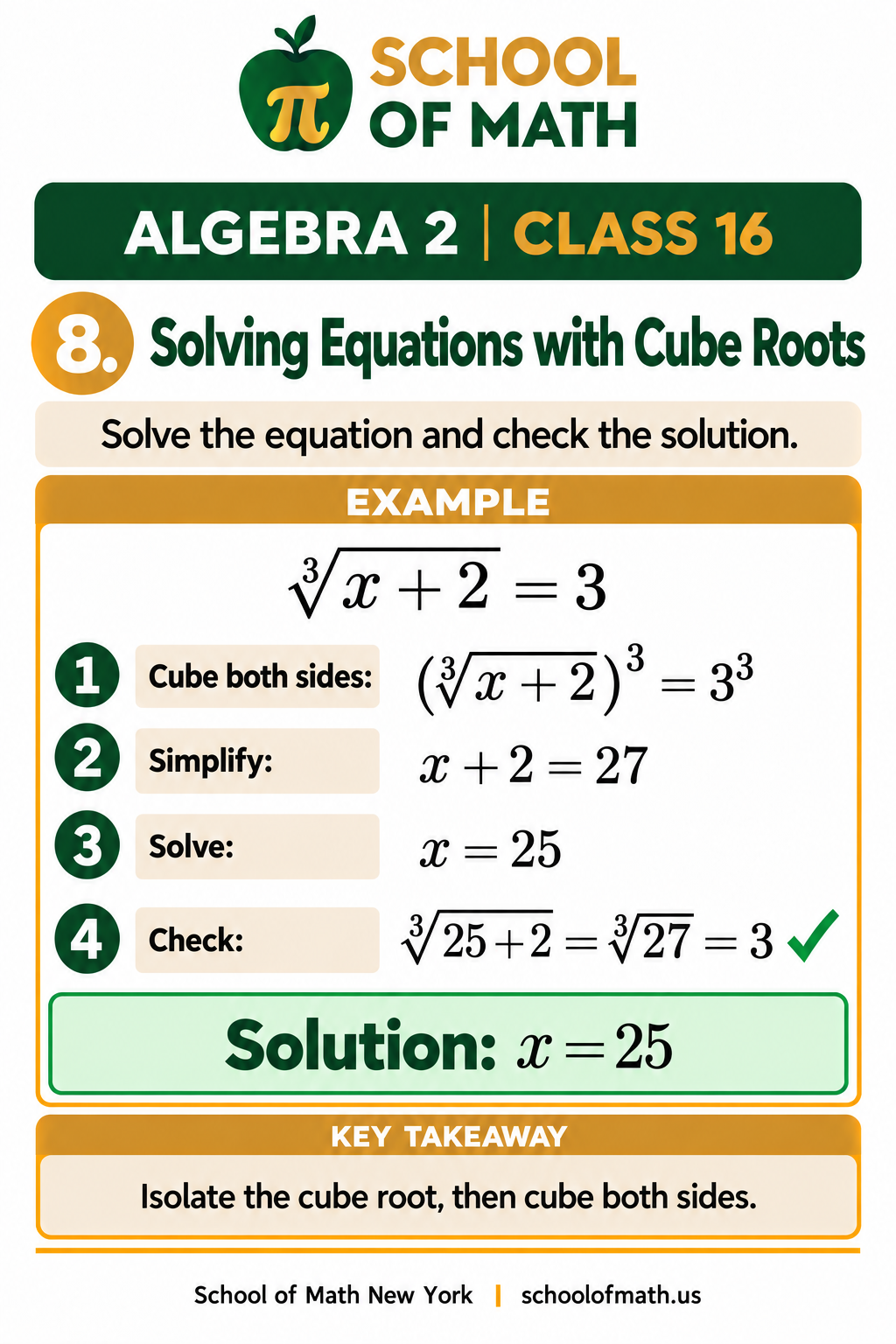
A real cube root can be negative: \(\sqrt[3]{-8}=-2\). Isolate the cube root and cube both sides. Unlike squaring, cubing is one-to-one on the real numbers and does not lose sign information.
Use the real cube root when evaluating negative radicands. Do not impose a square-root restriction on a cube-root equation, and do not replace a negative cube root with a nonreal principal fractional power.
Practice: try these five questions
Q36
Solve using real cube roots and check in the original equation.
Answer
\(x=12\)
A real cube root may have a positive, zero, or negative radicand. Unlike a square root, it has no nonnegativity restriction.
Undo the outside operations to isolate the cube root.
\[\sqrt[3]{x - 4}=2\]Cube both sides. Cubing is one-to-one on the real numbers, so this operation preserves equivalence.
\[x - 4=8\]Collect terms and solve.
\[x - 12=0\]The real candidates are:
\[x\in\left\{12\right\}\]
Check in the original equation
\(x=12\): Valid.
Q37
Solve using real cube roots and check in the original equation.
Answer
\(x=-14\)
A real cube root may have a positive, zero, or negative radicand. Unlike a square root, it has no nonnegativity restriction.
Undo the outside operations to isolate the cube root.
\[\sqrt[3]{2 x + 1}=-3\]Cube both sides. Cubing is one-to-one on the real numbers, so this operation preserves equivalence.
\[2 x + 1=-27\]Collect terms and solve.
\[2 x + 28=0\]The real candidates are:
\[x\in\left\{-14\right\}\]
Check in the original equation
\(x=-14\): Valid.
Q38
Solve using real cube roots and check in the original equation.
Answer
\(x=59\)
A real cube root may have a positive, zero, or negative radicand. Unlike a square root, it has no nonnegativity restriction.
Undo the outside operations to isolate the cube root.
\[\sqrt[3]{x + 5}=4\]Cube both sides. Cubing is one-to-one on the real numbers, so this operation preserves equivalence.
\[x + 5=64\]Collect terms and solve.
\[x - 59=0\]The real candidates are:
\[x\in\left\{59\right\}\]
Check in the original equation
\(x=59\): Valid.
Q39
Solve using real cube roots and check in the original equation.
Answer
\(x=- \frac{62}{3}\)
A real cube root may have a positive, zero, or negative radicand. Unlike a square root, it has no nonnegativity restriction.
Undo the outside operations to isolate the cube root.
\[\sqrt[3]{3 x - 2}=-4\]Cube both sides. Cubing is one-to-one on the real numbers, so this operation preserves equivalence.
\[3 x - 2=-64\]Collect terms and solve.
\[3 x + 62=0\]The real candidates are:
\[x\in\left\{- \frac{62}{3}\right\}\]
Check in the original equation
\(x=- \frac{62}{3}\): Valid.
Q40
Solve using real cube roots and check in the original equation.
Answer
\(x=8\)
A real cube root may have a positive, zero, or negative radicand. Unlike a square root, it has no nonnegativity restriction.
Undo the outside operations to isolate the cube root.
\[\sqrt[3]{\frac{x}{2} + 4}=2\]Cube both sides. Cubing is one-to-one on the real numbers, so this operation preserves equivalence.
\[\frac{x}{2} + 4=8\]Collect terms and solve.
\[\frac{x}{2} - 4=0\]The real candidates are:
\[x\in\left\{8\right\}\]
Check in the original equation
\(x=8\): Valid.
Recognize no-real-solution cases
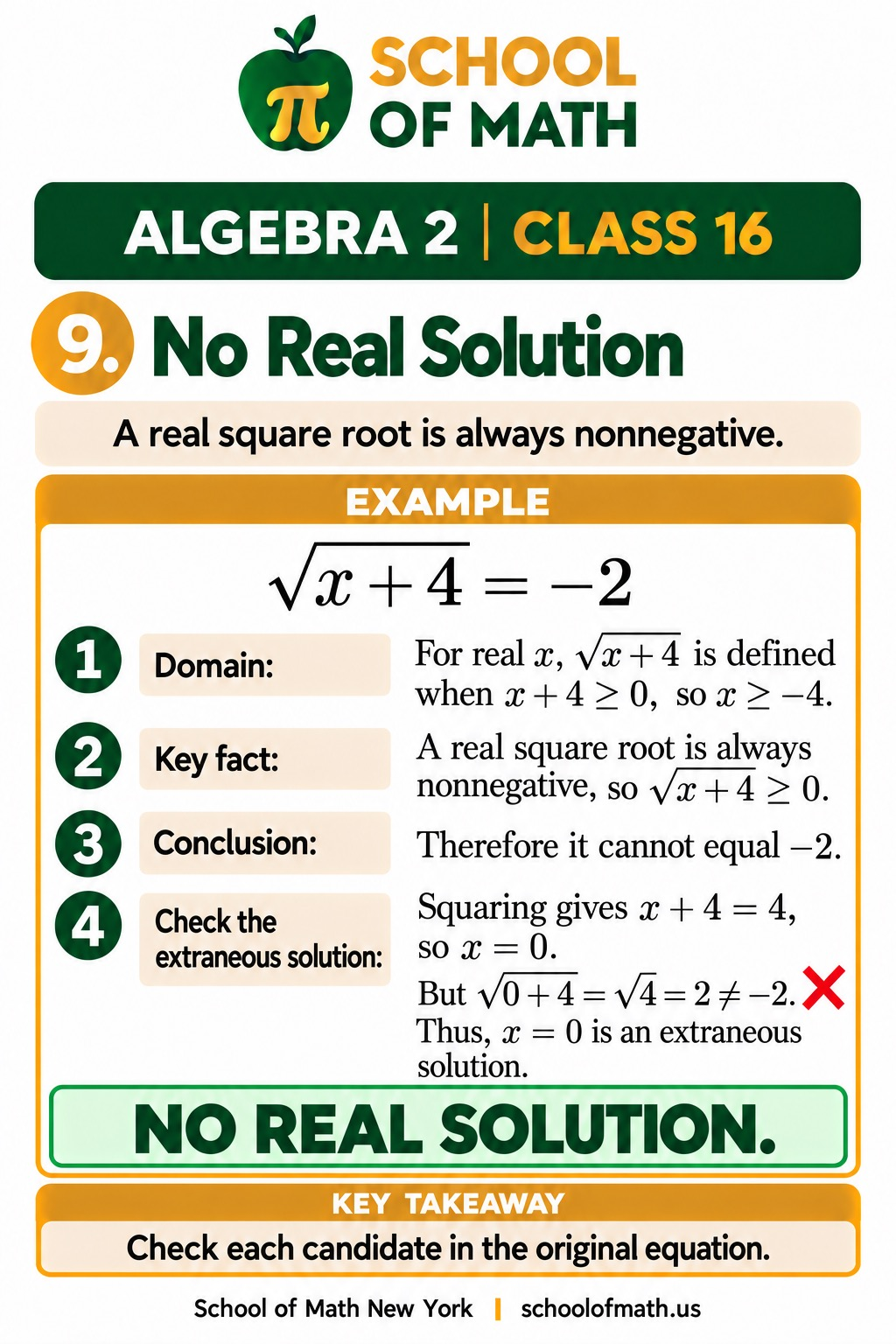
Check signs and domains before doing long algebra. A sum of principal square roots cannot be negative. An isolated principal square root cannot equal a negative constant.
Other equations fail because their domain and sign requirements do not overlap, or because equating radicands creates a contradiction. A real root of a squared equation is not proof that the original equation has a real solution.
Practice: try these five questions
Q41
Solve over the real numbers. State the restrictions and check every candidate in the original equation.
Answer
No real solution.
A real square root requires a nonnegative radicand. Record the original domain.
\[-7 \leq x\]The isolated principal square root is nonnegative, so its opposite side must also be nonnegative. Combine this with the radicand restriction.
\[\text{False}\]These necessary conditions cannot both hold. There is no real solution; any candidates obtained by squaring below must be rejected.
Square both sides to obtain a necessary equation. Squaring may introduce candidates, so this is not yet the solution set.
\[x + 7=16\]Expand and collect terms on one side.
\[9 - x=0\]Solve the polynomial to obtain candidates, not automatically valid solutions.
\[x\in\left\{9\right\}\]
Check in the original equation
Candidate \(x=9\): Reject: extraneous candidate.
Q42
Solve over the real numbers. State the restrictions and check every candidate in the original equation.
Answer
No real solution.
A real square root requires a nonnegative radicand. Record the original domain.
\[\frac{1}{2} \leq x\]Undo the outside addition/subtraction and multiplication/division to isolate the radical before squaring.
\[\sqrt{2 x - 1}=-1\]The isolated principal square root is nonnegative, so its opposite side must also be nonnegative. Combine this with the radicand restriction.
\[\text{False}\]These necessary conditions cannot both hold. There is no real solution; any candidates obtained by squaring below must be rejected.
Square both sides to obtain a necessary equation. Squaring may introduce candidates, so this is not yet the solution set.
\[2 x - 1=1\]Expand and collect terms on one side.
\[2 - 2 x=0\]Factor the polynomial; set each nonconstant factor equal to zero.
\[- 2 \left(x - 1\right)=0\]Solve the polynomial to obtain candidates, not automatically valid solutions.
\[x\in\left\{1\right\}\]
Check in the original equation
Candidate \(x=1\): Reject: extraneous candidate.
Q43
Solve the equation with two radicals. Show each squaring step and check all candidates.
Answer
No real solution.
Require both radicands to be nonnegative and intersect their domains.
\[4 \leq x \wedge x \leq 9\]Isolate one square root on the left.
\[\sqrt{x - 4}=-2-\sqrt{9 - x}\]Square the entire opposite side. Include the middle term from the binomial square.
\[x - 4=13 - x+4\sqrt{9 - x}\]Move the nonradical terms and divide to isolate the remaining root.
\[\sqrt{9 - x}=\frac{x}{2} - \frac{17}{4}\]This isolated right side must be nonnegative. Check this condition when testing candidates.
\[\frac{17}{2} \leq x\]Square a second time, then collect terms.
\[\frac{x^{2}}{4} - \frac{13 x}{4} + \frac{145}{16}=0\]Factor the polynomial to find its candidate roots.
\[\frac{4 x^{2} - 52 x + 145}{16}=0\]List all real candidates from the squared equation.
\[x\in\left\{\frac{13}{2} - \sqrt{6},\sqrt{6} + \frac{13}{2}\right\}\]
Check in the original equation
\(x=\frac{13}{2} - \sqrt{6}\): Extraneous: fails the original equation.
\(x=\sqrt{6} + \frac{13}{2}\): Extraneous: fails the original equation.
Q44
Solve the equation with two radicals. Show each squaring step and check all candidates.
Answer
No real solution.
Require both radicands to be nonnegative and intersect their domains.
\[2 \leq x\]Both sides are nonnegative. Square once to equate the radicands.
\[x - 2=x + 7\]Collect like terms and solve the resulting equation.
\[-9=0\]The reduced equation has no real roots. Therefore the original equation has no real solution.
Check in the original equation
No real candidate satisfies the reduced necessary equation.
Q45
Solve over the real numbers. State the restrictions and check every candidate in the original equation.
Answer
No real solution.
A real square root requires a nonnegative radicand. Record the original domain.
\[x \leq 3\]The isolated principal square root is nonnegative, so its opposite side must also be nonnegative. Combine this with the radicand restriction.
\[\text{False}\]These necessary conditions cannot both hold. There is no real solution; any candidates obtained by squaring below must be rejected.
Square both sides to obtain a necessary equation. Squaring may introduce candidates, so this is not yet the solution set.
\[3 - x=\left(x - 4\right)^{2}\]Expand and collect terms on one side.
\[x^{2} - 7 x + 13=0\]The resulting polynomial has no real roots, so the original equation has no real solution.
Check in the original equation
The necessary squared equation has no real candidate to test. This agrees with the restrictions above.
Apply radical equations to models
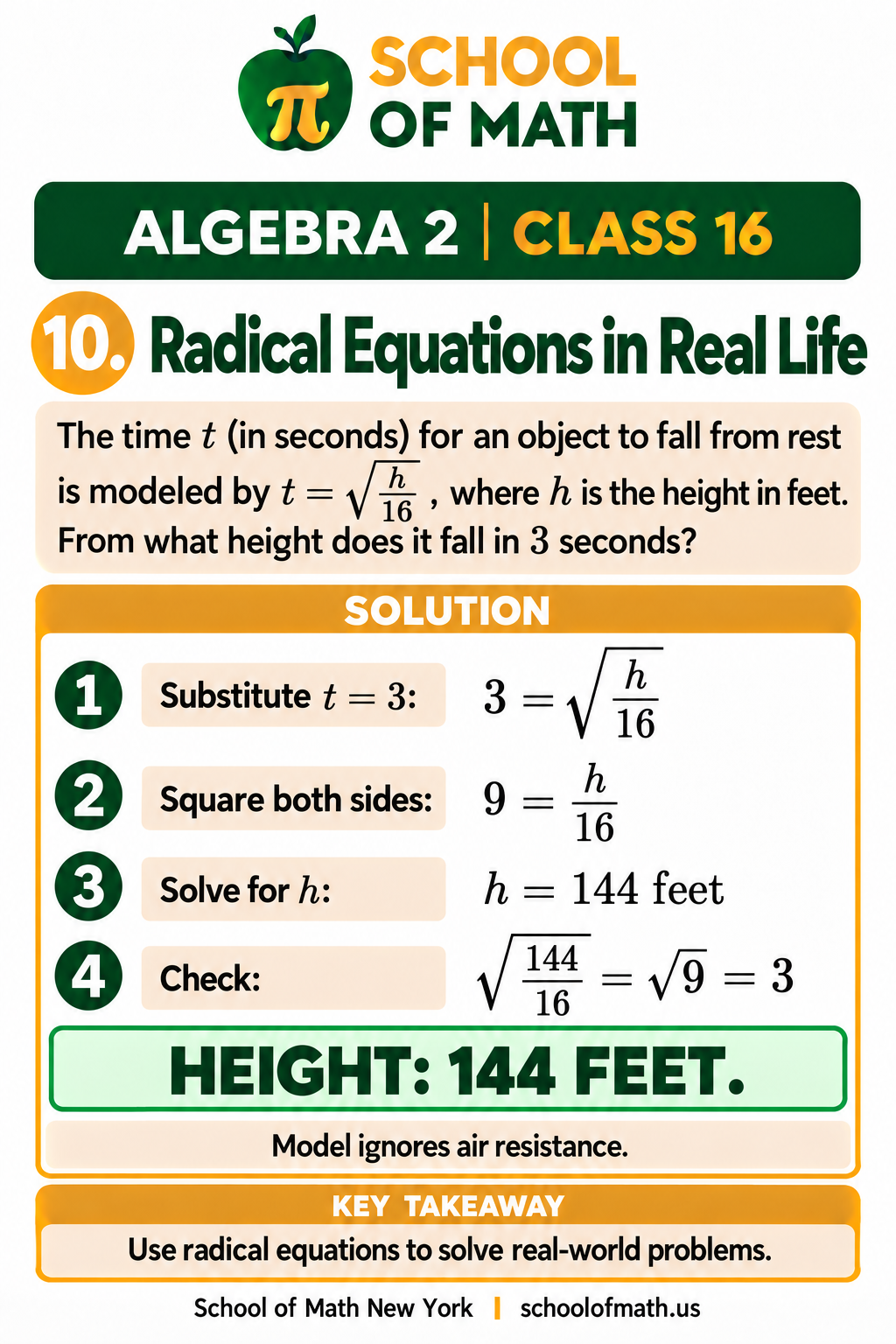
Define the unknown and its units before solving. Physical quantities such as area, volume, height, distance, and elapsed time are usually nonnegative. These contextual restrictions may discard an algebraically valid negative root.
Use the stated model rather than guessing units or constants. For the supplied fall-time model, assume an object is released from rest and air resistance is ignored. Substitute the final value back into the model and report units.
Practice: try these five questions
Q46
In the model t = sqrt(h/16), t is fall time in seconds and h is height in feet. An object falls from rest for 4 seconds. Let x represent h; find the height. Ignore air resistance.
Answer
\(x=256\) (nonnegative physical value). The height is 256 feet.
A real square root requires a nonnegative radicand. Record the original domain.
\[0 \leq x\]The isolated principal square root is nonnegative, so its opposite side must also be nonnegative. Combine this with the radicand restriction.
\[0 \leq x\]Square both sides to obtain a necessary equation. Squaring may introduce candidates, so this is not yet the solution set.
\[\frac{x}{16}=16\]Expand and collect terms on one side.
\[16 - \frac{x}{16}=0\]Factor the polynomial; set each nonconstant factor equal to zero.
\[- \frac{x - 256}{16}=0\]Solve the polynomial to obtain candidates, not automatically valid solutions.
\[x\in\left\{256\right\}\]
Check in the original equation
Candidate \(x=256\): Valid in the original equation.
Q47
A square has side length 12 centimeters. Its area x satisfies the equation below. Find the area with units.
Answer
\(x=144\) (nonnegative physical value). The area is 144 square centimeters.
A real square root requires a nonnegative radicand. Record the original domain.
\[0 \leq x\]The isolated principal square root is nonnegative, so its opposite side must also be nonnegative. Combine this with the radicand restriction.
\[0 \leq x\]Square both sides to obtain a necessary equation. Squaring may introduce candidates, so this is not yet the solution set.
\[x=144\]Expand and collect terms on one side.
\[144 - x=0\]Solve the polynomial to obtain candidates, not automatically valid solutions.
\[x\in\left\{144\right\}\]
Check in the original equation
Candidate \(x=144\): Valid in the original equation.
Q48
A hypothetical speed model is v = sqrt(20d), with v in feet per second and d in feet. A speed of 30 feet per second is recorded. Let x represent d and find the distance.
Answer
\(x=45\) (nonnegative physical value). The distance is 45 feet.
A real square root requires a nonnegative radicand. Record the original domain.
\[0 \leq x\]The isolated principal square root is nonnegative, so its opposite side must also be nonnegative. Combine this with the radicand restriction.
\[0 \leq x\]Square both sides to obtain a necessary equation. Squaring may introduce candidates, so this is not yet the solution set.
\[20 x=900\]Expand and collect terms on one side.
\[900 - 20 x=0\]Factor the polynomial; set each nonconstant factor equal to zero.
\[- 20 \left(x - 45\right)=0\]Solve the polynomial to obtain candidates, not automatically valid solutions.
\[x\in\left\{45\right\}\]
Check in the original equation
Candidate \(x=45\): Valid in the original equation.
Q49
A right triangle has one leg 6 meters and hypotenuse 10 meters. The other leg x satisfies the equation below. Find its length and reject any physically impossible value.
Answer
\(x=8\) (nonnegative physical value). The other leg is 8 meters.
A real square root requires a nonnegative radicand. Record the original domain.
\[\text{True}\]The isolated principal square root is nonnegative, so its opposite side must also be nonnegative. Combine this with the radicand restriction.
\[\text{True}\]Square both sides to obtain a necessary equation. Squaring may introduce candidates, so this is not yet the solution set.
\[x^{2} + 36=100\]Expand and collect terms on one side.
\[64 - x^{2}=0\]Factor the polynomial; set each nonconstant factor equal to zero.
\[- \left(x - 8\right) \left(x + 8\right)=0\]Solve the polynomial to obtain candidates, not automatically valid solutions.
\[x\in\left\{-8, 8\right\}\]
Check in the original equation
Candidate \(x=-8\): Algebraically valid, but reject the negative value in this physical context.
Candidate \(x=8\): Valid in the original equation.
Q50
A cube has edge length 5 centimeters. Let x be its volume in cubic centimeters. Use the equation below to find the volume.
Answer
\(x=125\) The volume is 125 cubic centimeters.
A real cube root may have a positive, zero, or negative radicand. Unlike a square root, it has no nonnegativity restriction.
Undo the outside operations to isolate the cube root.
\[\sqrt[3]{x}=5\]Cube both sides. Cubing is one-to-one on the real numbers, so this operation preserves equivalence.
\[x=125\]Collect terms and solve.
\[x - 125=0\]The real candidates are:
\[x\in\left\{125\right\}\]
Check in the original equation
\(x=125\): Valid.
Homework review
Review isolation, domain restrictions, candidates, two radicals, and real cube roots. Show the original-equation check.
R1
Solve over the real numbers. State the restrictions and check every candidate in the original equation.
Answer
\(x=9\)
A real square root requires a nonnegative radicand. Record the original domain.
\[\frac{5}{6} \leq x\]The isolated principal square root is nonnegative, so its opposite side must also be nonnegative. Combine this with the radicand restriction.
\[\frac{5}{6} \leq x\]Square both sides to obtain a necessary equation. Squaring may introduce candidates, so this is not yet the solution set.
\[6 x - 5=49\]Expand and collect terms on one side.
\[54 - 6 x=0\]Factor the polynomial; set each nonconstant factor equal to zero.
\[- 6 \left(x - 9\right)=0\]Solve the polynomial to obtain candidates, not automatically valid solutions.
\[x\in\left\{9\right\}\]
Check in the original equation
Candidate \(x=9\): Valid in the original equation.
R2
Solve over the real numbers. State the restrictions and check every candidate in the original equation.
Answer
\(x=23\)
A real square root requires a nonnegative radicand. Record the original domain.
\[-2 \leq x\]Undo the outside addition/subtraction and multiplication/division to isolate the radical before squaring.
\[\sqrt{x + 2}=5\]The isolated principal square root is nonnegative, so its opposite side must also be nonnegative. Combine this with the radicand restriction.
\[-2 \leq x\]Square both sides to obtain a necessary equation. Squaring may introduce candidates, so this is not yet the solution set.
\[x + 2=25\]Expand and collect terms on one side.
\[23 - x=0\]Solve the polynomial to obtain candidates, not automatically valid solutions.
\[x\in\left\{23\right\}\]
Check in the original equation
Candidate \(x=23\): Valid in the original equation.
R3
Solve over the real numbers. State the restrictions and check every candidate in the original equation.
Answer
\(x=7\)
A real square root requires a nonnegative radicand. Record the original domain.
\[-42 \leq x\]The isolated principal square root is nonnegative, so its opposite side must also be nonnegative. Combine this with the radicand restriction.
\[0 \leq x\]Square both sides to obtain a necessary equation. Squaring may introduce candidates, so this is not yet the solution set.
\[x + 42=x^{2}\]Expand and collect terms on one side.
\[x^{2} - x - 42=0\]Factor the polynomial; set each nonconstant factor equal to zero.
\[\left(x - 7\right) \left(x + 6\right)=0\]Solve the polynomial to obtain candidates, not automatically valid solutions.
\[x\in\left\{-6, 7\right\}\]
Check in the original equation
Candidate \(x=-6\): Reject: extraneous candidate.
Candidate \(x=7\): Valid in the original equation.
R4
Solve over the real numbers. State the restrictions and check every candidate in the original equation.
Answer
\(x=4\;\text{or}\;x=5\)
A real square root requires a nonnegative radicand. Record the original domain.
\[\frac{20}{9} \leq x\]The isolated principal square root is nonnegative, so its opposite side must also be nonnegative. Combine this with the radicand restriction.
\[\frac{20}{9} \leq x\]Square both sides to obtain a necessary equation. Squaring may introduce candidates, so this is not yet the solution set.
\[9 x - 20=x^{2}\]Expand and collect terms on one side.
\[x^{2} - 9 x + 20=0\]Factor the polynomial; set each nonconstant factor equal to zero.
\[\left(x - 5\right) \left(x - 4\right)=0\]Solve the polynomial to obtain candidates, not automatically valid solutions.
\[x\in\left\{4, 5\right\}\]
Check in the original equation
Candidate \(x=4\): Valid in the original equation.
Candidate \(x=5\): Valid in the original equation.
R5
Solve the equation with two radicals. Show each squaring step and check all candidates.
Answer
\(x=4\)
Require both radicands to be nonnegative and intersect their domains.
\[0 \leq x\]Square the entire opposite side. Include the middle term from the binomial square.
\[x + 12=x + 4+4\sqrt{x}\]Move the nonradical terms and divide to isolate the remaining root.
\[\sqrt{x}=2\]This isolated right side must be nonnegative. Check this condition when testing candidates.
\[\text{True}\]Square a second time, then collect terms.
\[4 - x=0\]List all real candidates from the squared equation.
\[x\in\left\{4\right\}\]
Check in the original equation
\(x=4\): Valid in the original equation.
R6
Solve using real cube roots and check in the original equation.
Answer
\(x=- \frac{61}{2}\)
A real cube root may have a positive, zero, or negative radicand. Unlike a square root, it has no nonnegativity restriction.
Undo the outside operations to isolate the cube root.
\[\sqrt[3]{4 x - 3}=-5\]Cube both sides. Cubing is one-to-one on the real numbers, so this operation preserves equivalence.
\[4 x - 3=-125\]Collect terms and solve.
\[4 x + 122=0\]The real candidates are:
\[x\in\left\{- \frac{61}{2}\right\}\]
Check in the original equation
\(x=- \frac{61}{2}\): Valid.
R7
Solve over the real numbers. State the restrictions and check every candidate in the original equation.
Answer
No real solution.
A real square root requires a nonnegative radicand. Record the original domain.
\[- \frac{2}{5} \leq x\]Undo the outside addition/subtraction and multiplication/division to isolate the radical before squaring.
\[\sqrt{5 x + 2}=-3\]The isolated principal square root is nonnegative, so its opposite side must also be nonnegative. Combine this with the radicand restriction.
\[\text{False}\]These necessary conditions cannot both hold. There is no real solution; any candidates obtained by squaring below must be rejected.
Square both sides to obtain a necessary equation. Squaring may introduce candidates, so this is not yet the solution set.
\[5 x + 2=9\]Expand and collect terms on one side.
\[7 - 5 x=0\]Solve the polynomial to obtain candidates, not automatically valid solutions.
\[x\in\left\{\frac{7}{5}\right\}\]
Check in the original equation
Candidate \(x=\frac{7}{5}\): Reject: extraneous candidate.
R8
Find the nonnegative value of x and explain what happens to the negative algebraic root.
Answer
\(x=12\) (nonnegative physical value). The required nonnegative value is 12.
A real square root requires a nonnegative radicand. Record the original domain.
\[\text{True}\]The isolated principal square root is nonnegative, so its opposite side must also be nonnegative. Combine this with the radicand restriction.
\[\text{True}\]Square both sides to obtain a necessary equation. Squaring may introduce candidates, so this is not yet the solution set.
\[x^{2} + 25=169\]Expand and collect terms on one side.
\[144 - x^{2}=0\]Factor the polynomial; set each nonconstant factor equal to zero.
\[- \left(x - 12\right) \left(x + 12\right)=0\]Solve the polynomial to obtain candidates, not automatically valid solutions.
\[x\in\left\{-12, 12\right\}\]
Check in the original equation
Candidate \(x=-12\): Algebraically valid, but reject the negative value in this physical context.
Candidate \(x=12\): Valid in the original equation.
Homework word problems
Twelve problems progress from direct models to comparing radical expressions. Define the unknown, state restrictions, solve, check, and interpret the result with units.
W1
A square mat has side length 9 feet. Its area is x square feet. Use the radical equation below to find x.
Answer
\(x=81\) (nonnegative physical value). The mat has area 81 square feet.
A real square root requires a nonnegative radicand. Record the original domain.
\[0 \leq x\]The isolated principal square root is nonnegative, so its opposite side must also be nonnegative. Combine this with the radicand restriction.
\[0 \leq x\]Square both sides to obtain a necessary equation. Squaring may introduce candidates, so this is not yet the solution set.
\[x=81\]Expand and collect terms on one side.
\[81 - x=0\]Solve the polynomial to obtain candidates, not automatically valid solutions.
\[x\in\left\{81\right\}\]
Check in the original equation
Candidate \(x=81\): Valid in the original equation.
W2
Using t = sqrt(h/16), an object released from rest falls for 2.5 seconds. Let x be height in feet; find x. Ignore air resistance.
Answer
\(x=100\) (nonnegative physical value). The height is 100 feet.
A real square root requires a nonnegative radicand. Record the original domain.
\[0 \leq x\]The isolated principal square root is nonnegative, so its opposite side must also be nonnegative. Combine this with the radicand restriction.
\[0 \leq x\]Square both sides to obtain a necessary equation. Squaring may introduce candidates, so this is not yet the solution set.
\[\frac{x}{16}=\frac{25}{4}\]Expand and collect terms on one side.
\[\frac{25}{4} - \frac{x}{16}=0\]Factor the polynomial; set each nonconstant factor equal to zero.
\[- \frac{x - 100}{16}=0\]Solve the polynomial to obtain candidates, not automatically valid solutions.
\[x\in\left\{100\right\}\]
Check in the original equation
Candidate \(x=100\): Valid in the original equation.
W3
A hypothetical model connects speed v in meters per second to distance d in meters by v = sqrt(18d). Let x be d. Find the distance when v = 36.
Answer
\(x=72\) (nonnegative physical value). The distance is 72 meters.
A real square root requires a nonnegative radicand. Record the original domain.
\[0 \leq x\]The isolated principal square root is nonnegative, so its opposite side must also be nonnegative. Combine this with the radicand restriction.
\[0 \leq x\]Square both sides to obtain a necessary equation. Squaring may introduce candidates, so this is not yet the solution set.
\[18 x=1296\]Expand and collect terms on one side.
\[1296 - 18 x=0\]Factor the polynomial; set each nonconstant factor equal to zero.
\[- 18 \left(x - 72\right)=0\]Solve the polynomial to obtain candidates, not automatically valid solutions.
\[x\in\left\{72\right\}\]
Check in the original equation
Candidate \(x=72\): Valid in the original equation.
W4
A circle has diameter 10 centimeters. Its area x satisfies the equation below. Find the exact area in terms of pi.
Answer
\(x=25 \pi\) (nonnegative physical value). The area is 25π square centimeters.
A real square root requires a nonnegative radicand. Record the original domain.
\[0 \leq x\]Undo the outside addition/subtraction and multiplication/division to isolate the radical before squaring.
\[\sqrt{\frac{x}{\pi}}=5\]The isolated principal square root is nonnegative, so its opposite side must also be nonnegative. Combine this with the radicand restriction.
\[0 \leq x\]Square both sides to obtain a necessary equation. Squaring may introduce candidates, so this is not yet the solution set.
\[\frac{x}{\pi}=25\]Expand and collect terms on one side.
\[- \frac{x}{\pi} + 25=0\]Factor the polynomial; set each nonconstant factor equal to zero.
\[- \frac{x - 25 \pi}{\pi}=0\]Solve the polynomial to obtain candidates, not automatically valid solutions.
\[x\in\left\{25 \pi\right\}\]
Check in the original equation
Candidate \(x=25 \pi\): Valid in the original equation.
W5
A rectangular screen is 9 inches tall and has a 15-inch diagonal. Its width is x inches. Use the equation below to find the width.
Answer
\(x=12\) (nonnegative physical value). The width is 12 inches.
A real square root requires a nonnegative radicand. Record the original domain.
\[\text{True}\]The isolated principal square root is nonnegative, so its opposite side must also be nonnegative. Combine this with the radicand restriction.
\[\text{True}\]Square both sides to obtain a necessary equation. Squaring may introduce candidates, so this is not yet the solution set.
\[x^{2} + 81=225\]Expand and collect terms on one side.
\[144 - x^{2}=0\]Factor the polynomial; set each nonconstant factor equal to zero.
\[- \left(x - 12\right) \left(x + 12\right)=0\]Solve the polynomial to obtain candidates, not automatically valid solutions.
\[x\in\left\{-12, 12\right\}\]
Check in the original equation
Candidate \(x=-12\): Algebraically valid, but reject the negative value in this physical context.
Candidate \(x=12\): Valid in the original equation.
W6
A cube-shaped container has edge length 4 meters. Its volume x satisfies the equation below. Find the volume.
Answer
\(x=64\) The volume is 64 cubic meters.
A real cube root may have a positive, zero, or negative radicand. Unlike a square root, it has no nonnegativity restriction.
Undo the outside operations to isolate the cube root.
\[\sqrt[3]{x}=4\]Cube both sides. Cubing is one-to-one on the real numbers, so this operation preserves equivalence.
\[x=64\]Collect terms and solve.
\[x - 64=0\]The real candidates are:
\[x\in\left\{64\right\}\]
Check in the original equation
\(x=64\): Valid.
W7
A cube-shaped display has volume x cubic feet. A trim-length model is L = 2 times the cube root of x, minus 1, with L in feet. The trim length is 5 feet. Find the volume.
Answer
\(x=27\) The volume is 27 cubic feet.
A real cube root may have a positive, zero, or negative radicand. Unlike a square root, it has no nonnegativity restriction.
Undo the outside operations to isolate the cube root.
\[\sqrt[3]{x}=3\]Cube both sides. Cubing is one-to-one on the real numbers, so this operation preserves equivalence.
\[x=27\]Collect terms and solve.
\[x - 27=0\]The real candidates are:
\[x\in\left\{27\right\}\]
Check in the original equation
\(x=27\): Valid.
W8
Two square garden beds have areas x and x + 20 square meters. The larger bed’s side is 2 meters longer. Find both areas using the equation below.
Answer
\(x=16\) The areas are 16 and 36 square meters; side lengths are 4 and 6 meters.
Require both radicands to be nonnegative and intersect their domains.
\[0 \leq x\]Square the entire opposite side. Include the middle term from the binomial square.
\[x + 20=x + 4+4\sqrt{x}\]Move the nonradical terms and divide to isolate the remaining root.
\[\sqrt{x}=4\]This isolated right side must be nonnegative. Check this condition when testing candidates.
\[\text{True}\]Square a second time, then collect terms.
\[16 - x=0\]List all real candidates from the squared equation.
\[x\in\left\{16\right\}\]
Check in the original equation
\(x=16\): Valid in the original equation.
W9
Two square panels have areas x and x + 9 square centimeters. Their side lengths add to 9 centimeters. Find their areas.
Answer
\(x=16\) The areas are 16 and 25 square centimeters; side lengths are 4 and 5 centimeters.
Require both radicands to be nonnegative and intersect their domains.
\[0 \leq x\]Isolate one square root on the left.
\[\sqrt{x + 9}=9-\sqrt{x}\]Square the entire opposite side. Include the middle term from the binomial square.
\[x + 9=x + 81-18\sqrt{x}\]Move the nonradical terms and divide to isolate the remaining root.
\[\sqrt{x}=4\]This isolated right side must be nonnegative. Check this condition when testing candidates.
\[\text{True}\]Square a second time, then collect terms.
\[16 - x=0\]List all real candidates from the squared equation.
\[x\in\left\{16\right\}\]
Check in the original equation
\(x=16\): Valid in the original equation.
W10
Two design models give the same height: H = sqrt(4x + 4) and H = x − 2, where x is a nonnegative design parameter and H is in meters. Find x and the common height.
Answer
\(x=8\) (nonnegative physical value). The parameter is x = 8 and the common height is 6 meters.
A real square root requires a nonnegative radicand. Record the original domain.
\[-1 \leq x\]The isolated principal square root is nonnegative, so its opposite side must also be nonnegative. Combine this with the radicand restriction.
\[2 \leq x\]Square both sides to obtain a necessary equation. Squaring may introduce candidates, so this is not yet the solution set.
\[4 x + 4=\left(x - 2\right)^{2}\]Expand and collect terms on one side.
\[x^{2} - 8 x=0\]Factor the polynomial; set each nonconstant factor equal to zero.
\[x \left(x - 8\right)=0\]Solve the polynomial to obtain candidates, not automatically valid solutions.
\[x\in\left\{0, 8\right\}\]
Check in the original equation
Candidate \(x=0\): Reject: extraneous candidate.
Candidate \(x=8\): Valid in the original equation.
W11
A sensor model gives reading R = 3 sqrt(t − 2) + 4 for t ≥ 2 seconds. Let x represent t. Can the reading equal 1? Explain why or why not.
Answer
No real solution. No allowable time produces a reading of 1; every reading is at least 4.
A real square root requires a nonnegative radicand. Record the original domain.
\[2 \leq x\]Undo the outside addition/subtraction and multiplication/division to isolate the radical before squaring.
\[\sqrt{x - 2}=-1\]The isolated principal square root is nonnegative, so its opposite side must also be nonnegative. Combine this with the radicand restriction.
\[\text{False}\]These necessary conditions cannot both hold. There is no real solution; any candidates obtained by squaring below must be rejected.
Square both sides to obtain a necessary equation. Squaring may introduce candidates, so this is not yet the solution set.
\[x - 2=1\]Expand and collect terms on one side.
\[3 - x=0\]Solve the polynomial to obtain candidates, not automatically valid solutions.
\[x\in\left\{3\right\}\]
Check in the original equation
Candidate \(x=3\): Reject: extraneous candidate.
W12
For a project of length x meters, two hypothetical cost models are A = 20 + 4 sqrt(x) dollars and B = 2x dollars, with x ≥ 0. Find the exact length where the costs agree, and reject any extraneous candidate.
Answer
\(x=2 \sqrt{11} + 12\) (nonnegative physical value). The matching length is 12 + 2√11 meters, approximately 18.63 meters.
A real square root requires a nonnegative radicand. Record the original domain.
\[0 \leq x\]Undo the outside addition/subtraction and multiplication/division to isolate the radical before squaring.
\[\sqrt{x}=\frac{x}{2} - 5\]The isolated principal square root is nonnegative, so its opposite side must also be nonnegative. Combine this with the radicand restriction.
\[10 \leq x\]Square both sides to obtain a necessary equation. Squaring may introduce candidates, so this is not yet the solution set.
\[x=\left(\frac{x}{2} - 5\right)^{2}\]Expand and collect terms on one side.
\[\frac{x^{2}}{4} - 6 x + 25=0\]Factor the polynomial; set each nonconstant factor equal to zero.
\[\frac{x^{2} - 24 x + 100}{4}=0\]Solve the polynomial to obtain candidates, not automatically valid solutions.
\[x\in\left\{12 - 2 \sqrt{11}, 2 \sqrt{11} + 12\right\}\]
Check in the original equation
Candidate \(x=12 - 2 \sqrt{11}\): Reject: extraneous candidate.
Candidate \(x=2 \sqrt{11} + 12\): Valid in the original equation.
Quick questions and answers
What is an extraneous solution?
It is a candidate that satisfies a transformed equation but not the original equation. Squaring can introduce such candidates because unequal opposite numbers have equal squares.
Why isolate a radical first?
Isolating avoids unnecessary binomial expansions and makes the square-root sign restriction visible. Undo operations outside the radical before squaring.
Does a square root have a plus-or-minus sign?
The principal square root is nonnegative. Solving x² = 25 produces two values of x, but the expression √25 itself equals 5, not plus or minus 5.
Can a negative value of x be valid?
Yes. Check the radicand and both original sides. A negative x can still make a nonnegative radicand and satisfy the equation.
How do I solve equations with two radicals?
State both radicand restrictions, isolate one radical, square carefully with the middle term, then isolate and square again if needed. Check all candidates in the original equation.
Can a cube root be negative?
Yes. The real cube root of a negative number is negative. Cubing is one-to-one over the reals, unlike squaring, so it does not lose sign information.
Do I need earlier class attendance?
No. This is an independent topic in a rolling course, with the explanations, practice, and worked answers included here.