Algebra 2 · Class 15
Radical Expressions: Simplifying, Rationalizing, and Rational Exponents
Simplify radical expressions by extracting perfect powers, combining like radicals, and applying product and quotient rules within their domains. Rationalize denominators with an appropriate root or conjugate, and connect roots to rational exponents. Keep sign restrictions and check every candidate when solving a radical equation.
Work through twelve topics with five original questions per topic. Then complete twelve homework review questions and eight word problems: 60 practice questions, 20 homework questions, and 80 worked answers. Select the compact blue Answer control only after trying a question.
Continue from Class 14: rational equations and extraneous roots. Explore the Algebra 2 syllabus, view the schedule, or book an evaluation at SOMATH.
Variables are real unless a question says they are positive. Give exact simplified answers unless rounding is requested. The application scenarios and supplied formulas are learning models; measurements, rates, and prices are illustrative.
Download the student workbook (PDF)30 pages · Supplied cover, 12 teaching images, 60 practice questions, and 20 homework questions · Blank working space · No exercise solutions
Understanding radicals
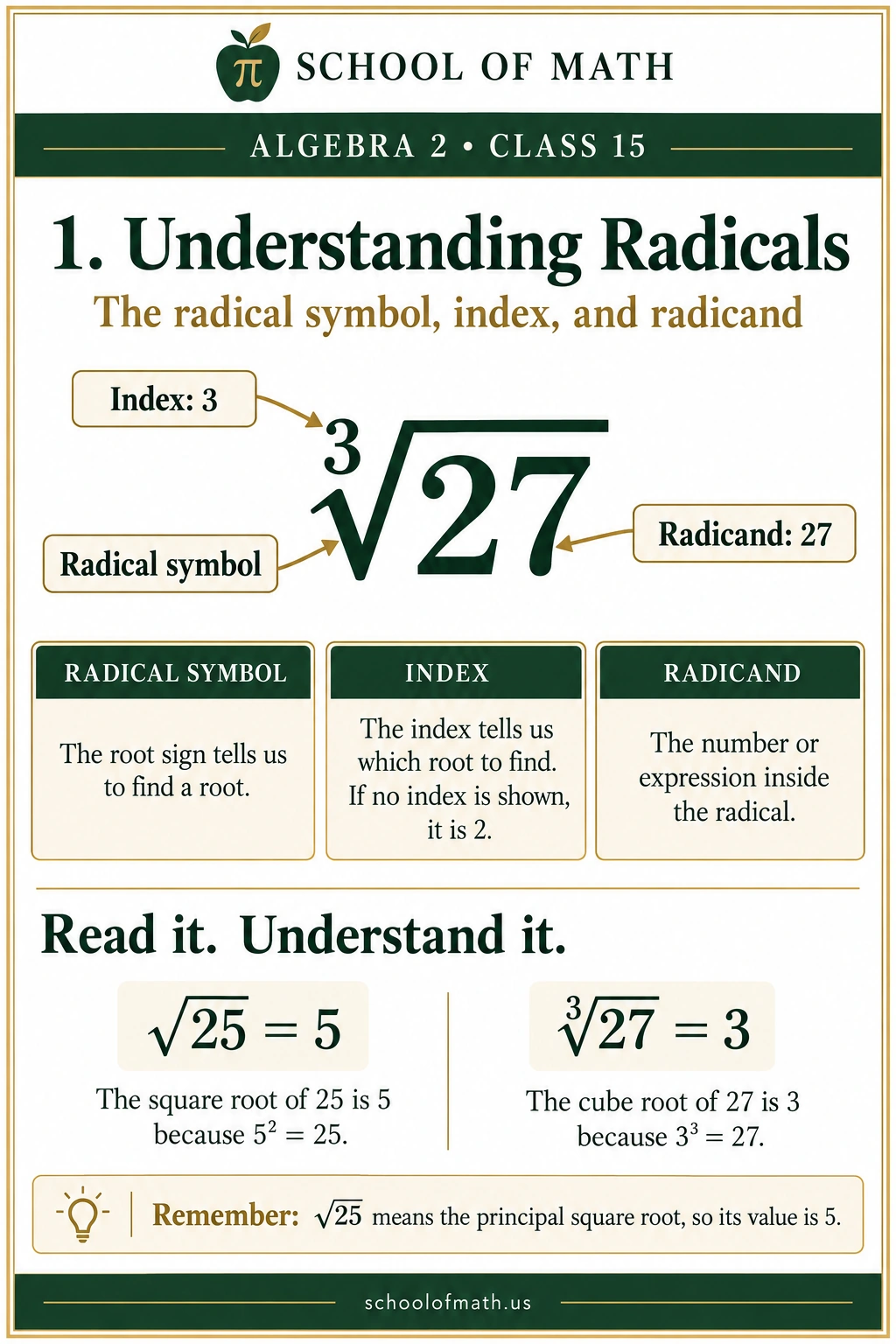
A radical reverses a power. In \(\sqrt[n]{a}\), the index \(n\) tells you which root to take, and the radicand \(a\) is the expression inside. A square root has an understood index of 2. The coefficient in \(5\sqrt[3]{a}\) multiplies the entire cube root; it is not the index.
The principal even root is nonnegative. For example, \(\sqrt{100}=10\), not \(\pm10\). By contrast, solving \(x^2=100\) gives two values, \(10\) and \(-10\), because both squares equal 100. An odd root keeps the sign of its radicand.
In this lesson we work with real numbers. An even-root radicand must be nonnegative; an odd-root radicand can be any real number. A variable radical expression has a domain: the set of inputs for which the original expression is defined.
Try it yourself: five questions
Q1 Practice 1 of 5
In \(7\sqrt[3]{19}\), identify the coefficient, index, and radicand.
Answer
Coefficient: 7. Index: 3. Radicand: 19.
- The 7 multiplies the root, the small 3 identifies a cube root, and 19 is inside the radical.
Q2 Practice 2 of 5
Find the principal fourth root \(\sqrt[4]{81}\). Explain why the answer is not \(\pm3\).
Answer
\(3\).
- Because \(3^4=81\), the nonnegative fourth root is 3. The notation asks for the principal root, not all solutions to an equation.
Q3 Practice 3 of 5
Which are real: \(\sqrt{-49}\), \(\sqrt[3]{-125}\), and \(\sqrt{0}\)? Evaluate those that are real.
Answer
\(\sqrt{-49}\) is not real; \(\sqrt[3]{-125}=-5\); \(\sqrt0=0\).
- No real square is negative. An odd root may be negative, and zero has a square root of zero.
Q4 Practice 4 of 5
Compare these two tasks: (a) evaluate \(\sqrt{196}\); (b) solve \(t^2=196\).
Answer
(a) \(14\). (b) \(t=-14\) or \(t=14\).
- The radical symbol selects one principal root. The equation asks for every real number whose square is 196.
Q5 Practice 5 of 5
Find the real-number domain of \(\sqrt{7-2x}\).
Answer
\(x\leq\frac72\).
- Require \(7-2x\geq0\). Then \(-2x\geq-7\); dividing by a negative reverses the inequality.
- The endpoint is included because a radicand of zero is allowed.
Square roots and cube roots
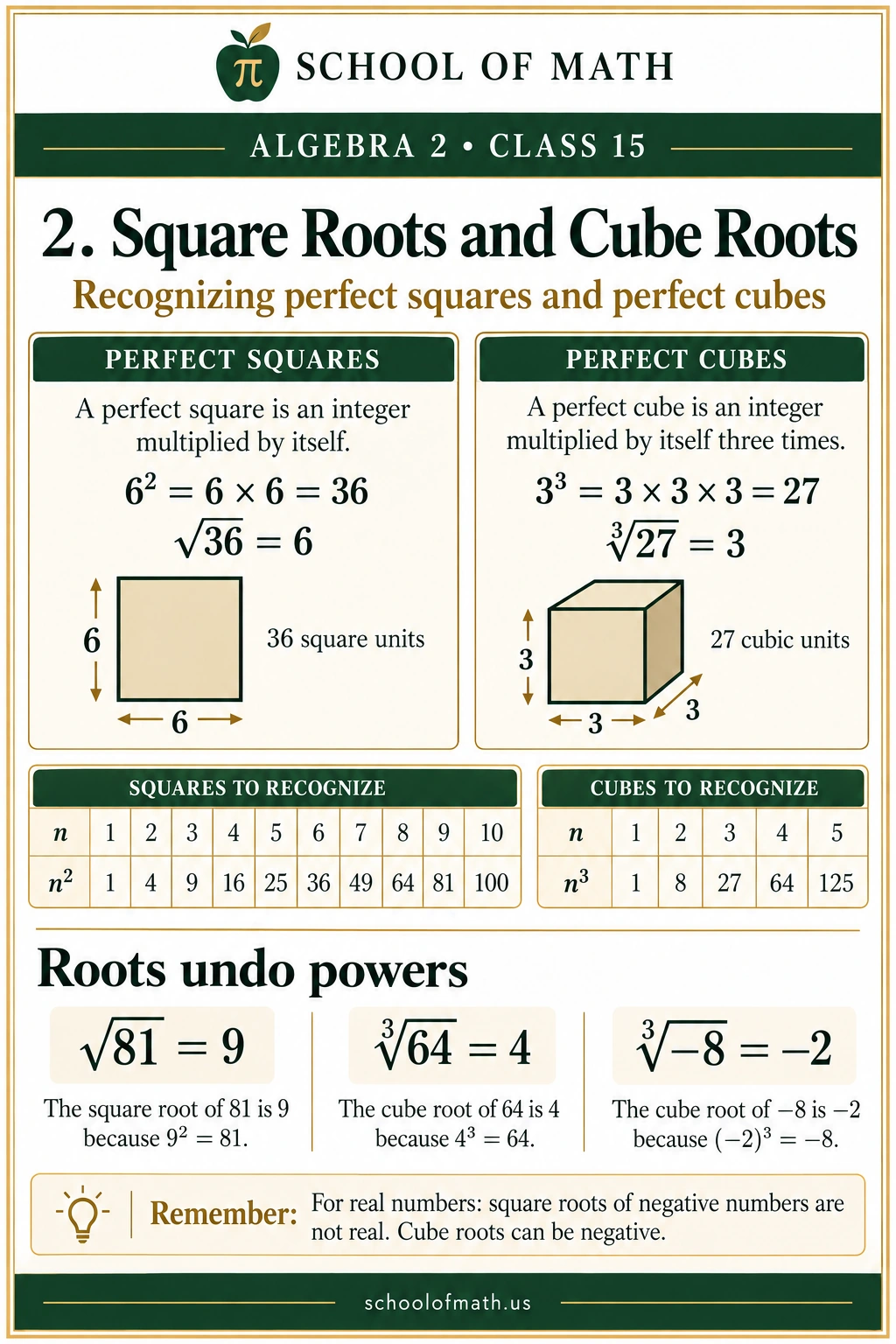
Recognizing perfect powers makes exact arithmetic faster. Squaring a number gives a perfect square; cubing gives a perfect cube. The operations reverse each other when the root convention is respected.
An even power loses the sign of a real input. Consequently \(\sqrt{(-a)^2}=|a|\), not necessarily \(-a\) or \(a\). Cubing keeps the sign, so \(\sqrt[3]{a^3}=a\) for every real \(a\).
For a nonnegative numerator and positive denominator, you may take square roots of the numerator and denominator separately. Cube-root fractions also allow negative numerators. Keep exact fractions rather than changing to decimals.
Try it yourself: five questions
Q6 Practice 1 of 5
Evaluate \(\sqrt{121}\).
Answer
\(11\).
- \(11^2=121\); choose the nonnegative root.
Q7 Practice 2 of 5
Evaluate \(\sqrt[3]{-216}\).
Answer
\(-6\).
- \((-6)^3=-216\). An odd root retains the negative sign.
Q8 Practice 3 of 5
Evaluate \(\sqrt{\frac{225}{64}}\).
Answer
\(\frac{15}{8}\).
- Take the principal square root of both positive parts: \(\sqrt{225}/\sqrt{64}=15/8\).
Q9 Practice 4 of 5
Evaluate \(\sqrt[3]{-\frac{343}{8}}\).
Answer
\(-\frac72\).
- The cube root of \(-343\) is \(-7\), and the cube root of 8 is 2.
Q10 Practice 5 of 5
Evaluate \(\sqrt{(-13)^2}-\sqrt[3]{-512}\).
Answer
\(21\).
- The first term is \(|-13|=13\), and the second root is \(-8\).
- Subtracting a negative gives \(13-(-8)=21\).
Simplifying radicals with perfect powers
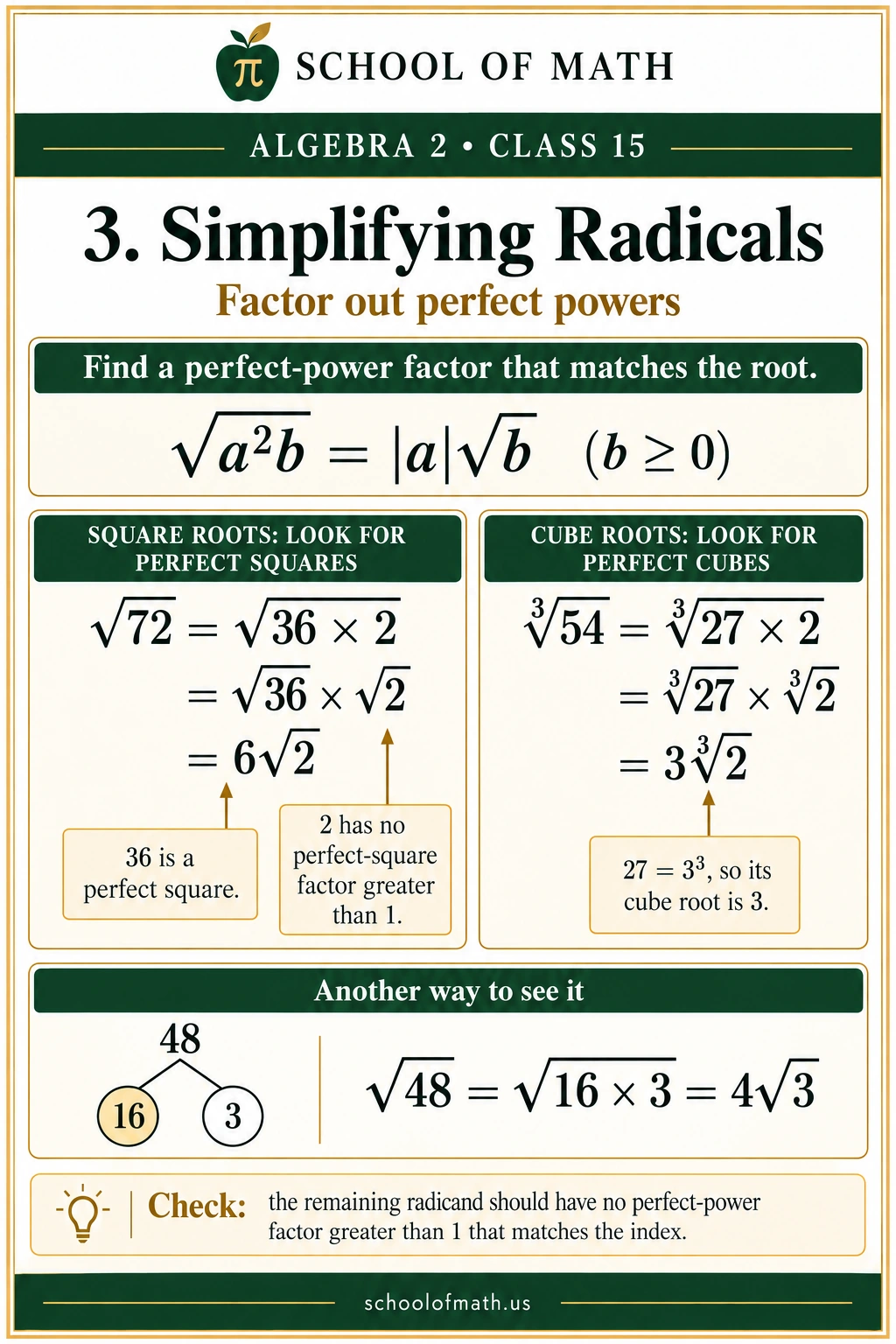
Factor a radicand into a perfect power and a remaining factor. For square roots, extract pairs of equal factors. For cube roots, extract groups of three; for fourth roots, extract groups of four.
Use the largest convenient perfect-power factor to shorten the work. If a square root becomes \(2\sqrt{27}\), it is not yet fully simplified because 27 still contains a square factor of 9. Continue until no suitable perfect-power factor remains.
An outside coefficient multiplies whatever leaves the radical. Do not add it to the extracted factor. For an odd root of a negative number, the negative sign can come outside; for even roots we stay within the real-number domain.
Try it yourself: five questions
Q11 Practice 1 of 5
Simplify \(\sqrt{108}\).
Answer
\(6\sqrt3\).
- Factor \(108=36\cdot3\). Then \(\sqrt{36}\sqrt3=6\sqrt3\).
Q12 Practice 2 of 5
Simplify \(\sqrt{200}\).
Answer
\(10\sqrt2\).
- Use \(200=100\cdot2\). The perfect-square factor contributes 10.
Q13 Practice 3 of 5
Simplify \(\sqrt[3]{375}\).
Answer
\(5\sqrt[3]3\).
- Factor \(375=125\cdot3\), then take the cube root of 125.
Q14 Practice 4 of 5
Simplify \(3\sqrt{147}\).
Answer
\(21\sqrt3\).
- First, \(\sqrt{147}=\sqrt{49\cdot3}=7\sqrt3\).
- Multiply the outside coefficients: \(3\cdot7=21\).
Q15 Practice 5 of 5
Simplify both: (a) \(\sqrt[3]{-432}\); (b) \(\sqrt[4]{6480}\).
Answer
(a) \(-6\sqrt[3]2\). (b) \(6\sqrt[4]5\).
- For (a), use \(-432=(-216)\cdot2\), and \(\sqrt[3]{-216}=-6\).
- For (b), \(6480=1296\cdot5=6^4\cdot5\). Extract the group of four, leaving 5.
Radicals with variables
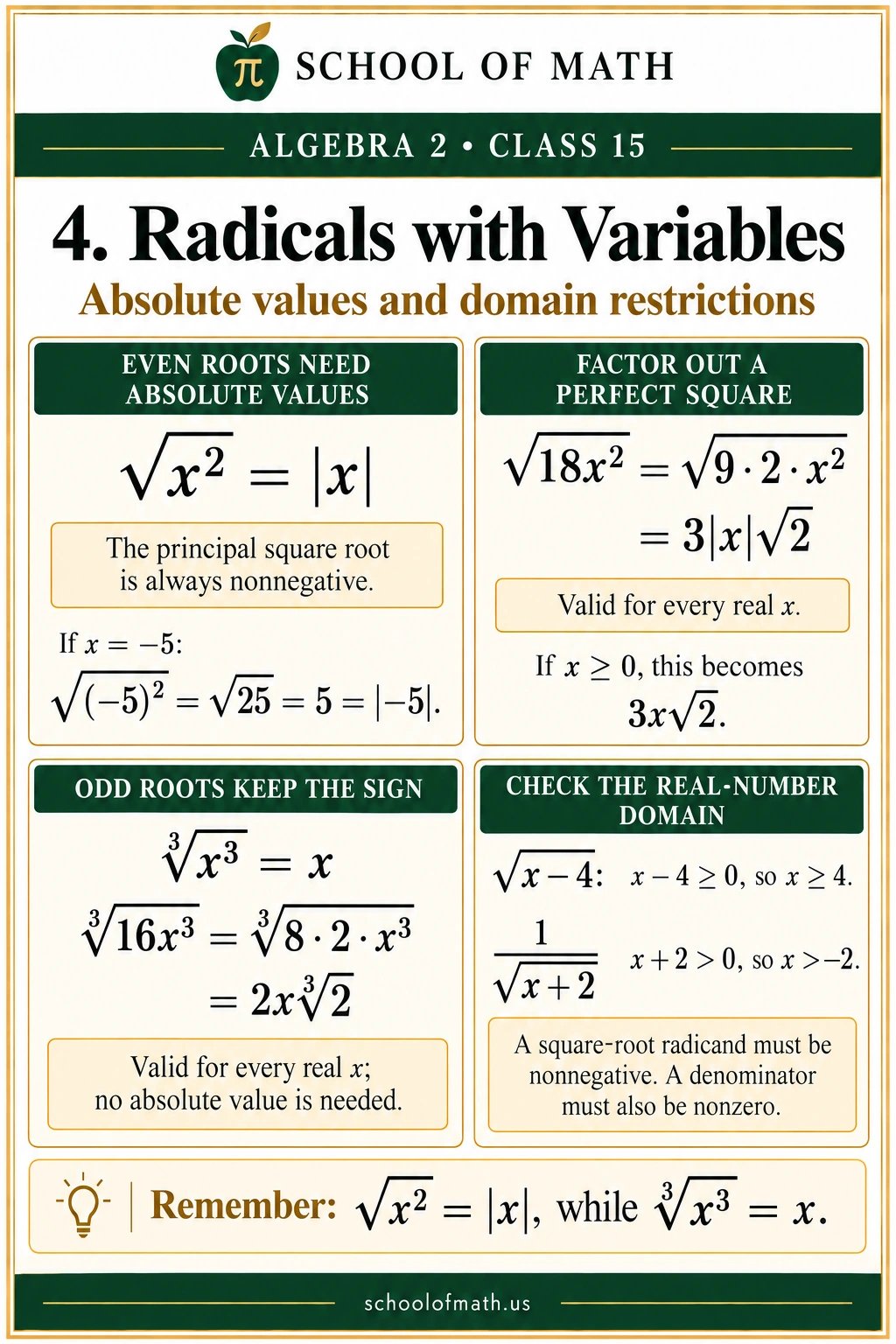
Always distinguish an identity for all real variables from a shortcut that assumes nonnegative variables. For example, \(\sqrt{x^2}=|x|\). When \(x<0\), replacing \(|x|\) with \(x\) would give a negative principal square root.
Factor even powers into squares before extracting them. The identity \(\sqrt{x^6}=|x^3|\) works for every real \(x\), while \(\sqrt{x^4}=x^2\) needs no absolute-value bars because \(x^2\) is already nonnegative. Odd roots do not need this sign correction.
Domain restrictions come from the original expression. A square-root radicand must be at least zero, and a denominator cannot be zero. For a fraction inside a square root, use a sign chart rather than requiring numerator and denominator to be positive separately.
Try it yourself: five questions
Q16 Practice 1 of 5
Simplify \(\sqrt{49x^2}\) for every real \(x\).
Answer
\(7|x|\).
- Extract \(\sqrt{49}=7\) and \(\sqrt{x^2}=|x|\).
Q17 Practice 2 of 5
Simplify \(\sqrt{32x^6}\) for every real \(x\).
Answer
\(4|x^3|\sqrt2\).
- Write the radicand as \(16\cdot2\cdot(x^3)^2\).
- The principal root of \((x^3)^2\) is \(|x^3|\).
Q18 Practice 3 of 5
Simplify \(\sqrt[3]{-54x^4}\) for every real \(x\).
Answer
\(-3x\sqrt[3]{2x}\).
- Factor \(-54x^4=(-27x^3)(2x)\).
- The cube root of \(-27x^3\) is \(-3x\), including when \(x\) is negative.
Q19 Practice 4 of 5
Simplify \(\sqrt{75a^4b^2}\) for real \(a\) and \(b\).
Answer
\(5a^2|b|\sqrt3\).
- Factor \(75a^4b^2=25\cdot3\cdot(a^2)^2\cdot b^2\).
- Because \(a^2\geq0\), its principal square root contribution is \(a^2\). The factor from \(b^2\) is \(|b|\).
Q20 Practice 5 of 5
Find the real domain of \(\sqrt{\frac{x-1}{x+2}}\).
Answer
\((-\infty,-2)\cup[1,\infty)\).
- The denominator excludes \(x=-2\). The radicand must satisfy \((x-1)/(x+2)\geq0\).
- The quotient is positive when both factors are negative (\(x<-2\)) or both are positive (\(x>1\)). At \(x=1\), the quotient is zero, so include 1.
Adding and subtracting radicals
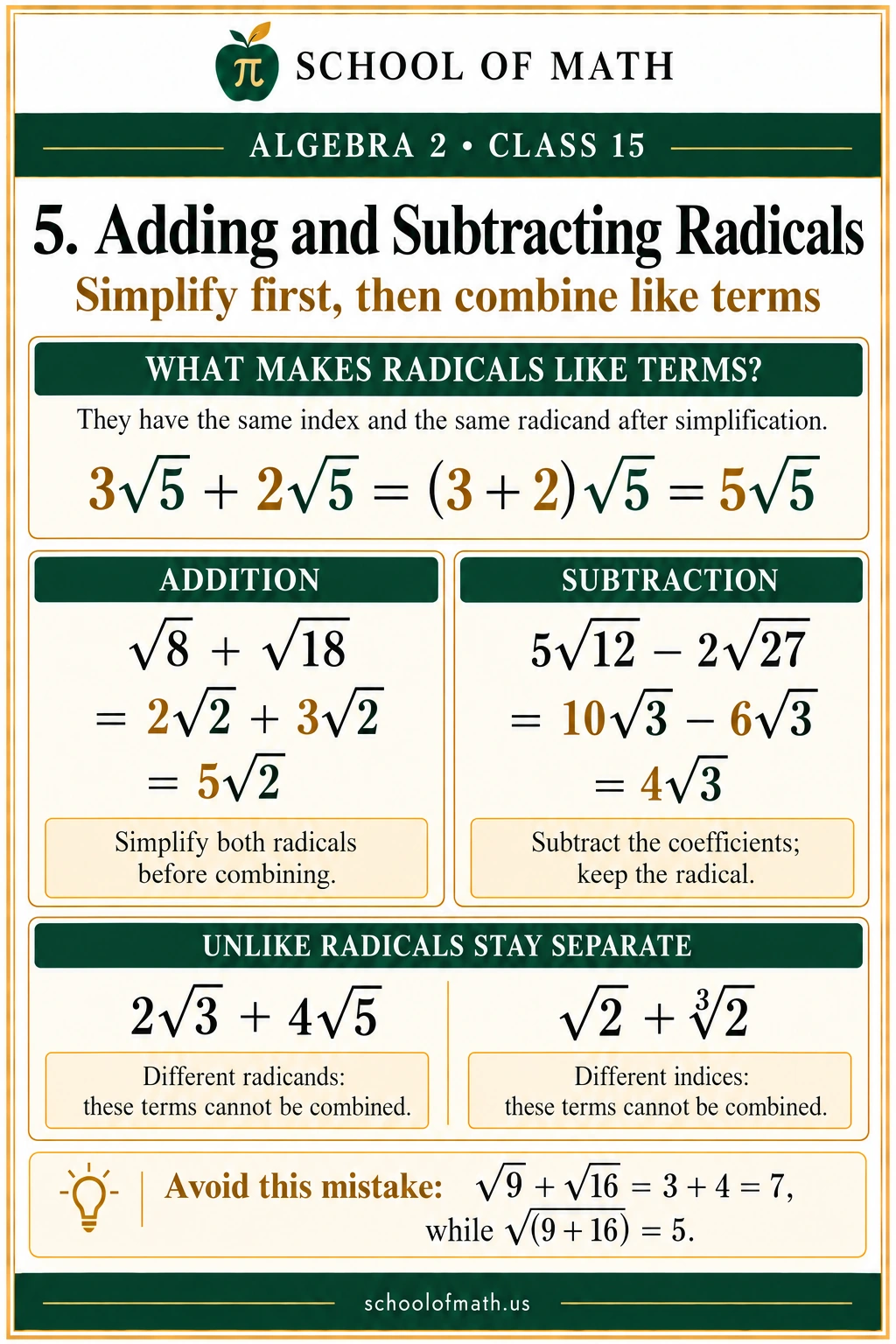
Like radicals have the same index and the same radicand after simplification. Combine only their coefficients. For example, \(a\sqrt m+b\sqrt m=(a+b)\sqrt m\) whenever the real radicals are defined.
Simplify every radical before deciding which terms are alike. Terms that look different at first may reduce to the same root. Unlike roots remain separate, even if both are square roots.
The square root does not distribute across addition or subtraction. In general, \(\sqrt{a+b}\) is not \(\sqrt a+\sqrt b\). Check the structure of the expression before using a product or quotient rule.
Try it yourself: five questions
Q21 Practice 1 of 5
Simplify \(7\sqrt{11}-4\sqrt{11}\).
Answer
\(3\sqrt{11}\).
- The roots match, so subtract coefficients: \(7-4=3\).
Q22 Practice 2 of 5
Simplify \(\sqrt{48}+\sqrt{75}\).
Answer
\(9\sqrt3\).
- The terms become \(4\sqrt3+5\sqrt3\). Combine the coefficients.
Q23 Practice 3 of 5
Simplify \(4\sqrt{20}-\sqrt{125}\).
Answer
\(3\sqrt5\).
- First get \(4(2\sqrt5)-5\sqrt5\).
- Then \(8\sqrt5-5\sqrt5=3\sqrt5\).
Q24 Practice 4 of 5
Simplify \(2\sqrt{45}+3\sqrt{80}-\sqrt5\).
Answer
\(17\sqrt5\).
- The three terms become \(6\sqrt5+12\sqrt5-\sqrt5\).
- Combine \(6+12-1=17\).
Q25 Practice 5 of 5
Simplify \(\sqrt{12}+\sqrt{20}+\sqrt{27}-\sqrt{45}\).
Answer
\(5\sqrt3-\sqrt5\).
- Rewrite as \(2\sqrt3+2\sqrt5+3\sqrt3-3\sqrt5\).
- Group like radicals. The remaining \(\sqrt3\) and \(\sqrt5\) terms cannot be combined.
Multiplying radicals
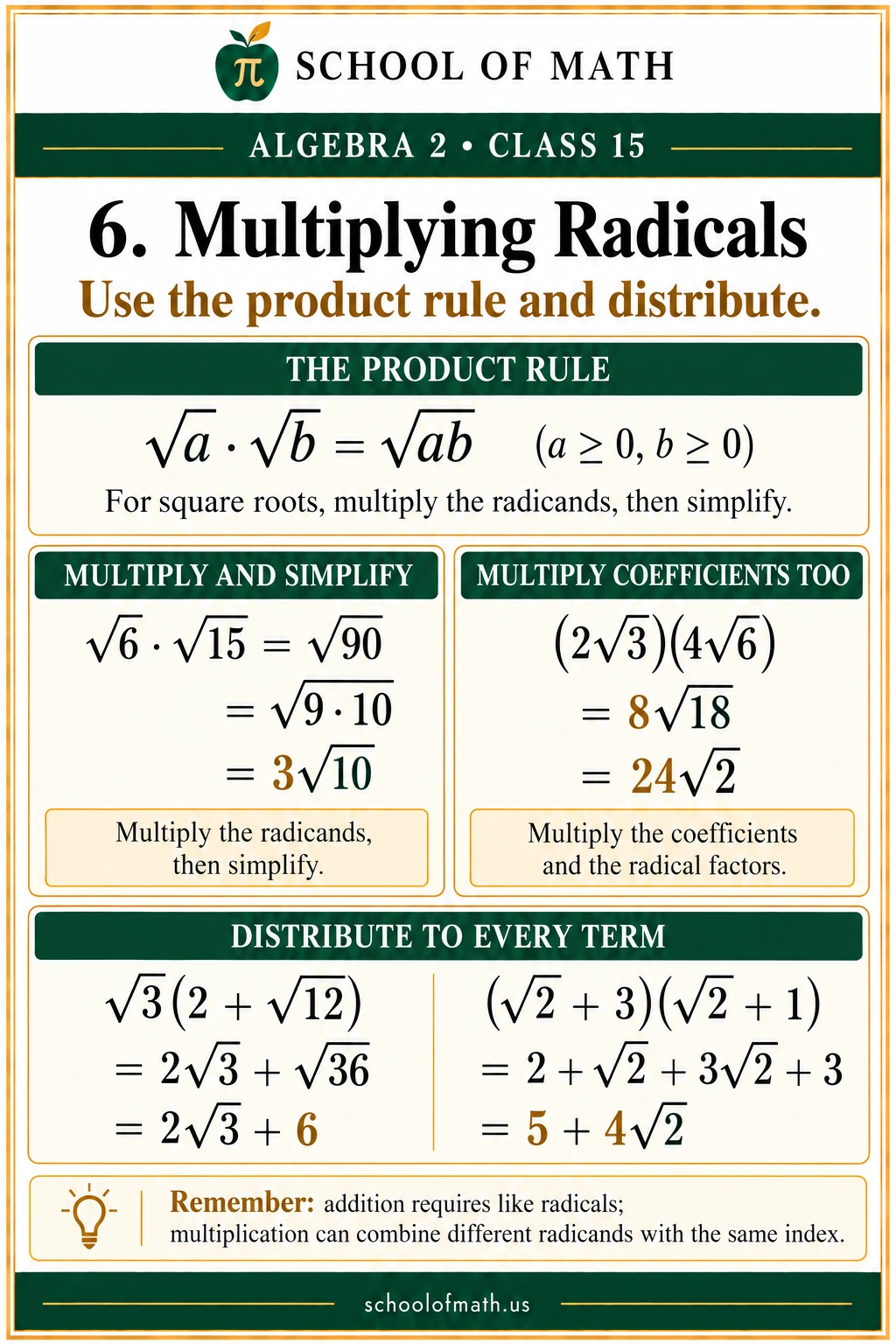
For \(a\geq0\) and \(b\geq0\), \(\sqrt a\sqrt b=\sqrt{ab}\). Multiply outside coefficients separately, then simplify the new radical. The real-number restrictions matter: this square-root rule is not permission to use negative radicands.
When multiplying a radical by a sum, distribute to every term. When multiplying two binomials, form all four products and collect like terms. A radical can disappear when its product is a perfect square.
Remember the middle term when squaring a binomial. The identity \((u-v)^2=u^2-2uv+v^2\) applies to radicals too. Conjugate pairs instead use \((u+v)(u-v)=u^2-v^2\).
Try it yourself: five questions
Q26 Practice 1 of 5
Simplify \(\sqrt{14}\sqrt{21}\).
Answer
\(7\sqrt6\).
- Multiply inside to get \(\sqrt{294}=\sqrt{49\cdot6}\).
Q27 Practice 2 of 5
Simplify \((3\sqrt5)(-2\sqrt{15})\).
Answer
\(-30\sqrt3\).
- The coefficient is \(-6\), and \(\sqrt{75}=5\sqrt3\). Multiply to get \(-30\sqrt3\).
Q28 Practice 3 of 5
Simplify \(\sqrt7(2\sqrt7-\sqrt{28})\).
Answer
\(0\).
- Distribute to get \(14-\sqrt{196}=14-14\).
- Alternatively, simplify \(\sqrt{28}=2\sqrt7\) first; the parentheses then equal zero.
Q29 Practice 4 of 5
Expand and simplify \((\sqrt6+2)(\sqrt6-5)\).
Answer
\(-4-3\sqrt6\).
- The four products are \(6-5\sqrt6+2\sqrt6-10\).
- Combine constants and like radicals separately.
Q30 Practice 5 of 5
Expand and simplify \((3\sqrt2-\sqrt5)^2\).
Answer
\(23-6\sqrt{10}\).
- Use \(u^2-2uv+v^2\): \(18-6\sqrt{10}+5\).
- The middle term is essential; squaring each term alone would incorrectly give 23.
Dividing radicals
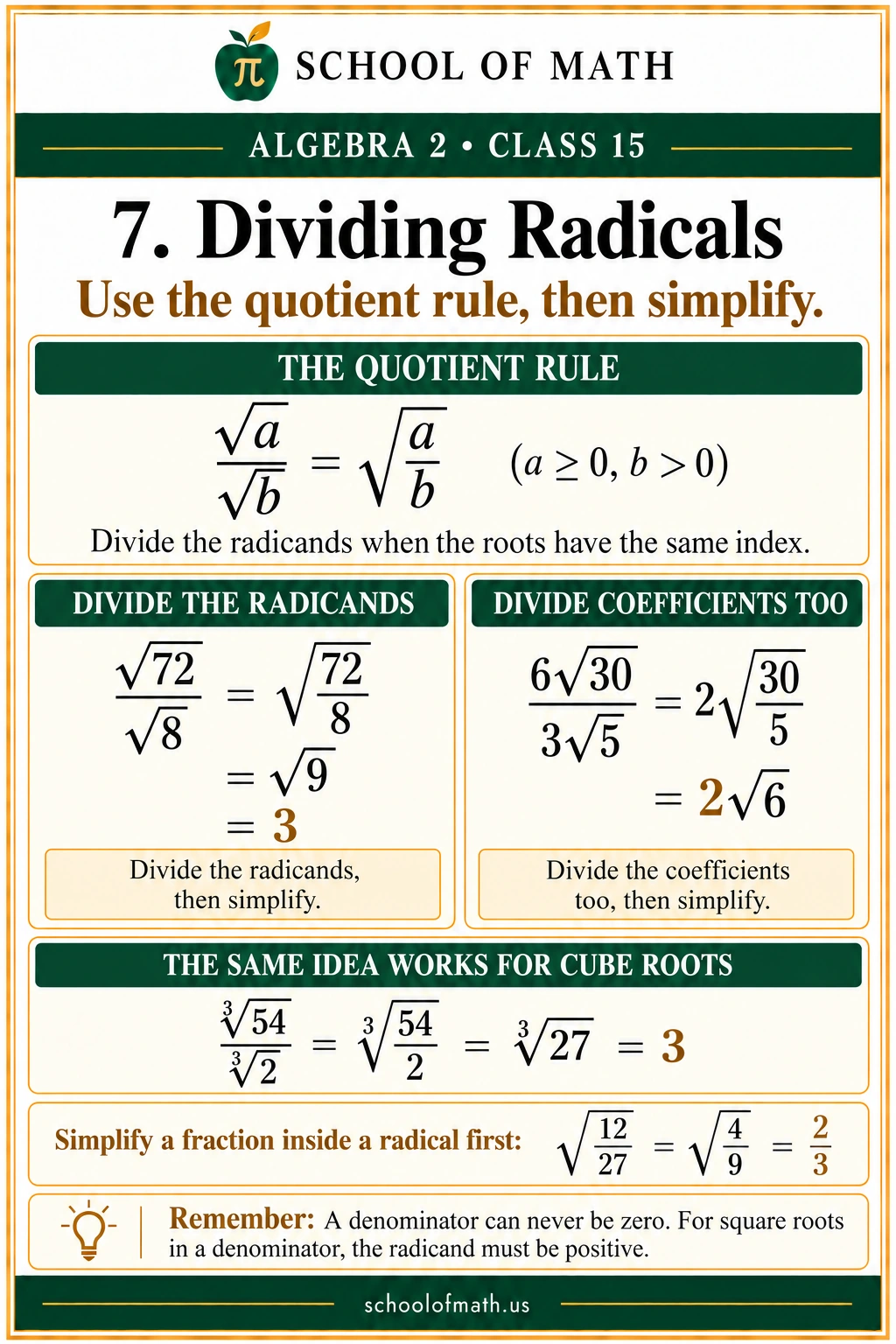
For \(a\geq0\) and \(b>0\), \(\sqrt a/\sqrt b=\sqrt{a/b}\). The denominator condition is strict because division by zero is undefined. Simplify a fraction inside a radical when it reveals a perfect square.
With coefficients, divide the coefficients and the radicals as separate factors. For cube roots, the quotient rule also works with negative radicands, as long as the denominator is nonzero.
After simplification, retain exclusions from the original denominator. An expression that looks defined at a formerly excluded value does not restore that value to the original domain.
Try it yourself: five questions
Q31 Practice 1 of 5
Simplify \(\frac{\sqrt{150}}{\sqrt6}\).
Answer
\(5\).
- Combine into \(\sqrt{150/6}=\sqrt{25}\).
Q32 Practice 2 of 5
Simplify \(\frac{10\sqrt{42}}{5\sqrt7}\).
Answer
\(2\sqrt6\).
- Divide coefficients to get 2, then divide radicands: \(42/7=6\).
Q33 Practice 3 of 5
Simplify \(\frac{\sqrt[3]{-250}}{\sqrt[3]2}\).
Answer
\(-5\).
- The quotient is \(\sqrt[3]{-125}=-5\).
Q34 Practice 4 of 5
Simplify \(\sqrt{\frac{75}{108}}\).
Answer
\(\frac56\).
- Reduce the fraction first: \(75/108=25/36\). Then take principal square roots.
Q35 Practice 5 of 5
Simplify \(\frac{\sqrt{72x^4}}{\sqrt{2x^2}}\) for real \(x\), and retain its restriction.
Answer
\(6|x|\), with \(x\ne0\).
- The original denominator is zero at \(x=0\), so exclude it.
- For allowed inputs, combine radicands to get \(\sqrt{36x^2}=6|x|\).
Rationalizing monomial denominators
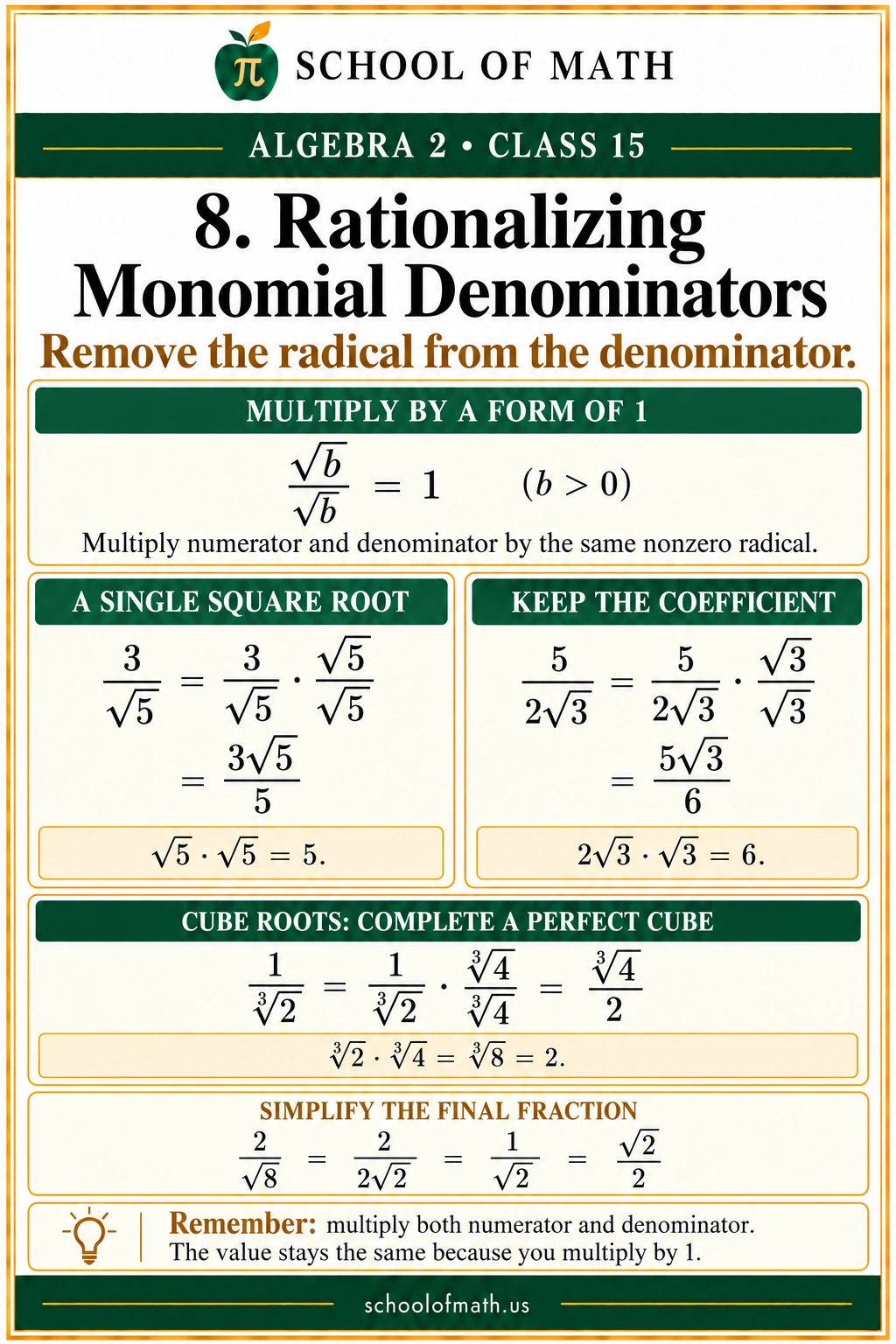
Rationalizing rewrites a fraction without a radical in its denominator. It does not change its value. Multiply numerator and denominator by the same nonzero expression, which is a form of 1.
For one square-root factor in the denominator, multiplying by that same root produces a rational radicand. Simplify first when possible, and reduce the final fraction after rationalization.
For a cube root, complete a group of three equal factors rather than a pair. For variable denominators, state the original domain before multiplying; do not use a multiplier that is zero on an allowed input.
Try it yourself: five questions
Q36 Practice 1 of 5
Rationalize \(\frac4{\sqrt7}\).
Answer
\(\frac{4\sqrt7}{7}\).
- Multiply top and bottom by \(\sqrt7\); the denominator becomes 7.
Q37 Practice 2 of 5
Rationalize and reduce \(\frac9{2\sqrt6}\).
Answer
\(\frac{3\sqrt6}{4}\).
- Multiply by \(\sqrt6/\sqrt6\) to get \(9\sqrt6/12\). Reduce 9/12.
Q38 Practice 3 of 5
Rationalize and simplify \(\frac{\sqrt{10}}{\sqrt{15}}\).
Answer
\(\frac{\sqrt6}{3}\).
- Multiply by \(\sqrt{15}/\sqrt{15}\) to get \(\sqrt{150}/15\).
- Simplify \(\sqrt{150}=5\sqrt6\) and reduce.
Q39 Practice 4 of 5
Rationalize \(\frac5{\sqrt[3]9}\).
Answer
\(\frac{5\sqrt[3]3}{3}\).
- Since \(9=3^2\), multiply by \(\sqrt[3]3/\sqrt[3]3\).
- The denominator becomes \(\sqrt[3]{27}=3\).
Q40 Practice 5 of 5
Rationalize \(\frac2{x\sqrt{3x}}\) and state the real-number domain.
Answer
\(\frac{2\sqrt{3x}}{3x^2}\), with \(x>0\).
- The denominator requires \(3x>0\), so \(x>0\).
- Multiply by \(\sqrt{3x}/\sqrt{3x}\). The new denominator is \(x(3x)=3x^2\).
Rationalizing binomial denominators
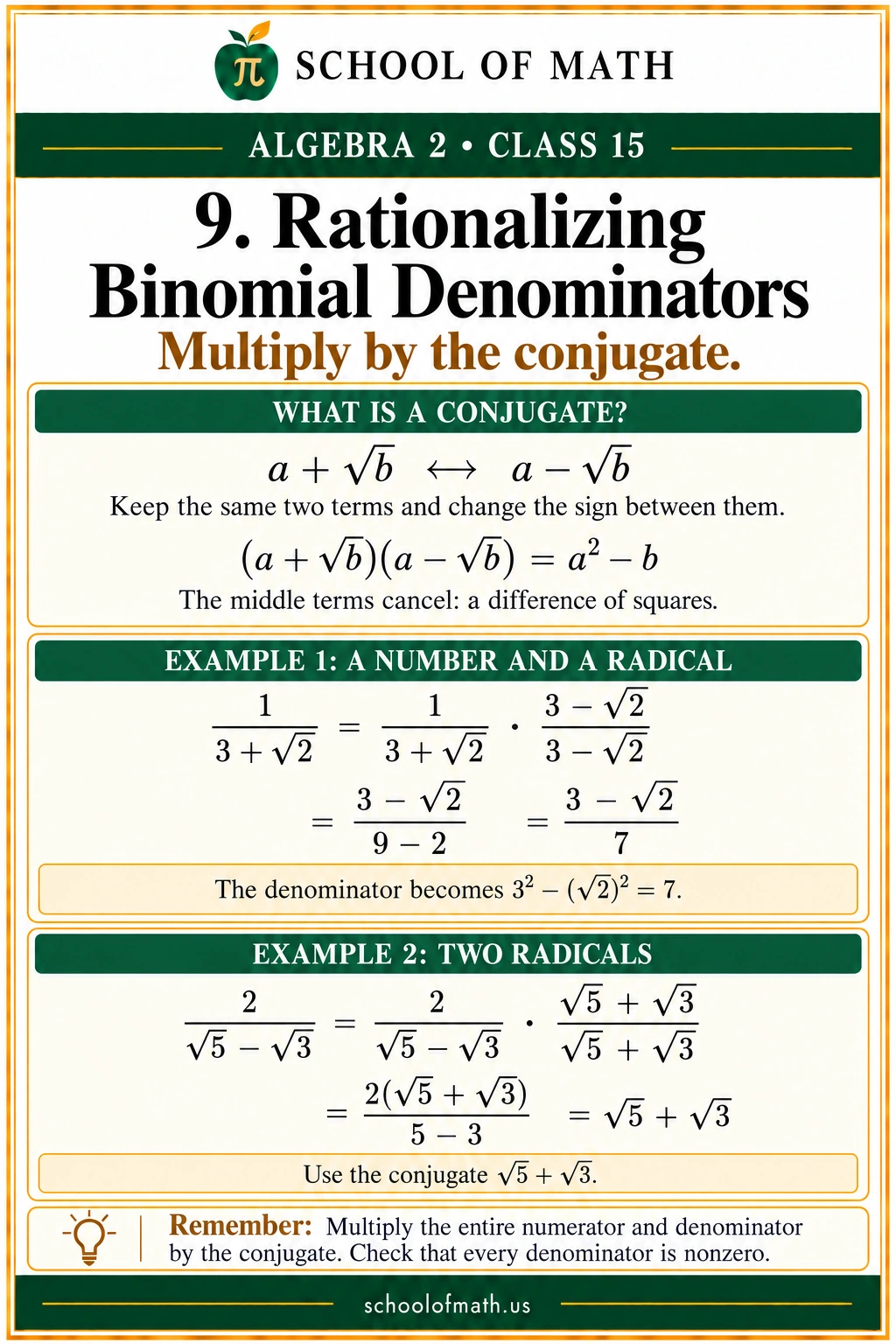
A conjugate changes the sign between two terms. Multiplying \(a+\sqrt b\) by \(a-\sqrt b\) gives \(a^2-b\), because the two mixed terms cancel. Multiply the entire numerator and denominator by the conjugate.
The same structure works when both terms are radicals: \((\sqrt a+\sqrt b)(\sqrt a-\sqrt b)=a-b\). If the numerator also contains a sum, distribute it fully rather than multiplying just one term.
With variables, check whether the conjugate could be zero at an input allowed by the original expression. The transformed quotient may need a separately stated value at such an input. A rewritten formula must not silently change the domain.
Try it yourself: five questions
Q41 Practice 1 of 5
Rationalize \(\frac1{4+\sqrt3}\).
Answer
\(\frac{4-\sqrt3}{13}\).
- Multiply by the conjugate \(4-\sqrt3\). The denominator is \(16-3=13\).
Q42 Practice 2 of 5
Rationalize \(\frac3{\sqrt7-2}\).
Answer
\(\sqrt7+2\).
- Multiply by \((\sqrt7+2)/(\sqrt7+2)\).
- The denominator is \(7-4=3\), which cancels the outside factor of 3.
Q43 Practice 3 of 5
Rationalize \(\frac4{\sqrt{11}+\sqrt3}\).
Answer
\(\frac{\sqrt{11}-\sqrt3}{2}\).
- The conjugate gives \(4(\sqrt{11}-\sqrt3)/(11-3)\). Reduce the factor \(4/8\).
Q44 Practice 4 of 5
Rationalize and simplify \(\frac{\sqrt5+1}{\sqrt5-1}\).
Answer
\(\frac{3+\sqrt5}{2}\).
- Multiply by \((\sqrt5+1)/(\sqrt5+1)\).
- The numerator is \((\sqrt5+1)^2=6+2\sqrt5\); the denominator is \(5-1=4\). Reduce.
Q45 Practice 5 of 5
For \(f(x)=\frac{\sqrt x-\sqrt2}{\sqrt x+\sqrt2}\), state the original domain, rationalize where possible, and find \(f(2)\).
Answer
Domain: \(x\geq0\). For \(x\ne2\), \(f(x)=\frac{x+2-2\sqrt{2x}}{x-2}\). Separately, \(f(2)=0\).
- The original denominator is positive for every \(x\geq0\), so 2 is allowed.
- Multiplying by the conjugate gives numerator \((\sqrt x-\sqrt2)^2\) and denominator \(x-2\), but the multiplier is zero when \(x=2\).
- Evaluate that input in the original expression: the numerator is zero and the denominator is \(2\sqrt2\). The rationalized quotient alone would incorrectly omit this value.
Rational exponents
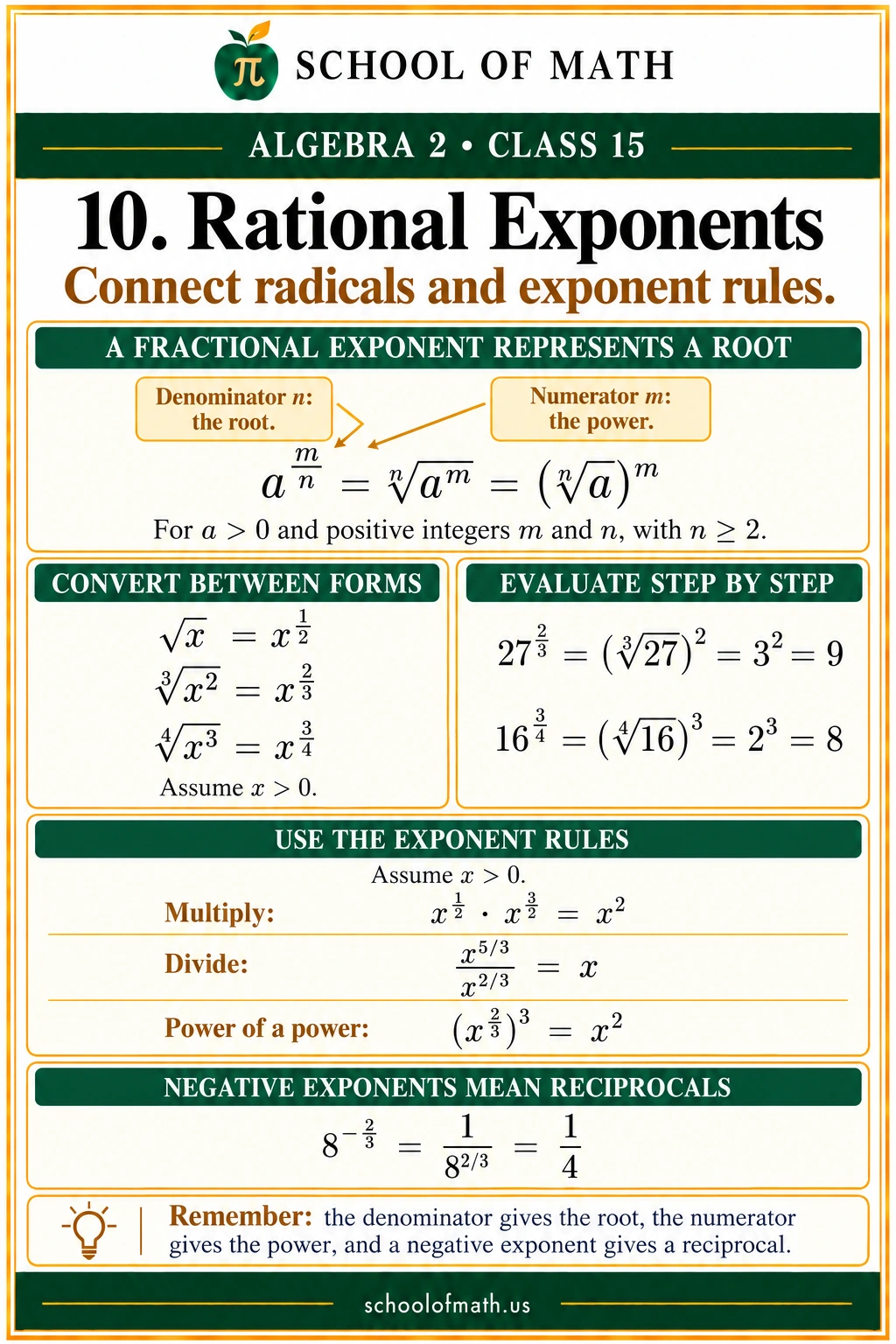
For a positive base \(a\), \(a^{m/n}=(\sqrt[n]{a})^m=\sqrt[n]{a^m}\), with integers \(m\) and \(n>0\). The denominator specifies the root; the numerator specifies the power. Taking the root first often keeps the arithmetic smaller.
A negative exponent means a reciprocal, not a negative answer. With positive bases, the usual product, quotient, and power rules remain valid: add exponents when multiplying like bases, subtract when dividing, and multiply when raising a power to a power.
In the rational-exponent exercises, variable bases are explicitly positive. This avoids ambiguity about negative bases and fractional-power conventions. Do not extend an identity beyond its stated domain without checking root parity and nonzero-denominator requirements.
Try it yourself: five questions
Q46 Practice 1 of 5
Evaluate \(125^{2/3}\).
Answer
\(25\).
- Take the cube root first: \(\sqrt[3]{125}=5\). Then square: \(5^2=25\).
Q47 Practice 2 of 5
Evaluate \(81^{3/4}\).
Answer
\(27\).
- The fourth root of 81 is 3. Raise it to the third power: \(3^3=27\).
Q48 Practice 3 of 5
Evaluate \(32^{-2/5}\).
Answer
\(\frac14\).
- The fifth root of 32 is 2, so \(32^{2/5}=4\). The negative exponent takes its reciprocal.
Q49 Practice 4 of 5
For \(x>0\), simplify \(\frac{x^{5/6}x^{1/3}}{x^{1/2}}\). Give exponent and radical forms.
Answer
\(x^{2/3}=\sqrt[3]{x^2}\).
- Combine exponents: \(5/6+1/3-1/2=5/6+2/6-3/6=2/3\).
Q50 Practice 5 of 5
For \(x>0\) and \(y>0\), simplify \((16x^8y^4)^{3/4}\).
Answer
\(8x^6y^3\).
- Apply the exponent to each positive factor. \(16^{3/4}=8\), \(x^{8(3/4)}=x^6\), and \(y^{4(3/4)}=y^3\).
Solving radical equations
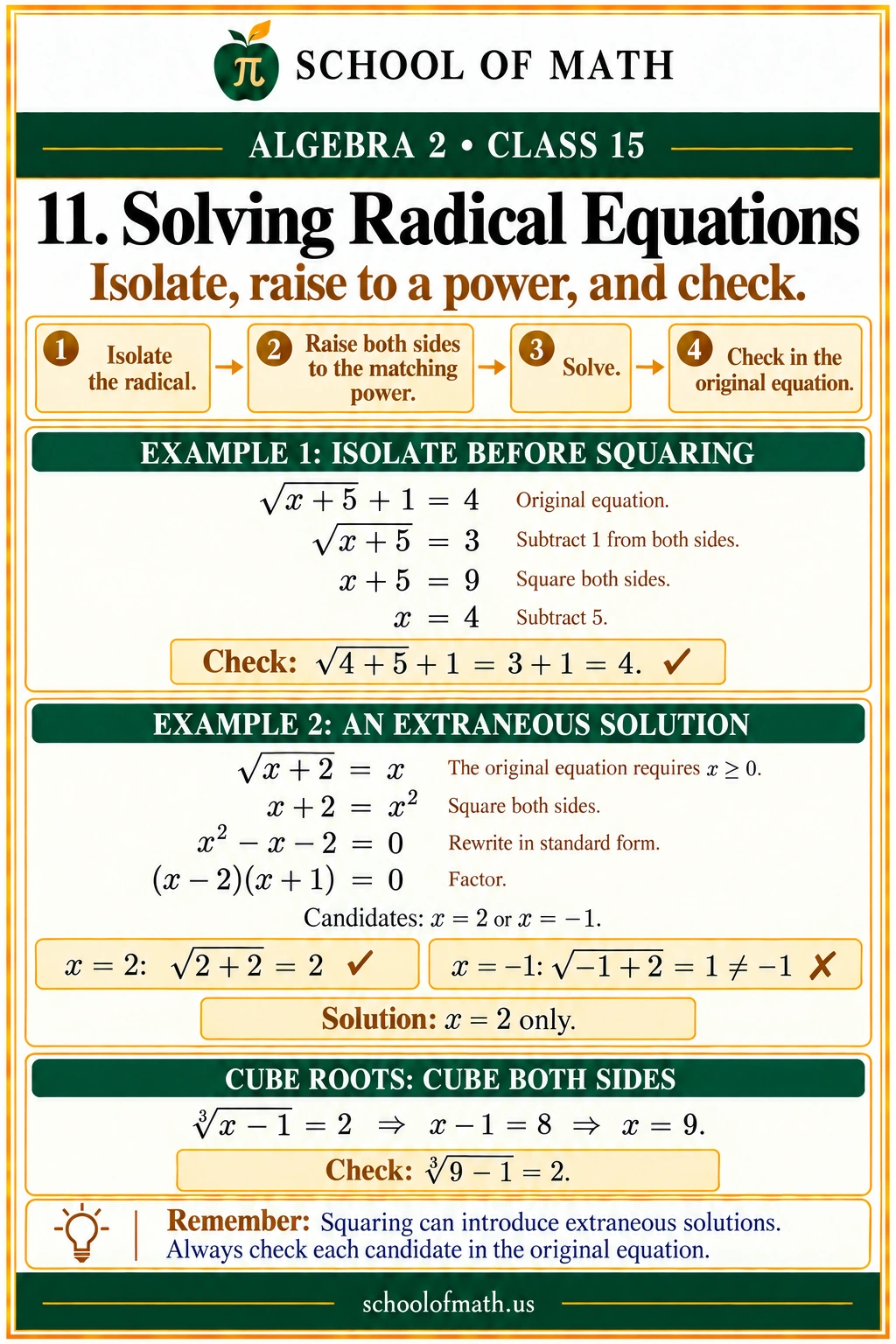
Isolate the radical before applying a power. For a square-root equation, note both the radicand restriction and the fact that the isolated root is nonnegative. These restrictions can rule out a proposed answer immediately.
Squaring both sides may introduce extraneous candidates. For instance, two opposite numbers have equal squares even though the numbers themselves are not equal. Solve the transformed equation, then substitute every candidate into the original one.
If two radicals remain, isolate one, square carefully, and isolate the remaining radical before squaring again if needed. Keep an equals sign on each balanced step. A check must use the original equation, not just the equation obtained after squaring.
Try it yourself: five questions
Q51 Practice 1 of 5
Solve \(\sqrt{x+8}=5\).
Answer
\(x=17\).
- The domain requires \(x\geq-8\). Squaring gives \(x+8=25\).
- Check: \(\sqrt{17+8}=\sqrt{25}=5\).
Q52 Practice 2 of 5
Solve \(3\sqrt{2x-1}+2=17\).
Answer
\(x=13\).
- Subtract 2 and divide by 3 to isolate \(\sqrt{2x-1}=5\).
- Square: \(2x-1=25\), so \(x=13\). Check: \(3\sqrt{25}+2=17\).
Q53 Practice 3 of 5
Solve \(\sqrt{x+10}=x-2\), rejecting any extraneous candidate.
Answer
\(x=6\) only.
- The right side must be nonnegative, so \(x\geq2\). Squaring gives \(x+10=(x-2)^2\).
- Rearrange to \(x^2-5x-6=(x-6)(x+1)=0\), giving candidates 6 and \(-1\).
- At 6: \(\sqrt{16}=4=6-2\). At \(-1\): \(\sqrt9=3\ne-3\), so reject \(-1\).
Q54 Practice 4 of 5
Solve \(\sqrt{3x+4}=x\). Show why one squared-equation candidate fails.
Answer
\(x=4\) only.
- The root is nonnegative, so \(x\geq0\). Squaring gives \(x^2-3x-4=(x-4)(x+1)=0\).
- At 4, both sides are 4. At \(-1\), the left side is 1 but the right side is \(-1\).
Q55 Practice 5 of 5
Solve \(\sqrt{x+6}=\sqrt{x+1}+1\).
Answer
\(x=3\).
- The original domain is \(x\geq-1\). Square: \(x+6=x+2+2\sqrt{x+1}\).
- Thus \(4=2\sqrt{x+1}\), so \(\sqrt{x+1}=2\) and \(x=3\).
- Original check: \(\sqrt9=\sqrt4+1\), or \(3=3\).
Radicals in real-world applications
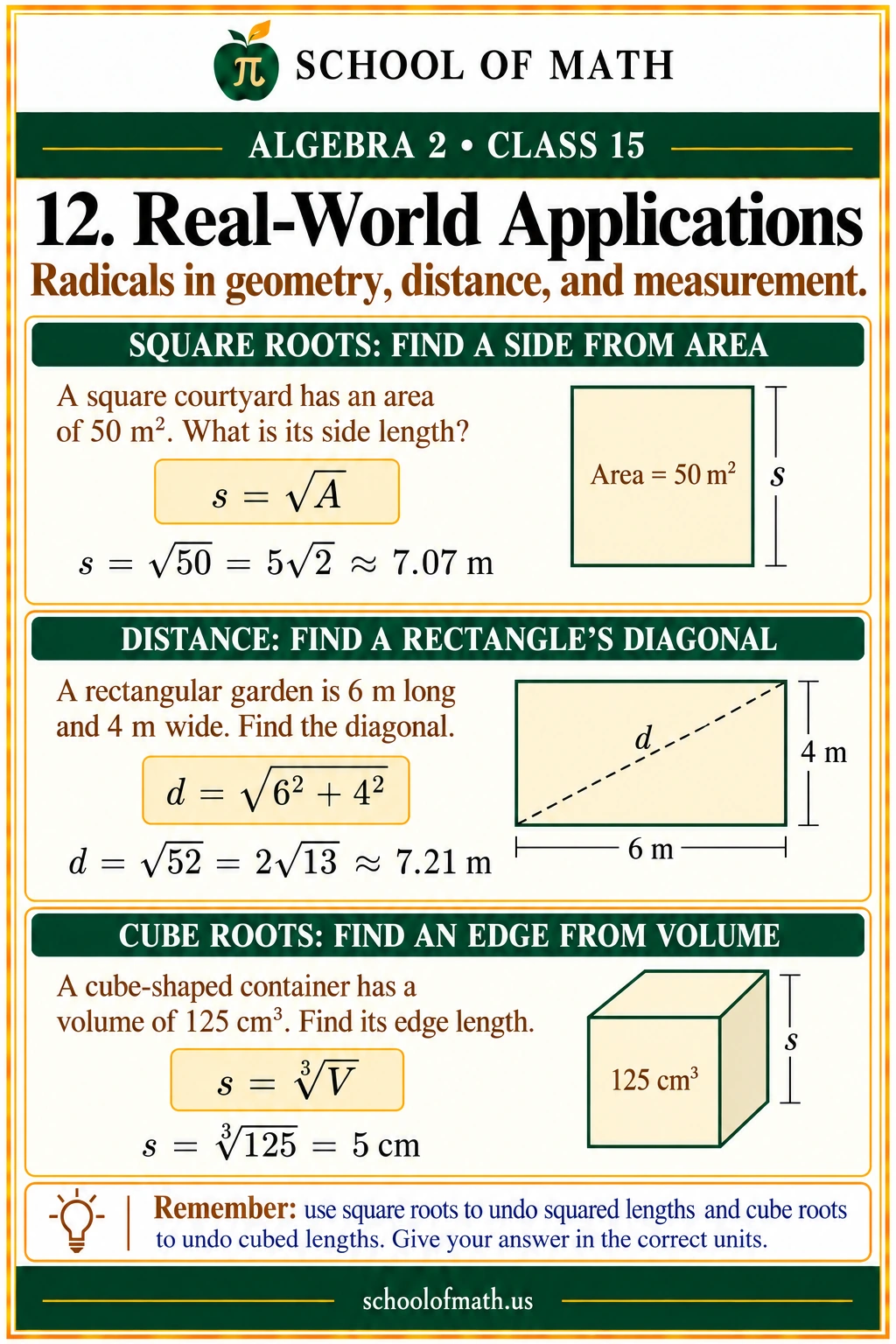
Roots recover a length from an area or volume. If a square has area \(A\), its side is \(\sqrt A\). If a cube has volume \(V\), its edge is \(\sqrt[3]V\). Interpret the result in length units, not square or cubic units.
The Pythagorean theorem connects radicals to distances. A right triangle with legs \(a,b\) has hypotenuse \(\sqrt{a^2+b^2}\). On a coordinate grid, calculate horizontal and vertical changes first, square them, add, and take the principal root.
Use the stated model and its units, then reject answers that cannot represent the quantity in the story. Physical lengths are positive. Keep radicals exact until a decimal is requested; round only at the end. Application models here are supplied for mathematical practice, not engineering design.
Try it yourself: five questions
Q56 Practice 1 of 5
A square tile has area \(98\text{ cm}^2\). Find its exact side length.
Answer
\(7\sqrt2\text{ cm}\).
- Let \(s>0\) be the side. Then \(s^2=98\), so \(s=\sqrt{98}=7\sqrt2\).
- The answer is a length, so use centimeters.
Q57 Practice 2 of 5
A cube-shaped container has volume \(250\text{ cm}^3\). Find its exact edge length.
Answer
\(5\sqrt[3]2\text{ cm}\).
- The edge is \(\sqrt[3]{250}=\sqrt[3]{125\cdot2}=5\sqrt[3]2\).
Q58 Practice 3 of 5
Find the exact distance between \(A=(-2,1)\) and \(B=(4,5)\), in coordinate units.
Answer
\(2\sqrt{13}\) units.
- The changes are \(4-(-2)=6\) and \(5-1=4\).
- Distance is \(\sqrt{6^2+4^2}=\sqrt{52}=2\sqrt{13}\).
Q59 Practice 4 of 5
Use the supplied pendulum model \(T=2\pi\sqrt{L/9.8}\), with \(L\) in meters and \(T\) in seconds. Find the exact modeled period when \(L=2.45\).
Answer
\(T=\pi\) seconds.
- The fraction is \(2.45/9.8=1/4\). Its square root is \(1/2\).
- Thus \(T=2\pi(1/2)=\pi\). This is the result of the supplied idealized model.
Q60 Practice 5 of 5
A right triangle has legs \(x\) cm and \(x+2\) cm, with hypotenuse \(10\) cm. Model the hypotenuse with a radical and find both legs.
Answer
The legs are 6 cm and 8 cm.
- For \(x>0\), write \(\sqrt{x^2+(x+2)^2}=10\).
- Square and simplify: \(2x^2+4x+4=100\), so \(x^2+2x-48=(x+8)(x-6)=0\).
- Reject \(-8\) as a length. For \(x=6\), the legs are 6 and 8, and \(\sqrt{36+64}=10\).
Homework review
Complete one review question for each of the twelve topics. Show simplification steps and retain domain restrictions.
R1 Review topic 1 of 12
Explain the difference between \(\sqrt{144}\) and the real solutions of \(z^2=144\).
Answer
\(\sqrt{144}=12\), while \(z=\pm12\).
- A principal square root is nonnegative. Both 12 and \(-12\) solve the squared equation.
R2 Review topic 2 of 12
Evaluate \(\sqrt{\frac{361}{100}}+\sqrt[3]{-64}\).
Answer
\(-\frac{21}{10}\).
- The roots are \(19/10\) and \(-4\). Add: \(19/10-40/10=-21/10\).
R3 Review topic 3 of 12
Simplify \(2\sqrt{180}-\sqrt[3]{128}\).
Answer
\(12\sqrt5-4\sqrt[3]2\).
- Extract \(\sqrt{36}=6\) from the first root and \(\sqrt[3]{64}=4\) from the second.
- The root indices differ, so the resulting terms do not combine.
R4 Review topic 4 of 12
Simplify \(\sqrt{48u^4v^2}\) for real \(u,v\).
Answer
\(4u^2|v|\sqrt3\).
- Use \(48=16\cdot3\), \(\sqrt{u^4}=u^2\), and \(\sqrt{v^2}=|v|\).
R5 Review topic 5 of 12
Simplify \(3\sqrt{28}-2\sqrt{63}+\sqrt{175}\).
Answer
\(5\sqrt7\).
- The expression becomes \(6\sqrt7-6\sqrt7+5\sqrt7\).
R6 Review topic 6 of 12
Expand and simplify \((\sqrt3+\sqrt8)^2\).
Answer
\(11+4\sqrt6\).
- The square is \(3+2\sqrt{24}+8\). Simplify the middle radical: \(2\sqrt{24}=4\sqrt6\).
R7 Review topic 7 of 12
Simplify \(\frac{12\sqrt{55}}{3\sqrt5}\).
Answer
\(4\sqrt{11}\).
- Divide the coefficients to get 4 and the radicands to get 11.
R8 Review topic 8 of 12
Rationalize \(\frac7{\sqrt{28}}\).
Answer
\(\frac{\sqrt7}{2}\).
- First \(\sqrt{28}=2\sqrt7\). Multiplying \(7/(2\sqrt7)\) by \(\sqrt7/\sqrt7\) gives \(7\sqrt7/14\).
R9 Review topic 9 of 12
Rationalize \(\frac5{3-\sqrt2}\).
Answer
\(\frac{15+5\sqrt2}{7}\).
- Multiply by the conjugate \(3+\sqrt2\). The denominator is \(9-2=7\).
R10 Review topic 10 of 12
Evaluate \(64^{-2/3}\).
Answer
\(\frac1{16}\).
- The cube root of 64 is 4. Squaring gives 16, then the negative exponent gives its reciprocal.
R11 Review topic 11 of 12
Solve \(\sqrt{2x+9}=x\) and check both candidates from squaring.
Answer
\(x=1+\sqrt{10}\) only.
- The right side requires \(x\geq0\). Squaring gives \(x^2-2x-9=0\), so candidates are \(1\pm\sqrt{10}\).
- The minus candidate is negative. For the positive candidate, \(x^2=2x+9\) and \(\sqrt{x^2}=x\), so it satisfies the original equation.
R12 Review topic 12 of 12
A rectangle has side lengths \(\sqrt{45}\) m and \(\sqrt{20}\) m. Find its exact perimeter and area.
Answer
Perimeter: \(10\sqrt5\) m. Area: \(30\text{ m}^2\).
- The sides simplify to \(3\sqrt5\) and \(2\sqrt5\).
- Perimeter is \(2(3\sqrt5+2\sqrt5)=10\sqrt5\). Area is \(3\sqrt5\cdot2\sqrt5=30\).
Homework word problems
These eight increasingly challenging problems complete the 20-question homework. Define quantities, write a model, show your reasoning, and give units. Reject values that do not fit the original equation or the situation.
W1 Homework word problem 1 of 8
A square garden has area \(162\text{ m}^2\). Find its exact side length and the exact fencing length needed around all four sides.
Answer
Side: \(9\sqrt2\) m. Fencing: \(36\sqrt2\) m.
- The side is \(\sqrt{162}=\sqrt{81\cdot2}=9\sqrt2\). Multiply by 4 for the perimeter.
W2 Homework word problem 2 of 8
A cube-shaped gift box has volume \(432\text{ cm}^3\). Ribbon runs along four consecutive edges around one square face. Find the exact edge length and the ribbon length, with no extra ribbon for a knot.
Answer
Edge: \(6\sqrt[3]2\) cm. Ribbon: \(24\sqrt[3]2\) cm.
- Use \(e=\sqrt[3]{432}=\sqrt[3]{216\cdot2}=6\sqrt[3]2\).
- The stated ribbon path has four edges, so its length is \(4e\).
W3 Homework word problem 3 of 8
Two straight paths run due east and then due north, with lengths \(\sqrt{75}\) m and \(\sqrt{27}\) m. Find the total walking distance and the direct straight-line distance between start and finish.
Answer
Walking: \(8\sqrt3\) m. Direct: \(\sqrt{102}\) m.
- The walking distance is \(5\sqrt3+3\sqrt3=8\sqrt3\).
- The paths meet at a right angle. The direct distance is \(\sqrt{75+27}=\sqrt{102}\), which has no square factor greater than 1.
W4 Homework word problem 4 of 8
A rectangular panel has area \(30\text{ m}^2\) and length \(3\sqrt{10}\) m. Find its exact width with a rationalized denominator, then its exact perimeter.
Answer
Width: \(\sqrt{10}\) m. Perimeter: \(8\sqrt{10}\) m.
- Width is \(30/(3\sqrt{10})=10/\sqrt{10}=\sqrt{10}\).
- Then \(P=2(3\sqrt{10}+\sqrt{10})=8\sqrt{10}\).
W5 Homework word problem 5 of 8
A walker covers 18 km at a constant speed of \(3+\sqrt3\) km/h. Find the exact travel time with a rational denominator, then round to the nearest hundredth of an hour.
Answer
\(9-3\sqrt3\) hours, approximately \(3.80\) hours.
- Time is distance divided by speed: \(18/(3+\sqrt3)\).
- Multiply by the conjugate: \(18(3-\sqrt3)/(9-3)=3(3-\sqrt3)\).
- Round only the final value \(3.8038\ldots\).
W6 Homework word problem 6 of 8
A cube has volume \(125\text{ cm}^3\). A larger, similar cube has 8 times that volume. Using \(S=6V^{2/3}\), find both surface areas and their ratio. Explain why the ratio is not 8.
Answer
Original: \(150\text{ cm}^2\). Larger: \(600\text{ cm}^2\). Ratio: \(4:1\).
- The volumes are 125 and 1000. Thus \(6(125)^{2/3}=6(25)=150\) and \(6(1000)^{2/3}=6(100)=600\).
- An eightfold volume multiplies each length by 2 and each area by \(2^2=4\). Equivalently, \(8^{2/3}=4\).
W7 Homework word problem 7 of 8
A 13-foot ladder leans against a wall. Its foot is \(x\) feet from the wall and its top is \(x+7\) feet above the ground. Model the height as \(\sqrt{169-x^2}\) and find both distances.
Answer
The foot is 5 feet from the wall; the top is 12 feet high.
- Write \(\sqrt{169-x^2}=x+7\), with \(x>0\) and \(x\leq13\).
- Square: \(169-x^2=x^2+14x+49\). Then \(x^2+7x-60=(x+12)(x-5)=0\).
- Reject \(-12\) as a distance. For \(x=5\), \(\sqrt{169-25}=12=5+7\).
W8 Homework word problem 8 of 8
Two square murals have areas \(x+32\) and \(x+7\) square meters. The larger mural’s side is exactly 1 meter longer. Find \(x\), both areas, and both side lengths.
Answer
\(x=137\). Areas: \(169\text{ m}^2\) and \(144\text{ m}^2\). Sides: 13 m and 12 m.
- The model is \(\sqrt{x+32}-\sqrt{x+7}=1\), with \(x>-7\) for two positive areas.
- Isolate and square: \(x+32=x+8+2\sqrt{x+7}\). Thus \(24=2\sqrt{x+7}\).
- Now \(\sqrt{x+7}=12\), so \(x=137\). Check the original difference: \(\sqrt{169}-\sqrt{144}=13-12=1\).
Quick questions and answers
What is a radical expression?
It is an expression containing a root, such as a square root or cube root. The index identifies the root, and the radicand is the quantity inside the radical.
Why does the square root of x squared need an absolute value?
The principal square root is nonnegative. For a real x, the square root of x squared equals its absolute value, so the result remains correct when x is negative.
When can radicals be added or subtracted?
After simplification, their indices and radicands must match. Combine the coefficients of like radicals; leave unlike radicals separate.
How do I rationalize a binomial denominator?
Multiply the whole numerator and denominator by the conjugate. Use the difference-of-squares identity, simplify the numerator, and preserve the original domain.
What does a fractional exponent mean?
For a positive base, the denominator of the exponent gives the root and the numerator gives the power. A negative exponent takes the reciprocal.
Why do radical equations need an original-equation check?
Squaring can turn unequal opposite numbers into equal squares, introducing extraneous candidates. Substitute each candidate into the original equation and respect its domain.
What practice is included in Class 15?
Twelve topics each include five original practice questions. Homework contains twelve review questions and eight word problems. All 80 questions have hidden worked answers online; the student workbook omits exercise solutions.