Kid Einsteins · Class 12 · Grades 3–4
Kid Einsteins Class 12: Subtracting Fractions with Like Denominators
11 illustrated SOMATH posters, theory for every concept, 55 practice questions, and 10 bonus word problems from easy to challenge. Every question has a click-to-reveal worked solution.
How do you subtract fractions with like denominators?
Subtract the numerators, keep the common denominator, then simplify. For example, 7/8 − 3/8 = 4/8 = 1/2. We count how many same-sized pieces remain; we do not subtract the piece sizes.
This lesson connects pictures, equations, and number lines so students can explain why the rule works, not only remember it.
SOMATH Kid Einsteins · Grades 3–4
Build on Class 11: from adding to subtracting fractions
This is Class 12 of the Kid Einsteins course at School of Math, 226 W 79th St, 1st Floor, Upper West Side, New York, NY 10024. Call (646) 668-6151, book a free evaluation, or view the schedule.
Before starting, review Class 11: adding fractions with like denominators. Next comes Class 13: decimals to the tenths and hundredths.
What does subtracting fractions mean?
Poster 1 of 11 · Kid Einsteins Class 12
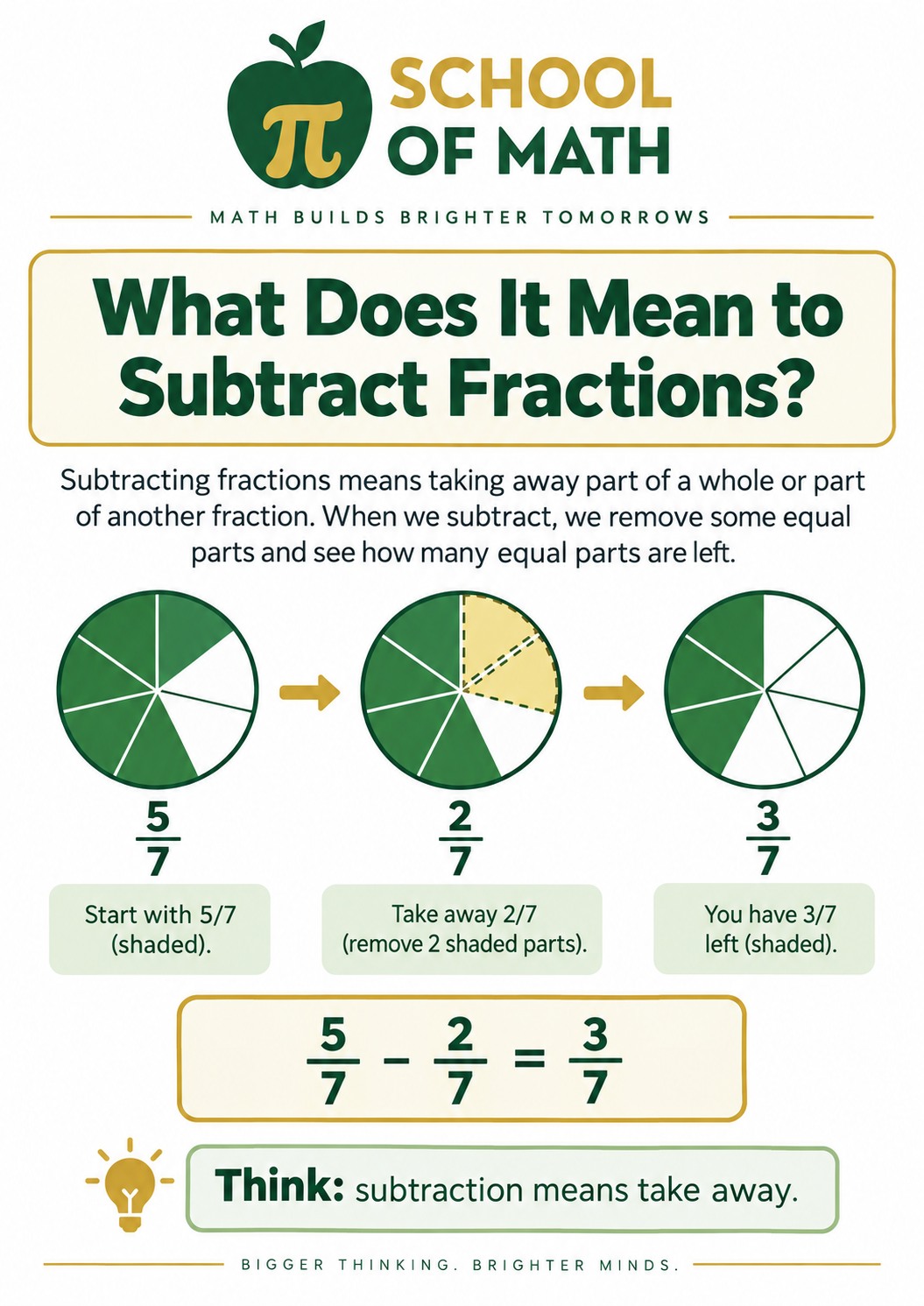
Theory and worked example
Subtraction can mean taking away an amount or finding the difference between two amounts. The numerator counts the equal parts you have; the denominator names how many equal parts make one whole.
Start with five sevenths, remove two sevenths, and three sevenths remain: 5/7 − 2/7 = 3/7. Say it in words before writing the equation: “Five seventh-sized pieces minus two seventh-sized pieces leaves three seventh-sized pieces.”
All fractions in one story must refer to the same-sized whole. Circle drawings are schematic: when you draw your own, make the pieces equal. A seven-part bar is often easier to partition accurately than a circle.
Five practice questions
Q1. You have 4 of the 5 equal pieces of a paper strip. Remove 1 piece. What fraction of the original strip remains?
Answer
Q2. Subtract and simplify: 7/9 − 2/9.
Answer
Q3. Subtract and simplify: 3/4 − 1/4.
Answer
Q4. Which story matches 6/8 − 2/8? A. Start with six eighths and add two eighths. B. Start with six eighths and remove two eighths. C. Start with two eighths and remove six eighths.
Answer
Q5. Can you subtract 1/6 of a small paper sheet from 4/6 of a large paper sheet just by counting pieces? Explain.
Answer
Same denominator, same-sized parts
Poster 2 of 11 · Kid Einsteins Class 12
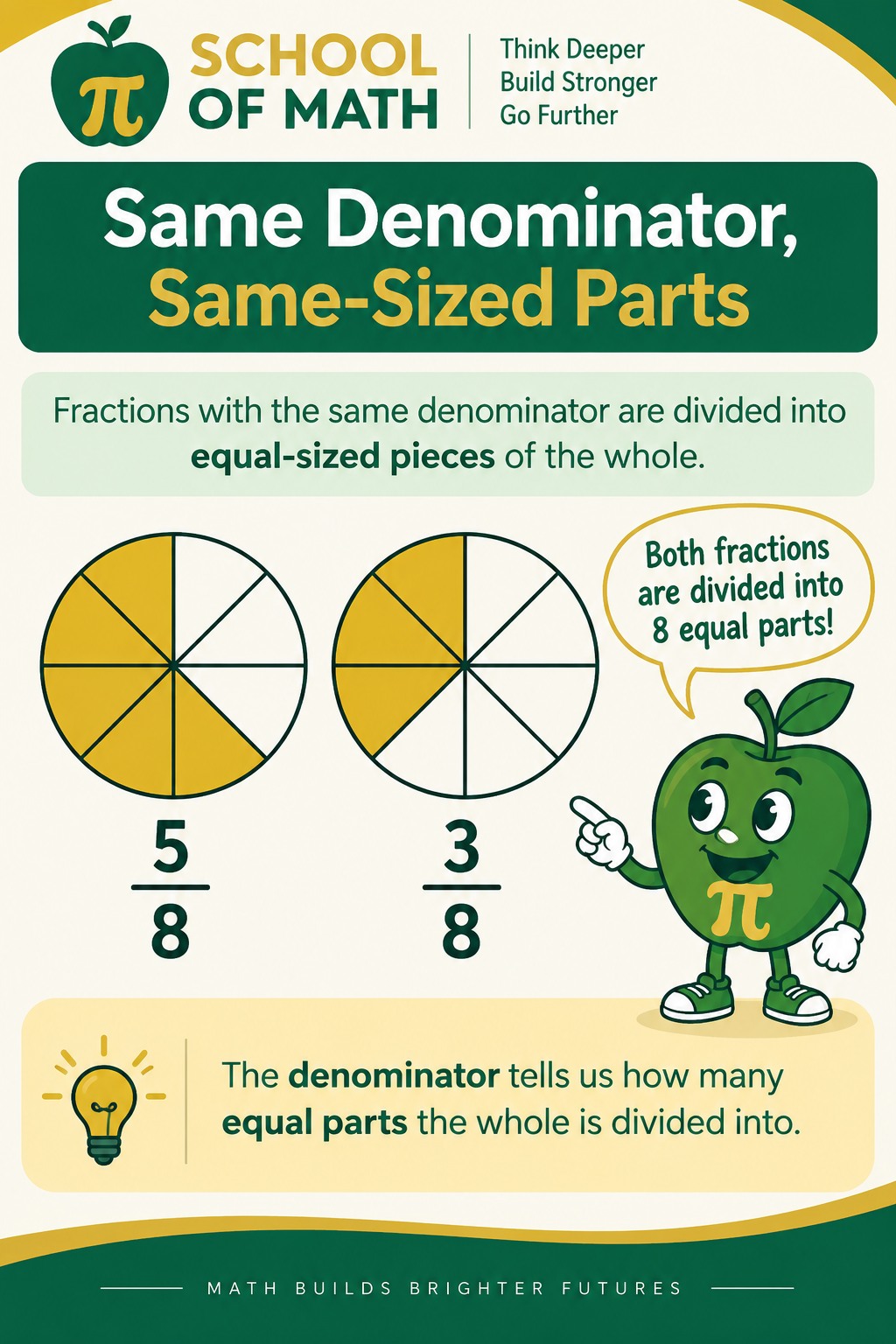
Theory and worked example
Like denominators are equal denominators. In 5/8 and 3/8, both fractions count eighths of the same whole. Think of the denominator as the name of the unit: apples with apples, centimeters with centimeters, eighths with eighths.
The poster's equal-sized circles each have eight equal parts. Five shaded eighths and three shaded eighths differ by two eighths: 5/8 − 3/8 = 2/8 = 1/4.
If the denominators differ, stop. The pieces need to be renamed with a common denominator before subtracting their counts. That is a later lesson; today we focus on like denominators.
Five practice questions
Q6. Which pair has like denominators? A. 3/5 and 2/5. B. 3/5 and 3/7. C. 1/4 and 1/8.
Answer
Q7. In 7/10 − 4/10, what size is each piece?
Answer
Q8. Subtract and simplify: 9/11 − 2/11.
Answer
Q9. Two equal-sized bars are divided into 6 equal parts each. One has 5 parts shaded and the other has 2. Write their difference.
Answer
Q10. A rectangle has four unequal pieces. May you label each piece 1/4 just because there are four?
Answer
Subtract the numerators
Poster 3 of 11 · Kid Einsteins Class 12
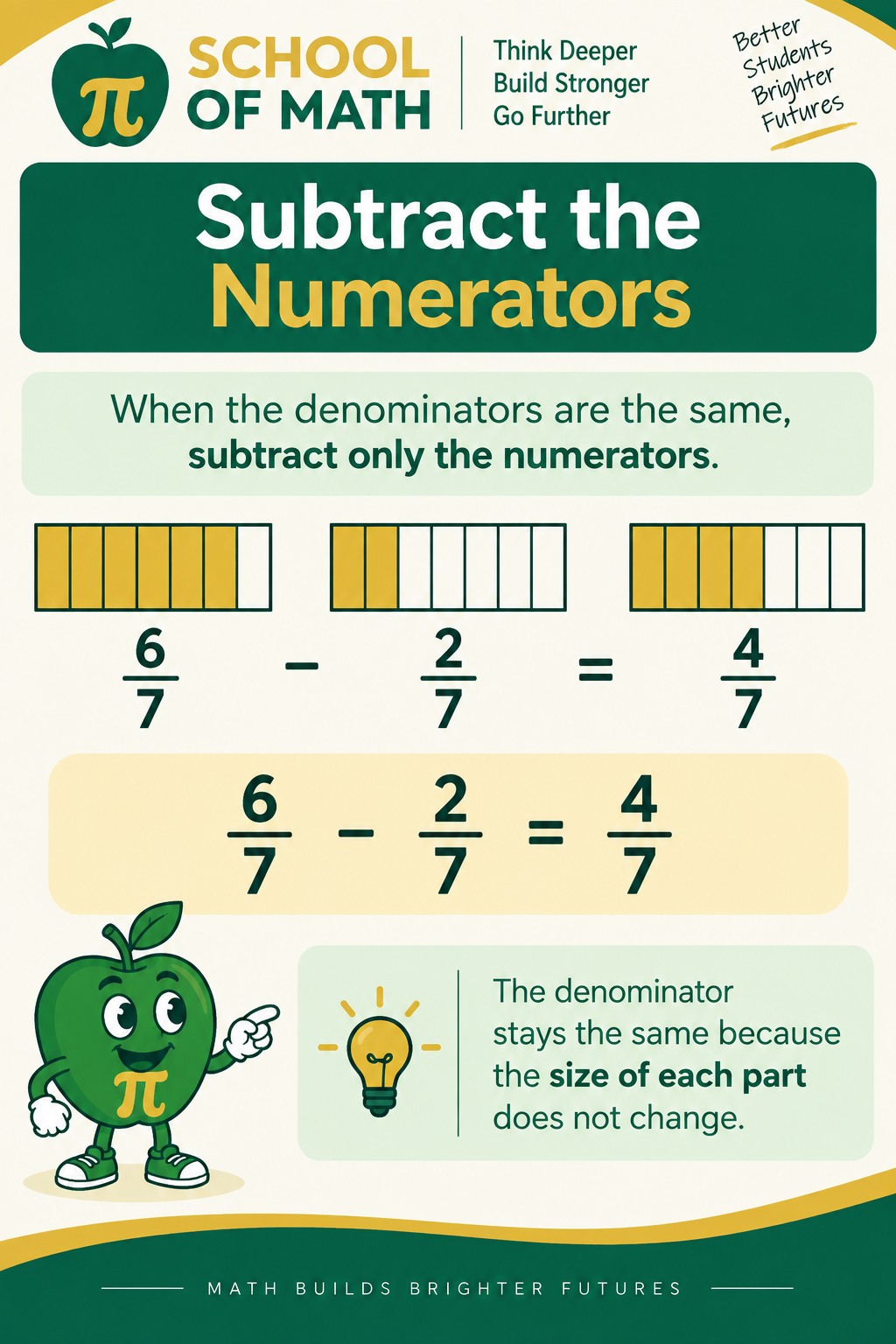
Theory and worked example
Once the denominators match, subtract the top numbers. For 6/7 − 2/7, work out 6 − 2 = 4, then write 4/7. You removed two of the six seventh-sized pieces.
The general rule is a/d − b/d = (a − b)/d, where d is positive. In this class we use starting amounts at least as large as the amounts removed, so the differences are not negative.
Subtract in the order written. Do not reverse the numbers merely to get an answer you like. Check the result with addition: 4/7 + 2/7 = 6/7.
Five practice questions
Q11. Subtract and simplify: 10/11 − 3/11.
Answer
Q12. Subtract and simplify: 8/9 − 3/9.
Answer
Q13. Subtract and simplify: 11/12 − 4/12.
Answer
Q14. Subtract and simplify: 9/10 − 7/10.
Answer
Q15. Fill the blank: 8/11 − □/11 = 3/11.
Answer
Keep the denominator the same
Poster 4 of 11 · Kid Einsteins Class 12
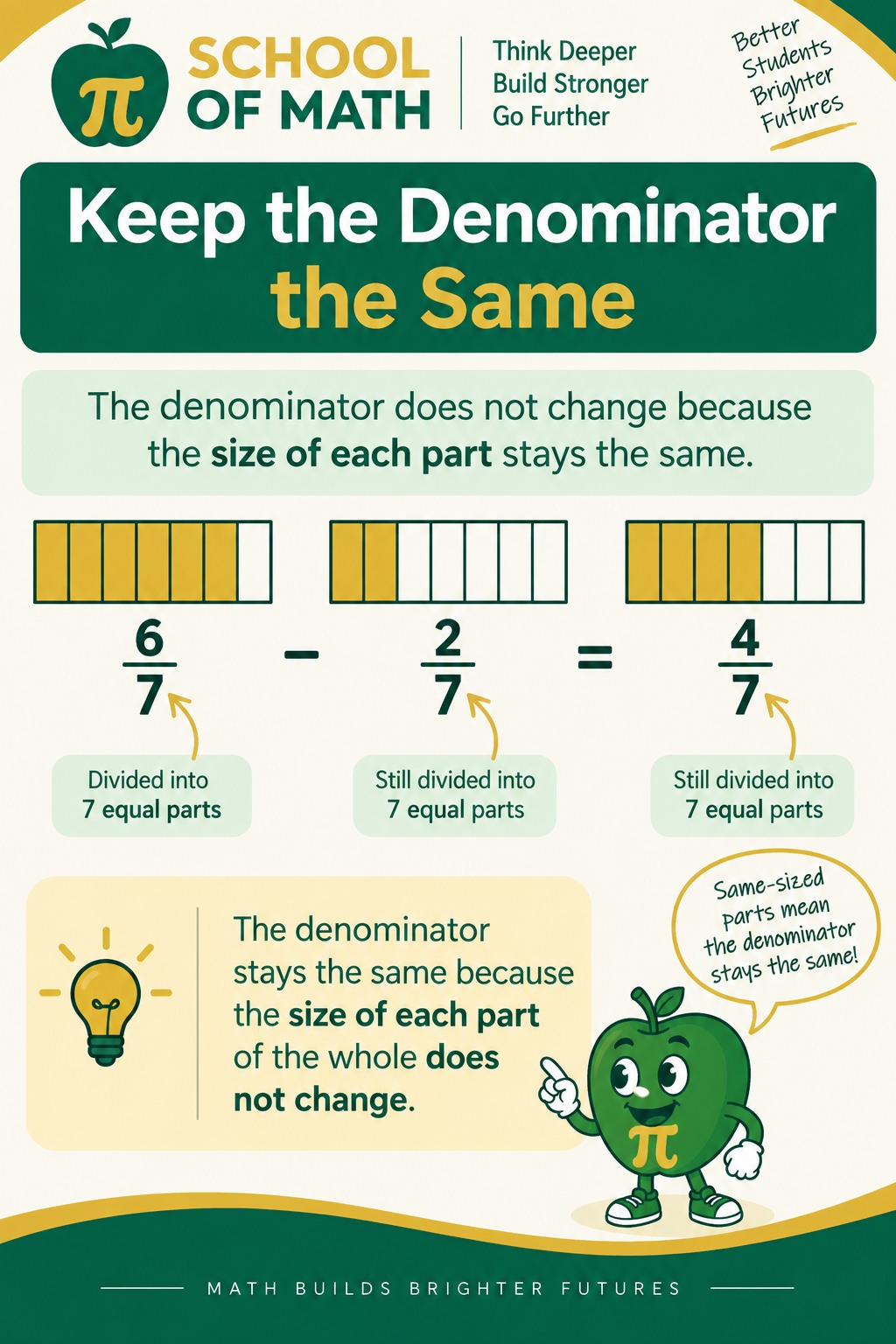
Theory and worked example
Taking away pieces changes how many pieces remain, not the original size of each piece. After 6/7 − 2/7, the remaining pieces are still sevenths. The answer before simplifying is 4/7, not 4/0 and not 4/14.
Never subtract the denominators. A denominator of zero does not describe a valid fraction. You also do not add the denominators when subtracting.
“Keep the denominator” describes the subtraction step. You may then simplify the result by dividing both numerator and denominator by the same nonzero common factor. For example, 6/8 − 2/8 = 4/8 = 1/2.
Five practice questions
Q16. A student writes 8/9 − 1/9 = 7/0. Correct the error.
Answer
Q17. Complete: 9/12 − 5/12 = 4/□. Then simplify.
Answer
Q18. Subtract and simplify: 7/8 − 3/8.
Answer
Q19. Why does 5/9 − 2/9 not equal 3/18?
Answer
Q20. For 8/10 − 3/10, which remains unchanged during subtraction: the count of pieces or the size of each piece?
Answer
Model subtraction with fraction bars
Poster 5 of 11 · Kid Einsteins Class 12
Theory and worked example
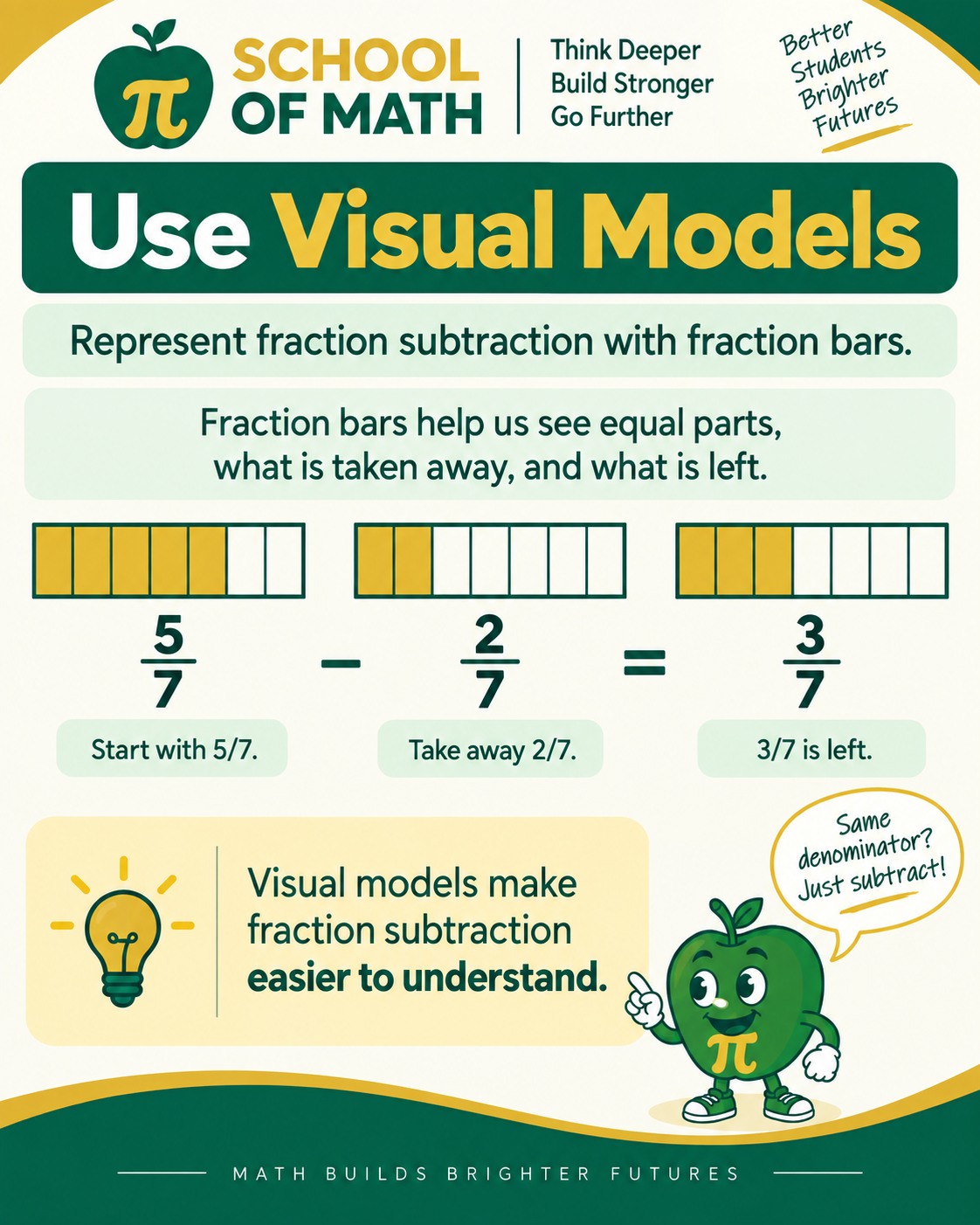
Draw one rectangle and split it into equal-width sections. Shade the starting numerator, cross out the amount removed, and count the shaded sections that remain. Keep the outline of the original whole visible.
The poster uses seven equal sections: shade five, cross out two of those five, and count three left. The equation is 5/7 − 2/7 = 3/7.
Use the same-length bar if you draw the start, removed amount, and result separately. Do not shorten the whole when shading less of it. For your written work, a single bar with crossed-out pieces makes the take-away action especially clear.
Five practice questions
Q21. Draw a bar with 8 equal sections. Shade 7 and cross out 3 of the shaded sections. Write and simplify the result.
Answer
Q22. A bar has 10 equal sections with 9 shaded. Cross out 4. How many sections and what fraction remain?
Answer
Q23. Draw a model for 4/6 − 1/6.
Answer
Q24. A bar of 12 equal sections ends with 5 shaded after 4 shaded sections were crossed out. What was the starting fraction?
Answer
Q25. A child cuts away 3 shaded sections from a bar originally divided into 10 equal sections. Four shaded sections remain. The child calls the remaining shaded amount 4/7. What fraction of the original whole is shaded?
Answer
Model subtraction with circles
Poster 6 of 11 · Kid Einsteins Class 12
Theory and worked example
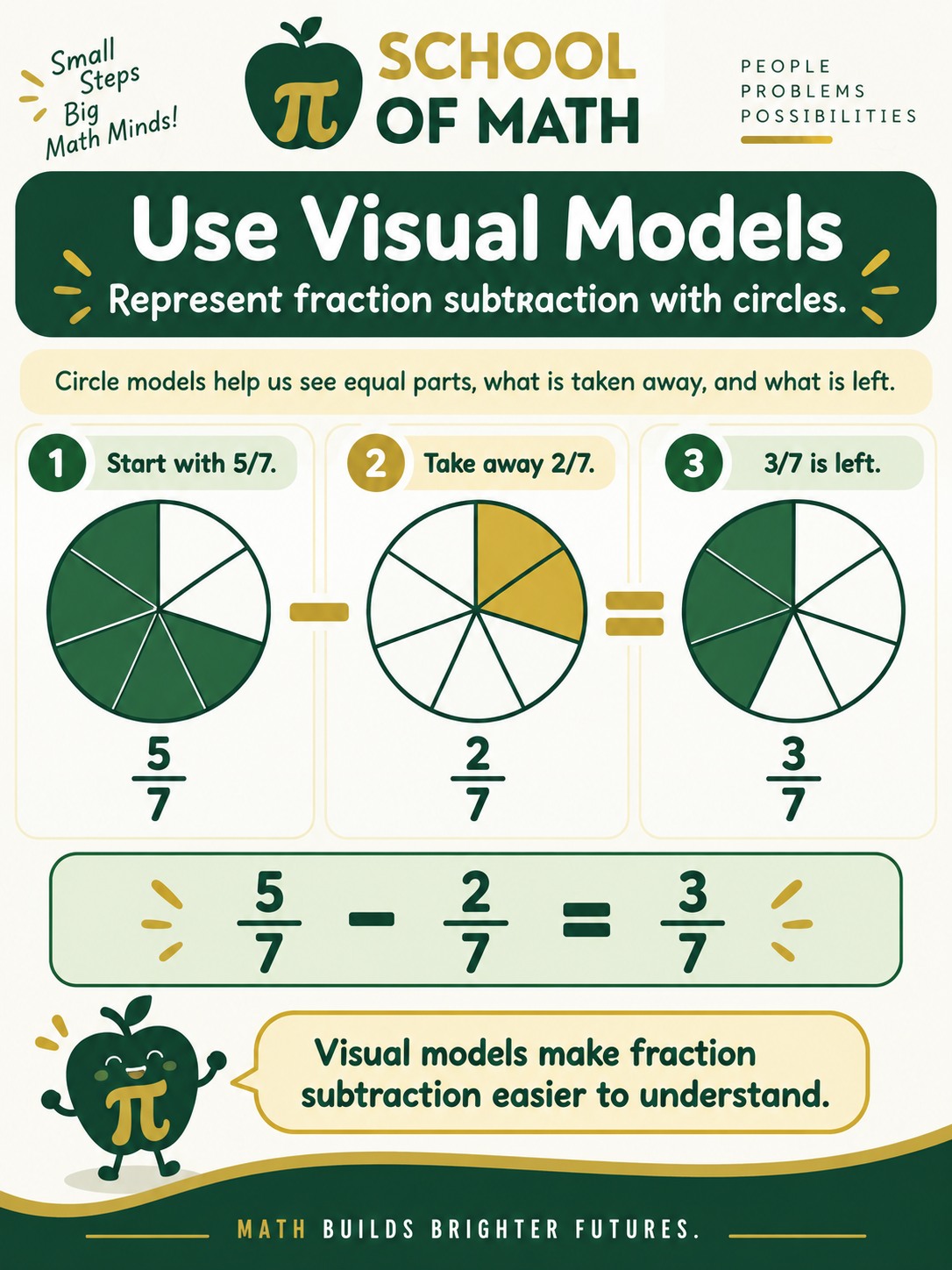
A circle can represent one whole pizza or one whole pie. Equal fractions require equal-area sectors. Use a prepared fraction circle or draw halves, fourths, or eighths carefully; treat the poster's seventh-sized sectors as a schematic picture, not a measuring template.
For the poster's equation, imagine seven equal sectors, shade five, and remove two shaded sectors. Three sevenths remain. The number of equal sectors in the original whole stays seven.
The shape may change from bar to circle, but the mathematics does not. 5/7 − 2/7 = 3/7 in either model because the same fraction units are being counted.
Five practice questions
Q26. A circle has 4 equal sectors. Shade 3, then cross out 1 shaded sector. What fraction remains?
Answer
Q27. A circle has 8 equal sectors. Shade 6 and remove 2 shaded sectors. Simplify the remainder.
Answer
Q28. Model 5/6 − 2/6 with a circle. Describe your drawing.
Answer
Q29. Two same-sized circles have 8 equal sectors each. One has 7 shaded and the other has 3. How much greater is the first shaded amount?
Answer
Q30. Show 11/12 − 4/12 with both a circle and a bar. Should the two models give different fraction answers?
Answer
Model fractions with shaded sets
Poster 7 of 11 · Kid Einsteins Class 12
Theory and worked example
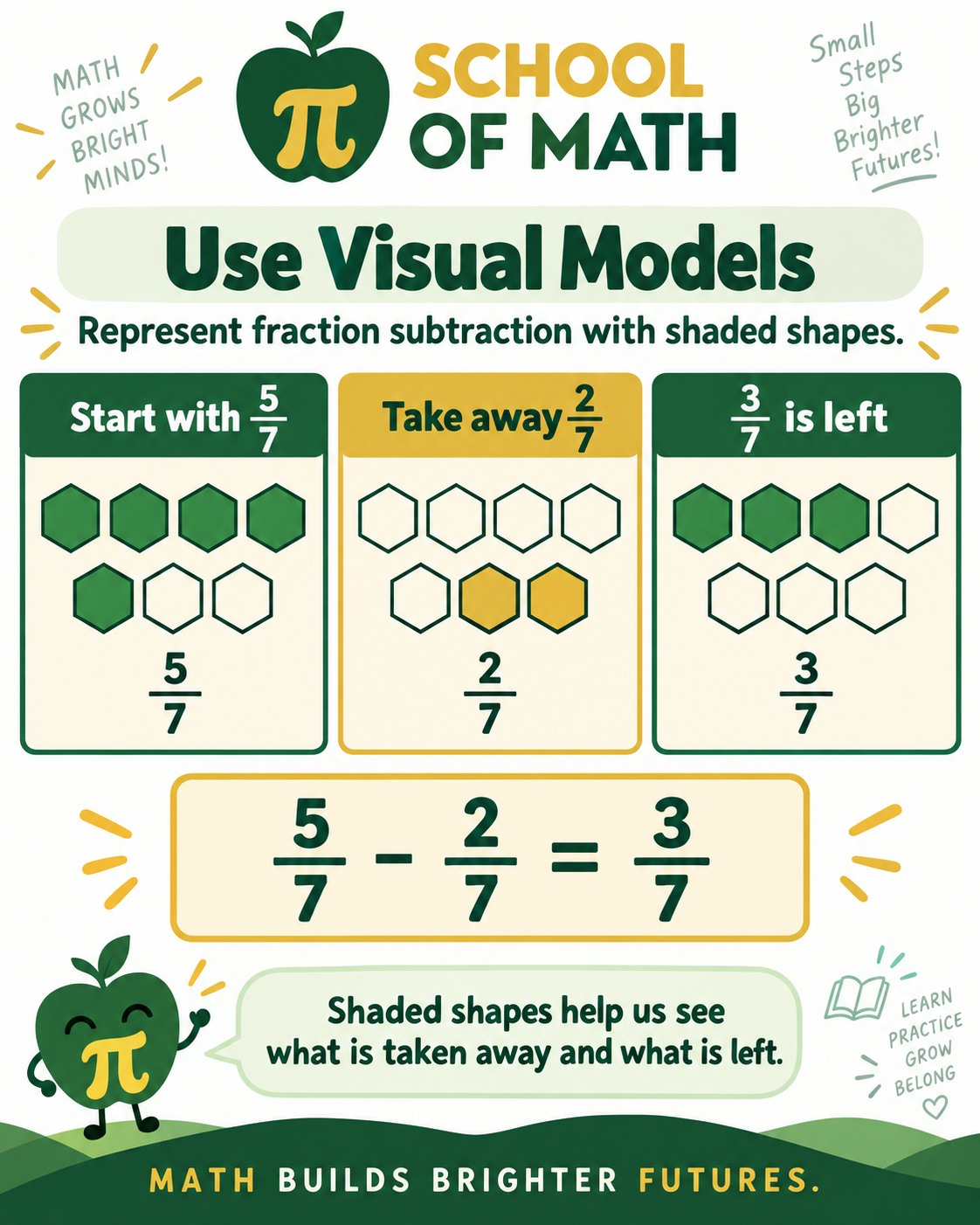
The whole does not have to be a single connected shape. In this poster, the full set of seven hexagons is one whole set. Five selected hexagons represent 5/7 of that set.
Remove two of the five selected hexagons and three selected hexagons remain: 5/7 − 2/7 = 3/7 of the original set. The denominator counts the original seven objects, not the number currently selected.
This is a counting model: each object contributes one equal counting unit. The yellow pair shows how many to remove; to show the action on a single drawing, cross out two originally green hexagons.
Five practice questions
Q31. A set has 9 identical counters. Seven are selected. Remove 2 selected counters. What fraction of the original set remains selected?
Answer
Q32. Six of 8 stars are colored. Erase the color from 2 stars. What fraction stays colored?
Answer
Q33. A set contains 12 beads. Ten are in a chosen group. Move 4 out of that group. Write and simplify the change.
Answer
Q34. After 3 of 6 selected counters are removed, 3 remain. The original set had 7 counters. Is the remaining selected fraction 3/4 or 3/7?
Answer
Q35. A set of 10 counters has 4 still selected after 3 selected counters were removed. What fraction was selected at the start?
Answer
Subtract on a number line
Poster 8 of 11 · Kid Einsteins Class 12
Theory and worked example
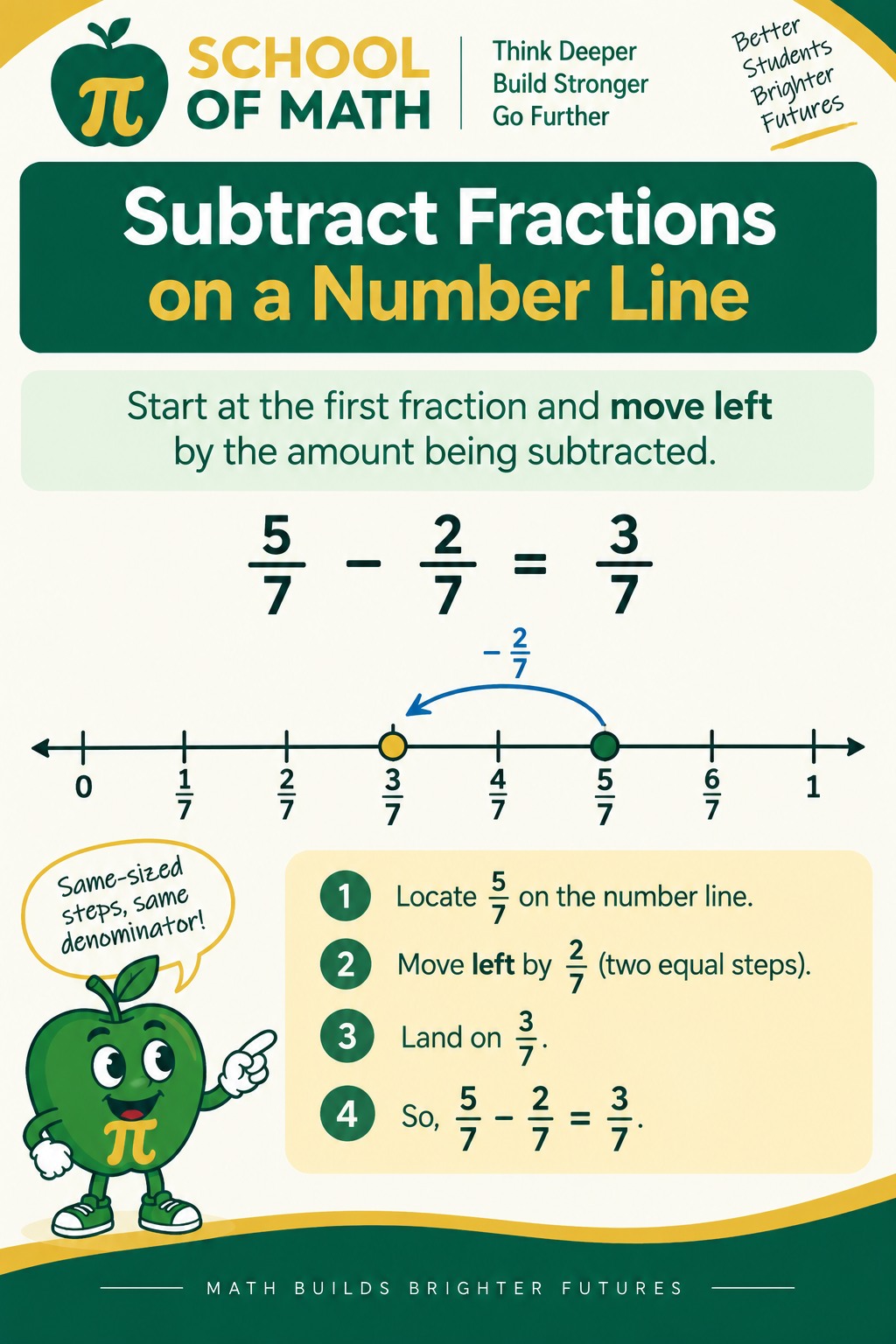
Divide the interval from 0 to 1 into equal steps. On a sevenths line, each step is 1/7. Start at the first fraction and move left by the amount you subtract.
To model 5/7 − 2/7, start at 5/7 and move two steps left: first to 4/7, then to 3/7. The landing point is the difference. Count the spaces between tick marks, not the number of marks you touch.
The whole interval from 0 to 1 has seven steps but eight tick marks, including both endpoints. Subtracting zero means no movement; subtracting the full starting amount lands at zero.
Five practice questions
Q36. On a line marked in eighths, start at 7/8 and move left 3 steps. Where do you land?
Answer
Q37. On a line marked in tenths, start at 9/10 and subtract 4/10. Give the direction, number of steps, and landing point.
Answer
Q38. You move from 6/7 to 2/7. What fraction did you subtract?
Answer
Q39. How many equally spaced tick marks, including 0 and 1, are needed to mark a whole in fifths?
Answer
Q40. Start at 5/6 and move left 5 sixth-sized steps. Where do you land?
Answer
Simplify the difference
Poster 9 of 11 · Kid Einsteins Class 12
Theory and worked example
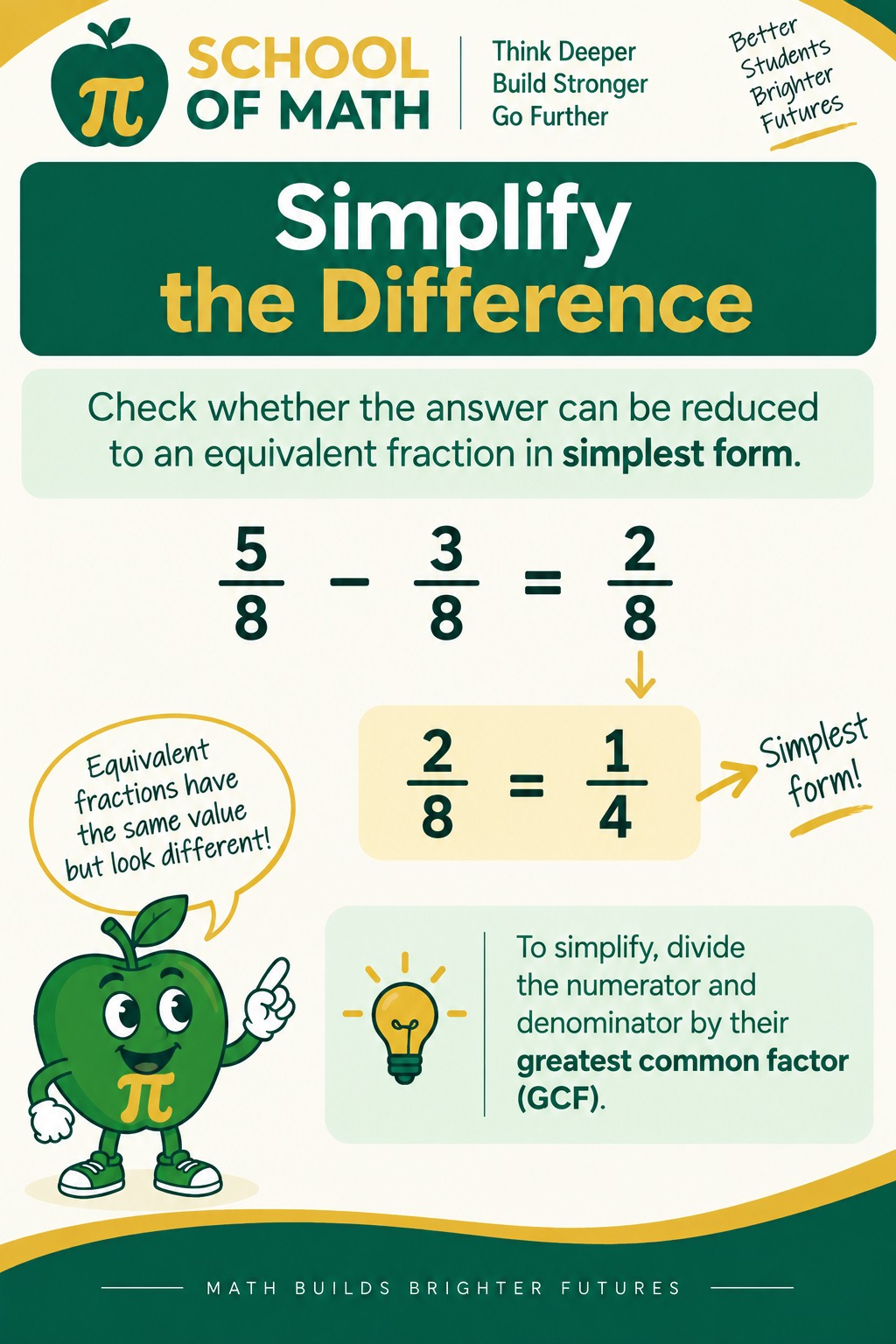
First subtract using the common denominator. Then look for a number greater than 1 that divides both the numerator and denominator. Dividing both by their greatest common factor (GCF) writes the answer in simplest form.
For 5/8 − 3/8, subtraction gives 2/8. Divide 2 and 8 by 2 to get 1/4. The amount did not shrink; two small eighths have simply been renamed as one fourth.
Both 2/8 and 1/4 are correct values, but “simplify” asks for 1/4. If the numerator is zero, write 0. If the numerator equals the positive denominator, write 1. Check by adding back the removed amount, using the original denominator if that is easier.
Five practice questions
Q41. Subtract and simplify: 13/16 − 3/16.
Answer
Q42. Subtract and simplify: 9/12 − 3/12.
Answer
Q43. Subtract and simplify: 11/15 − 5/15.
Answer
Q44. Subtract and simplify: 14/20 − 6/20.
Answer
Q45. A student simplifies 6/9 to 2/9 by dividing only the numerator by 3. Explain and correct.
Answer
Word problems about food
Poster 10 of 11 · Kid Einsteins Class 12
Theory and worked example
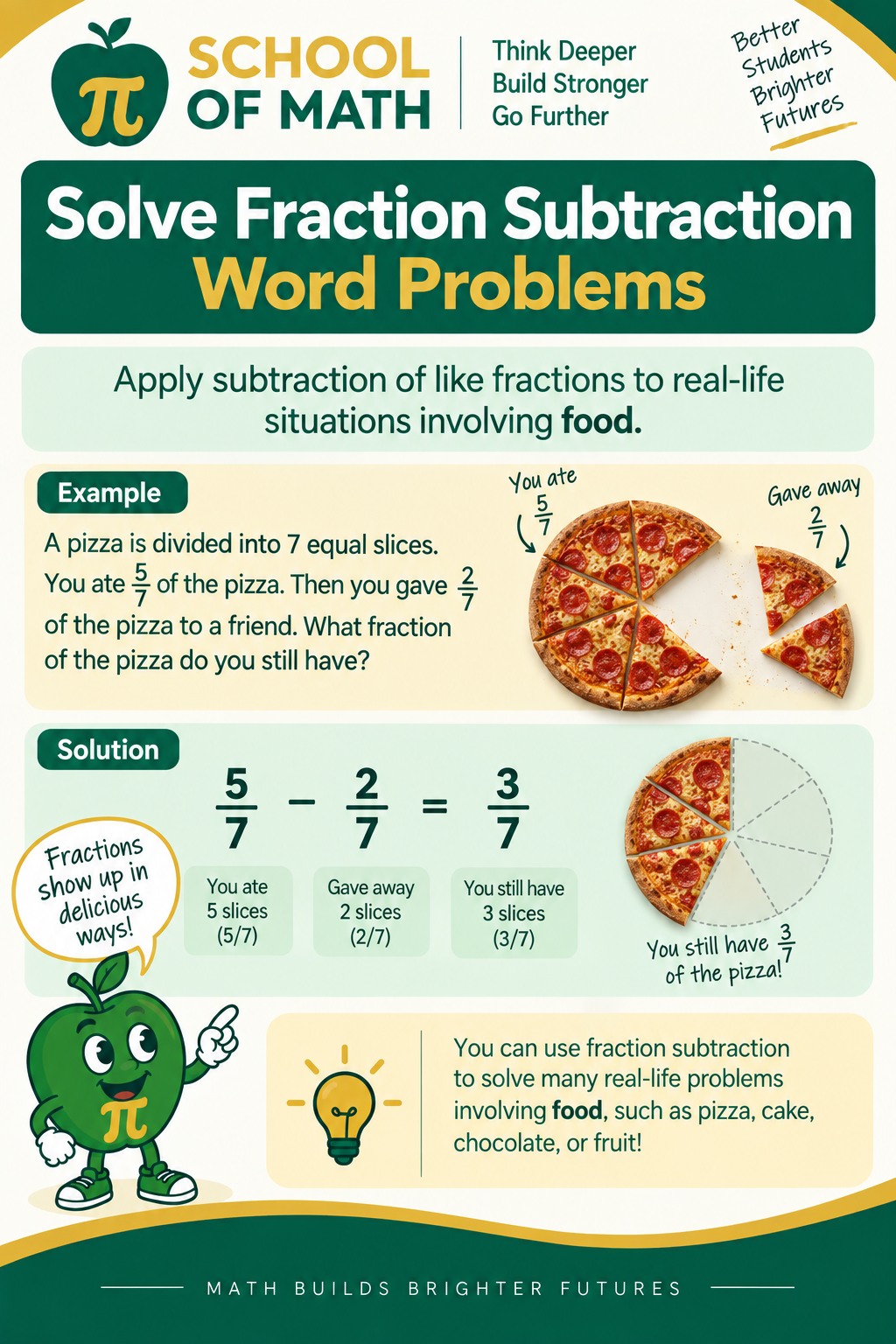
Corrected example: You had 5/7 of a pizza and gave a friend 2/7 of that same whole pizza. What remains? Subtract the amount given away from the amount you had: 5/7 − 2/7 = 3/7 of the pizza.
Track what each action means. Eating and giving away both remove food. If you began with a whole pizza, ate 5/7, and then gave away 2/7, you would have 7/7 − 5/7 − 2/7 = 0 left, not 3/7.
Before calculating, name the starting amount, the amount removed, and the unit. Finish with a sentence such as “There is one fourth of the original cake left,” not just a bare number.
Five practice questions
Q46. You have 7/8 of a pizza and serve 3/8 of the whole pizza. What fraction remains?
Answer
Q47. There is 5/6 of a cake. Friends eat 2/6 of the whole cake. How much is left?
Answer
Q48. A chocolate bar has 10 equal pieces. You have 8 pieces and give away 3. What fraction of the original bar do you keep?
Answer
Q49. A tray starts with 12 equal-sized muffins. Breakfast uses 5 muffins and a snack uses 4. What fraction of the original tray remains?
Answer
Q50. A container holds 11/12 liter of soup. Lunch uses 4/12 liter and dinner uses 3/12 liter. How much remains?
Answer
Word problems about distance
Poster 11 of 11 · Kid Einsteins Class 12
Theory and worked example
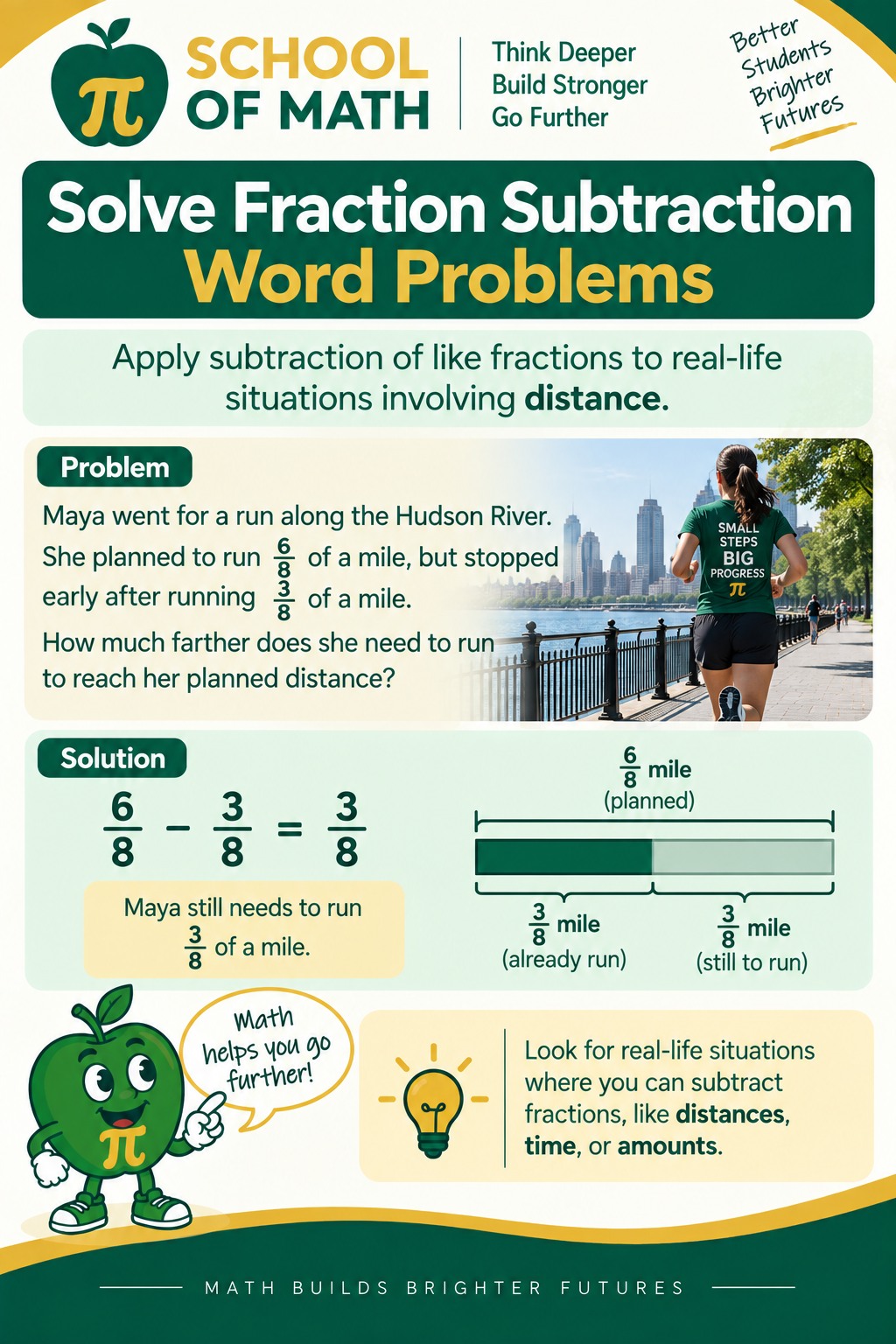
“How much farther?” asks for the difference between a target distance and the distance already covered. In the poster, Maya plans 6/8 mile and runs 3/8 mile. She still needs 6/8 − 3/8 = 3/8 mile.
The reference unit is one mile. The diagram shows a 6/8-mile segment split into two 3/8-mile lengths; the entire drawn segment is not one mile. Always read the labels before interpreting the picture.
Use the same rule for lengths of ribbon, amounts of liquid, or time measured in hours. Keep the unit in your final answer, and make sure both measurements use that same unit before subtracting.
Five practice questions
Q51. Owen plans to cycle 11/16 mile and has cycled 5/16 mile. How much farther must he cycle?
Answer
Q52. A Riverside Park walk is 9/10 mile. You have walked 4/10 mile. How much remains?
Answer
Q53. A ribbon is 11/12 meter long. You cut off 5/12 meter. How much is left?
Answer
Q54. Lena walks 7/8 mile. Noah walks 5/8 mile. How much farther does Lena walk?
Answer
Q55. Your goal is 11/12 mile. You walk 3/12 mile before a break and 4/12 mile afterward. How much farther is needed?
Answer
10 bonus word problems
Easy → medium → hard → challenge
Write an equation, solve, simplify, and label the unit. For multi-step problems, name the amount left after each action before continuing.
W1 (Easy). At an Upper West Side pizza shop, Ava has 5/8 of a pizza. She shares 1/8 of the whole pizza with her brother. What fraction does she keep?
Answer
W2 (Easy). A craft ribbon at SOMATH measures 7/10 meter. You use 2/10 meter for a bookmark. How much ribbon remains?
Answer
W3 (Easy). A toy train track is 13/14 meter long. A train has traveled 5/14 meter from the start. How much farther is the end of the track?
Answer
W4 (Medium). A garden watering can holds 11/12 liter. You pour 3/12 liter on flowers and 2/12 liter on herbs. How much remains?
Answer
W5 (Medium). Milo reads for 7/8 hour on Saturday and 3/8 hour on Sunday. How much longer does he read on Saturday? Give the answer in hours.
Answer
W6 (Medium). A juice pitcher has some juice. After you pour out 3/10 liter, 4/10 liter remains. How much juice was there at the start?
Answer
W7 (Hard). A Central Park route is 15/16 mile. You walk 5/16 mile before a stop and 4/16 mile afterward. How much of the route is left, in miles?
Answer
W8 (Hard). A baker has 13/15 kilogram of dough. She uses 4/15 kilogram for rolls. She needs 6/15 kilogram for a loaf. After making both, how much dough will remain?
Answer
W9 (Challenge). Two same-sized fruit trays each begin with 9/10 of a full tray. From tray A, children eat 2/10 of a full tray. From tray B, they eat 5/10. How much more fruit remains in A than in B?
Answer
W10 (Challenge). A class has 17/20 liter of paint. The first mural uses 5/20 liter. After a second mural, 4/20 liter remains. How much paint did the second mural use? Was it more or less than the first, and by how much?
Answer
Frequently asked questions
How do you subtract fractions with like denominators?
Why does the denominator stay the same?
Can the denominator change when I simplify?
How do I subtract fractions on a number line?
What happens when I subtract a fraction from itself?
Do the wholes have to be the same size?
What if the denominators are different?
What is included in Kid Einsteins Class 12?
Ready to move on?
You are ready when you can identify the whole, subtract without changing the denominator, draw a model, simplify, and check by addition. If a step is difficult, return to that poster and explain one example in words before trying another question.
Find the right next class at SOMATH
Explore the Kid Einsteins syllabus, check the schedule, or book a free evaluation at 226 W 79th St, Upper West Side. Questions? Call (646) 668-6151.