Kid Einsteins · Class 15 · Grades 3–4
Two-Step Word Problems with the Four Operations
To solve a two-step word problem, first find the missing information you need, then use that result to answer the final question. Choose addition, subtraction, multiplication, or division from what is happening in the story. Show both steps, label the answer, and check it.
Study the six images in order and try five new questions after each image. Finish with six homework review questions and fourteen homework word problems: 20 homework questions and 50 questions altogether. Try a question before selecting its blue Answer button.
Part of Kid Einsteins at SOMATH. Book a free evaluation to discuss the right starting point, or view the class schedule. Use a drawing, equal groups, or a bar model to explain why your two operations fit.
Download the student workbook (PDF)18 pages · Supplied cover, six teaching images, and all 50 questions. Each image is followed by its five practice questions; homework follows with up to five questions per page.Numbered pages and generous blank answer space. No exercise solutions, writing lines, name fields, or date fields.
Understanding the problem
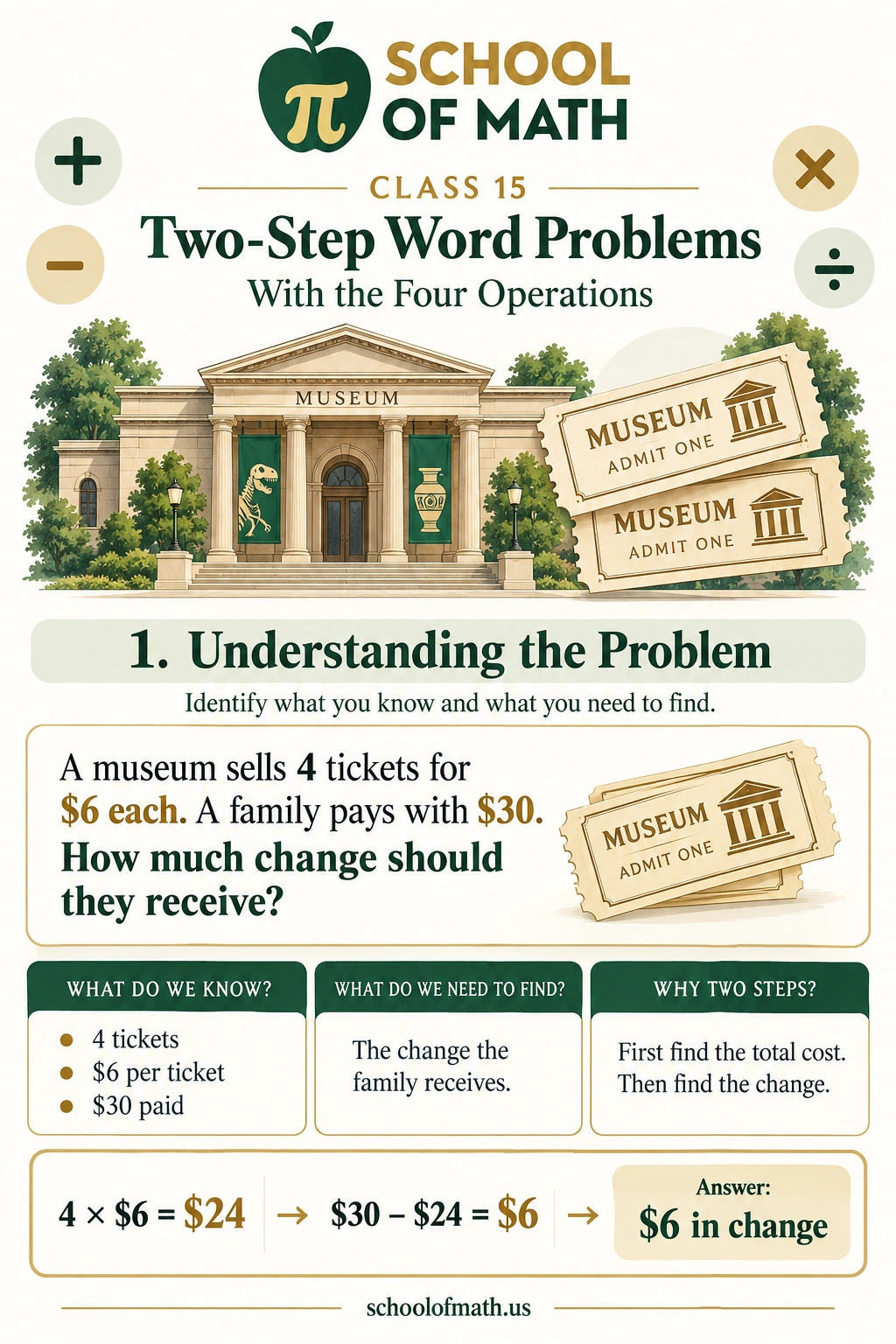
Read the final question first, then read the whole story. Identify what you know, what you need to find, and the unit your answer should use. A two-step problem needs an intermediate result: something useful you must find before you can answer the final question.
In a shopping story, “How much change?” is not the same as “How much did it cost?” First find the total cost, then subtract it from the amount paid. Label your two results so you do not accidentally stop after the first calculation. Information that does not help answer the question can be left unused.
Try it yourself: five questions
Q1 Practice 1 of 5
A family buys 3 planetarium tickets for $7 each and pays with $25. How much change should the family receive?
Answer
$4 in change.
- Find the cost of all three tickets. 3 × 7 = 21.
- Subtract the cost from the amount paid. 25 − 21 = 4.
Q2 Practice 2 of 5
A school shop has 5 packs with 4 notebooks in each pack. It sells 7 notebooks. How many notebooks remain?
Answer
13 notebooks remain.
- Find the starting number of notebooks. 5 × 4 = 20.
- Remove the notebooks sold. 20 − 7 = 13.
Q3 Practice 3 of 5
Thirty-six crayons are shared equally among 6 children. One child receives 3 extra crayons. How many crayons does that child have now?
Answer
9 crayons.
- Find one child’s equal share. 36 ÷ 6 = 6.
- Add the extras to that child’s share. 6 + 3 = 9.
Q4 Practice 4 of 5
A museum opens at 9 a.m. A class buys 5 tickets at $4 each and pays with $30. How much change does the class receive?
Answer
$10 in change.
- Find the ticket cost. The opening time is not needed. 5 × 4 = 20.
- Subtract the ticket cost from the amount paid. 30 − 20 = 10.
Q5 Practice 5 of 5
A reading corner has 32 books. A teacher adds 14 books, and children borrow 9. How many books are there now?
Answer
37 books.
- Find the total after the books are added. 32 + 14 = 46.
- Subtract the borrowed books. 46 − 9 = 37.
Planning two steps
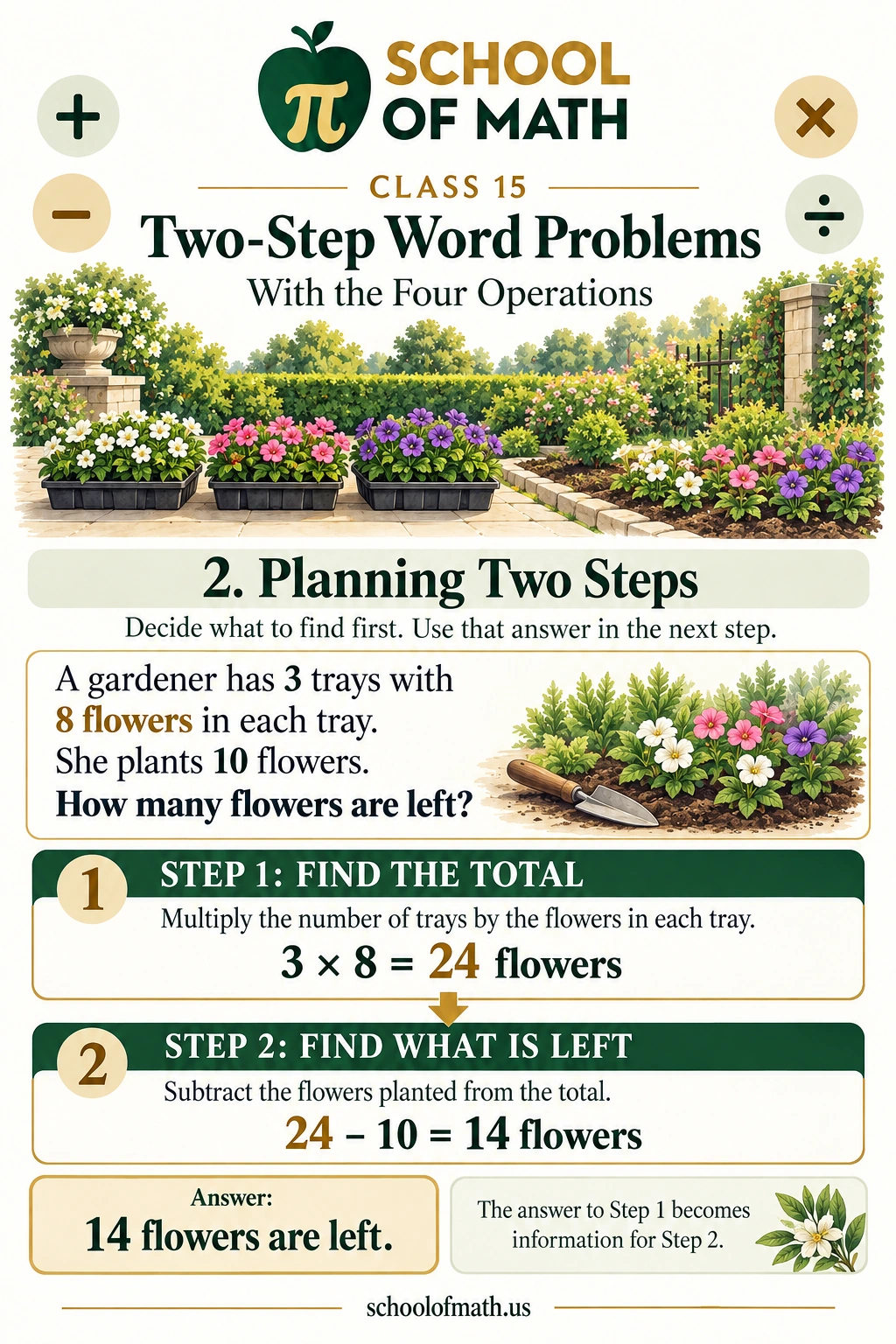
Say your plan in words before calculating: “First I will find ____. Then I will use that answer to find ____.” The second step must use the information found in the first step, not a number chosen just because it appears in the story.
A quick picture or bar model can show what is missing. Draw equal groups when every group has the same number, or draw a whole split into parts when sharing. Sometimes you must combine two amounts before dividing. Choose the order from the story, not from the order in which the numbers are written.
Try it yourself: five questions
Q6 Practice 1 of 5
A gardener has 4 trays with 7 seedlings in each tray. She plants 9 seedlings. How many seedlings are left? State what you will find first.
Answer
19 seedlings are left.
- First find the total number of seedlings. 4 × 7 = 28.
- Then subtract those planted. 28 − 9 = 19.
Q7 Practice 2 of 5
A craft club has 18 red beads and 12 blue beads. It shares all the beads equally among 5 children. How many beads does each child receive?
Answer
6 beads per child.
- First combine the two colors. 18 + 12 = 30.
- Then share the total equally among five children. 30 ÷ 5 = 6.
Q8 Practice 3 of 5
A baker makes 48 rolls and sets aside 8 for a display. The rest go equally into 5 bags. How many rolls go into each bag?
Answer
8 rolls per bag.
- First find how many rolls are available for the bags. 48 − 8 = 40.
- Then share those rolls among five bags. 40 ÷ 5 = 8.
Q9 Practice 4 of 5
Thirty-two bookmarks are shared equally among 4 tables. A teacher adds 5 more bookmarks to one table. How many bookmarks are on that table?
Answer
13 bookmarks on that table.
- First find the number on each table. 32 ÷ 4 = 8.
- Then add five to the one table named in the question. 8 + 5 = 13.
Q10 Practice 5 of 5
A school orders 6 boxes with 5 pencils in each box. It also receives 8 loose pencils. How many pencils arrive altogether?
Answer
38 pencils.
- First find the pencils in the boxes. 6 × 5 = 30.
- Then add the loose pencils. 30 + 8 = 38.
Choosing the operations
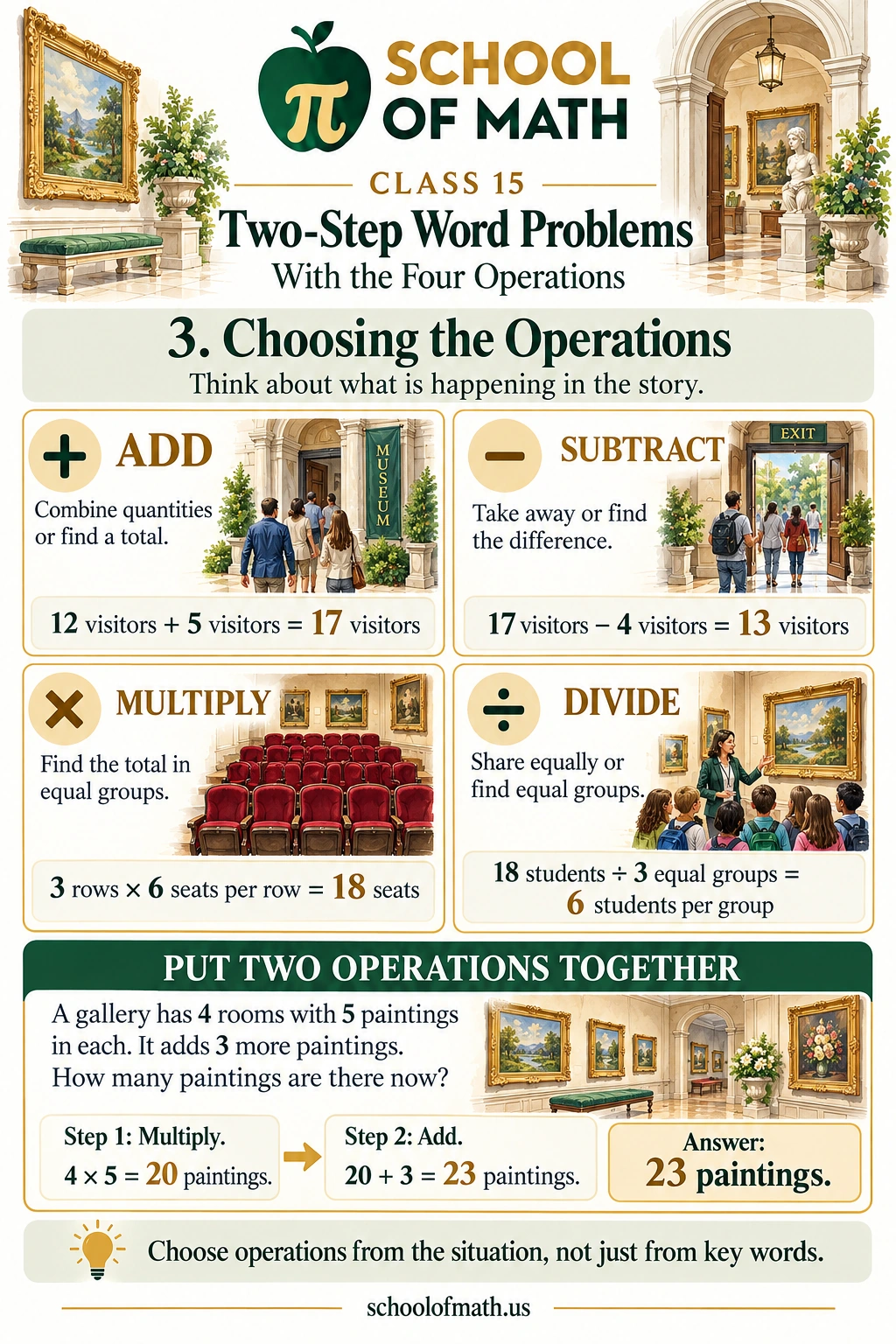
Addition combines amounts. Subtraction can take away an amount, compare two amounts, or find a missing part. Multiplication finds the total in equal groups. Division can find the size of each equal share or the number of equal groups.
Do not choose an operation from one keyword alone. “More” might describe a comparison whose missing amount requires subtraction. Ask what each quantity represents, then explain why the operation fits. Use two separate number sentences while you are learning to plan.
| Operation | What it can help you find |
|---|---|
| Add | A combined amount or an amount after more arrives |
| Subtract | What remains, a difference, or a missing part |
| Multiply | The total in equal groups |
| Divide | One equal share or the number of equal groups |
Try it yourself: five questions
Q11 Practice 1 of 5
A club has 16 members. Seven new members join and 5 members leave. How many members are there now? Name both operations.
Answer
18 members.
- Add because members join. 16 + 7 = 23.
- Subtract because members leave. 23 − 5 = 18.
Q12 Practice 2 of 5
Five tables each need 6 chairs. A teacher brings 4 extra chairs for guests. How many chairs are needed in all? Name both operations.
Answer
34 chairs.
- Multiply to find the chairs for equal-sized table groups. 5 × 6 = 30.
- Add the extra chairs. 30 + 4 = 34.
Q13 Practice 3 of 5
Forty-two cards are shared equally among 7 students. One student gives away 2 of her cards. How many cards does she keep? Name both operations.
Answer
4 cards.
- Divide to find one student’s share. 42 ÷ 7 = 6.
- Subtract the cards that student gives away. 6 − 2 = 4.
Q14 Practice 4 of 5
A shop has 27 orange balloons and 18 green balloons. It puts all the balloons into bunches of 5. How many bunches can it make? Name both operations.
Answer
9 bunches.
- Add the balloons of both colors. 27 + 18 = 45.
- Divide to find how many groups of five fit in the total. 45 ÷ 5 = 9.
Q15 Practice 5 of 5
Liam has 4 bags with 6 marbles in each bag. Ava has 31 marbles. How many more marbles does Ava have than Liam?
Answer
7 more marbles.
- Multiply to find Liam’s total. 4 × 6 = 24.
- Compare Ava’s total with Liam’s total by subtracting. 31 − 24 = 7.
Addition and subtraction
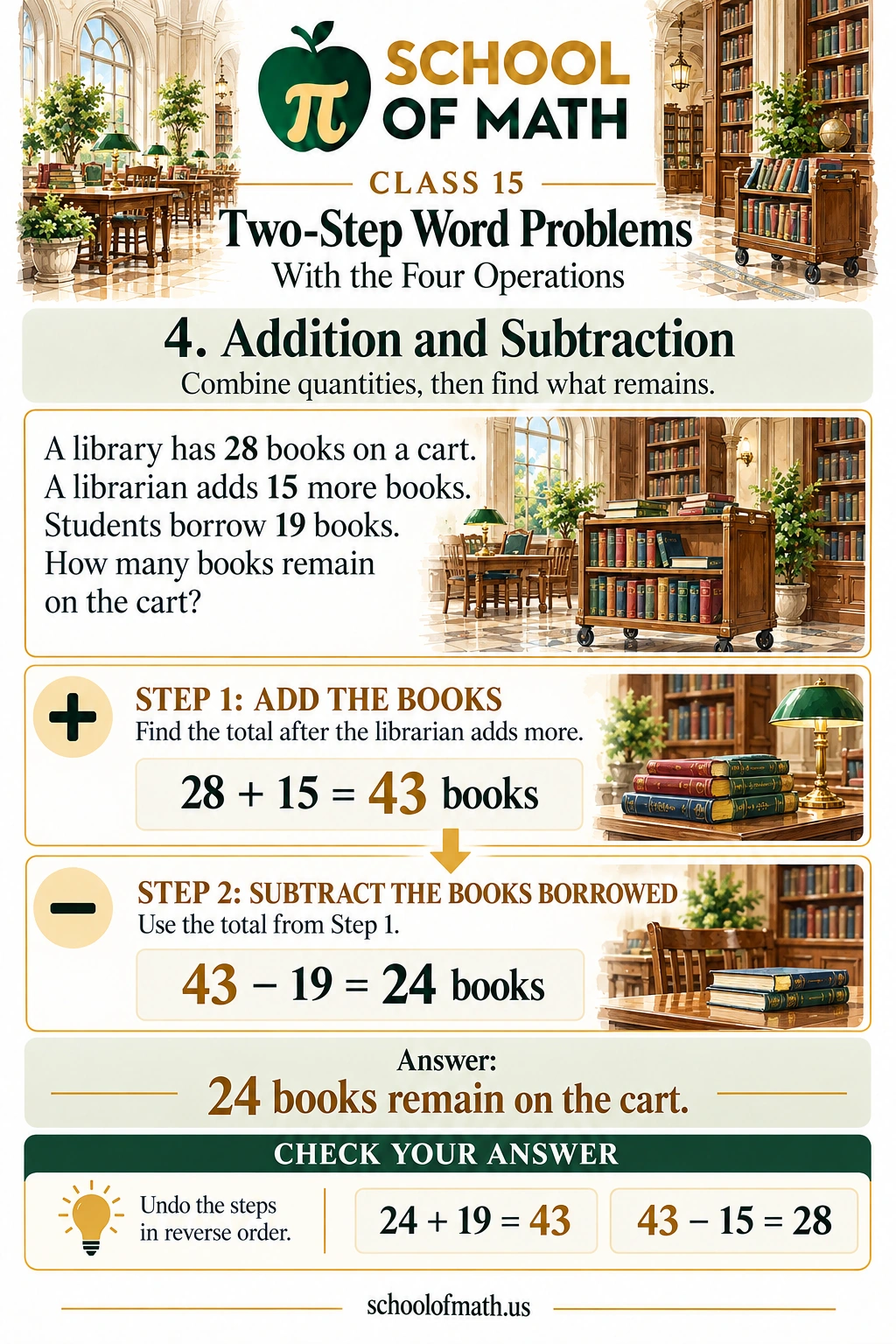
When a story adds items and then removes some, first find the new total and then subtract what leaves. If items leave first and more arrive later, follow that sequence. The result of the first calculation becomes the starting amount for the second.
Keep track of the same kind of object through both steps. Check your result by reversing the changes: undo a subtraction with addition and undo an addition with subtraction. You should arrive back at the original amount.
Try it yourself: five questions
Q16 Practice 1 of 5
A library cart has 37 books. A librarian adds 26 books, and students borrow 18. How many books remain on the cart?
Answer
45 books remain.
- Find the total after the addition. 37 + 26 = 63.
- Remove the borrowed books. 63 − 18 = 45.
- Check by undoing the steps in reverse order: 45 + 18 = 63; then 63 − 26 = 37. Both original quantities are recovered.
Q17 Practice 2 of 5
A school bus has 45 passengers. Seventeen get off, then 9 get on. How many passengers are now on the bus?
Answer
37 passengers.
- Find the passengers who stay on the bus. 45 − 17 = 28.
- Add those who get on. 28 + 9 = 37.
- Check by undoing the steps in reverse order: 37 − 9 = 28; then 28 + 17 = 45. Both original quantities are recovered.
Q18 Practice 3 of 5
A shop has 68 postcards, sells 24, and receives 15 more. How many postcards does it have now?
Answer
59 postcards.
- Find what remains after the sales. 68 − 24 = 44.
- Add the new postcards. 44 + 15 = 59.
Q19 Practice 4 of 5
A reading challenge begins with 86 points. A team earns 27 points and then spends 35 points on a reward. How many points does the team have left?
Answer
78 points.
- Find the score after earning points. 86 + 27 = 113.
- Subtract the points spent. 113 − 35 = 78.
Q20 Practice 5 of 5
A class collects 125 cans on Monday and 48 on Tuesday. It sends 67 cans for recycling. How many cans are waiting to be sent?
Answer
106 cans.
- Combine the cans from both days. 125 + 48 = 173.
- Subtract the cans already sent. 173 − 67 = 106.
- Check by undoing the steps in reverse order: 106 + 67 = 173; then 173 − 48 = 125. Both original quantities are recovered.
Multiply, then add or subtract
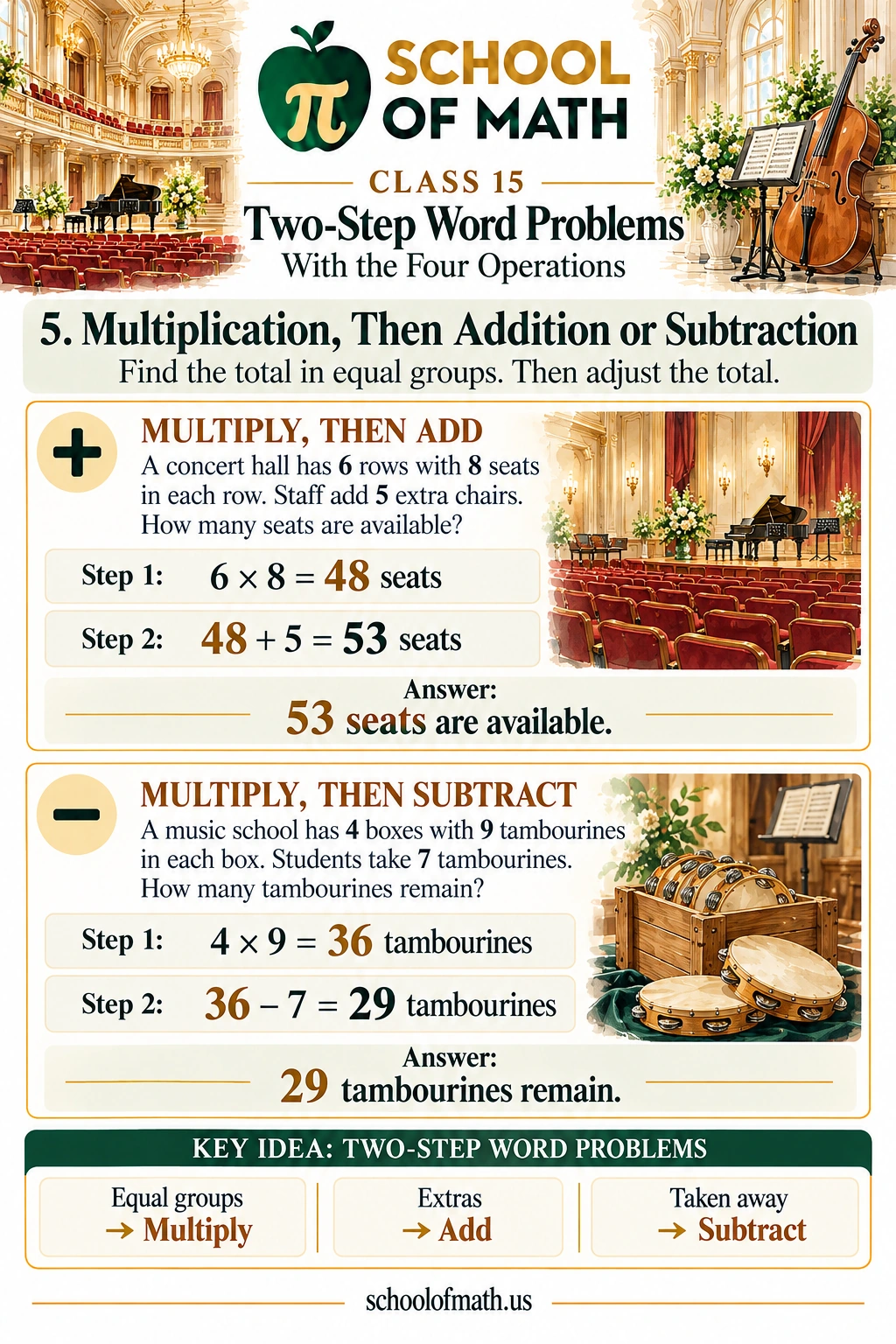
When there are equal groups, multiply the number of groups by the number in each group to find the total. Then add extra items or subtract items that are taken away. Check that the groups really are equal before multiplying.
Be precise about what changes. “Add three chairs altogether” is different from “add three chairs to every row.” In these practice problems, the extra or removed amount changes the whole total once. If you pay for several identical items, find their total cost before calculating change.
Try it yourself: five questions
Q21 Practice 1 of 5
A music room has 7 rows with 6 chairs in each row. Staff add 9 extra chairs altogether. How many chairs are there now?
Answer
51 chairs.
- Find the chairs in the rows. 7 × 6 = 42.
- Add the nine extra chairs once. 42 + 9 = 51.
Q22 Practice 2 of 5
A coach has 5 boxes with 8 tennis balls in each box. Students take 13 balls to practice. How many balls remain?
Answer
27 balls remain.
- Find the starting total. 5 × 8 = 40.
- Subtract the balls taken to practice. 40 − 13 = 27.
Q23 Practice 3 of 5
A shop receives 8 packs with 7 stickers in each pack and 6 loose stickers. How many stickers arrive?
Answer
62 stickers.
- Find the stickers in all eight packs. 8 × 7 = 56.
- Add the loose stickers. 56 + 6 = 62.
Q24 Practice 4 of 5
A family buys 4 art kits costing $9 each and pays with $50. How much change should it receive?
Answer
$14 in change.
- Find the total cost of the kits. 4 × 9 = 36.
- Subtract that cost from the amount paid. 50 − 36 = 14.
Q25 Practice 5 of 5
A garden has 9 rows with 8 plants in each row. Gardeners move 17 plants to another garden. How many plants remain?
Answer
55 plants remain.
- Find the original plant total. 9 × 8 = 72.
- Subtract the plants moved. 72 − 17 = 55.
Divide, then adjust one share
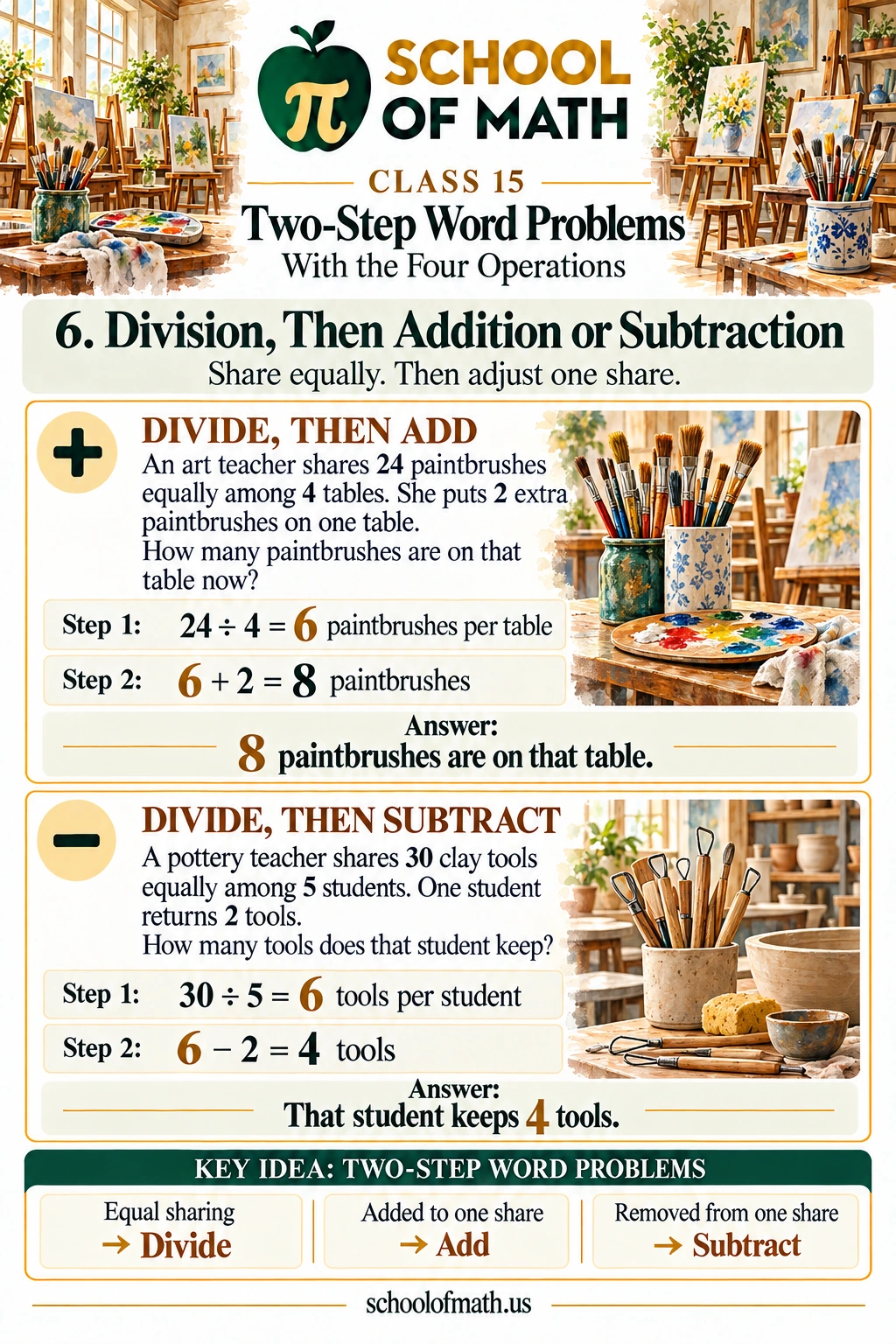
Equal sharing starts with division: total amount divided by number of recipients gives the amount for one recipient. After that, an addition or subtraction can change one share. The second calculation uses one share, not the original total.
Read the final question carefully. If one student receives extra pencils, you are finding that student’s new amount, not the number of pencils everywhere. Label the first result “per student,” “per table,” or “per bag” to keep its meaning clear.
Try it yourself: five questions
Q26 Practice 1 of 5
Forty-eight paintbrushes are shared equally among 6 tables. One table receives 3 extra brushes. How many brushes are on that table now?
Answer
11 brushes on that table.
- Find one table’s share. 48 ÷ 6 = 8.
- Add three brushes to that share. 8 + 3 = 11.
Q27 Practice 2 of 5
Forty-five clay tools are shared equally among 5 students. One student returns 4 tools. How many tools does that student keep?
Answer
5 tools.
- Find the number each student starts with. 45 ÷ 5 = 9.
- Subtract the tools returned by that student. 9 − 4 = 5.
Q28 Practice 3 of 5
Fifty-six beads are shared equally among 7 children. One child finds 6 more beads. How many beads does that child have?
Answer
14 beads.
- Find one child’s equal share. 56 ÷ 7 = 8.
- Add the beads that child finds. 8 + 6 = 14.
Q29 Practice 4 of 5
Sixty-three sheets of paper are shared equally among 9 groups. One group uses 2 sheets. How many unused sheets does that group have?
Answer
5 unused sheets.
- Find the sheets assigned to one group. 63 ÷ 9 = 7.
- Subtract the sheets that group uses. 7 − 2 = 5.
Q30 Practice 5 of 5
Eighty-one counters are shared equally among 9 students. One student receives 7 bonus counters. How many counters does that student have now?
Answer
16 counters.
- Find one student’s share. 81 ÷ 9 = 9.
- Add the bonus counters to that share. 9 + 7 = 16.
Homework review
Review understanding a story, planning two steps, choosing operations, combining and removing amounts, equal groups, and equal shares. Complete one review question for each of the six images, in the same order.
R1 Review image 1 of 6
A family buys 5 aquarium tickets at $7 each and pays with $40. What must you find before the change, and how much change should the family receive?
Answer
$5 in change.
- First find the total ticket cost. 5 × 7 = 35.
- Then subtract that cost from the amount paid. 40 − 35 = 5.
R2 Review image 2 of 6
A gardener has 6 trays with 4 seedlings in each tray and plants 11 seedlings. State a two-step plan and find how many are left.
Answer
13 seedlings are left.
- First find the total number of seedlings. 6 × 4 = 24.
- Then subtract those planted. 24 − 11 = 13.
R3 Review image 3 of 6
A club collects 21 red counters and 15 yellow counters. It shares them equally among 6 children. Name the operations and find each child’s share.
Answer
6 counters per child.
- Add to combine the two colors. 21 + 15 = 36.
- Divide to share the total equally. 36 ÷ 6 = 6.
R4 Review image 4 of 6
A librarian starts with 54 books, adds 17 books, and lends out 26. How many books remain?
Answer
45 books remain.
- Find the new total. 54 + 17 = 71.
- Subtract the books lent out. 71 − 26 = 45.
R5 Review image 5 of 6
A music room has 8 rows with 5 chairs in each row. Staff bring in 7 extra chairs altogether. How many chairs are available?
Answer
47 chairs.
- Find the chairs in the rows. 8 × 5 = 40.
- Add the extra chairs once. 40 + 7 = 47.
R6 Review image 6 of 6
Forty-nine pencils are shared equally among 7 students. One student receives 5 extra pencils. How many pencils does that student have?
Answer
12 pencils.
- Find one student’s share. 49 ÷ 7 = 7.
- Add the extras to that share. 7 + 5 = 12.
Homework word problems
These fourteen stories build from straightforward changes and equal groups to sharing a combined amount, comparing totals, and finding an original amount. Each problem needs two calculation steps. Show what the first result means and include units in the final answer.
W1 Homework word problem 1 of 14
A class has 23 markers. A teacher brings 12 more, and 8 markers run out of ink. How many markers still work?
Answer
27 working markers.
- Combine the working markers before any run out. 23 + 12 = 35.
- Remove the markers that no longer work. 35 − 8 = 27.
W2 Homework word problem 2 of 14
A train has 58 passengers. Nineteen passengers get off, and 26 new passengers get on. How many passengers are on the train now?
Answer
65 passengers.
- Find the passengers who stay on the train. 58 − 19 = 39.
- Add the passengers who get on. 39 + 26 = 65.
- Check by undoing the steps in reverse order: 65 − 26 = 39; then 39 + 19 = 58. Both original quantities are recovered.
W3 Homework word problem 3 of 14
A bakery fills 4 trays with 6 muffins each. It sells 9 muffins. How many muffins remain?
Answer
15 muffins remain.
- Find the total baked. 4 × 6 = 24.
- Subtract those sold. 24 − 9 = 15.
W4 Homework word problem 4 of 14
An art club fills 5 tables with 7 children at each table. Three more children arrive. How many children are there altogether?
Answer
38 children.
- Find the children already at the tables. 5 × 7 = 35.
- Add the late arrivals. 35 + 3 = 38.
W5 Homework word problem 5 of 14
A science club has 6 boxes with 9 magnets in each box. A teacher brings 7 extra magnets altogether. How many magnets does the club have now?
Answer
61 magnets.
- Find the magnets in the six boxes. 6 × 9 = 54.
- Add the seven extra magnets once. 54 + 7 = 61.
W6 Homework word problem 6 of 14
Thirty-five stickers are shared equally among 5 friends. One friend gets 4 extra stickers. How many stickers does that friend have?
Answer
11 stickers.
- Find one friend’s share. 35 ÷ 5 = 7.
- Add the extras to that share. 7 + 4 = 11.
W7 Homework word problem 7 of 14
Fifty-four crackers are shared equally among 6 children. One child eats 3 of her crackers. How many crackers does she have left?
Answer
6 crackers.
- Find the crackers each child receives. 54 ÷ 6 = 9.
- Subtract the crackers that child eats. 9 − 3 = 6.
W8 Homework word problem 8 of 14
A family buys 6 sketchbooks for $7 each and pays with $50. How much change does it receive?
Answer
$8 in change.
- Find the cost of all six sketchbooks. 6 × 7 = 42.
- Subtract the cost from the amount paid. 50 − 42 = 8.
W9 Homework word problem 9 of 14
A class collects 24 cans in the morning and 32 in the afternoon. It packs all the cans into boxes of 8. How many boxes does it fill?
Answer
7 boxes.
- Combine both collections. 24 + 32 = 56.
- Find how many groups of eight fit in the total. 56 ÷ 8 = 7.
W10 Homework word problem 10 of 14
A bakery has 72 rolls. It saves 16 for a school lunch and puts the rest equally into 7 bags. How many rolls go in each bag?
Answer
8 rolls per bag.
- Find the rolls available for the bags. 72 − 16 = 56.
- Share the remaining rolls equally. 56 ÷ 7 = 8.
W11 Homework word problem 11 of 14
Maya has 7 packs with 8 cards in each pack. Noah has 68 cards. How many more cards does Noah have than Maya?
Answer
12 more cards.
- Find Maya’s total. 7 × 8 = 56.
- Subtract Maya’s total from Noah’s total. 68 − 56 = 12.
W12 Homework word problem 12 of 14
Three class projects earn 18 points each. The class needs 80 points for a reward. How many more points does it need?
Answer
26 more points.
- Find the points already earned. 3 × 18 = 54.
- Find the gap between the goal and the points earned. 80 − 54 = 26.
W13 Homework word problem 13 of 14
A school buys 8 boxes with 12 pencils in each box. It shares all the pencils equally among 6 classrooms. How many pencils does each classroom receive?
Answer
16 pencils per classroom.
- Find the total pencils purchased. 8 × 12 = 96.
- Share the total among six classrooms. 96 ÷ 6 = 16.
- Check by undoing the steps in reverse order: 16 × 6 = 96; then 96 ÷ 12 = 8. Both original quantities are recovered.
W14 Homework word problem 14 of 14
A teacher gives the same number of beads to each of 8 children. Each child gets 9 beads, and 14 beads remain in the box. How many beads did the teacher have before sharing?
Answer
86 beads at the start.
- Find the total number of beads given to the children. 8 × 9 = 72.
- Add the beads that were not given out to recover the starting total. 72 + 14 = 86.
- Check by undoing the steps in reverse order: 86 − 14 = 72; then 72 ÷ 9 = 8. Both original quantities are recovered.
Quick questions and answers
How do you solve a two-step word problem?
Identify the final question, plan what to find first, calculate that intermediate result, and use it in the second calculation. Label the answer and check that it fits the story.
Does a two-step problem use all four operations at once?
No. A two-step problem uses two calculation steps. This lesson offers practice choosing among addition, subtraction, multiplication, and division; a single problem does not need all four.
How do I choose between multiplication and division?
Multiply to find the total in equal groups when you know the number of groups and the amount in each. Divide to find an equal share or the number of groups when you know the total.
Should I always calculate in the order the numbers appear?
No. Choose the order from what each quantity means and what the question asks. You may need to find a cost before change, or combine amounts before sharing them equally.
Why does it matter whether one share or the whole total changes?
After equal sharing, an extra amount given to one child changes that child’s share. It should be added after division. Adding it to the original total and dividing would spread the extra amount among everyone instead.
How much practice and homework does Class 15 include?
There are six image sections with five new practice questions each, followed by six homework review questions and fourteen homework word problems. All 50 questions have hidden worked answers online and appear without exercise solutions in the 18-page student workbook.