Kid Einsteins · Class 20 · Grades 3–4
Multiplying Fractions by Whole Numbers and by Fractions
Multiplying a fraction counts equal groups or takes part of an amount. With a whole number, multiply the numerator and keep the denominator; with two fractions, multiply across the top and across the bottom, then simplify: 3 × \(\frac{1}{4}\) = \(\frac{3}{4}\) and \(\frac{1}{2}\) × \(\frac{2}{3}\) = \(\frac{2}{6}\) = \(\frac{1}{3}\).
Study eight illustrated topics with five original practice questions after each image. Finish with eight Homework review questions and twelve Homework word problems: 40 practice questions, 20 homework questions, and 60 hidden worked answers. Attempt each question before opening its blue Answer control.
This is an independent Kid Einsteins topic at SOMATH. Earlier-numbered classes are not attendance prerequisites. Predict the size of each product before you multiply, simplify every answer, and label story answers with their units. View the schedule or book an evaluation to find the appropriate course level.
Download the student workbook (PDF)22 pages · Supplied cover, eight teaching images, and all 60 questions · Generous blank answer space · No exercise solutions
Multiplication as repeated addition
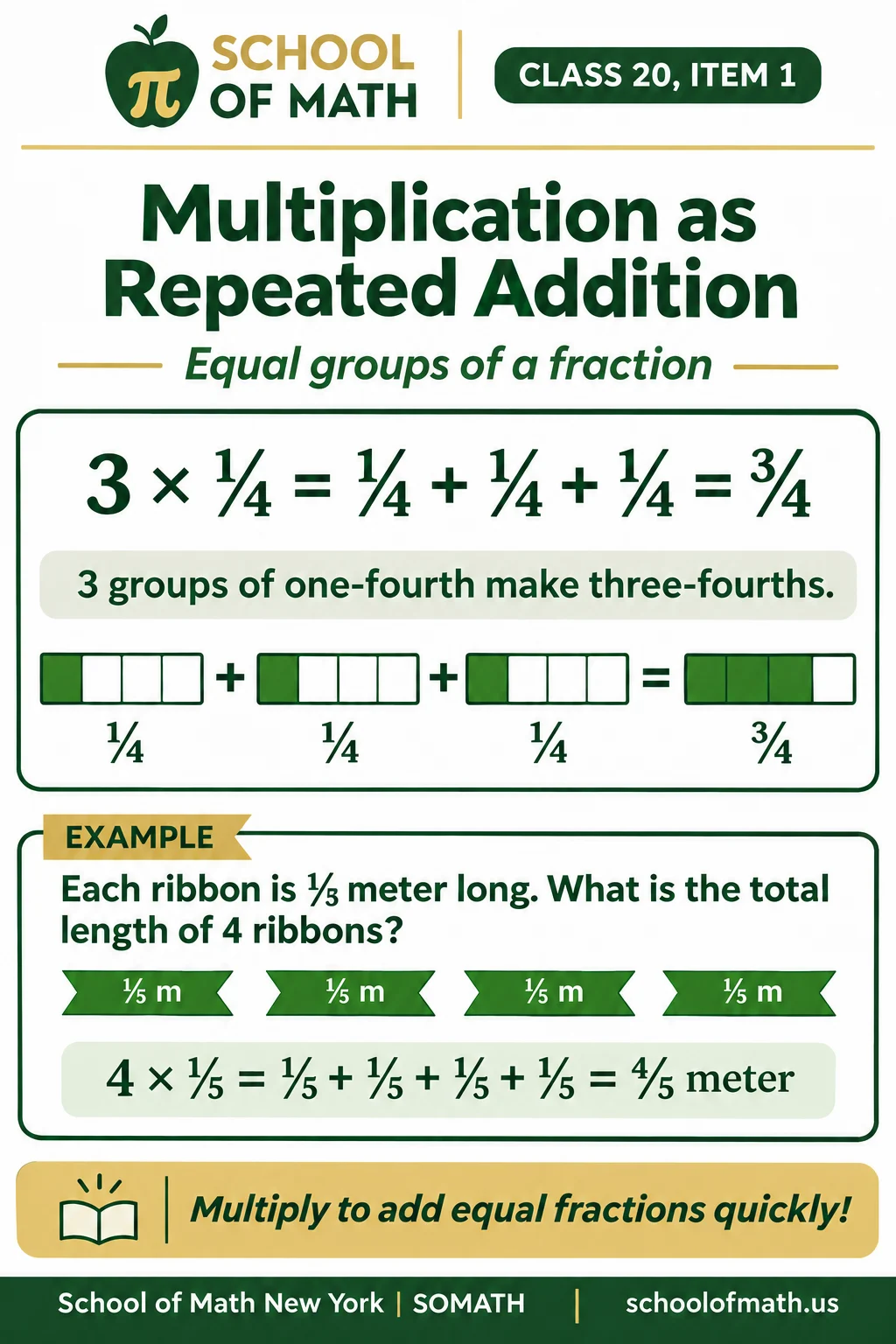
A note on the example in the image: the sentence says each ribbon is “1/3 meter,” but the ribbons and the number sentence show 1/5 meter. Read the example as 1/5 meter per ribbon: 4 × \(\frac{1}{5}\) = \(\frac{1}{5}\) + \(\frac{1}{5}\) + \(\frac{1}{5}\) + \(\frac{1}{5}\) = \(\frac{4}{5}\) meter.
Multiplication means equal groups. Just as 3 × 2 means three groups of 2, the product 3 × \(\frac{1}{4}\) means three groups of one-fourth: \(\frac{1}{4}\) + \(\frac{1}{4}\) + \(\frac{1}{4}\). Count the fourths: one fourth, two fourths, three fourths. So 3 × \(\frac{1}{4}\) = \(\frac{3}{4}\).
The denominator names the size of each piece, and it does not change when we add equal pieces. Only the number of pieces grows. The whole number tells how many groups we have, so we multiply it by the numerator: 3 groups of 1 fourth is 3 fourths.
Multiplying is a fast way to add the same fraction again and again. Instead of writing \(\frac{1}{6}\) six times, write 6 × \(\frac{1}{6}\) = \(\frac{6}{6}\) = 1 whole.
Practice: try these five questions
Q1
Write 5 × \(\dfrac{1}{6}\) as a repeated addition. Then find the product.
Answer
\(\dfrac{5}{6}\)
- 5 × \(\frac{1}{6}\) means 5 groups of one-sixth.
- Repeated addition: \(\frac{1}{6}\) + \(\frac{1}{6}\) + \(\frac{1}{6}\) + \(\frac{1}{6}\) + \(\frac{1}{6}\).
- Count the sixths: 5 sixths, so the product is \(\frac{5}{6}\).
Q2
Write \(\dfrac{2}{9}\) + \(\dfrac{2}{9}\) + \(\dfrac{2}{9}\) + \(\dfrac{2}{9}\) as a multiplication. Then find the total.
Answer
4 × \(\dfrac{2}{9}\) = \(\dfrac{8}{9}\)
- The same fraction, \(\frac{2}{9}\), is added 4 times, so the multiplication is 4 × \(\frac{2}{9}\).
- Each group has 2 ninths. Four groups have 4 × 2 = 8 ninths.
- The total is \(\frac{8}{9}\).
Q3
A small glass holds \(\dfrac{1}{8}\) liter of juice. How much juice is in 7 glasses?
Answer
\(\dfrac{7}{8}\) liter
- There are 7 equal groups of \(\frac{1}{8}\) liter, so multiply: 7 × \(\frac{1}{8}\).
- 7 groups of 1 eighth is 7 eighths: 7 × \(\frac{1}{8}\) = \(\frac{7}{8}\).
- The 7 glasses hold \(\frac{7}{8}\) liter of juice.
Q4
Is 6 × \(\dfrac{1}{6}\) more than, less than, or equal to 1 whole? Explain using equal groups.
Answer
Equal to 1 whole
- 6 × \(\frac{1}{6}\) means 6 groups of one-sixth: \(\frac{1}{6}\) + \(\frac{1}{6}\) + \(\frac{1}{6}\) + \(\frac{1}{6}\) + \(\frac{1}{6}\) + \(\frac{1}{6}\).
- That is 6 sixths, or \(\frac{6}{6}\).
- A whole cut into 6 equal parts has exactly 6 sixths, so \(\frac{6}{6}\) = 1. The product is equal to 1 whole.
Q5
One lap around a small track is \(\dfrac{1}{10}\) mile. Mia runs 9 laps. Write a repeated addition and a multiplication, then find how far she runs.
Answer
\(\dfrac{9}{10}\) mile
- Repeated addition: \(\frac{1}{10}\) added 9 times.
- Multiplication: 9 × \(\frac{1}{10}\).
- 9 groups of 1 tenth is 9 tenths, so Mia runs \(\frac{9}{10}\) mile.
Multiplying a fraction by a whole number
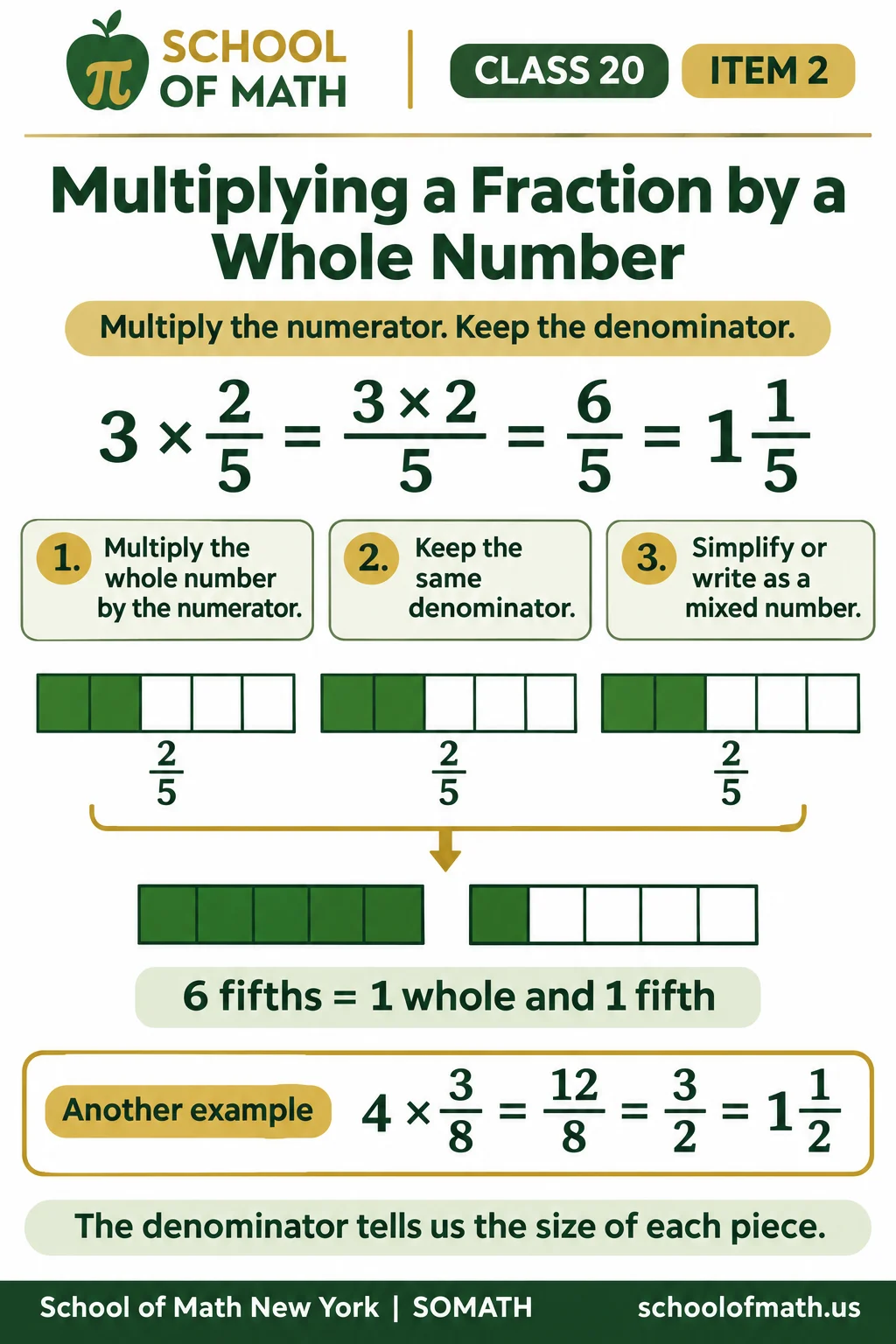
To multiply a whole number by a fraction, multiply the whole number by the numerator and keep the same denominator: 3 × \(\frac{2}{5}\) = \(\frac{3 \times 2}{5}\) = \(\frac{6}{5}\). Three groups of 2 fifths make 6 fifths. The pieces are still fifths, so the denominator stays 5.
When the numerator becomes larger than the denominator, the product is more than 1 whole. Five fifths make one whole, so \(\frac{6}{5}\) is 1 whole and 1 fifth: \(\frac{6}{5}\) = \(1\frac{1}{5}\). To change an improper fraction to a mixed number, divide the numerator by the denominator: 6 ÷ 5 = 1 remainder 1.
Always check whether the answer can be simplified. In 4 × \(\frac{3}{8}\) = \(\frac{12}{8}\), both 12 and 8 can be divided by 4, so \(\frac{12}{8}\) = \(\frac{3}{2}\) = \(1\frac{1}{2}\). A common mistake is to multiply the denominator too. Remember: the denominator tells the size of each piece, and the size does not change.
Practice: try these five questions
Q6
Find 4 × \(\dfrac{2}{9}\).
Answer
\(\dfrac{8}{9}\)
- Multiply the whole number by the numerator: 4 × 2 = 8.
- Keep the denominator 9: 4 × \(\frac{2}{9}\) = \(\frac{4 \times 2}{9}\) = \(\frac{8}{9}\).
- 8 and 9 share no common factor greater than 1, so \(\frac{8}{9}\) is in simplest form.
Q7
Find 5 × \(\dfrac{3}{7}\). Write the answer as a mixed number.
Answer
\(2\dfrac{1}{7}\)
- Multiply the numerator: 5 × 3 = 15. Keep the denominator: \(\frac{15}{7}\).
- Divide 15 by 7: 15 ÷ 7 = 2 remainder 1.
- So \(\frac{15}{7}\) = \(2\frac{1}{7}\).
Q8
Find 6 × \(\dfrac{5}{8}\). Simplify and write the answer as a mixed number.
Answer
\(3\dfrac{3}{4}\)
- Multiply the numerator: 6 × 5 = 30. Keep the denominator: \(\frac{30}{8}\).
- Simplify by dividing the numerator and denominator by 2: \(\frac{30}{8}\) = \(\frac{15}{4}\).
- Divide: 15 ÷ 4 = 3 remainder 3, so \(\frac{15}{4}\) = \(3\frac{3}{4}\).
Q9
Find 3 × \(\dfrac{4}{5}\). Write the answer as a mixed number.
Answer
\(2\dfrac{2}{5}\)
- Multiply the numerator: 3 × 4 = 12. Keep the denominator: \(\frac{12}{5}\).
- Divide: 12 ÷ 5 = 2 remainder 2.
- So 3 × \(\frac{4}{5}\) = \(\frac{12}{5}\) = \(2\frac{2}{5}\).
Q10
Ben says 2 × \(\dfrac{3}{5}\) = \(\dfrac{6}{10}\). Explain his mistake and find the correct product.
Answer
\(\dfrac{6}{5}\) = \(1\dfrac{1}{5}\)
- Ben multiplied both the numerator and the denominator by 2.
- The denominator tells the size of the pieces. Two groups of 3 fifths are still fifths, so the denominator stays 5.
- Correct work: 2 × \(\frac{3}{5}\) = \(\frac{2 \times 3}{5}\) = \(\frac{6}{5}\) = \(1\frac{1}{5}\). (Ben's \(\frac{6}{10}\) equals \(\frac{3}{5}\), which is only one group.)
Using visual models
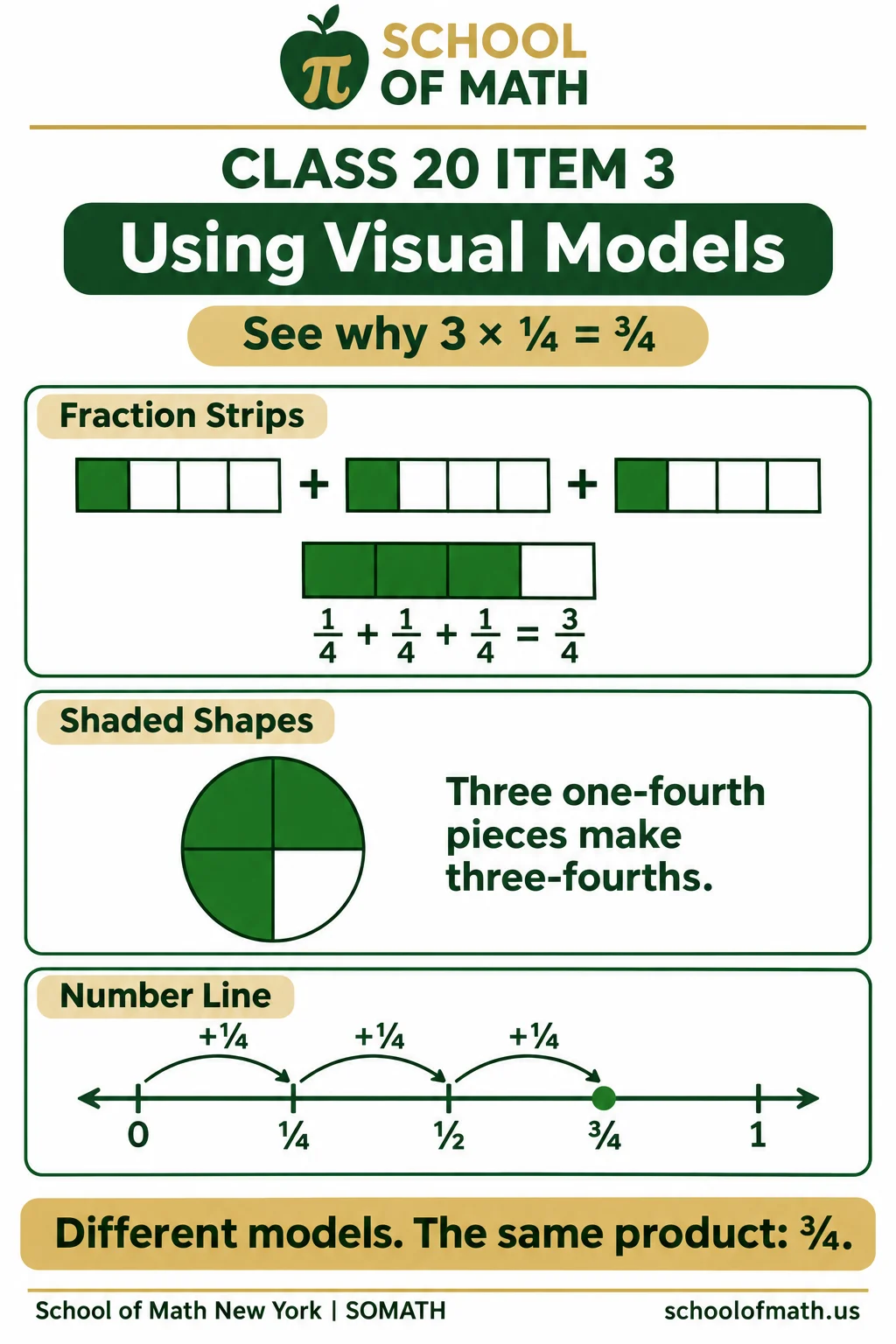
A picture helps us see why multiplying by the numerator works. Three models show the same product 3 × \(\frac{1}{4}\) = \(\frac{3}{4}\).
Fraction strips: draw one strip for each group. Each strip is cut into fourths with 1 part shaded. Slide the shaded parts together onto one strip: 3 shaded fourths, or \(\frac{3}{4}\). Shaded shapes: a circle cut into 4 equal slices with 3 slices shaded shows three one-fourth pieces. Number line: cut the space from 0 to 1 into 4 equal jumps. Start at 0 and make 3 jumps of \(\frac{1}{4}\): you land at \(\frac{3}{4}\).
On a number line, the whole number tells how many jumps to make and the fraction tells how long each jump is. If the jumps go past 1, the product is greater than 1 whole: 3 jumps of \(\frac{2}{5}\) land at \(\frac{6}{5}\) = \(1\frac{1}{5}\). Different models give the same product.
Practice: try these five questions
Q11
The model shows equal strips. Each strip is cut into sixths. Write the multiplication that the model shows, then find the product.
Answer
3 × \(\dfrac{2}{6}\) = \(\dfrac{6}{6}\) = 1
- There are 3 strips, so there are 3 groups.
- Each strip has 2 of 6 equal parts shaded, so each group is \(\frac{2}{6}\).
- Multiply: 3 × \(\frac{2}{6}\) = \(\frac{6}{6}\). Six sixths fill one whole strip, so the product is 1.
Q12
The number line from 0 to 1 is cut into eighths. Start at 0 and make 5 jumps of \(\dfrac{1}{8}\). Where do you land? Write the multiplication.
Answer
5 × \(\dfrac{1}{8}\) = \(\dfrac{5}{8}\)
- Each jump is \(\frac{1}{8}\), the length of one space on the number line.
- After 5 jumps: \(\frac{1}{8}\), \(\frac{2}{8}\), \(\frac{3}{8}\), \(\frac{4}{8}\), \(\frac{5}{8}\).
- You land at \(\frac{5}{8}\), so 5 × \(\frac{1}{8}\) = \(\frac{5}{8}\).
Q13
A circle is cut into 6 equal slices. You shade \(\dfrac{1}{6}\) of the circle five times, one slice at a time. What fraction of the circle is shaded, and what fraction is not shaded?
Answer
\(\dfrac{5}{6}\) shaded; \(\dfrac{1}{6}\) not shaded
- Shading \(\frac{1}{6}\) five times is 5 × \(\frac{1}{6}\) = \(\frac{5}{6}\).
- The whole circle is \(\frac{6}{6}\). Unshaded: \(\frac{6}{6}\) − \(\frac{5}{6}\) = \(\frac{1}{6}\).
- Check: \(\frac{5}{6}\) + \(\frac{1}{6}\) = \(\frac{6}{6}\) = 1 whole circle.
Q14
Use the number line from 0 to 2, cut into fifths, to show 3 × \(\dfrac{2}{5}\). How long is each jump, and where do you land?
Answer
Each jump is \(\dfrac{2}{5}\); you land at \(\dfrac{6}{5}\) = \(1\dfrac{1}{5}\)
- The fraction tells the jump length: each jump covers 2 fifths, or \(\frac{2}{5}\).
- Three jumps: \(\frac{2}{5}\), then \(\frac{4}{5}\), then \(\frac{6}{5}\).
- \(\frac{6}{5}\) is past 1: it is 1 whole and 1 more fifth, so 3 × \(\frac{2}{5}\) = \(\frac{6}{5}\) = \(1\frac{1}{5}\).
Q15
Draw strips to show 4 × \(\dfrac{1}{3}\). How many whole strips can you fill, and what is the product?
Answer
\(\dfrac{4}{3}\) = \(1\dfrac{1}{3}\): one full strip and one third of another
- Draw 4 strips cut into thirds, each with 1 part shaded: 4 × \(\frac{1}{3}\) = \(\frac{4}{3}\).
- Slide the shaded thirds together. Three thirds fill one whole strip.
- One shaded third is left over, so the product is \(\frac{4}{3}\) = \(1\frac{1}{3}\).
Multiplying fractions by fractions
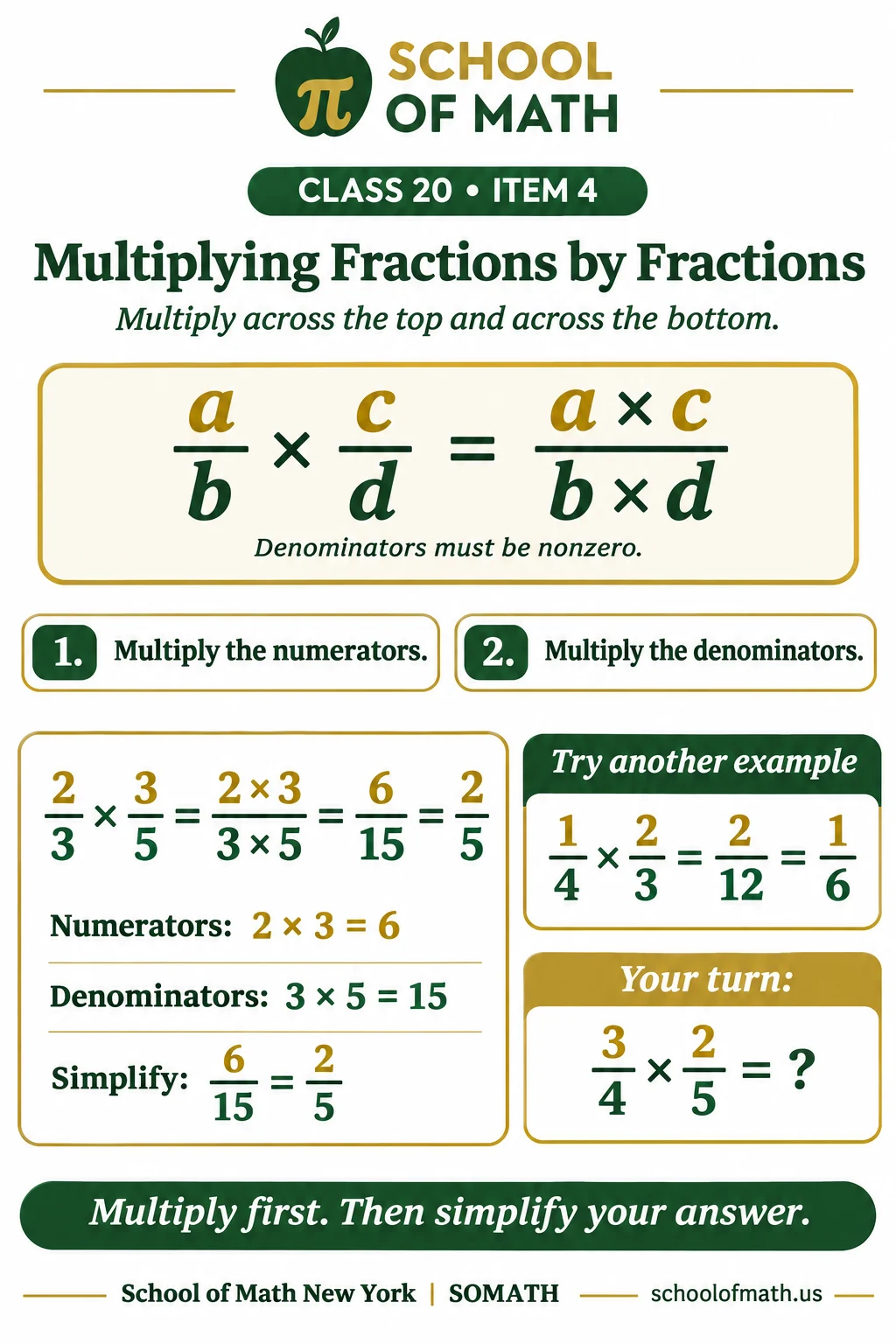
To multiply two fractions, multiply across the top and across the bottom: \(\frac{a}{b}\) × \(\frac{c}{d}\) = \(\frac{a \times c}{b \times d}\). The denominators b and d must not be zero, because we can never cut a whole into zero parts.
Step 1: multiply the numerators. Step 2: multiply the denominators. Step 3: simplify. For example, \(\frac{2}{3}\) × \(\frac{3}{5}\): the numerators give 2 × 3 = 6, the denominators give 3 × 5 = 15, so the product is \(\frac{6}{15}\). Dividing 6 and 15 by their common factor 3 gives \(\frac{2}{5}\).
Unlike adding, multiplying fractions does not need a common denominator. Never add the numerators or the denominators when you multiply. The “Your turn” in the image works the same way: \(\frac{3}{4}\) × \(\frac{2}{5}\) = \(\frac{6}{20}\) = \(\frac{3}{10}\).
Practice: try these five questions
Q16
Find \(\dfrac{1}{3}\) × \(\dfrac{4}{5}\).
Answer
\(\dfrac{4}{15}\)
- Multiply the numerators: 1 × 4 = 4.
- Multiply the denominators: 3 × 5 = 15.
- The product is \(\frac{4}{15}\). 4 and 15 share no common factor, so it is in simplest form.
Q17
Find \(\dfrac{2}{7}\) × \(\dfrac{3}{4}\). Simplify your answer.
Answer
\(\dfrac{3}{14}\)
- Numerators: 2 × 3 = 6. Denominators: 7 × 4 = 28. Product: \(\frac{6}{28}\).
- 6 and 28 are both even, so divide each by 2.
- \(\frac{6}{28}\) = \(\frac{3}{14}\).
Q18
Find \(\dfrac{5}{6}\) × \(\dfrac{1}{2}\).
Answer
\(\dfrac{5}{12}\)
- Numerators: 5 × 1 = 5.
- Denominators: 6 × 2 = 12.
- The product is \(\frac{5}{12}\), already in simplest form.
Q19
Find \(\dfrac{3}{5}\) × \(\dfrac{5}{8}\). Simplify your answer.
Answer
\(\dfrac{3}{8}\)
- Numerators: 3 × 5 = 15. Denominators: 5 × 8 = 40. Product: \(\frac{15}{40}\).
- 15 and 40 share the common factor 5.
- \(\frac{15}{40}\) = \(\frac{3}{8}\).
Q20
Ana writes \(\dfrac{2}{5}\) × \(\dfrac{1}{3}\) = \(\dfrac{3}{8}\). What did she do wrong? Find the correct product.
Answer
\(\dfrac{2}{15}\)
- Ana added the numerators (2 + 1 = 3) and added the denominators (5 + 3 = 8). That is not the rule for multiplying.
- Multiply across: numerators 2 × 1 = 2, denominators 5 × 3 = 15.
- The correct product is \(\frac{2}{15}\). It makes sense that it is smaller than \(\frac{2}{5}\), because we are taking one third of \(\frac{2}{5}\).
Finding a fraction of a fraction
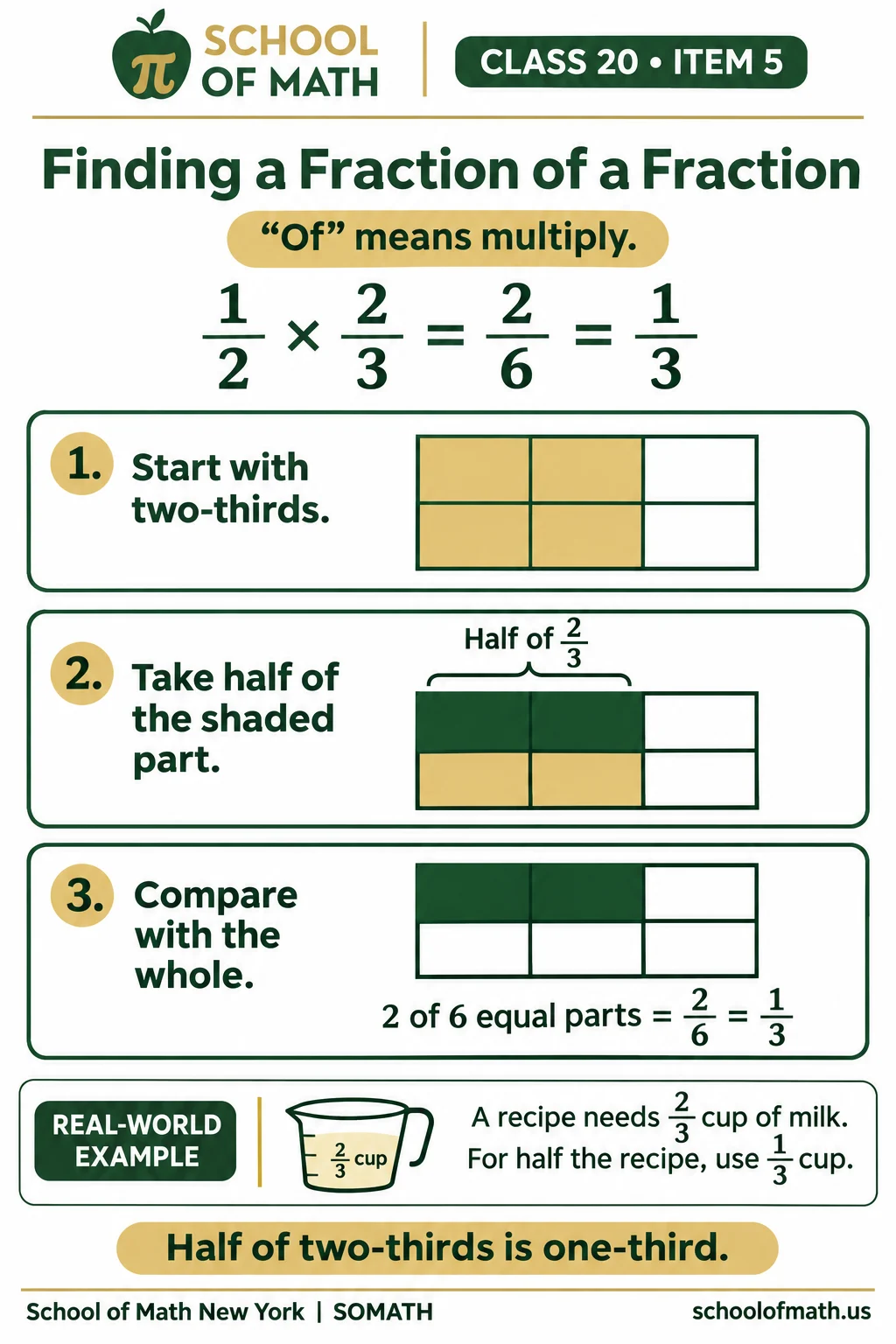
The word “of” means multiply. “Half of two-thirds” means \(\frac{1}{2}\) × \(\frac{2}{3}\).
An area model shows why. Step 1: draw a rectangle, cut it into 3 equal columns, and shade 2 columns to show \(\frac{2}{3}\). Step 2: cut the rectangle into 2 equal rows and take half of the shaded part, the top row of the two shaded columns. Step 3: compare with the whole. The rectangle now has 2 × 3 = 6 equal parts, and 2 of them are in the double-shaded part, so \(\frac{1}{2}\) of \(\frac{2}{3}\) = \(\frac{2}{6}\) = \(\frac{1}{3}\).
The area model also shows why we multiply the denominators: cutting thirds into 2 rows makes sixths. Multiplying the numerators counts the double-shaded parts. In a recipe that needs \(\frac{2}{3}\) cup of milk, half the recipe needs \(\frac{1}{2}\) × \(\frac{2}{3}\) = \(\frac{1}{3}\) cup.
Practice: try these five questions
Q21
Find \(\dfrac{1}{2}\) of \(\dfrac{3}{4}\).
Answer
\(\dfrac{3}{8}\)
- “Of” means multiply: \(\frac{1}{2}\) × \(\frac{3}{4}\).
- Numerators: 1 × 3 = 3. Denominators: 2 × 4 = 8.
- Half of three-fourths is \(\frac{3}{8}\).
Q22
Find \(\dfrac{1}{3}\) of \(\dfrac{3}{5}\). Simplify your answer.
Answer
\(\dfrac{1}{5}\)
- Write it as multiplication: \(\frac{1}{3}\) × \(\frac{3}{5}\).
- Numerators: 1 × 3 = 3. Denominators: 3 × 5 = 15. Product: \(\frac{3}{15}\).
- Divide by 3: \(\frac{3}{15}\) = \(\frac{1}{5}\). One third of 3 fifths is 1 fifth.
Q23
A rectangle is cut into 4 equal columns, and 3 columns are lightly shaded to show \(\dfrac{3}{4}\). It is also cut into 3 equal rows, and 2 rows of the shaded part are shaded dark. What fraction of the whole rectangle is dark? Write the multiplication.
Answer
\(\dfrac{2}{3}\) × \(\dfrac{3}{4}\) = \(\dfrac{6}{12}\) = \(\dfrac{1}{2}\)
- The dark part is \(\frac{2}{3}\) of the shaded \(\frac{3}{4}\), so multiply \(\frac{2}{3}\) × \(\frac{3}{4}\).
- The rectangle has 3 rows × 4 columns = 12 equal parts. The dark part has 2 rows × 3 columns = 6 parts, so it is \(\frac{6}{12}\).
- Simplify: \(\frac{6}{12}\) = \(\frac{1}{2}\). The dark part is half of the whole rectangle.
Q24
A garden is \(\dfrac{4}{5}\) planted. Carrots grow in \(\dfrac{1}{4}\) of the planted part. What fraction of the whole garden has carrots?
Answer
\(\dfrac{1}{5}\) of the garden
- “\(\frac{1}{4}\) of the planted part” means \(\frac{1}{4}\) × \(\frac{4}{5}\).
- Numerators: 1 × 4 = 4. Denominators: 4 × 5 = 20. Product: \(\frac{4}{20}\).
- Simplify by dividing by 4: \(\frac{4}{20}\) = \(\frac{1}{5}\) of the whole garden.
Q25
There is \(\dfrac{3}{4}\) of a tray of brownies left. Sam eats \(\dfrac{1}{3}\) of what is left. What fraction of the whole tray does Sam eat?
Answer
\(\dfrac{1}{4}\) of the tray
- Sam eats \(\frac{1}{3}\) of \(\frac{3}{4}\), so multiply \(\frac{1}{3}\) × \(\frac{3}{4}\).
- Numerators: 1 × 3 = 3. Denominators: 3 × 4 = 12. Product: \(\frac{3}{12}\).
- Simplify: \(\frac{3}{12}\) = \(\frac{1}{4}\). Sam eats one fourth of the whole tray.
Simplifying products two ways
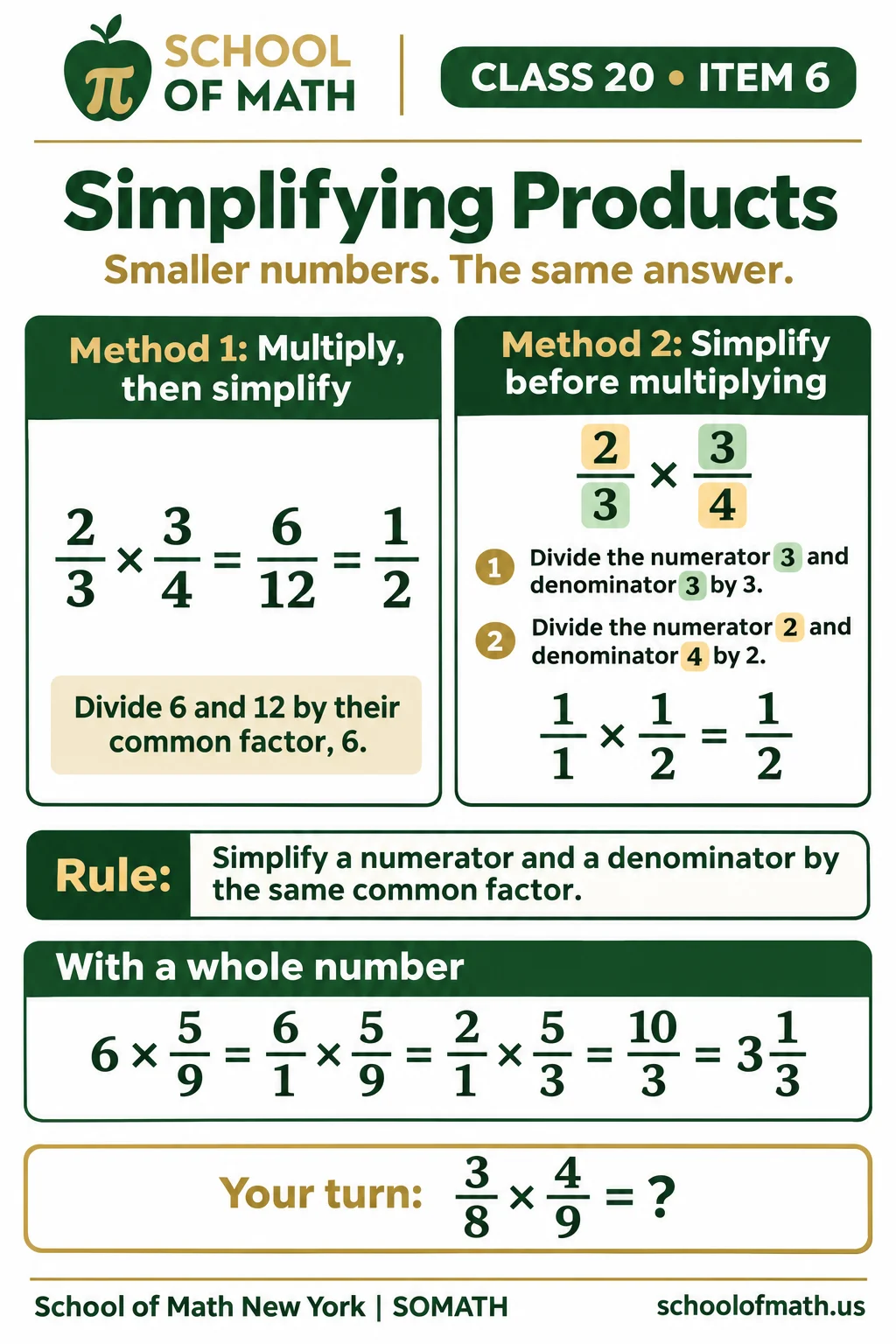
There are two ways to reach a product in simplest form. Method 1: multiply, then simplify. \(\frac{2}{3}\) × \(\frac{3}{4}\) = \(\frac{6}{12}\), and dividing 6 and 12 by their common factor 6 gives \(\frac{1}{2}\).
Method 2: simplify before multiplying. Any numerator can be paired with any denominator, even across the × sign, and divided by a common factor. In \(\frac{2}{3}\) × \(\frac{3}{4}\), divide the numerator 3 and the denominator 3 by 3, and divide the numerator 2 and the denominator 4 by 2. The problem becomes \(\frac{1}{1}\) × \(\frac{1}{2}\) = \(\frac{1}{2}\): the same answer with smaller numbers.
With a whole number, first write it over 1. For 6 × \(\frac{5}{9}\), write \(\frac{6}{1}\) × \(\frac{5}{9}\), divide 6 and 9 by 3 to get \(\frac{2}{1}\) × \(\frac{5}{3}\) = \(\frac{10}{3}\) = \(3\frac{1}{3}\). Simplify only a numerator with a denominator, never two numerators or two denominators. The “Your turn” in the image: \(\frac{3}{8}\) × \(\frac{4}{9}\) becomes \(\frac{1}{2}\) × \(\frac{1}{3}\) = \(\frac{1}{6}\).
Practice: try these five questions
Q26
Find \(\dfrac{4}{9}\) × \(\dfrac{3}{8}\) two ways: multiply then simplify, and simplify before multiplying.
Answer
\(\dfrac{1}{6}\)
- Method 1: \(\frac{4 \times 3}{9 \times 8}\) = \(\frac{12}{72}\). The greatest common factor of 12 and 72 is 12, so \(\frac{12}{72}\) = \(\frac{1}{6}\).
- Method 2: divide the numerator 4 and the denominator 8 by 4 to get 1 and 2. Divide the numerator 3 and the denominator 9 by 3 to get 1 and 3.
- Now multiply: \(\frac{1}{3}\) × \(\frac{1}{2}\) = \(\frac{1}{6}\). Both methods give \(\frac{1}{6}\).
Q27
Simplify before multiplying: \(\dfrac{5}{6}\) × \(\dfrac{3}{10}\).
Answer
\(\dfrac{1}{4}\)
- Pair the numerator 5 with the denominator 10: divide both by 5 to get 1 and 2.
- Pair the numerator 3 with the denominator 6: divide both by 3 to get 1 and 2.
- Multiply: \(\frac{1}{2}\) × \(\frac{1}{2}\) = \(\frac{1}{4}\). Check: \(\frac{15}{60}\) = \(\frac{1}{4}\).
Q28
Find 8 × \(\dfrac{3}{4}\) by simplifying first.
Answer
6
- Write the whole number over 1: \(\frac{8}{1}\) × \(\frac{3}{4}\).
- Divide the numerator 8 and the denominator 4 by 4 to get 2 and 1: \(\frac{2}{1}\) × \(\frac{3}{1}\).
- Multiply: \(\frac{6}{1}\) = 6. Check: 8 × 3 = 24 and \(\frac{24}{4}\) = 6.
Q29
Find 10 × \(\dfrac{7}{15}\). Simplify first and write the answer as a mixed number.
Answer
\(4\dfrac{2}{3}\)
- Write \(\frac{10}{1}\) × \(\frac{7}{15}\).
- Divide the numerator 10 and the denominator 15 by their common factor 5 to get 2 and 3: \(\frac{2}{1}\) × \(\frac{7}{3}\).
- Multiply: \(\frac{14}{3}\). Divide: 14 ÷ 3 = 4 remainder 2, so the product is \(4\frac{2}{3}\).
Q30
Simplify before multiplying: \(\dfrac{6}{7}\) × \(\dfrac{7}{12}\).
Answer
\(\dfrac{1}{2}\)
- Divide the numerator 7 and the denominator 7 by 7 to get 1 and 1.
- Divide the numerator 6 and the denominator 12 by 6 to get 1 and 2.
- Multiply: \(\frac{1}{1}\) × \(\frac{1}{2}\) = \(\frac{1}{2}\). Check: \(\frac{42}{84}\) = \(\frac{1}{2}\).
Understanding the size of the product
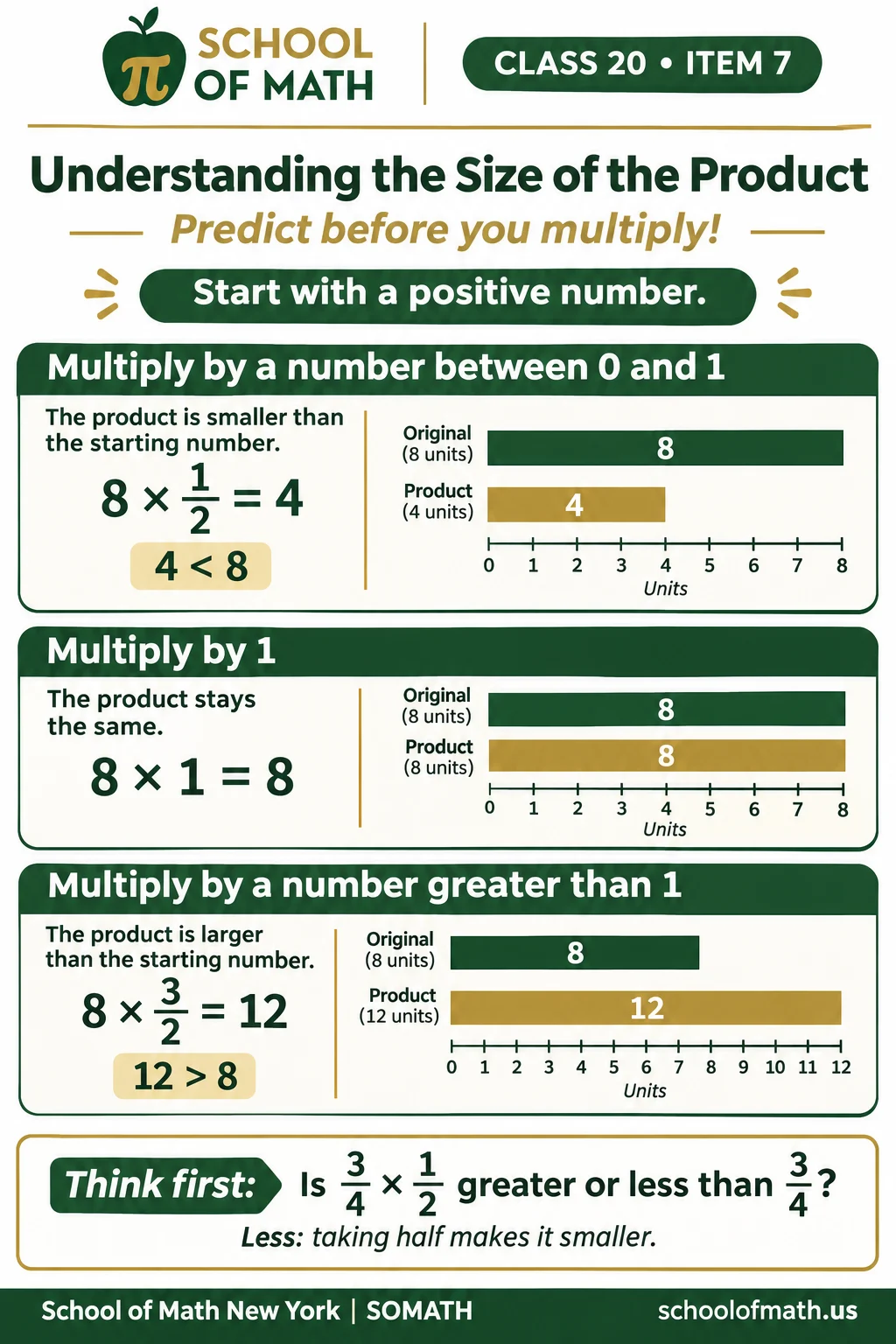
Before multiplying, predict the size of the answer. Start with a positive number and look at the other factor.
If the factor is between 0 and 1 (a fraction smaller than 1, like \(\frac{1}{2}\)), the product is smaller than the starting number: 8 × \(\frac{1}{2}\) = 4, and 4 < 8. We are taking only part of 8. If the factor is exactly 1 (including fractions like \(\frac{5}{5}\)), the product stays the same: 8 × 1 = 8. If the factor is greater than 1 (like \(\frac{3}{2}\)), the product is larger: 8 × \(\frac{3}{2}\) = 12, and 12 > 8.
This is called scaling. It is a quick way to catch mistakes. For example, \(\frac{3}{4}\) × \(\frac{1}{2}\) must be less than \(\frac{3}{4}\), because taking half of something makes it smaller. Indeed, \(\frac{3}{4}\) × \(\frac{1}{2}\) = \(\frac{3}{8}\).
Practice: try these five questions
Q31
Without multiplying, decide whether 9 × \(\dfrac{2}{3}\) is greater than or less than 9. Then find the product to check.
Answer
Less than 9; the product is 6
- The factor \(\frac{2}{3}\) is between 0 and 1, so the product is smaller than 9.
- Multiply: 9 × \(\frac{2}{3}\) = \(\frac{18}{3}\) = 6.
- Check: 6 < 9, which matches the prediction.
Q32
Is 6 × \(\dfrac{5}{4}\) greater than or less than 6? Explain, then find the product as a mixed number.
Answer
Greater than 6; the product is \(7\dfrac{1}{2}\)
- \(\frac{5}{4}\) is greater than 1 because the numerator is larger than the denominator. Multiplying by a number greater than 1 makes the product larger.
- Multiply: 6 × \(\frac{5}{4}\) = \(\frac{30}{4}\) = \(\frac{15}{2}\).
- 15 ÷ 2 = 7 remainder 1, so \(\frac{15}{2}\) = \(7\frac{1}{2}\), and \(7\frac{1}{2}\) > 6.
Q33
Order from least to greatest without finding exact answers: 10 × \(\dfrac{7}{5}\), 10 × 1, 10 × \(\dfrac{3}{5}\). Then check by multiplying.
Answer
10 × \(\dfrac{3}{5}\), 10 × 1, 10 × \(\dfrac{7}{5}\) (6, 10, 14)
- \(\frac{3}{5}\) is less than 1, so 10 × \(\frac{3}{5}\) is less than 10. Multiplying by 1 gives exactly 10. \(\frac{7}{5}\) is greater than 1, so 10 × \(\frac{7}{5}\) is more than 10.
- Check: 10 × \(\frac{3}{5}\) = \(\frac{30}{5}\) = 6; 10 × 1 = 10; 10 × \(\frac{7}{5}\) = \(\frac{70}{5}\) = 14.
- Order: 6, 10, 14.
Q34
Is \(\dfrac{2}{3}\) × \(\dfrac{4}{5}\) greater than or less than \(\dfrac{4}{5}\)? Explain, then check.
Answer
Less than \(\dfrac{4}{5}\); the product is \(\dfrac{8}{15}\)
- We take \(\frac{2}{3}\) of \(\frac{4}{5}\). Since \(\frac{2}{3}\) is less than 1, the product is less than \(\frac{4}{5}\).
- Multiply: \(\frac{2}{3}\) × \(\frac{4}{5}\) = \(\frac{8}{15}\).
- Compare with fifteenths: \(\frac{4}{5}\) = \(\frac{12}{15}\), and \(\frac{8}{15}\) < \(\frac{12}{15}\).
Q35
Write <, >, or = in each blank: (a) 12 × \(\dfrac{5}{5}\) ___ 12 (b) 12 × \(\dfrac{4}{3}\) ___ 12
Answer
(a) = (b) >
- (a) \(\frac{5}{5}\) = 1, and multiplying by 1 keeps the number the same: 12 × \(\frac{5}{5}\) = 12, so the sign is =.
- (b) \(\frac{4}{3}\) is greater than 1, so the product is larger than 12: 12 × \(\frac{4}{3}\) = \(\frac{48}{3}\) = 16.
- 16 > 12, so the sign is >.
Solving real-world fraction problems
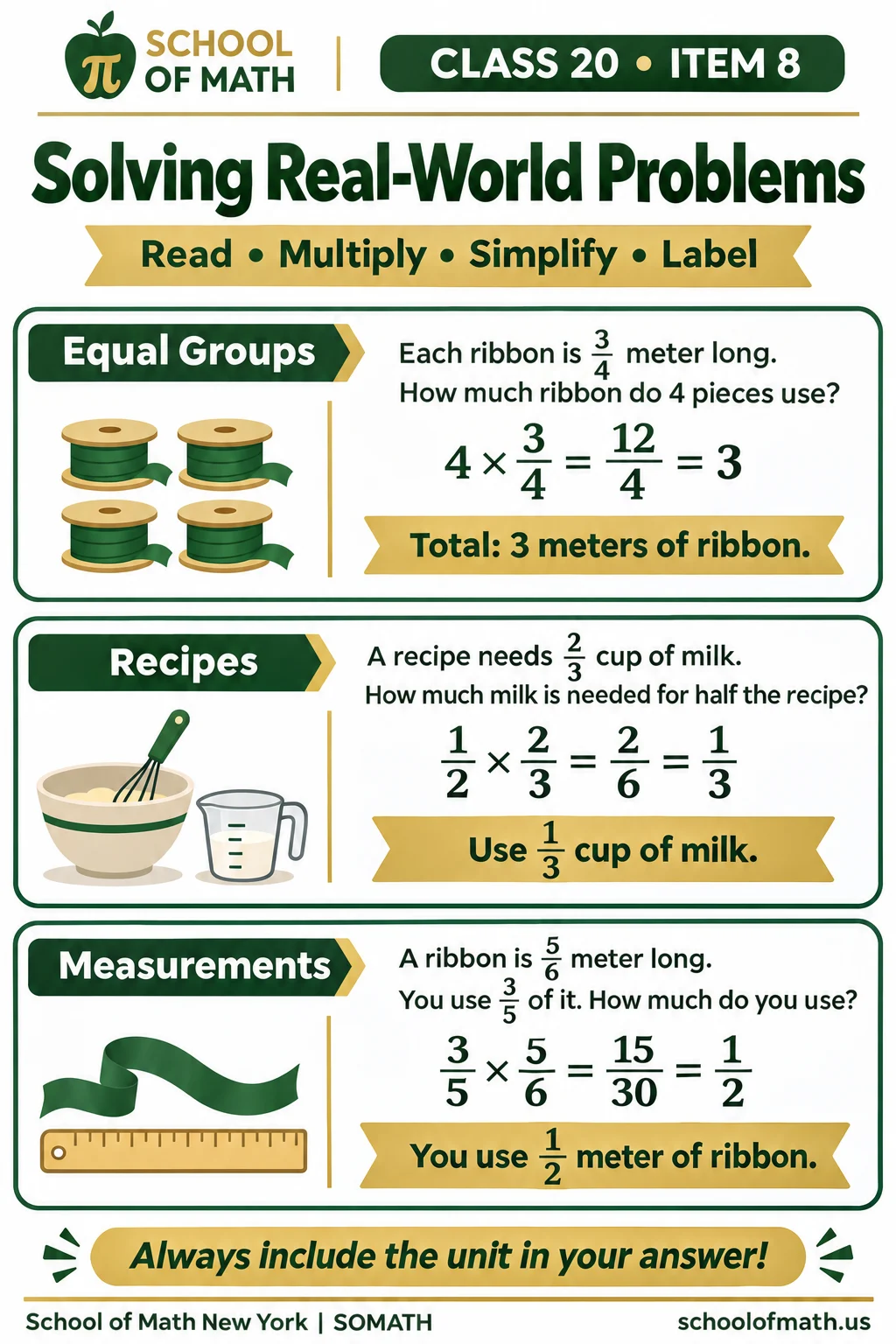
Solve every story problem in four steps: read, multiply, simplify, label.
Read: decide what kind of story it is. Equal groups (“each,” “every,” “how much in all”) use a whole number times a fraction: 4 ribbons of \(\frac{3}{4}\) meter each use 4 × \(\frac{3}{4}\) = \(\frac{12}{4}\) = 3 meters. Part of an amount (“half of,” “\(\frac{3}{5}\) of,” “for half the recipe”) uses fraction times fraction: half of \(\frac{2}{3}\) cup is \(\frac{1}{2}\) × \(\frac{2}{3}\) = \(\frac{1}{3}\) cup.
Multiply, simplify, and write the answer as a whole or mixed number when that is easier to understand. Label: always include the unit, such as meters, cups, or pounds. Finally, check the size: taking part of an amount gives less than the amount; several groups give more than one group.
Practice: try these five questions
Q36
Each bag holds \(\dfrac{2}{3}\) pound of trail mix. How much trail mix is in 5 bags?
Answer
\(3\dfrac{1}{3}\) pounds
- Equal groups: 5 bags of \(\frac{2}{3}\) pound, so multiply 5 × \(\frac{2}{3}\).
- 5 × 2 = 10, so the product is \(\frac{10}{3}\).
- 10 ÷ 3 = 3 remainder 1: \(\frac{10}{3}\) = \(3\frac{1}{3}\) pounds.
Q37
A recipe needs \(\dfrac{3}{4}\) cup of sugar. Maya makes one-third of the recipe. How much sugar does she use?
Answer
\(\dfrac{1}{4}\) cup
- One-third of \(\frac{3}{4}\) cup means \(\frac{1}{3}\) × \(\frac{3}{4}\).
- Simplify first: the numerator 3 and the denominator 3 become 1 and 1, so \(\frac{1}{1}\) × \(\frac{1}{4}\) = \(\frac{1}{4}\).
- Maya uses \(\frac{1}{4}\) cup of sugar. Check: \(\frac{1}{4}\) is less than \(\frac{3}{4}\), as expected.
Q38
A wooden board is \(\dfrac{7}{8}\) meter long. Theo uses \(\dfrac{2}{3}\) of it for a shelf. How long is the shelf?
Answer
\(\dfrac{7}{12}\) meter
- \(\frac{2}{3}\) of \(\frac{7}{8}\) meter means \(\frac{2}{3}\) × \(\frac{7}{8}\).
- Simplify first: divide the numerator 2 and the denominator 8 by 2 to get 1 and 4: \(\frac{1}{3}\) × \(\frac{7}{4}\).
- Multiply: \(\frac{7}{12}\). The shelf is \(\frac{7}{12}\) meter long.
Q39
There are 24 students in a class, and \(\dfrac{3}{8}\) of them walk to school. How many students walk to school?
Answer
9 students
- \(\frac{3}{8}\) of 24 means \(\frac{3}{8}\) × 24.
- Simplify: write \(\frac{24}{1}\), then divide 24 and the denominator 8 by 8 to get 3 and 1: \(\frac{3}{1}\) × \(\frac{3}{1}\) = 9.
- Check: \(\frac{1}{8}\) of 24 is 3, so \(\frac{3}{8}\) of 24 is 3 × 3 = 9 students.
Q40
A painter uses \(\dfrac{5}{6}\) gallon of paint for each wall. How much paint does she need for 4 walls?
Answer
\(3\dfrac{1}{3}\) gallons
- Equal groups: 4 walls × \(\frac{5}{6}\) gallon each = 4 × \(\frac{5}{6}\).
- 4 × 5 = 20, so the product is \(\frac{20}{6}\), which simplifies to \(\frac{10}{3}\).
- 10 ÷ 3 = 3 remainder 1: she needs \(3\frac{1}{3}\) gallons of paint.
Homework review
One review question for each topic, in image order. Show each step, simplify, and check the size of your answer.
R1
Write \(\dfrac{3}{7}\) + \(\dfrac{3}{7}\) + \(\dfrac{3}{7}\) as a multiplication and find the total as a mixed number.
Answer
3 × \(\dfrac{3}{7}\) = \(\dfrac{9}{7}\) = \(1\dfrac{2}{7}\)
- The fraction \(\frac{3}{7}\) is added 3 times, so the multiplication is 3 × \(\frac{3}{7}\).
- 3 groups of 3 sevenths is 9 sevenths: \(\frac{9}{7}\).
- 9 ÷ 7 = 1 remainder 2, so \(\frac{9}{7}\) = \(1\frac{2}{7}\).
R2
Find 7 × \(\dfrac{3}{10}\). Write the answer as a mixed number.
Answer
\(2\dfrac{1}{10}\)
- Multiply the numerator: 7 × 3 = 21. Keep the denominator: \(\frac{21}{10}\).
- 21 ÷ 10 = 2 remainder 1.
- So 7 × \(\frac{3}{10}\) = \(2\frac{1}{10}\).
R3
Use the number line from 0 to 2, cut into thirds, to show 4 × \(\dfrac{1}{3}\). Where do you land?
Answer
\(\dfrac{4}{3}\) = \(1\dfrac{1}{3}\)
- Each jump is \(\frac{1}{3}\). Make 4 jumps: \(\frac{1}{3}\), \(\frac{2}{3}\), \(\frac{3}{3}\) = 1, \(\frac{4}{3}\).
- The fourth jump goes one third past 1.
- You land at \(\frac{4}{3}\) = \(1\frac{1}{3}\).
R4
Find \(\dfrac{4}{9}\) × \(\dfrac{2}{3}\).
Answer
\(\dfrac{8}{27}\)
- Numerators: 4 × 2 = 8.
- Denominators: 9 × 3 = 27.
- The product is \(\frac{8}{27}\); 8 and 27 share no common factor, so it is in simplest form.
R5
Find \(\dfrac{3}{4}\) of \(\dfrac{2}{5}\). Simplify your answer.
Answer
\(\dfrac{3}{10}\)
- “Of” means multiply: \(\frac{3}{4}\) × \(\frac{2}{5}\).
- Numerators: 3 × 2 = 6. Denominators: 4 × 5 = 20. Product: \(\frac{6}{20}\).
- Divide by 2: \(\frac{6}{20}\) = \(\frac{3}{10}\).
R6
Simplify before multiplying: \(\dfrac{9}{10}\) × \(\dfrac{5}{12}\).
Answer
\(\dfrac{3}{8}\)
- Divide the numerator 9 and the denominator 12 by 3 to get 3 and 4.
- Divide the numerator 5 and the denominator 10 by 5 to get 1 and 2.
- Multiply: \(\frac{3}{2}\) × \(\frac{1}{4}\), which gives \(\frac{3 \times 1}{2 \times 4}\) = \(\frac{3}{8}\). Check: \(\frac{45}{120}\) = \(\frac{3}{8}\).
R7
Without multiplying, is 15 × \(\dfrac{3}{5}\) greater than or less than 15? Then find the product.
Answer
Less than 15; the product is 9
- \(\frac{3}{5}\) is between 0 and 1, so the product is less than 15.
- Simplify: 15 and the denominator 5 divide by 5 to get 3 and 1, so 3 × 3 = 9.
- 9 < 15, matching the prediction.
R8
Each bottle holds \(\dfrac{3}{5}\) liter of water. How much water is in 6 bottles?
Answer
\(3\dfrac{3}{5}\) liters
- Equal groups: 6 × \(\frac{3}{5}\).
- 6 × 3 = 18, so the product is \(\frac{18}{5}\).
- 18 ÷ 5 = 3 remainder 3: \(\frac{18}{5}\) = \(3\frac{3}{5}\) liters.
Homework word problems
Twelve stories that grow harder as you go. Decide whether the story has equal groups or asks for part of an amount; then multiply, simplify, and label your answer with its unit.
W1
Each of 3 children gets \(\dfrac{1}{4}\) of a sandwich. How much sandwich do they get in all?
Answer
\(\dfrac{3}{4}\) of a sandwich
- Equal groups: 3 × \(\frac{1}{4}\).
- 3 groups of 1 fourth is 3 fourths.
- They get \(\frac{3}{4}\) of a sandwich in all.
W2
A puppy eats \(\dfrac{2}{5}\) cup of food at each meal and has 3 meals a day. How much food does it eat in one day?
Answer
\(1\dfrac{1}{5}\) cups
- Equal groups: 3 meals × \(\frac{2}{5}\) cup = 3 × \(\frac{2}{5}\).
- 3 × 2 = 6, so the product is \(\frac{6}{5}\).
- \(\frac{6}{5}\) = \(1\frac{1}{5}\) cups of food each day.
W3
A ribbon is \(\dfrac{5}{6}\) yard long. Maya uses \(\dfrac{1}{2}\) of it for a bow. How much ribbon is in the bow?
Answer
\(\dfrac{5}{12}\) yard
- \(\frac{1}{2}\) of \(\frac{5}{6}\) yard means \(\frac{1}{2}\) × \(\frac{5}{6}\).
- Numerators: 1 × 5 = 5. Denominators: 2 × 6 = 12.
- The bow uses \(\frac{5}{12}\) yard of ribbon.
W4
Leo walks \(\dfrac{3}{4}\) mile to school each morning. How far does he walk to school in 5 mornings?
Answer
\(3\dfrac{3}{4}\) miles
- Equal groups: 5 × \(\frac{3}{4}\).
- 5 × 3 = 15, so the product is \(\frac{15}{4}\).
- 15 ÷ 4 = 3 remainder 3: Leo walks \(3\frac{3}{4}\) miles.
W5
In a club, \(\dfrac{2}{3}\) of the members play chess. Half of the chess players are in 4th grade. What fraction of the whole club are 4th-grade chess players?
Answer
\(\dfrac{1}{3}\) of the club
- Half of \(\frac{2}{3}\) means \(\frac{1}{2}\) × \(\frac{2}{3}\).
- Numerators: 1 × 2 = 2. Denominators: 2 × 3 = 6. Product: \(\frac{2}{6}\).
- Simplify: \(\frac{2}{6}\) = \(\frac{1}{3}\) of the club.
W6
A pitcher holds \(\dfrac{9}{10}\) liter of lemonade. Kai pours out \(\dfrac{2}{3}\) of it into cups. How much lemonade does he pour?
Answer
\(\dfrac{3}{5}\) liter
- \(\frac{2}{3}\) of \(\frac{9}{10}\) liter means \(\frac{2}{3}\) × \(\frac{9}{10}\).
- Simplify first: divide the numerator 9 and the denominator 3 by 3 to get 3 and 1; divide the numerator 2 and the denominator 10 by 2 to get 1 and 5.
- Multiply: \(\frac{1}{1}\) × \(\frac{3}{5}\) = \(\frac{3}{5}\) liter. Check: \(\frac{18}{30}\) = \(\frac{3}{5}\).
W7
One batch of muffins needs \(\dfrac{3}{4}\) cup of flour. How much flour is needed for 6 batches?
Answer
\(4\dfrac{1}{2}\) cups
- Equal groups: 6 × \(\frac{3}{4}\).
- 6 × 3 = 18, so the product is \(\frac{18}{4}\), which simplifies to \(\frac{9}{2}\).
- 9 ÷ 2 = 4 remainder 1: \(4\frac{1}{2}\) cups of flour.
W8
A jar has 30 marbles, and \(\dfrac{2}{5}\) of them are blue. How many marbles are blue?
Answer
12 blue marbles
- \(\frac{2}{5}\) of 30 means \(\frac{2}{5}\) × 30.
- \(\frac{1}{5}\) of 30 is 30 ÷ 5 = 6.
- So \(\frac{2}{5}\) of 30 is 2 × 6 = 12 blue marbles.
W9
A garden covers \(\dfrac{5}{8}\) of a yard. Tomatoes grow in \(\dfrac{2}{5}\) of the garden. What fraction of the whole yard has tomatoes? Is that more or less than \(\dfrac{5}{8}\)?
Answer
\(\dfrac{1}{4}\) of the yard; less than \(\dfrac{5}{8}\)
- \(\frac{2}{5}\) of \(\frac{5}{8}\) means \(\frac{2}{5}\) × \(\frac{5}{8}\).
- Simplify first: 5 and 5 become 1 and 1; 2 and 8 become 1 and 4. Multiply: \(\frac{1}{1}\) × \(\frac{1}{4}\) = \(\frac{1}{4}\).
- \(\frac{2}{5}\) is less than 1, so the product must be less than \(\frac{5}{8}\). Check: \(\frac{1}{4}\) = \(\frac{2}{8}\) < \(\frac{5}{8}\).
W10
Zoe has \(\dfrac{4}{5}\) of a pizza left. She gives \(\dfrac{1}{2}\) of the leftover pizza to her brother and eats \(\dfrac{1}{4}\) of the leftover pizza herself. What fraction of the whole pizza is still left?
Answer
\(\dfrac{1}{5}\) of the pizza
- Brother: \(\frac{1}{2}\) × \(\frac{4}{5}\) = \(\frac{4}{10}\) = \(\frac{2}{5}\) of the pizza.
- Zoe: \(\frac{1}{4}\) × \(\frac{4}{5}\) = \(\frac{4}{20}\) = \(\frac{1}{5}\) of the pizza.
- Left: \(\frac{4}{5}\) − \(\frac{2}{5}\) − \(\frac{1}{5}\) = \(\frac{1}{5}\) of the whole pizza.
W11
A plant is 2 inches tall. It grows \(\dfrac{3}{4}\) inch every week. How tall is it after 6 weeks?
Answer
\(6\dfrac{1}{2}\) inches
- Growth in 6 weeks: 6 × \(\frac{3}{4}\) = \(\frac{18}{4}\) = \(\frac{9}{2}\) = \(4\frac{1}{2}\) inches.
- Add the starting height: 2 + \(4\frac{1}{2}\) = \(6\frac{1}{2}\).
- After 6 weeks the plant is \(6\frac{1}{2}\) inches tall.
W12
A rug has an area of 12 square feet. \(\dfrac{2}{3}\) of the rug is red, and \(\dfrac{3}{8}\) of the red part has a star pattern. How many square feet have the star pattern?
Answer
3 square feet
- Fraction of the rug with stars: \(\frac{3}{8}\) × \(\frac{2}{3}\). Simplify first: 3 and 3 become 1 and 1; 2 and 8 become 1 and 4, so the product is \(\frac{1}{4}\).
- Now find \(\frac{1}{4}\) of 12 square feet: 12 ÷ 4 = 3.
- Check another way: red part = \(\frac{2}{3}\) × 12 = 8 square feet; stars = \(\frac{3}{8}\) × 8 = 3 square feet.
Quick questions and answers
How do you multiply a fraction by a whole number?
Multiply the whole number by the numerator and keep the denominator. For example, 3 × 2/5 = 6/5 = 1 1/5. The denominator stays the same because the size of each piece does not change.
Why is multiplying a fraction by a whole number like repeated addition?
Multiplication counts equal groups. 4 × 1/5 means four groups of one-fifth, or 1/5 + 1/5 + 1/5 + 1/5 = 4/5.
How do you multiply two fractions?
Multiply the numerators and multiply the denominators, then simplify: 2/3 × 3/5 = 6/15 = 2/5. Unlike adding, multiplying does not need a common denominator.
What does “of” mean with fractions?
“Of” means multiply. Half of 2/3 is 1/2 × 2/3 = 2/6 = 1/3. An area model shows this as 2 of 6 equal parts of the whole.
What does simplifying before multiplying mean?
Divide any numerator and any denominator by a common factor before multiplying. In 3/8 × 4/9, divide 3 and 9 by 3 and divide 4 and 8 by 4 to get 1/2 × 1/3 = 1/6.
Does multiplying always make a number bigger?
No. Multiplying a positive number by a fraction between 0 and 1 makes it smaller, multiplying by 1 keeps it the same, and multiplying by a number greater than 1 makes it larger.
Is an earlier class required, and what homework is included?
No earlier attendance is required. This self-contained rolling lesson has eight supplied images, forty original practice questions, eight Homework review questions, and twelve Homework word problems. All sixty questions have hidden worked answers. The 22-page student workbook includes the supplied PDF-only cover, the eight teaching images, and the same sixty questions with blank answer space and no exercise solutions.