Little Newtons · Class 15 · Grades 1–2
Recognizing Shapes in Everyday Objects
Recognize squares, rectangles, triangles, and circles by looking at their sides, corners, and boundaries. Use these properties to identify the shapes you see in everyday objects, even when the shapes are turned, resized, or colored differently.
Study the eight images in order and try five new questions after each image. Homework includes eight review questions and twelve word problems: 20 homework questions and 60 questions altogether. Try each question before selecting its blue Answer button.
Part of Little Newtons at SOMATH. Book an evaluation to discuss placement or view the class schedule. Grown-ups can read prompts aloud and invite children to draw, point, and explain their thinking.
Download the student workbook (PDF)22 pages · Cover, eight teaching images, and all 60 questions. Each image is followed by its five practice questions; homework follows with up to five questions per page.Numbered pages and generous blank answer space. No exercise solutions, writing lines, name fields, or date fields.
Recognizing shapes in everyday objects
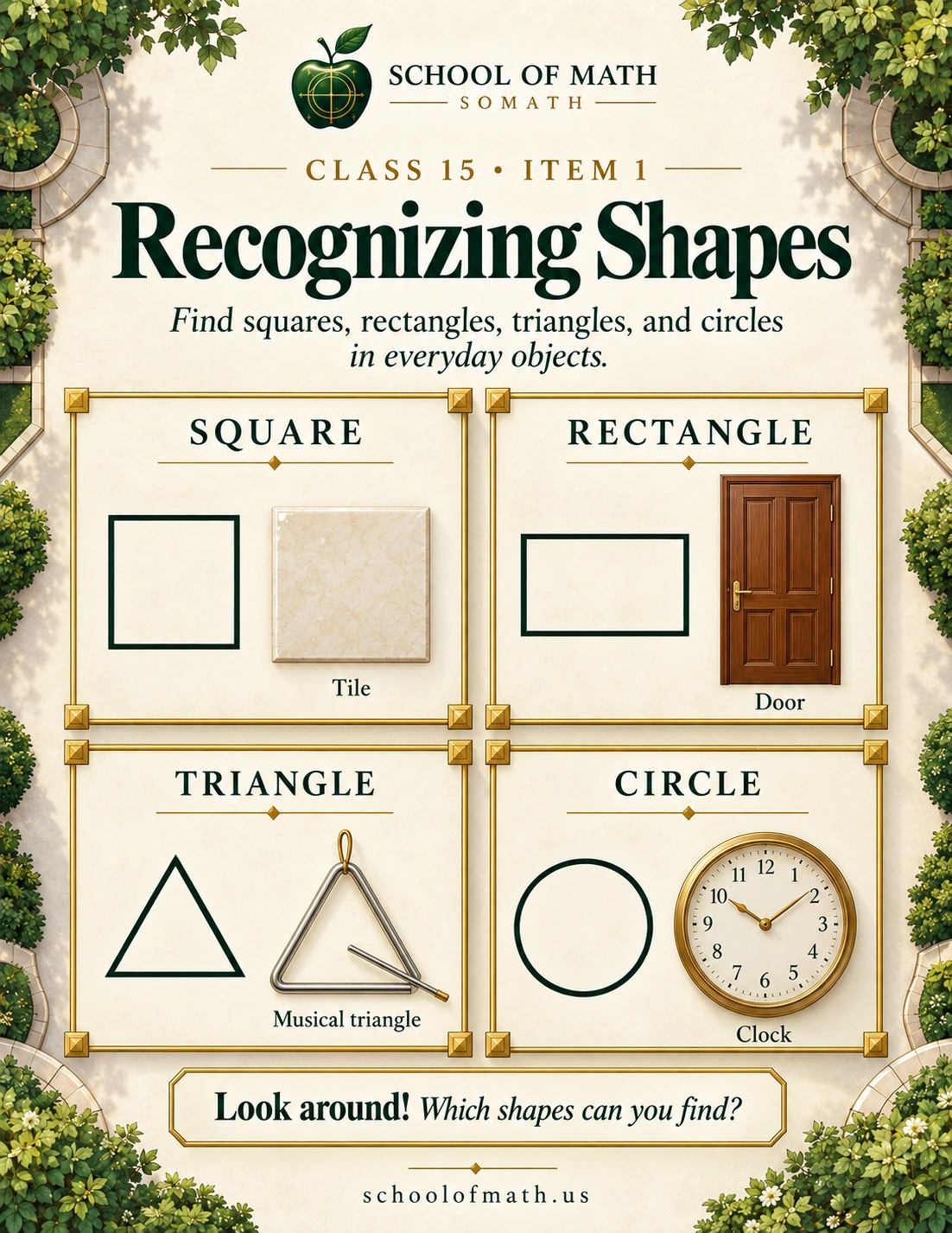
A shape tells us about an outline. We can look at the flat face of an object, trace its boundary, and compare it with a square, rectangle, triangle, or circle. A real object is not the same thing as a flat shape: a can is three-dimensional, but its flat top may look like a circle.
Look carefully instead of guessing from the object’s name. A window might be a square, a rectangle, or a circle. Describe the outline you can actually see. Start with straight or curved edges, then count the corners.
Try it yourself: five questions
Q1 Practice 1 of 5
A round button has a smooth outline with no corners. Which shape does its outline resemble?
Answer
A circle.
- A circle has a curved boundary and no corners.
Q2 Practice 2 of 5
A bookmark has four square corners and two long sides opposite each other. Its other two sides are shorter. Name its shape.
Answer
A rectangle, but not a square.
- It has four square corners. Its sides are not all equal.
Q3 Practice 3 of 5
A paper flag is a closed shape with three straight sides. What shape is it?
Answer
A triangle.
- Count three sides and three corners.
Q4 Practice 4 of 5
A sticker has four equal straight sides and four square corners. What is its most specific name?
Answer
A square.
- Four equal sides and four square corners identify a square. It is also a rectangle.
Q5 Practice 5 of 5
Find a flat object nearby. Draw its outline and name the shape it resembles.
Answer
Answers vary; for example, the front of a notebook may resemble a rectangle.
- Trace or imagine the outline. Use its sides and corners to explain your name.
Sides and vertices
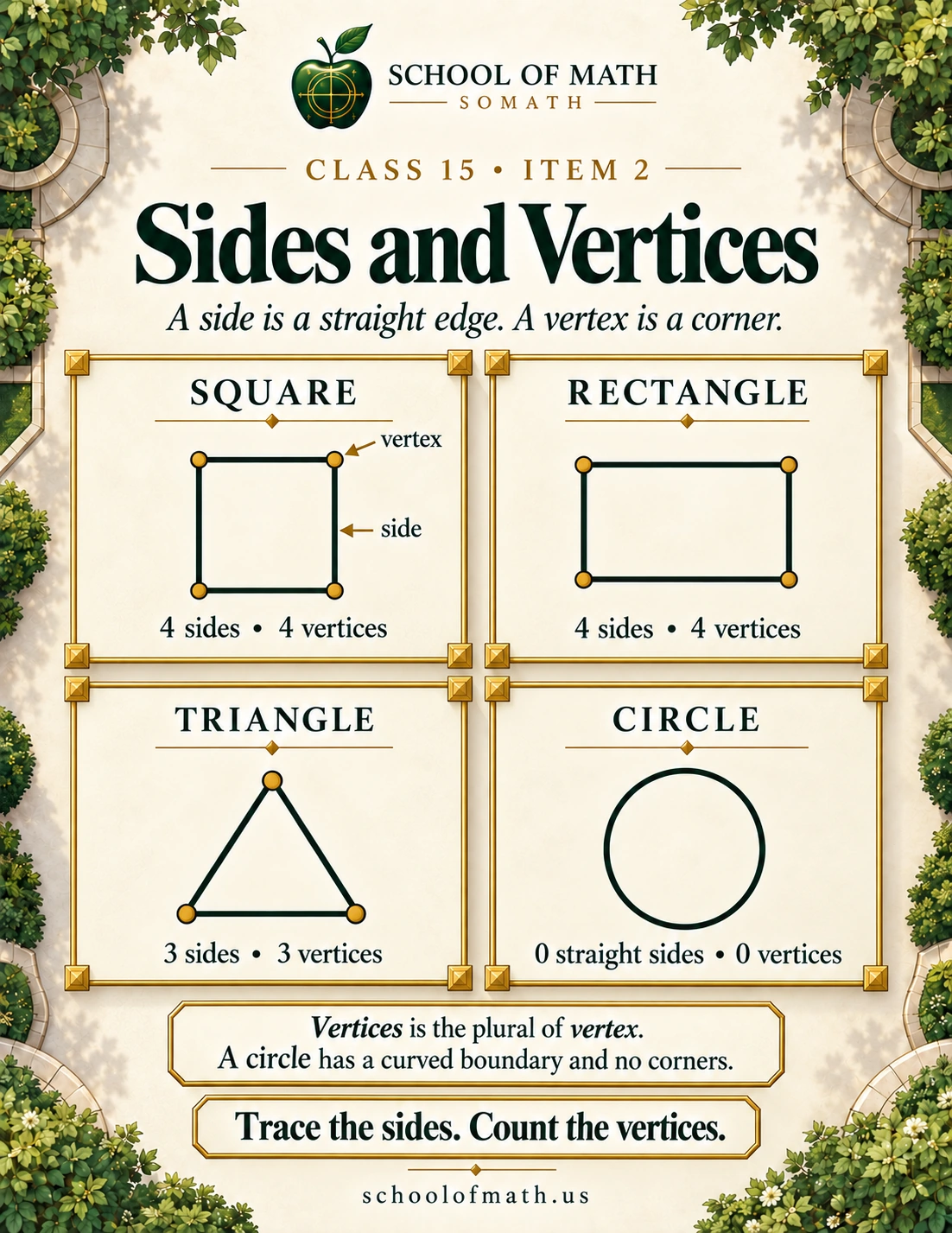
A side is a straight part of a shape’s boundary. A vertex is a corner where two sides meet; the plural is vertices. Move a finger around the outline and count each side and each corner once.
Triangles have three sides and three vertices. Squares and rectangles have four sides and four vertices. A circle has one continuous curved boundary, but no straight sides and no vertices. Counting four sides alone does not prove that a shape is a rectangle: the corners must also be square corners.
Try it yourself: five questions
Q6 Practice 1 of 5
Draw a triangle. Put a dot on each vertex. How many dots do you need?
Answer
3 dots.
- A triangle has three vertices, so each corner gets one dot.
Q7 Practice 2 of 5
A rectangle has one side colored red. How many sides have not been colored?
Answer
3 sides.
- A rectangle has four sides. Four minus one is three.
Q8 Practice 3 of 5
How many vertices does a circle have? Explain.
Answer
0 vertices.
- Its boundary curves smoothly and has no corners.
Q9 Practice 4 of 5
Lena draws two separate triangles. How many vertices do they have altogether?
Answer
6 vertices.
- Each triangle has three vertices. Add 3 + 3 = 6.
Q10 Practice 5 of 5
A closed shape has four straight sides, but one corner is not a square corner. Can it be a rectangle?
Answer
No.
- Every rectangle must have four square corners. Four sides alone are not enough.
Squares: equal sides and square corners
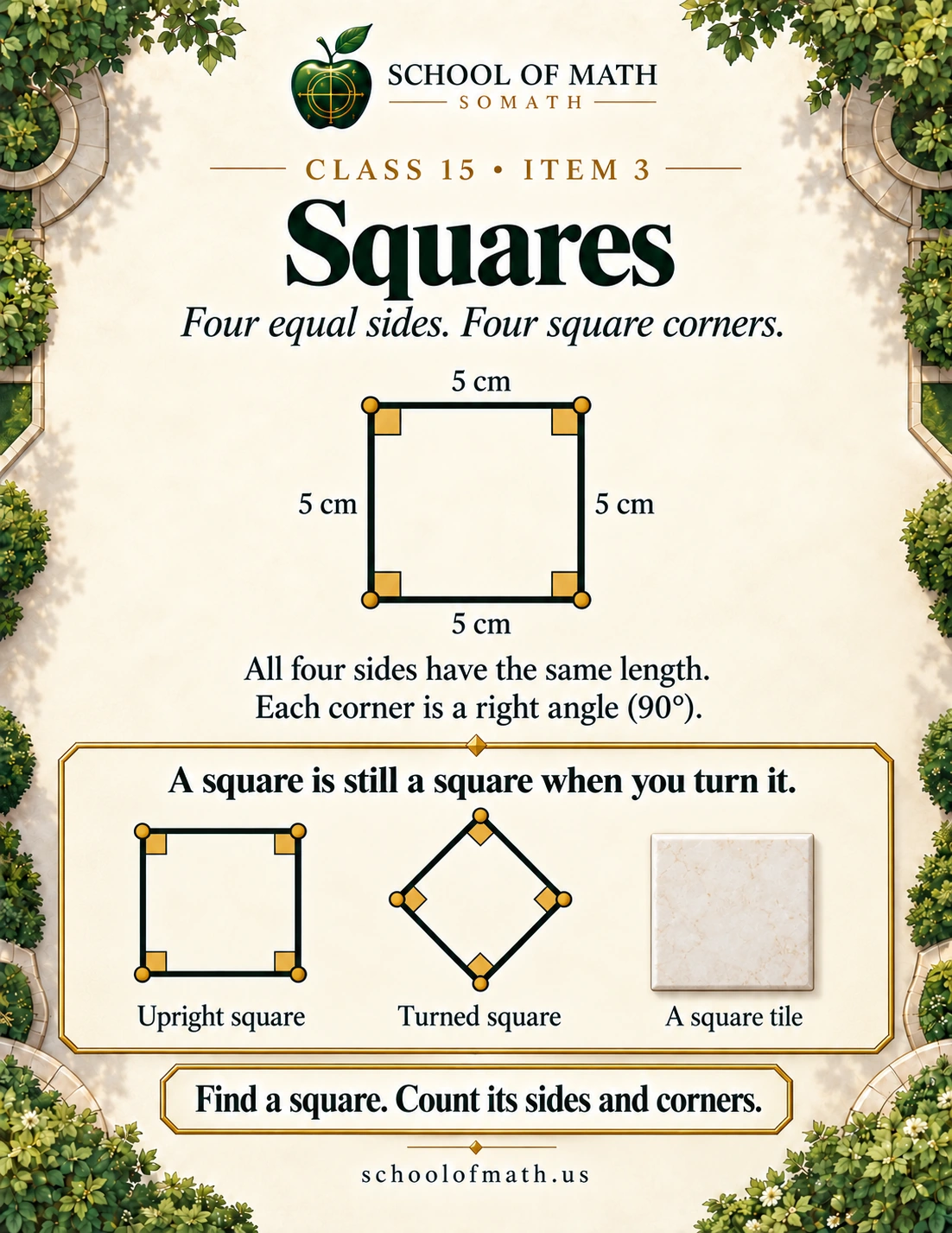
A square has four equal straight sides and four square corners. A square corner is also called a right angle; it matches the corner of an ordinary sheet of paper. We check both the sides and the corners.
Turning a square, making it bigger, or coloring it does not change its shape. A square resting on one corner is still a square. A shape with four equal sides but slanted, non-square corners is not a square.
Try it yourself: five questions
Q11 Practice 1 of 5
One side of a square is 3 centimeters long. How long is each of its other sides?
Answer
3 centimeters.
- All four sides of a square have the same length.
Q12 Practice 2 of 5
Draw a square. Then draw another square resting on one corner. Did turning it change its name?
Answer
No; both are squares.
- The turn changes direction, not side lengths or corner shapes.
Q13 Practice 3 of 5
A shape has four square corners. Its side lengths go 2, 5, 2, 5 centimeters around the edge. Is it a square?
Answer
No. It is a rectangle that is not a square.
- A square needs four equal sides; 2 and 5 are different.
Q14 Practice 4 of 5
A closed shape has four equal sides but no square corners. Is it a square?
Answer
No.
- Equal sides are only one requirement. A square must also have four square corners.
Q15 Practice 5 of 5
Three separate square cards lie on a table. How many corners do the cards have altogether?
Answer
12 corners.
- Count 4 + 4 + 4 = 12 corners.
Rectangles and the square connection
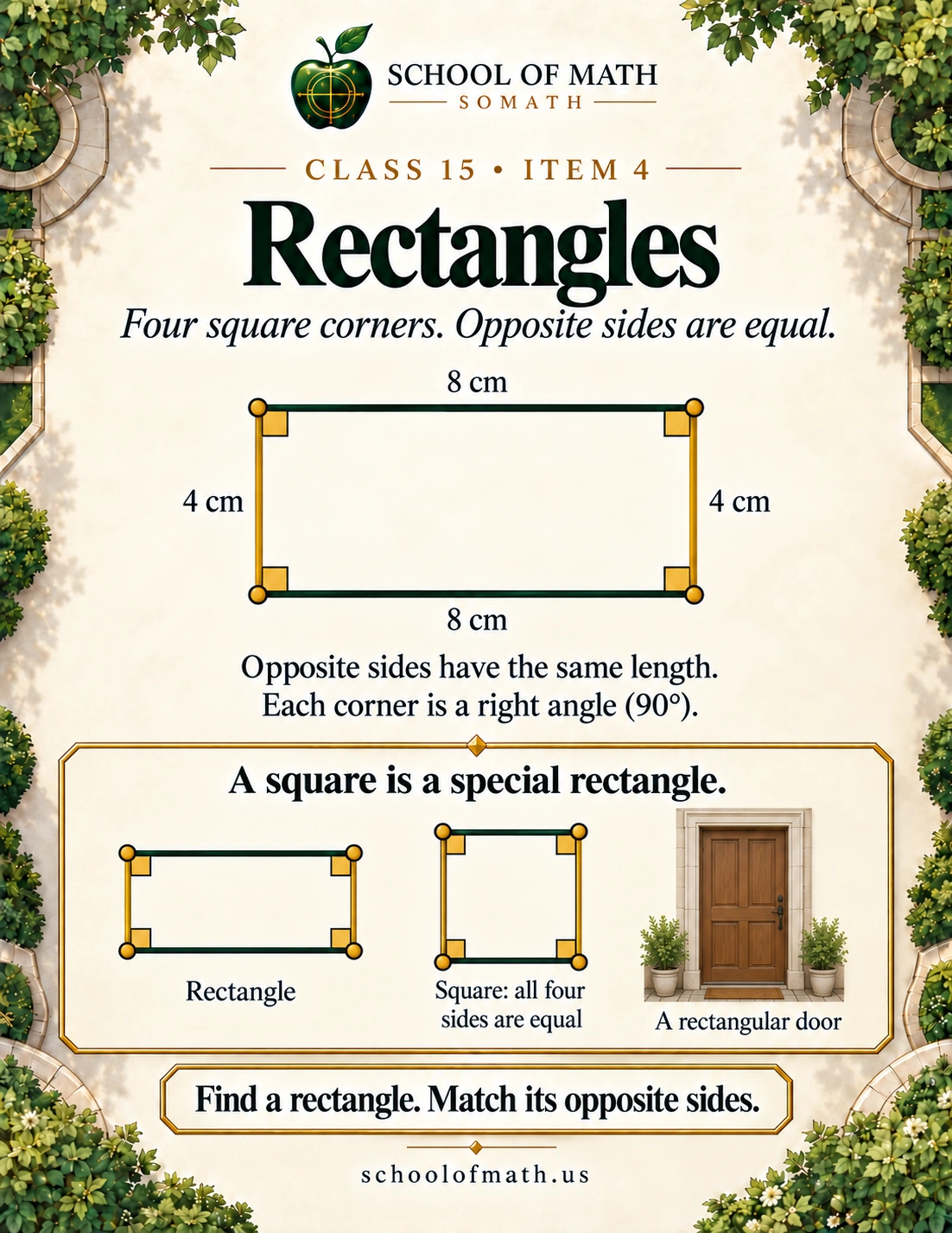
A rectangle has four straight sides and four square corners. Opposite sides are equal in length. The side across from the top matches the top; the side across from the left matches the left.
A square is a special rectangle with all four sides equal. When a question asks for all rectangles, include squares. When it asks for rectangles that are not squares, leave the squares out. A rectangle does not have to lie sideways: turning it upright changes nothing about its properties.
Try it yourself: five questions
Q16 Practice 1 of 5
A rectangle has a top side 7 centimeters long and a left side 3 centimeters long. How long are the bottom and right sides?
Answer
Bottom: 7 centimeters. Right: 3 centimeters.
- Opposite sides of a rectangle are equal.
Q17 Practice 2 of 5
A tall rectangle is turned so it lies sideways. Is it still a rectangle?
Answer
Yes.
- It still has the same four sides and four square corners.
Q18 Practice 3 of 5
Can a square go in a group labeled “all rectangles”? Explain.
Answer
Yes.
- A square meets every rectangle rule: four straight sides and four square corners.
Q19 Practice 4 of 5
A tray has 2 squares and 3 rectangles that are not squares. How many rectangles are there in all?
Answer
5 rectangles.
- Include the two squares: 2 + 3 = 5.
Q20 Practice 5 of 5
A shape has four square corners, two sides 6 centimeters long, and two sides 2 centimeters long. Is it a square, a rectangle that is not a square, or neither?
Answer
A rectangle that is not a square.
- It has four square corners, but its four sides are not all equal.
Triangles in different positions
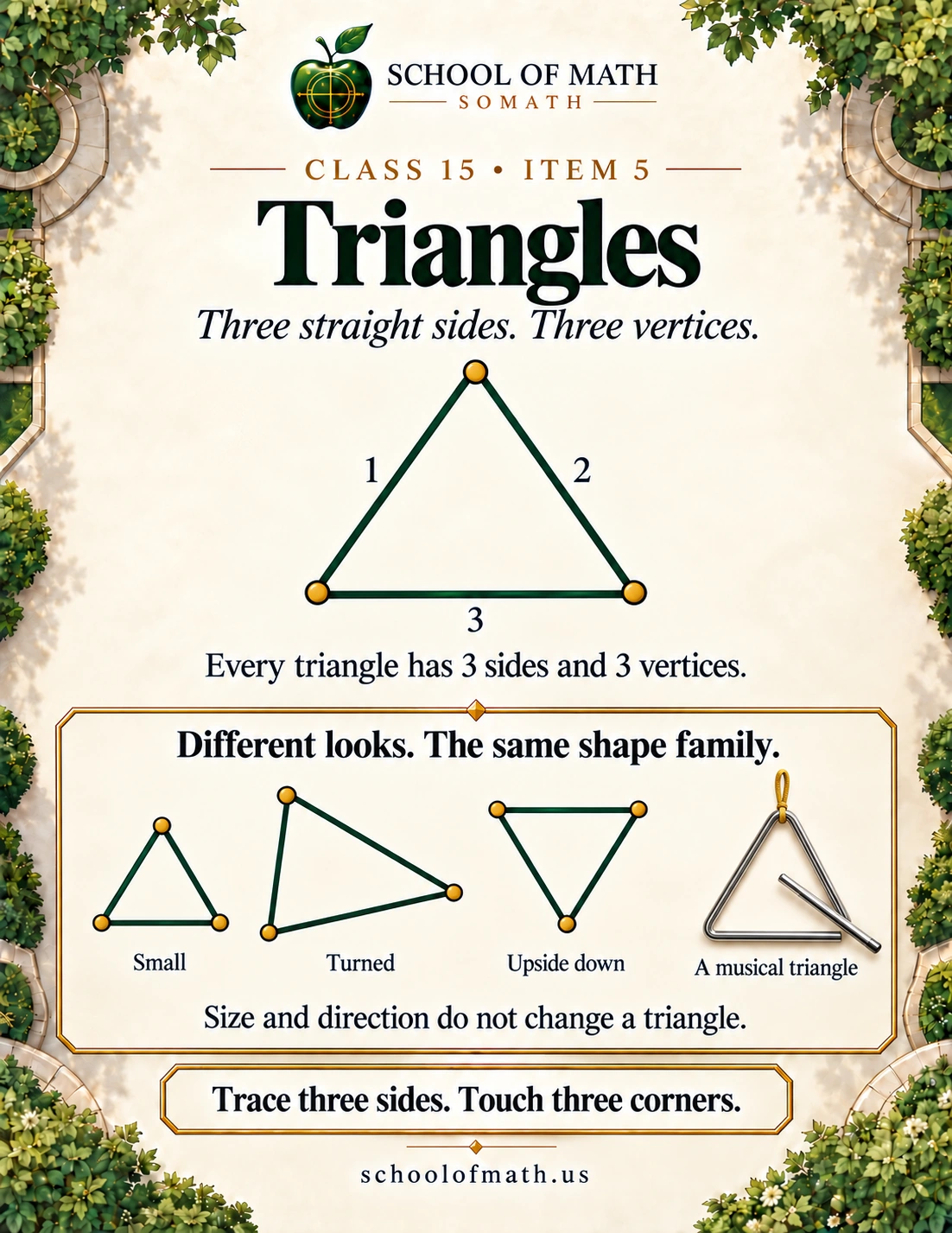
A triangle is a closed flat shape with three straight sides and three vertices. Its sides do not all need to have the same length. Triangles can look tall, wide, narrow, or tilted.
A shape must close up to be a triangle. Three sticks with a gap do not yet make a closed triangle. Everyday objects may resemble triangles even when their outlines have small gaps or rounded edges; the mathematical shape is an ideal outline.
Try it yourself: five questions
Q21 Practice 1 of 5
Draw a narrow triangle and a wide triangle. How many sides does each have?
Answer
3 sides each.
- Width changes how a triangle looks, not its number of sides.
Q22 Practice 2 of 5
A triangle points to the left instead of upward. Is it still a triangle?
Answer
Yes.
- It remains a closed shape with three straight sides and three vertices.
Q23 Practice 3 of 5
Three sticks almost make a triangle, but there is a gap at one corner. Is the outline a closed triangle yet?
Answer
No.
- Move the sticks until their ends meet and the boundary is closed.
Q24 Practice 4 of 5
Do all three sides of every triangle have to be equal?
Answer
No.
- A triangle needs three straight sides, but those sides can have different lengths.
Q25 Practice 5 of 5
A square and a triangle are drawn separately. Which has more vertices, and how many more?
Answer
The square has 1 more vertex.
- A square has four; a triangle has three. Compare 4 − 3 = 1.
Circles and curved boundaries
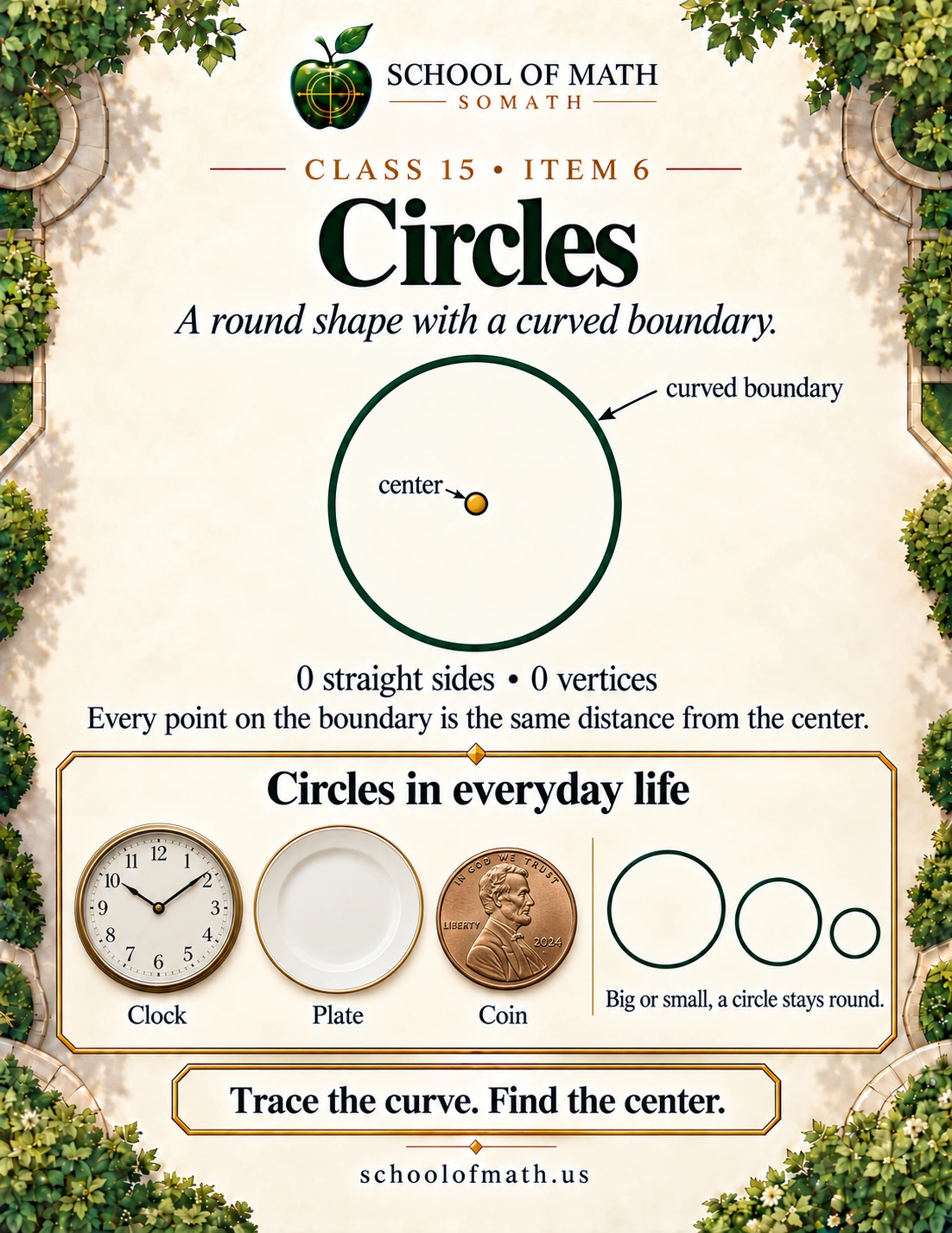
A circle’s boundary is round and curved. Every point on that boundary is the same distance from its center. A circle has no straight sides and no vertices.
A stretched oval is not a circle: points on its boundary are not all the same distance from its center. To identify a circle on a real object, look straight at its flat face. A round lid seen at a slant may look oval even though the lid’s face is circular.
Try it yourself: five questions
Q26 Practice 1 of 5
Draw a circle and mark a dot near its center. Does the boundary have any corners?
Answer
No. A circle has no corners.
- Follow the smooth curved boundary all the way around.
Q27 Practice 2 of 5
A smooth outline is stretched like an egg. Must it be a circle because it has no corners?
Answer
No.
- A circle is equally round in every direction from its center. Having no corners is not enough.
Q28 Practice 3 of 5
Which has straight sides: a circle or a triangle?
Answer
The triangle.
- A triangle has three straight sides. A circle has no straight sides.
Q29 Practice 4 of 5
A drawing shows a large circle and a small circle. How many vertices do they have altogether?
Answer
0 vertices.
- Neither circle has a vertex: 0 + 0 = 0.
Q30 Practice 5 of 5
A round lid is turned halfway around on a table. Does its circular outline become a different shape?
Answer
No; it remains a circle.
- Turning the lid does not change its boundary.
Comparing and sorting shapes
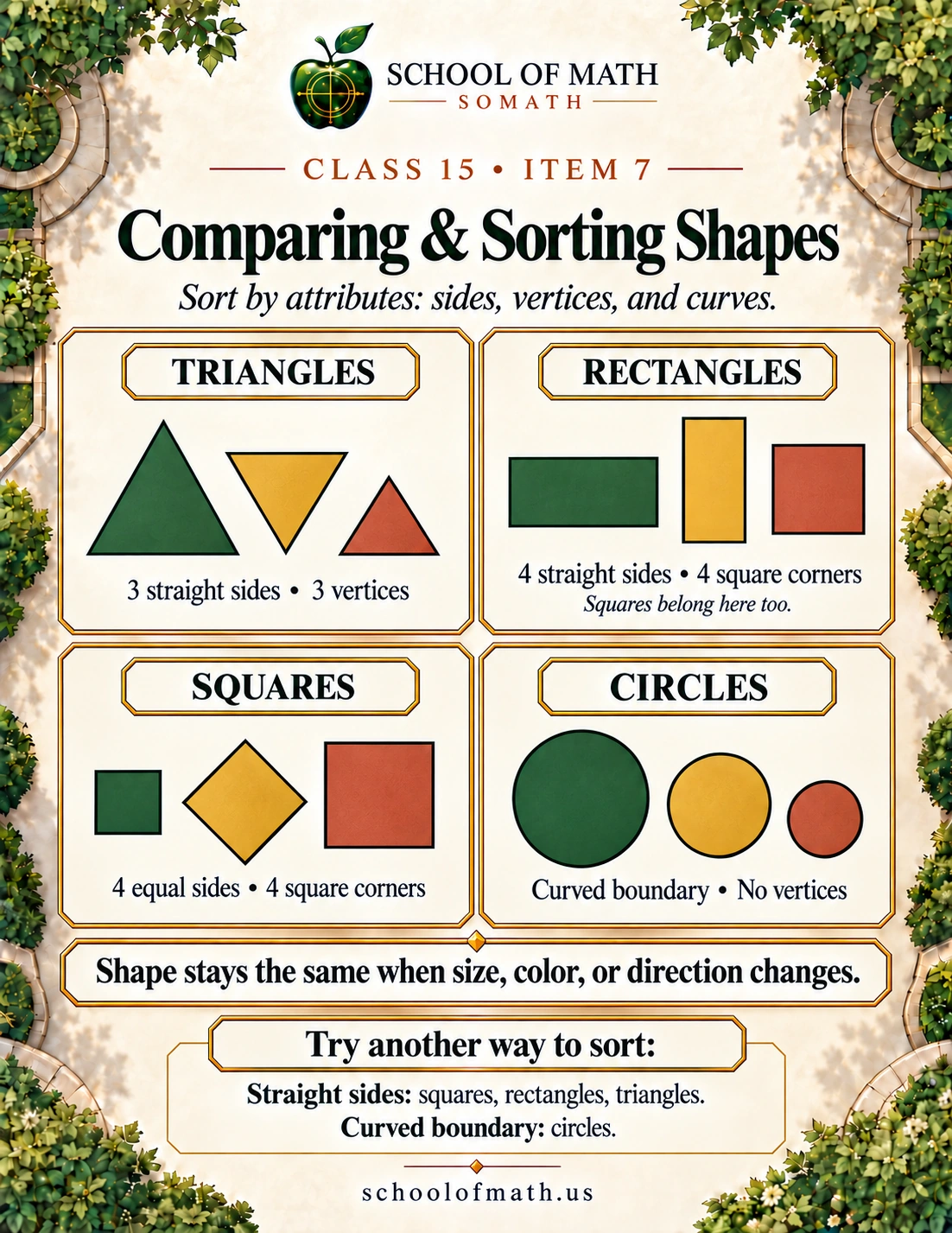
Sort shapes using a rule, such as “has three sides,” “has four square corners,” or “has no vertices.” Color and size can make useful sorting games, but they do not determine a shape’s mathematical name.
Some groups overlap. Every square belongs in the rectangle group too. If you need separate groups with no overlap, use the labels squares, rectangles that are not squares, triangles, and circles. Always state your sorting rule before you start.
Try it yourself: five questions
Q31 Practice 1 of 5
You have a blue triangle, a red triangle, and a blue circle. Which two belong together under the rule “three straight sides”?
Answer
The blue triangle and the red triangle.
- Both triangles meet the rule. Their colors do not matter.
Q32 Practice 2 of 5
Sort a square, a circle, and a triangle into “has vertices” and “has no vertices.”
Answer
Has vertices: square and triangle. Has no vertices: circle.
- Count the corners of each shape.
Q33 Practice 3 of 5
You have 3 squares, 2 rectangles that are not squares, and 1 circle. How many have four square corners?
Answer
5 shapes.
- The three squares and two other rectangles qualify: 3 + 2 = 5.
Q34 Practice 4 of 5
A square fits both “four equal sides” and “four square corners.” Is that a sorting mistake?
Answer
No.
- One shape can satisfy more than one rule. The groups may overlap.
Q35 Practice 5 of 5
Choose the better rule for naming triangles: “is green” or “is closed with three straight sides.” Explain.
Answer
“Is closed with three straight sides.”
- Triangles can be any color. Their sides and closed boundary define them.
Building and combining shapes
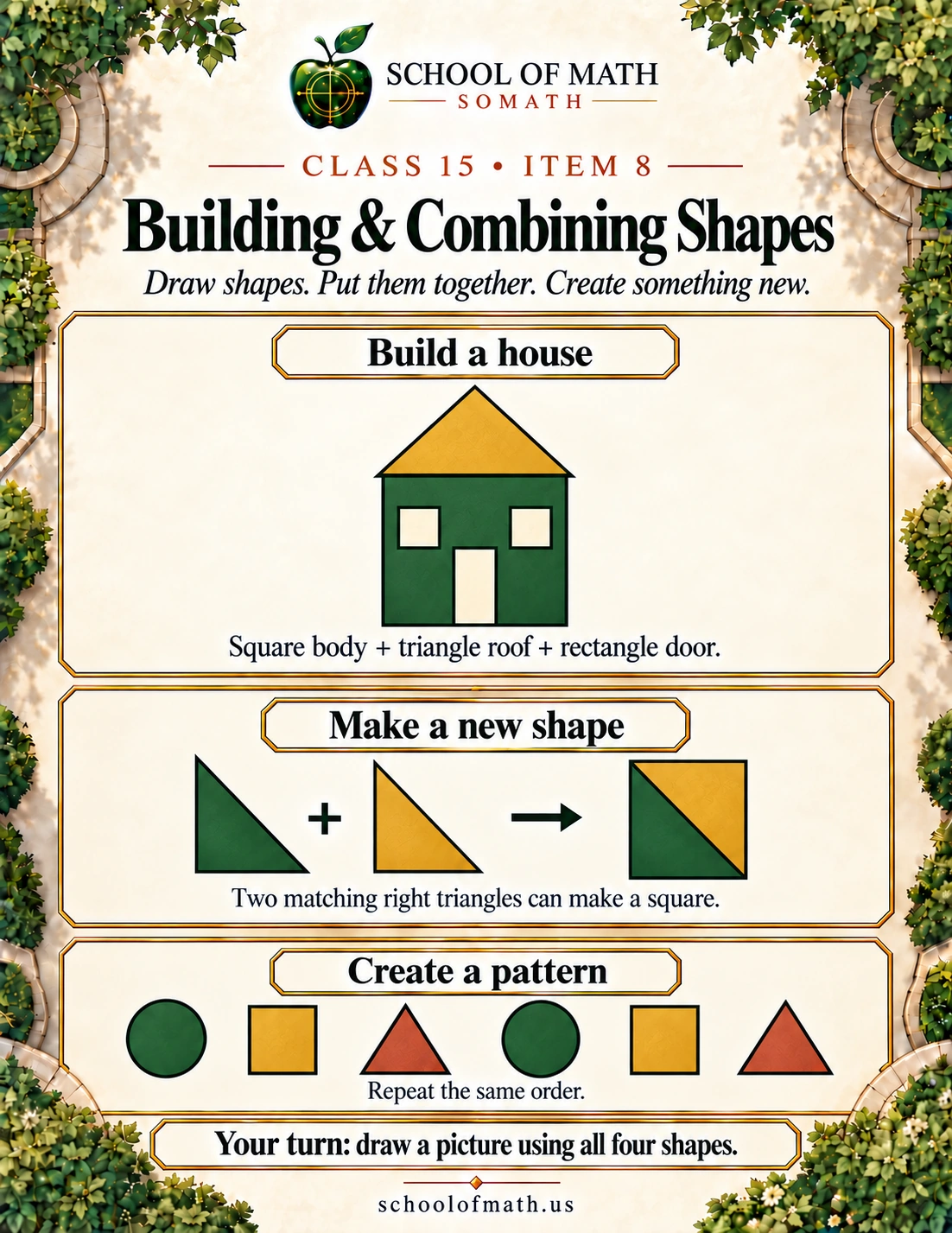
Small shapes can be arranged to build a larger picture. Name each piece before you combine it. A picture of a rocket might use a rectangular body, triangular fins, and a circular window.
Cut a square along a diagonal, from one corner to the opposite corner. The two pieces are matching triangles, and putting them back together makes the original square. Not every pair of triangles will make a square. When pieces touch, count the original pieces separately unless the question asks for the outside shape.
Try it yourself: five questions
Q36 Practice 1 of 5
A paper rocket uses 1 rectangle, 2 triangles, and 1 circle. How many pieces does it use?
Answer
4 pieces.
- Add 1 + 2 + 1 = 4.
Q37 Practice 2 of 5
A square is cut along a diagonal into two pieces. What shape is each piece?
Answer
A triangle.
- Each piece has three straight sides, including the cut edge.
Q38 Practice 3 of 5
You put those two pieces back exactly as they were before the cut. What outside shape do they make?
Answer
A square.
- Rejoining the matching cut edges restores the original outline.
Q39 Practice 4 of 5
Two equal square tiles touch along a full side, with no overlap. What is the outside shape of the pair?
Answer
A rectangle that is not a square.
- The pair is twice as long as one tile but only one tile high. Its four outside corners are square corners.
Q40 Practice 5 of 5
Continue this repeating pattern with the next three shapes: triangle, circle, circle, triangle, circle, circle.
Answer
Triangle, circle, circle.
- The repeating group contains one triangle followed by two circles.
Homework review
Review everyday shapes, sides and vertices, squares, rectangles, triangles, circles, sorting, and combining shapes. There is one review question for each image, in the same order.
R1 Review image 1 of 8
A flat gift tag is closed and has three straight sides. Name the shape and one clue you used.
Answer
A triangle.
- The closed outline has exactly three straight sides.
R2 Review image 2 of 8
Draw a rectangle and label one side and one vertex. How many of each does it have?
Answer
4 sides and 4 vertices.
- A side is a straight edge; a vertex is a corner.
R3 Review image 3 of 8
A square has sides 4 centimeters long and is turned onto one corner. What is its shape now, and how long is each side?
Answer
Still a square; each side is 4 centimeters.
- Turning does not change the side lengths or the four square corners.
R4 Review image 4 of 8
A collection has 4 squares and 2 rectangles that are not squares. How many shapes belong to the group “all rectangles”?
Answer
6 shapes.
- Squares are rectangles too. Add 4 + 2 = 6.
R5 Review image 5 of 8
A closed triangle is wide and points downward. How many sides and vertices does it have?
Answer
3 sides and 3 vertices.
- Position and width do not change the defining properties.
R6 Review image 6 of 8
A circle and a stretched oval both have no corners. Are they both circles? Explain.
Answer
No; the stretched oval is not a circle.
- All points on a circle’s boundary are equally far from its center; that is not true of the stretched oval.
R7 Review image 7 of 8
Sort these into “four square corners” and “not four square corners”: square, triangle, circle, rectangle that is not a square.
Answer
Four square corners: square and rectangle. Not four square corners: triangle and circle.
- Check each shape against the same rule.
R8 Review image 8 of 8
Two identical square tiles meet along a full side. Draw their outside outline and name it.
Answer
A rectangle that is not a square.
- The outside has four square corners and two long sides opposite two shorter sides.
Homework word problems
These twelve stories build from identifying a shape to sorting pieces, counting corners, following patterns, and solving a short two-step problem. Draw the shapes when that helps.
W1 Homework word problem 1 of 12
Nora puts a round coaster on her desk. Its outline is equally round in every direction from its center. What shape does the outline resemble?
Answer
A circle.
- It has a curved boundary with no corners, equally far from the center.
W2 Homework word problem 2 of 12
Leo makes a closed paper sail with three straight edges. What shape is his sail, and how many corners does it have?
Answer
A triangle with 3 corners.
- Three straight sides form a triangle; its three meeting points are vertices.
W3 Homework word problem 3 of 12
Mia turns a square napkin so one corner points toward her. Her friend calls it a new shape. Is her friend correct?
Answer
No; it is still a square.
- Turning preserves its four equal sides and four square corners.
W4 Homework word problem 4 of 12
A rectangular photo has a top edge 9 centimeters long and a left edge 6 centimeters long. What are the lengths of its bottom and right edges?
Answer
Bottom: 9 centimeters. Right: 6 centimeters.
- Opposite edges of a rectangle match.
W5 Homework word problem 5 of 12
Sam places 3 separate triangular signs on a table. How many corners do the signs have altogether?
Answer
9 corners.
- Each sign has three corners. Add 3 + 3 + 3 = 9.
W6 Homework word problem 6 of 12
A craft box holds 2 squares, 3 triangles, and 4 circles. How many pieces have at least one vertex?
Answer
5 pieces.
- Squares and triangles have vertices. Circles do not. Add 2 + 3 = 5.
W7 Homework word problem 7 of 12
A teacher puts 4 squares and 3 rectangles that are not squares in one tray. How many pieces should go into a group labeled “all rectangles”?
Answer
7 pieces.
- Include the squares because they also have four square corners: 4 + 3 = 7.
W8 Homework word problem 8 of 12
A robot picture uses 1 square head, 1 rectangular body, 2 rectangular arms, and 2 circular eyes. How many pieces are used? How many of them are rectangles, including squares?
Answer
6 pieces in all; 4 are rectangles.
- All pieces: 1 + 1 + 2 + 2 = 6. Rectangles: square head, body, and two arms, so 1 + 1 + 2 = 4.
W9 Homework word problem 9 of 12
A banner repeats square, triangle, circle. Ava adds two complete repeats. How many shapes does she add, and how many are triangles?
Answer
6 shapes, including 2 triangles.
- Two groups of three make 6. Each group contains one triangle, so there are 2 triangles.
W10 Homework word problem 10 of 12
Ben has 3 square sheets. He cuts each sheet once along a diagonal. How many triangular pieces does he get? How many whole squares can he rebuild using all the pieces?
Answer
6 triangles; 3 whole squares.
- Each sheet makes two triangles: 2 + 2 + 2 = 6. Rejoin each original pair to rebuild three squares.
W11 Homework word problem 11 of 12
A mosaic uses 2 separate square pieces and 2 separate triangle pieces. Before gluing them down, Ella counts all their corners. How many corners does she count?
Answer
14 corners.
- The squares contribute 4 + 4 = 8. The triangles contribute 3 + 3 = 6. Altogether, 8 + 6 = 14.
W12 Homework word problem 12 of 12
A bag holds 8 shape cards. Three are circles and two are triangles. All the remaining cards are squares. How many squares are there? How many vertices do those square cards have altogether?
Answer
3 squares with 12 vertices altogether.
- There are 3 + 2 = 5 cards that are not squares. Then 8 − 5 = 3 squares. Their corners total 4 + 4 + 4 = 12.
Quick questions and answers
How can children recognize squares, rectangles, triangles, and circles?
Look at the outline. Count straight sides and corners, then check whether the sides are equal and the corners are square. A circle has a curved boundary with no straight sides or corners.
Is a square also a rectangle?
Yes. A rectangle has four straight sides and four square corners. A square meets these rules and also has four equal sides. Include squares when counting all rectangles.
Does turning a shape change its name?
No. Turning, recoloring, or resizing a shape does not change its defining properties. A square resting on one corner is still a square.
How many sides and vertices does a circle have?
A circle has no straight sides and no vertices. Its boundary is one continuous curve, with every point the same distance from its center.
Can any two triangles make a square?
No. Two triangles made by cutting a square along a diagonal can be rejoined to make that square. Other pairs of triangles may not make a square.
What practice and homework are included in Class 15?
The lesson has eight teaching images, 40 practice questions, eight homework review questions, and twelve homework word problems. All 60 questions have hidden answers online. The 22-page printable workbook uses the supplied cover and includes blank answer space, without exercise solutions.