Little Newtons · Class 16 · Grades 1–2
Patterns and Sorting with Numbers and Shapes
Sorting puts numbers or shapes into groups that follow a rule. A pattern follows a rule too: it may repeat a small unit or change by the same amount at each step. Look closely, say the rule, and check that every part fits.
Study the eight images and try five new questions after each image. Finish with eight homework review questions and twelve homework word problems: 20 homework questions and 60 questions altogether. Try each question before selecting its blue Answer control.
Part of Little Newtons at SOMATH. Use counters, buttons, drawings, or spoken explanations as you practice. An adult may read the questions aloud. View the class schedule or book a free evaluation to find the right starting point.
Download the student workbook (PDF)22 pages · Supplied cover, eight teaching images, and all 60 questions. Each image is followed by five practice questions; homework follows with up to five questions per page.Numbered pages, generous blank answer space, and no exercise solutions or writing lines.
Sorting by attributes
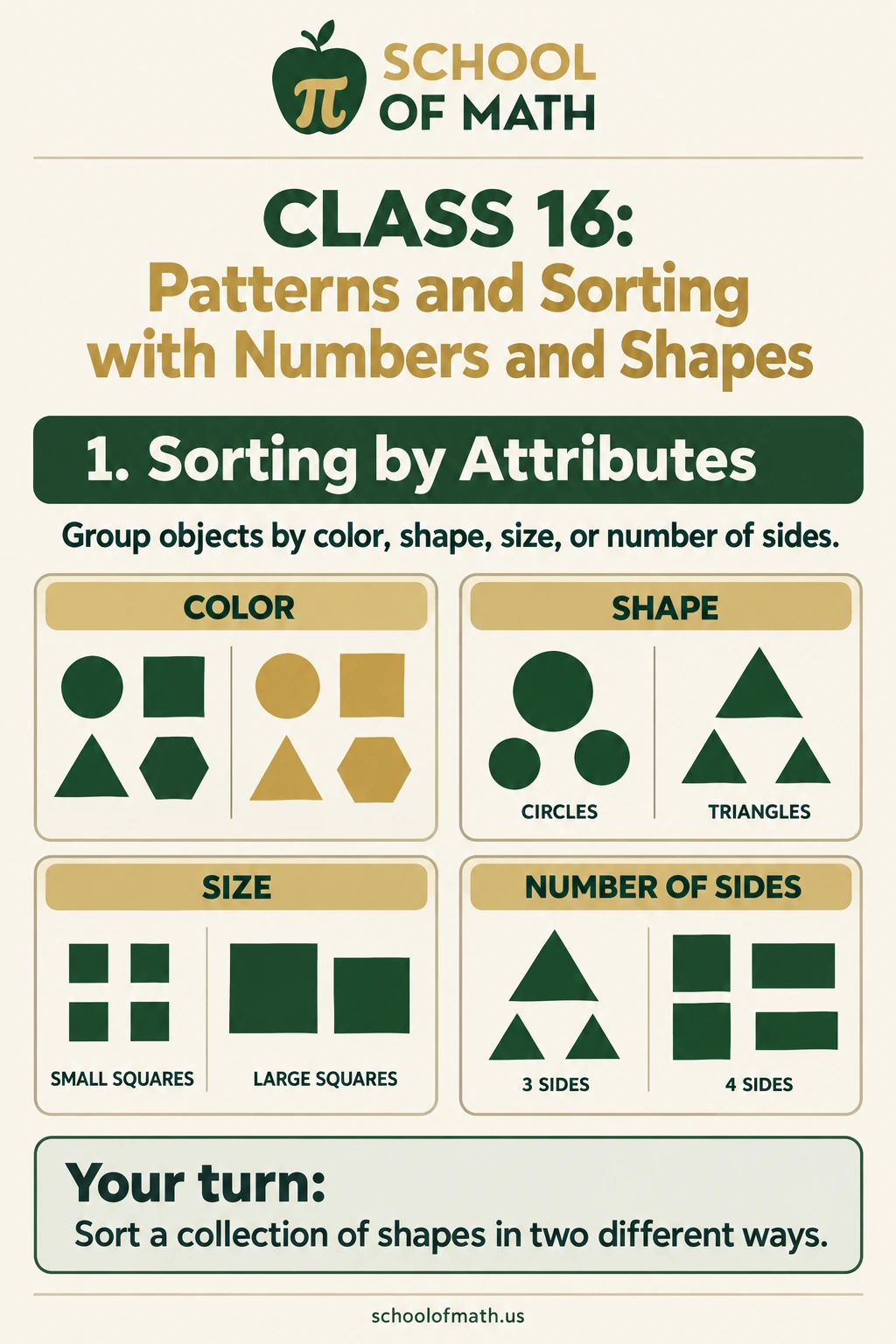
An attribute is something you can notice about an object, such as its color, shape, or size. Sorting means putting objects into groups that follow a rule. Say your rule before you start, then check every object against it.
The same collection can be sorted in different ways. A red triangle and a red circle go together when the rule is “red,” but they go into different groups when the rule is about shape. Turning a shape does not change how many sides it has.
Use group names that are clear. A square has four sides, so it belongs with other four-sided shapes. A circle has no straight sides. If you sort by more than one attribute, such as “small and blue,” an object must match both.
Try it yourself: five questions
Q1 Practice 1 of 5
You have a red circle, a blue circle, a red triangle, and a blue square. Sort them into a red group and a blue group.
Answer
Red: circle and triangle. Blue: circle and square.
Look only at color for this sort. Different shapes can belong to the same color group.
Q2 Practice 2 of 5
Sort a circle, a triangle, a square, and a rectangle that is not a square into groups with 0, 3, and 4 straight sides.
Answer
0: circle. 3: triangle. 4: square and rectangle.
Count straight sides, not curved boundaries. Both the square and the other rectangle have four straight sides.
Q3 Practice 3 of 5
A collection has a small triangle, a large triangle, a small circle, and a large circle. Sort by size.
Answer
Small: triangle and circle. Large: triangle and circle.
The size rule does not depend on the shape. Use the given small and large labels consistently.
Q4 Practice 4 of 5
A square card is turned so that one corner points up. Does it still belong in the four-sided group?
Answer
Yes.
Turning the card changes its direction, not its shape. It still has four straight sides.
Q5 Practice 5 of 5
Choose everything that belongs in a group labeled “small and blue”: a small blue square, a large blue square, a small red circle, and a small blue triangle.
Answer
The small blue square and the small blue triangle.
Each chosen object matches both rules. The large blue square fails the size rule; the small red circle fails the color rule.
Sorting numbers
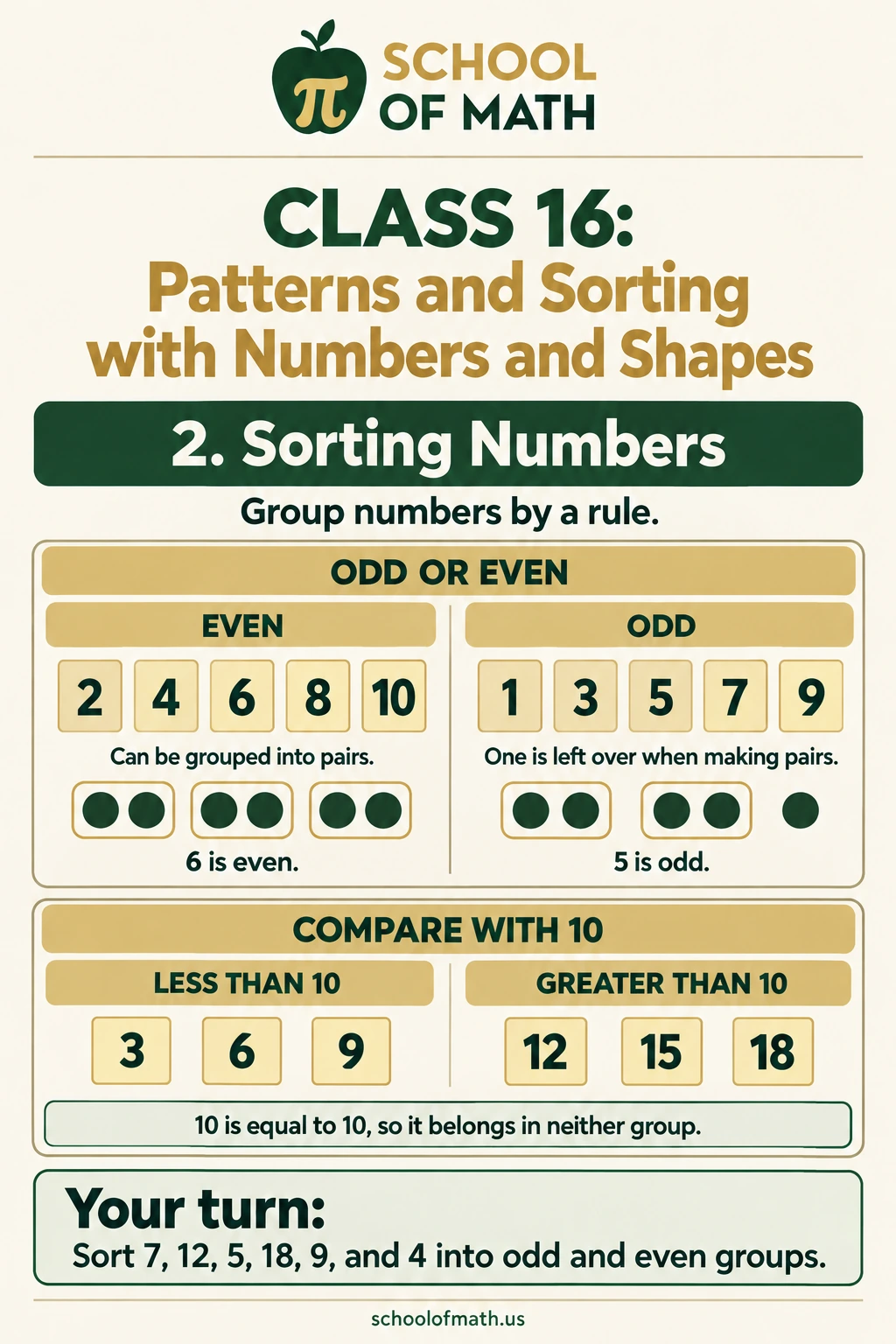
Even numbers can be arranged into pairs with none left over. Odd numbers leave one unpaired object. You can draw dots and circle them in twos to check a small number.
You can also sort numbers by comparing them with a chosen number. For example, use the groups “less than 12,” “equal to 12,” and “greater than 12.” Twelve belongs in the equal group, not in either of the other two.
A number can match more than one description. Fourteen is even and greater than 12. When you change the sorting rule, check the whole collection again instead of keeping the old groups.
Try it yourself: five questions
Q6 Practice 1 of 5
Sort 3, 8, 11, and 16 into odd and even groups.
Answer
Odd: 3, 11. Even: 8, 16.
Eight and sixteen make complete pairs. Three and eleven each leave one object unpaired.
Q7 Practice 2 of 5
Draw 7 dots and circle pairs. Is 7 odd or even? How many dots are left unpaired?
Answer
Odd; 1 dot is unpaired.
Make three pairs using six dots. The seventh dot has no partner.
Q8 Practice 3 of 5
Sort 4, 10, 13, and 19 into “less than 10,” “equal to 10,” and “greater than 10.”
Answer
Less: 4. Equal: 10. Greater: 13, 19.
Compare each number with 10. Ten needs its own equal group.
Q9 Practice 4 of 5
From 6, 10, 14, and 17, choose every number that is even and greater than 10.
Answer
14 only.
Six and ten are even but not greater than 10. Seventeen is greater than 10 but is odd.
Q10 Practice 5 of 5
A tray has 9 counters. One more counter is added. Is the new total odd or even? Explain with pairs.
Answer
10 counters; even.
Adding one gives the unpaired counter a partner. Ten counters make five complete pairs.
Recognizing repeating patterns
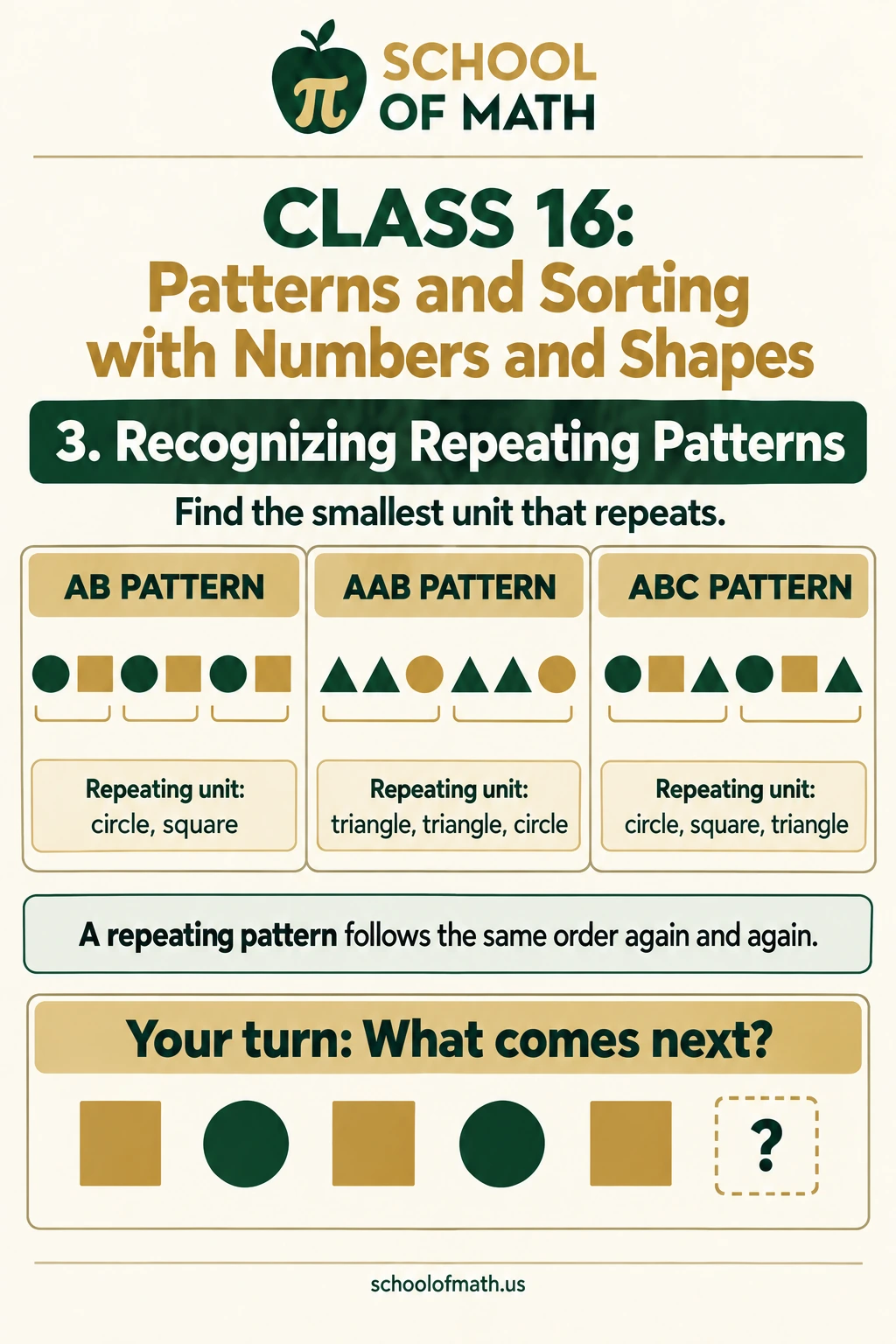
A repeating pattern follows the same small group in the same order again and again. That small group is called the repeating unit. Look for the smallest unit that makes the whole pattern.
Letters can describe the structure. AB uses two different parts; AAB repeats the first part twice before the second; ABC uses three different parts. The letters stand for objects, sounds, colors, or numbers.
Do not decide from just the last object. Say the whole unit and repeat it from the beginning. A unit must explain every part shown, not just a few nearby items.
Try it yourself: five questions
Q11 Practice 1 of 5
Find the smallest repeating unit: triangle, square, triangle, square, triangle, square.
Answer
triangle, square.
Repeat that two-shape unit three times. It follows an AB pattern.
Q12 Practice 2 of 5
Find the smallest repeating unit: circle, circle, square, circle, circle, square.
Answer
circle, circle, square.
Two circles are followed by one square, and then the unit starts again. This is AAB.
Q13 Practice 3 of 5
Find the smallest repeating unit: square, triangle, circle, square, triangle, circle.
Answer
square, triangle, circle.
All three shapes are needed to make the order repeat. This is ABC.
Q14 Practice 4 of 5
Continue the repeating pattern with two more numbers: 4, 7, 4, 7, 4, __, __.
Answer
7, 4.
The unit is 4, 7. Finish the current unit with 7, then start the next unit with 4.
Q15 Practice 5 of 5
Nora says the smallest unit is “triangle, square, triangle, square” in triangle, square, triangle, square, triangle, square. Is there a smaller unit?
Answer
Yes: triangle, square.
Her four-shape block contains the two-shape unit twice. The smallest unit is just the two different shapes.
Completing missing parts
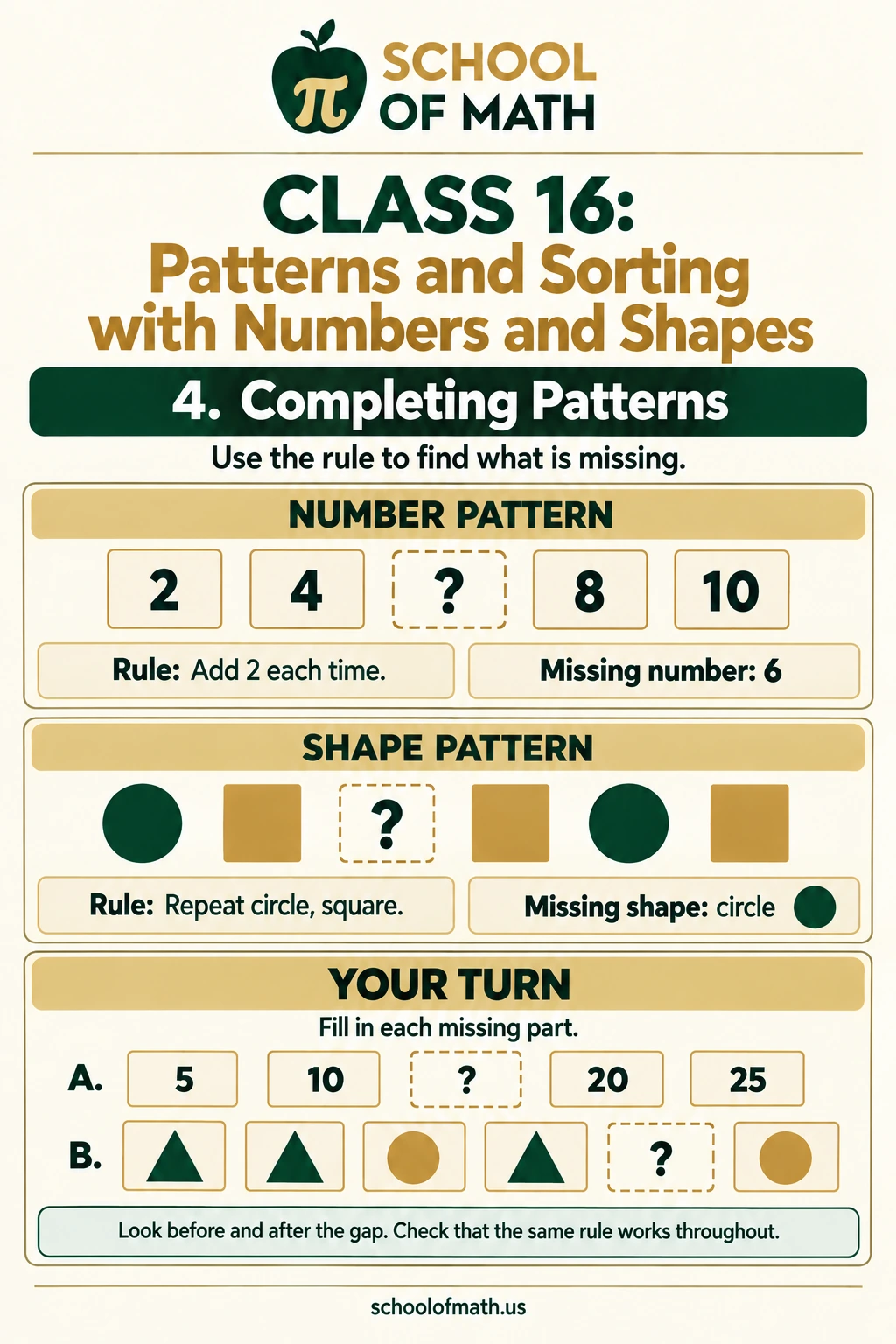
To fill a gap, first use the stated rule or identify the repeating unit. Look before and after the gap. Your missing part must make the same rule work across the whole pattern.
In a number pattern with equal steps, check the amount added or taken away. If the rule is “add 2,” every step must add 2, even when a number is missing.
In a shape pattern, keep each position in the unit. Count through the unit again when it ends. The practice questions give a rule so you can check your answer rather than guess.
Try it yourself: five questions
Q16 Practice 1 of 5
Add 2 each time. Fill the gap: 3, 5, __, 9, 11.
Answer
7.
Five plus two is seven, and seven plus two is nine. The rule works on both sides of the gap.
Q17 Practice 2 of 5
Subtract 2 each time. Fill the gap: 14, 12, __, 8, 6.
Answer
10.
Twelve minus two is ten. Ten minus two is eight, so the next step also works.
Q18 Practice 3 of 5
Repeat “square, triangle.” Fill the gap: square, triangle, square, __, square, triangle.
Answer
triangle.
The fourth position is the second part of the square-triangle unit.
Q19 Practice 4 of 5
Repeat “circle, square, square.” Fill both gaps: circle, __, square, circle, square, __.
Answer
square; square.
Each unit has one circle followed by two squares. Both missing positions need squares.
Q20 Practice 5 of 5
Add 3 each time. Fill both gaps: 2, __, 8, __, 14.
Answer
5 and 11.
The complete pattern is 2, 5, 8, 11, 14. Check that each neighboring pair differs by 3.
Extending number patterns
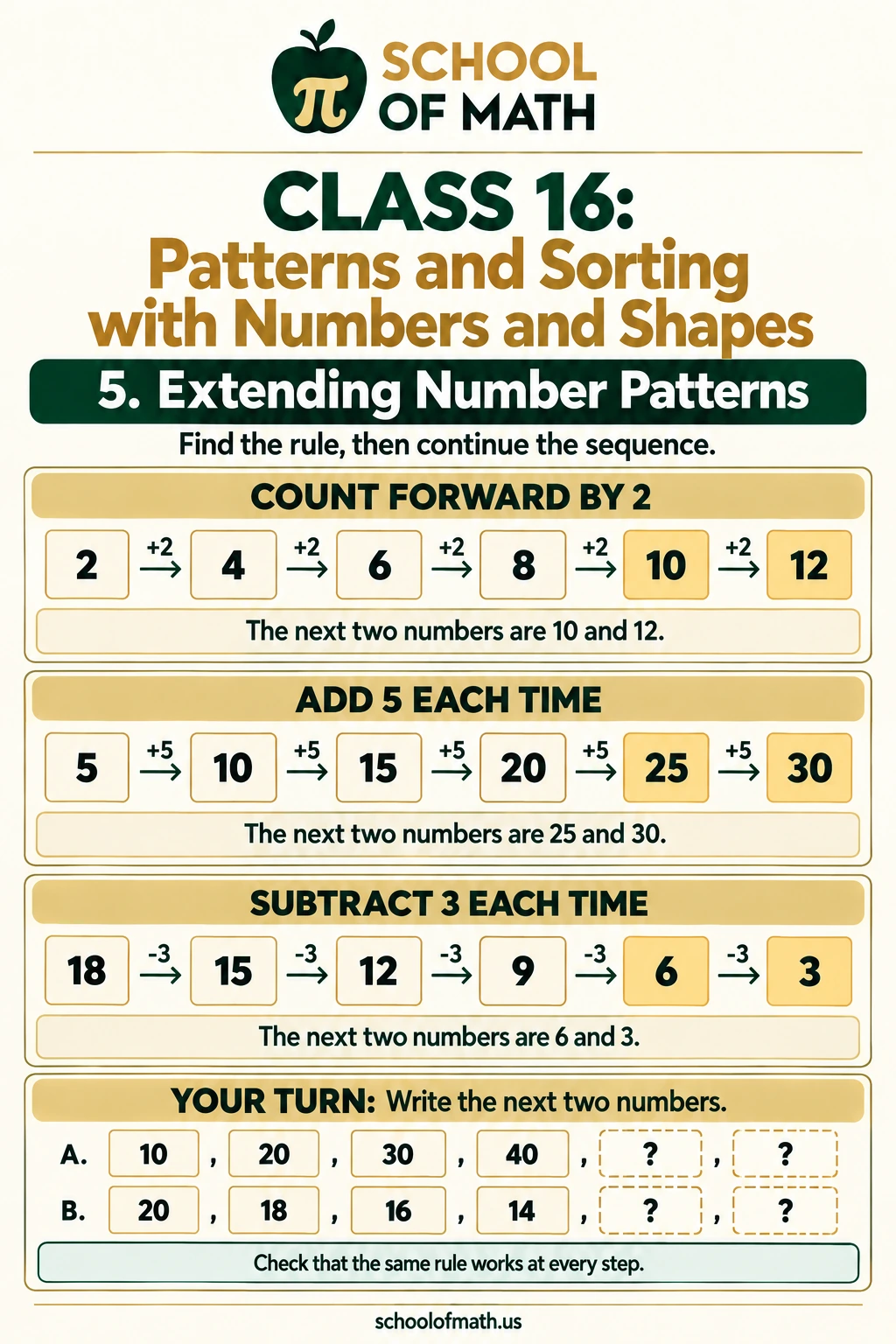
Extending a pattern means continuing it after the last part shown. First say the rule. Then apply the same rule once for every new number you write.
A number pattern can go forward or backward. “Add 5” makes the numbers larger. “Subtract 2” makes them smaller. Do not switch direction unless the rule tells you to.
A short list can fit more than one possible rule. In this lesson, follow the rule stated in the question. When you create your own pattern, tell someone your rule so they know how you intend it to continue.
Try it yourself: five questions
Q21 Practice 1 of 5
Add 2 each time. Write the next two numbers: 1, 3, 5, 7, __, __.
Answer
9, 11.
Seven plus two is nine; nine plus two is eleven.
Q22 Practice 2 of 5
Add 5 each time. Write the next two numbers: 2, 7, 12, 17, __, __.
Answer
22, 27.
Add five to seventeen, then add five again. The start does not have to be 0 or 5.
Q23 Practice 3 of 5
Subtract 2 each time. Continue: 19, 17, 15, 13, __, __.
Answer
11, 9.
Thirteen minus two is eleven. Eleven minus two is nine.
Q24 Practice 4 of 5
Start at 6 and add 10 each time. Write the next three numbers.
Answer
16, 26, 36.
Keep adding one ten. The ones digit stays 6.
Q25 Practice 5 of 5
The rule is “add 3.” Correct the last number, then write one more: 4, 7, 10, 14.
Answer
Change 14 to 13; the next number is 16.
Ten plus three is thirteen, not fourteen. Applying the same rule again gives sixteen.
Exploring growing patterns
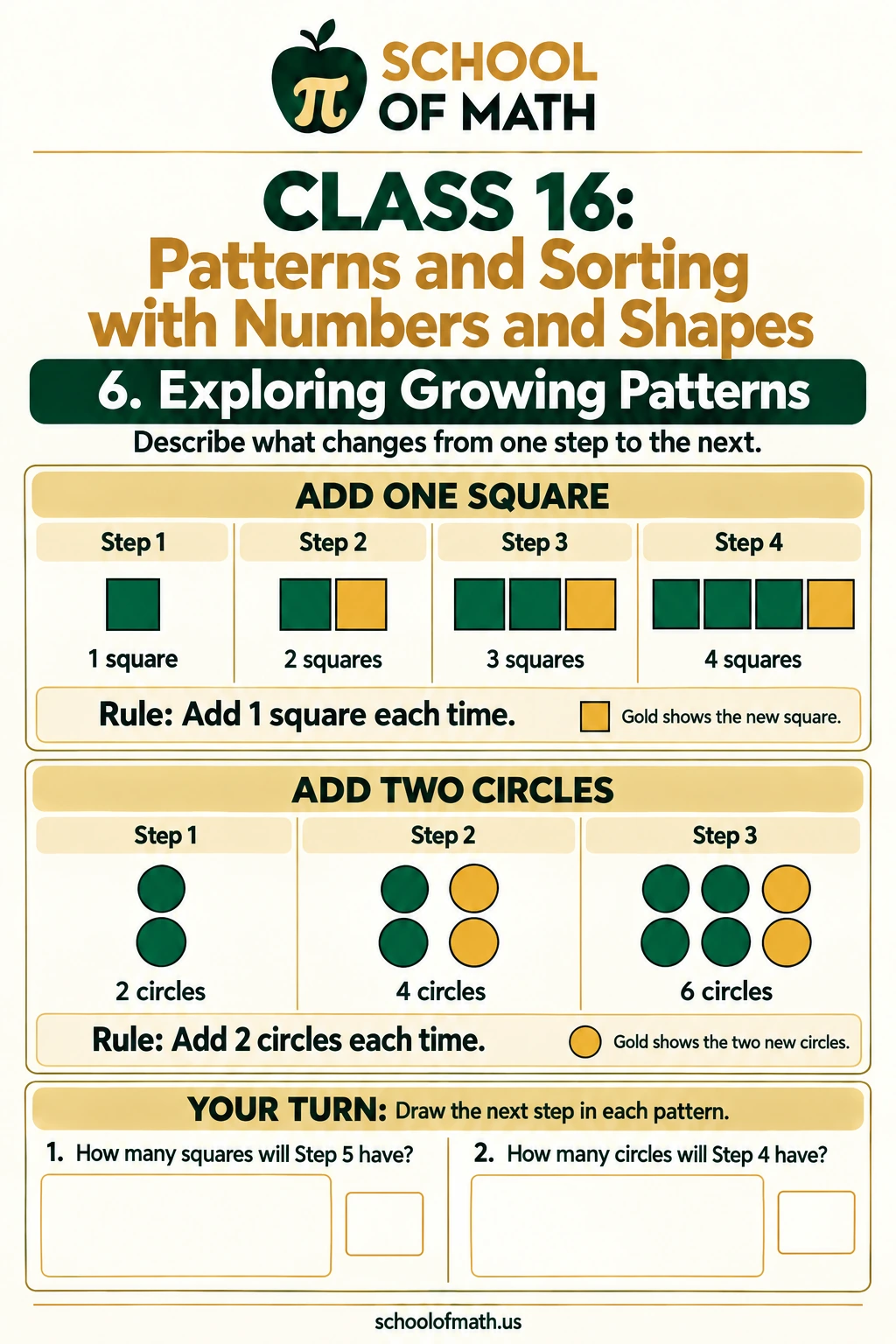
In a growing shape pattern, the number of objects increases from one step to the next. Count the objects in each step and describe how many are added. Keep the starting amount separate from the amount added.
For example, if Step 1 has 3 squares and you add 2 squares each time, Steps 2 and 3 have 5 and 7 squares. Step 1 is already the starting picture; reaching Step 3 takes two additions, not three.
A repeating pattern repeats a fixed unit. A growing pattern builds larger steps. A picture can use color to mark new pieces, but the growth rule comes from the change in the number of pieces.
Try it yourself: five questions
Q26 Practice 1 of 5
Step 1 has 2 squares. Add 1 square at each new step. How many squares are in Step 2 and Step 3?
Answer
Step 2: 3. Step 3: 4.
Start with two, then add one for each move to the next step.
Q27 Practice 2 of 5
Step 1 has 3 circles. Add 2 circles at each new step. Draw Step 2 and Step 3.
Answer
Draw 5 circles for Step 2 and 7 circles for Step 3.
The totals are 3, 5, 7. Each new picture adds two circles to the previous total.
Q28 Practice 3 of 5
A growing pattern adds the same number of squares each step. Its first three totals are 4, 7, 10. How many are added, and what is the Step 4 total?
Answer
Add 3 squares; Step 4 has 13.
Seven minus four is three, and ten minus seven is three. Add another three to reach thirteen.
Q29 Practice 4 of 5
Step 1 has 1 triangle. Add 2 triangles at each new step. How many triangles does Step 5 have?
Answer
9 triangles.
Count the five totals: 1, 3, 5, 7, 9. There are four additions after Step 1.
Q30 Practice 5 of 5
Step 1 has 4 squares, and the rule is “add 2 squares each step.” Eli says Step 3 has 10 squares. Correct him.
Answer
Step 3 has 8 squares.
The totals are Step 1: 4, Step 2: 6, Step 3: 8. Ten is the total for Step 4.
Finding and testing the sorting rule
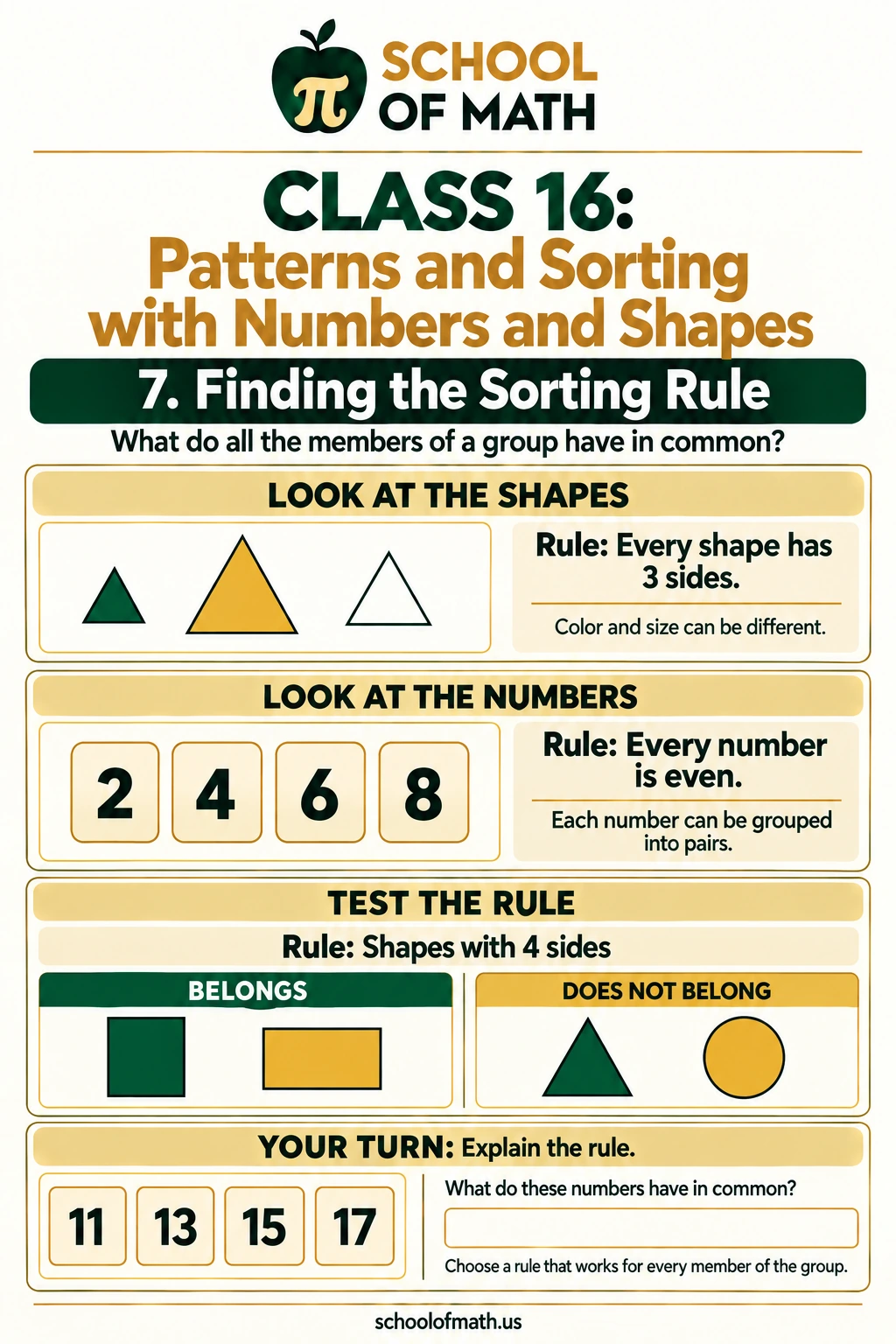
To find a sorting rule, ask what the objects in a group have in common. Test the rule on every member. If even one object breaks the rule, it does not describe the whole group.
Look at examples that belong and examples that do not belong. A group of squares and other rectangles might use the rule “four straight sides.” A triangle does not fit that rule because it has three.
Sometimes more than one rule can describe a group. Give one rule that fits all the stated information. When the question names possible rules, choose the one that matches both the included and excluded objects.
Try it yourself: five questions
Q31 Practice 1 of 5
A group contains a small red circle and a large blue circle. Which rule fits: “all red,” “all small,” or “all circles”?
Answer
All circles.
The colors and sizes differ, but both objects are circles.
Q32 Practice 2 of 5
A number group contains 12, 16, and 20, but excludes 13 and 17. Which rule fits: “even numbers” or “numbers greater than 10”?
Answer
Even numbers.
The included numbers are even and the excluded numbers are odd. Every listed number is greater than 10, so that rule would not separate them.
Q33 Practice 3 of 5
The rule is “shapes with four straight sides.” Which do not belong: square, triangle, circle, rectangle?
Answer
Triangle and circle.
A triangle has three straight sides. A circle has no straight sides. The square and rectangle both have four.
Q34 Practice 4 of 5
The rule is “numbers less than 15.” The group is 8, 12, 15, 14. Which number should be removed?
Answer
15.
Fifteen is equal to 15, not less than 15. The other three numbers are smaller.
Q35 Practice 5 of 5
A group contains a red triangle, a red square, and a blue square. Sam says the rule is “all red.” Does that rule work? Give one rule that fits every shape.
Answer
No. One possible rule is “shapes with straight sides.”
The blue square breaks the color rule. All three shapes have straight sides; other clearly stated rules that fit every shape may also be valid.
Creating and explaining patterns
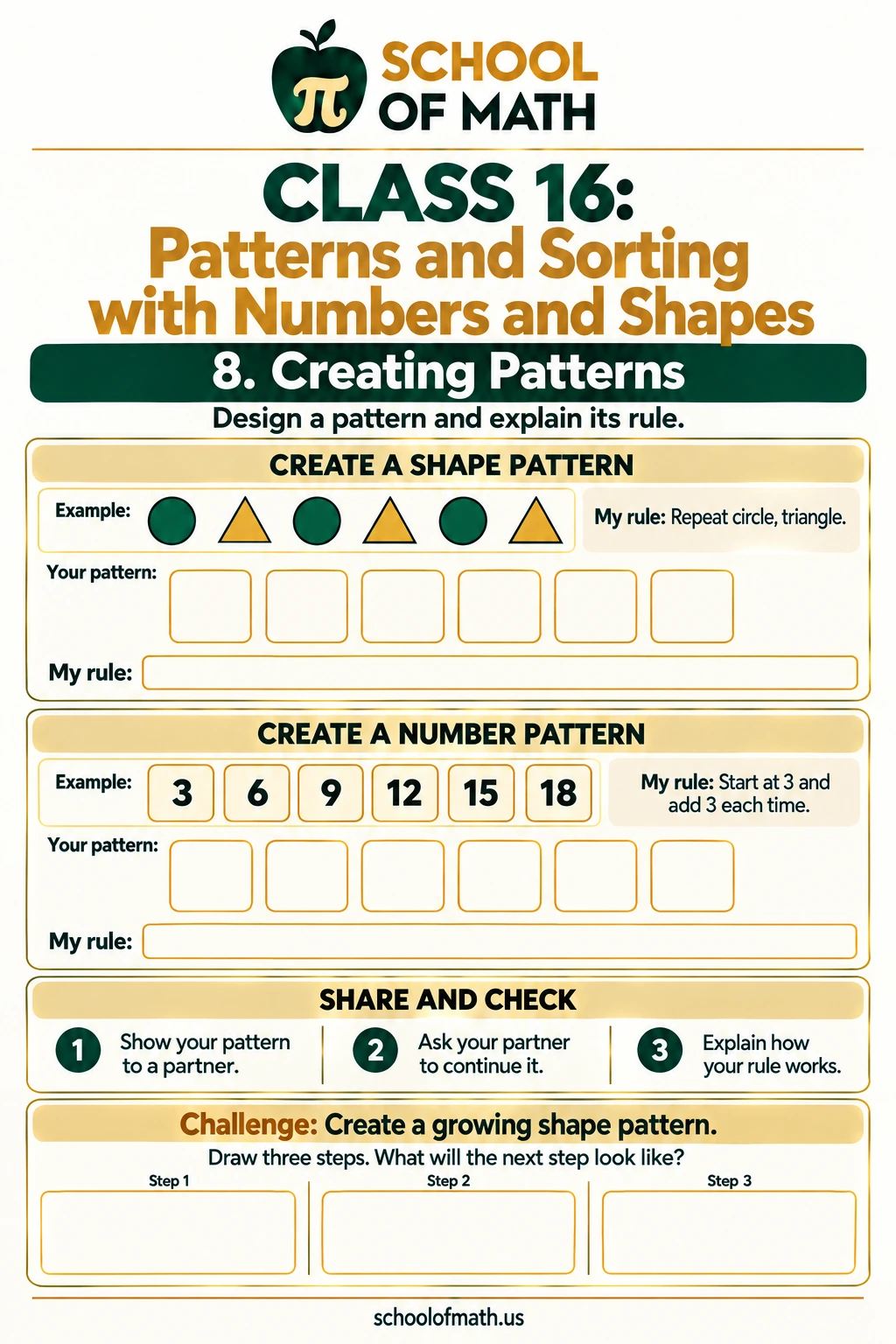
Choose a rule before making a pattern. You might repeat two different shapes, add the same number each time, or add the same number of objects to a drawing. Keep the rule unchanged as you build.
Show enough of your pattern for someone to check it. For a repeating pattern, show the smallest unit at least twice. For a growing pattern, draw several steps and count the objects in each.
Some questions in this section have many correct answers. The hidden answer gives one example, not the only acceptable pattern. Check the requested structure, starting point, and rule instead of copying the example.
Try it yourself: five questions
Q36 Practice 1 of 5
Create an AB pattern using a square and a circle. Draw 6 shapes and state your rule.
Answer
One example: square, circle, square, circle, square, circle.
Repeat square-circle three times. Starting with circle and alternating is also valid if you state that rule.
Q37 Practice 2 of 5
Create an AAB pattern using two different shapes. Draw 9 shapes and name the repeating unit.
Answer
One example: square, square, triangle; square, square, triangle; square, square, triangle.
The smallest unit is square-square-triangle. Other choices of two different shapes are valid when the first appears twice and the second once in each unit.
Q38 Practice 3 of 5
Create a number pattern that starts at 4 and adds 4 each time. Write the first 5 numbers.
Answer
4, 8, 12, 16, 20.
Four is the first number. Add four four more times to make a list of five numbers.
Q39 Practice 4 of 5
Create a growing square pattern with 2 squares at Step 1 and 3 more squares at every new step. Draw Steps 1, 2, and 3.
Answer
Draw 2 squares, then 5 squares, then 8 squares.
The layout can vary, but the totals must be 2, 5, and 8. Each new step adds three squares.
Q40 Practice 5 of 5
Create a 4-number pattern that starts at 5. Choose either “add 2” or “add 5” and use your rule every time. Then write a fifth number for a partner to check.
Answer
Add 2: 5, 7, 9, 11; next 13. Or add 5: 5, 10, 15, 20; next 25.
Both answers are valid. State which rule you chose and check that every step follows it.
Homework review
Complete one review question for each image, in order. Say the sorting or pattern rule before you explain your answer.
R1 Review image 1 of 8
Sort a green triangle, a yellow circle, a yellow triangle, and a green circle by shape.
Answer
Triangles: green and yellow triangles. Circles: yellow and green circles.
For a shape sort, ignore color. Each group has one kind of shape.
R2 Review image 2 of 8
Sort 2, 7, 14, and 19 into even and odd groups.
Answer
Even: 2, 14. Odd: 7, 19.
Even numbers make complete pairs. Odd numbers leave one unpaired object.
R3 Review image 3 of 8
Find the smallest repeating unit: triangle, circle, circle, triangle, circle, circle.
Answer
triangle, circle, circle.
The three-shape unit appears twice. Its structure is ABB.
R4 Review image 4 of 8
Add 4 each time. Fill the gap: 1, 5, __, 13, 17.
Answer
9.
Five plus four is nine, and nine plus four is thirteen.
R5 Review image 5 of 8
Subtract 5 each time. Write the next two numbers: 28, 23, 18, __, __.
Answer
13, 8.
Take five away from eighteen, then take five away again.
R6 Review image 6 of 8
Step 1 has 5 circles. Add 2 each step. How many circles are in Step 4?
Answer
11 circles.
The totals are 5, 7, 9, 11. Reaching Step 4 requires three additions.
R7 Review image 7 of 8
The rule is “odd numbers greater than 10.” Which of 9, 11, 14, and 15 belong?
Answer
11 and 15.
Nine is odd but too small. Fourteen is greater than 10 but even. Eleven and fifteen satisfy both rules.
R8 Review image 8 of 8
Create a 6-shape ABC pattern using a circle, a square, and a triangle. State the unit you chose.
Answer
One example: triangle, square, circle, triangle, square, circle.
Choose an order with three different shapes, then repeat it. Other orders are valid when the same three-shape unit repeats twice.
Homework word problems
These twelve problems complete the 20-question homework. Draw, use objects, or explain aloud, then write your answer. Keep the same rule throughout each pattern.
W1 Homework word problem 1 of 12
Mia has a red square button, a blue square button, and a red round button. She sorts by color. Which buttons go together?
Answer
The red square button and red round button.
They share the color red even though their shapes differ. The blue square button goes in the blue group.
W2 Homework word problem 2 of 12
A teacher has 5 triangle cards and 3 square cards. She sorts them by number of sides. How many cards are in each group?
Answer
Three-sided group: 5 cards. Four-sided group: 3 cards.
All triangles have three sides; all squares have four. Sorting changes the arrangement, not the number of cards.
W3 Homework word problem 3 of 12
Ten children stand in pairs for a game. How many pairs can they make? Is anyone left without a partner?
Answer
5 pairs; no one is left over.
Count by twos to ten: 2, 4, 6, 8, 10. Ten is even.
W4 Homework word problem 4 of 12
Nine socks are laid out in pairs. How many complete pairs can be made, and how many socks are left?
Answer
4 pairs and 1 sock left.
Four pairs use eight socks. Nine minus eight leaves one, so nine is odd.
W5 Homework word problem 5 of 12
A bracelet repeats “blue bead, yellow bead.” Its first five beads are blue, yellow, blue, yellow, blue. What are beads 6 and 7?
Answer
Bead 6 is yellow; bead 7 is blue.
Finish the blue-yellow unit, then start the next one. The same two-bead order keeps repeating.
W6 Homework word problem 6 of 12
A wall border repeats “square, square, circle.” The first six shapes make two complete units. What are shapes 7, 8, and 9?
Answer
square, square, circle.
The seventh shape starts the third unit. Repeat the entire three-shape unit once more.
W7 Homework word problem 7 of 12
House numbers on one side of a street start 11, 13, 15, 17 and increase by 2. What are the next three house numbers?
Answer
19, 21, 23.
Add two to seventeen, then keep adding two for each new house.
W8 Homework word problem 8 of 12
An elevator is on floor 16. It goes down 3 floors at each stop. What floors are its next three stops?
Answer
13, 10, 7.
Subtract three at each stop: 16 − 3 = 13, then 10, then 7.
W9 Homework word problem 9 of 12
A block tower has 3 blocks at Step 1. Noah adds 2 blocks at each new step. How many blocks are in Step 4?
Answer
9 blocks.
The step totals are 3, 5, 7, 9. There are three additions after the starting picture.
W10 Homework word problem 10 of 12
A shop puts number cards into a box labeled “even and less than 15.” Which of 8, 13, 14, and 16 should go in the box?
Answer
8 and 14.
Thirteen is odd. Sixteen is even but not less than 15. Eight and fourteen meet both requirements.
W11 Homework word problem 11 of 12
A garden adds the same number of flowers at every step. Step 1 has 2 flowers, Step 2 has 5, and Step 3 has 8. What is the rule, and how many flowers are in Step 5?
Answer
Add 3 flowers each step; Step 5 has 14.
Both shown increases are three. Continue to Step 4 with eleven, then Step 5 with fourteen.
W12 Homework word problem 12 of 12
A dance repeats “clap, clap, tap.” Leo writes the first eight moves as clap, clap, tap, clap, tap, tap, clap, clap. Which move must change, and what is move 9?
Answer
Move 5 must be clap. Move 9 is tap.
Split the moves into groups of three. Each group must be clap-clap-tap. The second group has the error in its middle position.
Quick questions and answers
What does sorting by an attribute mean?
It means grouping objects by a chosen feature, such as color, shape, size, or number of sides. The same collection can be sorted in different ways when the rule changes.
How can a young child check whether a number is odd or even?
Make that many dots or use counters. Arrange them in pairs. If no object is left over, the number is even. If one object is left without a partner, the number is odd.
Where does 10 belong when sorting numbers as less than or greater than 10?
It belongs in neither group because it is equal to 10. Add an equal-to-10 group when the collection includes 10.
What is the smallest repeating unit?
It is the shortest group of parts that repeats in the same order to make the pattern. For square-circle-square-circle, the smallest unit is square-circle.
How is a growing pattern different from a repeating pattern?
A repeating pattern repeats a fixed unit. A growing pattern adds objects from step to step. Count each step and describe how much is added.
Can a pattern or sorting question have more than one valid answer?
Yes, especially when students create a pattern or suggest a rule. State the rule and check that it satisfies every requirement. The lesson labels open-ended responses as examples rather than unique answers.
What practice and homework are included in Class 16?
There are eight teaching images with five new questions each, eight homework review questions, and twelve homework word problems. All 60 questions have hidden answers with explanations online. The 22-page student workbook includes the supplied PDF-only cover, all eight teaching images, and the same 60 questions with blank answer space and no exercise solutions.