Little Newtons · Class 20 · Grades 1–2
Place Value to 1,000: Hundreds, Tens, and Ones
Every digit in a three-digit number has a job. Build numbers with hundreds, tens, and ones, read and write them, break them into expanded form, see why zero holds a place, trade groups of ten, compare and order, and count all the way to 1,000.
Explore eight teaching images and five original questions after each image. Finish with eight Homework review questions and twelve Homework word problems: 40 practice questions, 20 homework questions, and 60 hidden worked answers. Try each problem before opening its blue Answer control.
This independent lesson is part of Little Newtons at SOMATH, for first and second graders on the Upper West Side and online. Use base-10 blocks, drawings, or a place value chart; an adult may read the questions aloud. Earlier-numbered classes are not required. See the class schedule or book an evaluation for the right course level.
Download the student workbook (PDF)22 pages · Supplied cover, eight teaching images, and all 60 questions · Generous blank answer space · No exercise solutions
Build three-digit numbers
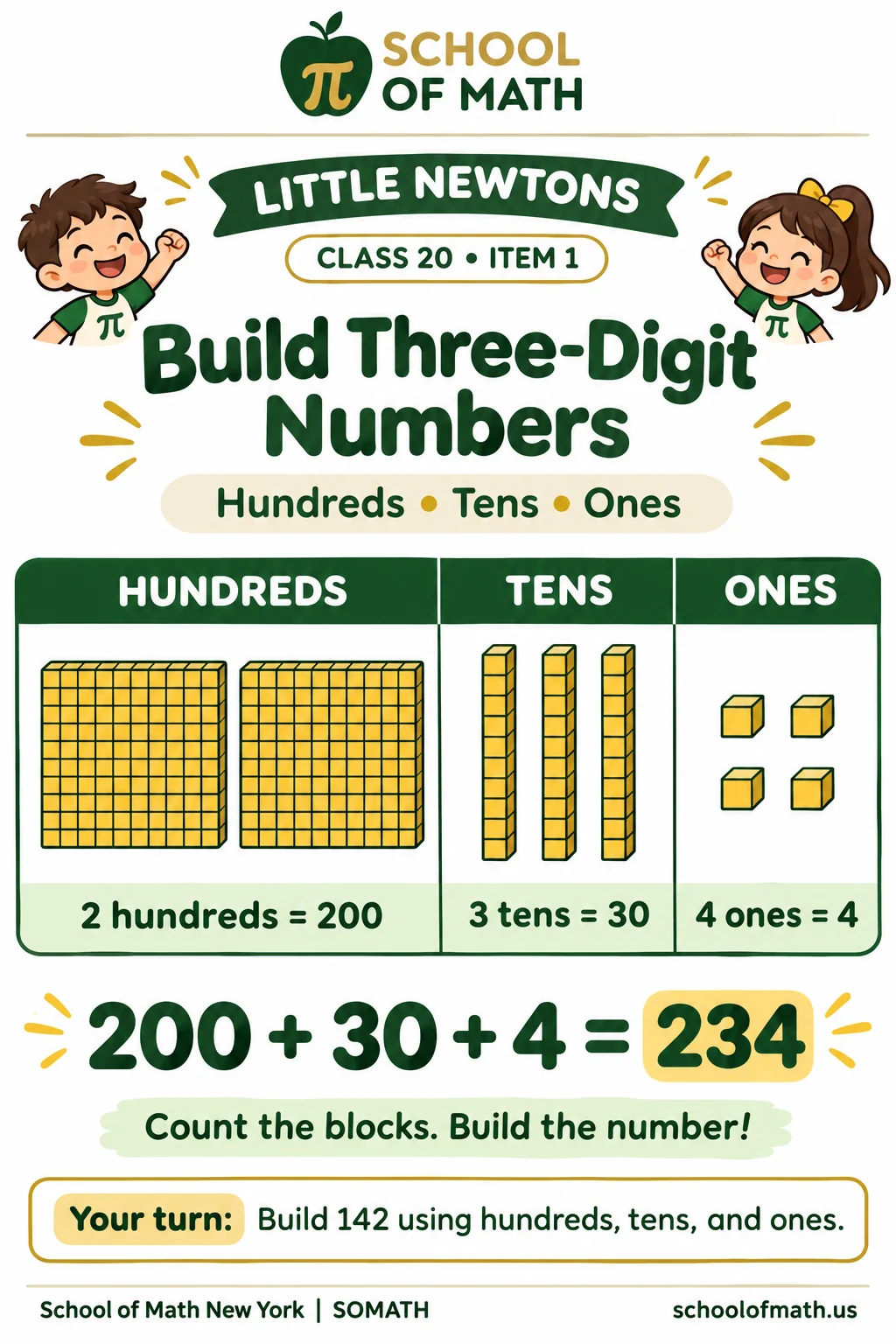
A three-digit number is built from three kinds of groups. A hundreds flat is a square of 100 little cubes, a tens rod is a stick of 10 cubes, and a ones cube is a single cube. In the image, 2 hundreds flats, 3 tens rods, and 4 ones cubes are sorted into a hundreds, tens, and ones chart.
Count each group, then put the values together: 2 hundreds = 200, 3 tens = 30, and 4 ones = 4, so 200 + 30 + 4 = 234. The digits are written in the same order as the chart: hundreds first, then tens, then ones. To build a number, read its digits and take that many of each block.
Practice: try these five questions
Q1
A model shows 3 hundreds flats, 5 tens rods, and 6 ones cubes. What number does it show?
Answer
356
3 hundreds = 300, 5 tens = 50, and 6 ones = 6. Put them together: 300 + 50 + 6 = 356.
Q2
You want to build 427. How many hundreds flats, tens rods, and ones cubes do you need?
Answer
4 hundreds flats, 2 tens rods, 7 ones cubes
Read the digits from left to right: 4 is in the hundreds place, 2 is in the tens place, and 7 is in the ones place. Check: 400 + 20 + 7 = 427.
Q3
Lina uses 6 hundreds flats, 1 tens rod, and 8 ones cubes. Write the number and an addition sentence for her model.
Answer
600 + 10 + 8 = 618
6 hundreds = 600, 1 ten = 10, and 8 ones = 8. Add the values: 600 + 10 + 8 = 618.
Q4
Sam builds a number with 2 hundreds flats and 9 ones cubes. He uses no tens rods. What number did he build?
Answer
209
2 hundreds = 200, 0 tens = 0, and 9 ones = 9. 200 + 0 + 9 = 209. The tens place gets a 0 because there are no tens rods.
Q5
Build 165 with blocks. How many blocks do you use in all, counting every flat, rod, and cube?
Answer
12 blocks
165 has 1 hundred, 6 tens, and 5 ones, so you use 1 flat, 6 rods, and 5 cubes. Count the blocks: 1 + 6 + 5 = 12 blocks. The blocks still show the value 100 + 60 + 5 = 165.
Each digit has a value
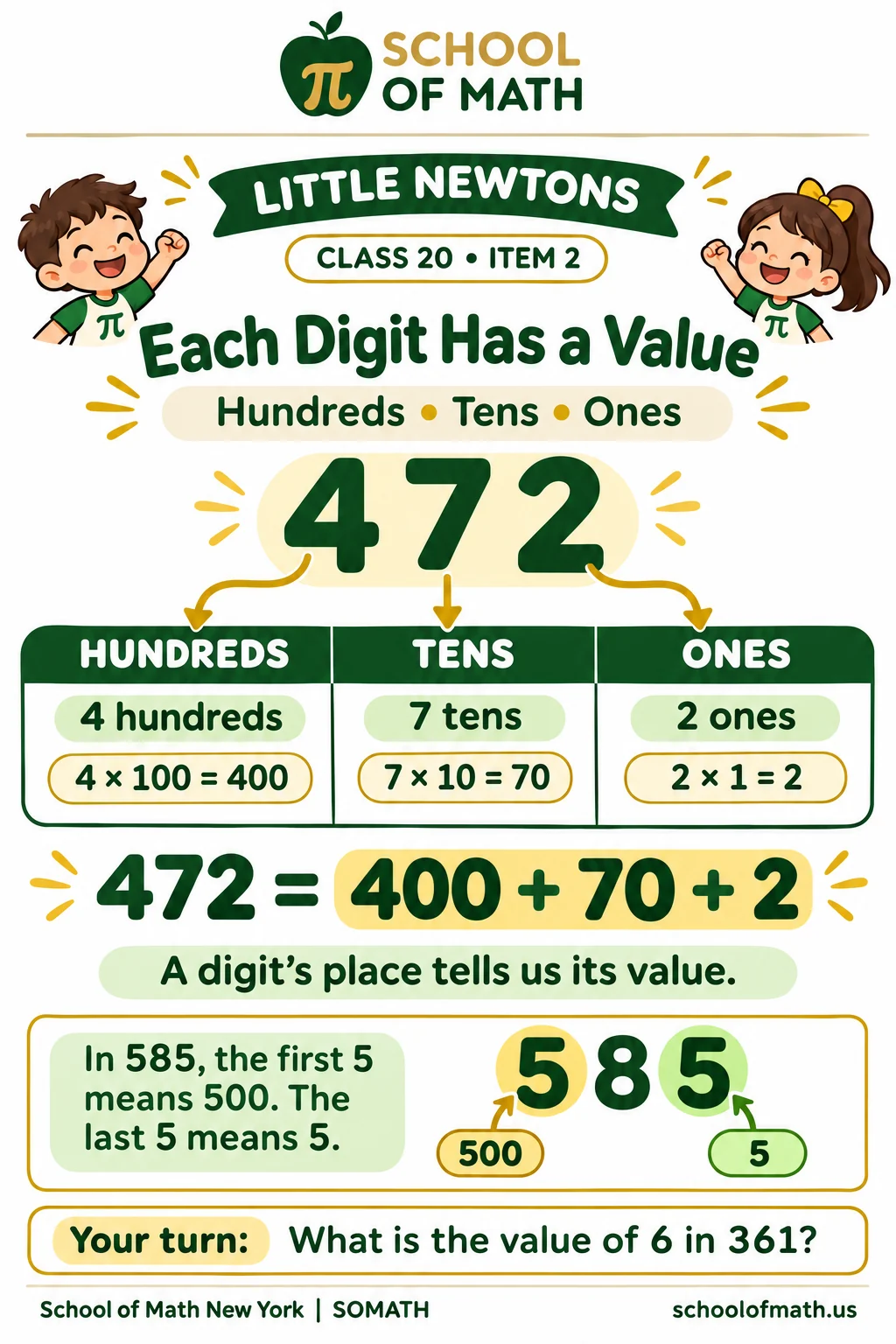
A digit is one of the symbols 0 to 9. The place of a digit tells us its value. In the image, 472 has 4 in the hundreds place, so it is worth 4 × 100 = 400; 7 is in the tens place, worth 7 × 10 = 70; and 2 is in the ones place, worth 2 × 1 = 2. So 472 = 400 + 70 + 2.
The same digit can have different values in different places. In 585 the first 5 is in the hundreds place and means 500, while the last 5 is in the ones place and means only 5. To find the value of a digit, name its place first, then multiply the digit by 100, 10, or 1.
Practice: try these five questions
Q6
What is the value of the 8 in 283?
Answer
80
In 283, the 2 is in the hundreds place, the 8 is in the tens place, and the 3 is in the ones place. The 8 means 8 tens: 8 × 10 = 80.
Q7
In 947, which digit is in the hundreds place? What is its value?
Answer
9; its value is 900
The first digit of a three-digit number is in the hundreds place, so it is 9. Its value is 9 × 100 = 900.
Q8
The number 333 has three 3s. What is the value of each 3?
Answer
300, 30, and 3
The first 3 is in the hundreds place: 3 × 100 = 300. The middle 3 is in the tens place: 3 × 10 = 30. The last 3 is in the ones place: 3 × 1 = 3. Check: 300 + 30 + 3 = 333.
Q9
Write one number for 5 × 100, 2 × 10, and 6 × 1.
Answer
526
5 × 100 = 500, 2 × 10 = 20, and 6 × 1 = 6. Put them in the hundreds, tens, and ones places: 500 + 20 + 6 = 526.
Q10
Mia says the 4 in 149 is worth 4. Is she right? Explain.
Answer
No; the 4 is worth 40
In 149 the digits are 1 hundred, 4 tens, and 9 ones. The 4 is in the tens place, so it means 4 tens: 4 × 10 = 40, not 4.
Read and write numbers
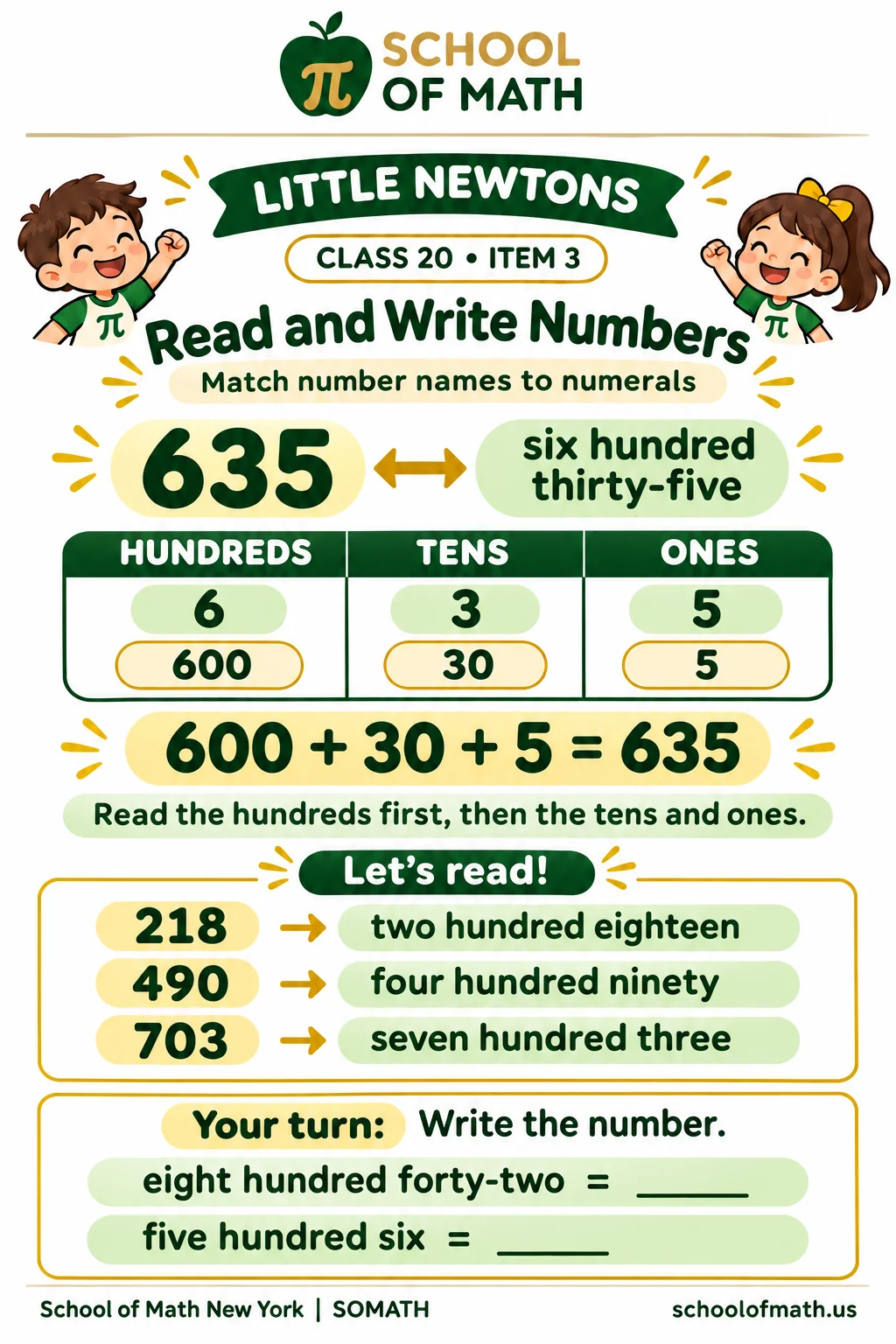
We can write a number with numerals, like 635, or with words, like six hundred thirty-five. To read a three-digit number, say the hundreds first, then the tens and ones together. In the image, 635 has 6 hundreds, 3 tens, and 5 ones, so we say “six hundred” and then “thirty-five.”
When the tens digit is 0, skip straight to the ones: 703 is “seven hundred three.” When the ones digit is 0, stop at the tens word: 490 is “four hundred ninety.” Numbers from 11 to 19 have special names, so 218 is “two hundred eighteen.” Tens and ones words above twenty are joined with a hyphen, such as thirty-five. We never say “and” inside a whole number like 635.
Practice: try these five questions
Q11
Write 527 in words.
Answer
five hundred twenty-seven
Read the hundreds first: 5 hundreds is “five hundred.” Then read the last two digits, 27, as “twenty-seven.” Together: five hundred twenty-seven.
Q12
Write the number: three hundred sixty-four.
Answer
364
“Three hundred” means 3 hundreds. “Sixty-four” means 6 tens and 4 ones. Hundreds 3, tens 6, ones 4 gives 364.
Q13
Write 810 in words.
Answer
eight hundred ten
8 hundreds is “eight hundred.” The last two digits are 10, which we read as “ten.” So 810 is eight hundred ten.
Q14
Write the number: nine hundred seven.
Answer
907
“Nine hundred” is 9 hundreds. There is no tens word, so the tens digit is 0. “Seven” is 7 ones. Hundreds 9, tens 0, ones 7 gives 907.
Q15
Leo wrote “two hundred fifty” as 20050. What did he do wrong? Write it correctly.
Answer
250
Leo wrote 200 and then 50 side by side. In place value, two hundred fifty is 2 hundreds, 5 tens, and 0 ones, so it is written with three digits: 250. Check: 200 + 50 = 250.
Write numbers in expanded form
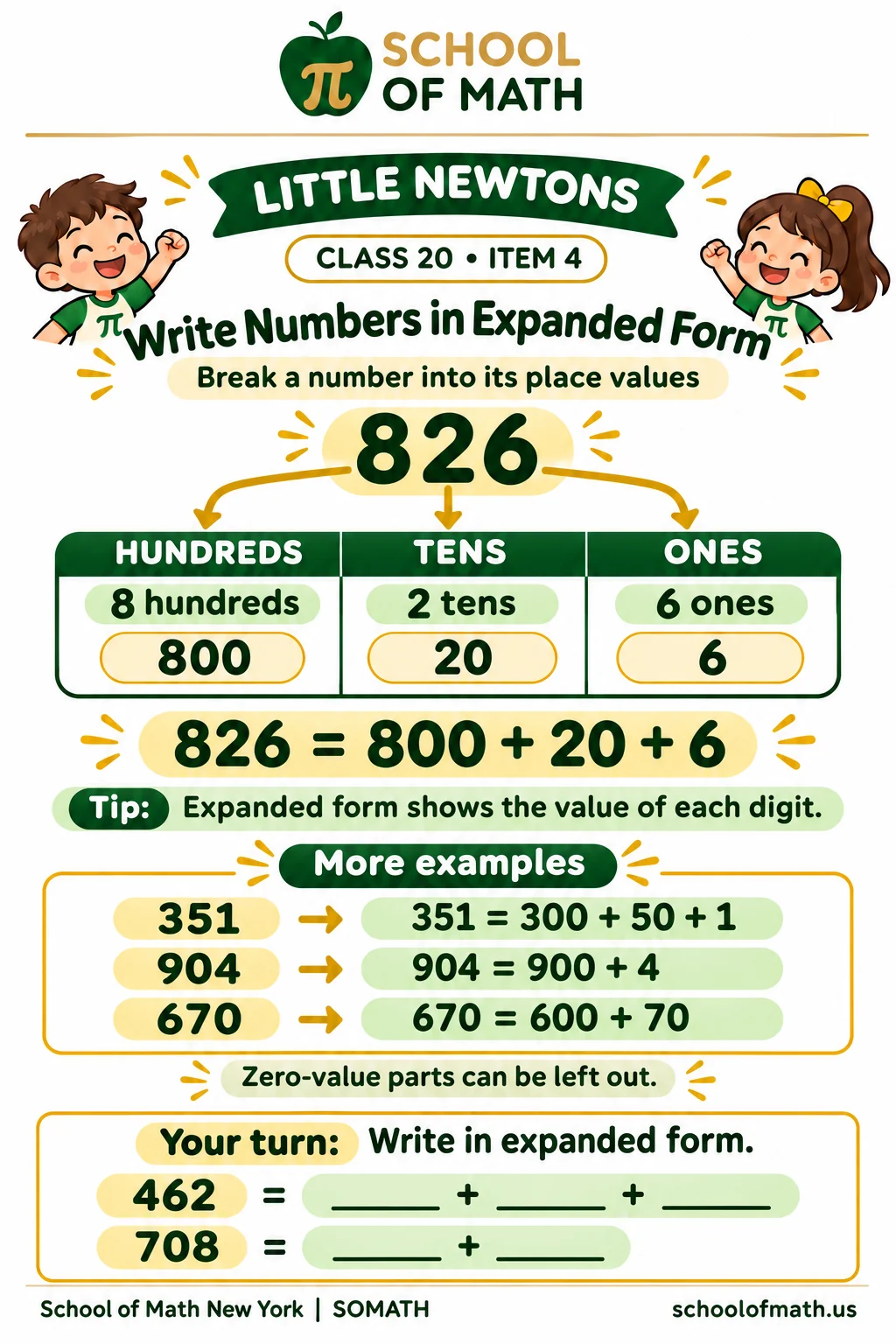
Expanded form breaks a number into the value of each digit and shows them as an addition sentence. In the image, 826 has 8 hundreds, 2 tens, and 6 ones, so 826 = 800 + 20 + 6. Standard form is the usual way of writing the number: 826.
To write expanded form, find each digit’s value and join the values with plus signs. Zero-value parts can be left out: 904 = 900 + 4 and 670 = 600 + 70. To go back to standard form, put each value in its place. Even if the parts are written in a different order, the place values decide the digits.
Practice: try these five questions
Q16
Write 537 in expanded form.
Answer
500 + 30 + 7
537 has 5 hundreds, 3 tens, and 7 ones. Their values are 500, 30, and 7, so 537 = 500 + 30 + 7.
Q17
Write 285 in expanded form.
Answer
200 + 80 + 5
2 hundreds = 200, 8 tens = 80, and 5 ones = 5. So 285 = 200 + 80 + 5.
Q18
Write 400 + 60 + 9 in standard form.
Answer
469
400 means 4 hundreds, 60 means 6 tens, and 9 means 9 ones. Put the digits in order: 469.
Q19
Write 806 in expanded form.
Answer
800 + 6
806 has 8 hundreds, 0 tens, and 6 ones. The zero-value part can be left out, so 806 = 800 + 6 (or 800 + 0 + 6).
Q20
The parts are mixed up: 20 + 900 + 3. What number is this?
Answer
923
Sort the parts by place value. 900 is 9 hundreds, 20 is 2 tens, and 3 is 3 ones. Hundreds 9, tens 2, ones 3 gives 923.
Zero holds a place
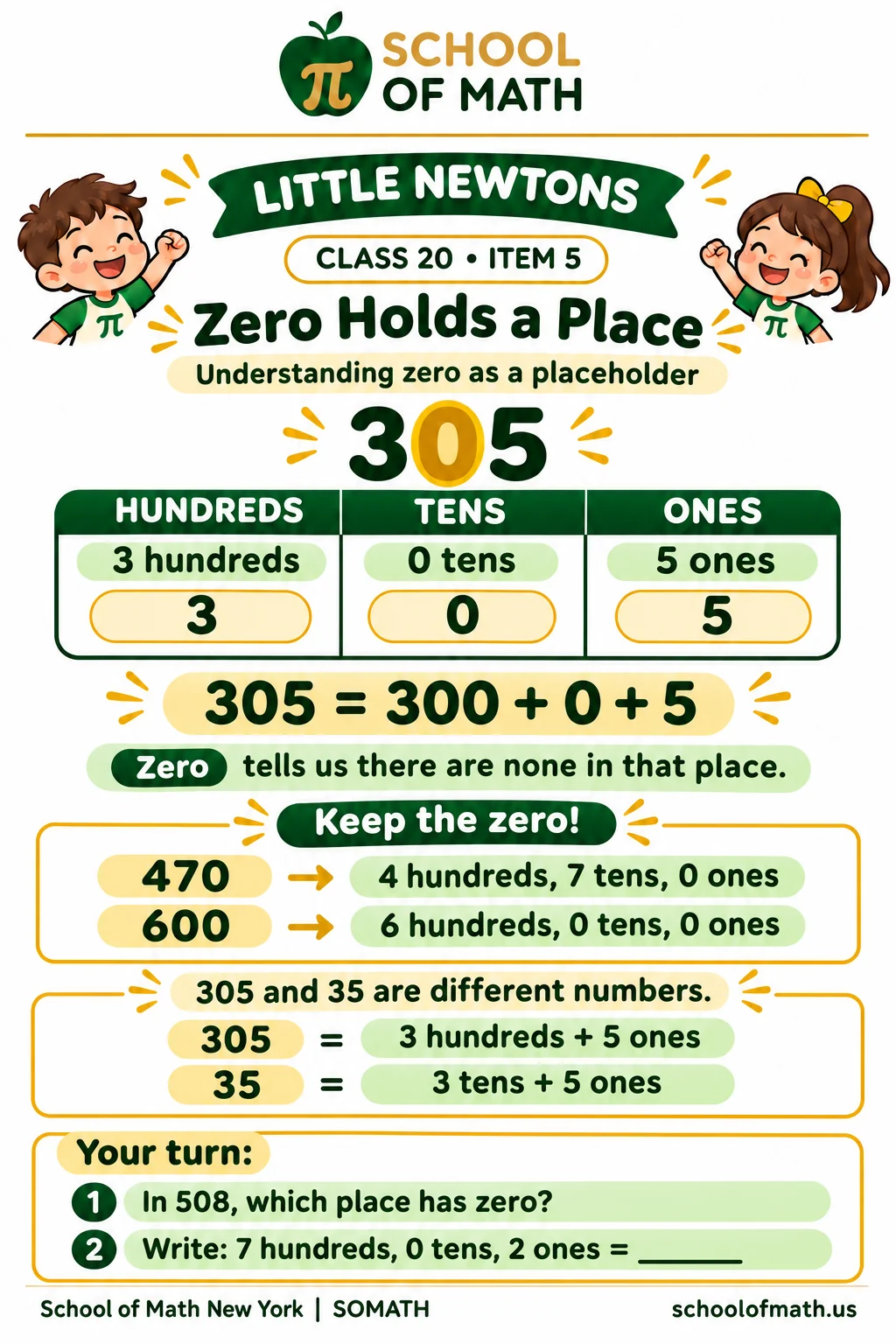
Zero tells us there are none in that place, but it still has an important job: it holds the place so the other digits stay where they belong. In the image, 305 has 3 hundreds, 0 tens, and 5 ones, so 305 = 300 + 0 + 5.
If we drop the zero, the number changes. 305 means 3 hundreds and 5 ones, but 35 means only 3 tens and 5 ones. In the same way, 470 is 4 hundreds, 7 tens, and 0 ones, and 600 is 6 hundreds, 0 tens, and 0 ones. Always keep the zero when a place is empty.
Practice: try these five questions
Q21
In 407, which place has a zero? How many tens are in 407?
Answer
The tens place; 0 tens
407 has 4 hundreds, 0 tens, and 7 ones. The zero is in the tens place, so there are no tens. 407 = 400 + 0 + 7.
Q22
Write the number: 6 hundreds, 0 tens, 8 ones.
Answer
608
Put 6 in the hundreds place, 0 in the tens place, and 8 in the ones place: 608. Check: 600 + 0 + 8 = 608.
Q23
Write the number: 5 hundreds, 3 tens, 0 ones.
Answer
530
Hundreds 5, tens 3, ones 0 gives 530. The zero in the ones place shows there are no ones. Check: 500 + 30 + 0 = 530.
Q24
Are 240 and 204 the same number? Explain using place value.
Answer
No
240 is 2 hundreds, 4 tens, and 0 ones (200 + 40). 204 is 2 hundreds, 0 tens, and 4 ones (200 + 4). The 4 is in a different place, so the numbers are different. 240 is greater.
Q25
Kai writes 3 hundreds and 7 ones as 37. What did he forget? Write the correct number.
Answer
He forgot the zero in the tens place; 307
There are no tens, so the tens place needs a 0 to hold it. Hundreds 3, tens 0, ones 7 gives 307. The number 37 would mean only 3 tens and 7 ones.
Trade ones, tens, and hundreds
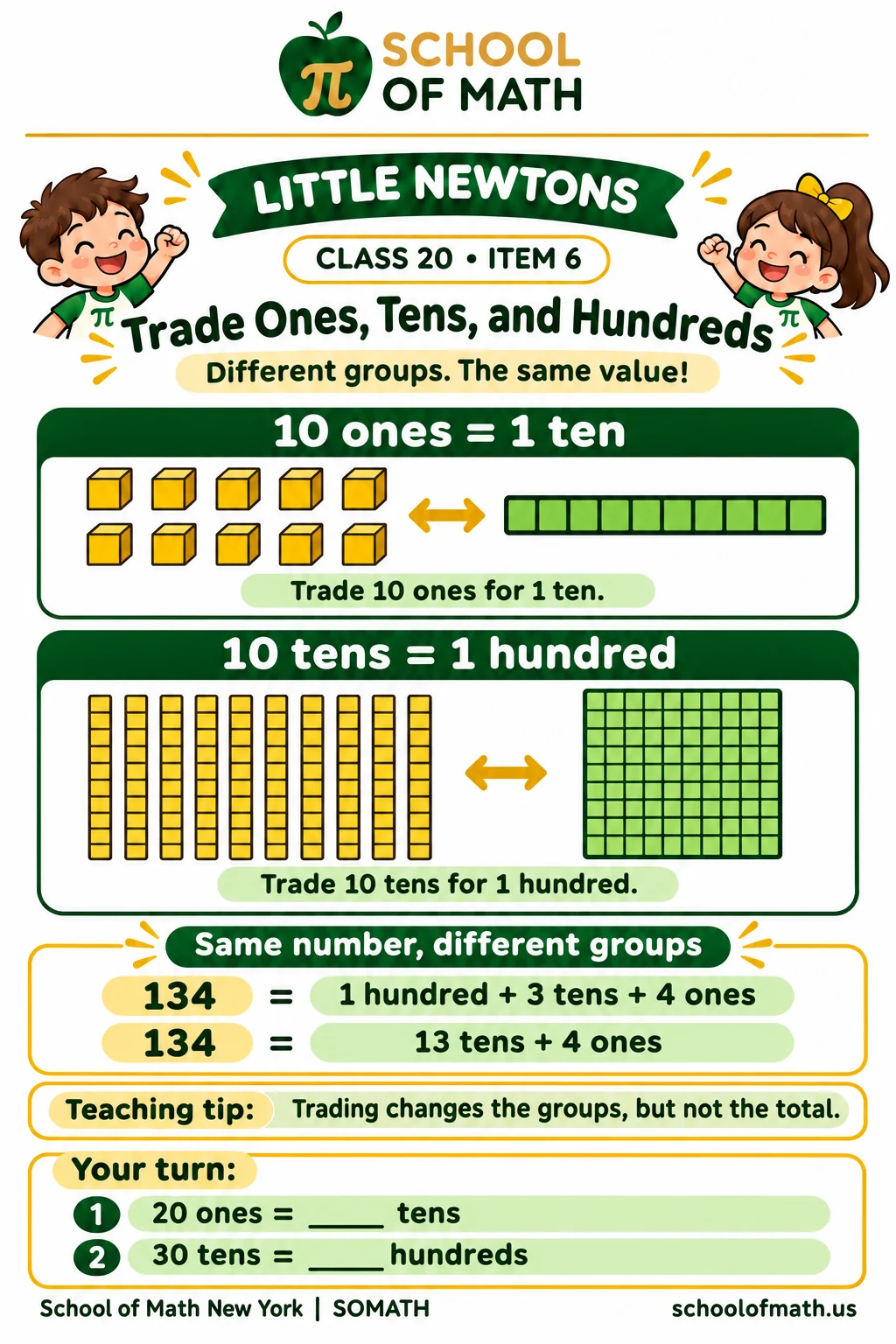
Place value works in groups of ten. In the image, 10 ones = 1 ten, so ten ones cubes can be traded for one tens rod. Also, 10 tens = 1 hundred, so ten tens rods can be traded for one hundreds flat. Trading goes both ways: one hundred can be broken into ten tens.
Trading changes the groups but not the total. The image shows 134 as 1 hundred + 3 tens + 4 ones, and also as 13 tens + 4 ones, because the 1 hundred is the same as 10 tens. When a model has 10 or more of one block, trade 10 of them for one block in the next place to the left.
Practice: try these five questions
Q26
50 ones = ___ tens
Answer
5 tens
Every 10 ones make 1 ten. 50 ones is five groups of 10 ones (10, 20, 30, 40, 50), so 50 ones = 5 tens.
Q27
70 tens = ___ hundreds
Answer
7 hundreds
Every 10 tens make 1 hundred. 70 tens is seven groups of 10 tens, so 70 tens = 7 hundreds (700).
Q28
1 hundred = ___ tens = ___ ones
Answer
10 tens; 100 ones
A hundreds flat is made of 10 tens rods, so 1 hundred = 10 tens. Each ten is 10 ones, so 10 tens = 100 ones.
Q29
256 is 2 hundreds, 5 tens, and 6 ones. Fill in: 256 = ___ tens and 6 ones.
Answer
25 tens
Trade the 2 hundreds for tens: 2 hundreds = 20 tens. Add the 5 tens already there: 20 + 5 = 25 tens. So 256 = 25 tens and 6 ones.
Q30
A model has 3 hundreds, 14 tens, and 2 ones. What number is it? Trade so that no place has more than 9.
Answer
442 (4 hundreds, 4 tens, 2 ones)
14 tens is too many for one place. Trade 10 tens for 1 hundred: 3 + 1 = 4 hundreds, and 14 − 10 = 4 tens. Now the model is 4 hundreds, 4 tens, 2 ones = 442. Check: 300 + 140 + 2 = 442.
Compare and order numbers
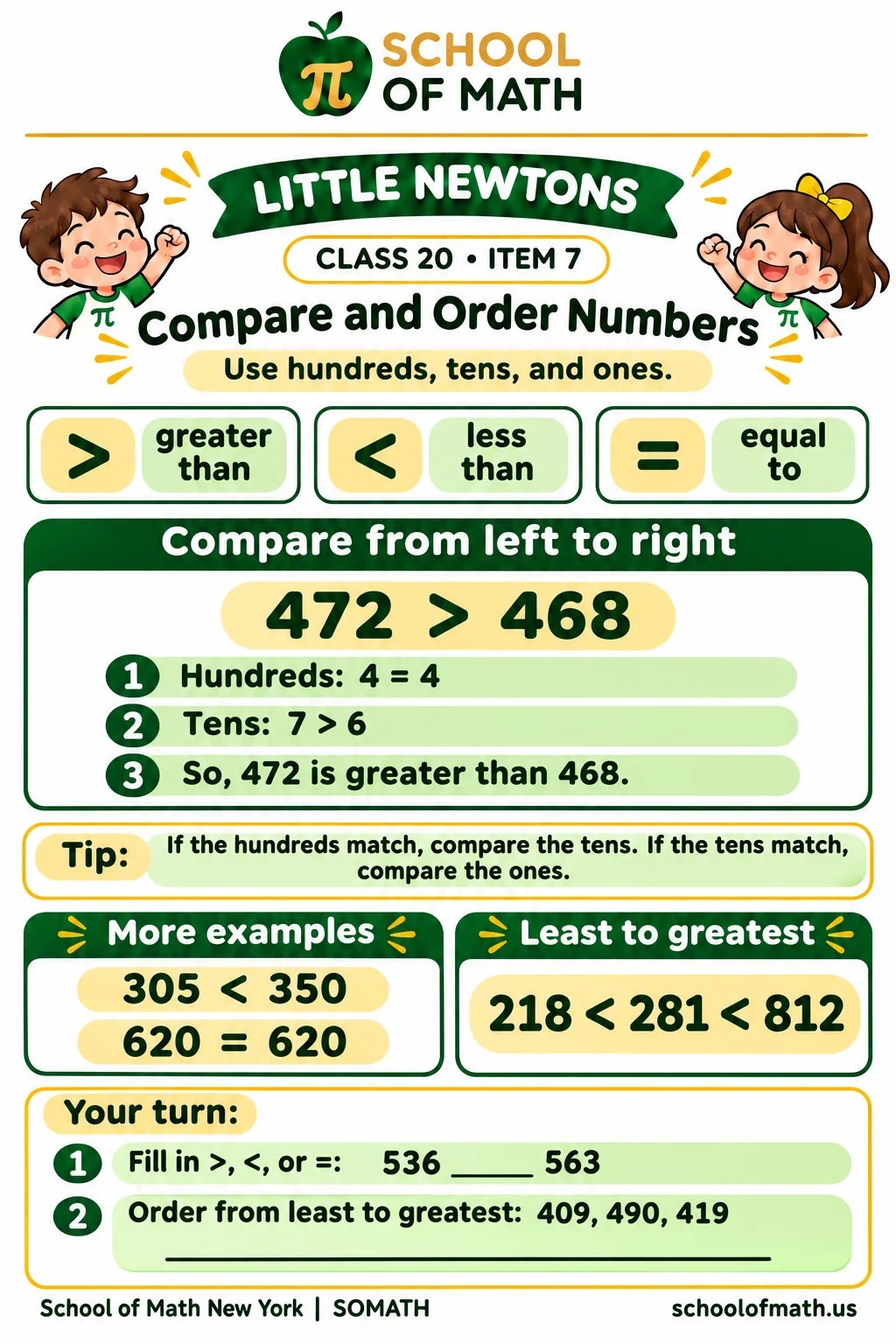
We compare numbers with three symbols: > means greater than, < means less than, and = means equal to. The open side of > or < faces the greater number. Compare from left to right, starting with the hundreds. In the image, 472 and 468 both have 4 hundreds, so we look at the tens: 7 tens > 6 tens, so 472 > 468.
If the hundreds match, compare the tens. If the tens also match, compare the ones. The first place that is different decides which number is greater, even if later digits are larger: 305 < 350 because 0 tens < 5 tens. To order numbers from least to greatest, compare them in pairs and line them up, as in 218 < 281 < 812.
Practice: try these five questions
Q31
Fill in >, <, or =: 645 ___ 654
Answer
645 < 654
Hundreds: 6 = 6. Tens: 4 < 5. The tens decide, so 645 is less than 654: 645 < 654.
Q32
Fill in >, <, or =: 723 ___ 689
Answer
723 > 689
Start with the hundreds: 7 > 6. The hundreds already decide, so 723 > 689, even though 689 has bigger tens and ones digits.
Q33
Fill in >, <, or =: 390 ___ 309
Answer
390 > 309
Hundreds: 3 = 3. Tens: 9 > 0. So 390 > 309. The 9 in 390 is worth 90, but the 9 in 309 is worth only 9.
Q34
Order from least to greatest: 527, 572, 257
Answer
257, 527, 572
Compare hundreds first: 257 has 2 hundreds, which is the least. 527 and 572 both have 5 hundreds, so compare tens: 2 < 7. So 257 < 527 < 572.
Q35
Order from greatest to least: 618, 681, 168, 186
Answer
681, 618, 186, 168
The numbers with 6 hundreds are greater than the numbers with 1 hundred. Among 618 and 681, 8 tens > 1 ten, so 681 comes first. Among 168 and 186, 8 tens > 6 tens, so 186 comes before 168. Order: 681 > 618 > 186 > 168.
Reach 1,000
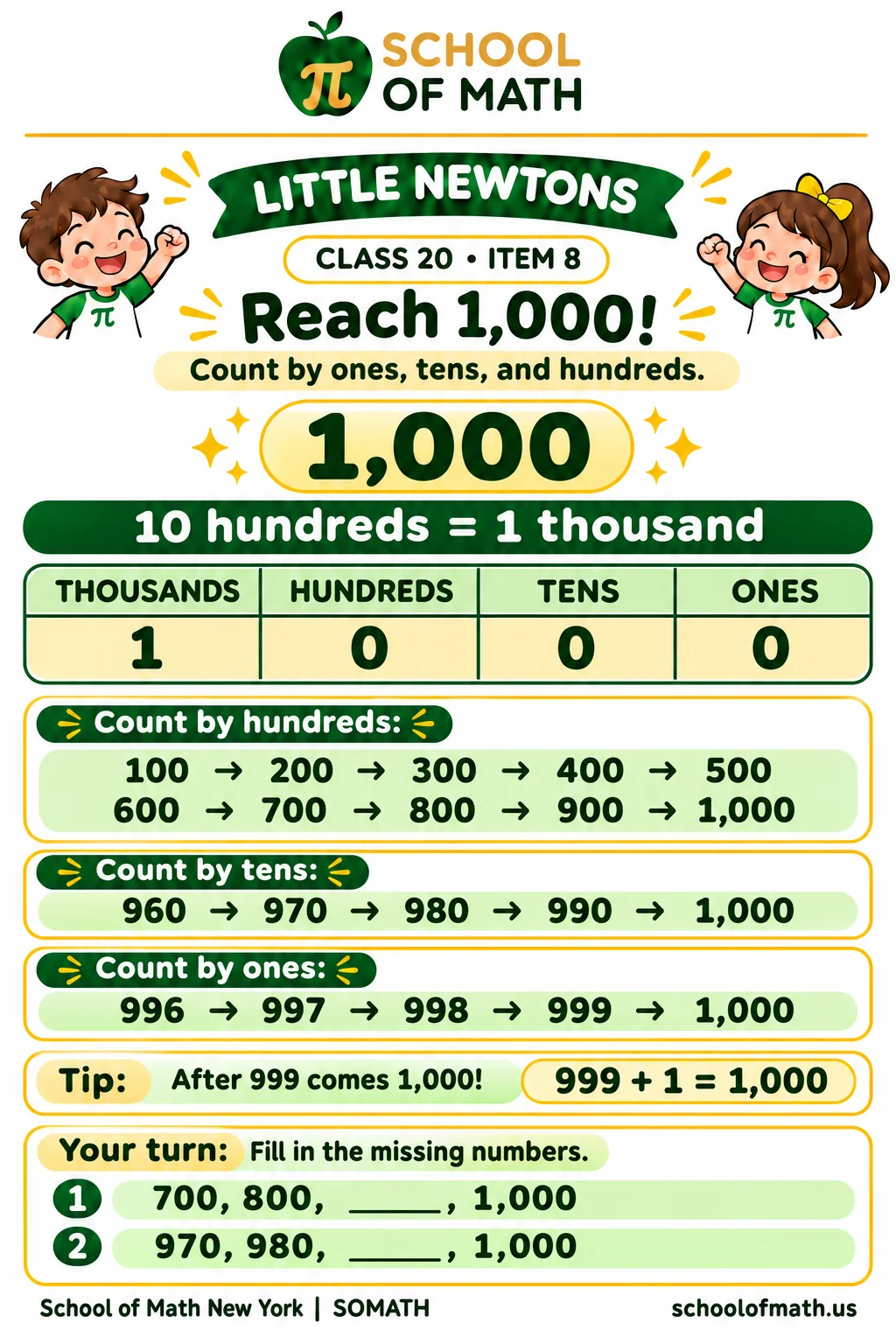
When we have 10 hundreds, we trade them for 1 thousand. The image shows 1,000 in a place value chart with a new place on the left: 1 thousand, 0 hundreds, 0 tens, and 0 ones. The comma in 1,000 helps us read it as “one thousand.”
We can reach 1,000 by counting by hundreds (100, 200, … 900, 1,000), by tens (960, 970, 980, 990, 1,000), or by ones (996, 997, 998, 999, 1,000). When counting by tens, only the tens digit changes until it passes 9; when counting by hundreds, only the hundreds digit changes. After 999 comes 1,000, because 999 + 1 = 1,000.
Practice: try these five questions
Q36
Count by hundreds. Fill in the missing number: 250, 350, ___, 550
Answer
450
Counting by hundreds adds 100 each time, so only the hundreds digit goes up by 1: 250, 350, 450, 550. The tens and ones stay 5 and 0.
Q37
Count by tens. Fill in the missing numbers: 920, 930, ___, ___, 960
Answer
940, 950
Counting by tens adds 10 each time, so the tens digit goes up by 1: 920, 930, 940, 950, 960.
Q38
Count by ones. Fill in the missing numbers: 994, 995, ___, 997, ___
Answer
996, 998
Counting by ones adds 1 each time: 994, 995, 996, 997, 998. Only the ones digit changes.
Q39
What is 1 more than 999? 10 more than 990? 100 more than 900?
Answer
1,000 each time
999 + 1 = 1,000; 990 + 10 = 1,000; and 900 + 100 = 1,000. Each time, a full group of ten is traded into the next place until we reach 1 thousand.
Q40
How many hundreds make 1,000? How many tens make 1,000?
Answer
10 hundreds; 100 tens
Counting by hundreds, 100, 200, … 1,000 takes 10 steps, so 10 hundreds = 1,000. Each hundred is 10 tens, so 10 hundreds = 10 × 10 = 100 tens.
Homework review
These eight questions revisit the eight ideas in this lesson, in the same order as the images. Name each place before you answer, and keep the answers closed until you have tried.
R1
Write the number: 4 hundreds, 8 tens, and 3 ones.
Answer
483
400 + 80 + 3 = 483. Write the hundreds digit, then the tens digit, then the ones digit.
R2
What is the value of the 6 in 862?
Answer
60
In 862 the 6 is in the tens place, so it means 6 tens: 6 × 10 = 60.
R3
Write 741 in words.
Answer
seven hundred forty-one
Say the hundreds first, “seven hundred,” then the last two digits, 41, “forty-one.”
R4
Write 359 in expanded form.
Answer
300 + 50 + 9
3 hundreds = 300, 5 tens = 50, 9 ones = 9. So 359 = 300 + 50 + 9.
R5
Write the number: 9 hundreds, 0 tens, and 6 ones.
Answer
906
Hundreds 9, tens 0, ones 6 gives 906. The zero holds the tens place. Check: 900 + 0 + 6 = 906.
R6
18 tens = ___ hundred and ___ tens. What number is that?
Answer
1 hundred and 8 tens; 180
Trade 10 of the 18 tens for 1 hundred. That leaves 18 − 10 = 8 tens. 1 hundred and 8 tens = 100 + 80 = 180.
R7
Fill in >, <, or =: 467 ___ 476
Answer
467 < 476
Hundreds: 4 = 4. Tens: 6 < 7. So 467 < 476.
R8
Count by hundreds. Fill in the missing numbers: 600, 700, 800, ___, ___
Answer
900, 1,000
Add 100 each time: 800 + 100 = 900 and 900 + 100 = 1,000. Ten hundreds make one thousand.
Homework word problems
Work from the easier stories toward the challenges. Draw blocks or a place value chart, solve, check, and answer in a sentence with the correct label.
W1
A teacher has 2 boxes of 100 pencils, 4 packs of 10 pencils, and 5 loose pencils. How many pencils does she have?
Answer
245 pencils
2 boxes of 100 = 200, 4 packs of 10 = 40, and 5 loose pencils = 5. 200 + 40 + 5 = 245. She has 245 pencils.
W2
An art room has 5 big boxes of 100 crayons and 7 loose crayons. There are no packs of 10. How many crayons are there?
Answer
507 crayons
5 hundreds, 0 tens, and 7 ones. The zero holds the tens place: 500 + 0 + 7 = 507 crayons.
W3
Jada’s secret number has 7 hundreds, 2 tens, and 9 ones. Write it with numerals and with words.
Answer
729; seven hundred twenty-nine
Hundreds 7, tens 2, ones 9 gives 729. In words: seven hundred twenty-nine.
W4
Noah builds a number with 2 hundreds flats and 15 tens rods. What number did he build?
Answer
350
2 hundreds = 200. 15 tens = 150 (trade 10 tens for 1 hundred, leaving 5 tens). 200 + 150 = 350, which is 3 hundreds, 5 tens, and 0 ones.
W5
Ella has 438 stickers. Owen has 483 stickers. Who has more stickers? Use > or < to show it.
Answer
Owen; 483 > 438
Both numbers have 4 hundreds. Compare the tens: 8 tens > 3 tens, so 483 > 438. Owen has more stickers.
W6
A bakery packs muffins in boxes of 10. It baked 260 muffins. How many full boxes can it fill?
Answer
26 boxes
260 is 2 hundreds and 6 tens. 2 hundreds = 20 tens, and 20 + 6 = 26 tens. Each box holds one ten, so the bakery fills 26 boxes.
W7
Ms. Lee writes 592, 529, and 925 on the board. Put them in order from least to greatest.
Answer
529, 592, 925
925 has 9 hundreds, so it is the greatest. 529 and 592 both have 5 hundreds; compare tens: 2 < 9. So 529 < 592 < 925.
W8
Raj starts at 930 and counts by tens until he reaches 1,000. How many tens does he count?
Answer
7 tens
Count on by tens: 940, 950, 960, 970, 980, 990, 1,000. That is 7 jumps of 10. Check: 930 + 70 = 1,000.
W9
Mystery number: it has 6 hundreds. Its tens digit is 2 more than its hundreds digit. Its ones digit is 0. What is the number?
Answer
680
Hundreds digit: 6. Tens digit: 6 + 2 = 8. Ones digit: 0. The number is 680.
W10
Use the digits 4, 0, and 7 once each. Make the greatest and the least three-digit number.
Answer
Greatest 740; least 407
For the greatest, put the biggest digit in the hundreds place: 7, then 4, then 0, giving 740. For the least, the hundreds digit cannot be 0 or the number would not have three digits, so use 4, then 0, then 7, giving 407.
W11
Zoe’s block model has 7 hundreds, 12 tens, and 5 ones. Trade so no place has more than 9. What number is it?
Answer
825
Trade 10 of the 12 tens for 1 hundred: 7 + 1 = 8 hundreds and 12 − 10 = 2 tens. The model is 8 hundreds, 2 tens, 5 ones = 825. Check: 700 + 120 + 5 = 825.
W12
Challenge: My number is between 400 and 500. My ones digit is 3. My tens digit is double my ones digit. What number am I?
Answer
463
Between 400 and 500 means the hundreds digit is 4. The ones digit is 3. Double 3 is 6, so the tens digit is 6. The number is 463, and 400 < 463 < 500.
Quick questions and answers
What is place value?
Place value means a digit’s value depends on where it sits in a number. In 472, the 4 is in the hundreds place and is worth 400, the 7 is in the tens place and is worth 70, and the 2 is in the ones place and is worth 2.
How do base-10 blocks help children learn place value?
Base-10 blocks make the groups visible: a cube is 1, a rod is 10, and a flat is 100. Children count each kind of block, write the digit for each place, and see that 2 flats, 3 rods, and 4 cubes make 200 + 30 + 4 = 234.
What is expanded form?
Expanded form writes a number as the sum of its place values, such as 826 = 800 + 20 + 6. Parts worth zero can be left out, so 904 = 900 + 4.
Why does zero matter in a number like 305?
Zero holds the tens place to show there are no tens. Without it, 305 would become 35, which is only 3 tens and 5 ones instead of 3 hundreds and 5 ones.
How do you compare three-digit numbers?
Compare from left to right. Start with the hundreds; if they match, compare the tens; if those match, compare the ones. The first place that differs decides, so 472 > 468 because 7 tens > 6 tens.
Does a student need to attend an earlier class first?
No. This is a self-contained Little Newtons lesson in a rolling rotation. It reviews the counting and grouping ideas it uses; class numbers identify topics, not attendance prerequisites.
What practice and homework are included?
There are eight supplied teaching images, forty original practice questions, eight Homework review questions, and twelve Homework word problems. All sixty questions have hidden worked explanations. The 22-page student workbook contains the supplied PDF-only cover, eight teaching images, and the same sixty questions with blank answer space and no exercise solutions.