Pre-Algebra · Class 15 · Grades 5–6
Two-Step Equations: Bringing It All Together
Solve a two-step equation by undoing the operations applied to the variable in reverse order, while doing the same operation to both sides. For the equations in this class, remove the added or subtracted constant first, then undo the multiplication or division. Substitute your result into the original equation to check it.
Follow the eight images in order, with five original practice questions after every image. Homework includes eight review questions and twelve word problems: 20 homework questions and 60 questions in total. Try each problem before selecting its blue Answer button.
Part of Pre-Algebra at SOMATH. Book a free evaluation to find your starting point or view the class schedule. Review Class 14’s multiplication and division equations if you would like a one-step warm-up.
Download the student workbook (PDF)22 pages · Cover, eight teaching images, and all 60 questions. Each image is followed by its five practice questions; homework follows with up to five questions per page.Numbered pages and generous blank answer space. No exercise solutions or writing lines.
Understanding two-step equations
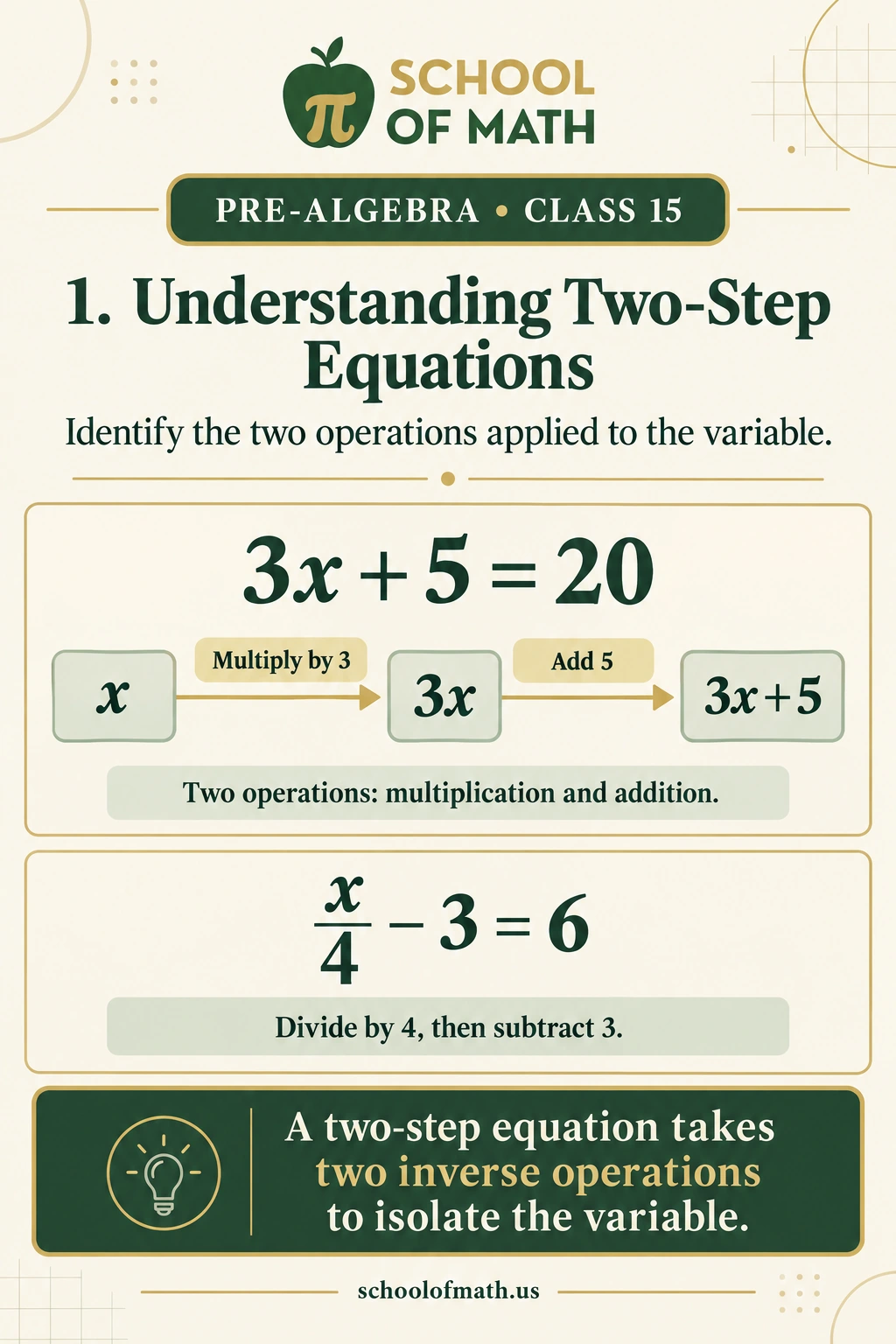
A solution is a value that makes both sides of an equation equal. In this lesson, one side contains a variable affected by two operations, such as multiplication followed by addition. Isolating the variable means finding its value by undoing those operations.
Read the variable expression in its usual order of operations. In \(\displaystyle ax+b=c\), multiply x by a, then add b. To solve, work backward: undo the addition first, then undo the multiplication. For \(\displaystyle \frac{x}{a}+b=c\), the first operation applied to x is division by a. The multiplier or divisor must be nonzero.
Try it yourself: five questions
Q1 Practice 1 of 5
Name the two operations applied to x, then solve \(\displaystyle 2x + 3 = 17\).
Answer
\(\displaystyle x = 7\).
- The operations applied to x are: multiply by \(\displaystyle 2\), then add 3. Undo them in reverse order.
- Subtract \(\displaystyle 3\) from both sides: \(\displaystyle 2x = 14\).
- Divide both sides by \(\displaystyle 2\): \(\displaystyle x = 7\).
- Check in the original equation: \(\displaystyle 2\cdot(7) + 3 = 14 + 3 = 17\). Both sides equal \(\displaystyle 17\).
Q2 Practice 2 of 5
Name the two operations applied to x, then solve \(\displaystyle 5x - 4 = 26\).
Answer
\(\displaystyle x = 6\).
- The operations applied to x are: multiply by \(\displaystyle 5\), then subtract 4. Undo them in reverse order.
- Add \(\displaystyle 4\) to both sides: \(\displaystyle 5x = 30\).
- Divide both sides by \(\displaystyle 5\): \(\displaystyle x = 6\).
- Check in the original equation: \(\displaystyle 5\cdot(6) - 4 = 30 - 4 = 26\). Both sides equal \(\displaystyle 26\).
Q3 Practice 3 of 5
Name the two operations applied to x, then solve \(\displaystyle \frac{x}{3} + 2 = 7\).
Answer
\(\displaystyle x = 15\).
- The operations applied to x are: divide by \(\displaystyle 3\), then add 2. Undo them in reverse order.
- Subtract \(\displaystyle 2\) from both sides: \(\displaystyle \frac{x}{3} = 5\).
- Multiply both sides by \(\displaystyle 3\): \(\displaystyle x = 15\).
- Check in the original equation: \(\displaystyle \frac{15}{3} + 2 = 5 + 2 = 7\). Both sides equal \(\displaystyle 7\).
Q4 Practice 4 of 5
Name the two operations applied to x, then solve \(\displaystyle \frac{x}{6} - 1 = 4\).
Answer
\(\displaystyle x = 30\).
- The operations applied to x are: divide by \(\displaystyle 6\), then subtract 1. Undo them in reverse order.
- Add \(\displaystyle 1\) to both sides: \(\displaystyle \frac{x}{6} = 5\).
- Multiply both sides by \(\displaystyle 6\): \(\displaystyle x = 30\).
- Check in the original equation: \(\displaystyle \frac{30}{6} - 1 = 5 - 1 = 4\). Both sides equal \(\displaystyle 4\).
Q5 Practice 5 of 5
Explain which operation to undo first, then solve \(\displaystyle 4x + 7 = 39\).
Answer
\(\displaystyle x = 8\).
- The operations applied to x are: multiply by \(\displaystyle 4\), then add 7. Undo them in reverse order.
- Subtract \(\displaystyle 7\) from both sides: \(\displaystyle 4x = 32\).
- Divide both sides by \(\displaystyle 4\): \(\displaystyle x = 8\).
- Check in the original equation: \(\displaystyle 4\cdot(8) + 7 = 32 + 7 = 39\). Both sides equal \(\displaystyle 39\).
Using inverse operations
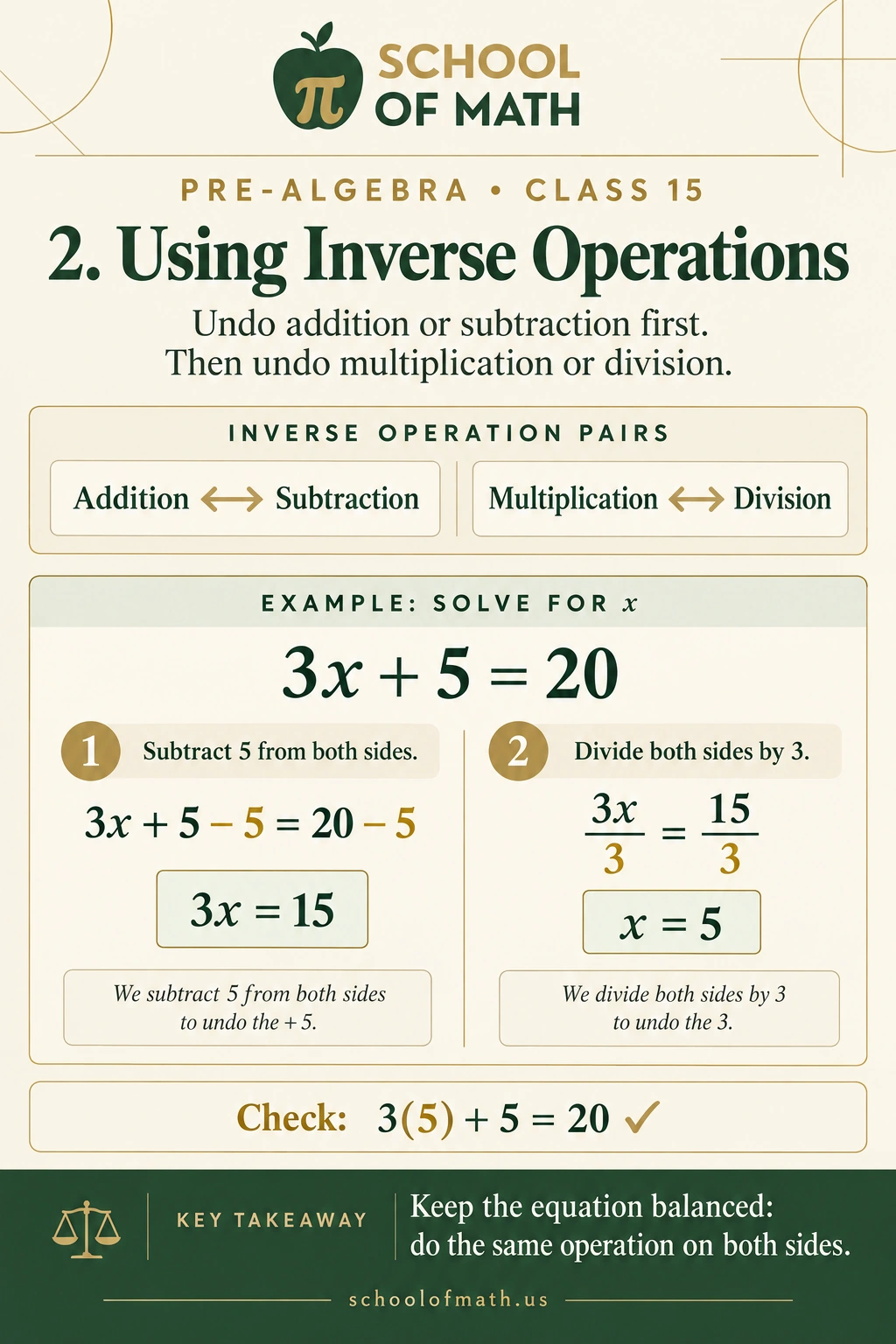
An equation is a statement of equality, so keep it balanced by doing the same operation to both sides. Subtraction undoes addition, addition undoes subtraction, division undoes multiplication, and multiplication undoes division.
For the forms in this lesson, remove the added or subtracted constant first. Then undo the multiplication or division involving x. Write a new equality after each step rather than saying a number “moves across” the equals sign. That habit makes the reason for each sign change visible.
Try it yourself: five questions
Q6 Practice 1 of 5
State the first inverse operation and solve \(\displaystyle 3x + 4 = 25\).
Answer
\(\displaystyle x = 7\).
- Subtract \(\displaystyle 4\) from both sides: \(\displaystyle 3x = 21\).
- Divide both sides by \(\displaystyle 3\): \(\displaystyle x = 7\).
- Check in the original equation: \(\displaystyle 3\cdot(7) + 4 = 21 + 4 = 25\). Both sides equal \(\displaystyle 25\).
Q7 Practice 2 of 5
State the first inverse operation and solve \(\displaystyle 6x - 5 = 31\).
Answer
\(\displaystyle x = 6\).
- Add \(\displaystyle 5\) to both sides: \(\displaystyle 6x = 36\).
- Divide both sides by \(\displaystyle 6\): \(\displaystyle x = 6\).
- Check in the original equation: \(\displaystyle 6\cdot(6) - 5 = 36 - 5 = 31\). Both sides equal \(\displaystyle 31\).
Q8 Practice 3 of 5
State both inverse operations in order and solve \(\displaystyle \frac{x}{5} + 3 = 11\).
Answer
\(\displaystyle x = 40\).
- Subtract \(\displaystyle 3\) from both sides: \(\displaystyle \frac{x}{5} = 8\).
- Multiply both sides by \(\displaystyle 5\): \(\displaystyle x = 40\).
- Check in the original equation: \(\displaystyle \frac{40}{5} + 3 = 8 + 3 = 11\). Both sides equal \(\displaystyle 11\).
Q9 Practice 4 of 5
A student wants to subtract 9 first. Choose the correct first step and solve \(\displaystyle 7x - 9 = 26\).
Answer
\(\displaystyle x = 5\).
- Add \(\displaystyle 9\) to both sides: \(\displaystyle 7x = 35\).
- Divide both sides by \(\displaystyle 7\): \(\displaystyle x = 5\).
- Check in the original equation: \(\displaystyle 7\cdot(5) - 9 = 35 - 9 = 26\). Both sides equal \(\displaystyle 26\).
Q10 Practice 5 of 5
Explain why you add 2 first, then solve \(\displaystyle \frac{x}{4} - 2 = 9\).
Answer
\(\displaystyle x = 44\).
- Add \(\displaystyle 2\) to both sides: \(\displaystyle \frac{x}{4} = 11\).
- Multiply both sides by \(\displaystyle 4\): \(\displaystyle x = 44\).
- Check in the original equation: \(\displaystyle \frac{44}{4} - 2 = 11 - 2 = 9\). Both sides equal \(\displaystyle 9\).
Equations with multiplication
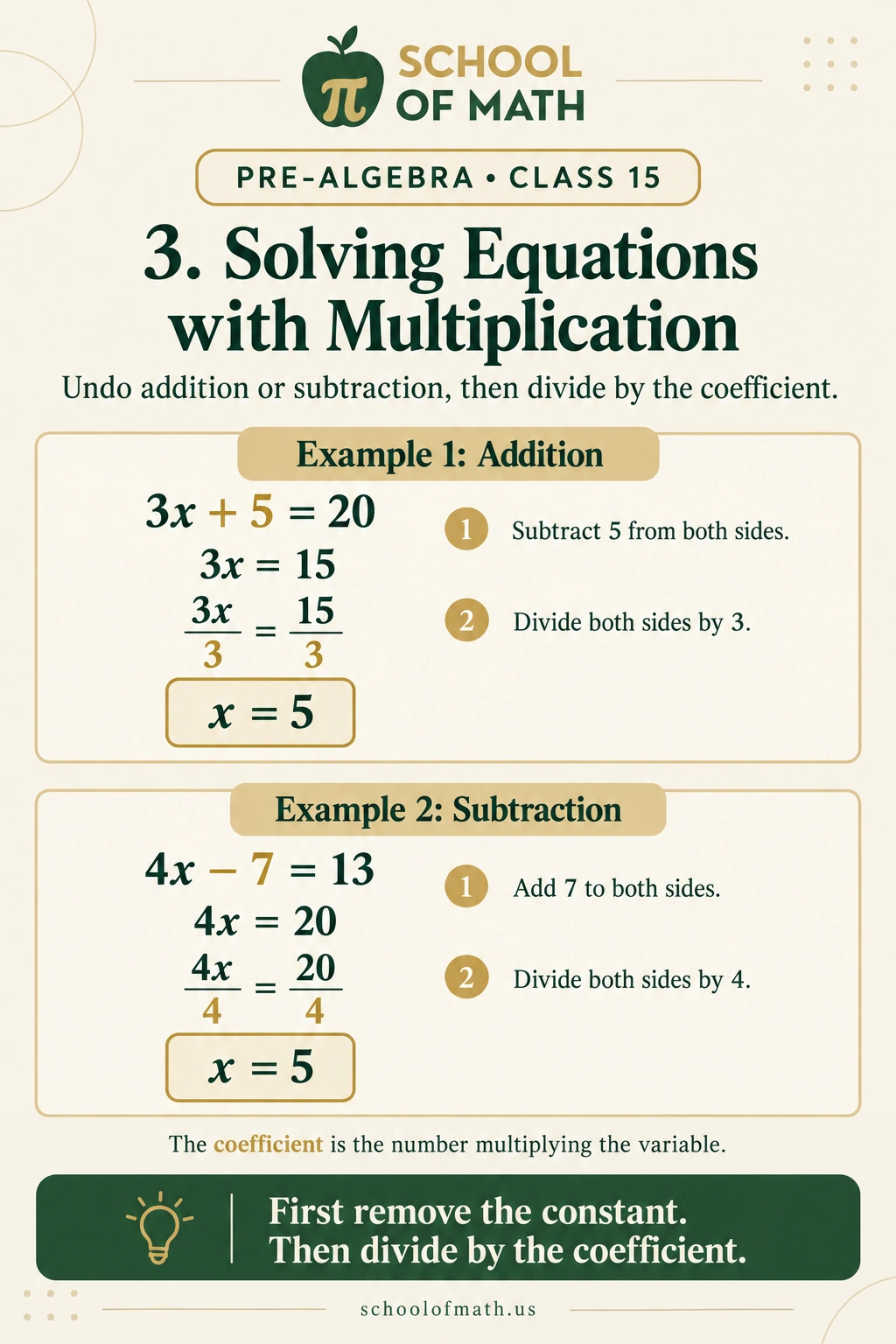
The coefficient is the number multiplying the variable. After you remove the constant, divide both sides by that nonzero coefficient. Division acts on the whole side of the equation, not just one convenient term.
Read subtraction carefully: to undo “minus 11,” add 11 to both sides. When you obtain a value for x, substitute it into the original expression, including the constant, rather than checking only the final simplified line.
Try it yourself: five questions
Q11 Practice 1 of 5
Solve \(\displaystyle 8x + 5 = 61\).
Answer
\(\displaystyle x = 7\).
- Subtract \(\displaystyle 5\) from both sides: \(\displaystyle 8x = 56\).
- Divide both sides by \(\displaystyle 8\): \(\displaystyle x = 7\).
- Check in the original equation: \(\displaystyle 8\cdot(7) + 5 = 56 + 5 = 61\). Both sides equal \(\displaystyle 61\).
Q12 Practice 2 of 5
Solve \(\displaystyle 9x - 11 = 43\).
Answer
\(\displaystyle x = 6\).
- Add \(\displaystyle 11\) to both sides: \(\displaystyle 9x = 54\).
- Divide both sides by \(\displaystyle 9\): \(\displaystyle x = 6\).
- Check in the original equation: \(\displaystyle 9\cdot(6) - 11 = 54 - 11 = 43\). Both sides equal \(\displaystyle 43\).
Q13 Practice 3 of 5
Solve \(\displaystyle 6x + 14 = 62\).
Answer
\(\displaystyle x = 8\).
- Subtract \(\displaystyle 14\) from both sides: \(\displaystyle 6x = 48\).
- Divide both sides by \(\displaystyle 6\): \(\displaystyle x = 8\).
- Check in the original equation: \(\displaystyle 6\cdot(8) + 14 = 48 + 14 = 62\). Both sides equal \(\displaystyle 62\).
Q14 Practice 4 of 5
Solve \(\displaystyle 12x - 7 = 65\).
Answer
\(\displaystyle x = 6\).
- Add \(\displaystyle 7\) to both sides: \(\displaystyle 12x = 72\).
- Divide both sides by \(\displaystyle 12\): \(\displaystyle x = 6\).
- Check in the original equation: \(\displaystyle 12\cdot(6) - 7 = 72 - 7 = 65\). Both sides equal \(\displaystyle 65\).
Q15 Practice 5 of 5
Solve \(\displaystyle 7x + 8 = 43\).
Answer
\(\displaystyle x = 5\).
- Subtract \(\displaystyle 8\) from both sides: \(\displaystyle 7x = 35\).
- Divide both sides by \(\displaystyle 7\): \(\displaystyle x = 5\).
- Check in the original equation: \(\displaystyle 7\cdot(5) + 8 = 35 + 8 = 43\). Both sides equal \(\displaystyle 43\).
Equations with division
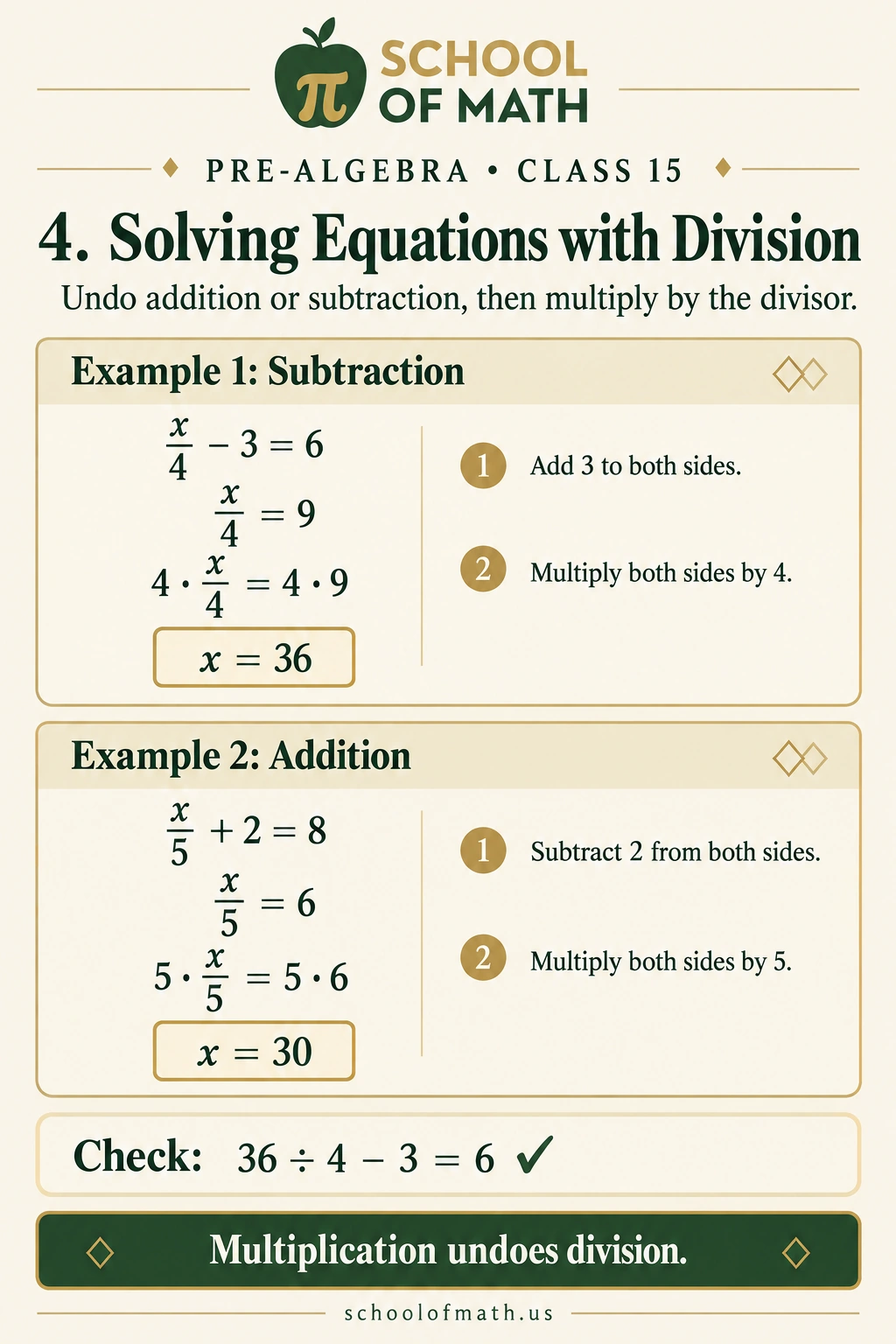
A fraction bar can mean division. If x is divided by a number, first remove the added or subtracted constant, then multiply both sides by the divisor. This restores the whole value of x.
Watch the fraction bar’s grouping. The expression \(\displaystyle \frac{x}{7}-4\) means divide x by 7, then subtract 4. It is not the same as \(\displaystyle \frac{x-4}{7}\), where the subtraction happens before division. The questions in this section have the constant outside the fraction.
Try it yourself: five questions
Q16 Practice 1 of 5
Solve \(\displaystyle \frac{x}{2} + 6 = 17\).
Answer
\(\displaystyle x = 22\).
- Subtract \(\displaystyle 6\) from both sides: \(\displaystyle \frac{x}{2} = 11\).
- Multiply both sides by \(\displaystyle 2\): \(\displaystyle x = 22\).
- Check in the original equation: \(\displaystyle \frac{22}{2} + 6 = 11 + 6 = 17\). Both sides equal \(\displaystyle 17\).
Q17 Practice 2 of 5
Solve \(\displaystyle \frac{x}{7} - 4 = 5\).
Answer
\(\displaystyle x = 63\).
- Add \(\displaystyle 4\) to both sides: \(\displaystyle \frac{x}{7} = 9\).
- Multiply both sides by \(\displaystyle 7\): \(\displaystyle x = 63\).
- Check in the original equation: \(\displaystyle \frac{63}{7} - 4 = 9 - 4 = 5\). Both sides equal \(\displaystyle 5\).
Q18 Practice 3 of 5
Solve \(\displaystyle \frac{x}{8} + 3 = 12\).
Answer
\(\displaystyle x = 72\).
- Subtract \(\displaystyle 3\) from both sides: \(\displaystyle \frac{x}{8} = 9\).
- Multiply both sides by \(\displaystyle 8\): \(\displaystyle x = 72\).
- Check in the original equation: \(\displaystyle \frac{72}{8} + 3 = 9 + 3 = 12\). Both sides equal \(\displaystyle 12\).
Q19 Practice 4 of 5
Solve \(\displaystyle \frac{x}{9} - 5 = 3\).
Answer
\(\displaystyle x = 72\).
- Add \(\displaystyle 5\) to both sides: \(\displaystyle \frac{x}{9} = 8\).
- Multiply both sides by \(\displaystyle 9\): \(\displaystyle x = 72\).
- Check in the original equation: \(\displaystyle \frac{72}{9} - 5 = 8 - 5 = 3\). Both sides equal \(\displaystyle 3\).
Q20 Practice 5 of 5
Solve \(\displaystyle \frac{x}{6} + 7 = 15\).
Answer
\(\displaystyle x = 48\).
- Subtract \(\displaystyle 7\) from both sides: \(\displaystyle \frac{x}{6} = 8\).
- Multiply both sides by \(\displaystyle 6\): \(\displaystyle x = 48\).
- Check in the original equation: \(\displaystyle \frac{48}{6} + 7 = 8 + 7 = 15\). Both sides equal \(\displaystyle 15\).
Working with negative numbers
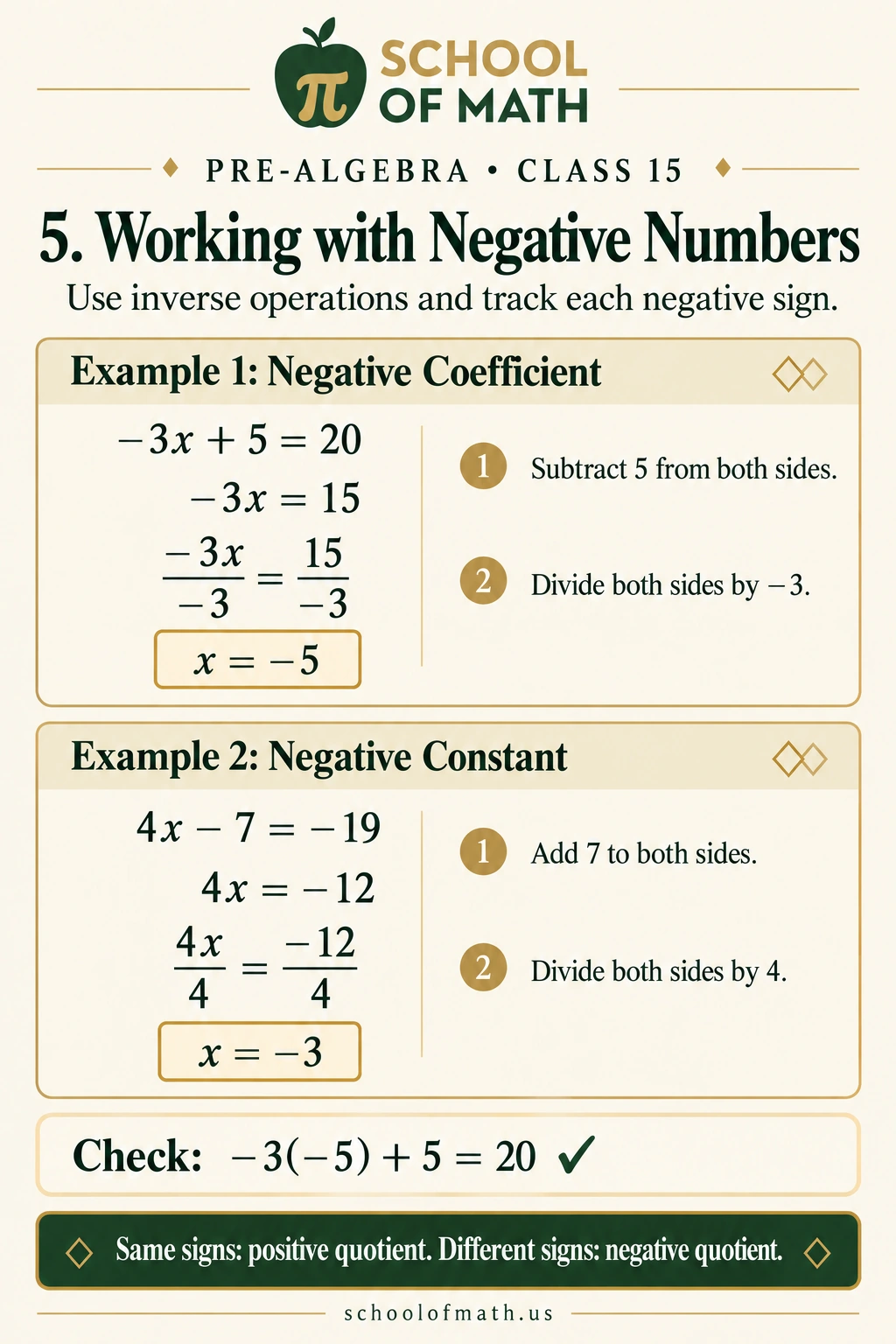
The negative sign is part of the coefficient. If the variable term is \(\displaystyle -4x\), divide by −4, not by 4. Same-sign division gives a positive quotient; different-sign division gives a negative quotient.
A negative answer can be completely valid. Decide by substituting it into the original equation. Use parentheses around a negative value when substituting so that, for example, a negative coefficient multiplied by a negative solution is clearly a positive product.
Try it yourself: five questions
Q21 Practice 1 of 5
Solve \(\displaystyle -4x + 6 = 26\).
Answer
\(\displaystyle x = -5\).
- Subtract \(\displaystyle 6\) from both sides: \(\displaystyle -4x = 20\).
- Divide both sides by \(\displaystyle -4\): \(\displaystyle x = -5\).
- Check in the original equation: \(\displaystyle -4\cdot(-5) + 6 = 20 + 6 = 26\). Both sides equal \(\displaystyle 26\).
Q22 Practice 2 of 5
Solve \(\displaystyle 5x - 9 = -29\).
Answer
\(\displaystyle x = -4\).
- Add \(\displaystyle 9\) to both sides: \(\displaystyle 5x = -20\).
- Divide both sides by \(\displaystyle 5\): \(\displaystyle x = -4\).
- Check in the original equation: \(\displaystyle 5\cdot(-4) - 9 = -20 - 9 = -29\). Both sides equal \(\displaystyle -29\).
Q23 Practice 3 of 5
Solve \(\displaystyle -6x - 7 = 23\).
Answer
\(\displaystyle x = -5\).
- Add \(\displaystyle 7\) to both sides: \(\displaystyle -6x = 30\).
- Divide both sides by \(\displaystyle -6\): \(\displaystyle x = -5\).
- Check in the original equation: \(\displaystyle -6\cdot(-5) - 7 = 30 - 7 = 23\). Both sides equal \(\displaystyle 23\).
Q24 Practice 4 of 5
Solve \(\displaystyle \frac{x}{-3} + 4 = 10\).
Answer
\(\displaystyle x = -18\).
- Subtract \(\displaystyle 4\) from both sides: \(\displaystyle \frac{x}{-3} = 6\).
- Multiply both sides by \(\displaystyle -3\): \(\displaystyle x = -18\).
- Check in the original equation: \(\displaystyle \frac{-18}{-3} + 4 = 6 + 4 = 10\). Both sides equal \(\displaystyle 10\).
Q25 Practice 5 of 5
Solve \(\displaystyle -2x + 9 = -7\).
Answer
\(\displaystyle x = 8\).
- Subtract \(\displaystyle 9\) from both sides: \(\displaystyle -2x = -16\).
- Divide both sides by \(\displaystyle -2\): \(\displaystyle x = 8\).
- Check in the original equation: \(\displaystyle -2\cdot(8) + 9 = -16 + 9 = -7\). Both sides equal \(\displaystyle -7\).
Working with fractions and decimals
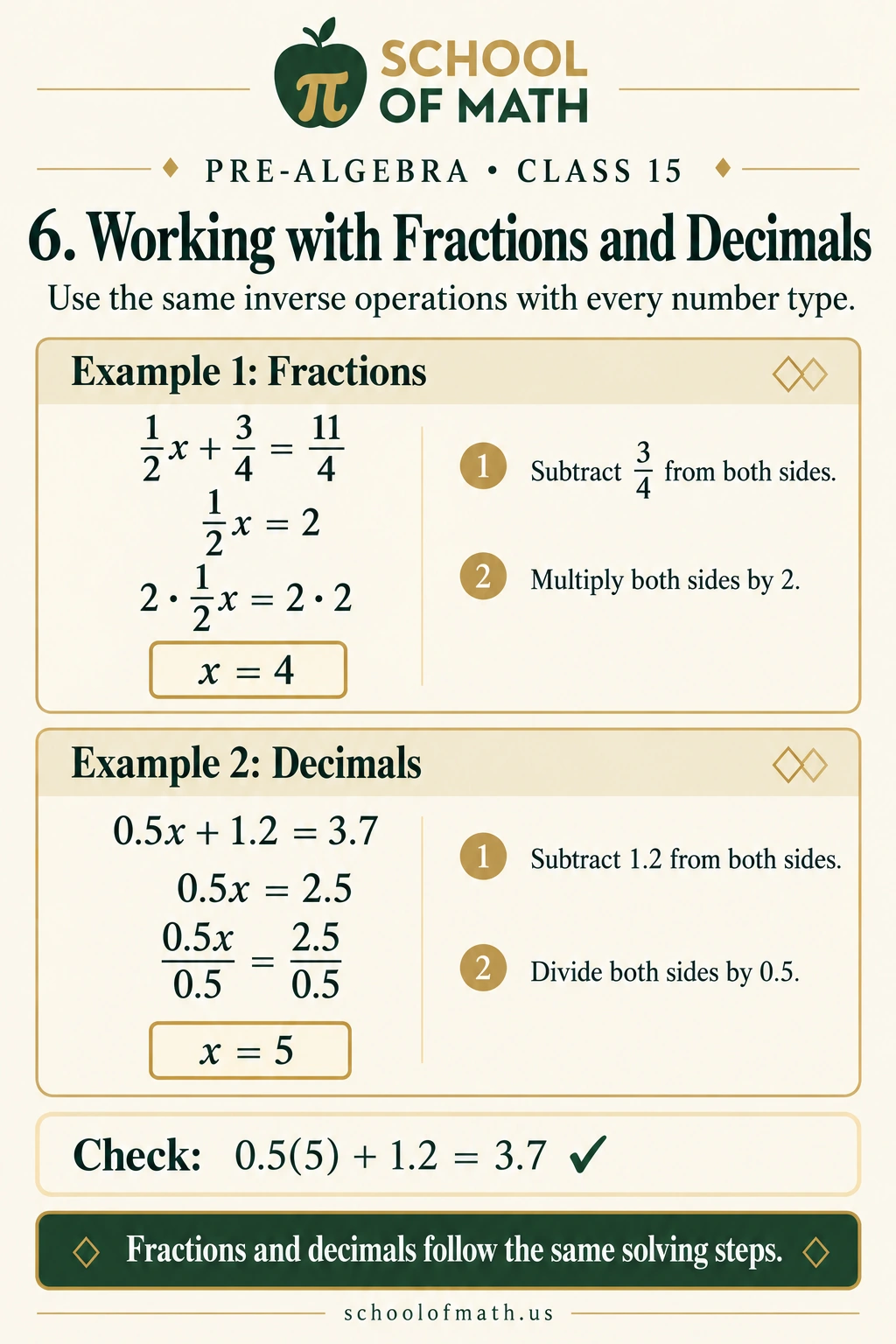
Fractions and decimals follow the same balance rules as whole numbers. Remove the constant, then undo the coefficient. To undo multiplication by a nonzero fraction, multiply by its reciprocal, or equivalently divide by that fraction.
Keep values exact. Align decimal places when adding or subtracting, and use a common denominator when subtracting fractions. You do not need to change every fraction into a decimal. Before checking your answer, return to the original equation so that no constant is left out.
Try it yourself: five questions
Q26 Practice 1 of 5
Solve \(\displaystyle \frac{1}{3}x + \frac{1}{2} = \frac{5}{2}\).
Answer
\(\displaystyle x = 6\).
- Subtract \(\displaystyle \frac{1}{2}\) from both sides: \(\displaystyle \frac{1}{3}x = 2\).
- Multiply both sides by the reciprocal, \(\displaystyle 3\): \(\displaystyle x = 6\).
- Check in the original equation: \(\displaystyle \frac{1}{3}\cdot(6) + \frac{1}{2} = 2 + \frac{1}{2} = \frac{5}{2}\). Both sides equal \(\displaystyle \frac{5}{2}\).
Q27 Practice 2 of 5
Solve \(\displaystyle \frac{3}{4}x - \frac{1}{2} = 4\).
Answer
\(\displaystyle x = 6\).
- Add \(\displaystyle \frac{1}{2}\) to both sides: \(\displaystyle \frac{3}{4}x = \frac{9}{2}\).
- Multiply both sides by the reciprocal, \(\displaystyle \frac{4}{3}\): \(\displaystyle x = 6\).
- Check in the original equation: \(\displaystyle \frac{3}{4}\cdot(6) - \frac{1}{2} = \frac{9}{2} - \frac{1}{2} = 4\). Both sides equal \(\displaystyle 4\).
Q28 Practice 3 of 5
Solve \(\displaystyle 0.4x + 1.6 = 4.4\).
Answer
\(\displaystyle x = 7\).
- Subtract \(\displaystyle 1.6\) from both sides: \(\displaystyle 0.4x = 2.8\).
- Divide both sides by \(\displaystyle 0.4\): \(\displaystyle x = 7\).
- Check in the original equation: \(\displaystyle 0.4\cdot(7) + 1.6 = 2.8 + 1.6 = 4.4\). Both sides equal \(\displaystyle 4.4\).
Q29 Practice 4 of 5
Solve \(\displaystyle 1.5x - 2.4 = 6.6\).
Answer
\(\displaystyle x = 6\).
- Add \(\displaystyle 2.4\) to both sides: \(\displaystyle 1.5x = 9\).
- Divide both sides by \(\displaystyle 1.5\): \(\displaystyle x = 6\).
- Check in the original equation: \(\displaystyle 1.5\cdot(6) - 2.4 = 9 - 2.4 = 6.6\). Both sides equal \(\displaystyle 6.6\).
Q30 Practice 5 of 5
Solve \(\displaystyle \frac{x}{2.5} + 0.8 = 4.8\).
Answer
\(\displaystyle x = 10\).
- Subtract \(\displaystyle 0.8\) from both sides: \(\displaystyle \frac{x}{2.5} = 4\).
- Multiply both sides by \(\displaystyle 2.5\): \(\displaystyle x = 10\).
- Check in the original equation: \(\displaystyle \frac{10}{2.5} + 0.8 = 4 + 0.8 = 4.8\). Both sides equal \(\displaystyle 4.8\).
Variable on the right
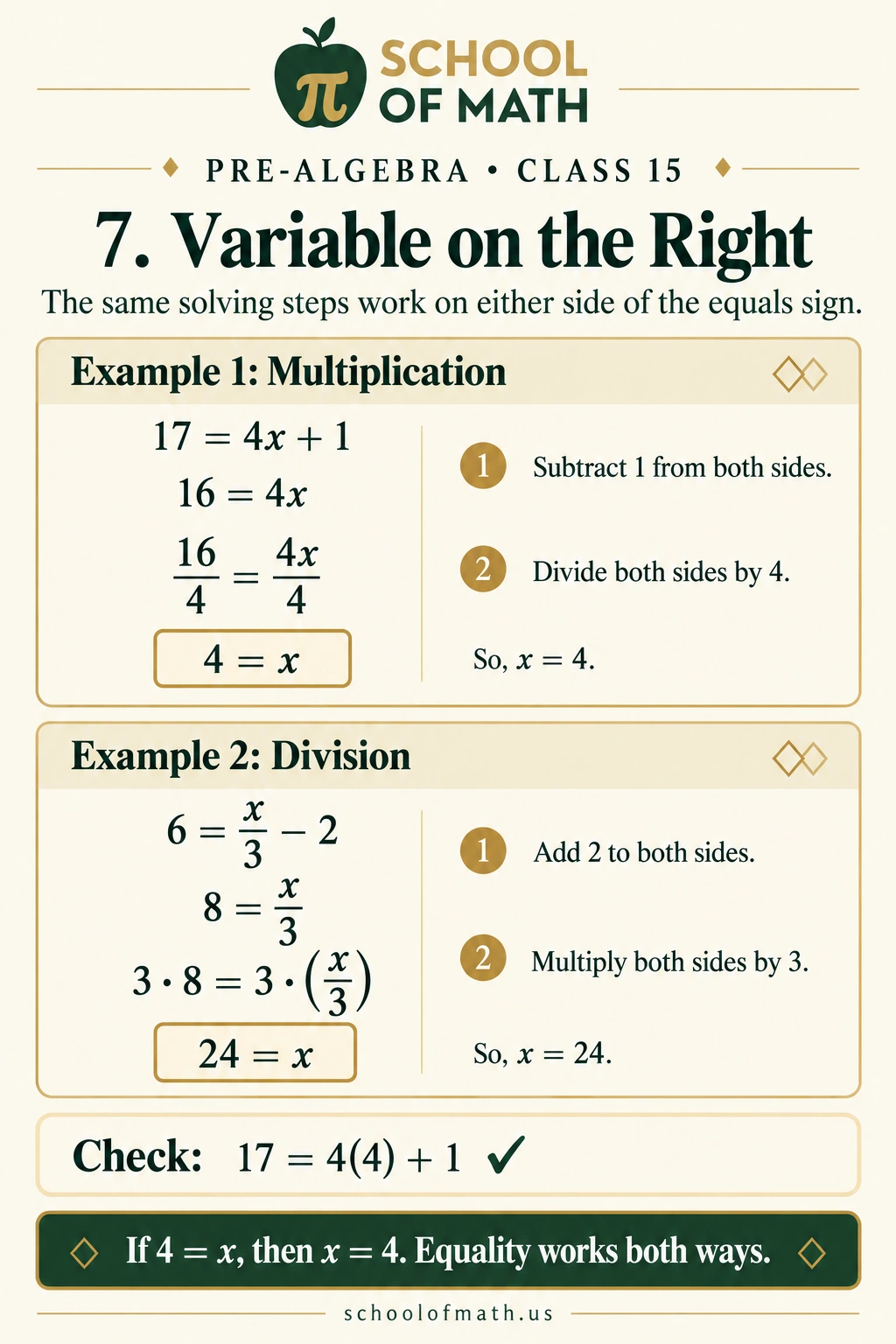
Equality works in both directions: if \(\displaystyle a=b\), then \(\displaystyle b=a\). You can solve with the variable on the right or rewrite the equation with the two complete sides exchanged. Swapping the sides does not change any signs.
Apply the same inverse operation to both sides and keep their order consistent. If the final line says \(\displaystyle 7=x\), you may write \(\displaystyle x=7\). Do not turn a positive coefficient into a negative one merely because it is on the right.
Try it yourself: five questions
Q31 Practice 1 of 5
Solve \(\displaystyle 37 = 5x + 2\).
Answer
\(\displaystyle x = 7\).
- Subtract \(\displaystyle 2\) from both sides: \(\displaystyle 35 = 5x\).
- Divide both sides by \(\displaystyle 5\): \(\displaystyle x = 7\).
- Check in the original equation: \(\displaystyle 5\cdot(7) + 2 = 35 + 2 = 37\). Both sides equal \(\displaystyle 37\).
Q32 Practice 2 of 5
Solve \(\displaystyle 16 = 6x - 8\).
Answer
\(\displaystyle x = 4\).
- Add \(\displaystyle 8\) to both sides: \(\displaystyle 24 = 6x\).
- Divide both sides by \(\displaystyle 6\): \(\displaystyle x = 4\).
- Check in the original equation: \(\displaystyle 6\cdot(4) - 8 = 24 - 8 = 16\). Both sides equal \(\displaystyle 16\).
Q33 Practice 3 of 5
Solve \(\displaystyle 12 = \frac{x}{4} + 5\).
Answer
\(\displaystyle x = 28\).
- Subtract \(\displaystyle 5\) from both sides: \(\displaystyle 7 = \frac{x}{4}\).
- Multiply both sides by \(\displaystyle 4\): \(\displaystyle x = 28\).
- Check in the original equation: \(\displaystyle \frac{28}{4} + 5 = 7 + 5 = 12\). Both sides equal \(\displaystyle 12\).
Q34 Practice 4 of 5
Solve \(\displaystyle 19 = -3x + 4\).
Answer
\(\displaystyle x = -5\).
- Subtract \(\displaystyle 4\) from both sides: \(\displaystyle 15 = -3x\).
- Divide both sides by \(\displaystyle -3\): \(\displaystyle x = -5\).
- Check in the original equation: \(\displaystyle -3\cdot(-5) + 4 = 15 + 4 = 19\). Both sides equal \(\displaystyle 19\).
Q35 Practice 5 of 5
Solve \(\displaystyle 4.9 = 0.5x + 1.4\).
Answer
\(\displaystyle x = 7\).
- Subtract \(\displaystyle 1.4\) from both sides: \(\displaystyle 3.5 = 0.5x\).
- Divide both sides by \(\displaystyle 0.5\): \(\displaystyle x = 7\).
- Check in the original equation: \(\displaystyle 0.5\cdot(7) + 1.4 = 3.5 + 1.4 = 4.9\). Both sides equal \(\displaystyle 4.9\).
Solving word problems
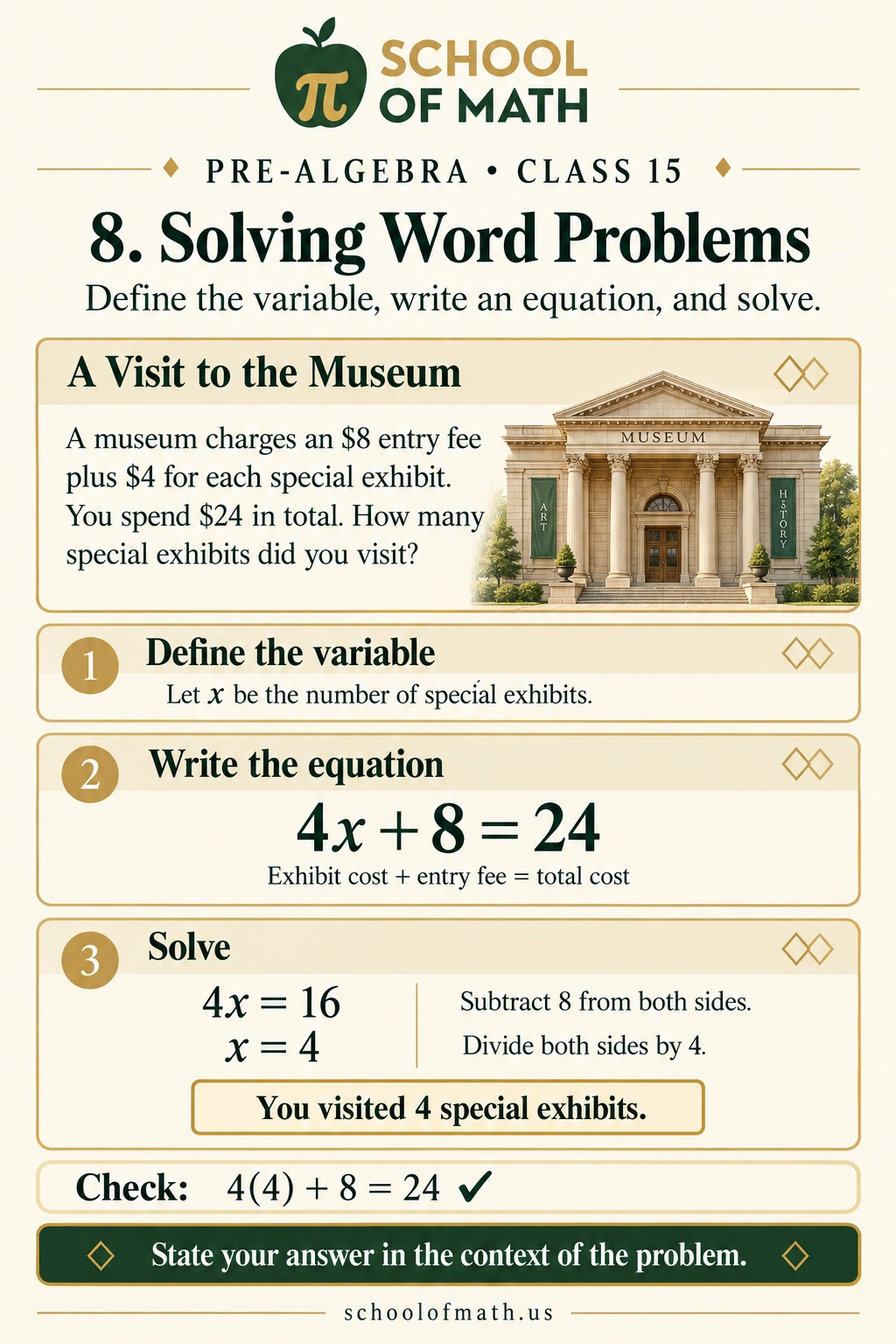
Define x as the quantity you need to find, including its unit. Translate each part of the story into an expression: a fixed fee is a constant, a cost per item is a coefficient, and equal sharing can be represented by division.
Write an equation for the stated total, solve it, and interpret the value in context. A count of tickets or people should be a nonnegative whole number. A length, time, or price may be fractional. Check both the calculation and whether the result answers the actual question.
Try it yourself: five questions
Q36 Practice 1 of 5
An activity center charges a $6 entry fee plus $3 per game. You spend $27 in total. How many games do you play? Define x, write a two-step equation, and solve.
Answer
\(\displaystyle x = 7\). 7 games.
- Let x be the number of games. The equation is \(\displaystyle 3x + 6 = 27\).
- Subtract \(\displaystyle 6\) from both sides: \(\displaystyle 3x = 21\).
- Divide both sides by \(\displaystyle 3\): \(\displaystyle x = 7\).
- Check in the original equation: \(\displaystyle 3\cdot(7) + 6 = 21 + 6 = 27\). Both sides equal \(\displaystyle 27\).
Q37 Practice 2 of 5
An art workshop charges $4 for supplies and $6 per lesson. The total bill is $34. How many lessons are included? Define x, write a two-step equation, and solve.
Answer
\(\displaystyle x = 5\). 5 lessons.
- Let x be the number of lessons. The equation is \(\displaystyle 6x + 4 = 34\).
- Subtract \(\displaystyle 4\) from both sides: \(\displaystyle 6x = 30\).
- Divide both sides by \(\displaystyle 6\): \(\displaystyle x = 5\).
- Check in the original equation: \(\displaystyle 6\cdot(5) + 4 = 30 + 4 = 34\). Both sides equal \(\displaystyle 34\).
Q38 Practice 3 of 5
Four identical notebooks cost $25 after a $3 discount on the entire purchase. What was the original price of one notebook? Define x, write a two-step equation, and solve.
Answer
\(\displaystyle x = 7\). 7 dollars per notebook.
- Let x be the original price of one notebook in dollars. The equation is \(\displaystyle 4x - 3 = 25\).
- Add \(\displaystyle 3\) to both sides: \(\displaystyle 4x = 28\).
- Divide both sides by \(\displaystyle 4\): \(\displaystyle x = 7\).
- Check in the original equation: \(\displaystyle 4\cdot(7) - 3 = 28 - 3 = 25\). Both sides equal \(\displaystyle 25\).
Q39 Practice 4 of 5
Some tokens are shared equally among 5 players. One player then receives 2 extra tokens and has 9 tokens. How many tokens were shared originally? Define x, write a two-step equation, and solve.
Answer
\(\displaystyle x = 35\). 35 tokens originally.
- Let x be the original number of tokens. The equation is \(\displaystyle \frac{x}{5} + 2 = 9\).
- Subtract \(\displaystyle 2\) from both sides: \(\displaystyle \frac{x}{5} = 7\).
- Multiply both sides by \(\displaystyle 5\): \(\displaystyle x = 35\).
- Check in the original equation: \(\displaystyle \frac{35}{5} + 2 = 7 + 2 = 9\). Both sides equal \(\displaystyle 9\).
Q40 Practice 5 of 5
A reader has already read 15 pages and then reads 12 pages each day. The reader reaches 75 pages read. How many additional days of reading were needed? Define x, write a two-step equation, and solve.
Answer
\(\displaystyle x = 5\). 5 days.
- Let x be the number of additional days. The equation is \(\displaystyle 12x + 15 = 75\).
- Subtract \(\displaystyle 15\) from both sides: \(\displaystyle 12x = 60\).
- Divide both sides by \(\displaystyle 12\): \(\displaystyle x = 5\).
- Check in the original equation: \(\displaystyle 12\cdot(5) + 15 = 60 + 15 = 75\). Both sides equal \(\displaystyle 75\).
Homework review
Review the two operations, inverse steps, multiplication and division equations, negative numbers, fractions and decimals, variables on the right, and translating a story into an equation. Complete one review question for each image in order.
R1 Review image 1 of 8
Identify the two operations applied to x, then solve \(\displaystyle 7x + 3 = 52\).
Answer
\(\displaystyle x = 7\).
- The operations applied to x are: multiply by \(\displaystyle 7\), then add 3. Undo them in reverse order.
- Subtract \(\displaystyle 3\) from both sides: \(\displaystyle 7x = 49\).
- Divide both sides by \(\displaystyle 7\): \(\displaystyle x = 7\).
- Check in the original equation: \(\displaystyle 7\cdot(7) + 3 = 49 + 3 = 52\). Both sides equal \(\displaystyle 52\).
R2 Review image 2 of 8
State the inverse operations in order and solve \(\displaystyle \frac{x}{8} - 3 = 4\).
Answer
\(\displaystyle x = 56\).
- Add \(\displaystyle 3\) to both sides: \(\displaystyle \frac{x}{8} = 7\).
- Multiply both sides by \(\displaystyle 8\): \(\displaystyle x = 56\).
- Check in the original equation: \(\displaystyle \frac{56}{8} - 3 = 7 - 3 = 4\). Both sides equal \(\displaystyle 4\).
R3 Review image 3 of 8
Solve \(\displaystyle 9x + 8 = 71\).
Answer
\(\displaystyle x = 7\).
- Subtract \(\displaystyle 8\) from both sides: \(\displaystyle 9x = 63\).
- Divide both sides by \(\displaystyle 9\): \(\displaystyle x = 7\).
- Check in the original equation: \(\displaystyle 9\cdot(7) + 8 = 63 + 8 = 71\). Both sides equal \(\displaystyle 71\).
R4 Review image 4 of 8
Solve \(\displaystyle \frac{x}{6} + 4 = 13\).
Answer
\(\displaystyle x = 54\).
- Subtract \(\displaystyle 4\) from both sides: \(\displaystyle \frac{x}{6} = 9\).
- Multiply both sides by \(\displaystyle 6\): \(\displaystyle x = 54\).
- Check in the original equation: \(\displaystyle \frac{54}{6} + 4 = 9 + 4 = 13\). Both sides equal \(\displaystyle 13\).
R5 Review image 5 of 8
Solve \(\displaystyle -5x - 2 = 18\).
Answer
\(\displaystyle x = -4\).
- Add \(\displaystyle 2\) to both sides: \(\displaystyle -5x = 20\).
- Divide both sides by \(\displaystyle -5\): \(\displaystyle x = -4\).
- Check in the original equation: \(\displaystyle -5\cdot(-4) - 2 = 20 - 2 = 18\). Both sides equal \(\displaystyle 18\).
R6 Review image 6 of 8
Solve \(\displaystyle \frac{1}{4}x + \frac{1}{2} = \frac{7}{2}\).
Answer
\(\displaystyle x = 12\).
- Subtract \(\displaystyle \frac{1}{2}\) from both sides: \(\displaystyle \frac{1}{4}x = 3\).
- Multiply both sides by the reciprocal, \(\displaystyle 4\): \(\displaystyle x = 12\).
- Check in the original equation: \(\displaystyle \frac{1}{4}\cdot(12) + \frac{1}{2} = 3 + \frac{1}{2} = \frac{7}{2}\). Both sides equal \(\displaystyle \frac{7}{2}\).
R7 Review image 7 of 8
Solve \(\displaystyle 23 = 3x - 4\).
Answer
\(\displaystyle x = 9\).
- Add \(\displaystyle 4\) to both sides: \(\displaystyle 27 = 3x\).
- Divide both sides by \(\displaystyle 3\): \(\displaystyle x = 9\).
- Check in the original equation: \(\displaystyle 3\cdot(9) - 4 = 27 - 4 = 23\). Both sides equal \(\displaystyle 23\).
R8 Review image 8 of 8
A bird park charges a $10 group booking fee and $3 per student. The total is $31. How many students are in the group? Define x, write a two-step equation, and solve.
Answer
\(\displaystyle x = 7\). 7 students.
- Let x be the number of students. The equation is \(\displaystyle 3x + 10 = 31\).
- Subtract \(\displaystyle 10\) from both sides: \(\displaystyle 3x = 21\).
- Divide both sides by \(\displaystyle 3\): \(\displaystyle x = 7\).
- Check in the original equation: \(\displaystyle 3\cdot(7) + 10 = 21 + 10 = 31\). Both sides equal \(\displaystyle 31\).
Homework word problems
These twelve problems progress from simple fees and equal shares to negative changes, decimal rates, fractional amounts, and finding an original length. Define your variable, write an equation, show both inverse steps, and give an answer with units.
W1 Homework word problem 1 of 12
Mia starts with $7 and saves $3 each week. She now has $22. For how many weeks has she saved? Define x, write a two-step equation, and solve.
Answer
\(\displaystyle x = 5\). 5 weeks.
- Let x be the number of weeks. The equation is \(\displaystyle 3x + 7 = 22\).
- Subtract \(\displaystyle 7\) from both sides: \(\displaystyle 3x = 15\).
- Divide both sides by \(\displaystyle 3\): \(\displaystyle x = 5\).
- Check in the original equation: \(\displaystyle 3\cdot(5) + 7 = 15 + 7 = 22\). Both sides equal \(\displaystyle 22\).
W2 Homework word problem 2 of 12
A fair charges a $5 entrance fee and $4 per ride. A visitor spends $29. How many rides did the visitor take? Define x, write a two-step equation, and solve.
Answer
\(\displaystyle x = 6\). 6 rides.
- Let x be the number of rides. The equation is \(\displaystyle 4x + 5 = 29\).
- Subtract \(\displaystyle 5\) from both sides: \(\displaystyle 4x = 24\).
- Divide both sides by \(\displaystyle 4\): \(\displaystyle x = 6\).
- Check in the original equation: \(\displaystyle 4\cdot(6) + 5 = 24 + 5 = 29\). Both sides equal \(\displaystyle 29\).
W3 Homework word problem 3 of 12
Six identical notebooks cost $32 after a $4 coupon is applied to the whole purchase. What is the price of one notebook before the coupon? Define x, write a two-step equation, and solve.
Answer
\(\displaystyle x = 6\). 6 dollars per notebook.
- Let x be the price of one notebook in dollars. The equation is \(\displaystyle 6x - 4 = 32\).
- Add \(\displaystyle 4\) to both sides: \(\displaystyle 6x = 36\).
- Divide both sides by \(\displaystyle 6\): \(\displaystyle x = 6\).
- Check in the original equation: \(\displaystyle 6\cdot(6) - 4 = 36 - 4 = 32\). Both sides equal \(\displaystyle 32\).
W4 Homework word problem 4 of 12
A set of cards is shared equally among 4 children. One child receives 3 bonus cards and then has 11. How many cards were in the original set? Define x, write a two-step equation, and solve.
Answer
\(\displaystyle x = 32\). 32 cards originally.
- Let x be the original number of cards. The equation is \(\displaystyle \frac{x}{4} + 3 = 11\).
- Subtract \(\displaystyle 3\) from both sides: \(\displaystyle \frac{x}{4} = 8\).
- Multiply both sides by \(\displaystyle 4\): \(\displaystyle x = 32\).
- Check in the original equation: \(\displaystyle \frac{32}{4} + 3 = 8 + 3 = 11\). Both sides equal \(\displaystyle 11\).
W5 Homework word problem 5 of 12
Jon has read 14 pages of a book. He reads 8 more pages each day until he has read 70 pages. How many additional days does he read? Define x, write a two-step equation, and solve.
Answer
\(\displaystyle x = 7\). 7 days.
- Let x be the number of additional reading days. The equation is \(\displaystyle 8x + 14 = 70\).
- Subtract \(\displaystyle 14\) from both sides: \(\displaystyle 8x = 56\).
- Divide both sides by \(\displaystyle 8\): \(\displaystyle x = 7\).
- Check in the original equation: \(\displaystyle 8\cdot(7) + 14 = 56 + 14 = 70\). Both sides equal \(\displaystyle 70\).
W6 Homework word problem 6 of 12
Five students pay the same admission price for a museum trip. Their group also pays a $12 booking fee. The total bill is $57. What is the admission price per student? Define x, write a two-step equation, and solve.
Answer
\(\displaystyle x = 9\). 9 dollars per student.
- Let x be the admission price per student in dollars. The equation is \(\displaystyle 57 = 5x + 12\).
- Subtract \(\displaystyle 12\) from both sides: \(\displaystyle 45 = 5x\).
- Divide both sides by \(\displaystyle 5\): \(\displaystyle x = 9\).
- Check in the original equation: \(\displaystyle 5\cdot(9) + 12 = 45 + 12 = 57\). Both sides equal \(\displaystyle 57\).
W7 Homework word problem 7 of 12
A player starts with 12 points and loses 3 points in each round. After several rounds, the score is −6. How many rounds were played? Define x, write a two-step equation, and solve.
Answer
\(\displaystyle x = 6\). 6 rounds.
- Let x be the number of rounds. The equation is \(\displaystyle -3x + 12 = -6\).
- Subtract \(\displaystyle 12\) from both sides: \(\displaystyle -3x = -18\).
- Divide both sides by \(\displaystyle -3\): \(\displaystyle x = 6\).
- Check in the original equation: \(\displaystyle -3\cdot(6) + 12 = -18 + 12 = -6\). Both sides equal \(\displaystyle -6\).
W8 Homework word problem 8 of 12
A freezer starts at 4°C and cools at a constant rate of 3°C per minute. How many minutes does it take to reach −14°C? Define x, write a two-step equation, and solve.
Answer
\(\displaystyle x = 6\). 6 minutes.
- Let x be the cooling time in minutes. The equation is \(\displaystyle -3x + 4 = -14\).
- Subtract \(\displaystyle 4\) from both sides: \(\displaystyle -3x = -18\).
- Divide both sides by \(\displaystyle -3\): \(\displaystyle x = 6\).
- Check in the original equation: \(\displaystyle -3\cdot(6) + 4 = -18 + 4 = -14\). Both sides equal \(\displaystyle -14\).
W9 Homework word problem 9 of 12
A fictional shuttle fare is a $4.50 starting fee plus $2.50 per mile. The total fare is $19.50. How many miles is the trip? Define x, write a two-step equation, and solve.
Answer
\(\displaystyle x = 6\). 6 miles.
- Let x be the distance traveled in miles. The equation is \(\displaystyle 2.5x + 4.5 = 19.5\).
- Subtract \(\displaystyle 4.5\) from both sides: \(\displaystyle 2.5x = 15\).
- Divide both sides by \(\displaystyle 2.5\): \(\displaystyle x = 6\).
- Check in the original equation: \(\displaystyle 2.5\cdot(6) + 4.5 = 15 + 4.5 = 19.5\). Both sides equal \(\displaystyle 19.5\).
W10 Homework word problem 10 of 12
A craft project uses half of a ribbon plus 1.25 meters from a second roll. The project uses 4.75 meters altogether. How long was the first ribbon? Define x, write a two-step equation, and solve.
Answer
\(\displaystyle x = 7\). 7 meters.
- Let x be the length of the first ribbon in meters. The equation is \(\displaystyle 0.5x + 1.25 = 4.75\).
- Subtract \(\displaystyle 1.25\) from both sides: \(\displaystyle 0.5x = 3.5\).
- Divide both sides by \(\displaystyle 0.5\): \(\displaystyle x = 7\).
- Check in the original equation: \(\displaystyle 0.5\cdot(7) + 1.25 = 3.5 + 1.25 = 4.75\). Both sides equal \(\displaystyle 4.75\).
W11 Homework word problem 11 of 12
A tank contains two-thirds of its full capacity. After 4 liters are added, it contains 18 liters. What is the tank’s full capacity? Define x, write a two-step equation, and solve.
Answer
\(\displaystyle x = 21\). 21 liters.
- Let x be the full tank capacity in liters. The equation is \(\displaystyle \frac{2}{3}x + 4 = 18\).
- Subtract \(\displaystyle 4\) from both sides: \(\displaystyle \frac{2}{3}x = 14\).
- Multiply both sides by the reciprocal, \(\displaystyle \frac{3}{2}\): \(\displaystyle x = 21\).
- Check in the original equation: \(\displaystyle \frac{2}{3}\cdot(21) + 4 = 14 + 4 = 18\). Both sides equal \(\displaystyle 18\).
W12 Homework word problem 12 of 12
A rope is cut into 6 equal pieces. One piece is shortened by 1.5 meters and is then 5.5 meters long. How long was the original rope? Define x, write a two-step equation, and solve.
Answer
\(\displaystyle x = 42\). 42 meters.
- Let x be the length of the original rope in meters. The equation is \(\displaystyle \frac{x}{6} - 1.5 = 5.5\).
- Add \(\displaystyle 1.5\) to both sides: \(\displaystyle \frac{x}{6} = 7\).
- Multiply both sides by \(\displaystyle 6\): \(\displaystyle x = 42\).
- Check in the original equation: \(\displaystyle \frac{42}{6} - 1.5 = 7 - 1.5 = 5.5\). Both sides equal \(\displaystyle 5.5\).
Quick questions and answers
How do you solve a two-step equation?
For the forms in this lesson, undo the added or subtracted constant first, then undo the multiplication or division involving the variable. Do the same operation to both sides and check by substitution.
Why do you undo the operations in reverse order?
You are working backward from the final value to the starting variable. If the expression multiplies x and then adds a constant, subtract the constant before dividing by the coefficient.
What if the coefficient is negative?
Keep the sign with the coefficient. After removing the constant, divide both sides by the signed coefficient. A negative solution is valid if it makes the original equality true.
Can the variable be on the right?
Yes. Equality works in both directions. You may leave the variable on the right while solving or exchange the two complete sides without changing signs.
Do fractions and decimals need different rules?
No. Use the same inverse operations and keep the arithmetic exact. A nonzero fractional coefficient can be undone by multiplying both sides by its reciprocal.
What practice and homework are included?
Eight image sections contain five new practice questions each. There are eight homework review questions, one per image, followed by twelve homework word problems. All 60 questions have hidden worked solutions with substitution checks.