SOMATH Journal · Competition Math
2025 AMC 10A problems & solutions
This guide works through all 25 problems from the 2025 AMC 10A, with the theory behind each question and detailed solutions hidden behind blue Answer controls. Start with a problem, explain your reasoning, and reveal the answer only when you’re ready to compare approaches.
Looking for AMC 10 prep in NYC? At School of Math | SOMATH, we use problems like these to build mathematical judgment, not just faster calculation. Book a free evaluation at 226 W 79th St, 1st Floor, Upper West Side, or call (646) 668-6151 to discuss a suitable starting point.
Our Tao Titans Math Competition Prep course offers in-person AMC 8, AMC 10 and AMC 12 preparation for grades 6–12, with practice matched to readiness. The current class meets Fridays, 4:00–6:00 PM; review the schedule and course details before enrolling.
25 questions with the supplied SOMATH cover, original problem diagrams, and space to work. No solutions or answer key. View the original supplied compilation.
Question source: the user-supplied 2025 AMC 10 A Problems and Answer Key, a compilation labeled Dr. Xue’s Math School. Question wording and available choices are transcribed, with web-friendly notation; original diagrams are retained. The detailed explanations and additional solution diagrams are newly written for SOMATH. Answer letters were checked against the supplied key and the published LIVE by Po-Shen Loh key. SOMATH is an independent preparation provider, not the MAA or an official contest sponsor.
What this AMC 10A teaches
A contest problem often combines two familiar ideas in an unfamiliar way. Use this table to decide what to review after your first attempt, rather than treating every wrong answer as the same kind of mistake.
| Theory area | Problems | What to practice |
|---|---|---|
| Modeling, rates and averages | 1, 2, 4 | Choose variables, track totals, and distinguish the asked-for quantity from an intermediate result. |
| Sequences and algebraic structure | 5, 7, 9, 11, 18, 19 | Group terms, substitute strategically, and use identities or recurrences instead of expanding everything. |
| Geometry and similarity | 3, 6, 10, 13, 15, 20, 22, 23 | Draw auxiliary lines, compare lengths and areas, connect centers, and choose helpful coordinates. |
| Counting, logic and probability | 8, 12, 14, 16, 24, 25 | Build equally likely sample spaces, separate cases, and recognize structural restrictions. |
| Number theory and proof | 11, 17, 21, 24 | Use remainders, gcds, extremal constructions and upper bounds. |
How to study without turning solutions into spoilers
For a first pass, keep the answer panels closed and work on paper. If you stall, write what you know, what you need, and the relationship that might connect them. The visible theory notes offer a direction without replacing your attempt.
On your second pass, open the solution and compare the first useful decision, not only the final arithmetic. Was the missing move a variable, a diagram, a case split or a bound? Close the panel and reconstruct the reasoning. That final retrieval step is our recommended way to check whether you can now use the idea independently.
The MAA describes the AMC 10 as a 25-question, 75-minute multiple-choice competition for students in grade 10 or below who are under 17.5 on contest day (MAA contest overview). Use 75 minutes for a later timed attempt; for learning, give the explanations the time they need.
Rates and a head startProblem 1
- (A) 3:30
- (B) 3:45
- (C) 4:00
- (D) 4:15
- (E) 4:30
The theory involved
Distance equals rate times elapsed time: \(d=rt\). When two travelers start at different times, give each traveler the correct elapsed time. Equal distances from a starting point do not require the travelers to meet.
Answer
Answer E: 4:30.
The SOMATH solution
- Measure \(t\) hours after 2:30. Betsy has ridden for \(t\) hours, while Andy has ridden for \(t+1\) hours because he started one hour earlier.
- Write their distances from Mathville: Andy travels \(8(t+1)\) miles and Betsy travels \(12t\) miles. Their north/east directions do not change these distances.
- Set the distances equal: \(8(t+1)=12t\). Expanding gives \(8t+8=12t\), so \(t=2\).
- Two hours after 2:30 is 4:30. At that time Andy has traveled \(8\cdot3=24\) miles and Betsy has traveled \(12\cdot2=24\) miles.
What to remember: Define the clock before writing the equation. Using \(8t=12t\) would erase Andy’s head start; using the Pythagorean theorem would answer a different question about the distance between the riders.
Next problemMixtures and weighted averagesProblem 2
- (A) 3.5
- (B) 4
- (C) 4.5
- (D) 5
- (E) 6
The theory involved
A mixture percentage is a weighted average. Track actual pounds of an ingredient first, then divide by the total weight. Two percentages cannot simply be averaged unless the two batches have equal weights.
Answer
Answer B: 4.
The SOMATH solution
- Let \(x\) be the pounds of the second mix added. The first mix contains \(0.50(10)=5\) pounds of peanuts; the second contributes \(0.20x\).
- The final mix weighs \(10+x\) pounds and is 40 percent peanuts, so \(5+0.20x=0.40(10+x)\).
- Solve: \(5+0.20x=4+0.40x\), hence \(x=5\). This is the amount of added mix, not the final answer.
- Now count cashews: the original box has \(0.20(10)=2\) pounds and the added mix has \(0.40(5)=2\) pounds. Total cashews: 4 pounds.
What to remember: Use the ingredient whose final percentage is known to determine the missing batch size. Then return to the ingredient the question actually asks about.
Next problemTriangle inequality and nonoverlapping casesProblem 3
- (A) 2025
- (B) 2026
- (C) 3012
- (D) 3037
- (E) 4050
The theory involved
An isosceles triangle has at least two equal sides. For positive area, the sum of the two shorter sides must be strictly greater than the longest side. Count distinct side-length triples, not different drawings or rotations.
Answer
Answer D: 3037.
The SOMATH solution
- First suppose the two equal sides are the longest: \((2025,2025,b)\). Every integer \(b\) from 1 through 2025 works. This gives 2025 triangles and includes the equilateral triangle.
- Now suppose 2025 is the unique longest side: \((a,a,2025)\), with \(a<2025\). The triangle inequality requires \(2a>2025\), so \(a\ge1013\).
- The allowed integers are \(1013,1014,\ldots,2024\). Their number is \(2024-1013+1=1012\). The \(+1\) matters because both endpoints are included.
- The two cases do not overlap. Add them: \(2025+1012=\boxed{3037}\).
What to remember: Count triangles by their side lengths, not by rotating or reflecting the same triangle. An equivalent count allows \(a=2025\) in the second case and then subtracts the one duplicated equilateral triangle.
Next problemAverages as totalsProblem 4
- (A) 28
- (B) 29
- (C) 30
- (D) 32
- (E) 33
The theory involved
Average times number of people equals total age. Adding one person changes both the numerator and the denominator of an average; track both changes.
Answer
Answer A: 28.
The SOMATH solution
- Let there be \(s\) students and \(t\) teachers, so \(s+t=15\). Let Ash’s age be \(a\).
- For the students, \(12s+a=14(s+1)\). Therefore \(a=2s+14\).
- For the teachers, \(55t+a=52(t+1)\). Therefore \(a=52-3t\). Substitute \(t=15-s\) to get \(a=7+3s\).
- Equate the two expressions: \(2s+14=7+3s\), so \(s=7\), \(t=8\), and \(a=28\). Check: \((84+28)/8=14\) and \((440+28)/9=52\).
What to remember: Translate every average statement into a total before combining equations. Do not assume that the two teams have the same size.
Next problemSequence blocks and square numbersProblem 5
- (A) 5
- (B) 15
- (C) 16
- (D) 44
- (E) 45
The theory involved
A long sequence can often be indexed by grouping it into predictable blocks. The identity \(1+3+5+\cdots+(2n-1)=n^2\) locates the ends of blocks with consecutive odd lengths.
Answer
Answer E: 45.
The SOMATH solution
- Partition the sequence as \([1]\), \([2,1,2]\), \([3,2,1,2,3]\), \([4,3,2,1,2,3,4]\), and so on.
- Block \(n\) descends from \(n\) to 1 and then rises back to \(n\). It contains \(2n-1\) terms and ends with \(n\).
- The first \(n\) blocks therefore contain \(1+3+\cdots+(2n-1)=n^2\) terms. Since \(2025=45^2\), position 2025 is the last position of block 45.
- The last term of that block is 45. Check the first few boundaries: positions 1, 4, and 9 contain 1, 2, and 3.
What to remember: Do not try to list thousands of terms. A useful grouping turns an indexing problem into a familiar sum.
Next problemAngle chasing and rotational symmetryProblem 6
- (A) 80
- (B) 90
- (C) 100
- (D) 110
- (E) 120
The theory involved
An equilateral triangle has three \(60^\circ\) angles. Trisectors make angles of \(20^\circ\) and \(40^\circ\) with a side. Triangle angle sums and the threefold symmetry determine the central intersection.
Answer
Answer C: 100.
The SOMATH solution
- Label the original triangle \(ABC\). From \(A\) and \(B\), the two trisector rays that make \(40^\circ\) with side \(AB\) meet at a vertex of the central hexagon.
- The triangle formed by these rays and \(AB\) has base angles \(40^\circ\) and \(40^\circ\). Its apex angle, which is also the interior angle of the hexagon there, is \(180^\circ-40^\circ-40^\circ=100^\circ\).
- The other alternating type of hexagon vertex comes from the rays making \(20^\circ\) with \(AB\). The upward-facing intersection angle is \(180^\circ-20^\circ-20^\circ=140^\circ\).
- Rotating the diagram by \(120^\circ\) repeats each type three times. Thus the angles alternate \(100^\circ,140^\circ\), and the smallest is \(100^\circ\). Their sum \(3(100+140)=720^\circ\) agrees with the hexagon angle-sum formula.
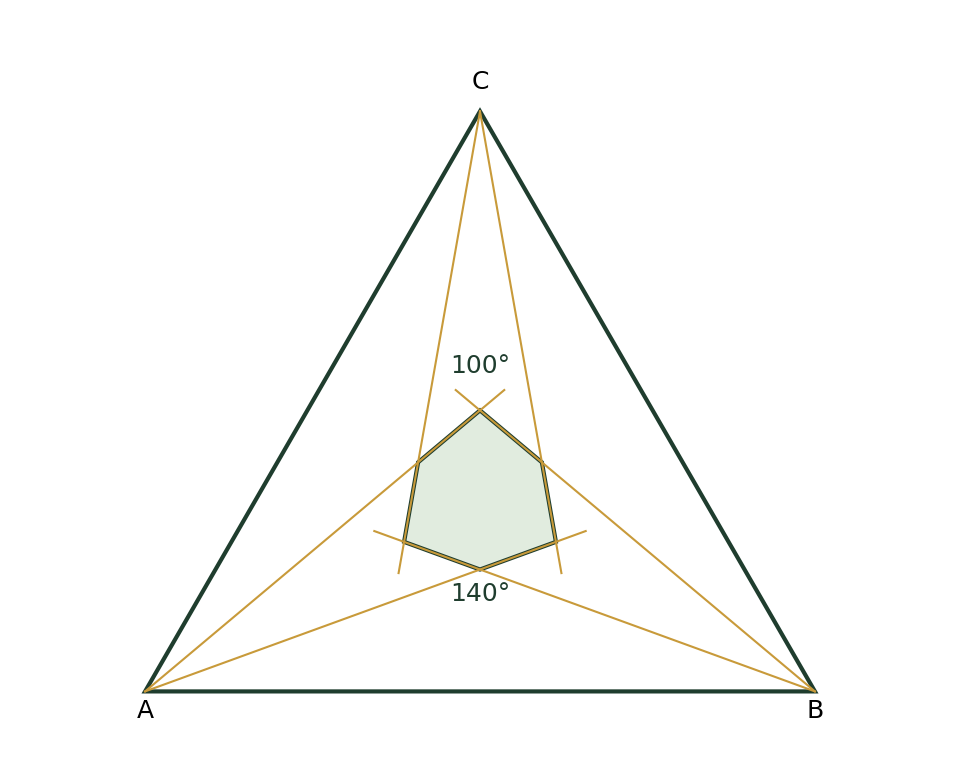
What to remember: Symmetry does not imply that this hexagon is regular. The two alternating angle types must be distinguished.
Next problemThe polynomial remainder theoremProblem 7
- (A) 14
- (B) 15
- (C) 16
- (D) 17
- (E) 18
The theory involved
The remainder when \(P(x)\) is divided by \(x-c\) is \(P(c)\). This turns polynomial division information into substitution equations without long division.
Answer
Answer E: 18.
The SOMATH solution
- Let \(P(x)=x^3+x^2+ax+b\). From the remainder on division by \(x-1\), \(P(1)=4\), so \(1+1+a+b=4\), or \(a+b=2\).
- From division by \(x-2\), \(P(2)=6\), so \(8+4+2a+b=6\), or \(2a+b=-6\).
- Subtract the first equation from the second: \(a=-8\). Substitution into \(a+b=2\) gives \(b=10\).
- Therefore \(b-a=10-(-8)=\boxed{18}\). A direct check gives \(P(1)=4\) and \(P(2)=6\).
What to remember: For divisor \(x-c\), substitute \(c\), not \(-c\). Notice the subtraction of a negative in the final expression.
Next problemSelf-consistent logicProblem 8
- At least one of these statements is true.
- At least two of these statements are true.
- At least two of these statements are false.
- At least one of these statements is false.
- (A) 0
- (B) 1
- (C) 2
- (D) 3
- (E) 4
The theory involved
Self-referential statements must be jointly consistent. Assume a number of false statements, evaluate all four claims, and check whether the resulting number agrees with the assumption.
Answer
Answer B: 1.
The SOMATH solution
- Suppose \(f\) statements are false. Then \(4-f\) are true. The four statements respectively assert \(f\le3\), \(f\le2\), \(f\ge2\), and \(f\ge1\).
- Test \(f=0,1,2,3,4\). The resulting numbers of false statements are respectively \(2,1,0,1,2\).
- Only \(f=1\) returns the same number of false statements as assumed. In that case the statements have truth values true, true, false, true.
- There are therefore 1 false statement and 3 true statements. The third statement is the false one.
What to remember: Finding a plausible assignment is not enough: verify that it is consistent and that the other possibilities fail.
Next problemHorizontal shifts and counting polynomial rootsProblem 9
- (A) 1
- (B) 2
- (C) 3
- (D) 4
- (E) more than 4
The theory involved
A point \((x_0,y_0)\) lies on \(y=f(x-a)\) when \(f(x_0-a)=y_0\). A degree-three polynomial has at most three distinct real roots, and sign changes across disjoint intervals can establish that three exist.
Answer
Answer C: 3.
The SOMATH solution
- Substitute the point: \(f(1-a)=25\). Set \(u=1-a\). Each real value of \(u\) corresponds to exactly one real value of \(a\), so count solutions of \(f(u)=25\).
- Factor \(f(u)=100u(u-1)(u-2)\). We have \(f(0)=0\), \(f(1/2)=37.5\), and \(f(1)=0\). Because a polynomial is continuous, it crosses height 25 once or more in each of \((0,1/2)\) and \((1/2,1)\).
- Also \(f(2)=0\) and \(f(3)=600\), so there is a third crossing in \((2,3)\). These three intervals are disjoint, giving three distinct solutions.
- The equation \(f(u)-25=0\) is cubic, so it cannot have more than three distinct roots. Exactly 3 values of \(a\) work.
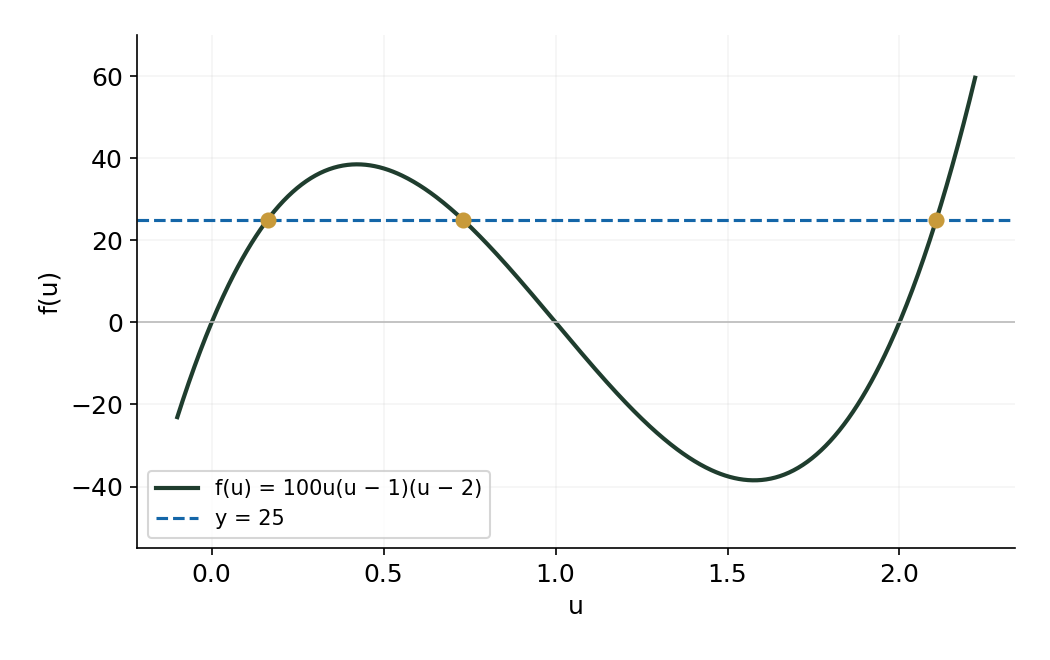
What to remember: You do not need the actual roots. Establishing a lower bound of three and an upper bound of three finishes the count without a cubic formula or calculus.
Next problemCircle chords and area differencesProblem 10
- (A) \(16\pi\)
- (B) \(24\pi\)
- (C) \(32\pi\)
- (D) \(48\pi\)
- (E) \(64\pi\)
The theory involved
The perpendicular from a circle’s center to a chord bisects that chord. A right triangle links the large radius, the chord’s half-length, and the chord’s distance from the diameter.
Answer
Answer C: \(32\pi\).
The SOMATH solution
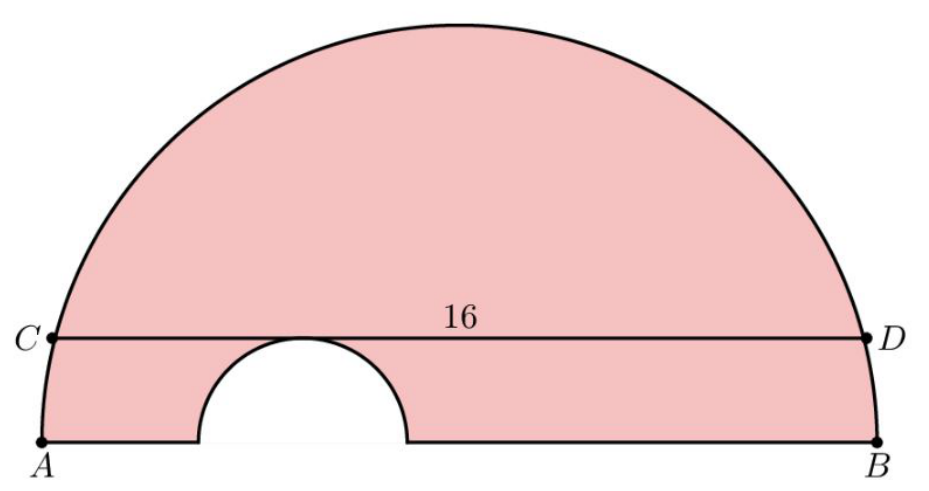
- Let \(R\) be the large radius and \(r\) the small radius. Since the small semicircle rests on \(AB\) and is tangent to the horizontal chord, the chord is \(r\) units above \(AB\).
- The large circle’s center lies on \(AB\). Drop its perpendicular to the chord. Half of the chord is \(16/2=8\), so the Pythagorean theorem gives \(R^2=r^2+8^2\).
- The shaded area is the difference of the two semicircle areas: \(\frac{\pi}{2}(R^2-r^2)\).
- Substitute \(R^2-r^2=64\): the shaded area is \(\frac{\pi}{2}\cdot64=\boxed{32\pi}\).
What to remember: The small semicircle does not need to be concentric with the large circle. Its height determines \(r\), and the area depends only on \(R^2-r^2\).
Next problemArithmetic and geometric sequences with integer constraintsProblem 11
- (A) 66
- (B) 91
- (C) 103
- (D) 132
- (E) 149
The theory involved
An arithmetic sequence uses a common difference; a geometric sequence uses a common ratio. When a sequence begins with 1 and its second term is an integer, the geometric ratio is itself an integer.
Answer
Answer E: 149.
The SOMATH solution
- Write the arithmetic sequence as \(1,1+d,1+2d,1+3d\), where \(d\) is a positive integer. Thus \(z=1+3d\), so \(z\equiv1\pmod3\).
- Write the geometric sequence as \(1,r,r^2,r^3\), where \(r\) is an integer greater than 1. We need \(r^3\equiv1\pmod3\). Since a cube has the same remainder modulo 3 as its base, \(r\equiv1\pmod3\).
- The smallest possible ratio is \(r=4\). Then \(z=64\), \(d=(64-1)/3=21\), \(x=22\), \(y=43\), \(p=4\), and \(q=16\).
- The required sum is \(22+43+64+4+16=\boxed{149}\). Ratios 2 and 3 fail because their cubes, 8 and 27, are not 1 modulo 3.
What to remember: Turn “smallest possible” into a restriction on the simplest parameter, here the integer common ratio.
Next problemCounting with overlapping digit propertiesProblem 12
- (A) 176
- (B) 192
- (C) 432
- (D) 464
- (E) 608
The theory involved
Exactly-one conditions are easiest to count using disjoint cases. The digit 2 is both even and prime; the odd nonprime digits allowed here are 1 and 9. Repeated digits are allowed because the question does not prohibit them.
Answer
Answer D: 464.
The SOMATH solution
- Case 1: the even digit and the prime digit are the same occurrence, namely 2. Choose its position in 4 ways. Every other position must be 1 or 9, giving \(4\cdot2^3=32\) codes.
- Case 2: the even and prime digits occupy different positions. The even digit is one of \(4,6,8\), and the prime digit is one of \(3,5,7\).
- Choose the even digit’s position in 4 ways and the prime digit’s position in 3 ways. Choose the two values in \(3\cdot3\) ways. Fill the remaining two positions with 1 or 9 in \(2^2\) ways.
- Case 2 contributes \(4\cdot3\cdot3\cdot3\cdot4=432\). Add the disjoint cases: \(32+432=\boxed{464}\).
What to remember: The number 1 is not prime. Forgetting that 2 satisfies both properties loses an entire case.
Next problemGeometric series and similarityProblem 13
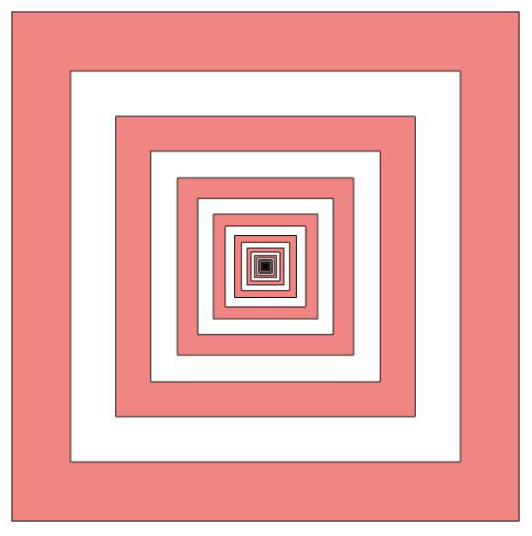
Wording note: the supplied question reverses the ratio. For \(0<k<1\), the intended shrinking factor is the next inner square’s side divided by the surrounding square’s side. The solution uses that interpretation.
- (A) \(\frac35\)
- (B) \(\frac{16}{25}\)
- (C) \(\frac23\)
- (D) \(\frac34\)
- (E) \(\frac45\)
The theory involved
If similar figures have side-length ratio \(k\), their area ratio is \(k^2\). An infinite geometric series with first term \(a\) and ratio \(r\), where \(|r|<1\), has sum \(a/(1-r)\).
Answer
Answer D: \(\frac34\).
The SOMATH solution
- Scale the outer square to area 1. Successive square areas are \(1,k^2,k^4,k^6,\ldots\).
- The first shaded ring has area \(1-k^2\). The next shaded ring has area \(k^4-k^6=k^4(1-k^2)\), and each later shaded ring is \(k^4\) times the previous one.
- Thus the total shaded fraction is \(\frac{1-k^2}{1-k^4}=\frac1{1+k^2}\). Set this equal to \(0.64=16/25\).
- Then \(1+k^2=25/16\), so \(k^2=9/16\). Since \(k>0\), \(k=\boxed{3/4}\). As a quick check, \(1/(1+9/16)=16/25\).
What to remember: A side ratio and an area ratio are not interchangeable. The supplied \(k<1\) also tells you which direction the intended ratio must run.
Next problemAdjacent seating and conditional probabilityProblem 14
- (A) \(\frac16\)
- (B) \(\frac15\)
- (C) \(\frac29\)
- (D) \(\frac3{13}\)
- (E) \(\frac14\)
The theory involved
Conditional probability lets us place one group first, then count what remains. Numbering the chairs is safe: every assignment to labeled chairs is equally likely, and rotations do not need separate correction.
Answer
Answer B: \(\frac15\).
The SOMATH solution
- The two students occupy an unordered pair of chairs. There are \(\binom62=15\) possible pairs and 6 adjacent pairs around the circle, so their probability of adjacency is \(6/15=2/5\).
- Given that the students are adjacent, the four remaining chairs form a chain of four consecutive chairs. The teachers have \(\binom42=6\) possible pairs among them.
- Exactly three of those pairs are adjacent: the first and second, second and third, or third and fourth chairs in the chain. The conditional probability is \(3/6=1/2\).
- Multiply: \(\frac25\cdot\frac12=\boxed{\frac15}\). Distinguishing the two students or the two teachers would multiply favorable and total counts equally.
What to remember: The teachers’ adjacency probability is not again \(2/5\). Once the students sit down, the available chairs have changed.
Next problemRectangle geometry and coordinate vectorsProblem 15
- (A) \(\frac38\)
- (B) \(\frac49\)
- (C) \(\frac{\sqrt{13}}8\)
- (D) \(\frac7{15}\)
- (E) \(\frac{\sqrt{15}}8\)
The theory involved
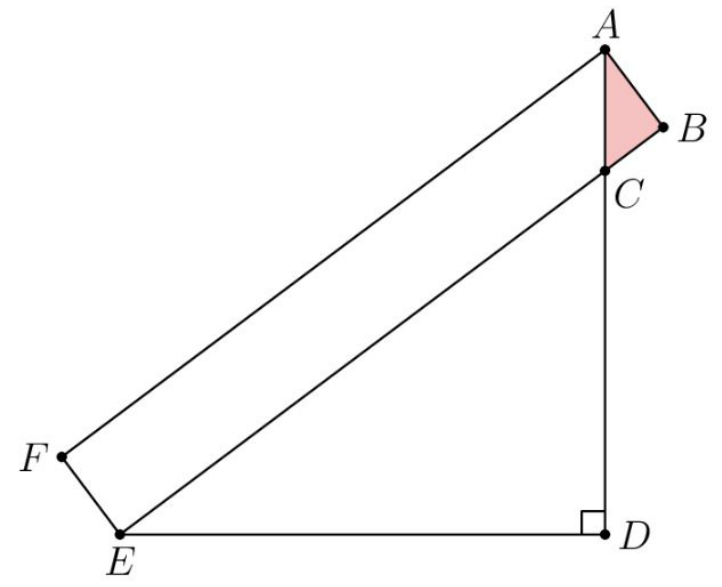
A rectangle’s diagonal satisfies the Pythagorean theorem. Coordinate geometry converts a tilted rectangle into perpendicular unit directions, and a triangle’s area is one half base times perpendicular height.
Answer
Answer A: \(\frac38\).
The SOMATH solution
- The rectangle has side lengths 7 and 1, so \(AE^2=7^2+1^2=50\). Right triangle \(ADE\) has \(AD=5\), hence \(DE^2=50-25=25\), giving \(DE=5\).
- Set \(D=(0,0)\), \(A=(0,5)\), and \(E=(-5,0)\). Let the unit direction from \(E\) to \(B\) be \((c,s)\). The perpendicular unit direction from \(B\) to \(A\) is \((-s,c)\).
- Moving from \(E\) to \(A\) through \(B\) gives \((5,5)=7(c,s)+(-s,c)\). Thus \(7c-s=5\) and \(c+7s=5\), yielding \(c=4/5\) and \(s=3/5\). These satisfy \(c^2+s^2=1\), as required.
- Then \(B=E+7(c,s)=(3/5,21/5)\). Line \(EB\) has slope \(3/4\), so its intersection with \(AD\), where \(x=0\), is \(C=(0,15/4)\).
- Use vertical base \(AC=5-15/4=5/4\). The perpendicular height from \(B\) is \(3/5\). Area \(=\frac12\cdot\frac54\cdot\frac35=\boxed{\frac38}\).
What to remember: The relevant height is the horizontal distance from \(B\) to line \(AC\), not the length of the slanted side \(AB\).
Next problemExpected value from occupancy patternsProblem 16
- (A) \(\frac43\)
- (B) \(\frac{13}9\)
- (C) \(\frac53\)
- (D) \(\frac{17}9\)
- (E) 2
The theory involved
Expected value is a probability-weighted average of a random variable’s possible values. Treat the three coins as distinguishable trials: there are \(3^3=27\) equally likely placements.
Answer
Answer D: \(\frac{17}9\).
The SOMATH solution
- Let \(M\) be the largest jar count. The only possibilities are \(M=1,2,3\).
- For \(M=1\), each jar gets exactly one coin. There are \(3!=6\) placements.
- For \(M=3\), all coins go in one jar. Choose that jar in 3 ways. The remaining \(27-6-3=18\) placements have pattern \(2,1,0\), so \(M=2\).
- Compute \(E[M]=1\cdot\frac6{27}+2\cdot\frac{18}{27}+3\cdot\frac3{27}=\frac{51}{27}=\boxed{\frac{17}9}\).
What to remember: The three patterns are not equally likely. Averaging 1, 2, and 3 without their probabilities would give the wrong answer.
Next problemRemainders and the Euclidean algorithmProblem 17
- (A) 0
- (B) 1
- (C) 2
- (D) 3
- (E) 4
The theory involved
If dividing \(A\) by \(N\) leaves remainder \(r\), then \(N\mid(A-r)\) and \(0\le r<N\). Two remainder conditions force \(N\) to be a common divisor.
Answer
Answer E: 4.
The SOMATH solution
- Subtract the remainders: \(N\mid273420\) and \(N\mid272745\). Their difference is 675, so the gcd can be found from much smaller numbers.
- Apply Euclid’s algorithm: \(272745=404(675)+45\), and \(675=15(45)\). Therefore \(\gcd(273420,272745)=45\).
- Thus \(N\) is a positive divisor of 45: \(1,3,5,9,15,45\). The remainder 16 must be smaller than \(N\), leaving only \(N=45\).
- The tens digit of 45 is 4. Check: \(273436=45(6076)+16\) and \(272760=45(6061)+15\).
What to remember: Do not take the gcd of the original numbers. Subtract the remainders first, and remember that a remainder must be less than the divisor.
Next problemVieta’s formulas and the harmonic meanProblem 18
- (A) \(-\frac53\)
- (B) \(-\frac32\)
- (C) \(-\frac65\)
- (D) \(-\frac56\)
- (E) \(-\frac23\)
The theory involved
For roots \(u,v\) of \(ax^2+bx+c=0\), Vieta gives \(u+v=-b/a\) and \(uv=c/a\). Their reciprocal sum is \((u+v)/(uv)\). The harmonic mean of \(n\) nonzero numbers is \(n\) divided by their reciprocal sum.
Answer
Answer B: \(-\frac32\).
The SOMATH solution
- Each quadratic \(kx^2-4x-3\) has discriminant \(16+12k>0\), so it contributes two distinct real roots. No root is zero because the constant term is \(-3\).
- Different factors cannot share a root: subtracting two equations would give \((k-\ell)x^2=0\), impossible for \(k\ne\ell\) and \(x\ne0\). There are therefore 4050 distinct real roots.
- For one factor, \(u+v=4/k\) and \(uv=-3/k\). Hence \(\frac1u+\frac1v=\frac{4/k}{-3/k}=-4/3\), independent of \(k\).
- Sum over 2025 factors: the reciprocal sum is \(2025(-4/3)=-2700\). The harmonic mean is \(4050/(-2700)=\boxed{-3/2}\).
What to remember: Do not expand a degree-4050 polynomial or solve 2025 quadratics. Pair the roots within each quadratic and look for an expression that stays constant.
Next problemPascal-style recurrencesProblem 19
- (A) \(-29\)
- (B) \(-21\)
- (C) \(-14\)
- (D) \(-8\)
- (E) \(-3\)
The theory involved
A recurrence describes how each step changes a quantity. Track row sums and the first few entries separately rather than generating an entire expanding array.
Answer
Answer A: \(-29\).
The SOMATH solution
- Let the top row be row \(n=0\). Its sum is 3. When forming the next row, every interior entry is counted twice; the endpoint correction cancels because the endpoints are \(-1\) and 1. Thus each row sum doubles.
- The row-\(n\) sum is \(3\cdot2^n\). Since \(12288=3\cdot4096=3\cdot2^{12}\), the desired row is \(n=12\), twelve transitions below the top.
- Let \(b_n\) and \(c_n\) be its second and third entries. Since the first entry is always \(-1\), \(b_n=3-n\). Also \(c_{n+1}=b_n+c_n\), with \(c_0=1\).
- Therefore \(c_{12}=1+\sum_{n=0}^{11}(3-n)=1+36-\frac{11\cdot12}{2}=\boxed{-29}\).
What to remember: State whether you start numbering at 0 or 1. That convention changes the index label, not the number of transitions.
Next problemTangency and point-to-line distanceProblem 20
The supplied PDF omits this problem’s answer choices. The answer is solved numerically below; its answer key labels the correct option A.
The theory involved
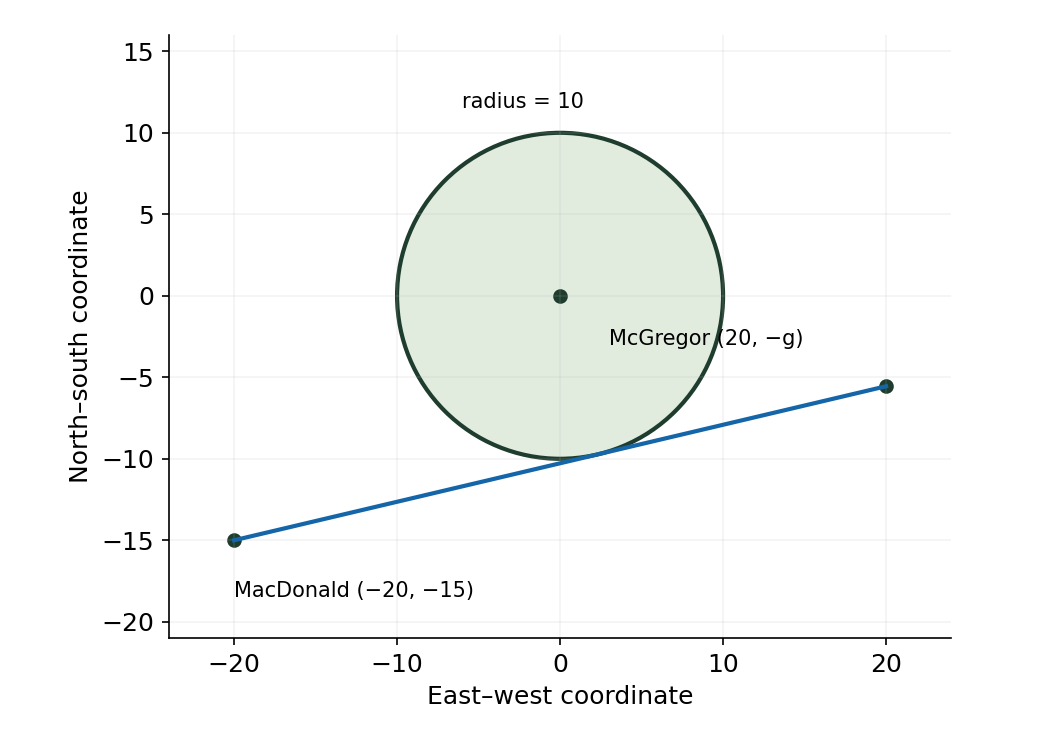
Viewed from above, the silo is a circle of radius 10. A tangent line has perpendicular distance 10 from the center. The distance from \((0,0)\) to \(ax+by+c=0\) is \(|c|/\sqrt{a^2+b^2}\).
Answer
Answer A: 119 (option A in the supplied key).
The SOMATH solution
- Place the silo center at \((0,0)\), MacDonald at \((-20,-15)\), and McGregor at \((20,-g)\). The line through them has equation \((g-15)x+40y+20(g+15)=0\).
- Tangency requires \(\frac{20(g+15)}{\sqrt{(g-15)^2+1600}}=10\). The numerator is positive because \(g>0\). Squaring and simplifying yields \(4(g+15)^2=(g-15)^2+1600\).
- Expand: \(3g^2+150g-925=0\). The quadratic formula gives \(g=\frac{-150\pm40\sqrt{21}}6=\frac{-75\pm20\sqrt{21}}3\).
- The positive solution is \(g=(20\sqrt{21}-75)/3\), approximately 5.55 meters. Here \(a=20,b=21,c=75,d=3\). The integer 21 is squarefree and \(\gcd(3,\gcd(20,75))=1\).
- Thus \(a+b+c+d=20+21+75+3=\boxed{119}\). The negative root contradicts the given \(g>0\) and must be rejected.
What to remember: Use the radius, not the diameter, in the distance condition. A tangent line’s nearest point to the center must be exactly one radius away.
Next problemSum-free sets and an extremal boundProblem 21
- (A) 8
- (B) 9
- (C) 10
- (D) 11
- (E) 12
The theory involved
A maximum-size problem needs both a construction and an upper bound. If a set is sum-free and contains its largest element \(m\), it cannot contain both \(a\) and \(m-a\).
Answer
Answer C: 10.
The SOMATH solution
- A construction is \(\{11,12,\ldots,20\}\). Any sum of two of its elements is at least 22, outside the set. This achieves 10 elements.
- For an upper bound, suppose a nonempty sum-free set \(S\) has \(k\) elements and largest element \(m\le20\). Consider the \(k-1\) positive numbers \(m-a\) for \(a\in S\setminus\{m\}\). They are distinct and belong to \(\{1,\ldots,m\}\).
- None of those numbers can lie in \(S\): otherwise \(a+(m-a)=m\) would violate the sum-free condition. This includes the case \(a=m-a\), since the question allows equal summands.
- We have two disjoint collections totaling \(k+(k-1)=2k-1\) numbers in a universe of at most 20. Hence \(2k-1\le20\), so the integer \(k\le10\). Together with the construction, the maximum is 10.
What to remember: An example with 10 elements proves only that the maximum is at least 10. The disjoint-set argument rules out 11 or more.
Next problemTangent circles and a hidden 3–4–5 triangleProblem 22
- (A) \(\frac14\)
- (B) \(\frac6{23}\)
- (C) \(\frac3{11}\)
- (D) \(\frac5{17}\)
- (E) \(\frac3{10}\)
The theory involved
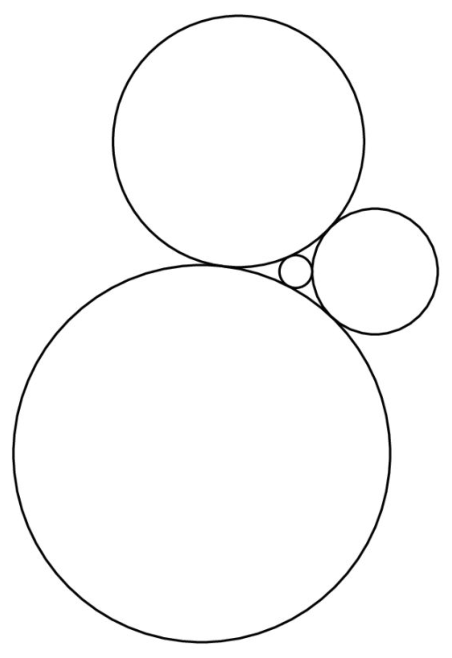
The distance between the centers of externally tangent circles equals the sum of their radii. Here the outer centers have pairwise distances \(1+2=3\), \(1+3=4\), and \(2+3=5\), forming a right triangle.
Answer
Answer B: \(\frac6{23}\).
The SOMATH solution
- Put the radius-1 center at \((0,0)\), the radius-2 center at \((3,0)\), and the radius-3 center at \((0,4)\). Let the small circle’s center be \((x,y)\).
- Tangency gives \(x^2+y^2=(r+1)^2\), \((x-3)^2+y^2=(r+2)^2\), and \(x^2+(y-4)^2=(r+3)^2\).
- Subtract the first equation from the second: \(-6x+9=2r+3\), so \(x=1-r/3\). Subtract it from the third: \(-8y+16=4r+8\), so \(y=1-r/2\).
- Substitute into the first equation: \((1-r/3)^2+(1-r/2)^2=(r+1)^2\). Multiply out and simplify to \(23r^2+132r-36=0\).
- Factor: \((23r-6)(r+6)=0\). Reject the negative radius \(-6\); the positive radius is \(\boxed{6/23}\). Its center \((21/23,20/23)\) lies inside the triangle of centers, consistent with the pictured inner circle.
What to remember: Connecting centers is more useful than measuring gaps in the drawing. This coordinate solution avoids requiring a specialized circle-packing formula.
Next problemAngle bisectors and an altitudeProblem 23
- (A) 18
- (B) 19
- (C) 20
- (D) 21
- (E) 22
The theory involved
The angle-bisector theorem divides the opposite side in the ratio of the adjacent sides. Coordinates make an altitude to a horizontal base a vertical line, so its intersection is easy to locate.
Answer
Answer D: 21.
The SOMATH solution
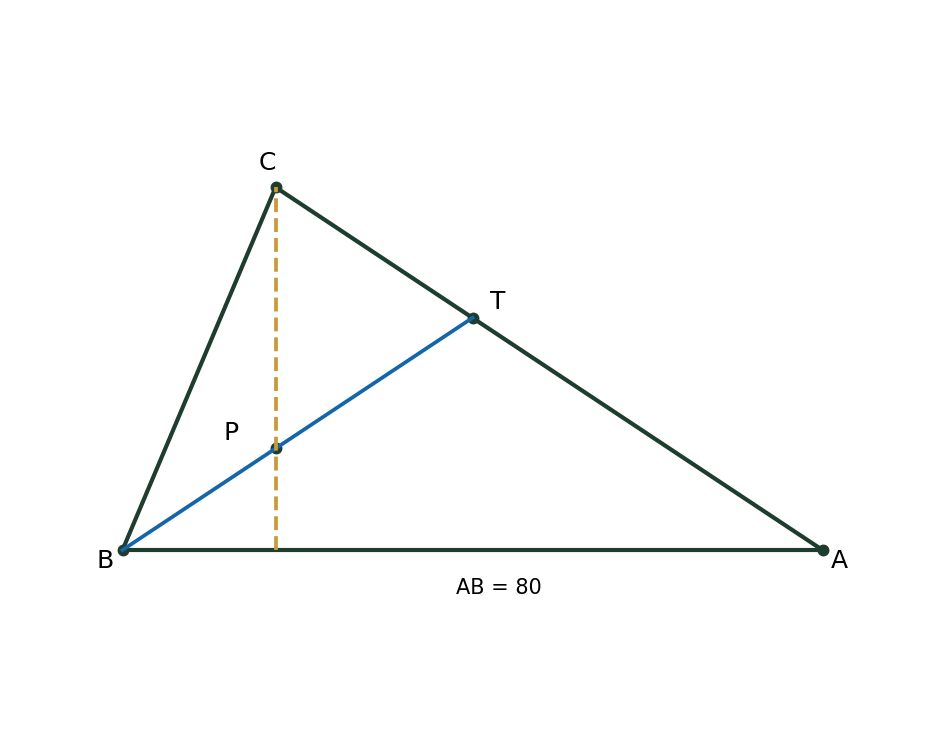
- Set \(B=(0,0)\), \(A=(80,0)\), and \(C=(x,y)\) above the base. The side lengths give \(x^2+y^2=45^2\) and \((x-80)^2+y^2=75^2\).
- Subtract: \(-160x+6400=3600\), so \(x=35/2\). Then \(y=\sqrt{2025-1225/4}=25\sqrt{11}/2\). The altitude from \(C\) is the line \(x=35/2\).
- Let the angle bisector from \(B\) meet \(AC\) at \(T\). By the angle-bisector theorem, \(AT:TC=80:45=16:9\), so \(T=(9A+16C)/25=(40,8\sqrt{11})\).
- Line \(BT\) therefore has slope \(\sqrt{11}/5\). At \(x=35/2\), it meets the altitude at \(P=(35/2,7\sqrt{11}/2)\).
- Finally, \[\begin{aligned}BP^2&=(35/2)^2+(7\sqrt{11}/2)^2\\&=(1225+539)/4=441.\end{aligned}\] Taking the positive square root gives \(BP=\boxed{21}\).
What to remember: The question asks for the segment to the altitude, not for the full angle-bisector segment \(BT\). Locate the intersection before computing its length.
Next problemForbidden valleys and counting by the maximumProblem 24
- (A) 511
- (B) 2584
- (C) 9841
- (D) 17711
- (E) 19682
The theory involved
With distinct digits, a digit adjacent to two greater digits is a strict local minimum, or valley. A sequence with no such valley must rise to its largest digit and then fall, allowing either side to be empty.
Answer
Answer C: 9841.
The SOMATH solution
- Any downward step followed later by an upward step would have a first change from decreasing to increasing, creating a forbidden valley. Therefore a fair number has one increasing part, a maximum, and one decreasing part.
- Fix the largest digit \(m\), where \(1\le m\le9\). Each smaller digit \(1,\ldots,m-1\) has three possibilities: omit it, place it to the left of \(m\), or place it to the right.
- Once these decisions are made, the order is forced: left-hand digits increase and right-hand digits decrease. Thus exactly \(3^{m-1}\) fair integers have largest digit \(m\). This includes single-digit integers.
- Sum over all possible maxima: \[1+3+\cdots+3^8=\frac{3^9-1}{3-1}=\frac{19683-1}{2}=\boxed{9841}.\]
What to remember: Do not multiply by a factorial after assigning digits to the two sides. The no-valley condition already fixes their order.
Next problemGeometric probability and circular segmentsProblem 25
- (A) 25
- (B) 26
- (C) 27
- (D) 28
- (E) 29
The theory involved
For a uniformly random point, probability is favorable area divided by total area. Perpendicular bisectors compare distances to two fixed points, and circles describe a fixed distance from one point. Boundary curves have area zero.
Answer
Answer A: 25.
The SOMATH solution
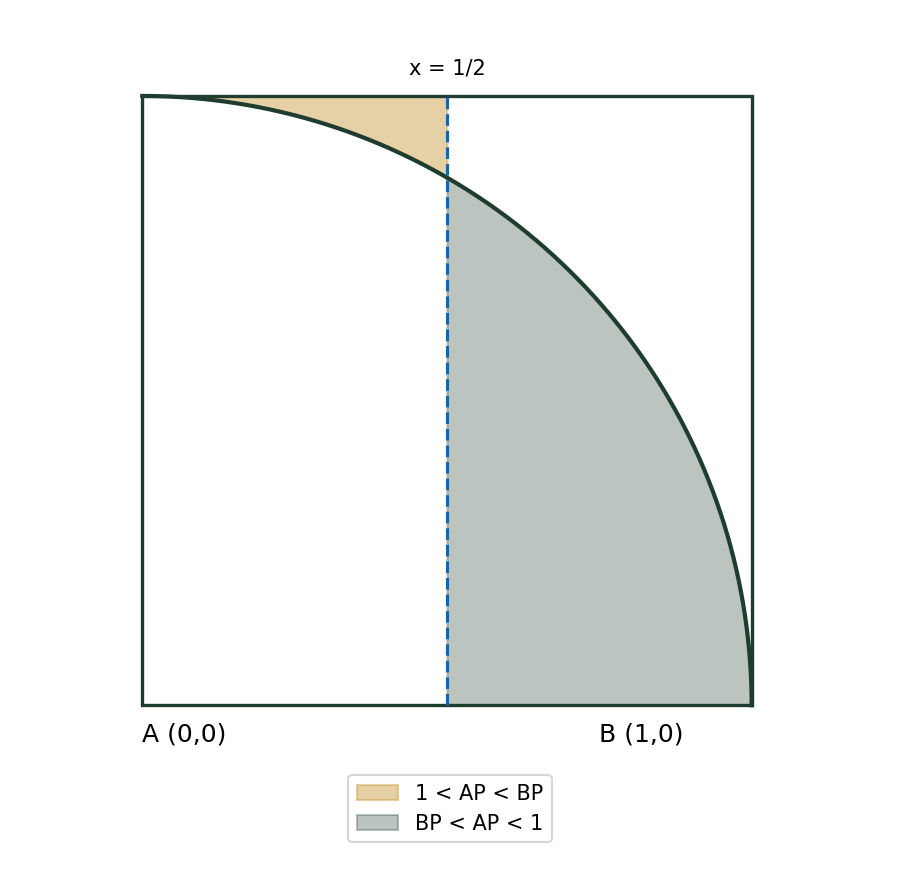
- Scale the square to side 1. Put \(A=(0,0)\), \(B=(1,0)\), and \(P=(x,y)\), where \(0<x,y<1\). Then \(AB=1\), and \(AP>BP\) exactly when \(x>1/2\).
- There are two disjoint ways for \(AP\) to be the middle side: \(BP<AP<1\), or \(1<AP<BP\). The first is the part of the quarter unit disk with \(x>1/2\); the second is the part outside that disk with \(x<1/2\).
- Let \(L\) be the area inside the quarter disk to the left of \(x=1/2\). The vertical line meets the circle at \(H=(1/2,\sqrt3/2)\). The region consists of a \(30^\circ\) sector, area \(\pi/12\), and a right triangle, area \(\frac12(1/2)(\sqrt3/2)=\sqrt3/8\). Thus \(L=\pi/12+\sqrt3/8\).
- The first favorable region has area \(\pi/4-L\). The second has area \(1/2-L\). Adding gives \[\frac{\pi}{4}+\frac12-2L=\frac12+\frac{\pi}{12}-\frac{\sqrt3}{4}=\frac{6+\pi-3\sqrt3}{12}.\]
- The square’s area is 1, so this is also the probability. Therefore \(a=6,b=1,c=3,d=3,e=12\), satisfying the stated reduction conditions, and their sum is \(\boxed{25}\).
What to remember: “Neither shortest nor longest” requires both orderings. Counting only points inside the circle on the right misses the favorable region outside the circle on the left.
Return to Problem 252025 AMC 10A answer key
Keep this closed until you finish your attempt. Every problem above has its own full explanation.
Reveal the complete answer key
Checked against the supplied document and the published answer key. For Problem 20, the value is 119; the source labels its missing option A.
AMC 10 preparation on the Upper West Side
Getting a school-math answer right and finding an efficient competition solution are related but different goals. A student may know the quadratic formula yet miss the structure in Problem 18, or understand probability yet use the wrong sample space in Problem 16. We recommend choosing the next practice set around those specific decisions.
For your evaluation, bring two problems your student solved and two they could not finish. Show the written working, including abandoned attempts. That gives us a more useful conversation than an answer-letter score alone: we can discuss algebra fluency, diagram habits, case organization and how comfortably the student explains a solution.
Tao Titans Math Competition Prep serves grades 6–12 and includes AMC 8 foundations, AMC 10 development and AMC 12 extensions, with level-appropriate practice. Its current Friday session is 4:00–6:00 PM at 226 W 79th St, 1st Floor, NYC, with a maximum of six students (SOMATH course details).
The course’s grade range is not the eligibility range of every competition. The MAA sets separate grade and age limits for AMC 8, AMC 10 and AMC 12 (MAA eligibility overview). We offer independent preparation; contest entry, registration and fees remain separate, and no score or qualification is guaranteed.
A practical review plan
- Model before calculating. Revisit Problems 1, 2 and 4 until the equations feel natural. Explain why each term belongs in the model.
- Trade long work for structure. Compare Problems 5, 7, 11, 18 and 19. Identify the grouping or invariant that removes unnecessary calculation.
- Draw only useful additions. In geometry, add a radius, a perpendicular or coordinates because it creates a relationship you can use.
- Audit every count. For Problems 12, 14, 16 and 24, ask whether all cases are covered and whether any outcome has been counted twice.
- Prove the limit. In Problem 21, an example alone is not enough. Practice giving both a construction and a reason no larger one exists.
Continue with related SOMATH lessons
For another full practice paper, try our 2025 AMC 10B questions and detailed solutions. For an earlier competition starting point, use our AMC 8 preparation guide and AMC 8 practice test with hidden solutions. To strengthen the algebra used in this walkthrough, revisit factoring trinomials. You can also browse the SOMATH Journal, compare courses, and check the weekly timetable.
AMC 10A study and SOMATH preparation: questions & answers
What does this 2025 AMC 10A walkthrough include?
All 25 questions from the supplied 2025 AMC 10A compilation, the available multiple-choice answers and original diagrams, theory notes, and independently written SOMATH solutions. Answers stay hidden until a reader opens them. Question 20’s choices are missing from the supplied file, and Question 13 has a clearly flagged wording issue.
How should I use the hidden solutions?
Attempt a problem on paper first. Name the idea you think applies, write your working, and choose an answer before opening the blue Answer control. After checking, close the explanation and solve the problem again without looking.
Who can take the AMC 10?
The MAA describes the AMC 10 as a competition for students in grade 10 or below who are under 17.5 years old on the day of the competition. Families should confirm current eligibility and registration requirements with the MAA. (MAA)
Does AMC 10 preparation require calculus?
No. The AMC 10 emphasizes elementary algebra, geometry, number theory and probability rather than calculus. These solutions focus on algebraic reasoning, counting, geometry and structural shortcuts. (MAA)
Where does SOMATH offer AMC preparation in NYC?
Tao Titans Math Competition Prep meets in person at School of Math, 226 W 79th St, 1st Floor, on Manhattan’s Upper West Side. The current Friday class runs from 4:00 to 6:00 PM; see the course page for availability and enrollment. (SOMATH course details)
Can middle-school students join Tao Titans?
SOMATH’s Tao Titans course serves grades 6–12, with AMC 8, AMC 10 or AMC 12 practice matched to readiness and eligibility. A free evaluation helps identify an appropriate starting point; all students are not expected to solve the same problems. (SOMATH course details)
Does joining SOMATH register a student for the AMC?
No. SOMATH provides independent preparation. Contest registration, eligibility, entry fees and participation are separate and controlled by the organizer. Enrollment does not guarantee contest admission, AIME qualification or awards. (SOMATH course details)