SOMATH Journal · Competition Math
2025 AMC 10B problems & solutions
This guide works through all 25 problems from the 2025 AMC 10B, with the theory behind each question and detailed solutions hidden behind blue Answer controls. Start with a problem, explain your reasoning, and reveal the answer only when you’re ready to compare approaches.
Looking for AMC 10 prep in NYC? At School of Math | SOMATH, we use problems like these to build mathematical judgment, not just faster calculation. Book a free evaluation at 226 W 79th St, 1st Floor, Upper West Side, or call (646) 668-6151 to discuss a suitable starting point.
Our Tao Titans Math Competition Prep course offers in-person AMC 8, AMC 10 and AMC 12 preparation for grades 6–12, with practice matched to readiness. The current class meets Fridays, 4:00–6:00 PM; review the schedule and course details before enrolling.
25 questions with the supplied SOMATH cover, original problem diagrams, and space to work. No solutions or answer key. View the published answer key.
Question source: the supplied 2025 AMC 10 B Problems and Answer Key compilation, labeled Dr. Xue’s Math School. All 25 questions and 125 alternatives are transcribed with web-friendly notation; the original question diagrams are retained. The detailed solutions, theory explanations and supplemental diagrams are independently written for SOMATH. Answer letters were checked against the supplied document and the published LIVE by Po-Shen Loh answer key. SOMATH provides independent preparation and is not the MAA or an official contest sponsor.
What this AMC 10B teaches
A contest problem often combines two familiar ideas in an unfamiliar way. Use this table to decide what to review after your first attempt, rather than treating every wrong answer as the same kind of mistake.
| Theory area | Problems | What to practice |
|---|---|---|
| Arithmetic, digits and number theory | 1, 2, 4, 8, 18, 22, 23 | Interpret remainders, use cycles, exploit digit restrictions and count integer solutions. |
| Sequences and algebra | 3, 9, 10, 15, 17 | Track totals, retain domain restrictions, telescope sums and recover terms from averages. |
| Geometry and similarity | 5, 6, 7, 12, 13, 19, 20, 25 | Connect centers, compare areas and volumes, choose coordinates and unfold reflected paths. |
| Counting and probability | 11, 14, 16, 21, 22, 24 | Choose the right sample space, organize colorings, use symmetry carefully and build first-step equations. |
How to study without turning solutions into spoilers
For a first pass, keep the answer panels closed and work on paper. If you stall, write what you know, what you need, and the relationship that might connect them. The visible theory notes offer a direction without replacing your attempt.
On your second pass, open the solution and compare the first useful decision, not only the final arithmetic. Was the missing move a variable, a diagram, a case split or a bound? Close the panel and reconstruct the reasoning. That final retrieval step is our recommended way to check whether you can now use the idea independently.
The MAA describes the AMC 10 as a 25-question, 75-minute multiple-choice competition for students in grade 10 or below who are under 17.5 on contest day (MAA contest overview). Use 75 minutes for a later timed attempt; for learning, give the explanations the time they need.
Whole-number quotientsProblem 1
- (A) 16
- (B) 17
- (C) 18
- (D) 19
- (E) 20
The theory involved
Division tells us how many equal groups fit into a total. When the question requires complete groups, use the integer part of the quotient rather than rounding to the nearest whole number.
Answer
Answer B: 17.
The SOMATH solution
- Let \(m\) be the number of full mugs. Each needs 20 grams, so the available beans impose \(20m\le350\).
- Divide by 20: \(m\le17.5\). Because \(m\) counts complete mugs, its greatest possible value is 17.
- Check both sides of the boundary: 17 mugs use \(17(20)=340\) grams, leaving 10 grams. Eighteen mugs would need 360 grams, which exceeds the bag.
- The answer is therefore 17 mugs. The remaining beans cannot make another properly brewed large mug.
What to remember: Ask what the remainder means. A leftover half-portion is not permission to round up when every serving must meet the stated requirement.
Next problemRepeating units-digit cyclesProblem 2
- (A) 9025
- (B) 9070
- (C) 9090
- (D) 9115
- (E) 9160
The theory involved
A square's units digit depends only on its base's units digit. Work modulo 10, find a complete repeating block, and handle the final incomplete block separately.
Answer
Answer D: 9115.
The SOMATH solution
- The squares of numbers ending in \(1,2,\ldots,9,0\) end in \(1,4,9,6,5,6,9,4,1,0\). This ten-term block repeats because \((n+10)^2-n^2=20n+100\) is divisible by 10.
- Add one block: \(1+4+9+6+5+6+9+4+1+0=45\).
- Since \(2025=202(10)+5\), there are 202 complete blocks followed by the first five entries of another block. Those five contribute \(1+4+9+6+5=25\).
- Thus the requested sum is \(202(45)+25=9090+25=\boxed{9115}\). We are adding the units digits, not finding the units digit of the sum of the squares.
What to remember: Separate the full cycles from the leftover terms before calculating. A correct cycle sum still gives the wrong answer if the last five entries are omitted.
Next problemPascal-type row sumsProblem 3
- (A) 11
- (B) 13
- (C) 14
- (D) 16
- (E) 17
The theory involved
When neighboring entries are added, it is often easier to follow the total of a row than its individual entries. Count how often each old entry contributes to the next row.
Answer
Answer D: 16.
The SOMATH solution
- The second row totals \(10+1=11\). From this row onward, every interior entry contributes to two neighboring sums in the next row.
- Each endpoint also contributes twice: once to the new endpoint and once to the neighboring interior sum. Thus every row sum doubles after row 2. For example, rows 3 and 4 total 22 and 44.
- Going from row 2 to row 11 takes nine doublings, not ten. The eleventh row therefore has sum \(11\cdot2^9=11\cdot512=5632\).
- The question asks for the digit sum of that total: \(5+6+3+2=\boxed{16}\). There is no need to construct the full eleventh row.
What to remember: A nonstandard first row can break a familiar formula. Start the recurrence at the first row where the actual doubling rule holds.
Next problemPlace value in different basesProblem 4
- (A) 7
- (B) 9
- (C) 10
- (D) 11
- (E) 14
The theory involved
In base \(b\), a two-digit numeral with digits \(u,v\) represents \(bu+v\). Digits must be smaller than the base, and the leading digit of a two-digit numeral cannot be zero.
Answer
Answer A: 7.
The SOMATH solution
- Translate both numerals into ordinary values: \(\overline{ab}_7=7a+b\) and \(\overline{ba}_9=9b+a\).
- Equating them gives \(7a+b=9b+a\), so \(6a=8b\), or \(3a=4b\). Since 3 and 4 are coprime, write \(a=4k\) and \(b=3k\).
- Both digits occur in the base-seven number, so \(a,b\le6\). Both are positive because each is a leading digit in one numeral. Only \(k=1\) works: \(a=4,b=3\).
- Then \(a+b=\boxed{7}\). Check the values: \(43_7=28+3=31\), while \(34_9=27+4=31\).
What to remember: An equation involving digits needs digit restrictions. Without the allowed ranges, the equation has many integer solutions that are not valid numerals.
Next problemInscribed and central anglesProblem 5
- (A) 20
- (B) 30
- (C) 40
- (D) 50
- (E) 60
The theory involved
An inscribed angle is half its intercepted arc. Two radii form an isosceles triangle, so a central angle determines the two equal base angles.
Answer
Answer C: 40.
The SOMATH solution
- The inscribed angle \(\angle ABC=130^\circ\) intercepts the arc from \(A\) to \(C\) not containing \(B\). That arc measures \(2(130^\circ)=260^\circ\), so it is the major arc.
- The other, minor arc \(AC\) measures \(360^\circ-260^\circ=100^\circ\). Therefore the smaller central angle \(\angle AOC\) is \(100^\circ\).
- Since \(OA=OC\), triangle \(AOC\) is isosceles. Its base angles are each \((180^\circ-100^\circ)/2=40^\circ\).
- Thus \(\angle CAO=\boxed{40^\circ}\). The side lengths 10 and 18 are not needed for this angle calculation.
What to remember: An obtuse inscribed angle intercepts a major arc. Do not put the reflex \(260^\circ\) angle inside triangle \(AOC\).
Next problemSplitting a trapezoid's areaProblem 6
- (A) 18
- (B) 19
- (C) 20
- (D) 21
- (E) 22
The theory involved
A trapezoid has area equal to its width times the average of its parallel side lengths. A vertical cut under a sloping line changes both the width and one height; equal widths need not give equal areas.
Answer
Answer C: 20.
The SOMATH solution
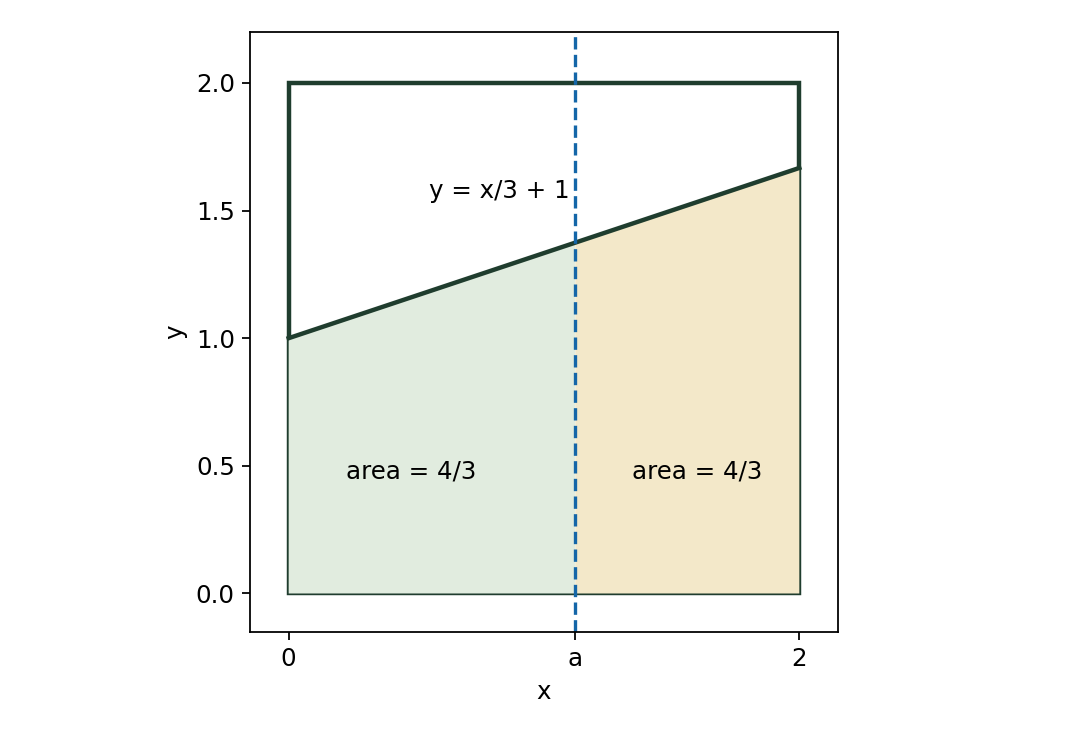
- At \(x=0\), the lower region has height 1. At \(x=2\), its height is \(1+\frac23=\frac53\). Its total area is \(2(1+\frac53)/2=\frac83\).
- Each desired piece must have area \(\frac43\). The piece between \(x=0\) and \(x=a\) is a trapezoid with width \(a\) and vertical heights 1 and \(1+\frac a3\).
- Its area is \(\frac a2(2+\frac a3)=a+\frac{a^2}{6}\). Set this equal to \(\frac43\): \(a^2+6a-8=0\), or \((a+3)^2=17\).
- The solution inside the square is \(a=\sqrt{17}-3\); the other root is negative. Thus \(s=17,t=3\), giving \(\boxed{20}\).
What to remember: Use area geometry before calculus. A trapezoid formula gives the exact equation with only algebra.
Next problemEqual paths and the Pythagorean theoremProblem 7
- (A) \(3\frac27\)
- (B) \(3\frac37\)
- (C) \(3\frac47\)
- (D) \(3\frac57\)
- (E) \(3\frac67\)
The theory involved
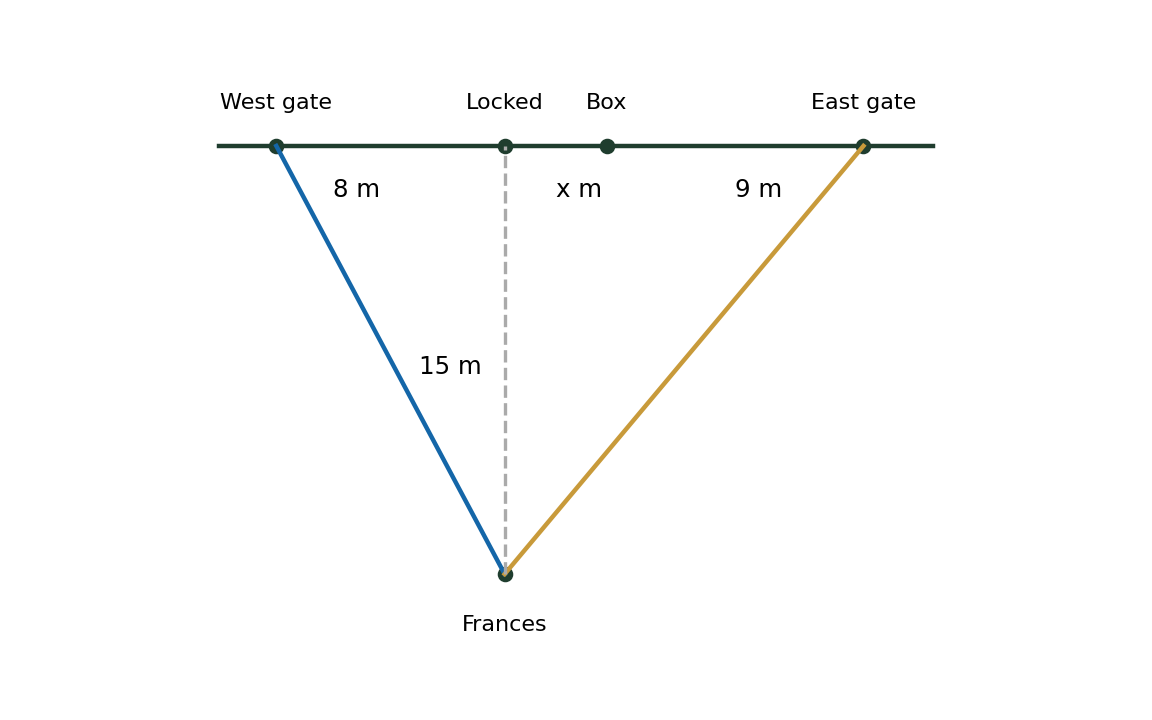
Represent the fence as a horizontal line. A diagonal walk to a gate is the hypotenuse of a right triangle, while the walk along the fence contributes an additional linear distance.
Answer
Answer C: \(3\frac47\).
The SOMATH solution
- Place the locked gate at \((0,0)\), Frances at \((0,-15)\), and the box at \((x,0)\). The west gate is \((-8,0)\), and the east gate is \((x+9,0)\).
- Via the west gate, the diagonal distance is \(\sqrt{8^2+15^2}=17\). The remaining distance is \(x+8\), so the whole route is \(x+25\).
- Via the east gate, the diagonal is \(\sqrt{(x+9)^2+225}\), followed by 9 meters. Equate routes and subtract 9: \(\sqrt{(x+9)^2+225}=x+16\).
- Squaring gives \(x^2+18x+306=x^2+32x+256\). Hence \(14x=50\), so \(x=\frac{25}{7}=3\frac47\). Both sides before squaring are positive, so this solution is valid.
What to remember: Count both pieces of each route. Equating only the two diagonal distances ignores the unequal walks from the gates to the box.
Next problemDivisibility and digit patternsProblem 8
- (A) 7
- (B) 8
- (C) 11
- (D) 14
- (E) 15
The theory involved
Convert dollars to integer cents before applying divisibility. Since \(36=4\cdot9\) and the factors are coprime, a number is divisible by 36 precisely when it is divisible by both 4 and 9.
Answer
Answer C: 11.
The SOMATH solution
- Use the intended equal-price, whole-cent interpretation for the shirts. The total in cents is the five-digit integer \(\overline{ABBBA}=10001A+1110B\), which must be divisible by 36.
- Divisibility by 9 requires \(2A+3B\equiv0\pmod9\), so \(A\) is a multiple of 3. Divisibility by 4 requires the last two digits, \(10B+A\), to be divisible by 4, so \(A\) is even.
- The only nonzero digit both even and divisible by 3 is \(A=6\). Now \(12+3B\) must be divisible by 9, giving \(B=2,5,\) or 8. Also \(10B+6\) must be divisible by 4, which requires \(B\) odd. Hence \(B=5\).
- The total is $655.56, and \(65556/36=1821\) cents per shirt, or $18.21. Therefore \(A+B=6+5=\boxed{11}\).
What to remember: State the money model: an equal unit price in whole cents is what turns this dialogue into a divisibility problem.
Next problemCounting integer triples by their sumProblem 9
- (A) 4
- (B) 8
- (C) 11
- (D) 15
- (E) 17
The theory involved
When inequalities are symmetric, introducing a total can reduce a three-variable problem to a few cases. For nonnegative integer triples totaling \(m\), stars and bars gives \(\binom{m+2}{2}\).
Answer
Answer C: 11.
The SOMATH solution
- Set \(S=x+y+z\). The first inequality gives \(S\ge2\). Adding the last three gives \(S\le6\), so \(S\) is one of \(2,3,4,5,6\).
- The last three inequalities say \(S-2x\le2\), \(S-2y\le2\), and \(S-2z\le2\). Therefore each coordinate is at least \(\lceil(S-2)/2\rceil\). This also proves the coordinates are nonnegative.
- For \(S=2\), the lower bound is 0 and there are \(\binom42=6\) triples. For \(S=3\), all coordinates are at least 1, giving only \((1,1,1)\). For \(S=4\), subtract 1 from each coordinate; the remaining total is 1, giving 3 triples.
- For \(S=5\), every coordinate would be at least 2, impossible for a total of 5. For \(S=6\), only \((2,2,2)\) works. Total: \(6+1+3+0+1=\boxed{11}\).
What to remember: A bound on the sum and a bound on each coordinate together make an infinite-looking integer search finite.
Next problemFactoring with domain restrictionsProblem 10
- (A) 2
- (B) 3
- (C) 4
- (D) 5
- (E) 6
The theory involved
Factor rational expressions, but preserve every restriction from the original denominator. If an integer plus a unit fraction is an integer, that fraction's integer denominator must be \(1\) or \(-1\).
Answer
Answer A: 2.
The SOMATH solution
- Factor the two cubics: \[\begin{aligned}f(n)&=(n-4)(n-2)(n+1),\\g(n)&=(n-4)(n-3)(n+1).\end{aligned}\] The original quotient is undefined at \(n=-1,3,4\).
- For all other \(n\), cancel common factors to obtain \(\frac{n-2}{n-3}=1+\frac1{n-3}\).
- For this to be an integer, \(n-3\) must divide 1. Thus \(n-3=1\) or \(-1\), giving candidates \(n=4\) and \(n=2\).
- Reject \(n=4\), since the original denominator vanishes there. At \(n=2\), the numerator is zero and the denominator is nonzero, so the quotient is the integer 0. The sum of the valid integers is \(\boxed{2}\).
What to remember: Canceling a factor simplifies values where the expression is defined; it does not fill a hole in the original domain.
Next problemExactly two fixed pointsProblem 11
- (A) \(\frac1{16}\)
- (B) \(\frac3{16}\)
- (C) \(\frac14\)
- (D) \(\frac38\)
- (E) \(\frac12\)
The theory involved
Treat each day's assignment as a one-to-one matching between students and tutors, as intended by the contest. A derangement is a permutation in which nobody keeps their original match.
Answer
Answer B: \(\frac3{16}\).
The SOMATH solution
- Fix Monday's matching as the reference. On Tuesday there are \(6!=720\) equally likely one-to-one assignments.
- Choose the two students keeping their tutors in \(\binom62=15\) ways. The remaining four must all change tutors; otherwise more than two students would keep their Monday tutors.
- Count derangements of four by inclusion-exclusion: \[D_4=4!-\binom413!+\binom422!-\binom431!+1.\] Equivalently, \(D_4=24-24+12-4+1=9\). There are \(15\cdot9=135\) favorable assignments.
- The probability is \(\frac{135}{720}=\boxed{\frac3{16}}\). A binomial model with independent \(1/6\) matches is inappropriate because two students cannot have the same tutor in this matching.
What to remember: The phrase 'exactly two' means the other four must not match. Choosing the two and freely permuting the rest would overcount.
Next problemComparing circle-packing densitiesProblem 12
- (A) \(T=H=R\)
- (B) \(H<R=T\)
- (C) \(H=R<T\)
- (D) \(H<R<T\)
- (E) \(H<T<R\)
The theory involved
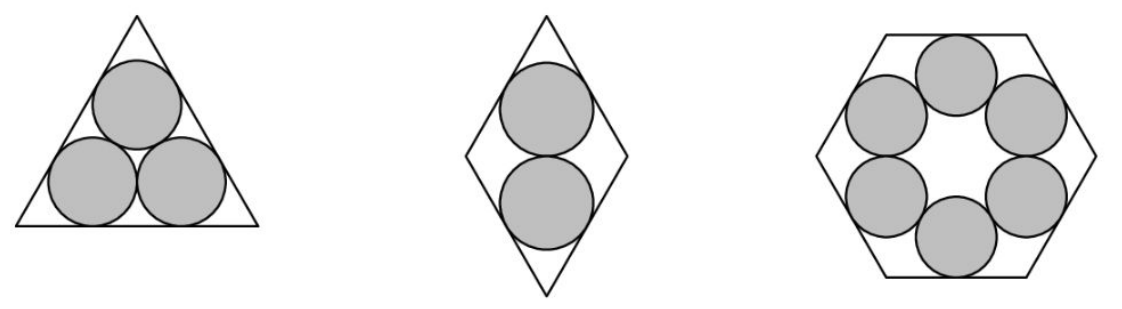
Area ratios do not change under scaling, so set every circle's radius to 1. Tangency, apothems, and \(30\!-\!60\!-\!90^\circ\) triangles then determine the polygons.
Answer
Answer C: \(H=R<T\).
The SOMATH solution
- In the equilateral triangle, the two bottom circle centers are 2 apart. Each center is \(\sqrt3\) horizontally from the nearest base vertex: its height is 1 and it lies on a \(30^\circ\) angle bisector. The triangle's side is \(2+2\sqrt3\), so its area is \(6+4\sqrt3\). Thus \(T=\frac{3\pi}{6+4\sqrt3}\).
- In the rhombus, the circle centers lie on the long diagonal. Each is 2 from its nearest \(60^\circ\) vertex because \(1/\sin30^\circ=2\). Their separation is 2, making the long diagonal 6. The short diagonal is \(6/\sqrt3=2\sqrt3\). The rhombus area is \(6\sqrt3\), so \(R=\frac{2\pi}{6\sqrt3}=\frac{\pi}{3\sqrt3}\).
- For the hexagon, the six centers form a regular hexagon of side 2 and circumradius 2. Each outer side is another radius away in the radial direction, so the enclosing hexagon's apothem is 3. Its side is \(2\sqrt3\), and its area is \(\frac12(12\sqrt3)(3)=18\sqrt3\). Therefore \(H=\frac{6\pi}{18\sqrt3}=\frac{\pi}{3\sqrt3}=R\).
- Finally, \(T>R\) is equivalent to \(9\sqrt3>6+4\sqrt3\), or \(5\sqrt3>6\), which is true. Hence \(\boxed{H=R<T}\).
What to remember: More circles do not automatically mean a higher covered fraction. Compare disk area with the enclosing area, using the same radius throughout.
Next problemAn altitude crossed by a medianProblem 13
- (A) \(\frac37\)
- (B) \(\frac{\sqrt3}{4}\)
- (C) \(\frac49\)
- (D) \(\frac5{11}\)
- (E) \(\frac{4\sqrt3}{15}\)
The theory involved
A \(30\!-\!60\!-\!90^\circ\) triangle has side ratio \(1:\sqrt3:2\). Coordinates along the two perpendicular legs turn the altitude and median into simple linear equations.
Answer
Answer A: \(\frac37\).
The SOMATH solution
- Put the right-angle vertex at \(O=(0,0)\), the long-leg endpoint at \(A=(\sqrt3,0)\), and the short-leg endpoint at \(B=(0,1)\). The hypotenuse has equation \(y=1-x/\sqrt3\). Here coordinate letters are separate from the segment lengths in the question.
- The altitude from \(O\) is perpendicular to that hypotenuse, so its equation is \(y=\sqrt3x\). It reaches the hypotenuse at \(H=(\sqrt3/4,3/4)\).
- The median to the shortest side joins \(A\) to the midpoint \((0,1/2)\) of \(OB\). Its equation is \(y=1/2-x/(2\sqrt3)\). Intersecting it with \(y=\sqrt3x\) gives \(P=(\sqrt3/7,3/7)\).
- Because \(P\) and \(H\) lie on the same ray from \(O\), \(OP/OH=(3/7)/(3/4)=4/7\). The other segment is \(PH/OH=3/7\), which is the smaller fraction. Thus \(\frac{x}{x+y}=\boxed{\frac37}\).
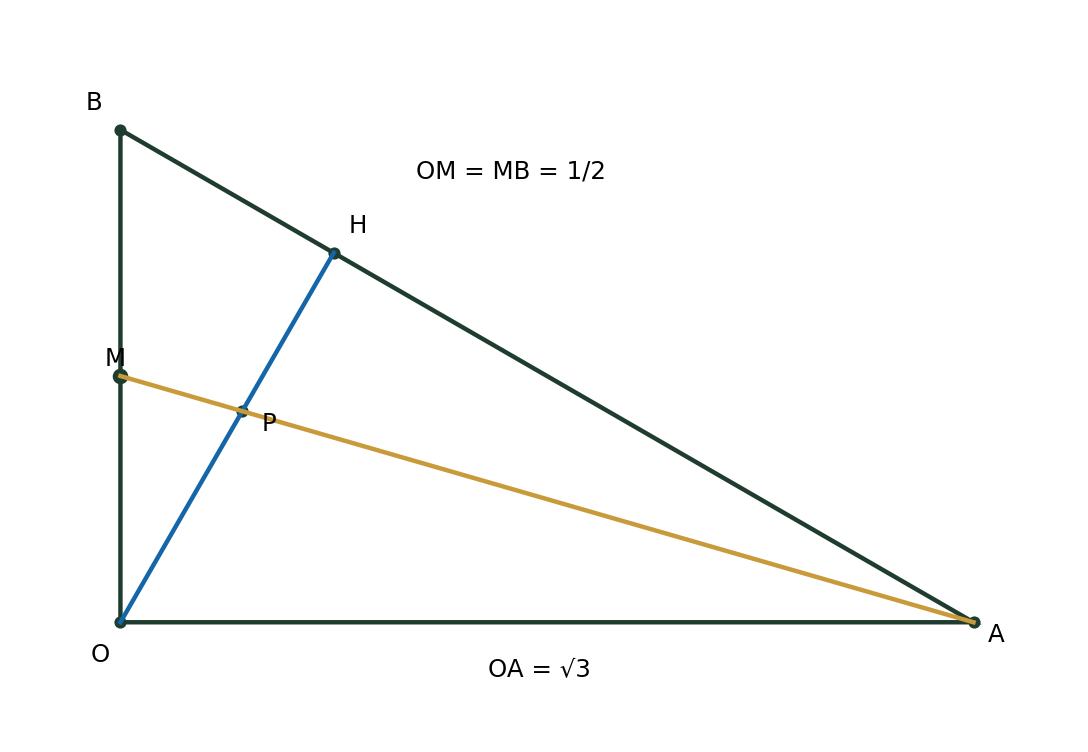
What to remember: The intersection divides the altitude into two fractions. Use the smaller one because the question explicitly states \(x<y\).
Next problemThree captains, three colorsProblem 14
- (A) \(\frac29\)
- (B) \(\frac27\)
- (C) \(\frac9{28}\)
- (D) \(\frac13\)
- (E) \(\frac38\)
The theory involved
Use symmetry to expose only the draws that matter. The three tallest athletes are exactly the three captains if and only if they receive three different colors.
Answer
Answer C: \(\frac9{28}\).
The SOMATH solution
- Imagine the tallest athletes draw first. This does not change the random allocation of the wristbands, because the original draws are without replacement and all assignments are equally likely.
- The tallest athlete may draw any color. Of the 8 bands remaining, 6 have a different color, so the second-tallest has probability \(6/8\) of avoiding the first color.
- Given different first two colors, all 3 bands of the third color remain among 7 bands. The third-tallest has probability \(3/7\) of getting that color.
- Multiply: \(\frac68\cdot\frac37=\boxed{\frac9{28}}\). With one of the top three in each group, no shorter athlete can displace them as captains.
What to remember: Replace the full team assignment with a necessary-and-sufficient condition on the three people who matter.
Next problemTelescoping a rational seriesProblem 15
- (A) 89
- (B) 97
- (C) 102
- (D) 107
- (E) 129
The theory involved
Factoring a denominator may reveal a telescoping decomposition. Prove cancellation in a finite partial sum first; then let its leftover tail tend to zero.
Answer
Answer D: 107.
The SOMATH solution
- Factor \(k^3+6k^2+8k=k(k+2)(k+4)\). The evenly spaced factors suggest \[\begin{aligned}\frac1{k(k+2)(k+4)}\\=\frac18\left(\frac1k-\frac2{k+2}+\frac1{k+4}\right).\end{aligned}\] Combining the right side over a common denominator verifies the numerator is 1.
- In the sum through \(k=N\), the middle terms cancel because their coefficients are \(1-2+1=0\). The beginning leaves \(1+\frac12-\frac13-\frac14\).
- The ending terms are \(-\frac1{N+1}-\frac1{N+2}+\frac1{N+3}+\frac1{N+4}\), all multiplied by \(1/8\). They approach zero as \(N\) grows.
- The infinite sum is therefore \(\frac18(1+\frac12-\frac13-\frac14)=\frac18\cdot\frac{11}{12}=\frac{11}{96}\). The numerator and denominator are coprime, so \(a+b=11+96=\boxed{107}\).
What to remember: Do not subtract divergent infinite sums separately. Cancellation is justified inside a finite partial sum before taking the limit.
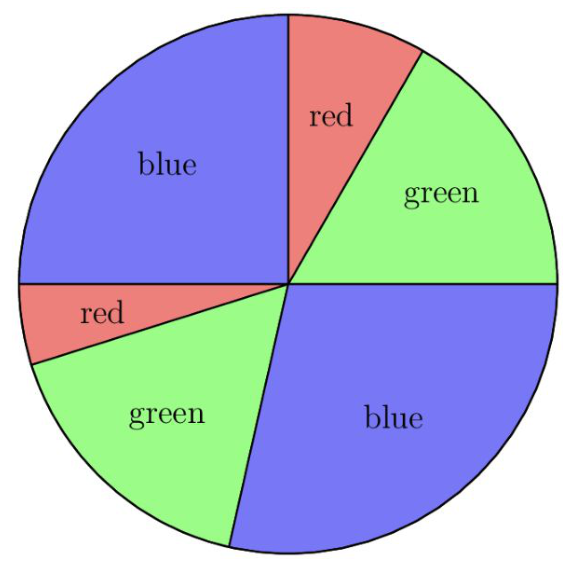
Next problemColoring a cycle with repeated colorsProblem 16
- (A) 12
- (B) 16
- (C) 18
- (D) 24
- (E) 28
The theory involved
Treat the unequal sectors as six distinguishable positions around a cycle. Classify the possible positions of one repeated color, then fill the gaps without placing equal colors next to each other.
Answer
Answer D: 24.
The SOMATH solution
- Label the six sectors in cyclic order. The two red sectors cannot be adjacent. Their shorter cyclic separation is either two steps or three steps (opposite). There are 6 pairs of the first kind and 3 opposite pairs.
- For a two-step red pair, there is one sector between the reds on one side and a run of three on the other. The isolated sector is either blue or green. The three-sector run must alternate and use the remaining color counts, giving exactly one completion for each choice: 2 completions per red pair.
- For an opposite red pair, the remaining sectors form two runs of length two. Each run must be blue-green or green-blue, independently. That gives \(2\cdot2=4\) completions per opposite pair.
- The total is \(6(2)+3(4)=12+12=\boxed{24}\). We do not divide by rotations: the sectors have different sizes, so their positions are distinguishable.
What to remember: Whether rotations count as the same is part of the problem's model. Here the unequal sector sizes fix the positions.
Next problemRecovering terms from averagesProblem 17
- (A) 1013
- (B) 1014
- (C) 1016
- (D) 2016
- (E) 2025
The theory involved
Average times number of terms gives a partial sum. Subtract consecutive partial sums to recover an individual term. A greatest-possible answer needs both an upper bound and an example attaining it.
Answer
Answer B: 1014.
The SOMATH solution
- Let \(A_k\) be the average of the first \(k\) terms. Starting from \(A_3=2025\), the rule gives \(A_k=2028-k\) for \(k\ge3\).
- The partial sum is \(S_k=kA_k=2028k-k^2\). For \(k\ge4\), \[x_k=S_k-S_{k-1}=2029-2k.\] Thus \(x_4=2021,x_5=2019,\ldots\), decreasing by 2 each time.
- Positivity requires \(2029-2n\ge1\), so \(n\le1014\). At \(n=1014\), the final term is 1; the next term would be negative.
- To show the bound is attainable, choose \(x_1=2026,x_2=2025,x_3=2024\), followed by \(2021,2019,\ldots,1\). The first three average 2025, the sequence strictly decreases, and the partial sums satisfy the required rule. The maximum is \(\boxed{1014}\).
What to remember: A changing average controls the next term through a difference of totals, not through a difference of averages alone.
Next problemGrouping floor values between squaresProblem 18
- (A) 1
- (B) 2
- (C) 3
- (D) 5
- (E) 8
The theory involved
The floor of a square root stays constant between consecutive perfect squares. Count how many inputs give each output before adding.
Answer
Answer D: 5.
The SOMATH solution
- For each integer \(j\), the value \(\lfloor\sqrt{k}\rfloor=j\) occurs for \(k=j^2,j^2+1,\ldots,(j+1)^2-1\). There are \((j+1)^2-j^2=2j+1\) such inputs.
- Because \(2025=45^2\), the blocks for \(j=1,\ldots,44\) are complete, and the final value 45 occurs once. The sum is \(\sum_{j=1}^{44}j(2j+1)+45\).
- Use \(\sum j=44\cdot45/2=990\) and \(\sum j^2=44\cdot45\cdot89/6=29370\). Thus the total is \(2(29370)+990+45=59775\).
- Its ones digit is \(\boxed5\). The isolated final term is essential: the entire block of 45s has not appeared yet.
What to remember: Check whether the last perfect-square block is complete. At an exact square, only its first term has arrived.
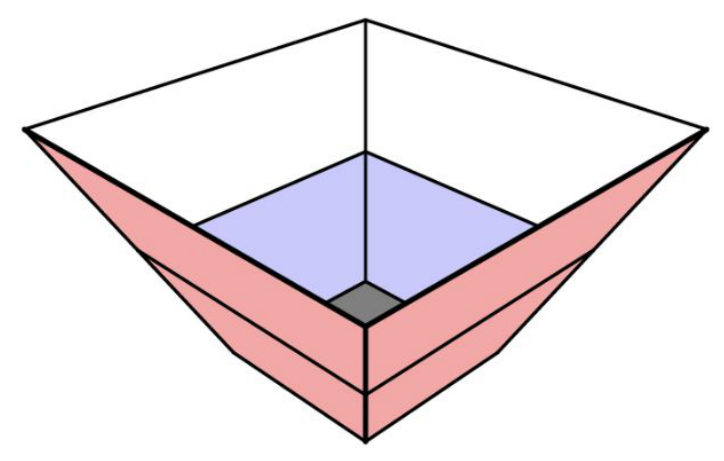
Next problemSimilar pyramids and filling timesProblem 19
- (A) 70
- (B) 85
- (C) 90
- (D) 95
- (E) 105
The theory involved
The container is a square-pyramid frustum. Extend its sides to a common apex: similar pyramids have volumes proportional to the cubes of corresponding side lengths. Constant flow makes time proportional to volume.
Answer
Answer D: 95.
The SOMATH solution
- At the trapezoid midlines, the horizontal square cross-section has side \((1+3)/2=2\). Extend the container's sides down to a virtual pyramid apex.
- The pyramids from that apex to the bottom, middle, and top cross-sections have linear scales \(1:2:3\). Their volumes are therefore in ratio \(1:8:27\).
- The lower half of the container has relative volume \(8-1=7\). The upper half has relative volume \(27-8=19\). Although the heights are equal, the upper half holds more water.
- If 7 volume units take 35 minutes, each unit takes 5 minutes. The remaining 19 units take \(19(5)=\boxed{95}\) minutes. This is the additional time, not the 130-minute total.
What to remember: For similar solids, cube the length scale. Equal changes in height do not produce equal volumes when the container widens.
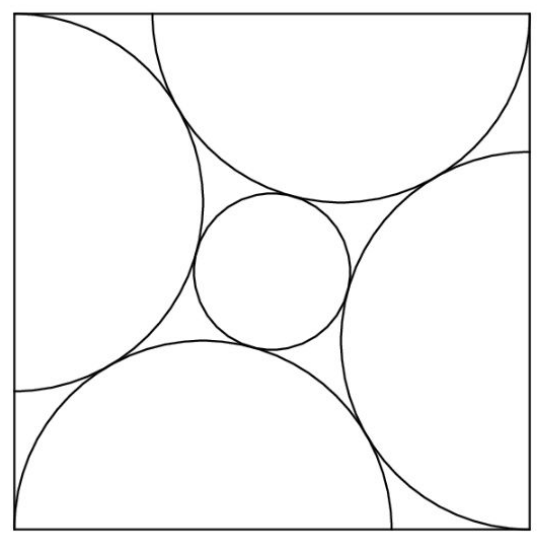
Next problemTangent circles and radical factorizationProblem 20
- (A) 3
- (B) 5
- (C) 8
- (D) 9
- (E) 11
The theory involved
For externally tangent circles, the distance between centers equals the sum of their radii. Coordinates convert two tangency conditions into equations; a radical expression may then factor unexpectedly.
Answer
Answer A: 3.
The SOMATH solution
- Let each semicircle have radius \(r\). Put the square at \([0,1]\times[0,1]\), with the bottom semicircle centered at \((r,0)\) and the right one at \((1,r)\). Their tangency gives \((1-r)^2+r^2=(2r)^2\).
- Simplify to \(2r^2+2r-1=0\). The positive root is \(r=(\sqrt3-1)/2\). Let the small circle's radius be \(\rho\) and its center be \((1/2,1/2)\).
- The distance to \((r,0)\) is \(r+\rho\), so \[r+\rho=\sqrt{(r-\tfrac12)^2+\tfrac14}=\sqrt{2-\sqrt3}.\] Consequently the small diameter is \(2\rho=2\sqrt{2-\sqrt3}-\sqrt3+1\).
- Since \((\sqrt6-\sqrt2)^2=8-4\sqrt3\), we have \(2\sqrt{2-\sqrt3}=\sqrt6-\sqrt2\). Therefore \[\begin{aligned}2\rho&=\sqrt6-\sqrt2-\sqrt3+1\\&=(\sqrt3-1)(\sqrt2-1).\end{aligned}\] Take \(a=3,b=-1,c=2,d=-1\), giving \(a+b+c+d=\boxed3\).
What to remember: Connect centers before manipulating radicals. Remember that \(b\) and \(d\) may be negative integers.
Next problemA grid-coloring proof using directed cyclesProblem 21
- (A) 3
- (B) 9
- (C) 12
- (D) 18
- (E) 27
The theory involved
Turn a local 'must have a neighbor' rule into directed arrows. A finite directed graph in which every vertex has an outgoing arrow contains a directed cycle. Grid parity and color order sharply restrict that cycle.
Answer
Answer C: 12.
The SOMATH solution
- From each cell choose one neighbor of its required next color: red to blue, blue to yellow, yellow to red. Repeatedly follow arrows. Because there are only nine cells, eventually a cell repeats, producing a simple directed cycle.
- The cycle length is divisible by 3 because colors repeat every three steps. It is also even because a square grid is bipartite: every move switches checkerboard parity. A simple cycle has at most nine cells, so its length must be 6. In a \(3\times3\) grid, a six-cell cycle is the perimeter of a \(2\times3\) or \(3\times2\) rectangle.
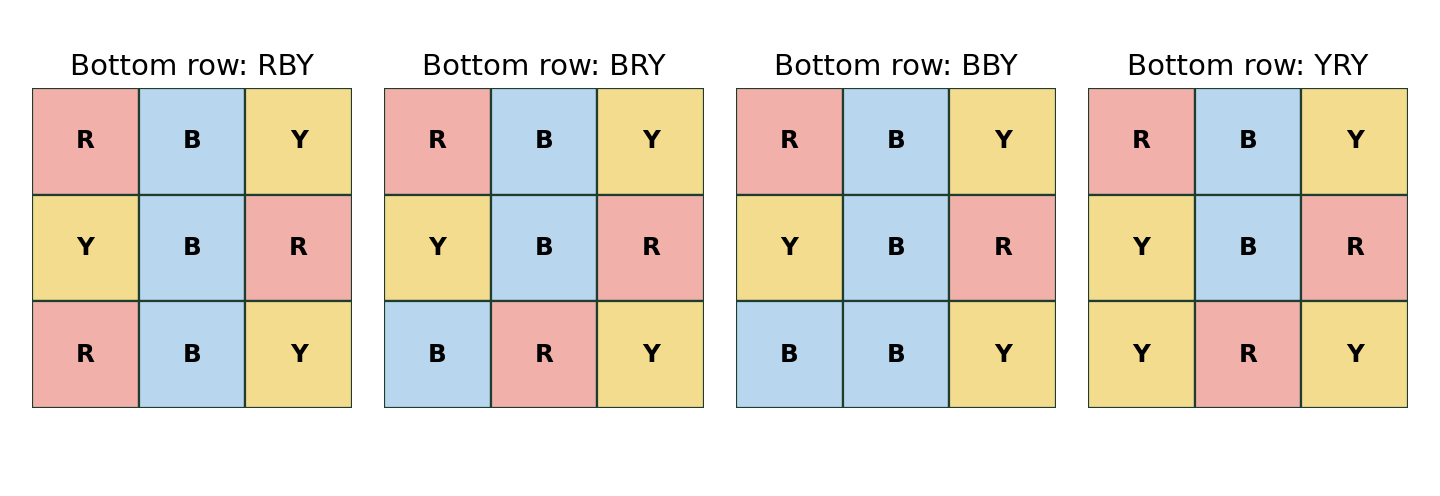
- Fix the center cell's color as blue. Rotations and reflections put one such cycle in the top two rows and orient its colors as follows, where the bottom row is not yet filled: \[\begin{array}{ccc}R&B&Y\\Y&B&R\\?&?&?\end{array}\] The six cycle cells already meet the neighbor rule. If the bottom-right cell were red, the bottom-middle would have to be blue; then the bottom-left is forced yellow but has no red neighbor. If the bottom-right were blue, the bottom-middle must be yellow and the bottom-left red, which has no blue neighbor. Hence the bottom-right is yellow.
- Now inspect the bottom-left. If it is red, the middle must be blue, giving \(RBY\). If it is blue, the middle can be red or blue, giving \(BRY\) or \(BBY\). If it is yellow, the middle must be red, giving \(YRY\). Direct inspection confirms all four completions work.
- These four are inequivalent under square symmetries. The \(BBY\) and \(YRY\) completions have distinct color counts. The \(RBY\) and \(BRY\) completions each have three cells of each color, but the center has two blue neighbors in the first and one in the second. Thus there are exactly four types with a blue center. Cyclically renaming the colors gives four with red center and four with yellow center. Symmetry cannot change the center's color, so the total is \(3(4)=\boxed{12}\).
What to remember: Do not divide a raw count by eight without checking symmetry. Some colorings have fewer than eight distinct rotations and reflections.
Next problemDigit deficits and divisibility by elevenProblem 22
- (A) \(\frac3{14}\)
- (B) \(\frac3{11}\)
- (C) \(\frac27\)
- (D) \(\frac4{11}\)
- (E) \(\frac37\)
The theory involved
When a digit sum is close to its maximum, count deficits from 9 rather than the digits themselves. Divisibility by 11 depends on the alternating sum of digits.
Answer
Answer A: \(\frac3{14}\).
The SOMATH solution
- Seven 9s sum to 63. To get 61, subtract a total deficit of 2 across seven positions. Each deficit is 0, 1, or 2, so every resulting number is still seven digits. Stars and bars gives \(\binom{8}{6}=\binom82=28\) equally likely numbers.
- Let \(E\) be the total deficit in the three even-numbered positions, and \(O\) the deficit in the four odd-numbered positions. Then \(O+E=2\).
- The odd-position digit sum minus the even-position sum is \((36-O)-(27-E)=9-O+E=7+2E\). Since \(E=0,1,\) or 2, this difference is 7, 9, or 11. Only 11 is divisible by 11, so all deficit must lie in the three even positions.
- Distribute a deficit of 2 among those three positions in \(\binom42=6\) ways. The probability is \(6/28=\boxed{\frac3{14}}\).
What to remember: Condition first. The sample space is the 28 numbers with digit sum 61, not all seven-digit integers.
Next problemMatching two grid-numbering systemsProblem 23
- (A) 7
- (B) 10
- (C) 11
- (D) 12
- (E) 19
The theory involved
Write an explicit value for each numbering rule at a general cell. Matching values produce a linear Diophantine equation, whose integer solutions are controlled by a greatest common divisor.
Answer
Answer C: 11.
The SOMATH solution
- Use zero-based row \(r=0,\ldots,140\) and column \(c=0,\ldots,90\). Horace writes \(91r+c+1\), while Vera writes \(141c+r+1\).
- Equality gives \(91r+c=141c+r\), or \(90r=140c\). Divide by 10 to obtain \(9r=14c\).
- Since 9 and 14 are coprime, the solutions are \(r=14t,c=9t\) for an integer \(t\). The grid bounds require \(0\le t\le10\).
- The eleven values \(t=0,1,\ldots,10\) each give a distinct cell, so the answer is \(\boxed{11}\). Both the top-left and bottom-right cells are included.
What to remember: Zero-based coordinates remove distracting offsets. Count the endpoints when converting an allowed parameter range into a number of cells.
Next problemFirst-step probability equationsProblem 24
- It starts at 0.
- If it is at 0, then it moves to 1 with probability \(\frac12\) and it disappears with probability \(\frac12\).
- For \(n=1,2,\) or 3, if it is at \(n\), then it moves to \(n+1\) with probability \(\frac14\), it moves to \(n-1\) with probability \(\frac14\), and it disappears with probability \(\frac12\).
- (A) \(\frac1{101}\)
- (B) \(\frac1{100}\)
- (C) \(\frac1{99}\)
- (D) \(\frac1{98}\)
- (E) \(\frac1{97}\)
The theory involved
A first-step equation conditions on the next move and automatically accounts for paths that revisit earlier states. Give disappearance a success probability of zero and reaching the target a success probability of one.
Answer
Answer E: \(\frac1{97}\).
The SOMATH solution
- Let \(p_i\) be the probability of eventually reaching 4 starting from \(i\). Then \(p_4=1\). At 0, the first move gives \(p_0=\frac12p_1\), so \(p_1=2p_0\).
- For \(i=1,2,3\), condition on the next step: \[p_i=\tfrac14p_{i+1}+\tfrac14p_{i-1}+\tfrac12(0).\] Rearrange to \(p_{i+1}=4p_i-p_{i-1}\).
- Starting from \(p_1=2p_0\), compute \(p_2=8p_0-p_0=7p_0\), then \(p_3=28p_0-2p_0=26p_0\).
- Finally \(p_4=104p_0-7p_0=97p_0=1\). Thus the required probability is \(p_0=\boxed{\frac1{97}}\). This includes paths with any number of backward steps.
What to remember: The direct path is only one way to succeed. Recursive state probabilities include all possible returns without listing infinitely many paths.
Next problemUnfolding a reflected pathProblem 25
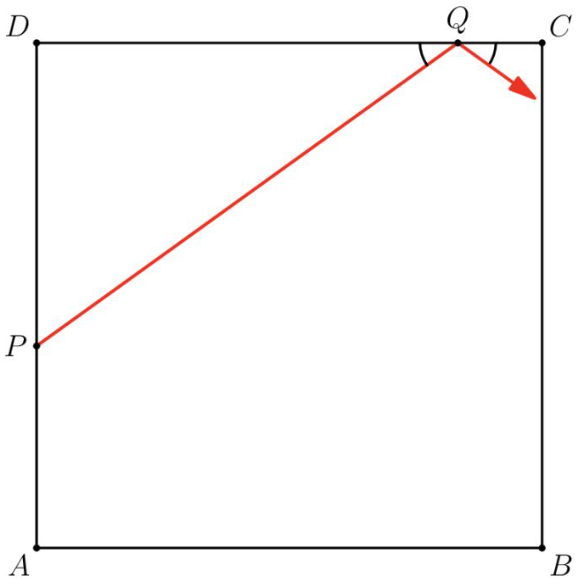
- (A) \(A\)
- (B) \(B\)
- (C) \(C\)
- (D) \(D\)
- (E) The path continues forever.
The theory involved
Instead of reflecting the path, reflect the square across its sides. The path becomes a straight line through a tiled plane. A vertex hit corresponds to a lattice point whose coordinates are multiples of the square's side length.
Answer
Answer B: \(B\).
The SOMATH solution
- Set \(A=(0,0),B=(4,0),C=(4,4),D=(0,4)\). Then \(P=(0,8/5)\) and \(Q=(10/3,4)\). The initial slope is \((4-8/5)/(10/3)=18/25\).
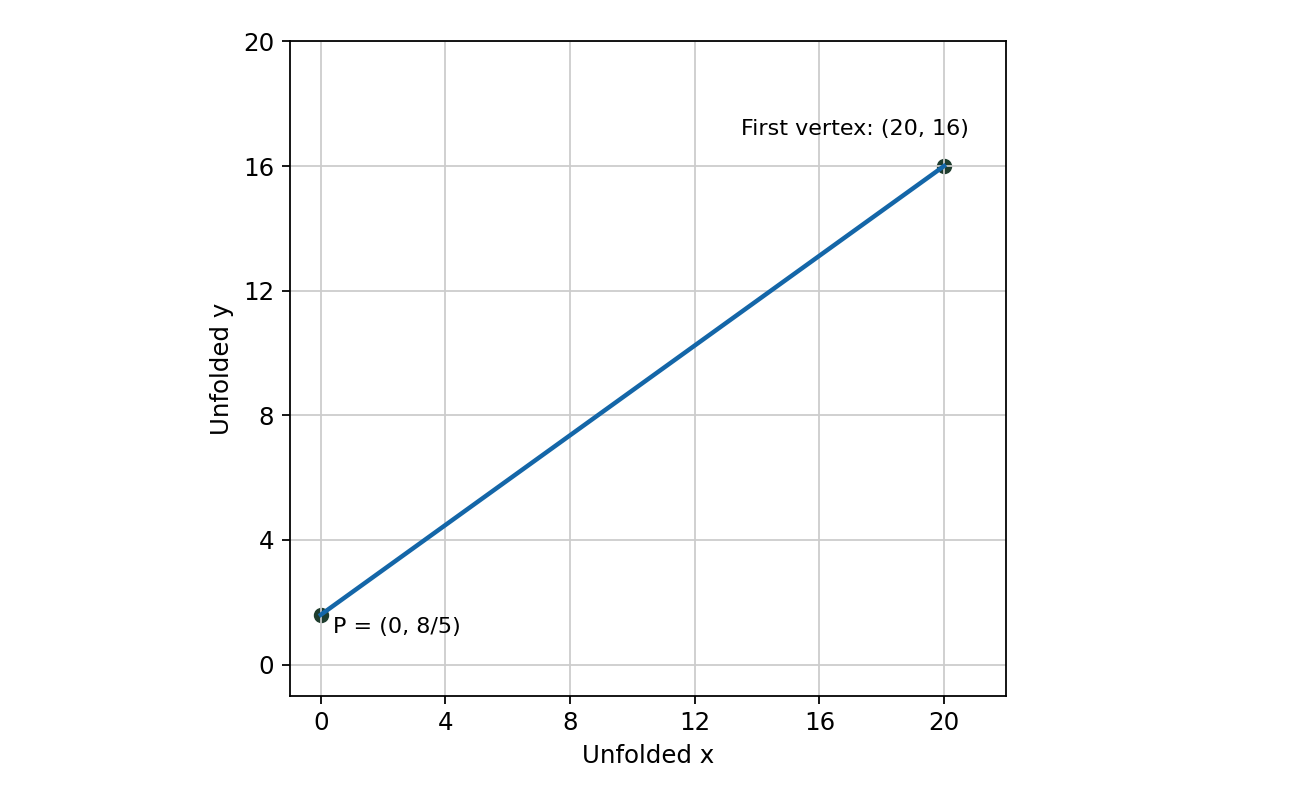
- In the unfolded plane, the line is \(y=8/5+(18/25)x\). A grid vertex has coordinates \((4m,4n)\), giving \(25n=10+18m\).
- Modulo 25, this requires \(18m\equiv15\pmod{25}\). Since \(18\cdot7\equiv1\pmod{25}\), \(m\equiv5\pmod{25}\). The first positive solution is \(m=5\), and then \(n=4\). Thus the first vertex reached in the unfolded plane is \((20,16)\).
- Fold back into the original square. An odd multiple of 4 in the horizontal direction lands on the right side; an even multiple of 4 in the vertical direction lands on the bottom. Since \(m=5\) is odd and \(n=4\) is even, the vertex is the bottom-right corner, \(\boxed B\).
What to remember: Use congruences to locate the first vertex, then parity to identify which original corner it represents. A straight unfolded path replaces many separate reflections.
Return to Problem 252025 AMC 10B answer key
Keep this closed until you finish your attempt. Every problem above has its own full explanation.
Reveal the complete answer key
Checked against the supplied document and the published answer key.
AMC 10 preparation on the Upper West Side
Getting a school-math answer right and finding an efficient competition solution are related but different goals. A student may know how to factor yet miss the excluded value in Problem 10, or understand probability yet overlook the repeated visits in Problem 24. We recommend choosing the next practice set around those specific decisions.
For your evaluation, bring two problems your student solved and two they could not finish. Show the written working, including abandoned attempts. That gives us a more useful conversation than an answer-letter score alone: we can discuss algebra fluency, diagram habits, case organization and how comfortably the student explains a solution.
Tao Titans Math Competition Prep serves grades 6–12 and includes AMC 8 foundations, AMC 10 development and AMC 12 extensions, with level-appropriate practice. Its current Friday session is 4:00–6:00 PM at 226 W 79th St, 1st Floor, NYC, with a maximum of six students (SOMATH course details).
The course’s grade range is not the eligibility range of every competition. The MAA sets separate grade and age limits for AMC 8, AMC 10 and AMC 12 (MAA eligibility overview). We offer independent preparation; contest entry, registration and fees remain separate, and no score or qualification is guaranteed.
A practical review plan
- Interpret before computing. Review Problems 1, 8 and 11. Explain the complete-serving, whole-cent and one-to-one matching assumptions.
- Track totals instead of every term. Compare Problems 3, 15, 17 and 18. Identify the row sum, telescoping cancellation, partial sum or repeated block.
- Draw useful additions. Add radii in Problems 5 and 20, coordinates in Problem 13, and the virtual pyramid apex in Problem 19.
- Audit every count. Distinguish the fixed sector positions in Problem 16 from the rotation-and-reflection equivalence in Problem 21.
- Turn motion into structure. For Problem 24, record the frog's state probabilities; for Problem 25, straighten the path by reflecting the square.
Continue with related SOMATH lessons
For another full practice paper, try our 2025 AMC 10A questions and detailed solutions. For an earlier competition starting point, use our AMC 8 preparation guide and AMC 8 practice test with hidden solutions. To strengthen the algebra used in this walkthrough, revisit factoring trinomials. You can also browse the SOMATH Journal, compare courses, and check the weekly timetable.
AMC 10B study and SOMATH preparation: questions & answers
What does this 2025 AMC 10B walkthrough include?
All 25 questions from the supplied 2025 AMC 10B compilation, the available multiple-choice answers and original diagrams, theory notes, and independently written SOMATH solutions. Answers stay hidden until a reader opens them. The questions-only PDF contains all 25 problems and all 125 answer choices, with no solutions or answer key.
How should I use the hidden solutions?
Attempt a problem on paper first. Name the idea you think applies, write your working, and choose an answer before opening the blue Answer control. After checking, close the explanation and solve the problem again without looking.
Who can take the AMC 10?
The MAA describes the AMC 10 as a competition for students in grade 10 or below who are under 17.5 years old on the day of the competition. Families should confirm current eligibility and registration requirements with the MAA. (MAA)
Does AMC 10 preparation require calculus?
No. The AMC 10 emphasizes elementary algebra, geometry, number theory and probability rather than calculus. These solutions focus on algebraic reasoning, counting, geometry and structural shortcuts. (MAA)
Where does SOMATH offer AMC preparation in NYC?
Tao Titans Math Competition Prep meets in person at School of Math, 226 W 79th St, 1st Floor, on Manhattan’s Upper West Side. The current Friday class runs from 4:00 to 6:00 PM; see the course page for availability and enrollment. (SOMATH course details)
Can middle-school students join Tao Titans?
SOMATH’s Tao Titans course serves grades 6–12, with AMC 8, AMC 10 or AMC 12 practice matched to readiness and eligibility. A free evaluation helps identify an appropriate starting point; all students are not expected to solve the same problems. (SOMATH course details)
Does joining SOMATH register a student for the AMC?
No. SOMATH provides independent preparation. Contest registration, eligibility, entry fees and participation are separate and controlled by the organizer. Enrollment does not guarantee contest admission, AIME qualification or awards. (SOMATH course details)