Young Fermats · Algebra II · Class 14
Algebra 2 Class 14: Rational Equations and Extraneous Roots
To solve a rational equation, first exclude values that make an original denominator zero. Multiply every term by the least common denominator, solve the resulting equation, then check each candidate in the original equation. Reject any extraneous root, even if it satisfies the transformed equation.
Study ten images in order, with theory and five original practice questions after each image. Then complete ten homework review questions and ten increasingly challenging word problems: 20 homework questions and 70 questions altogether. Each question has a compact blue Answer button with a worked explanation.
Continue from Class 13: rational expressions. For in-person Algebra 2 at SOMATH, book an evaluation or view the schedule.
Practice uses different examples from the posters and builds gradually within each section. Variables are real unless stated otherwise. Word-problem prices, measurements, and rates are fictional learning models. Keep exact values until a question asks for a decimal.
Download the student workbook (PDF)25 pages · Cover, ten lesson images with five practice questions each, ten homework review questions, and ten homework word problems.Blank answer space throughout. No exercise answers, writing lines, name fields, or date fields.
Understanding rational equations
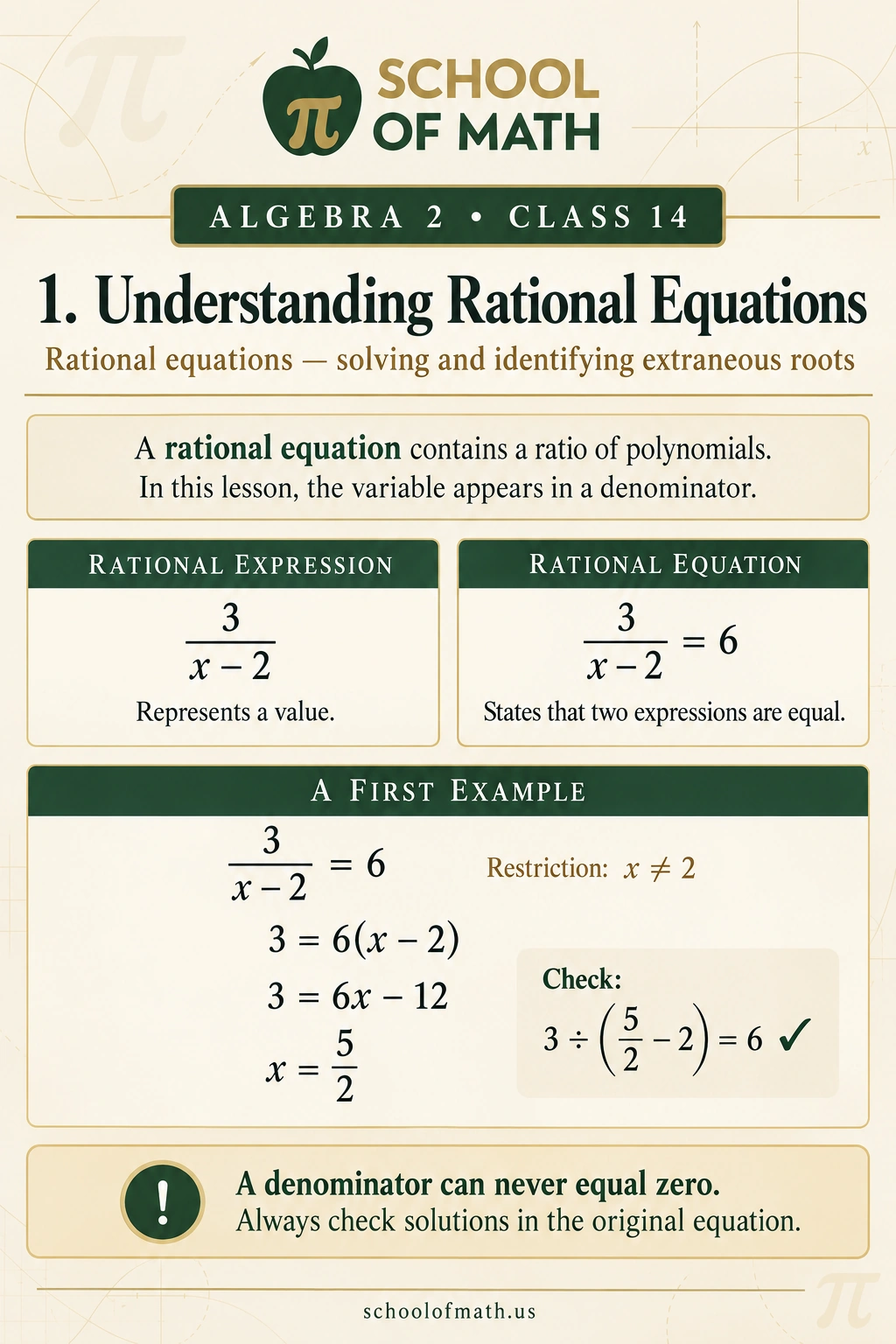
A rational expression is a quotient of polynomials. An equation asserts that two expressions have equal values. Here we focus on equations with a variable in a denominator. Before solving, identify values that would make an original denominator zero. Multiplying by an expression containing x is reversible only where that expression is nonzero, so the transformed equation gives candidates that must be checked.
Try it yourself: five questions
Q1 Practice 1 of 5
Which is an expression and which is an equation: \(\frac{7}{x+4}\) and \(\frac{7}{x+4}=2\)? Give the restriction.
Answer
The first is an expression; the second is an equation. \(x\ne-4\).
- The equals sign distinguishes an equation from an expression.
- Both contain the denominator x + 4. Setting it to zero gives x = −4, which is not allowed.
Q2 Practice 2 of 5
Can x = 0 be tested as a solution of \(\frac{x+6}{x}=3\)? Explain before solving.
Answer
No. x = 0 is outside the domain.
- Substituting zero would make the denominator zero.
- An undefined expression cannot equal 3; first exclude zero, then solve for other candidates.
Q3 Practice 3 of 5
Solve \(\frac{8}{x}=2\). State the restrictions and check every candidate.
Answer
Solution: \(x=4\).
- Record restrictions from every original denominator: \(x\ne 0\).
- Factor the denominators and use LCD \(x\). Multiply every term on both sides by this LCD.
- After clearing denominators: \(8=2 x\).
- Move all terms to one side: \(8 - 2 x=0\).
- Isolate x in the resulting linear equation.
- Candidate value: \(x=4\).
- Check \(x=4\) in the original equation: left = \(2\), right = \(2\). The denominators are nonzero, so accept it.
Q4 Practice 4 of 5
Solve \(\frac{12}{x + 1}=3\). State the restrictions and check every candidate.
Answer
Solution: \(x=3\).
- Record restrictions from every original denominator: \(x\ne -1\).
- Factor the denominators and use LCD \(x + 1\). Multiply every term on both sides by this LCD.
- After clearing denominators: \(12=3 x + 3\).
- Move all terms to one side: \(9 - 3 x=0\).
- Isolate x in the resulting linear equation.
- Candidate value: \(x=3\).
- Check \(x=3\) in the original equation: left = \(3\), right = \(3\). The denominators are nonzero, so accept it.
Q5 Practice 5 of 5
Solve \(\frac{2 x + 5}{x - 1}=3\). State the restrictions and check every candidate.
Answer
Solution: \(x=8\).
- Record restrictions from every original denominator: \(x\ne 1\).
- Factor the denominators and use LCD \(x - 1\). Multiply every term on both sides by this LCD.
- After clearing denominators: \(2 x + 5=3 x - 3\).
- Move all terms to one side: \(8 - x=0\).
- Isolate x in the resulting linear equation.
- Candidate value: \(x=8\).
- Check \(x=8\) in the original equation: left = \(3\), right = \(3\). The denominators are nonzero, so accept it.
Identifying domain restrictions
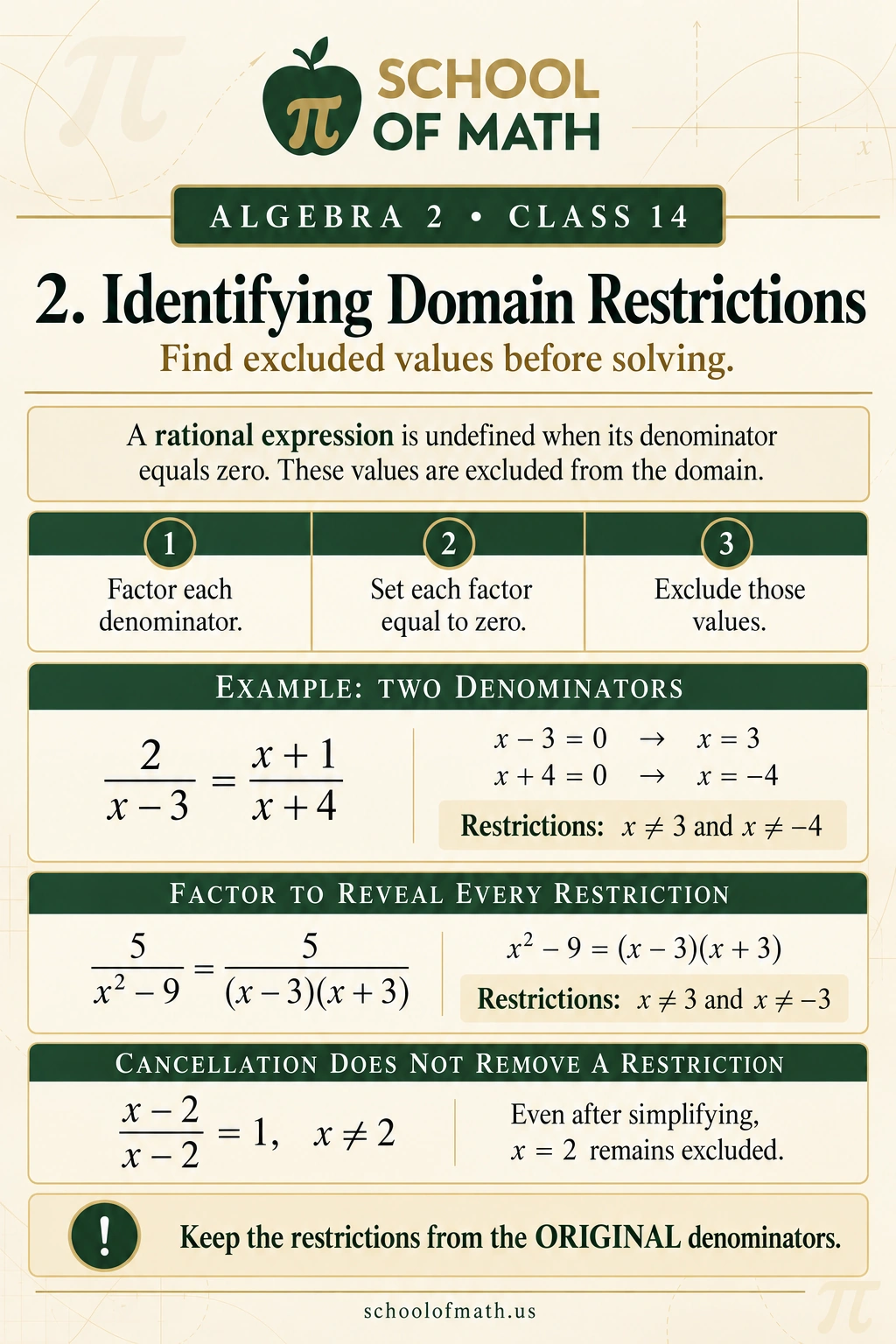
The domain belongs to the original equation, before any simplification. Factor each denominator and exclude the zeros of every factor, on either side of the equals sign. A zero numerator is allowed when its denominator is nonzero. If a numerator and denominator share a factor, cancellation shortens the formula but does not enlarge the original domain.
Try it yourself: five questions
Q6 Practice 1 of 5
State the restriction for \(\frac{9}{x-6}=2\). Do not solve.
Answer
Restrictions: \(x\ne 6\).
- Factor the original denominators: \(x - 6=x - 6\).
- Set every variable factor equal to zero to find the forbidden inputs.
- Exclude \(6\). Cancellation never restores an input missing from the original domain.
Q7 Practice 2 of 5
Find the excluded values in \(\frac{x+1}{x^2-25}\).
Answer
Restrictions: \(x\ne -5\), \(x\ne 5\).
- Factor the original denominators: \(x^{2} - 25=\left(x - 5\right) \left(x + 5\right)\).
- Set every variable factor equal to zero to find the forbidden inputs.
- Exclude \(-5\), \(5\). Cancellation never restores an input missing from the original domain.
Q8 Practice 3 of 5
Find every excluded value in \(\frac{5}{2x(x+3)}\).
Answer
Restrictions: \(x\ne -3\), \(x\ne 0\).
- Factor the original denominators: \(2 x \left(x + 3\right)=2 x \left(x + 3\right)\).
- Set every variable factor equal to zero to find the forbidden inputs.
- Exclude \(-3\), \(0\). Cancellation never restores an input missing from the original domain.
Q9 Practice 4 of 5
State all restrictions for \(\frac{2}{x^2-x-12}=\frac{7}{x^2-16}\).
Answer
Restrictions: \(x\ne -4\), \(x\ne -3\), \(x\ne 4\).
- Factor the original denominators: \(x^{2} - x - 12=\left(x - 4\right) \left(x + 3\right)\), \(x^{2} - 16=\left(x - 4\right) \left(x + 4\right)\).
- Set every variable factor equal to zero to find the forbidden inputs.
- Exclude \(-4\), \(-3\), \(4\). Cancellation never restores an input missing from the original domain.
Q10 Practice 5 of 5
A student cancels x − 7 in \(\frac{x^2-49}{x-7}\) and claims every real x is allowed. Correct the claim.
Answer
Restrictions: \(x\ne 7\).
- Factor the original denominators: \(x - 7=x - 7\).
- Set every variable factor equal to zero to find the forbidden inputs.
- Exclude \(7\). Cancellation never restores an input missing from the original domain.
Finding the least common denominator
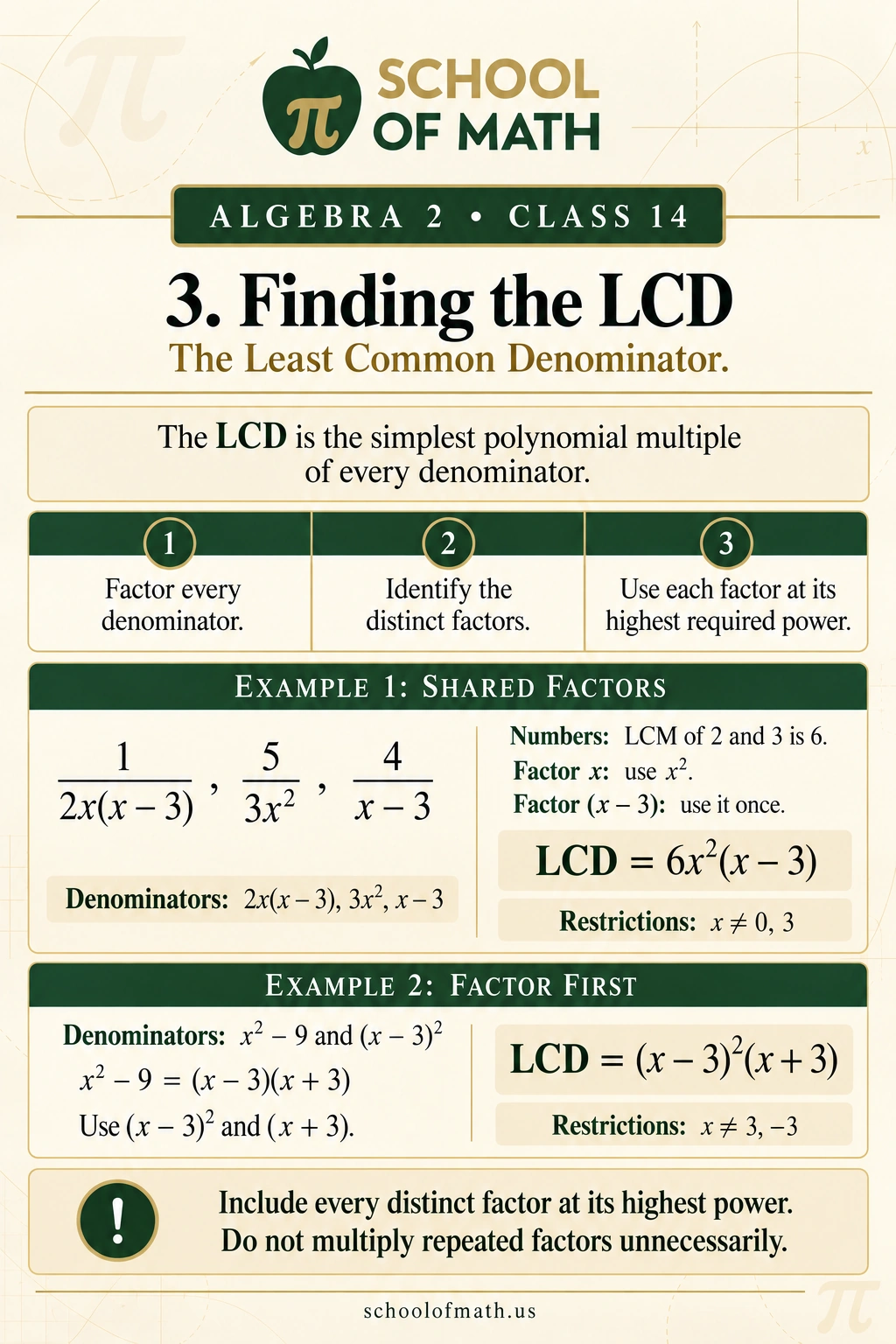
Factor first. The LCD contains each distinct factor at its highest required power, along with a numerical coefficient that clears every denominator. Shared factors should not be counted twice unnecessarily. Opposite factors such as x − 2 and 2 − x differ by a negative sign; account for that sign when canceling. You may multiply by a larger common denominator, but the LCD usually keeps the algebra shorter.
Try it yourself: five questions
Q11 Practice 1 of 5
Find the least common denominator for \(4 x\), \(6 x^{2}\). State the excluded values.
Answer
LCD: \(12 x^{2}\). Restrictions: \(x\ne 0\).
- Factor each denominator: \(4 x\), \(6 x^{2}\).
- Take the least common multiple of numerical factors. Include each variable factor at its highest required power.
- The result is \(12 x^{2}\). Each original denominator divides this polynomial exactly.
Q12 Practice 2 of 5
Find the least common denominator for \(x + 2\), \(x \left(x + 2\right)\). State the excluded values.
Answer
LCD: \(x \left(x + 2\right)\). Restrictions: \(x\ne -2\), \(x\ne 0\).
- Factor each denominator: \(x + 2\), \(x \left(x + 2\right)\).
- Take the least common multiple of numerical factors. Include each variable factor at its highest required power.
- The result is \(x \left(x + 2\right)\). Each original denominator divides this polynomial exactly.
Q13 Practice 3 of 5
Find the least common denominator for \(x^{2} - 16\), \(x - 4\). State the excluded values.
Answer
LCD: \(\left(x - 4\right) \left(x + 4\right)\). Restrictions: \(x\ne -4\), \(x\ne 4\).
- Factor each denominator: \(\left(x - 4\right) \left(x + 4\right)\), \(x - 4\).
- Take the least common multiple of numerical factors. Include each variable factor at its highest required power.
- The result is \(\left(x - 4\right) \left(x + 4\right)\). Each original denominator divides this polynomial exactly.
Q14 Practice 4 of 5
Find the least common denominator for \(\left(x - 1\right)^{2}\), \(x^{2} - 1\). State the excluded values.
Answer
LCD: \(\left(x - 1\right)^{2} \left(x + 1\right)\). Restrictions: \(x\ne -1\), \(x\ne 1\).
- Factor each denominator: \(\left(x - 1\right)^{2}\), \(\left(x - 1\right) \left(x + 1\right)\).
- Take the least common multiple of numerical factors. Include each variable factor at its highest required power.
- The result is \(\left(x - 1\right)^{2} \left(x + 1\right)\). Each original denominator divides this polynomial exactly.
Q15 Practice 5 of 5
Find the least common denominator for \(6 x \left(x + 4\right)\), \(9 x^{2} \left(x + 4\right)^{2}\). State the excluded values.
Answer
LCD: \(18 x^{2} \left(x + 4\right)^{2}\). Restrictions: \(x\ne -4\), \(x\ne 0\).
- Factor each denominator: \(6 x \left(x + 4\right)\), \(9 x^{2} \left(x + 4\right)^{2}\).
- Take the least common multiple of numerical factors. Include each variable factor at its highest required power.
- The result is \(18 x^{2} \left(x + 4\right)^{2}\). Each original denominator divides this polynomial exactly.
Clearing denominators
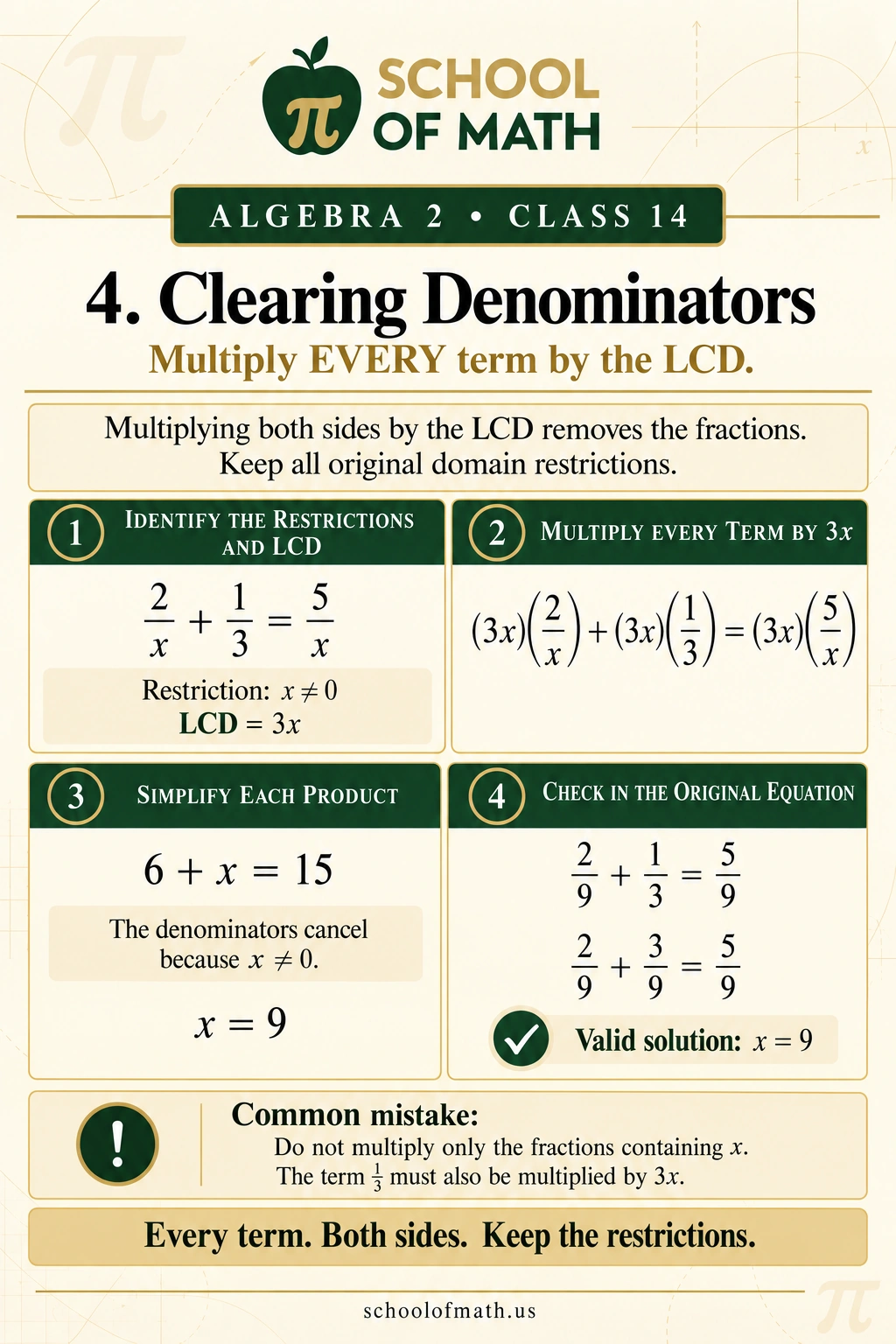
Multiply every term on both sides by the LCD, including whole-number terms and fractions with only constant denominators. Show the resulting equation before expanding. A term such as 2 becomes twice the LCD, not just 2. Keep the restriction list next to your work; it will be used after the linear or quadratic equation has been solved.
Try it yourself: five questions
Q16 Practice 1 of 5
Solve \(\frac{3}{x}+\frac{1}{2}=\frac{7}{x}\). State the restrictions and check every candidate.
Answer
Solution: \(x=8\).
- Record restrictions from every original denominator: \(x\ne 0\).
- Factor the denominators and use LCD \(2 x\). Multiply every term on both sides by this LCD.
- After clearing denominators: \(x + 6=14\).
- Move all terms to one side: \(x - 8=0\).
- Isolate x in the resulting linear equation.
- Candidate value: \(x=8\).
- Check \(x=8\) in the original equation: left = \(\frac{7}{8}\), right = \(\frac{7}{8}\). The denominators are nonzero, so accept it.
Q17 Practice 2 of 5
Solve \(\frac{2}{x + 1}+\frac{1}{3}=\frac{5}{x + 1}\). State the restrictions and check every candidate.
Answer
Solution: \(x=8\).
- Record restrictions from every original denominator: \(x\ne -1\).
- Factor the denominators and use LCD \(3 \left(x + 1\right)\). Multiply every term on both sides by this LCD.
- After clearing denominators: \(x + 7=15\).
- Move all terms to one side: \(x - 8=0\).
- Isolate x in the resulting linear equation.
- Candidate value: \(x=8\).
- Check \(x=8\) in the original equation: left = \(\frac{5}{9}\), right = \(\frac{5}{9}\). The denominators are nonzero, so accept it.
Q18 Practice 3 of 5
Solve \(\frac{1}{x}+\frac{1}{x + 2}=\frac{3}{x \left(x + 2\right)}\). State the restrictions and check every candidate.
Answer
Solution: \(x=\frac{1}{2}\).
- Record restrictions from every original denominator: \(x\ne -2\), \(x\ne 0\).
- Factor the denominators and use LCD \(x \left(x + 2\right)\). Multiply every term on both sides by this LCD.
- After clearing denominators: \(2 x + 2=3\).
- Move all terms to one side: \(2 x - 1=0\).
- Isolate x in the resulting linear equation.
- Candidate value: \(x=\frac{1}{2}\).
- Check \(x=\frac{1}{2}\) in the original equation: left = \(\frac{12}{5}\), right = \(\frac{12}{5}\). The denominators are nonzero, so accept it.
Q19 Practice 4 of 5
Solve \(\frac{4}{x - 3}-\frac{1}{x + 3}=\frac{18}{x^{2} - 9}\). State the restrictions and check every candidate.
Answer
Solution: \(x=1\).
- Record restrictions from every original denominator: \(x\ne -3\), \(x\ne 3\).
- Factor the denominators and use LCD \(\left(x - 3\right) \left(x + 3\right)\). Multiply every term on both sides by this LCD.
- After clearing denominators: \(3 x + 15=18\).
- Move all terms to one side: \(3 x - 3=0\).
- Isolate x in the resulting linear equation.
- Candidate value: \(x=1\).
- Check \(x=1\) in the original equation: left = \(- \frac{9}{4}\), right = \(- \frac{9}{4}\). The denominators are nonzero, so accept it.
Q20 Practice 5 of 5
Solve \(\frac{x + 1}{x - 2}=3+\frac{5}{x - 2}\). State the restrictions and check every candidate.
Answer
Solution: \(x=1\).
- Record restrictions from every original denominator: \(x\ne 2\).
- Factor the denominators and use LCD \(x - 2\). Multiply every term on both sides by this LCD.
- After clearing denominators: \(x + 1=3 x - 1\).
- Move all terms to one side: \(2 - 2 x=0\).
- Isolate x in the resulting linear equation.
- Candidate value: \(x=1\).
- Check \(x=1\) in the original equation: left = \(-2\), right = \(-2\). The denominators are nonzero, so accept it.
Equations that become linear
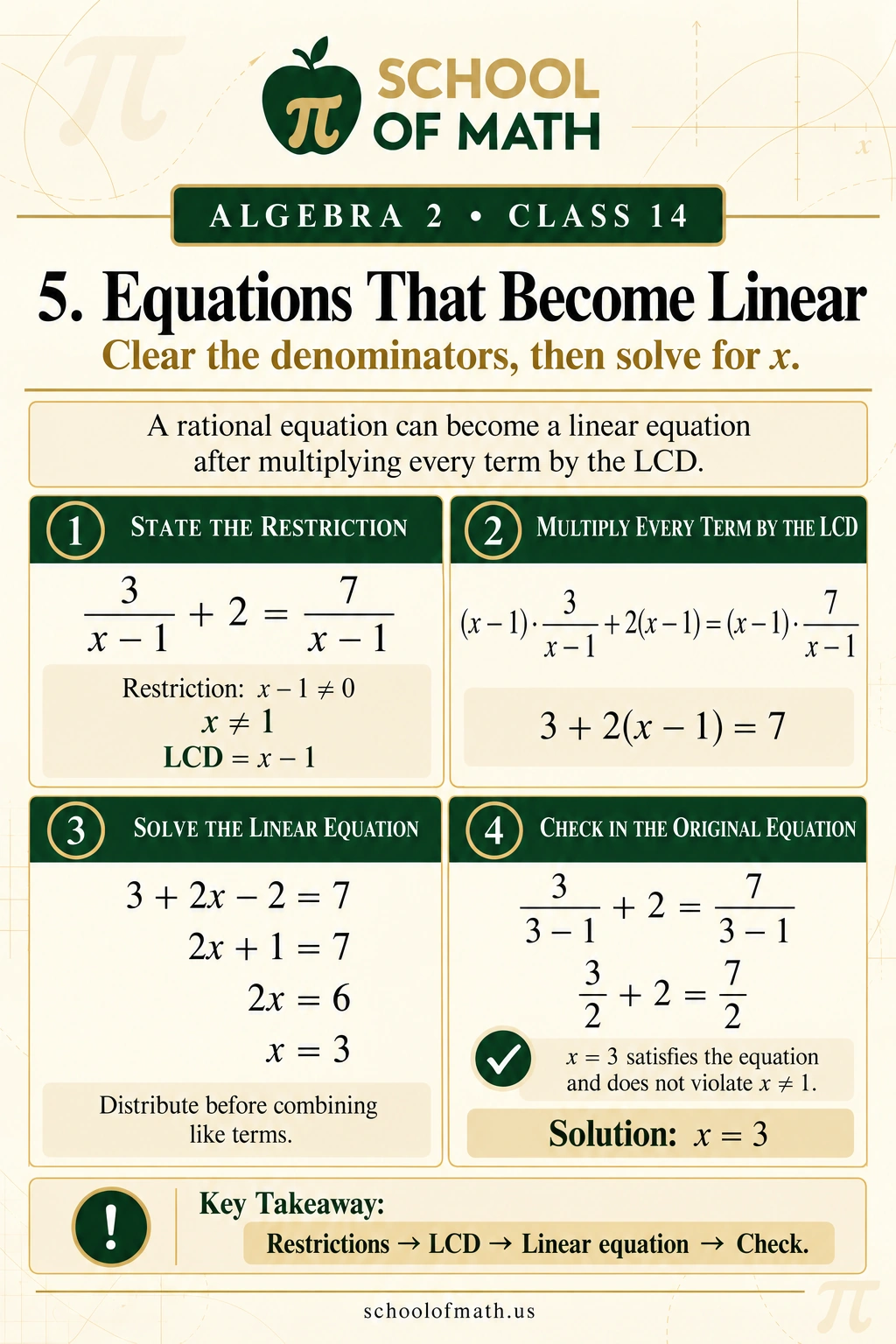
After clearing denominators, many rational equations reduce to ax + b = 0. Expand carefully, combine like terms, and solve the linear equation. A valid answer need not be positive or an integer unless a word problem requires that. A value from the restriction list must still be rejected even when the linear algebra was done correctly.
Try it yourself: five questions
Q21 Practice 1 of 5
Solve \(\frac{5}{x - 2}=1\). State the restrictions and check every candidate.
Answer
Solution: \(x=7\).
- Record restrictions from every original denominator: \(x\ne 2\).
- Factor the denominators and use LCD \(x - 2\). Multiply every term on both sides by this LCD.
- After clearing denominators: \(5=x - 2\).
- Move all terms to one side: \(7 - x=0\).
- Isolate x in the resulting linear equation.
- Candidate value: \(x=7\).
- Check \(x=7\) in the original equation: left = \(1\), right = \(1\). The denominators are nonzero, so accept it.
Q22 Practice 2 of 5
Solve \(\frac{2}{x + 3}+3=\frac{11}{x + 3}\). State the restrictions and check every candidate.
Answer
Solution: \(x=0\).
- Record restrictions from every original denominator: \(x\ne -3\).
- Factor the denominators and use LCD \(x + 3\). Multiply every term on both sides by this LCD.
- After clearing denominators: \(3 x + 11=11\).
- Move all terms to one side: \(3 x=0\).
- Isolate x in the resulting linear equation.
- Candidate value: \(x=0\).
- Check \(x=0\) in the original equation: left = \(\frac{11}{3}\), right = \(\frac{11}{3}\). The denominators are nonzero, so accept it.
Q23 Practice 3 of 5
Solve \(\frac{3}{x - 4}=\frac{5}{x + 2}\). State the restrictions and check every candidate.
Answer
Solution: \(x=13\).
- Record restrictions from every original denominator: \(x\ne -2\), \(x\ne 4\).
- Factor the denominators and use LCD \(\left(x - 4\right) \left(x + 2\right)\). Multiply every term on both sides by this LCD.
- After clearing denominators: \(3 x + 6=5 x - 20\).
- Move all terms to one side: \(26 - 2 x=0\).
- Isolate x in the resulting linear equation.
- Candidate value: \(x=13\).
- Check \(x=13\) in the original equation: left = \(\frac{1}{3}\), right = \(\frac{1}{3}\). The denominators are nonzero, so accept it.
Q24 Practice 4 of 5
Solve \(\frac{x + 2}{x - 3}=2+\frac{8}{x - 3}\). State the restrictions and check every candidate.
Answer
Solution: \(x=0\).
- Record restrictions from every original denominator: \(x\ne 3\).
- Factor the denominators and use LCD \(x - 3\). Multiply every term on both sides by this LCD.
- After clearing denominators: \(x + 2=2 x + 2\).
- Move all terms to one side: \(- x=0\).
- Isolate x in the resulting linear equation.
- Candidate value: \(x=0\).
- Check \(x=0\) in the original equation: left = \(- \frac{2}{3}\), right = \(- \frac{2}{3}\). The denominators are nonzero, so accept it.
Q25 Practice 5 of 5
Solve \(\frac{2 x + 1}{x + 4}=3-\frac{8}{x + 4}\). State the restrictions and check every candidate.
Answer
Solution: \(x=-3\).
- Record restrictions from every original denominator: \(x\ne -4\).
- Factor the denominators and use LCD \(x + 4\). Multiply every term on both sides by this LCD.
- After clearing denominators: \(2 x + 1=3 x + 4\).
- Move all terms to one side: \(- x - 3=0\).
- Isolate x in the resulting linear equation.
- Candidate value: \(x=-3\).
- Check \(x=-3\) in the original equation: left = \(-5\), right = \(-5\). The denominators are nonzero, so accept it.
Equations that become quadratic
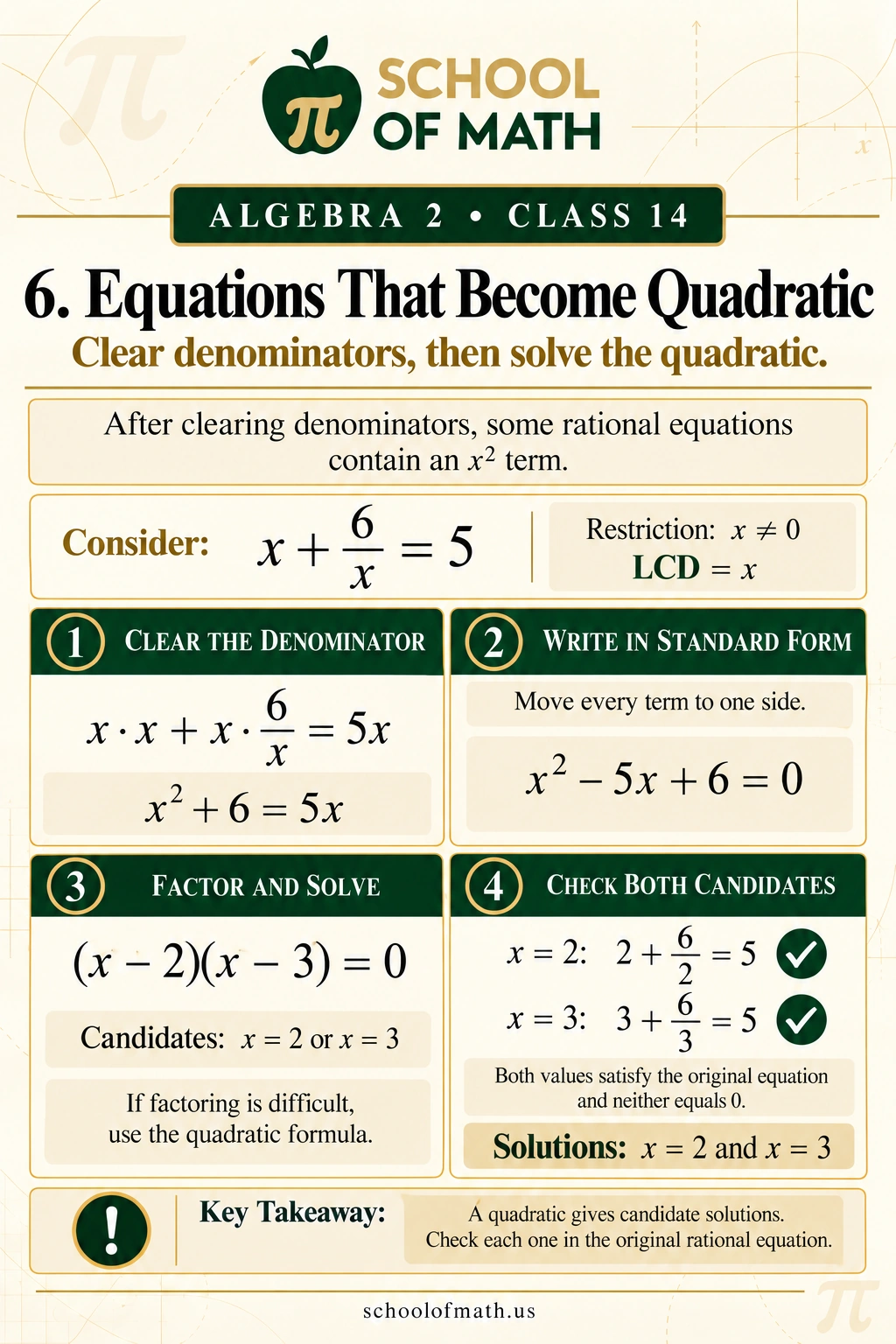
A term x multiplied by an LCD containing x can create x². Put the resulting quadratic into standard form, then factor or use the quadratic formula. Keep exact fractions and radicals until the end. Two real candidates can both work, only one can work, or neither can work; the original equation, not the transformed quadratic alone, decides the solution set.
Try it yourself: five questions
Q26 Practice 1 of 5
Solve \(x+\frac{12}{x}=7\). State the restrictions and check every candidate.
Answer
Solutions: \(x=3\), \(x=4\).
- Record restrictions from every original denominator: \(x\ne 0\).
- Factor the denominators and use LCD \(x\). Multiply every term on both sides by this LCD.
- After clearing denominators: \(x^{2} + 12=7 x\).
- Move all terms to one side: \(x^{2} - 7 x + 12=0\).
- Factor: \(\left(x - 4\right) \left(x - 3\right)=0\). Set each variable factor equal to zero.
- Candidate values: \(x=3\), \(x=4\).
- Check \(x=3\) in the original equation: left = \(7\), right = \(7\). The denominators are nonzero, so accept it.
- Check \(x=4\) in the original equation: left = \(7\), right = \(7\). The denominators are nonzero, so accept it.
Q27 Practice 2 of 5
Solve \(x-\frac{20}{x}=1\). State the restrictions and check every candidate.
Answer
Solutions: \(x=-4\), \(x=5\).
- Record restrictions from every original denominator: \(x\ne 0\).
- Factor the denominators and use LCD \(x\). Multiply every term on both sides by this LCD.
- After clearing denominators: \(x^{2} - 20=x\).
- Move all terms to one side: \(x^{2} - x - 20=0\).
- Factor: \(\left(x - 5\right) \left(x + 4\right)=0\). Set each variable factor equal to zero.
- Candidate values: \(x=-4\), \(x=5\).
- Check \(x=-4\) in the original equation: left = \(1\), right = \(1\). The denominators are nonzero, so accept it.
- Check \(x=5\) in the original equation: left = \(1\), right = \(1\). The denominators are nonzero, so accept it.
Q28 Practice 3 of 5
Solve \(x+\frac{18}{x}=9\). State the restrictions and check every candidate.
Answer
Solutions: \(x=3\), \(x=6\).
- Record restrictions from every original denominator: \(x\ne 0\).
- Factor the denominators and use LCD \(x\). Multiply every term on both sides by this LCD.
- After clearing denominators: \(x^{2} + 18=9 x\).
- Move all terms to one side: \(x^{2} - 9 x + 18=0\).
- Factor: \(\left(x - 6\right) \left(x - 3\right)=0\). Set each variable factor equal to zero.
- Candidate values: \(x=3\), \(x=6\).
- Check \(x=3\) in the original equation: left = \(9\), right = \(9\). The denominators are nonzero, so accept it.
- Check \(x=6\) in the original equation: left = \(9\), right = \(9\). The denominators are nonzero, so accept it.
Q29 Practice 4 of 5
Solve \(2 x+\frac{15}{x}=11\). State the restrictions and check every candidate.
Answer
Solutions: \(x=\frac{5}{2}\), \(x=3\).
- Record restrictions from every original denominator: \(x\ne 0\).
- Factor the denominators and use LCD \(x\). Multiply every term on both sides by this LCD.
- After clearing denominators: \(2 x^{2} + 15=11 x\).
- Move all terms to one side: \(2 x^{2} - 11 x + 15=0\).
- Factor: \(\left(x - 3\right) \left(2 x - 5\right)=0\). Set each variable factor equal to zero.
- Candidate values: \(x=\frac{5}{2}\), \(x=3\).
- Check \(x=\frac{5}{2}\) in the original equation: left = \(11\), right = \(11\). The denominators are nonzero, so accept it.
- Check \(x=3\) in the original equation: left = \(11\), right = \(11\). The denominators are nonzero, so accept it.
Q30 Practice 5 of 5
Solve \(x+\frac{4}{x - 2}=7\). State the restrictions and check every candidate.
Answer
Solutions: \(x=3\), \(x=6\).
- Record restrictions from every original denominator: \(x\ne 2\).
- Factor the denominators and use LCD \(x - 2\). Multiply every term on both sides by this LCD.
- After clearing denominators: \(x^{2} - 2 x + 4=7 x - 14\).
- Move all terms to one side: \(x^{2} - 9 x + 18=0\).
- Factor: \(\left(x - 6\right) \left(x - 3\right)=0\). Set each variable factor equal to zero.
- Candidate values: \(x=3\), \(x=6\).
- Check \(x=3\) in the original equation: left = \(7\), right = \(7\). The denominators are nonzero, so accept it.
- Check \(x=6\) in the original equation: left = \(7\), right = \(7\). The denominators are nonzero, so accept it.
Checking and rejecting extraneous roots
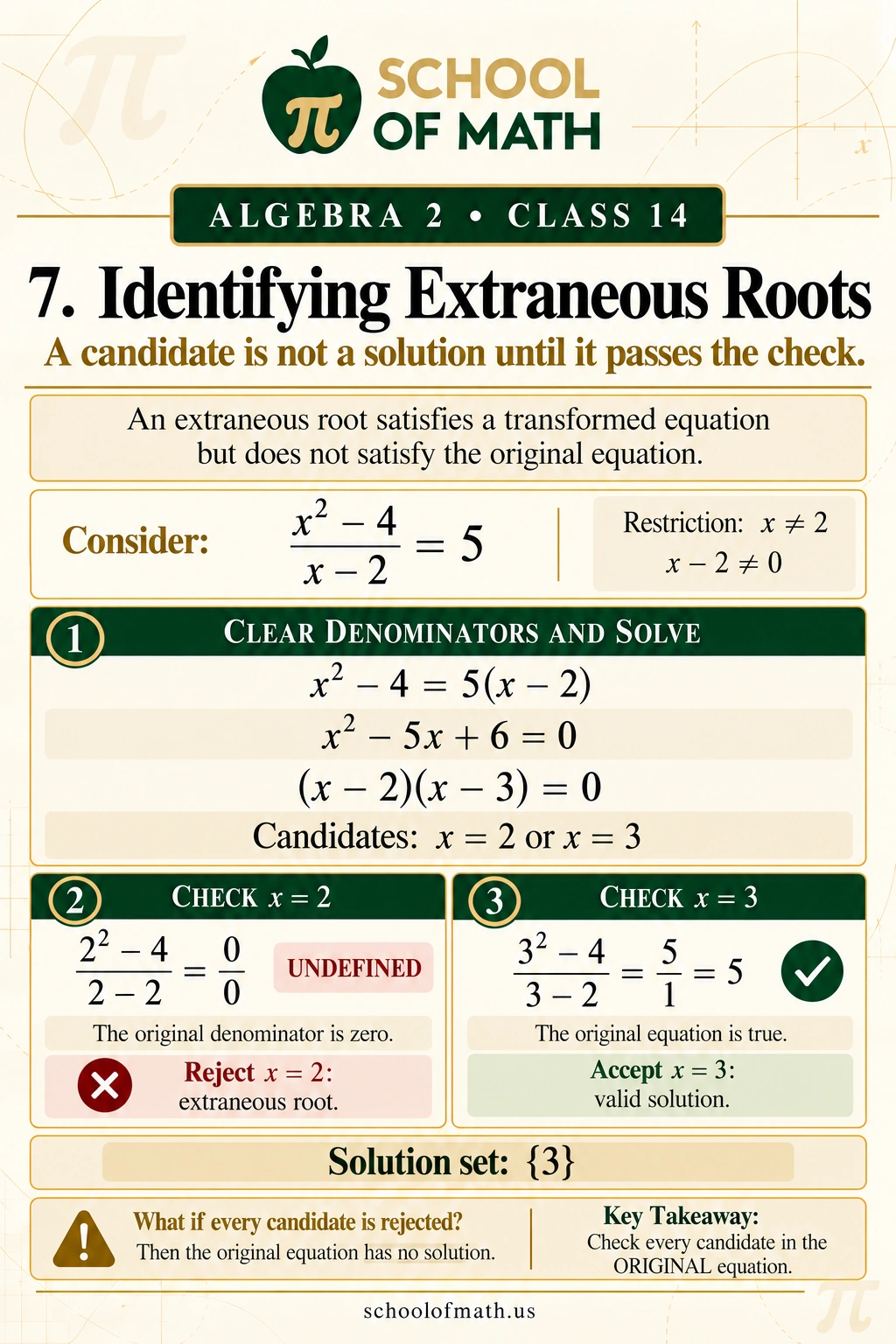
An extraneous root solves a transformed equation but not the original one. Clearing denominators can produce a candidate that makes an original denominator zero. Such a candidate is undefined, not a value that merely gives the wrong numerical result. Cross it out and state why. Rejecting every candidate means no solution, whereas an identity holds for every allowed input.
Try it yourself: five questions
Q31 Practice 1 of 5
Solve \(\frac{x^{2} - 9}{x - 3}=8\). State the restrictions and check every candidate.
Answer
Solution: \(x=5\). Extraneous: \(x=3\).
- Record restrictions from every original denominator: \(x\ne 3\).
- Factor the denominators and use LCD \(x - 3\). Multiply every term on both sides by this LCD.
- After clearing denominators: \(x^{2} - 9=8 x - 24\).
- Move all terms to one side: \(x^{2} - 8 x + 15=0\).
- Factor: \(\left(x - 5\right) \left(x - 3\right)=0\). Set each variable factor equal to zero.
- Candidate values: \(x=3\), \(x=5\).
- Reject \(x=3\): it makes an original denominator zero. This candidate is extraneous.
- Check \(x=5\) in the original equation: left = \(8\), right = \(8\). The denominators are nonzero, so accept it.
Q32 Practice 2 of 5
Solve \(\frac{x^{2} - 16}{x - 4}=8\). State the restrictions and check every candidate.
Answer
No real solution. Extraneous: \(x=4\).
- Record restrictions from every original denominator: \(x\ne 4\).
- Factor the denominators and use LCD \(x - 4\). Multiply every term on both sides by this LCD.
- After clearing denominators: \(x^{2} - 16=8 x - 32\).
- Move all terms to one side: \(x^{2} - 8 x + 16=0\).
- Factor: \(\left(x - 4\right)^{2}=0\). Set each variable factor equal to zero.
- Candidate value: \(x=4\).
- Reject \(x=4\): it makes an original denominator zero. This candidate is extraneous.
Q33 Practice 3 of 5
Solve \(\frac{x^{2} + x - 12}{x + 4}=2\). State the restrictions and check every candidate.
Answer
Solution: \(x=5\). Extraneous: \(x=-4\).
- Record restrictions from every original denominator: \(x\ne -4\).
- Factor the denominators and use LCD \(x + 4\). Multiply every term on both sides by this LCD.
- After clearing denominators: \(x^{2} + x - 12=2 x + 8\).
- Move all terms to one side: \(x^{2} - x - 20=0\).
- Factor: \(\left(x - 5\right) \left(x + 4\right)=0\). Set each variable factor equal to zero.
- Candidate values: \(x=-4\), \(x=5\).
- Reject \(x=-4\): it makes an original denominator zero. This candidate is extraneous.
- Check \(x=5\) in the original equation: left = \(2\), right = \(2\). The denominators are nonzero, so accept it.
Q34 Practice 4 of 5
Solve \(\frac{x^{2} - 1}{x - 1}=3 x - 1\). State the restrictions and check every candidate.
Answer
No real solution. Extraneous: \(x=1\).
- Record restrictions from every original denominator: \(x\ne 1\).
- Factor the denominators and use LCD \(x - 1\). Multiply every term on both sides by this LCD.
- After clearing denominators: \(x^{2} - 1=3 x^{2} - 4 x + 1\).
- Move all terms to one side: \(- 2 x^{2} + 4 x - 2=0\).
- Factor: \(- 2 \left(x - 1\right)^{2}=0\). Set each variable factor equal to zero.
- Candidate value: \(x=1\).
- Reject \(x=1\): it makes an original denominator zero. This candidate is extraneous.
Q35 Practice 5 of 5
Solve \(\frac{x^{2} - 25}{x^{2} - 3 x - 10}=2\). State the restrictions and check every candidate.
Answer
Solution: \(x=1\). Extraneous: \(x=5\).
- Record restrictions from every original denominator: \(x\ne -2\), \(x\ne 5\).
- Factor the denominators and use LCD \(\left(x - 5\right) \left(x + 2\right)\). Multiply every term on both sides by this LCD.
- After clearing denominators: \(x^{2} - 25=2 x^{2} - 6 x - 20\).
- Move all terms to one side: \(- x^{2} + 6 x - 5=0\).
- Factor: \(- \left(x - 5\right) \left(x - 1\right)=0\). Set each variable factor equal to zero.
- Candidate values: \(x=1\), \(x=5\).
- Check \(x=1\) in the original equation: left = \(2\), right = \(2\). The denominators are nonzero, so accept it.
- Reject \(x=5\): it makes an original denominator zero. This candidate is extraneous.
Rational equations in word problems
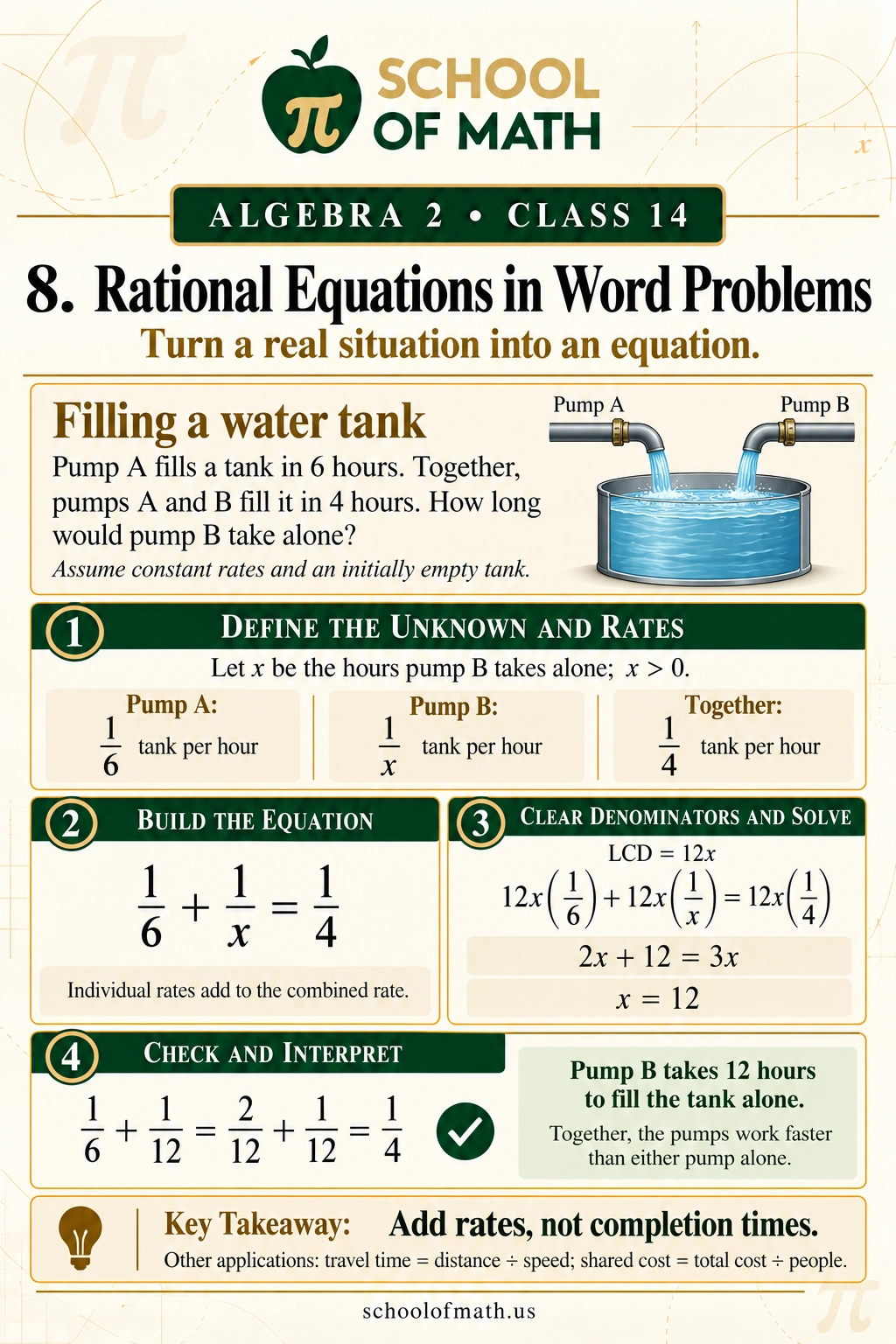
Define the unknown and its units before writing an equation. A machine completing one job in t hours works at 1/t jobs per hour. Add work rates, not completion times. Travel time is distance divided by speed, and an equal share is total cost divided by the number of people. Check both the original denominators and the story: times and speeds must be positive, and a number of people must be a positive integer. The models here assume constant rates.
Try it yourself: five questions
Q36 Practice 1 of 5
Printer A produces one batch in 8 minutes. Two printers working together produce that batch in 3 minutes. How long would printer B take alone?
Answer
Printer B takes \(\frac{24}{5}\) minutes, or 4.8 minutes.
- Let x > 0 be B's time in minutes. Add their batch-per-minute rates. Model: \(\frac{1}{8}+\frac{1}{x}=\frac{1}{3}\).
- Record restrictions from every original denominator: \(x\ne 0\).
- Factor the denominators and use LCD \(24 x\). Multiply every term on both sides by this LCD.
- After clearing denominators: \(3 x + 24=8 x\).
- Move all terms to one side: \(24 - 5 x=0\).
- Isolate x in the resulting linear equation.
- Candidate value: \(x=\frac{24}{5}\).
- Check \(x=\frac{24}{5}\) in the original equation: left = \(\frac{1}{3}\), right = \(\frac{1}{3}\). The denominators are nonzero, so accept it.
- The positive time 24/5 is valid. Check: 1/8 + 5/24 = 1/3.
Q37 Practice 2 of 5
One machine completes a job in 10 hours and another in 15 hours. How long do they take together?
Answer
6 hours.
- Let x > 0 be the combined time. Model: \(\frac{1}{10}+\frac{1}{15}=\frac{1}{x}\).
- Record restrictions from every original denominator: \(x\ne 0\).
- Factor the denominators and use LCD \(30 x\). Multiply every term on both sides by this LCD.
- After clearing denominators: \(5 x=30\).
- Move all terms to one side: \(5 x - 30=0\).
- Isolate x in the resulting linear equation.
- Candidate value: \(x=6\).
- Check \(x=6\) in the original equation: left = \(\frac{1}{6}\), right = \(\frac{1}{6}\). The denominators are nonzero, so accept it.
- Their rate is 1/6 job per hour, so one job takes 6 hours.
Q38 Practice 3 of 5
A $180 coach fee is shared equally. If 3 more students join, each pays $5 less. How many students were in the original group?
Answer
9 students originally.
- Let x be the original positive integer number of students. Model: \(\frac{180}{x}-\frac{180}{x + 3}=5\).
- Record restrictions from every original denominator: \(x\ne -3\), \(x\ne 0\).
- Factor the denominators and use LCD \(x \left(x + 3\right)\). Multiply every term on both sides by this LCD.
- After clearing denominators: \(540=5 x^{2} + 15 x\).
- Move all terms to one side: \(- 5 x^{2} - 15 x + 540=0\).
- Factor: \(- 5 \left(x - 9\right) \left(x + 12\right)=0\). Set each variable factor equal to zero.
- Candidate values: \(x=-12\), \(x=9\).
- Check \(x=-12\) in the original equation: left = \(5\), right = \(5\). The denominators are nonzero, so accept it.
- Check \(x=9\) in the original equation: left = \(5\), right = \(5\). The denominators are nonzero, so accept it.
- Reject −12 people. At x = 9, the shares are $20 and $15, a $5 decrease.
Q39 Practice 4 of 5
A cyclist travels 60 km at a steady speed. Increasing that speed by 5 km/h would reduce the time by 1 hour. Find the original speed.
Answer
15 km/h.
- Let x > 0 be the original speed in km/h. Model: \(\frac{60}{x}-\frac{60}{x + 5}=1\).
- Record restrictions from every original denominator: \(x\ne -5\), \(x\ne 0\).
- Factor the denominators and use LCD \(x \left(x + 5\right)\). Multiply every term on both sides by this LCD.
- After clearing denominators: \(300=x^{2} + 5 x\).
- Move all terms to one side: \(- x^{2} - 5 x + 300=0\).
- Factor: \(- \left(x - 15\right) \left(x + 20\right)=0\). Set each variable factor equal to zero.
- Candidate values: \(x=-20\), \(x=15\).
- Check \(x=-20\) in the original equation: left = \(1\), right = \(1\). The denominators are nonzero, so accept it.
- Check \(x=15\) in the original equation: left = \(1\), right = \(1\). The denominators are nonzero, so accept it.
- Reject −20 km/h. At 15 km/h the trip takes 4 hours; at 20 km/h it takes 3 hours.
Q40 Practice 5 of 5
A slower pump takes 3 hours longer than a faster pump to fill a tank. Together they fill it in 2 hours. Find each pump's time alone.
Answer
Faster pump: 3 hours. Slower pump: 6 hours.
- Let x > 0 be the faster time, so the slower time is x + 3. Model: \(\frac{1}{x}+\frac{1}{x + 3}=\frac{1}{2}\).
- Record restrictions from every original denominator: \(x\ne -3\), \(x\ne 0\).
- Factor the denominators and use LCD \(2 x \left(x + 3\right)\). Multiply every term on both sides by this LCD.
- After clearing denominators: \(4 x + 6=x^{2} + 3 x\).
- Move all terms to one side: \(- x^{2} + x + 6=0\).
- Factor: \(- \left(x - 3\right) \left(x + 2\right)=0\). Set each variable factor equal to zero.
- Candidate values: \(x=-2\), \(x=3\).
- Check \(x=-2\) in the original equation: left = \(\frac{1}{2}\), right = \(\frac{1}{2}\). The denominators are nonzero, so accept it.
- Check \(x=3\) in the original equation: left = \(\frac{1}{2}\), right = \(\frac{1}{2}\). The denominators are nonzero, so accept it.
- Reject x = −2 hours. With x = 3, 1/3 + 1/6 = 1/2 tank per hour.
Proportions and cross-multiplication
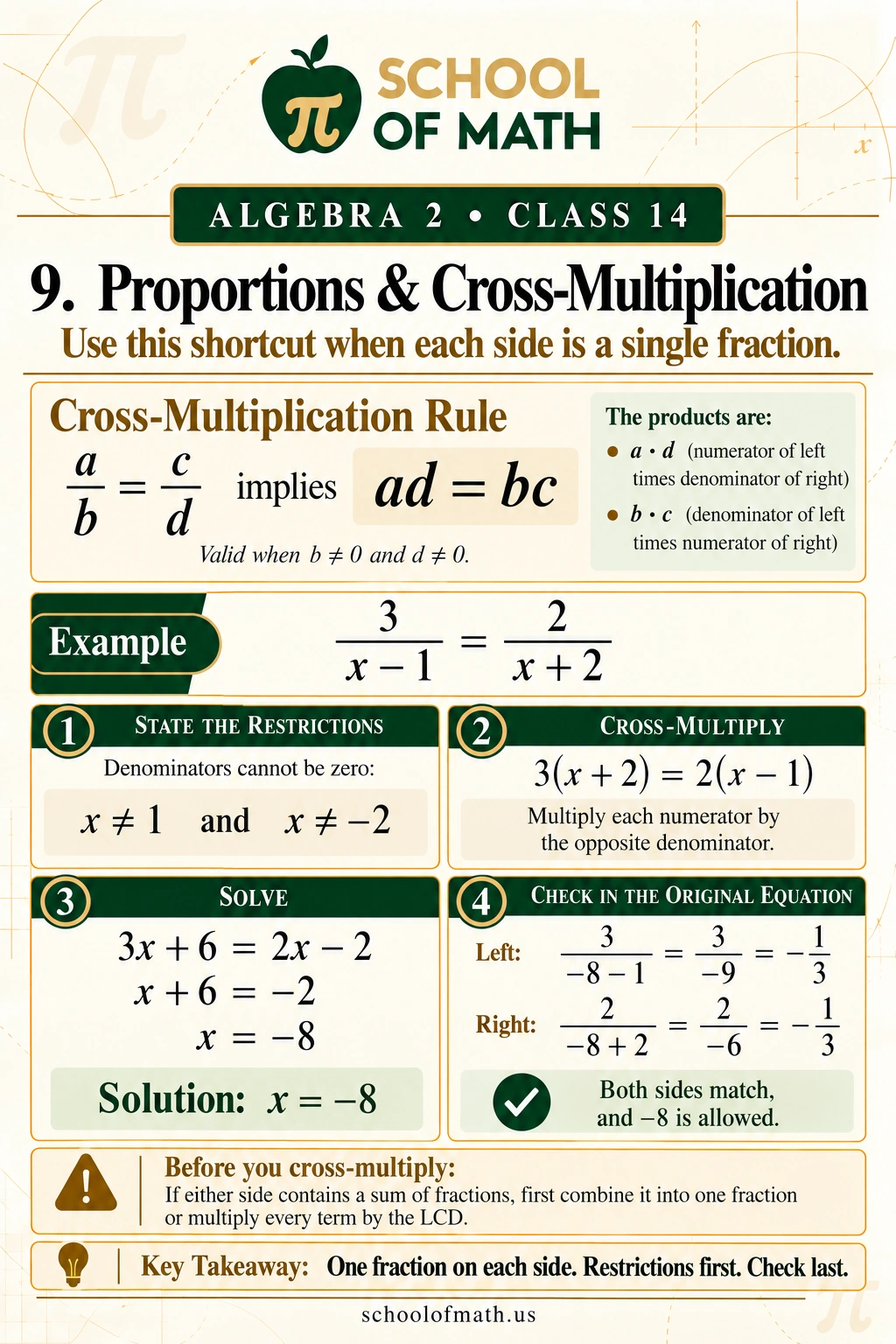
When each side is one fraction, a/b = c/d becomes ad = bc on the domain b ≠ 0 and d ≠ 0. This is clearing denominators written as a shortcut. Do not cross-multiply across an uncombined sum of fractions. Keep numerator expressions in parentheses while multiplying, then expand, solve, and check all candidates.
Try it yourself: five questions
Q41 Practice 1 of 5
Solve \(\frac{4}{x}=\frac{2}{7}\). State the restrictions and check every candidate.
Answer
Solution: \(x=14\).
- Record restrictions from every original denominator: \(x\ne 0\).
- Factor the denominators and use LCD \(7 x\). Multiply every term on both sides by this LCD.
- After clearing denominators: \(28=2 x\).
- Move all terms to one side: \(28 - 2 x=0\).
- Isolate x in the resulting linear equation.
- Candidate value: \(x=14\).
- Check \(x=14\) in the original equation: left = \(\frac{2}{7}\), right = \(\frac{2}{7}\). The denominators are nonzero, so accept it.
Q42 Practice 2 of 5
Solve \(\frac{5}{x - 2}=\frac{3}{x + 4}\). State the restrictions and check every candidate.
Answer
Solution: \(x=-13\).
- Record restrictions from every original denominator: \(x\ne -4\), \(x\ne 2\).
- Factor the denominators and use LCD \(\left(x - 2\right) \left(x + 4\right)\). Multiply every term on both sides by this LCD.
- After clearing denominators: \(5 x + 20=3 x - 6\).
- Move all terms to one side: \(2 x + 26=0\).
- Isolate x in the resulting linear equation.
- Candidate value: \(x=-13\).
- Check \(x=-13\) in the original equation: left = \(- \frac{1}{3}\), right = \(- \frac{1}{3}\). The denominators are nonzero, so accept it.
Q43 Practice 3 of 5
Solve \(\frac{x + 2}{5}=\frac{x - 1}{3}\). State the restrictions and check every candidate.
Answer
Solution: \(x=\frac{11}{2}\).
- Record restrictions from every original denominator: no real exclusions.
- Factor the denominators and use LCD \(15\). Multiply every term on both sides by this LCD.
- After clearing denominators: \(3 x + 6=5 x - 5\).
- Move all terms to one side: \(11 - 2 x=0\).
- Isolate x in the resulting linear equation.
- Candidate value: \(x=\frac{11}{2}\).
- Check \(x=\frac{11}{2}\) in the original equation: left = \(\frac{3}{2}\), right = \(\frac{3}{2}\). The denominators are nonzero, so accept it.
Q44 Practice 4 of 5
Solve \(\frac{x + 1}{x - 2}=\frac{x + 5}{x + 2}\). State the restrictions and check every candidate.
Answer
No solution.
- Record restrictions from every original denominator: \(x\ne -2\), \(x\ne 2\).
- Factor the denominators and use LCD \(\left(x - 2\right) \left(x + 2\right)\). Multiply every term on both sides by this LCD.
- After clearing denominators: \(x^{2} + 3 x + 2=x^{2} + 3 x - 10\).
- Rearranging gives \(12=0\), a false statement. No allowed value can satisfy the original equation.
Q45 Practice 5 of 5
Solve \(\frac{x}{x - 1}=\frac{6}{x + 1}\). State the restrictions and check every candidate.
Answer
Solutions: \(x=2\), \(x=3\).
- Record restrictions from every original denominator: \(x\ne -1\), \(x\ne 1\).
- Factor the denominators and use LCD \(\left(x - 1\right) \left(x + 1\right)\). Multiply every term on both sides by this LCD.
- After clearing denominators: \(x^{2} + x=6 x - 6\).
- Move all terms to one side: \(x^{2} - 5 x + 6=0\).
- Factor: \(\left(x - 3\right) \left(x - 2\right)=0\). Set each variable factor equal to zero.
- Candidate values: \(x=2\), \(x=3\).
- Check \(x=2\) in the original equation: left = \(2\), right = \(2\). The denominators are nonzero, so accept it.
- Check \(x=3\) in the original equation: left = \(\frac{3}{2}\), right = \(\frac{3}{2}\). The denominators are nonzero, so accept it.
Infinitely many solutions and no solution
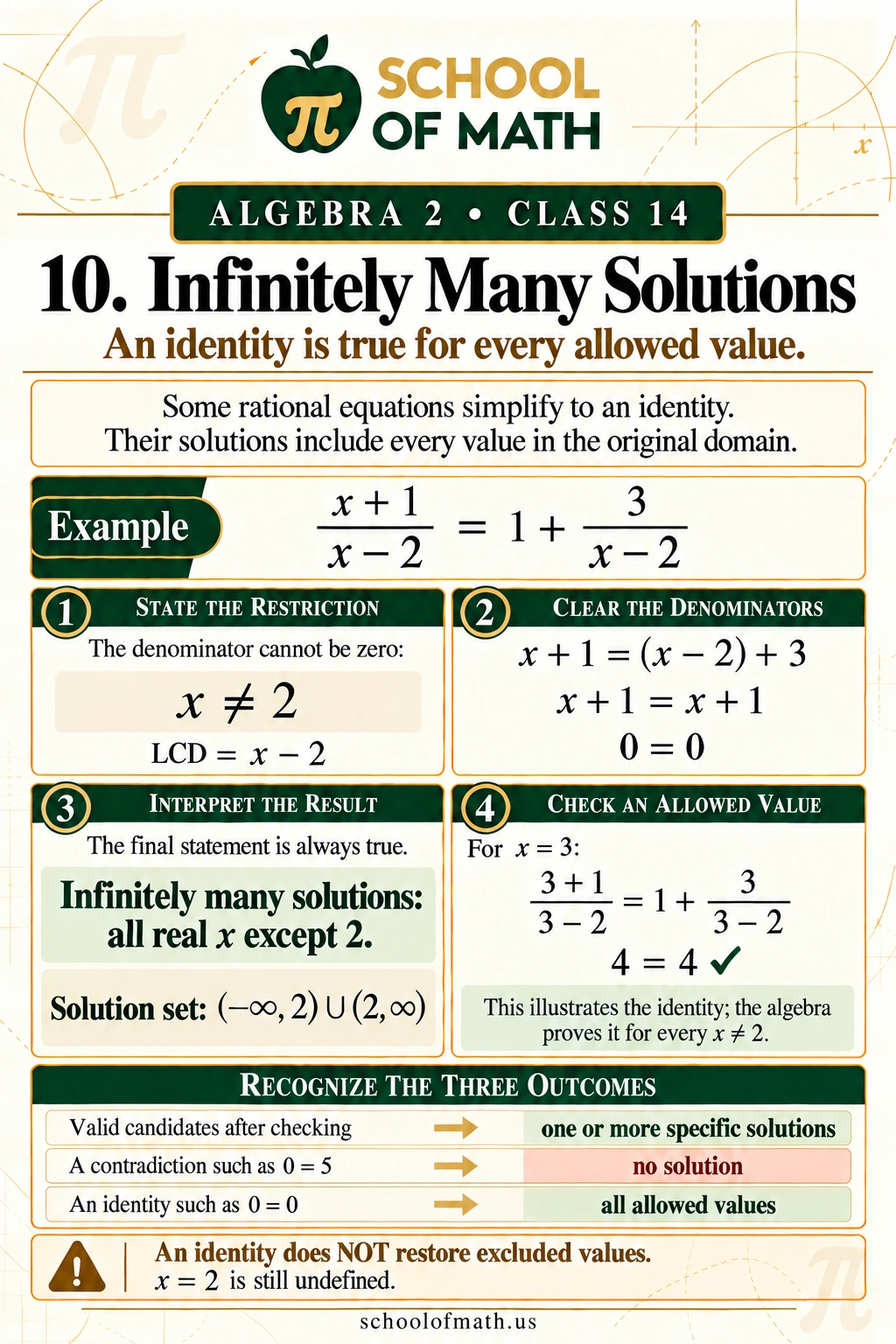
If clearing denominators leads to a true identity such as 0 = 0, every value in the original domain is a solution. Do not restore excluded inputs. A contradiction such as 0 = 4 means no solution. These conclusions differ from a finite list of checked roots. Testing one allowed input can illustrate an identity, but algebra is needed to establish it for every allowed input.
Try it yourself: five questions
Q46 Practice 1 of 5
Solve \(\frac{x + 4}{x + 1}=1+\frac{3}{x + 1}\). State the restrictions and check every candidate.
Answer
Infinitely many solutions: all real numbers except -1.
- Record restrictions from every original denominator: \(x\ne -1\).
- Factor the denominators and use LCD \(x + 1\). Multiply every term on both sides by this LCD.
- After clearing denominators: \(x + 4=x + 4\).
- Subtract one side from the other: \(0=0\). This is an identity, not the equation x = 0.
- It holds for every value in the original domain. The excluded values remain excluded.
Q47 Practice 2 of 5
Solve \(\frac{2 x - 6}{x - 3}=2\). State the restrictions and check every candidate.
Answer
Infinitely many solutions: all real numbers except 3.
- Record restrictions from every original denominator: \(x\ne 3\).
- Factor the denominators and use LCD \(x - 3\). Multiply every term on both sides by this LCD.
- After clearing denominators: \(2 x - 6=2 x - 6\).
- Subtract one side from the other: \(0=0\). This is an identity, not the equation x = 0.
- It holds for every value in the original domain. The excluded values remain excluded.
Q48 Practice 3 of 5
Solve \(\frac{x + 5}{x - 2}=1+\frac{6}{x - 2}\). State the restrictions and check every candidate.
Answer
No solution.
- Record restrictions from every original denominator: \(x\ne 2\).
- Factor the denominators and use LCD \(x - 2\). Multiply every term on both sides by this LCD.
- After clearing denominators: \(x + 5=x + 4\).
- Rearranging gives \(1=0\), a false statement. No allowed value can satisfy the original equation.
Q49 Practice 4 of 5
Solve \(\frac{x^{2} - 9}{x - 3}=x + 3\). State the restrictions and check every candidate.
Answer
Infinitely many solutions: all real numbers except 3.
- Record restrictions from every original denominator: \(x\ne 3\).
- Factor the denominators and use LCD \(x - 3\). Multiply every term on both sides by this LCD.
- After clearing denominators: \(x^{2} - 9=x^{2} - 9\).
- Subtract one side from the other: \(0=0\). This is an identity, not the equation x = 0.
- It holds for every value in the original domain. The excluded values remain excluded.
Q50 Practice 5 of 5
Solve \(\frac{1}{x - 1}-\frac{1}{x + 1}=\frac{2}{x^{2} - 1}\). State the restrictions and check every candidate.
Answer
Infinitely many solutions: all real numbers except -1, 1.
- Record restrictions from every original denominator: \(x\ne -1\), \(x\ne 1\).
- Factor the denominators and use LCD \(\left(x - 1\right) \left(x + 1\right)\). Multiply every term on both sides by this LCD.
- After clearing denominators: \(2=2\).
- Subtract one side from the other: \(0=0\). This is an identity, not the equation x = 0.
- It holds for every value in the original domain. The excluded values remain excluded.
Homework review
Review the ten lesson topics in order, with one question per image. Practice restrictions, LCDs, solving, checking, word models, proportions, and identities. Try each question before opening its answer.
R1 Homework 1 of 10
Solve \(\frac{15}{x + 2}=3\). State the restrictions and check every candidate.
Answer
Solution: \(x=3\).
- Record restrictions from every original denominator: \(x\ne -2\).
- Factor the denominators and use LCD \(x + 2\). Multiply every term on both sides by this LCD.
- After clearing denominators: \(15=3 x + 6\).
- Move all terms to one side: \(9 - 3 x=0\).
- Isolate x in the resulting linear equation.
- Candidate value: \(x=3\).
- Check \(x=3\) in the original equation: left = \(3\), right = \(3\). The denominators are nonzero, so accept it.
R2 Homework 2 of 10
List every restriction in \(\frac{1}{x^2-2x-15}=\frac{4}{x^2-9}\). Do not solve.
Answer
Restrictions: \(x\ne -3\), \(x\ne 3\), \(x\ne 5\).
- Factor the original denominators: \(x^{2} - 2 x - 15=\left(x - 5\right) \left(x + 3\right)\), \(x^{2} - 9=\left(x - 3\right) \left(x + 3\right)\).
- Set every variable factor equal to zero to find the forbidden inputs.
- Exclude \(-3\), \(3\), \(5\). Cancellation never restores an input missing from the original domain.
R3 Homework 3 of 10
Find the least common denominator for \(4 x \left(x - 2\right)\), \(6 x^{2} \left(x - 2\right)^{2}\). State the excluded values.
Answer
LCD: \(12 x^{2} \left(x - 2\right)^{2}\). Restrictions: \(x\ne 0\), \(x\ne 2\).
- Factor each denominator: \(4 x \left(x - 2\right)\), \(6 x^{2} \left(x - 2\right)^{2}\).
- Take the least common multiple of numerical factors. Include each variable factor at its highest required power.
- The result is \(12 x^{2} \left(x - 2\right)^{2}\). Each original denominator divides this polynomial exactly.
R4 Homework 4 of 10
Solve \(\frac{2}{x}+\frac{1}{4}=\frac{5}{x}\). State the restrictions and check every candidate.
Answer
Solution: \(x=12\).
- Record restrictions from every original denominator: \(x\ne 0\).
- Factor the denominators and use LCD \(4 x\). Multiply every term on both sides by this LCD.
- After clearing denominators: \(x + 8=20\).
- Move all terms to one side: \(x - 12=0\).
- Isolate x in the resulting linear equation.
- Candidate value: \(x=12\).
- Check \(x=12\) in the original equation: left = \(\frac{5}{12}\), right = \(\frac{5}{12}\). The denominators are nonzero, so accept it.
R5 Homework 5 of 10
Solve \(\frac{4}{x - 5}=\frac{3}{x + 1}\). State the restrictions and check every candidate.
Answer
Solution: \(x=-19\).
- Record restrictions from every original denominator: \(x\ne -1\), \(x\ne 5\).
- Factor the denominators and use LCD \(\left(x - 5\right) \left(x + 1\right)\). Multiply every term on both sides by this LCD.
- After clearing denominators: \(4 x + 4=3 x - 15\).
- Move all terms to one side: \(x + 19=0\).
- Isolate x in the resulting linear equation.
- Candidate value: \(x=-19\).
- Check \(x=-19\) in the original equation: left = \(- \frac{1}{6}\), right = \(- \frac{1}{6}\). The denominators are nonzero, so accept it.
R6 Homework 6 of 10
Solve \(x+\frac{24}{x}=10\). State the restrictions and check every candidate.
Answer
Solutions: \(x=4\), \(x=6\).
- Record restrictions from every original denominator: \(x\ne 0\).
- Factor the denominators and use LCD \(x\). Multiply every term on both sides by this LCD.
- After clearing denominators: \(x^{2} + 24=10 x\).
- Move all terms to one side: \(x^{2} - 10 x + 24=0\).
- Factor: \(\left(x - 6\right) \left(x - 4\right)=0\). Set each variable factor equal to zero.
- Candidate values: \(x=4\), \(x=6\).
- Check \(x=4\) in the original equation: left = \(10\), right = \(10\). The denominators are nonzero, so accept it.
- Check \(x=6\) in the original equation: left = \(10\), right = \(10\). The denominators are nonzero, so accept it.
R7 Homework 7 of 10
Solve \(\frac{x^{2} - 36}{x - 6}=10\). State the restrictions and check every candidate.
Answer
Solution: \(x=4\). Extraneous: \(x=6\).
- Record restrictions from every original denominator: \(x\ne 6\).
- Factor the denominators and use LCD \(x - 6\). Multiply every term on both sides by this LCD.
- After clearing denominators: \(x^{2} - 36=10 x - 60\).
- Move all terms to one side: \(x^{2} - 10 x + 24=0\).
- Factor: \(\left(x - 6\right) \left(x - 4\right)=0\). Set each variable factor equal to zero.
- Candidate values: \(x=4\), \(x=6\).
- Check \(x=4\) in the original equation: left = \(10\), right = \(10\). The denominators are nonzero, so accept it.
- Reject \(x=6\): it makes an original denominator zero. This candidate is extraneous.
R8 Homework 8 of 10
One machine completes a batch in 12 minutes. Together with a second machine it completes a batch in 5 minutes. Find the second machine's time alone.
Answer
\(\frac{60}{7}\) minutes.
- Let x > 0 be the second machine's time in minutes. Model: \(\frac{1}{12}+\frac{1}{x}=\frac{1}{5}\).
- Record restrictions from every original denominator: \(x\ne 0\).
- Factor the denominators and use LCD \(60 x\). Multiply every term on both sides by this LCD.
- After clearing denominators: \(5 x + 60=12 x\).
- Move all terms to one side: \(60 - 7 x=0\).
- Isolate x in the resulting linear equation.
- Candidate value: \(x=\frac{60}{7}\).
- Check \(x=\frac{60}{7}\) in the original equation: left = \(\frac{1}{5}\), right = \(\frac{1}{5}\). The denominators are nonzero, so accept it.
- Check: 1/12 + 7/60 = 1/5. The positive time is about 8.57 minutes.
R9 Homework 9 of 10
Solve \(\frac{x + 2}{x - 1}=\frac{x + 6}{x + 1}\). State the restrictions and check every candidate.
Answer
Solution: \(x=4\).
- Record restrictions from every original denominator: \(x\ne -1\), \(x\ne 1\).
- Factor the denominators and use LCD \(\left(x - 1\right) \left(x + 1\right)\). Multiply every term on both sides by this LCD.
- After clearing denominators: \(x^{2} + 3 x + 2=x^{2} + 5 x - 6\).
- Move all terms to one side: \(8 - 2 x=0\).
- Isolate x in the resulting linear equation.
- Candidate value: \(x=4\).
- Check \(x=4\) in the original equation: left = \(2\), right = \(2\). The denominators are nonzero, so accept it.
R10 Homework 10 of 10
Solve \(\frac{x + 7}{x + 2}=1+\frac{5}{x + 2}\). State the restrictions and check every candidate.
Answer
Infinitely many solutions: all real numbers except -2.
- Record restrictions from every original denominator: \(x\ne -2\).
- Factor the denominators and use LCD \(x + 2\). Multiply every term on both sides by this LCD.
- After clearing denominators: \(x + 7=x + 7\).
- Subtract one side from the other: \(0=0\). This is an identity, not the equation x = 0.
- It holds for every value in the original domain. The excluded values remain excluded.
Homework word problems
These ten problems build from shared costs and simple rates to extraneous roots, travel, combined work, and a quadratic requiring the quadratic formula. With the ten review questions, they complete your 20-question homework. Define the unknown, solve, check, and interpret every result.
W1 Homework 1 of 10
A group shares a $96 museum fee equally. Each person pays $12. How many people are in the group?
Answer
8 people.
- Let x be the positive integer group size. Model: \(\frac{96}{x}=12\).
- Record restrictions from every original denominator: \(x\ne 0\).
- Factor the denominators and use LCD \(x\). Multiply every term on both sides by this LCD.
- After clearing denominators: \(96=12 x\).
- Move all terms to one side: \(96 - 12 x=0\).
- Isolate x in the resulting linear equation.
- Candidate value: \(x=8\).
- Check \(x=8\) in the original equation: left = \(12\), right = \(12\). The denominators are nonzero, so accept it.
- At x = 8, 96/8 = 12 dollars each.
W2 Homework 2 of 10
A hiker covers 18 miles at a constant speed and takes 6 hours. What is the hiking speed?
Answer
3 miles per hour.
- Let x > 0 be the speed in miles per hour. Time = distance ÷ speed. Model: \(\frac{18}{x}=6\).
- Record restrictions from every original denominator: \(x\ne 0\).
- Factor the denominators and use LCD \(x\). Multiply every term on both sides by this LCD.
- After clearing denominators: \(18=6 x\).
- Move all terms to one side: \(18 - 6 x=0\).
- Isolate x in the resulting linear equation.
- Candidate value: \(x=3\).
- Check \(x=3\) in the original equation: left = \(6\), right = \(6\). The denominators are nonzero, so accept it.
- Check: 18/3 = 6 hours.
W3 Homework 3 of 10
A club's $150 transport cost is shared equally. Each student also pays a $5 ticket fee, for a total of $20 each. How many students are attending?
Answer
10 students.
- Let x be the positive integer number of students. Model: \(\frac{150}{x}+5=20\).
- Record restrictions from every original denominator: \(x\ne 0\).
- Factor the denominators and use LCD \(x\). Multiply every term on both sides by this LCD.
- After clearing denominators: \(5 x + 150=20 x\).
- Move all terms to one side: \(150 - 15 x=0\).
- Isolate x in the resulting linear equation.
- Candidate value: \(x=10\).
- Check \(x=10\) in the original equation: left = \(20\), right = \(20\). The denominators are nonzero, so accept it.
- At x = 10, each transport share is $15; with the ticket, each total is $20.
W4 Homework 4 of 10
Pump A fills a tank in 9 hours. A second pump working with A reduces the filling time to 6 hours. How long does the second pump take alone?
Answer
18 hours.
- Let x > 0 be the second pump's time. Model: \(\frac{1}{9}+\frac{1}{x}=\frac{1}{6}\).
- Record restrictions from every original denominator: \(x\ne 0\).
- Factor the denominators and use LCD \(18 x\). Multiply every term on both sides by this LCD.
- After clearing denominators: \(2 x + 18=3 x\).
- Move all terms to one side: \(18 - x=0\).
- Isolate x in the resulting linear equation.
- Candidate value: \(x=18\).
- Check \(x=18\) in the original equation: left = \(\frac{1}{6}\), right = \(\frac{1}{6}\). The denominators are nonzero, so accept it.
- Check: 1/9 + 1/18 = 1/6 tank per hour.
W5 Homework 5 of 10
A workshop model defines usable material per panel as \(A(x)=\frac{x^2-16}{x-4}\), where x is a dimension in meters and x > 0. Which x makes A(x) = 10 meters? Identify any extraneous root from clearing the denominator.
Answer
x = 6 meters; x = 4 is extraneous.
- Use the stated model and keep its original restriction x ≠ 4. Model: \(\frac{x^{2} - 16}{x - 4}=10\).
- Record restrictions from every original denominator: \(x\ne 4\).
- Factor the denominators and use LCD \(x - 4\). Multiply every term on both sides by this LCD.
- After clearing denominators: \(x^{2} - 16=10 x - 40\).
- Move all terms to one side: \(x^{2} - 10 x + 24=0\).
- Factor: \(\left(x - 6\right) \left(x - 4\right)=0\). Set each variable factor equal to zero.
- Candidate values: \(x=4\), \(x=6\).
- Reject \(x=4\): it makes an original denominator zero. This candidate is extraneous.
- Check \(x=6\) in the original equation: left = \(10\), right = \(10\). The denominators are nonzero, so accept it.
- Although the simplified model is x + 4, x = 4 remains undefined in the original. At x = 6, 20/2 = 10.
W6 Homework 6 of 10
A coach costs $240 to hire. If 4 extra students join, each student's share decreases by $5. How many students were in the original group?
Answer
12 students originally.
- Let x be the original positive integer group size. Model: \(\frac{240}{x}-\frac{240}{x + 4}=5\).
- Record restrictions from every original denominator: \(x\ne -4\), \(x\ne 0\).
- Factor the denominators and use LCD \(x \left(x + 4\right)\). Multiply every term on both sides by this LCD.
- After clearing denominators: \(960=5 x^{2} + 20 x\).
- Move all terms to one side: \(- 5 x^{2} - 20 x + 960=0\).
- Factor: \(- 5 \left(x - 12\right) \left(x + 16\right)=0\). Set each variable factor equal to zero.
- Candidate values: \(x=-16\), \(x=12\).
- Check \(x=-16\) in the original equation: left = \(5\), right = \(5\). The denominators are nonzero, so accept it.
- Check \(x=12\) in the original equation: left = \(5\), right = \(5\). The denominators are nonzero, so accept it.
- Reject −16 students. The original share is $20 and the new share is $15.
W7 Homework 7 of 10
A train travels 120 km at a steady speed. At a speed 10 km/h faster, it would arrive 1 hour sooner. Find its original speed.
Answer
30 km/h.
- Let x > 0 be the original speed. Model: \(\frac{120}{x}-\frac{120}{x + 10}=1\).
- Record restrictions from every original denominator: \(x\ne -10\), \(x\ne 0\).
- Factor the denominators and use LCD \(x \left(x + 10\right)\). Multiply every term on both sides by this LCD.
- After clearing denominators: \(1200=x^{2} + 10 x\).
- Move all terms to one side: \(- x^{2} - 10 x + 1200=0\).
- Factor: \(- \left(x - 30\right) \left(x + 40\right)=0\). Set each variable factor equal to zero.
- Candidate values: \(x=-40\), \(x=30\).
- Check \(x=-40\) in the original equation: left = \(1\), right = \(1\). The denominators are nonzero, so accept it.
- Check \(x=30\) in the original equation: left = \(1\), right = \(1\). The denominators are nonzero, so accept it.
- Reject −40 km/h. The trip takes 4 hours at 30 km/h and 3 hours at 40 km/h.
W8 Homework 8 of 10
One machine needs 5 hours longer than another to complete a job. Together they finish in 6 hours. How long does each take alone?
Answer
Faster machine: 10 hours. Slower machine: 15 hours.
- Let x > 0 be the faster machine's time. Model: \(\frac{1}{x}+\frac{1}{x + 5}=\frac{1}{6}\).
- Record restrictions from every original denominator: \(x\ne -5\), \(x\ne 0\).
- Factor the denominators and use LCD \(6 x \left(x + 5\right)\). Multiply every term on both sides by this LCD.
- After clearing denominators: \(12 x + 30=x^{2} + 5 x\).
- Move all terms to one side: \(- x^{2} + 7 x + 30=0\).
- Factor: \(- \left(x - 10\right) \left(x + 3\right)=0\). Set each variable factor equal to zero.
- Candidate values: \(x=-3\), \(x=10\).
- Check \(x=-3\) in the original equation: left = \(\frac{1}{6}\), right = \(\frac{1}{6}\). The denominators are nonzero, so accept it.
- Check \(x=10\) in the original equation: left = \(\frac{1}{6}\), right = \(\frac{1}{6}\). The denominators are nonzero, so accept it.
- Reject −3 hours. With times 10 and 15, the combined rate is 1/10 + 1/15 = 1/6.
W9 Homework 9 of 10
A boat travels 24 km downstream and 24 km upstream in 5 hours total. The current is 2 km/h. Find the boat's speed in still water, assuming constant speeds.
Answer
10 km/h in still water.
- Let x > 2 be the still-water speed. Downstream speed is x + 2 and upstream speed is x − 2. Model: \(\frac{24}{x + 2}+\frac{24}{x - 2}=5\).
- Record restrictions from every original denominator: \(x\ne -2\), \(x\ne 2\).
- Factor the denominators and use LCD \(\left(x - 2\right) \left(x + 2\right)\). Multiply every term on both sides by this LCD.
- After clearing denominators: \(48 x=5 x^{2} - 20\).
- Move all terms to one side: \(- 5 x^{2} + 48 x + 20=0\).
- Factor: \(- \left(x - 10\right) \left(5 x + 2\right)=0\). Set each variable factor equal to zero.
- Candidate values: \(x=- \frac{2}{5}\), \(x=10\).
- Check \(x=- \frac{2}{5}\) in the original equation: left = \(5\), right = \(5\). The denominators are nonzero, so accept it.
- Check \(x=10\) in the original equation: left = \(5\), right = \(5\). The denominators are nonzero, so accept it.
- The algebraic roots are −2/5 and 10. Reject −2/5 because x must exceed 2. Check: 24/12 + 24/8 = 2 + 3 = 5 hours.
W10 Homework 10 of 10
Two pumps fill a tank together in 6 hours. Working alone, the slower pump takes 7 hours longer than the faster pump. Find both individual times.
Answer
Faster pump: \(\frac{5+\sqrt{193}}{2}\) hours (about 9.45). Slower pump: \(\frac{19+\sqrt{193}}{2}\) hours (about 16.45).
- Let x > 0 be the faster time. The slower time is x + 7. Model: \(\frac{1}{x}+\frac{1}{x + 7}=\frac{1}{6}\).
- Record restrictions from every original denominator: \(x\ne -7\), \(x\ne 0\).
- Factor the denominators and use LCD \(6 x \left(x + 7\right)\). Multiply every term on both sides by this LCD.
- After clearing denominators: \(12 x + 42=x^{2} + 7 x\).
- Move all terms to one side: \(- x^{2} + 5 x + 42=0\).
- Use the quadratic formula \(x=\frac{-b\pm\sqrt{b^2-4ac}}{2a}\) with \(a=-1\), \(b=5\), \(c=42\).
- Candidate values: \(x=\frac{5}{2} - \frac{\sqrt{193}}{2}\), \(x=\frac{5}{2} + \frac{\sqrt{193}}{2}\).
- Check \(x=\frac{5}{2} - \frac{\sqrt{193}}{2}\) in the original equation: left = \(\frac{1}{6}\), right = \(\frac{1}{6}\). The denominators are nonzero, so accept it.
- Check \(x=\frac{5}{2} + \frac{\sqrt{193}}{2}\) in the original equation: left = \(\frac{1}{6}\), right = \(\frac{1}{6}\). The denominators are nonzero, so accept it.
- Reject the negative root (5 − √193)/2. Use the positive root and add 7 for the slower pump. Keep exact values when checking the combined rate.
Quick questions and answers
How do you solve a rational equation?
Record the original denominator restrictions, find the LCD, multiply every term by it, solve the resulting equation, and check each candidate in the original equation.
What is an extraneous root?
An extraneous root satisfies a transformed equation but not the original equation. In these exercises it usually makes an original denominator zero.
Do canceled factors still create restrictions?
Yes. Canceling a factor does not restore values that made an original denominator zero.
When can I cross-multiply?
Use cross-multiplication when each side is a single fraction and both denominators are nonzero. Otherwise combine fractions first or multiply every term by the LCD.
How can a rational equation have infinitely many solutions?
If it simplifies to an identity, it holds for every input in its original domain. Excluded values are still not solutions.
What is included in the Class 14 workbook?
Ten lesson images, 50 original practice questions, 10 homework review questions, and 10 homework word problems. The 25-page workbook has a cover and blank workspace without exercise answers; worked solutions are hidden online.