Young Fermats · Algebra II · Class 13 · Grades 7–10
Algebra 2 Class 13: Rational Expressions: Simplifying, Multiplying, and Dividing
To simplify rational expressions, factor first and cancel common factors, never individual terms. Keep every excluded value from the original expression. To divide, multiply by the reciprocal of the divisor and remember that the divisor cannot be zero.
Study the eight images in order, with theory and five original questions after each image. Then complete eight homework review questions and twelve word problems: 20 homework questions and 60 questions altogether. Each question has a compact blue Answer button with a worked explanation.
Continue from Class 12: polynomial zeros and factors, or review Class 11: factoring polynomials. For in-person Algebra 2 at SOMATH, book an evaluation or view the schedule.
Questions use different examples from the posters and build gradually within each section. Unless a context says otherwise, variables are real. In every simplification, keep the original exclusions. Story prices and measurements are fictional practice models.
Download the student workbook (PDF)22 pages · Each image on its own page, followed by five practice questions. Then eight homework review questions and twelve homework word problems.Blank answer space. No exercise answers, writing lines, name fields, or date fields.
Understanding rational expressions
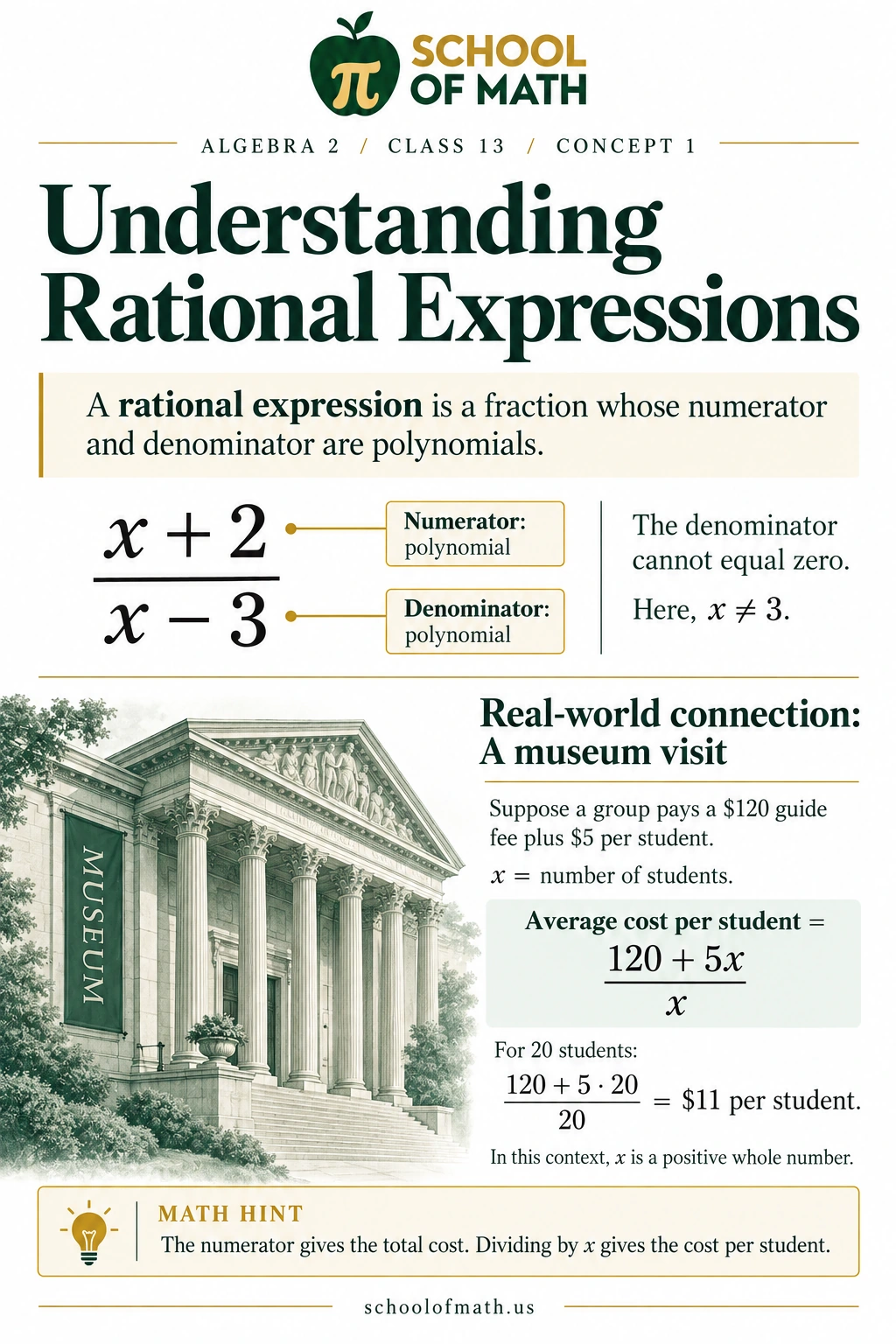
A rational expression is a quotient of two polynomials. The denominator polynomial must not be the zero polynomial, and any input that makes its value zero must be excluded. A numerator may be zero: zero divided by a nonzero number equals zero.
For \(\frac{2x+5}{x+4}\), the numerator is \(2x+5\) and the denominator is \(x+4\). The expression is undefined at \(x=-4\). At \(x=1\), it equals \(\frac{7}{5}\). Substitution is safe only after you check the denominator.
Simplifying rewrites an expression; solving an equation finds inputs that make a statement true. Here we simplify and evaluate expressions, not set every numerator equal to zero. In a word problem, state what the variable represents and include units; practical limits can be stronger than algebraic restrictions.
Try it yourself: five questions
Q1 Practice 1 of 5
In \(\frac{4x-1}{x+6}\), identify the numerator, denominator, and excluded value.
Answer
\(4x-1\); \(x+6\); \(x\ne-6\).
- The denominator vanishes when \(x+6=0\), so exclude \(-6\).
Q2 Practice 2 of 5
Evaluate \(\frac{2x+3}{x-4}\) at \(x=6\).
Answer
\(\frac{15}{2}\).
- Substitute: \(\frac{2(6)+3}{6-4}=\frac{15}{2}\). The denominator is 2, not zero.
Q3 Practice 3 of 5
Is \(\frac{x-7}{x+1}\) zero or undefined at \(x=7\)? Explain.
Answer
Zero.
- The numerator is 0 and the denominator is 8. \(0/8=0\) is defined.
Q4 Practice 4 of 5
Which is a rational expression: \(\frac{x^2+4}{x-6}\) or \(\frac{\sqrt{x}+4}{x-6}\)?
Answer
Only \(\frac{x^2+4}{x-6}\).
- A polynomial uses nonnegative integer exponents. \(\sqrt{x}=x^{1/2}\) is not a polynomial, so the second numerator does not qualify.
Q5 Practice 5 of 5
An art workshop costs $84 plus $6 per student. Write the average cost for \(x\) students and evaluate it for 12 students.
Answer
Average cost \(\frac{84+6x}{x}\) dollars; $13 per student for 12 students.
- Divide the total by the number of students: \((84+6\cdot12)/12=156/12=13\).
- Algebraically \(x\ne0\). In context, \(x\) is a positive whole number.
Finding excluded values
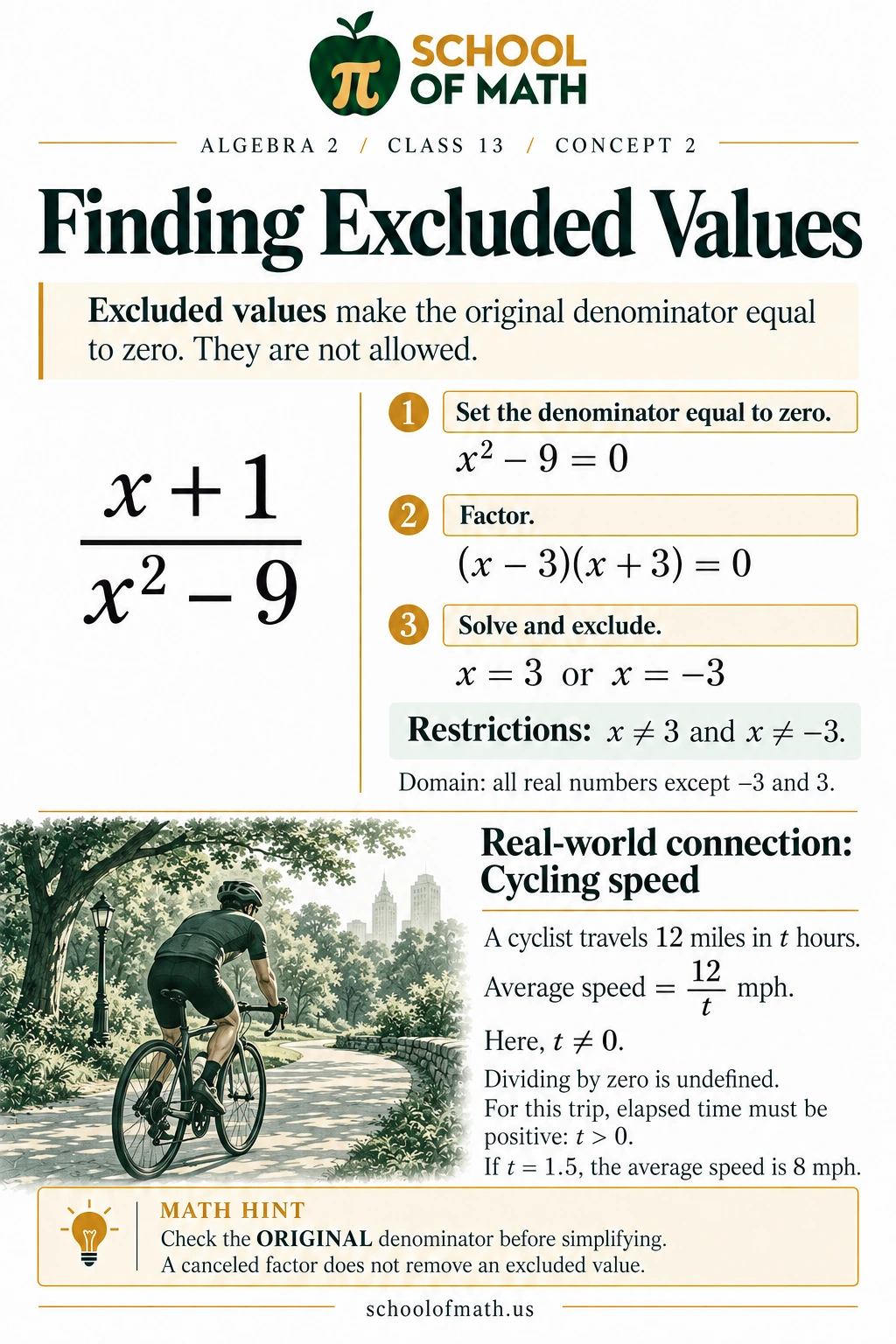
Excluded values come from the original expression, before cancellation. Set each original denominator equal to zero, factor it, solve, and record all resulting values. A fraction does not become valid at an excluded input just because its simplified form happens to be defined there.
For \(\frac{x+5}{x^2-16}\), factor the denominator as \((x-4)(x+4)\). Both \(4\) and \(-4\) are excluded. For \(\frac{x-4}{x^2-16}\), cancellation gives \(\frac1{x+4}\), but the restrictions are still \(x\ne-4,4\).
We use real-number domains in this class. When the variable represents people, elapsed time, or length, also impose the practical conditions: positive whole numbers for people, or positive measurements when appropriate.
Try it yourself: five questions
Q6 Practice 1 of 5
Find the excluded value of \(\frac7{x+4}\).
Answer
\(x\ne-4\).
- Solve \(x+4=0\).
Q7 Practice 2 of 5
Find all excluded values of \(\frac{x-1}{x(x-6)}\).
Answer
\(x\ne0,6\).
- The product is zero when \(x=0\) or \(x-6=0\).
Q8 Practice 3 of 5
Find the real domain of \(\frac{x+3}{x^2-49}\).
Answer
All real numbers except \(-7\) and \(7\).
- Factor \(x^2-49=(x-7)(x+7)\).
Q9 Practice 4 of 5
Find all excluded values of \(\frac{x-5}{x^2-5x+6}\).
Answer
\(x\ne2,3\).
- Factor \(x^2-5x+6=(x-2)(x-3)\).
Q10 Practice 5 of 5
Find every excluded value of \(\frac{x^2-4}{2x^2+2x-12}\). Does cancellation restore any value?
Answer
\(x\ne-3,2\). No.
- The original denominator is \(2(x+3)(x-2)\).
- Although the numerator contains \((x-2)\), cancellation does not allow \(x=2\) in the original expression.
Factoring before simplifying
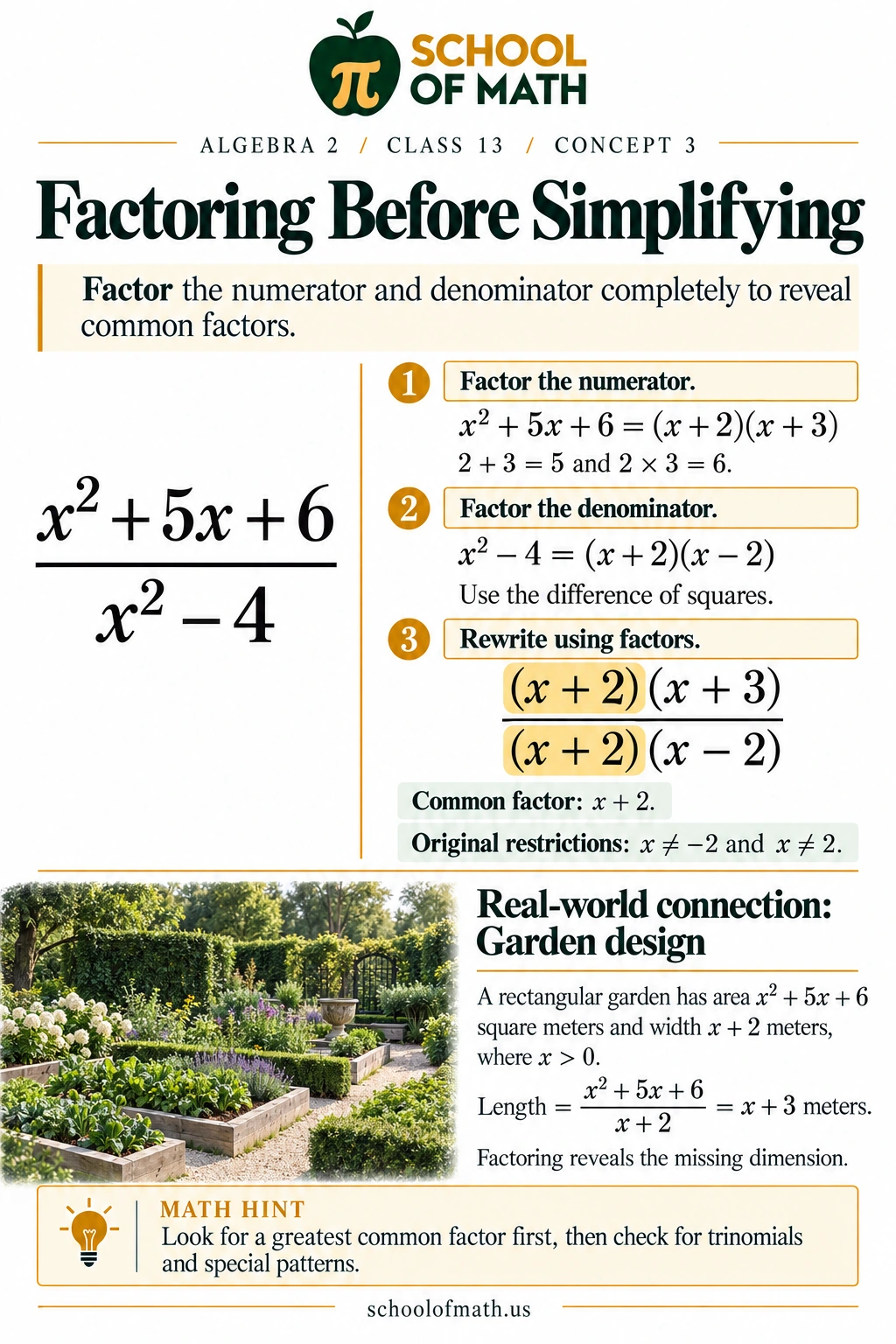
Cancellation works on factors, so turn sums into products first. Start with a greatest common factor, then check for differences of squares and factorable trinomials. A difference of squares follows \(a^2-b^2=(a-b)(a+b)\).
To factor \(x^2+7x+10\), find two numbers with product 10 and sum 7: 5 and 2. Thus it is \((x+5)(x+2)\). If the denominator is \(x^2-25=(x-5)(x+5)\), the common factor is the whole group \((x+5)\).
Record \(x\ne-5,5\) first, then cancel \((x+5)\) to get \(\frac{x+2}{x-5}\). The canceled factor represented multiplication by one only where it was nonzero. Expanding everything first usually hides this structure.
Try it yourself: five questions
Q11 Practice 1 of 5
Simplify and state every excluded value: \(\frac{6 x + 18}{3}\).
Answer
\(2 \left(x + 3\right)\); all real values of \(x\).
- Use the original denominators to find all real values of \(x\).
- Factor completely: \(\frac{6 \left(x + 3\right)}{3}\).
- Cancel matching nonzero factors from the numerator and denominator. The result is \(2 \left(x + 3\right)\). Keep all original exclusions, even when their factors disappear.
Q12 Practice 2 of 5
Simplify and state every excluded value: \(\frac{x^{2} - 36}{x + 6}\).
Answer
\(x - 6\); \(x\ne -6\).
- Use the original denominators to find \(x\ne -6\).
- Factor completely: \(\frac{\left(x - 6\right) \left(x + 6\right)}{x + 6}\).
- Cancel matching nonzero factors from the numerator and denominator. The result is \(x - 6\). Keep all original exclusions, even when their factors disappear.
Q13 Practice 3 of 5
Simplify and state every excluded value: \(\frac{x^{2} + 9 x + 20}{x + 5}\).
Answer
\(x + 4\); \(x\ne -5\).
- Use the original denominators to find \(x\ne -5\).
- Factor completely: \(\frac{\left(x + 4\right) \left(x + 5\right)}{x + 5}\).
- Cancel matching nonzero factors from the numerator and denominator. The result is \(x + 4\). Keep all original exclusions, even when their factors disappear.
Q14 Practice 4 of 5
Simplify and state every excluded value: \(\frac{x^{2} + 8 x + 15}{x^{2} - 9}\).
Answer
\(\frac{x + 5}{x - 3}\); \(x\ne -3, 3\).
- Use the original denominators to find \(x\ne -3, 3\).
- Factor completely: \(\frac{\left(x + 3\right) \left(x + 5\right)}{\left(x - 3\right) \left(x + 3\right)}\).
- Cancel matching nonzero factors from the numerator and denominator. The result is \(\frac{x + 5}{x - 3}\). Keep all original exclusions, even when their factors disappear.
Q15 Practice 5 of 5
Simplify and state every excluded value: \(\frac{2 x^{2} + 10 x + 12}{4 x^{2} - 16}\).
Answer
\(\frac{x + 3}{2 \left(x - 2\right)}\); \(x\ne -2, 2\).
- Use the original denominators to find \(x\ne -2, 2\).
- Factor completely: \(\frac{2 \left(x + 2\right) \left(x + 3\right)}{4 \left(x - 2\right) \left(x + 2\right)}\).
- Cancel matching nonzero factors from the numerator and denominator. The result is \(\frac{x + 3}{2 \left(x - 2\right)}\). Keep all original exclusions, even when their factors disappear.
Simplifying and keeping restrictions
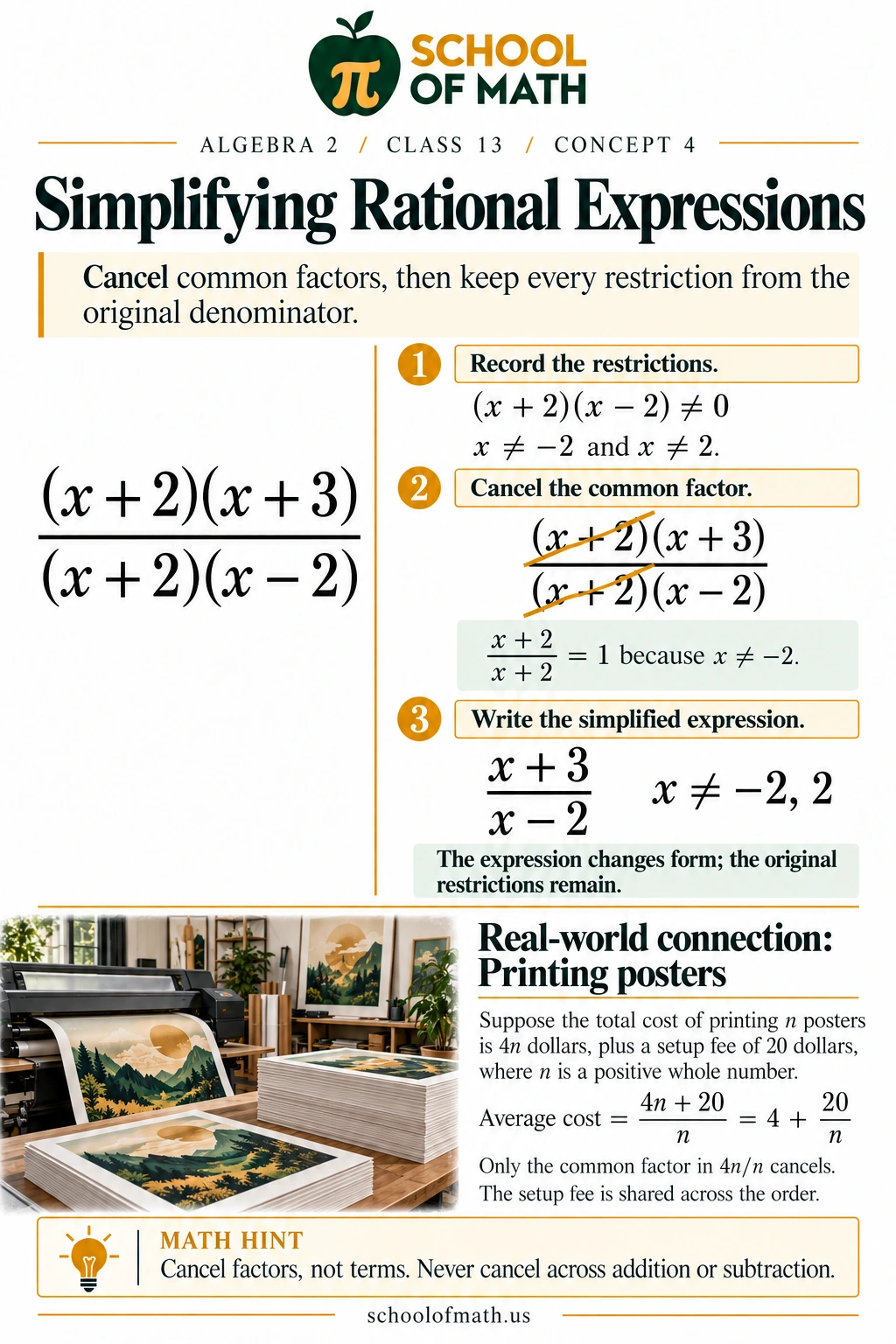
For nonzero \(B\) and \(C\), \(\frac{AC}{BC}=\frac AB\). Canceling \(C\) means dividing both the numerator and denominator by the same nonzero quantity. It does not mean erasing any symbol that appears in both places.
For \(\frac{(x-6)(x+2)}{(x-6)(x+7)}\), exclude \(x=6,-7\) before simplifying. The result is \(\frac{x+2}{x+7}\) on that original domain. Its simpler appearance does not make \(x=6\) valid.
Reduce numerical coefficients and variable powers as factors too. For \(\frac{12x^3}{18x^2}\), reduce \(12/18\) to \(2/3\) and \(x^3/x^2\) to \(x\). The result is \(2x/3\), with \(x\ne0\).
Try it yourself: five questions
Q16 Practice 1 of 5
Simplify and state every excluded value: \(\frac{10 x^{2}}{15 x}\).
Answer
\(\frac{2 x}{3}\); \(x\ne 0\).
- Use the original denominators to find \(x\ne 0\).
- Factor completely: \(\frac{10 x^{2}}{15 x}\).
- Cancel matching nonzero factors from the numerator and denominator. The result is \(\frac{2 x}{3}\). Keep all original exclusions, even when their factors disappear.
Q17 Practice 2 of 5
Simplify and state every excluded value: \(\frac{\left(x - 5\right) \left(x + 7\right)}{\left(x - 5\right) \left(x + 2\right)}\).
Answer
\(\frac{x + 7}{x + 2}\); \(x\ne -2, 5\).
- Use the original denominators to find \(x\ne -2, 5\).
- Factor completely: \(\frac{\left(x - 5\right) \left(x + 7\right)}{\left(x - 5\right) \left(x + 2\right)}\).
- Cancel matching nonzero factors from the numerator and denominator. The result is \(\frac{x + 7}{x + 2}\). Keep all original exclusions, even when their factors disappear.
Q18 Practice 3 of 5
Simplify and state every excluded value: \(\frac{x^{2} - 64}{x^{2} + 10 x + 16}\).
Answer
\(\frac{x - 8}{x + 2}\); \(x\ne -8, -2\).
- Use the original denominators to find \(x\ne -8, -2\).
- Factor completely: \(\frac{\left(x - 8\right) \left(x + 8\right)}{\left(x + 2\right) \left(x + 8\right)}\).
- Cancel matching nonzero factors from the numerator and denominator. The result is \(\frac{x - 8}{x + 2}\). Keep all original exclusions, even when their factors disappear.
Q19 Practice 4 of 5
Simplify and state every excluded value: \(\frac{x^{2} - 10 x + 25}{x^{2} - 25}\).
Answer
\(\frac{x - 5}{x + 5}\); \(x\ne -5, 5\).
- Use the original denominators to find \(x\ne -5, 5\).
- Factor completely: \(\frac{\left(x - 5\right)^{2}}{\left(x - 5\right) \left(x + 5\right)}\).
- Cancel matching nonzero factors from the numerator and denominator. The result is \(\frac{x - 5}{x + 5}\). Keep all original exclusions, even when their factors disappear.
Q20 Practice 5 of 5
Simplify and state every excluded value: \(\frac{3 x^{2} - 12 x}{x^{2} - 8 x + 16}\).
Answer
\(\frac{3 x}{x - 4}\); \(x\ne 4\).
- Use the original denominators to find \(x\ne 4\).
- Factor completely: \(\frac{3 x \left(x - 4\right)}{\left(x - 4\right)^{2}}\).
- Cancel matching nonzero factors from the numerator and denominator. The result is \(\frac{3 x}{x - 4}\). Keep all original exclusions, even when their factors disappear.
Avoiding cancellation mistakes
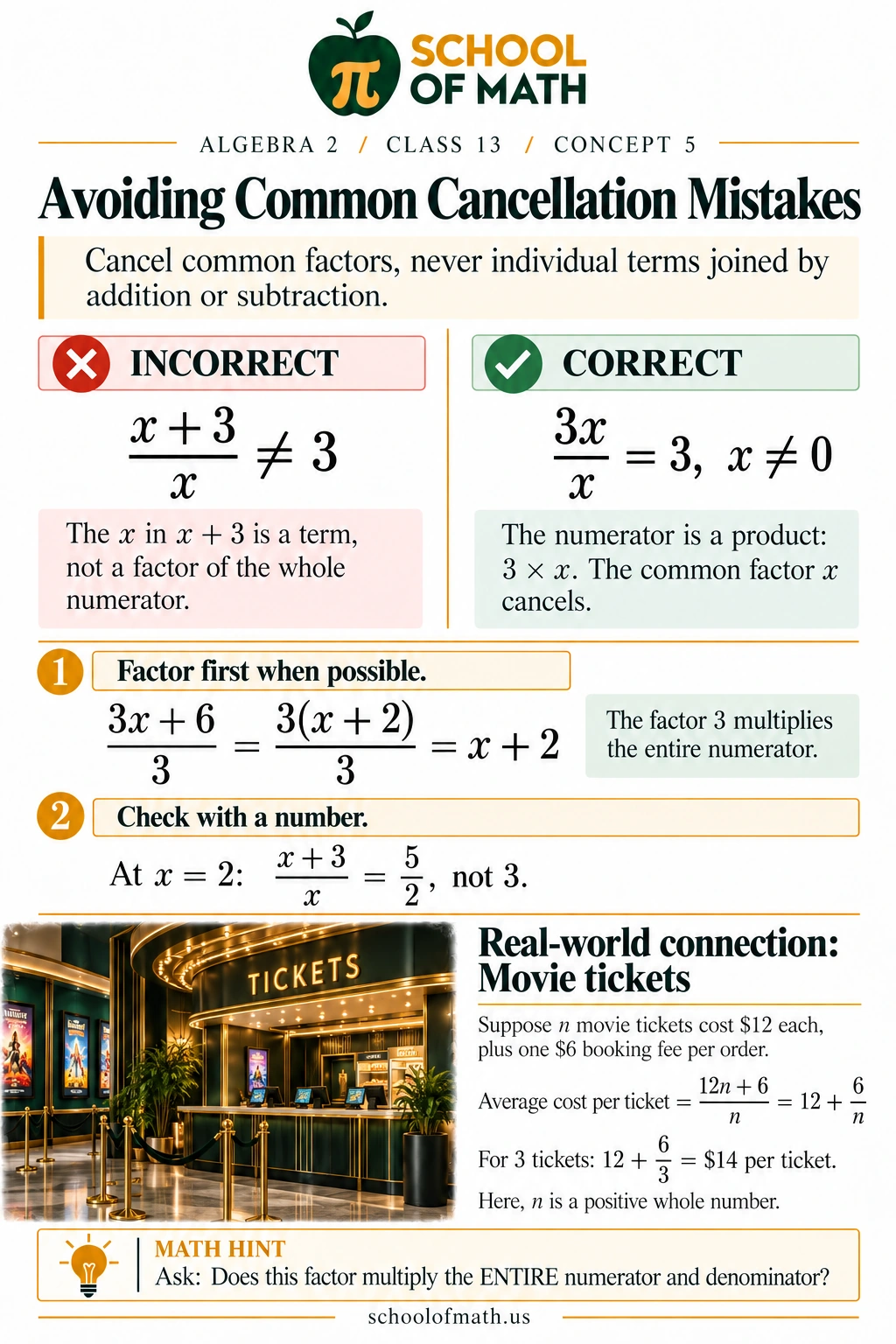
A term is a part separated by addition or subtraction; a factor multiplies the entire expression. In \(x+8\), \(x\) is a term, not a factor of the whole numerator. Therefore \(\frac{x+8}{x}\) cannot simplify to 8.
You may divide each term by a common denominator: \(\frac{5x+15}{x}=5+\frac{15}{x}\), with \(x\ne0\). Or factor first: \(5x+15=5(x+3)\). Neither method permits the cancellation of \(x\) from just one term while leaving the other untouched.
A quick numerical check can disprove a proposed rule: at \(x=4\), \(\frac{x+8}{x}=3\), not 8. One matching numerical check does not prove an identity, however. To prove equivalence, use valid algebra and keep the original domain. Also remember \(7-x=-(x-7)\).
Try it yourself: five questions
Q21 Practice 1 of 5
A student says \(\frac{x+8}{x}=8\). Use \(x=4\) to check the claim.
Answer
The claim is false: the original value is 3, not 8.
- Substitute \(x=4\): \((4+8)/4=12/4=3\). The numerator is a sum, so its \(x\) cannot simply be canceled.
Q22 Practice 2 of 5
Simplify \(\frac{5x+15}{5}\). Explain why this cancellation is valid.
Answer
\(x+3\) for every real \(x\).
- Factor the entire numerator: \(\frac{5(x+3)}5=x+3\). The constant denominator 5 is never zero.
Q23 Practice 3 of 5
Rewrite \(\frac{4x+12}{x}\) as a sum of two terms and state the restriction.
Answer
\(4+\frac{12}{x}\); \(x\ne0\).
- Divide both numerator terms by \(x\): \(\frac{4x}{x}+\frac{12}{x}\). Only the first term reduces to 4.
Q24 Practice 4 of 5
A student writes \(\frac{x^2-25}{x-5}=x+5\) and says the original is valid at \(x=5\). What must be corrected?
Answer
The simplification needs \(x\ne5\).
- At 5, the original denominator is zero. The simplified formula would give 10, but that is not a value of the original expression at the excluded input.
Q25 Practice 5 of 5
Simplify \(\frac{7-x}{x-7}\) and state the restriction.
Answer
\(-1\); \(x\ne7\).
- Since \(7-x=-(x-7)\), the fraction equals \(\frac{-(x-7)}{x-7}=-1\) whenever its denominator is nonzero.
Multiplying rational expressions
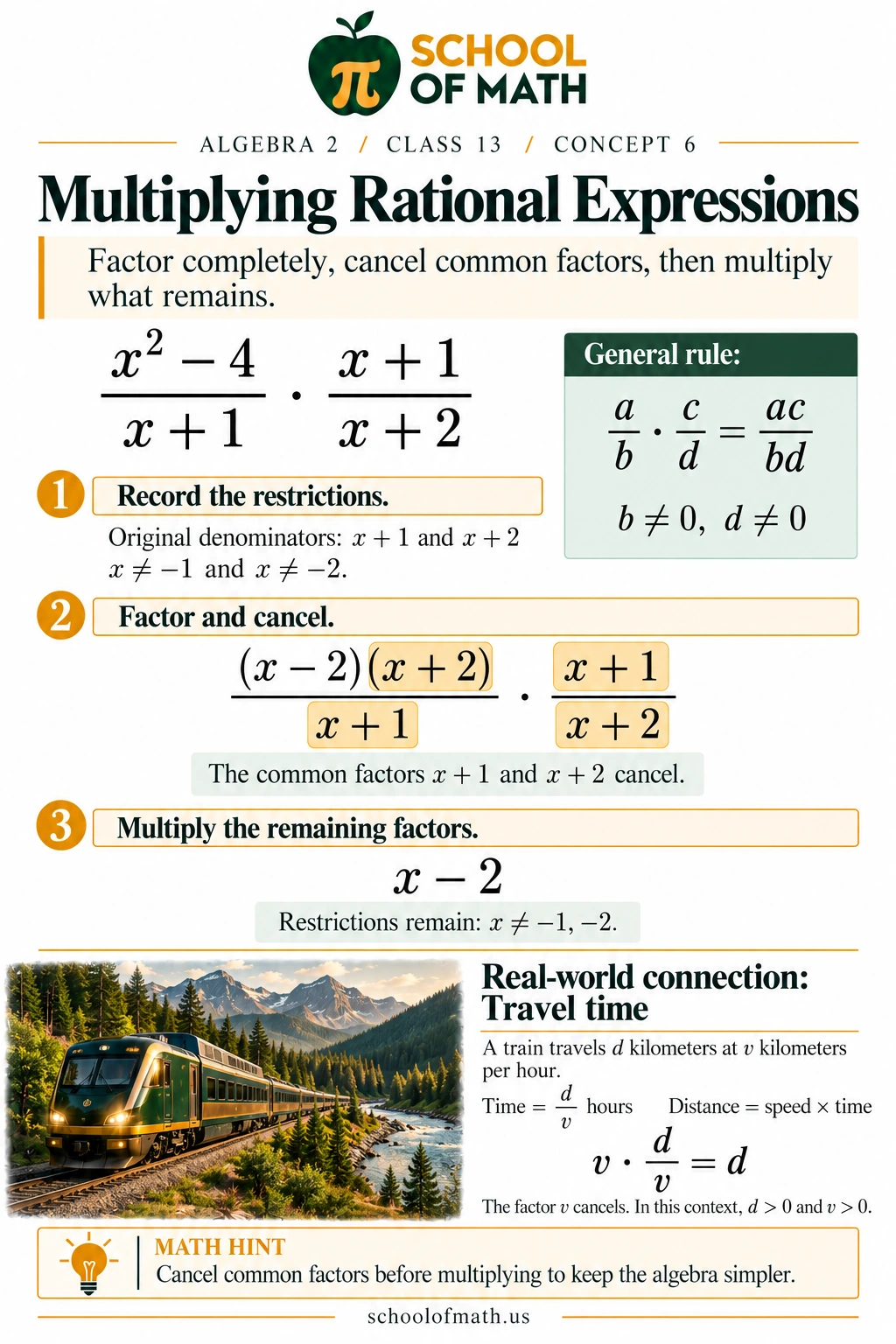
Multiplication follows the same rule as numerical fractions: multiply the numerators and multiply the denominators. First record the exclusions from every original denominator, then factor. Cancel common factors before multiplying the remaining factors to keep the algebra small.
For \(\frac{x^2-25}{x+3}\cdot\frac{x+3}{x+5}\), the original denominators exclude \(-3\) and \(-5\). Factor \(x^2-25=(x-5)(x+5)\). Cancel \((x+3)\) and \((x+5)\) to obtain \(x-5\), still with both exclusions.
A numerator can be zero in a product, so do not automatically exclude its zeros. You also do not need a common denominator to multiply fractions. A factor may cancel across the two fractions because, after multiplication, it is a factor of the entire numerator and denominator.
Try it yourself: five questions
Q26 Practice 1 of 5
Simplify and state every excluded value: \(\frac{3 x}{5}\cdot \frac{10}{9 x}\).
Answer
\(\frac{2}{3}\); \(x\ne 0\).
- Use the original denominators to find \(x\ne 0\).
- Factor completely: \(\frac{3 x}{5}\cdot\frac{10}{9 x}\).
- Cancel matching nonzero factors from the numerator and denominator. The result is \(\frac{2}{3}\). Keep all original exclusions, even when their factors disappear.
Q27 Practice 2 of 5
Simplify and state every excluded value: \(\frac{x + 4}{x - 1}\cdot \frac{x - 1}{x + 7}\).
Answer
\(\frac{x + 4}{x + 7}\); \(x\ne -7, 1\).
- Use the original denominators to find \(x\ne -7, 1\).
- Factor completely: \(\frac{x + 4}{x - 1}\cdot\frac{x - 1}{x + 7}\).
- Cancel matching nonzero factors from the numerator and denominator. The result is \(\frac{x + 4}{x + 7}\). Keep all original exclusions, even when their factors disappear.
Q28 Practice 3 of 5
Simplify and state every excluded value: \(\frac{x^{2} - 36}{x + 2}\cdot \frac{x + 2}{x + 6}\).
Answer
\(x - 6\); \(x\ne -6, -2\).
- Use the original denominators to find \(x\ne -6, -2\).
- Factor completely: \(\frac{\left(x - 6\right) \left(x + 6\right)}{x + 2}\cdot\frac{x + 2}{x + 6}\).
- Cancel matching nonzero factors from the numerator and denominator. The result is \(x - 6\). Keep all original exclusions, even when their factors disappear.
Q29 Practice 4 of 5
Simplify and state every excluded value: \(\frac{x^{2} + 7 x + 12}{x^{2} - 16}\cdot \frac{x - 4}{x + 6}\).
Answer
\(\frac{x + 3}{x + 6}\); \(x\ne -6, -4, 4\).
- Use the original denominators to find \(x\ne -6, -4, 4\).
- Factor completely: \(\frac{\left(x + 3\right) \left(x + 4\right)}{\left(x - 4\right) \left(x + 4\right)}\cdot\frac{x - 4}{x + 6}\).
- Cancel matching nonzero factors from the numerator and denominator. The result is \(\frac{x + 3}{x + 6}\). Keep all original exclusions, even when their factors disappear.
Q30 Practice 5 of 5
Simplify and state every excluded value: \(\frac{2 x^{2} - 8}{3 x + 9}\cdot \frac{x^{2} + 6 x + 9}{x^{2} + x - 2}\).
Answer
\(\frac{2 \left(x - 2\right) \left(x + 3\right)}{3 \left(x - 1\right)}\); \(x\ne -3, -2, 1\).
- Use the original denominators to find \(x\ne -3, -2, 1\).
- Factor completely: \(\frac{2 \left(x - 2\right) \left(x + 2\right)}{3 \left(x + 3\right)}\cdot\frac{\left(x + 3\right)^{2}}{\left(x - 1\right) \left(x + 2\right)}\).
- Cancel matching nonzero factors from the numerator and denominator. The result is \(\frac{2 \left(x - 2\right) \left(x + 3\right)}{3 \left(x - 1\right)}\). Keep all original exclusions, even when their factors disappear.
Dividing rational expressions
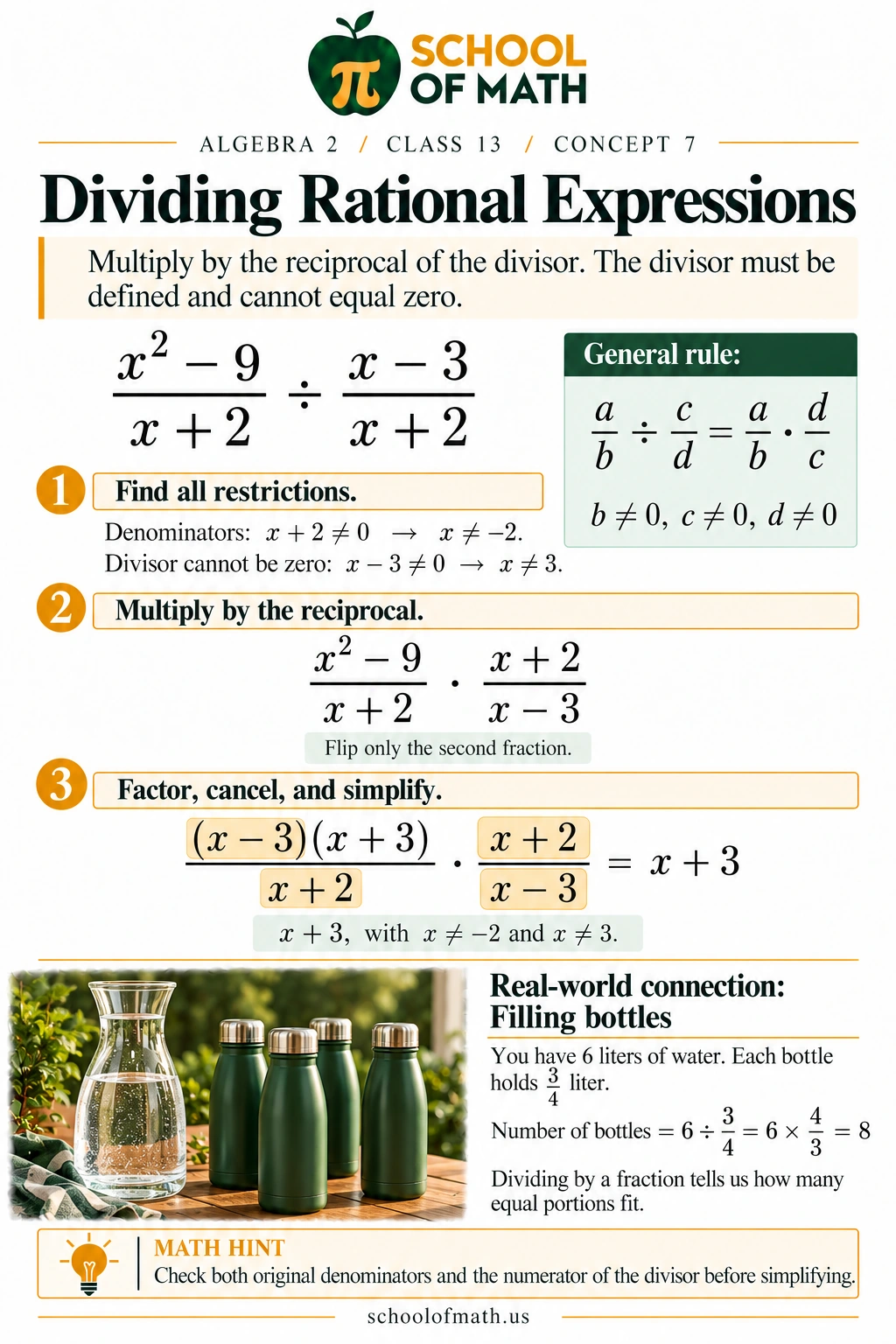
Dividing by a fraction means multiplying by its reciprocal. Keep the first fraction unchanged and flip only the divisor. Before doing that, require both original denominators to be nonzero and the divisor itself to be nonzero.
For \(\frac{x^2-16}{x+5}\div\frac{x-4}{x+5}\), the denominators exclude \(-5\). The divisor is zero at \(4\), so exclude that input too. Rewrite as \(\frac{x^2-16}{x+5}\cdot\frac{x+5}{x-4}\). Factoring and cancellation give \(x+4\), with \(x\ne-5,4\).
The extra check on the divisor is essential: division by zero is undefined even when the reciprocal form cancels to something harmless-looking. A zero numerator in the first fraction is allowed, provided every denominator and the divisor satisfy their restrictions.
Try it yourself: five questions
Q31 Practice 1 of 5
Simplify and state every excluded value: \(\frac{x}{6}\div \frac{x}{3}\).
Answer
\(\frac{1}{2}\); \(x\ne 0\).
- Use the original denominators and the numerator of each divisor to find \(x\ne 0\).
- Replace division by multiplication by the reciprocal of the divisor. Factor completely: \(\frac{x}{6}\cdot\frac{3}{x}\).
- Cancel matching nonzero factors from the numerator and denominator. The result is \(\frac{1}{2}\). Keep all original exclusions, even when their factors disappear.
Q32 Practice 2 of 5
Simplify and state every excluded value: \(\frac{x + 4}{x - 2}\div \frac{x + 4}{x + 5}\).
Answer
\(\frac{x + 5}{x - 2}\); \(x\ne -5, -4, 2\).
- Use the original denominators and the numerator of each divisor to find \(x\ne -5, -4, 2\).
- Replace division by multiplication by the reciprocal of the divisor. Factor completely: \(\frac{x + 4}{x - 2}\cdot\frac{x + 5}{x + 4}\).
- Cancel matching nonzero factors from the numerator and denominator. The result is \(\frac{x + 5}{x - 2}\). Keep all original exclusions, even when their factors disappear.
Q33 Practice 3 of 5
Simplify and state every excluded value: \(\frac{x^{2} - 49}{x + 3}\div \frac{x - 7}{x + 3}\).
Answer
\(x + 7\); \(x\ne -3, 7\).
- Use the original denominators and the numerator of each divisor to find \(x\ne -3, 7\).
- Replace division by multiplication by the reciprocal of the divisor. Factor completely: \(\frac{\left(x - 7\right) \left(x + 7\right)}{x + 3}\cdot\frac{x + 3}{x - 7}\).
- Cancel matching nonzero factors from the numerator and denominator. The result is \(x + 7\). Keep all original exclusions, even when their factors disappear.
Q34 Practice 4 of 5
Simplify and state every excluded value: \(\frac{x^{2} + 7 x + 10}{x^{2} - 4}\div \frac{x + 5}{x - 2}\).
Answer
\(1\); \(x\ne -5, -2, 2\).
- Use the original denominators and the numerator of each divisor to find \(x\ne -5, -2, 2\).
- Replace division by multiplication by the reciprocal of the divisor. Factor completely: \(\frac{\left(x + 2\right) \left(x + 5\right)}{\left(x - 2\right) \left(x + 2\right)}\cdot\frac{x - 2}{x + 5}\).
- Cancel matching nonzero factors from the numerator and denominator. The result is \(1\). Keep all original exclusions, even when their factors disappear.
Q35 Practice 5 of 5
Simplify and state every excluded value: \(\frac{x^{2} - 9}{x^{2} + 4 x + 3}\div \frac{x - 3}{x + 4}\).
Answer
\(\frac{x + 4}{x + 1}\); \(x\ne -4, -3, -1, 3\).
- Use the original denominators and the numerator of each divisor to find \(x\ne -4, -3, -1, 3\).
- Replace division by multiplication by the reciprocal of the divisor. Factor completely: \(\frac{\left(x - 3\right) \left(x + 3\right)}{\left(x + 1\right) \left(x + 3\right)}\cdot\frac{x + 4}{x - 3}\).
- Cancel matching nonzero factors from the numerator and denominator. The result is \(\frac{x + 4}{x + 1}\). Keep all original exclusions, even when their factors disappear.
Combining multiplication and division
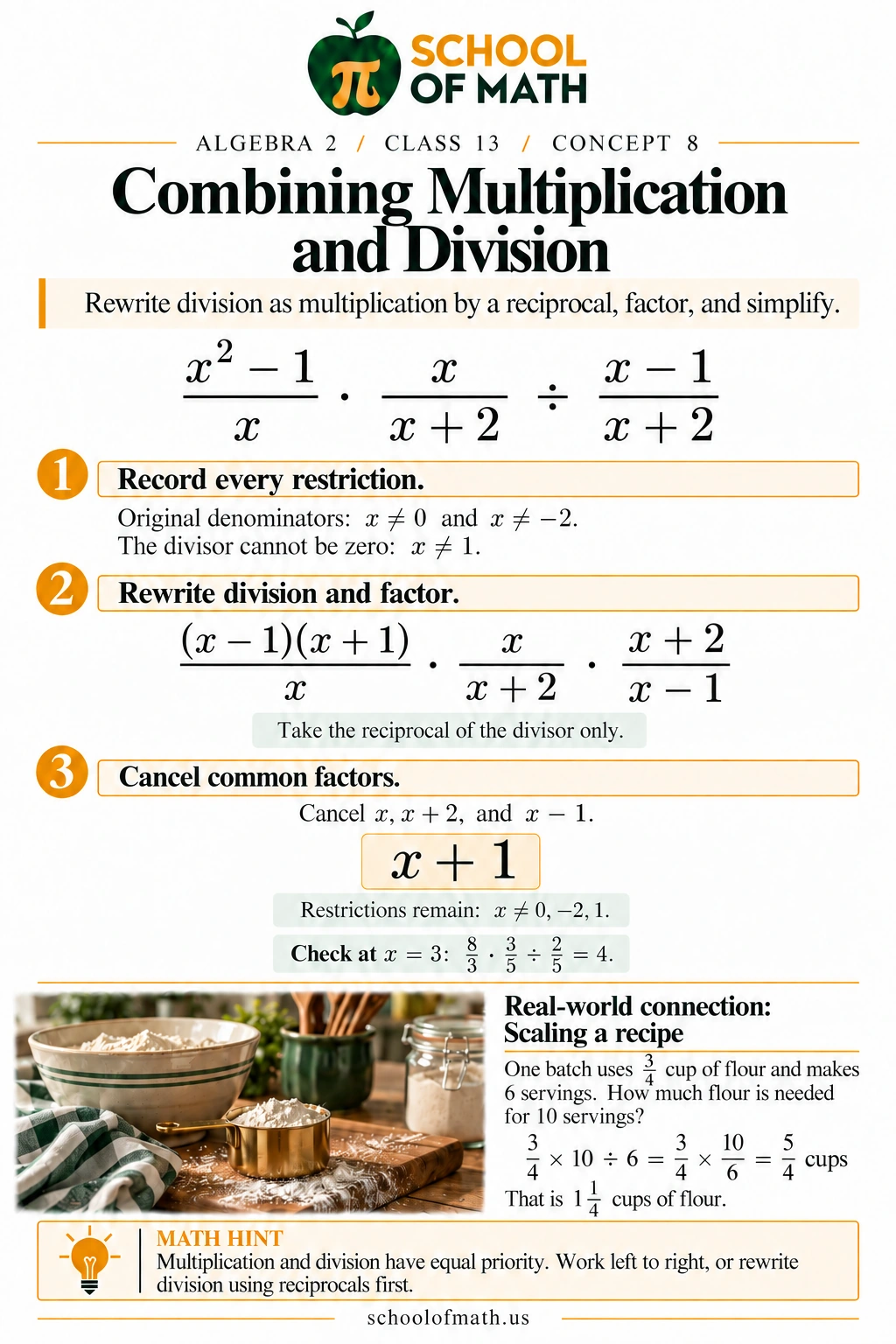
Multiplication and division have equal priority. With no grouping symbols, work from left to right, or rewrite each division as multiplication by a reciprocal while preserving the original grouping. The chain \(A\cdot B\div C\) becomes \(A\cdot B\cdot\frac1C\).
Keep a restriction list as you work: every original denominator must be nonzero, and every divisor must be defined and nonzero. Factor the full product only after you have recorded these conditions. Cancel matching factors and then simplify the remaining coefficients.
For \(\frac{x^2-16}{x}\cdot\frac{x}{x+5}\) divided by \(\frac{x-4}{x+5}\), exclude \(0,-5,4\). Rewrite the division, factor \((x-4)(x+4)\), and cancel to obtain \(x+4\). All three exclusions remain.
Finish with a check at a permitted input. At \(x=6\), the example is \(\frac{20}{6}\cdot\frac6{11}\div\frac2{11}=10\), matching \(6+4\). Checking a value helps catch mistakes but does not replace factoring or the restriction list. Parentheses matter: \(A\div(B\cdot C)\) is not generally the same as \(A\div B\cdot C\).
Try it yourself: five questions
Q36 Practice 1 of 5
Simplify and state every excluded value: \(\frac{2 x}{3}\cdot \frac{9}{x}\div \frac{4}{1}\).
Answer
\(\frac{3}{2}\); \(x\ne 0\).
- Use the original denominators and the numerator of each divisor to find \(x\ne 0\).
- Replace division by multiplication by the reciprocal of the divisor. Factor completely: \(\frac{2 x}{3}\cdot\frac{9}{x}\cdot\frac{1}{4}\).
- Cancel matching nonzero factors from the numerator and denominator. The result is \(\frac{3}{2}\). Keep all original exclusions, even when their factors disappear.
Q37 Practice 2 of 5
Simplify and state every excluded value: \(\frac{x + 2}{x - 3}\cdot \frac{x - 3}{x + 4}\div \frac{x + 2}{x + 5}\).
Answer
\(\frac{x + 5}{x + 4}\); \(x\ne -5, -4, -2, 3\).
- Use the original denominators and the numerator of each divisor to find \(x\ne -5, -4, -2, 3\).
- Replace division by multiplication by the reciprocal of the divisor. Factor completely: \(\frac{x + 2}{x - 3}\cdot\frac{x - 3}{x + 4}\cdot\frac{x + 5}{x + 2}\).
- Cancel matching nonzero factors from the numerator and denominator. The result is \(\frac{x + 5}{x + 4}\). Keep all original exclusions, even when their factors disappear.
Q38 Practice 3 of 5
Simplify and state every excluded value: \(\frac{x^{2} - 36}{x}\cdot \frac{x}{x + 1}\div \frac{x - 6}{x + 1}\).
Answer
\(x + 6\); \(x\ne -1, 0, 6\).
- Use the original denominators and the numerator of each divisor to find \(x\ne -1, 0, 6\).
- Replace division by multiplication by the reciprocal of the divisor. Factor completely: \(\frac{\left(x - 6\right) \left(x + 6\right)}{x}\cdot\frac{x}{x + 1}\cdot\frac{x + 1}{x - 6}\).
- Cancel matching nonzero factors from the numerator and denominator. The result is \(x + 6\). Keep all original exclusions, even when their factors disappear.
Q39 Practice 4 of 5
Simplify and state every excluded value: \(\frac{x^{2} + 8 x + 15}{x^{2} - 9}\cdot \frac{x - 3}{x + 7}\div \frac{x + 5}{x + 7}\).
Answer
\(1\); \(x\ne -7, -5, -3, 3\).
- Use the original denominators and the numerator of each divisor to find \(x\ne -7, -5, -3, 3\).
- Replace division by multiplication by the reciprocal of the divisor. Factor completely: \(\frac{\left(x + 3\right) \left(x + 5\right)}{\left(x - 3\right) \left(x + 3\right)}\cdot\frac{x - 3}{x + 7}\cdot\frac{x + 7}{x + 5}\).
- Cancel matching nonzero factors from the numerator and denominator. The result is \(1\). Keep all original exclusions, even when their factors disappear.
Q40 Practice 5 of 5
Simplify and state every excluded value: \(\frac{x^{2} - 25}{x^{2} - 1}\div \frac{x - 5}{x + 1}\cdot \frac{x - 1}{x + 2}\).
Answer
\(\frac{x + 5}{x + 2}\); \(x\ne -2, -1, 1, 5\).
- Use the original denominators and the numerator of each divisor to find \(x\ne -2, -1, 1, 5\).
- Replace division by multiplication by the reciprocal of the divisor. Factor completely: \(\frac{\left(x - 5\right) \left(x + 5\right)}{\left(x - 1\right) \left(x + 1\right)}\cdot\frac{x + 1}{x - 5}\cdot\frac{x - 1}{x + 2}\).
- Cancel matching nonzero factors from the numerator and denominator. The result is \(\frac{x + 5}{x + 2}\). Keep all original exclusions, even when their factors disappear.
Homework review
Review rational expressions, excluded values, factoring, valid cancellation, multiplication, division, and combined operations. Complete one question for each image, in order.
R1 Review image 1 of 8
Evaluate \(\frac{3x-2}{x+5}\) at \(x=2\) and state the excluded value.
Answer
\(\frac47\); \(x\ne-5\).
- At 2, the numerator is 4 and denominator is 7. The original denominator is zero at -5.
R2 Review image 2 of 8
Find all excluded values of \(\frac{x+2}{x^2-2x-15}\).
Answer
\(x\ne-3,5\).
- Factor the denominator: \((x-5)(x+3)\).
R3 Review image 3 of 8
Simplify and state every excluded value: \(\frac{x^{2} + 11 x + 30}{x + 6}\).
Answer
\(x + 5\); \(x\ne -6\).
- Use the original denominators to find \(x\ne -6\).
- Factor completely: \(\frac{\left(x + 5\right) \left(x + 6\right)}{x + 6}\).
- Cancel matching nonzero factors from the numerator and denominator. The result is \(x + 5\). Keep all original exclusions, even when their factors disappear.
R4 Review image 4 of 8
Simplify and state every excluded value: \(\frac{x^{2} - 81}{x^{2} + 12 x + 27}\).
Answer
\(\frac{x - 9}{x + 3}\); \(x\ne -9, -3\).
- Use the original denominators to find \(x\ne -9, -3\).
- Factor completely: \(\frac{\left(x - 9\right) \left(x + 9\right)}{\left(x + 3\right) \left(x + 9\right)}\).
- Cancel matching nonzero factors from the numerator and denominator. The result is \(\frac{x - 9}{x + 3}\). Keep all original exclusions, even when their factors disappear.
R5 Review image 5 of 8
Explain why \(\frac{2x+10}{x}\) is not always 12. Rewrite it correctly.
Answer
It is \(2+\frac{10}{x}\), with \(x\ne0\).
- The \(x\) is not a factor of the entire numerator. For example, at \(x=5\) the original is 4, not 12.
R6 Review image 6 of 8
Simplify and state every excluded value: \(\frac{x^{2} - 64}{x + 1}\cdot \frac{x + 1}{x + 8}\).
Answer
\(x - 8\); \(x\ne -8, -1\).
- Use the original denominators to find \(x\ne -8, -1\).
- Factor completely: \(\frac{\left(x - 8\right) \left(x + 8\right)}{x + 1}\cdot\frac{x + 1}{x + 8}\).
- Cancel matching nonzero factors from the numerator and denominator. The result is \(x - 8\). Keep all original exclusions, even when their factors disappear.
R7 Review image 7 of 8
Simplify and state every excluded value: \(\frac{x^{2} - 16}{x + 6}\div \frac{x - 4}{x + 6}\).
Answer
\(x + 4\); \(x\ne -6, 4\).
- Use the original denominators and the numerator of each divisor to find \(x\ne -6, 4\).
- Replace division by multiplication by the reciprocal of the divisor. Factor completely: \(\frac{\left(x - 4\right) \left(x + 4\right)}{x + 6}\cdot\frac{x + 6}{x - 4}\).
- Cancel matching nonzero factors from the numerator and denominator. The result is \(x + 4\). Keep all original exclusions, even when their factors disappear.
R8 Review image 8 of 8
Simplify and state every excluded value: \(\frac{x^{2} - 49}{x}\cdot \frac{x}{x + 2}\div \frac{x - 7}{x + 2}\).
Answer
\(x + 7\); \(x\ne -2, 0, 7\).
- Use the original denominators and the numerator of each divisor to find \(x\ne -2, 0, 7\).
- Replace division by multiplication by the reciprocal of the divisor. Factor completely: \(\frac{\left(x - 7\right) \left(x + 7\right)}{x}\cdot\frac{x}{x + 2}\cdot\frac{x + 2}{x - 7}\).
- Cancel matching nonzero factors from the numerator and denominator. The result is \(x + 7\). Keep all original exclusions, even when their factors disappear.
Homework word problems
These twelve stories progress from average cost and simple dimensions to multiplication and division models. Explain the units, keep algebraic restrictions, and respect the practical domain in each story.
W1 Homework word problem 1 of 12
A pottery club pays a $90 studio fee plus $7 per participant. Write the average cost for \(n\) participants. Find the average for 15 participants.
Answer
Average: \(7+\frac{90}{n}\) dollars; $13 for 15 participants.
- The total is \(90+7n\). Divide by \(n\) and substitute 15.
- Here \(n\) is a positive whole number; algebraically \(n\ne0\).
W2 Homework word problem 2 of 12
A runner covers 18 miles in \(t\) hours. Write the average speed and calculate it for 3 hours. State a sensible domain.
Answer
Speed \(18/t\) mph; 6 mph; \(t>0\).
- Speed is distance divided by time. \(18/3=6\). Zero hours is excluded, and elapsed time for this trip must be positive.
W3 Homework word problem 3 of 12
A rectangular mat has area \(x^2+9x+14\) square meters and width \(x+2\) meters, where \(x>0\). Find its length and then evaluate at \(x=3\).
Answer
Length \(x+7\) meters; 10 meters when \(x=3\).
- Factor the area as \((x+2)(x+7)\) and divide by \(x+2\). The algebraic exclusion \(x\ne-2\) is already outside the context \(x>0\).
W4 Homework word problem 4 of 12
A square display has area \(x^2\) square meters, and a 16-square-meter panel is removed. The remaining area is rearranged into a rectangle of width \(x-4\) meters, with \(x>4\). Find the new length.
Answer
Length \(x+4\) meters.
- The area is \(x^2-16=(x-4)(x+4)\). Divide by the width \(x-4\). Algebra excludes 4; the context requires \(x>4\).
W5 Homework word problem 5 of 12
Printing \(n\) postcards costs \(8n+24\) dollars. A student says the average is always $32 because the \(n\) cancels. Give the correct average and the value for 6 postcards.
Answer
Average \(8+\frac{24}{n}\) dollars; $12 for 6 postcards.
- Divide each term by \(n\). A variable cannot be canceled from just one term of a sum.
- Here \(n\) is a positive whole number. At 6, \(8+24/6=12\).
W6 Homework word problem 6 of 12
A rectangular sign has length \(\frac{x+4}{x+1}\) meters and width \(\frac{3(x+1)}{x+2}\) meters, with \(x>0\). Find its area in simplest form.
Answer
Area \(\frac{3(x+4)}{x+2}\) square meters.
- Multiply the two dimensions and cancel \((x+1)\). The original algebraic exclusions are \(x\ne-1,-2\); \(x>0\) satisfies them.
W7 Homework word problem 7 of 12
A machine works at \(\frac{5x}{x+2}\) parts per minute for \(\frac{3(x+2)}x\) minutes, where \(x>0\). How many parts does the model predict?
Answer
15 parts.
- Multiply rate by time. Cancel \(x\) and \((x+2)\), leaving \(5\cdot3=15\). Algebra excludes 0 and -2; the context is \(x>0\).
W8 Homework word problem 8 of 12
A ribbon is \(\frac{x^2-25}{x+1}\) meters long. Each piece must be \(\frac{x-5}{x+1}\) meter long, where \(x\) is a whole number greater than 5. How many pieces can be cut without waste?
Answer
Exactly \(x+5\) pieces.
- Divide the total length by one piece's length. Multiply by \(\frac{x+1}{x-5}\) and factor \(x^2-25\).
- Algebra excludes \(x=-1,5\). The stated whole-number context makes \(x+5\) a positive whole number.
W9 Homework word problem 9 of 12
A tank holds \(\frac{x^2+7x+12}{x+2}\) liters. Each container holds \(\frac{x+3}{x+2}\) liters. For a positive whole number \(x\), how many full containers can be filled? Evaluate at \(x=2\).
Answer
\(x+4\) containers; 6 containers when \(x=2\).
- Factor the tank amount as \(\frac{(x+3)(x+4)}{x+2}\) and divide by the container amount.
- The algebraic exclusions are \(x\ne-2,-3\): the original denominators exclude -2 and the divisor excludes -3. The positive context avoids both.
W10 Homework word problem 10 of 12
A rectangular panel has area \(\frac{x^2-9}{x+4}\) square meters and width \(\frac{x-3}{x+2}\) meters, where \(x>3\). Find its length and then its length at \(x=4\).
Answer
Length \(\frac{(x+3)(x+2)}{x+4}\) meters; \(\frac{21}{4}\) meters at 4.
- Length is area divided by width. Factor \(x^2-9\) and multiply by the reciprocal width.
- Algebra excludes -4, -2, and 3. At 4, the length is \(7\cdot6/8=21/4\).
W11 Homework word problem 11 of 12
A recipe uses \(\frac{x+3}{x+1}\) cups of flour for \(x+3\) servings, with \(x\) a positive whole number. How much flour is needed for \(2(x+1)\) servings at the same rate?
Answer
2 cups.
- Multiply the original flour amount by desired servings divided by original servings: \(\frac{x+3}{x+1}\cdot\frac{2(x+1)}{x+3}=2\).
- The algebraic exclusions are -1 and -3. Both are outside the positive whole-number domain.
W12 Homework word problem 12 of 12
A machine runs at \(\frac{x^2-16}{x+1}\) meters of ribbon per minute for \(\frac{x+1}{x+2}\) minutes. Each spool holds \(\frac{x-4}{x+2}\) meter. If \(x\) is a whole number greater than 4, how many spools are filled? Check \(x=6\).
Answer
\(x+4\) spools; 10 at \(x=6\).
- Multiply rate by time, then divide by ribbon per spool. Rewrite division with the reciprocal and factor \(x^2-16=(x-4)(x+4)\).
- Cancel \((x+1)\), \((x+2)\), and \((x-4)\). Exclusions are -1, -2, and 4; the context avoids them.
- At 6, the produced length is \(\frac{20}{7}\cdot\frac78=\frac52\) meters, and each spool holds \(\frac28=\frac14\) meter. \(\frac52\div\frac14=10\).
Quick questions and answers
What is a rational expression?
A rational expression is a quotient of polynomials. Its denominator must be nonzero for each allowed input.
How do you simplify a rational expression?
Record exclusions from the original denominator, factor completely, and cancel only common nonzero factors. Keep all original restrictions.
Why do canceled factors still give excluded values?
A canceled factor was part of the original denominator. An input that made that denominator zero was never allowed, even when the new formula is defined there.
How do you multiply rational expressions?
Factor all numerators and denominators, record original denominator restrictions, cancel common factors, and multiply what remains. A common denominator is not required.
What extra restriction matters when dividing?
The divisor must be defined and nonzero. Check both original denominators and the numerator of the divisor before multiplying by its reciprocal.
What practice and homework are included?
The class includes eight images, five original questions per image, eight homework review questions, and twelve progressively harder word problems. All 60 questions have hidden worked answers. The 22-page workbook includes images, questions, and blank workspace without exercise answers.