SOMATH Journal · Regents Geometry · Part I
August 2026 Geometry Regents: Part I
This August 2026 Geometry Regents Part I walkthrough covers transformations, right-triangle trigonometry, coordinate geometry, circles, and volume. Find the original questions and diagrams below, then select the blue Answer button for each original SOMATH solution: identify the idea, show the steps, and check the result.
Try each problem on paper before opening its answer. For guided preparation, book a SOMATH evaluation at 226 W 79th St, Upper West Side, or call (646) 668-6151.
Questions and original diagrams are reproduced from the NYSED August 2026 Geometry exam, with web formatting and mathematical notation normalized. The explanations are newly written by SOMATH, not NYSED solutions or an official scoring rubric; results were checked against the NYSED scoring key and rating guide.
Open the original exam PDF for the full booklet and reference sheet.
Part I has 24 questions at 2 credits each, with no partial credit. Choose one answer for each question; diagrams are not necessarily drawn to scale. These instructions are from the original exam.
Rigid motions and congruenceQuestion 1
If \(\triangle R'S'T'\) is the image of \(\triangle RST\), under which transformation will the triangles be congruent?
- (1) a vertical stretch with a scale factor of 4
- (2) a horizontal stretch with a scale factor of 3
- (3) a translation of 3 units to the right and 4 units up
- (4) a dilation centered at the origin with a scale factor of 3
Answer
Answer: (3), a translation.
- Congruent triangles have equal corresponding side lengths and angle measures. A rigid motion preserves both.
- A translation slides every point the same distance in the same direction. Here the rule is \((x,y)\mapsto(x+3,y+4)\).
- The stretches change lengths, and a dilation with scale factor 3 triples every side. Those are not congruence-preserving transformations.
SOMATH takeaway: Ask whether the transformation changes size. A slide, turn, or reflection preserves it.
Finding an angle with sineQuestion 2
In right triangle \(ABC\) below, \(m\angle B=90^\circ\).
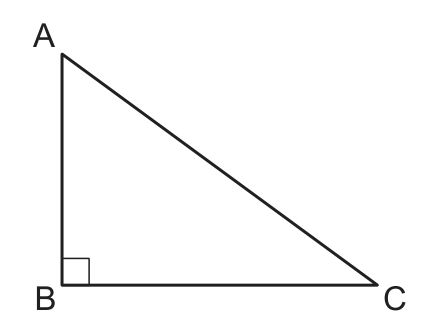
If \(AB=10.3\) and \(AC=14.8\), the measure of \(\angle C\), to the nearest degree, is
- (1) \(35^\circ\)
- (2) \(44^\circ\)
- (3) \(46^\circ\)
- (4) \(55^\circ\)
Answer
Answer: (2), \(44^\circ\).
- Look from angle \(C\): \(AB\) is opposite and \(AC\) is the hypotenuse.
- Use sine: \(\sin C=\frac{10.3}{14.8}\).
- In degree mode, \(C=\sin^{-1}(10.3/14.8)\approx44.10^\circ\). Round to \(44^\circ\).
SOMATH takeaway: Name the sides relative to the requested angle before choosing sine, cosine, or tangent.
Matching corresponding verticesQuestion 3
Scalene triangle \(ABC\) is mapped onto triangle \(KLM\) by a rotation. Another triangle, \(XYZ\), is mapped onto triangle \(KLM\) by a translation. Which statement is always true?
- (1) \(\overline{BC}\cong\overline{XY}\)
- (2) \(\overline{KM}\cong\overline{YZ}\)
- (3) \(\angle A\cong\angle L\)
- (4) \(\angle B\cong\angle Y\)
Answer
Answer: (4), \(\angle B\cong\angle Y\).
- Read corresponding vertices in order: \(A\leftrightarrow K\), \(B\leftrightarrow L\), and \(C\leftrightarrow M\).
- For the other mapping, \(X\leftrightarrow K\), \(Y\leftrightarrow L\), and \(Z\leftrightarrow M\).
- Both rotations and translations preserve angle measures. Thus \(\angle B\cong\angle L\) and \(\angle Y\cong\angle L\), giving \(\angle B\cong\angle Y\).
SOMATH takeaway: Matching the same target vertex is more reliable than matching letters that look familiar.
Sphere volume and densityQuestion 4
A solid spherical metal ball has a diameter of 3.5 cm. The density of the metal is 10.5 g/cm³. What is the mass of the metal ball, to the nearest tenth of a gram?
- (1) 134.7
- (2) 179.6
- (3) 235.7
- (4) 1885.7
Answer
Answer: (3), 235.7 grams.
- The radius is half the diameter: \(r=3.5/2=1.75\) cm.
- The sphere's volume is \(V=\frac43\pi r^3=\frac43\pi(1.75)^3\).
- Mass equals density times volume: \(m=10.5\left[\frac43\pi(1.75)^3\right]\approx235.717\) grams.
- Round only the final result: 235.7 grams.
SOMATH takeaway: Using the diameter as the radius makes the volume eight times too large.
Centroid and median ratiosQuestion 5
In the diagram below of \(\triangle ABC\), the midpoint of \(\overline{AC}\) is \(D\), the midpoint of \(\overline{BC}\) is \(E\), and \(\overline{AE}\) and \(\overline{BD}\) intersect at \(F\).
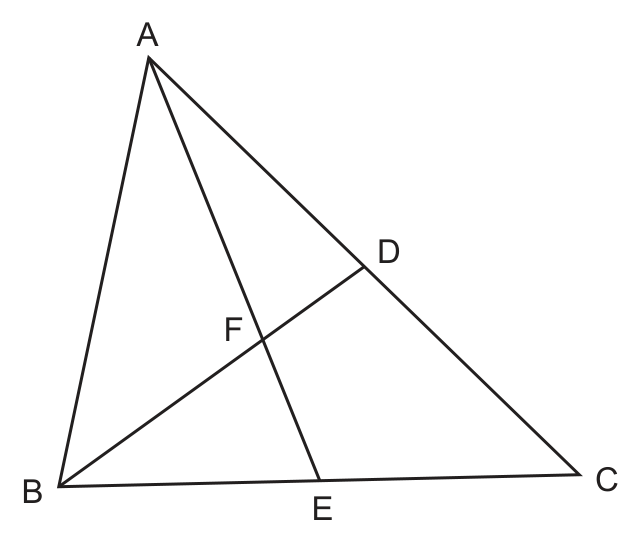
Which statement is always true?
- (1) \(AE=3(FE)\)
- (2) \(BF=3(FD)\)
- (3) \(AF=BF\)
- (4) \(AD=BE\)
Answer
Answer: (1), \(AE=3(FE)\).
- A segment from a vertex to the midpoint of the opposite side is a median. Therefore \(AE\) and \(BD\) are medians and \(F\) is the centroid.
- A centroid divides each median in a \(2:1\) ratio, with the longer piece next to the vertex. Thus \(AF=2(FE)\).
- The whole median is \(AE=AF+FE=3(FE)\). On the other median, \(BF=2(FD)\), not \(3(FD)\).
SOMATH takeaway: Distinguish a whole median, which is three short pieces, from the vertex-to-centroid piece, which is two.
Solids of revolutionQuestion 6
A square is rotated continuously around one of its sides. The three-dimensional object formed is a
- (1) cube
- (2) sphere
- (3) cylinder
- (4) pyramid
Answer
Answer: (3), cylinder.
- The fixed side is the axis of rotation. Every point on the opposite side travels around that axis in a circle.
- Those circles have the same radius all along the axis, so the swept solid has two circular bases and a constant width.
- That solid is a cylinder. Its height and radius each equal the side length of the square.
SOMATH takeaway: Imagine the shape swept out during the rotation, not just the square's starting position.
Exterior angles of trianglesQuestion 7
In \(\triangle TRU\) below, \(\overline{RU}\) is extended through \(U\) to point \(E\).
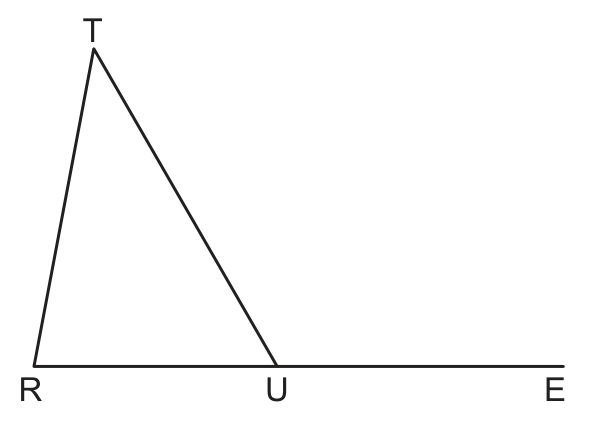
If \(m\angle TUE=120^\circ\) and \(m\angle R\) is twice \(m\angle T\), then \(m\angle R\) is
- (1) \(40^\circ\)
- (2) \(60^\circ\)
- (3) \(80^\circ\)
- (4) \(120^\circ\)
Answer
Answer: (3), \(80^\circ\).
- The exterior angle at \(U\) equals the sum of the two remote interior angles: \(m\angle R+m\angle T=120^\circ\).
- Let \(m\angle T=x\). Then \(m\angle R=2x\), so \(3x=120\) and \(x=40\).
- The question asks for \(\angle R\), so double 40: \(m\angle R=80^\circ\).
SOMATH takeaway: After solving for a variable, check whether it represents the requested angle.
Reflection symmetryQuestion 8
A hexagon is graphed on the set of axes below.
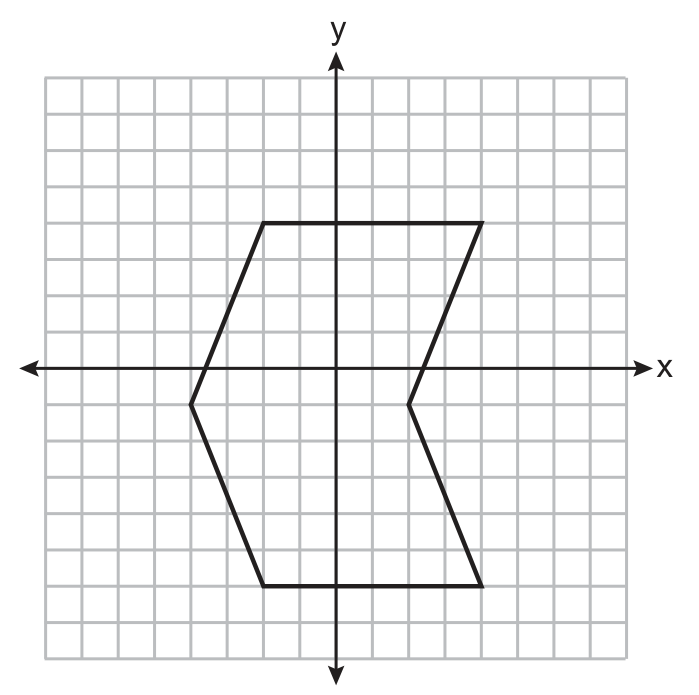
A reflection over which line would carry the hexagon onto itself?
- (1) \(y=-1\)
- (2) \(x=-1\)
- (3) y-axis
- (4) x-axis
Answer
Answer: (1), \(y=-1\).
- The upper horizontal edge lies at \(y=4\), and the lower one lies at \(y=-6\). Their halfway height is \(\frac{4+(-6)}2=-1\).
- Reflection across \(y=-1\) pairs the upper and lower vertices while keeping their x-coordinates unchanged.
- The two middle vertices lie on \(y=-1\), so they stay fixed. Every edge lands on a matching edge.
SOMATH takeaway: A symmetry line must work for the entire shape. It does not have to be a coordinate axis.
Isosceles triangles inside a larger triangleQuestion 9
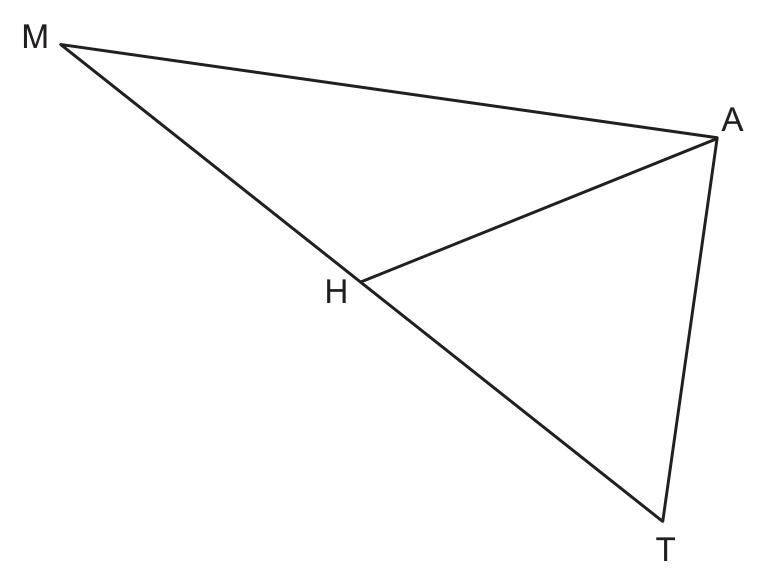
In scalene triangle \(MAT\) below, \(\overline{AH}\) is drawn such that \(\overline{MH}\cong\overline{TH}\cong\overline{AH}\).
Which angle is always congruent to \(\angle HTA\)?
- (1) \(\angle MAH\)
- (2) \(\angle TAH\)
- (3) \(\angle AMH\)
- (4) \(\angle THA\)
Answer
Answer: (2), \(\angle TAH\).
- Focus on the smaller triangle \(AHT\), because it contains the requested angle.
- Since \(AH=TH\), this triangle is isosceles with base \(AT\). The base angles at \(A\) and \(T\) are congruent.
- Those angles are \(\angle TAH\) and \(\angle HTA\). The larger triangle being scalene does not change this fact.
SOMATH takeaway: Equal sides face equal angles. Trace each angle's middle letter to locate its vertex.
Solving a pyramid volume formulaQuestion 10
A rectangular pyramid has a base whose dimensions are 16 by 12. If the volume of the pyramid is 1536, what is its height?
- (1) 24
- (2) 16
- (3) 12
- (4) 8
Answer
Answer: (1), 24.
- The rectangular base area is \(B=16(12)=192\).
- A pyramid has volume \(V=\frac13Bh\), so \(1536=\frac13(192)h=64h\).
- Divide by 64: \(h=1536/64=24\). Substitution gives \(\frac13(192)(24)=1536\), as required.
SOMATH takeaway: A pyramid uses one third of base area times height. Omitting that factor gives the prism answer.
Finding a side with cosineQuestion 11
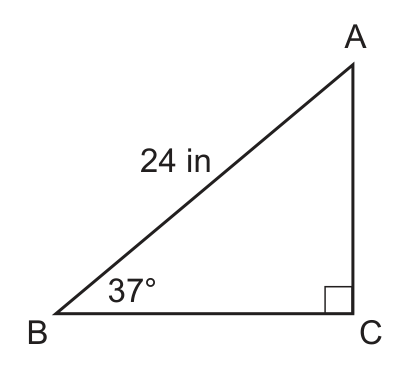
In \(\triangle ABC\) below, \(\angle C\) is a right angle, \(AB=24\) inches, and \(m\angle B=37^\circ\).
What is the length of \(\overline{BC}\), to the nearest inch?
- (1) 14
- (2) 18
- (3) 19
- (4) 30
Answer
Answer: (3), 19 inches.
- Relative to angle \(B\), \(BC\) is the adjacent leg and \(AB\) is the hypotenuse.
- Use \(\cos37^\circ=\frac{BC}{24}\). Multiply by 24 to get \(BC=24\cos37^\circ\).
- This is approximately \(19.167\), which rounds to 19 inches. It is shorter than the 24-inch hypotenuse, as it should be.
SOMATH takeaway: Cosine connects the adjacent leg and hypotenuse; keep the calculator in degree mode.
Partitioning a segmentQuestion 12
The coordinates of the endpoints of \(\overline{RST}\) are \(R(-5,6)\) and \(T(3,2)\). If \(RS:ST=3:1\), what are the coordinates of point \(S\)?
- (1) \((-3,5)\)
- (2) \((-1,4)\)
- (3) \((0,3)\)
- (4) \((1,3)\)
Answer
Answer: (4), \((1,3)\).
- The ratio \(3:1\) divides the whole segment into four equal parts. Point \(S\) is three fourths of the way from \(R\) to \(T\).
- The displacement from \(R\) to \(T\) is \((3-(-5),2-6)=(8,-4)\).
- Three fourths of that displacement is \((6,-3)\). Add it to \(R\): \((-5+6,6-3)=(1,3)\).
SOMATH takeaway: The fraction from the first endpoint is 3/(3+1), not 3/1. The point should be closer to T.
Composing transformationsQuestion 13
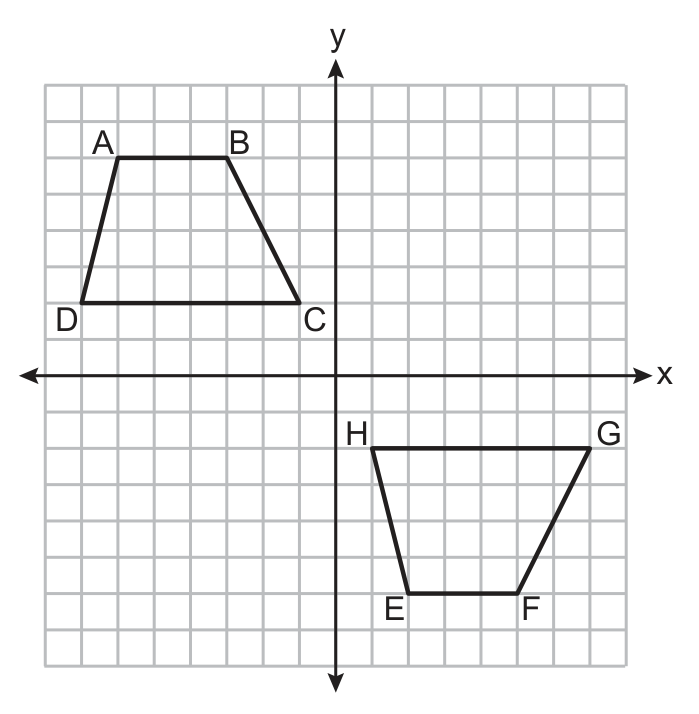
Trapezoids \(ABCD\) and \(EFGH\) are graphed on the set of axes below.
Which sequence of transformations maps trapezoid \(ABCD\) onto trapezoid \(EFGH\)?
- (1) a translation of 8 units down followed by a 90° counterclockwise rotation about the origin
- (2) a reflection over the x-axis followed by a translation of 8 units right
- (3) a 180° rotation about the origin
- (4) a reflection over the line \(y=x\)
Answer
Answer: (2), reflect across the x-axis, then translate 8 units right.
- The combined rule for choice (2) is \((x,y)\mapsto(x+8,-y)\). Reflection changes the sign of y; the translation then adds 8 to x.
- Read the vertices: \(A(-6,6)\), \(B(-3,6)\), \(C(-1,2)\), and \(D(-7,2)\).
- They map to \(E(2,-6)\), \(F(5,-6)\), \(G(7,-2)\), and \(H(1,-2)\), respectively. All four points match the graph.
SOMATH takeaway: Check the labeled correspondence, not just whether the transformed shape reaches the same quadrant.
Angles in a parallelogramQuestion 14
In parallelogram \(PARK\), \(m\angle P=(3x+42)^\circ\) and \(m\angle K=(5x-22)^\circ\). The measure of \(\angle R\) is
- (1) \(138^\circ\)
- (2) \(102^\circ\)
- (3) \(78^\circ\)
- (4) \(42^\circ\)
Answer
Answer: (2), \(102^\circ\).
- In the order \(P,A,R,K\), angles \(P\) and \(K\) are adjacent. Adjacent parallelogram angles are supplementary.
- Write \((3x+42)+(5x-22)=180\). Then \(8x+20=180\), so \(x=20\).
- Angle \(P\) measures \(3(20)+42=102^\circ\). Angle \(R\) is opposite \(P\), so \(m\angle R=102^\circ\).
SOMATH takeaway: Adjacent angles add to 180°; opposite angles are equal. Identify which relationship you have before writing an equation.
Perimeter on a coordinate planeQuestion 15
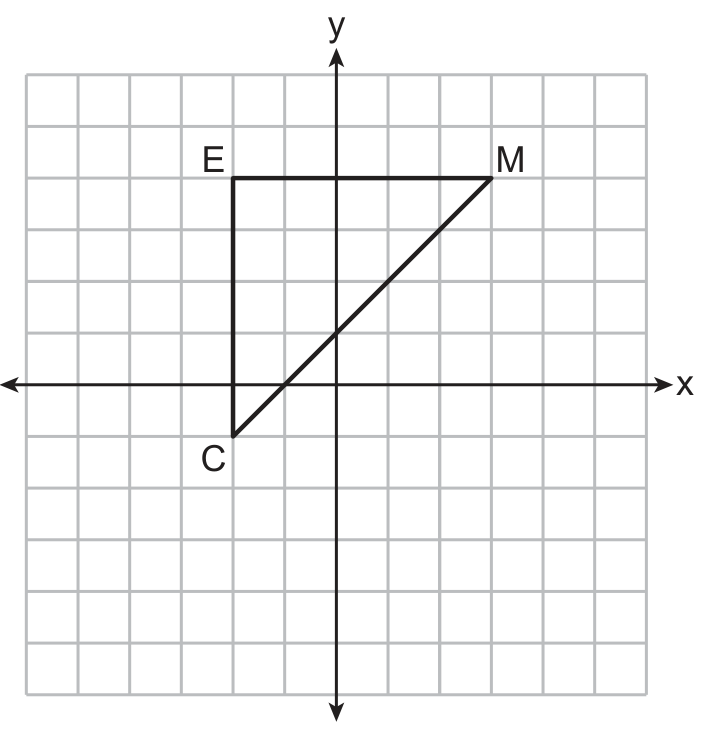
Triangle \(CEM\), with vertices at coordinates \(C(-2,-1)\), \(E(-2,4)\), and \(M(3,4)\), is graphed on the set of axes below.
What is the perimeter of \(\triangle CEM\)?
- (1) \(10+5\sqrt2\)
- (2) \(15\sqrt2\)
- (3) 12.5
- (4) 25
Answer
Answer: (1), \(10+5\sqrt2\).
- The vertical leg \(CE\) has length \(4-(-1)=5\). The horizontal leg \(EM\) has length \(3-(-2)=5\).
- By the Pythagorean theorem, \(CM=\sqrt{5^2+5^2}=\sqrt{50}=5\sqrt2\).
- Add all three side lengths: \(P=5+5+5\sqrt2=10+5\sqrt2\).
SOMATH takeaway: Perimeter adds lengths. The answer 12.5 is the triangle's area, not its perimeter.
Perpendicular slopesQuestion 16
What is the slope of the perpendicular bisector of \(\overline{MT}\) with endpoints whose coordinates are \(M(-2,-7)\) and \(T(3,8)\)?
- (1) \(\frac13\)
- (2) \(-\frac13\)
- (3) 3
- (4) −3
Answer
Answer: (2), \(-\frac13\).
- First find the slope of \(MT\): \(m=\frac{8-(-7)}{3-(-2)}=\frac{15}{5}=3\).
- A perpendicular nonvertical line has the negative reciprocal slope: \(-1/3\).
- The word “bisector” tells us where the line passes, but no midpoint calculation is needed when only its slope is requested.
SOMATH takeaway: A negative reciprocal changes the sign and flips the fraction. Simply changing 3 to −3 is not enough.
Two special right trianglesQuestion 17
In the diagram below, right triangles \(SLW\) and \(LOW\) are drawn.
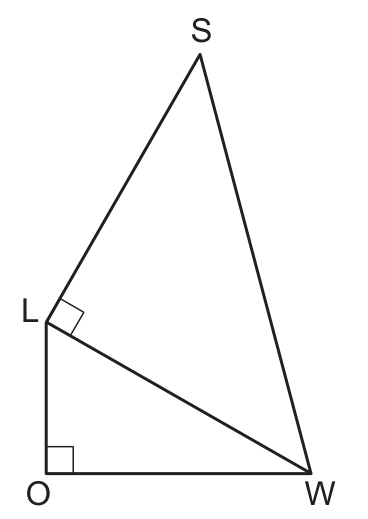
If \(m\angle S=45^\circ\), \(m\angle LWO=30^\circ\), and \(SW=18\sqrt2\), the length of \(\overline{OW}\) is
- (1) 9
- (2) \(9\sqrt2\)
- (3) \(9\sqrt3\)
- (4) 18
Answer
Answer: (3), \(9\sqrt3\).
- Triangle \(SLW\) is a \(45^\circ\)-\(45^\circ\)-\(90^\circ\) triangle with hypotenuse \(SW=18\sqrt2\). Each leg, including \(LW\), is 18.
- In triangle \(LOW\), \(LW=18\) is now the hypotenuse. Side \(OW\) is adjacent to the \(30^\circ\) angle at \(W\).
- Thus \(OW=18\cos30^\circ=18(\sqrt3/2)=9\sqrt3\).
SOMATH takeaway: A shared side can be a leg in one triangle and the hypotenuse in another. Relabel its role when switching triangles.
Equation of a circleQuestion 18
What is an equation of a circle with its center at \((0,-4)\) and a diameter of 30?
- (1) \(x^2+(y-4)^2=225\)
- (2) \(x^2+(y+4)^2=225\)
- (3) \(x^2+(y-4)^2=900\)
- (4) \(x^2+(y+4)^2=900\)
Answer
Answer: (2), \(x^2+(y+4)^2=225\).
- The standard form is \((x-h)^2+(y-k)^2=r^2\), where \((h,k)\) is the center.
- Here \(h=0\), \(k=-4\), and \(r=30/2=15\).
- Substitute: \(x^2+(y-(-4))^2=15^2\), or \(x^2+(y+4)^2=225\).
SOMATH takeaway: The center's y-coordinate is −4 even though the equation contains y+4. Also square the radius, not the diameter.
Volume and unit conversionQuestion 19
Jane is baking a cake in an 8-inch, square-base baking pan that is 2 inches deep. If she filled the pan with batter to a height of 1.5 inches, approximately how many cups of batter did she pour into this pan? [1 cup = 14.4375 in³]
- (1) 7
- (2) 2
- (3) 9
- (4) 4
Answer
Answer: (1), approximately 7 cups.
- The batter fills a rectangular prism with dimensions \(8\times8\times1.5\), not the full 2-inch depth.
- Its volume is \(V=8(8)(1.5)=96\) cubic inches.
- Divide by cubic inches per cup: \(96/14.4375\approx6.65\) cups. The closest choice is 7.
SOMATH takeaway: Use the actual filled height, then divide by the volume of one cup.
Altitude to a hypotenuseQuestion 20
In the diagram below of right triangle \(WSA\), altitude \(\overline{SD}\) is drawn to hypotenuse \(\overline{AW}\), \(SD=16\), and \(SA=34\).
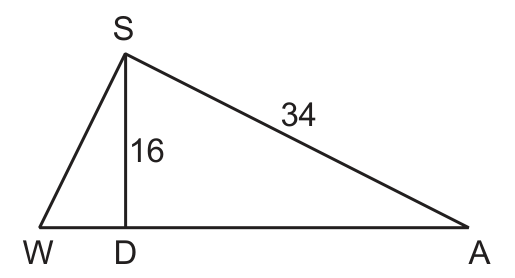
What is the length of \(\overline{WD}\), to the nearest tenth?
- (1) 4.3
- (2) 6.8
- (3) 7.5
- (4) 8.5
Answer
Answer: (4), 8.5.
- Start with right triangle \(SDA\). Its hypotenuse is 34 and one leg is 16, so \(AD=\sqrt{34^2-16^2}=\sqrt{900}=30\).
- An altitude to a right triangle's hypotenuse satisfies \(SD^2=WD\cdot AD\). This follows from the similarity of the two smaller triangles.
- Substitute: \(16^2=WD(30)\). Thus \(WD=256/30\approx8.533\), which rounds to 8.5.
SOMATH takeaway: Find the missing hypotenuse piece first. The altitude is the geometric mean of the two pieces, not their arithmetic mean.
Dilations: lengths, angles, and areaQuestion 21
Quadrilateral \(WXYZ\) is the image of quadrilateral \(ABCD\) after a dilation of scale factor \(\frac12\). Which statement is always true?
- (1) \(AB=\frac12(WX)\)
- (2) \(m\angle W=\frac12(m\angle A)\)
- (3) area of \(WXYZ=\frac12\)(area of \(ABCD\))
- (4) perimeter of \(WXYZ=\frac12\)(perimeter of \(ABCD\))
Answer
Answer: (4), the image's perimeter is half the original perimeter.
- A scale factor \(k=\frac12\) halves every corresponding side length, so adding the image's sides gives half the original perimeter.
- Angles are unchanged under dilation, so choice (2) is not correct.
- Area scales by \(k^2=\frac14\), not \(\frac12\). Also \(WX=\frac12 AB\), so choice (1) reverses the length relationship.
SOMATH takeaway: Lengths and perimeter scale by k, area by k², and angle measures do not change.
Triangle area from two sides and an angleQuestion 22
In \(\triangle AHL\), \(AH=10\), \(HL=12\), and \(m\angle H=40^\circ\). The area of \(\triangle AHL\), to the nearest square unit, is
- (1) 39
- (2) 46
- (3) 60
- (4) 77
Answer
Answer: (1), 39 square units.
- The given angle \(H\) is between the two given sides \(AH\) and \(HL\). Use \(A=\frac12 ab\sin C\).
- Substitute: \(A=\frac12(10)(12)\sin40^\circ=60\sin40^\circ\).
- The result is approximately 38.567, which rounds to 39 square units.
SOMATH takeaway: The sine factor supplies the perpendicular height. Using ½(10)(12) alone assumes a right angle that was not given.
Recognizing a rhombusQuestion 23
Parallelogram \(ABCD\) has diagonals \(\overline{AC}\) and \(\overline{BD}\), which intersect at point \(E\). Which additional information is sufficient to prove \(ABCD\) is a rhombus?
- (1) \(\overline{AE}\cong\overline{EC}\)
- (2) \(\overline{AC}\cong\overline{BD}\)
- (3) \(m\angle DEC=90^\circ\)
- (4) \(m\angle CDA=90^\circ\)
Answer
Answer: (3), \(m\angle DEC=90^\circ\).
- A parallelogram already has diagonals that bisect one another, so \(AE=EC\) adds nothing new.
- If \(\angle DEC=90^\circ\), the diagonals are perpendicular. A parallelogram with perpendicular diagonals is a rhombus.
- Why? The bisected diagonal pieces form right triangles with matching legs, so adjacent outer sides are congruent. Together with the parallelogram's opposite-side equality, all four sides are equal.
- Congruent diagonals or a right vertex angle would instead establish a rectangle, which need not be a rhombus.
SOMATH takeaway: Use the condition that distinguishes equal sides, rather than the condition that distinguishes right angles.
Dilating a line through the centerQuestion 24
The line whose equation is \(y=-2x-6\) is dilated by a scale factor of \(\frac12\) centered at \((-1,-4)\). An equation of the line’s image is
- (1) \(y=-x-3\)
- (2) \(y=-x-6\)
- (3) \(y=-2x-3\)
- (4) \(y=-2x-6\)
Answer
Answer: (4), \(y=-2x-6\).
- Check whether the dilation center lies on the line. At \(x=-1\), the equation gives \(y=-2(-1)-6=-4\). It does.
- A line through the center of a nonzero dilation maps onto itself. Its points move along that same line, rather than onto a new parallel line.
- For example, \((0,-6)\) maps halfway toward \((-1,-4)\), landing at \((-0.5,-5)\). This point still satisfies \(y=-2x-6\).
SOMATH takeaway: Do not halve a slope or intercept automatically. First locate the center relative to the line.
Answer key
Keep the key closed while you practice. Each question above includes the reasoning behind its answer.
Show answer key
Q1: (3), a translation.
Q2: (2), \(44^\circ\).
Q3: (4), \(\angle B\cong\angle Y\).
Q4: (3), 235.7 grams.
Q5: (1), \(AE=3(FE)\).
Q6: (3), cylinder.
Q7: (3), \(80^\circ\).
Q8: (1), \(y=-1\).
Q9: (2), \(\angle TAH\).
Q10: (1), 24.
Q11: (3), 19 inches.
Q12: (4), \((1,3)\).
Q13: (2), reflect across the x-axis, then translate 8 units right.
Q14: (2), \(102^\circ\).
Q15: (1), \(10+5\sqrt2\).
Q16: (2), \(-\frac13\).
Q17: (3), \(9\sqrt3\).
Q18: (2), \(x^2+(y+4)^2=225\).
Q19: (1), approximately 7 cups.
Q20: (4), 8.5.
Q21: (4), the image's perimeter is half the original perimeter.
Q22: (1), 39 square units.
Q23: (3), \(m\angle DEC=90^\circ\).
Q24: (4), \(y=-2x-6\).
Class review: what to remember
Group the problems by the decision they require. For transformations, decide whether size and orientation are preserved. For trigonometry, label sides relative to the angle. For volume, convert diameter to radius before substituting. For coordinates, distinguish slope, distance, midpoint, and partition formulas.
When an answer looks plausible, test it. A leg must be shorter than its hypotenuse, an image with scale factor one half has one quarter the area, and a line through the dilation center stays on the same line. These checks catch errors before they become habits.
Quick questions and answers
What does Part I of the August 2026 Geometry Regents include?
Part I has 24 multiple-choice questions, worth 2 credits each, for 48 credits. This walkthrough reproduces all choices and explains each answer. (NYSED scoring materials)
Does a dilation preserve congruence?
A dilation preserves angles and proportional side lengths. It generally changes size, so a scale factor other than 1 does not guarantee congruence.
When should I use sine, cosine, or tangent?
Label opposite, adjacent, and hypotenuse relative to the chosen acute angle. Sine uses opposite/hypotenuse, cosine uses adjacent/hypotenuse, and tangent uses opposite/adjacent.
How should I handle rounding?
Keep full calculator precision during intermediate calculations and round only the final answer to the requested place.
Are these official NYSED explanations?
No. The exam questions and diagrams are NYSED material. The step-by-step explanations are original SOMATH teaching solutions; the answer choices were checked against NYSED's scoring key.