SOMATH Journal · Regents Geometry · Part III
August 2026 Geometry Regents: Part III
This August 2026 Geometry Regents Part III walkthrough covers volume modeling, an SAS congruence proof, and an angle-of-elevation problem. Find the original questions and diagrams below, then select the blue Answer button for each original SOMATH solution: identify the idea, show the steps, and check the result.
Try each problem on paper before opening its answer. For guided preparation, book a SOMATH evaluation at 226 W 79th St, Upper West Side, or call (646) 668-6151.
Questions and original diagrams are reproduced from the NYSED August 2026 Geometry exam, with web formatting and mathematical notation normalized. The explanations are newly written by SOMATH, not NYSED solutions or an official scoring rubric; results were checked against the NYSED scoring key and rating guide.
Open the original exam PDF for the full booklet and reference sheet.
Show the reasoning, substitutions, and conclusions, not just an answer. The NYSED rating guide awards credit for the required work; for a numerical question, a correct answer alone receives only 1 credit. Keep construction marks visible and close each proof with an explicit conclusion.
Cylinder-to-cone volume modelingQuestion 32
A cylindrical container is completely filled with water. The inside of the cylinder has a diameter of 10 inches and is 20 inches tall.
Cone-shaped cups are filled from the container. The inside of a cone cup has a diameter of 3.25 inches and a height of 4.25 inches.
Determine and state the maximum number of full cups of water that can be filled from the cylindrical container.
Answer
Answer: 133 full cups.
- Convert each diameter to a radius. The cylinder radius is \(5\) inches; the cone radius is \(3.25/2=1.625\) inches.
- The cylinder contains \(V_{\rm cyl}=\pi(5)^2(20)=500\pi\) cubic inches.
- One conical cup holds \(V_{\rm cup}=\frac13\pi(1.625)^2(4.25)\) cubic inches.
- Divide container volume by cup volume. Cancel \(\pi\) before calculating: \(N=\frac{500}{(1/3)(1.625)^2(4.25)}\approx133.66\).
- Only completely filled cups count, so take the whole-number part: 133 cups. Rounding to 134 would require more water than the container holds.
SOMATH takeaway: There are two separate decisions: choose the correct volume formulas, then interpret the quotient in context. “Maximum full cups” means round down.
An isosceles-triangle congruence proofQuestion 33
Given: Isosceles triangle \(ABC\) with vertex angle \(ACB\), \(\overline{AM}\cong\overline{BN}\)
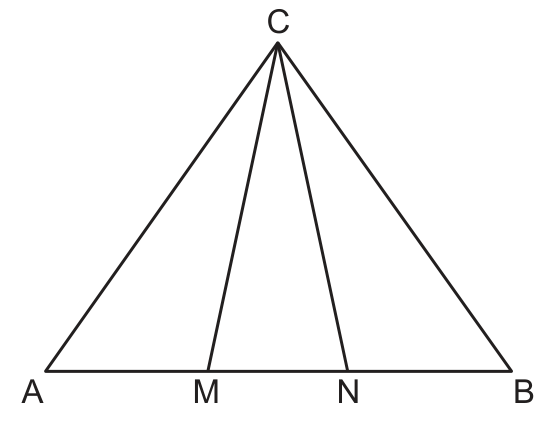
Prove: \(\triangle CAN\cong\triangle CBM\)
Answer
Answer: \(\triangle CAN\cong\triangle CBM\) by SAS.
- Because \(ABC\) is isosceles with vertex angle \(ACB\), its legs \(CA\) and \(CB\) are congruent.
- Its base angles are congruent: \(\angle CAB\cong\angle CBA\). Since \(A,M,N,B\) lie on the same line in that order, \(\angle CAN\) is the angle at \(A\), and \(\angle CBM\) is the angle at \(B\). Thus \(\angle CAN\cong\angle CBM\).
- The given congruent segments imply \(AM=BN\). Add \(MN\) to both: \(AM+MN=BN+MN\).
- By segment addition, \(AN=AM+MN\) and \(BM=BN+MN\), so \(\overline{AN}\cong\overline{BM}\).
- We have two corresponding sides, \(CA\cong CB\) and \(AN\cong BM\), and their included angles, \(\angle CAN\cong\angle CBM\). Therefore \(\triangle CAN\cong\triangle CBM\) by SAS.
A concise proof you can write
Since \(\triangle ABC\) is isosceles with vertex angle \(ACB\), \(\overline{CA}\cong\overline{CB}\) and \(\angle CAN\cong\angle CBM\) by the isosceles triangle theorem and collinearity. The given \(AM=BN\), together with segment addition, gives \(AN=AM+MN=BN+MN=BM\). Therefore \(\overline{AN}\cong\overline{BM}\), and \(\triangle CAN\cong\triangle CBM\) by SAS.
SOMATH takeaway: AM and BN are not whole sides of the target triangles. Add the shared middle segment to establish AN = BM before applying SAS.
Angle of elevation and the difference of distancesQuestion 34
Deshawn and Ziggy are standing on the ground at points \(D\) and \(Z\), respectively. Deshawn is 68 inches tall, Ziggy is 42 inches tall, and \(\overline{DZB}\) and \(\overline{AEB}\) are drawn, as modeled below.
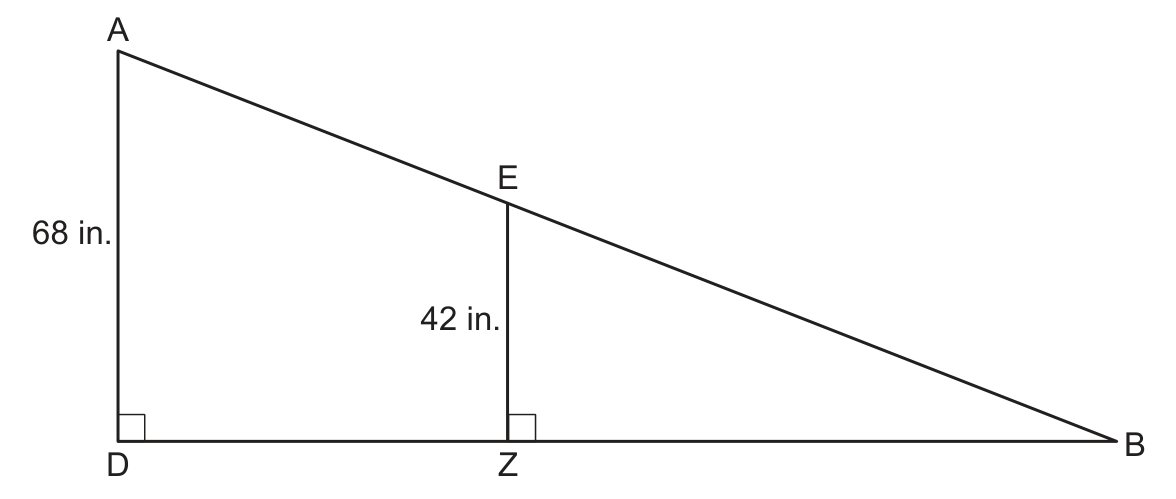
The angle of elevation from point \(B\) to the tops of their heads at \(A\) and \(E\) is \(23^\circ\). Determine and state the distance between \(D\) and \(Z\), to the nearest inch.
Answer
Answer: 61 inches.
- In the larger right triangle, \(\tan23^\circ=\frac{68}{BD}\). Hence \(BD=\frac{68}{\tan23^\circ}\).
- In the smaller right triangle, \(\tan23^\circ=\frac{42}{BZ}\). Hence \(BZ=\frac{42}{\tan23^\circ}\).
- Because \(Z\) is between \(D\) and \(B\), subtract: \(DZ=BD-BZ=\frac{68-42}{\tan23^\circ}\).
- Calculate \(DZ=\frac{26}{\tan23^\circ}\approx61.25\) inches, which rounds to 61 inches.
SOMATH takeaway: The question asks for the gap between the people, not either person's distance to B. Keep full precision until after subtracting.
Answer key
Keep the key closed while you practice. Each question above includes the reasoning behind its answer.
Class review: what to remember
Extended responses reward a chain of connected ideas. In Q32, geometry supplies the volumes and context decides rounding. In Q33, adding the same segment converts the given equality into the side equality needed for SAS. In Q34, trigonometry supplies two distances, but subtraction supplies the requested distance.
Write enough for another student to reconstruct the argument. A theorem name without its required facts, or a number without its interpretation, leaves the most important step unstated.
Quick questions and answers
Which questions are in Part III?
Part III contains Questions 32–34, worth 4 credits each, for 12 credits in total. (NYSED scoring materials)
Why is Question 32 answered with 133 rather than 134?
The volume quotient is approximately 133.66. The question asks for full cups, so the incomplete final cup does not count.
Which congruence theorem solves Question 33?
SAS works: CA equals CB, AN equals BM by adding the common segment MN to AM and BN, and the included base angles are congruent.
Why subtract distances in Question 34?
Both distances are measured from B. Since Z lies between D and B, the distance between the people is BD minus BZ.
Can a proof use the diagram's appearance as evidence?
No. Use the givens and established geometric relationships. The diagram helps organize reasoning but is not itself a proof of equal lengths or angles.