SOMATH Journal · Regents Geometry · Part II
August 2026 Geometry Regents: Part II
This August 2026 Geometry Regents Part II walkthrough covers angle relationships, density, similarity, circle geometry, and a compass-and-straightedge construction. Find the original questions and diagrams below, then select the blue Answer button for each original SOMATH solution: identify the idea, show the steps, and check the result.
Try each problem on paper before opening its answer. For guided preparation, book a SOMATH evaluation at 226 W 79th St, Upper West Side, or call (646) 668-6151.
Questions and original diagrams are reproduced from the NYSED August 2026 Geometry exam, with web formatting and mathematical notation normalized. The explanations are newly written by SOMATH, not NYSED solutions or an official scoring rubric; results were checked against the NYSED scoring key and rating guide.
Open the original exam PDF for the full booklet and reference sheet.
Show the reasoning, substitutions, and conclusions, not just an answer. The NYSED rating guide awards credit for the required work; for a numerical question, a correct answer alone receives only 1 credit. Keep construction marks visible and close each proof with an explicit conclusion.
Angle chasing in a parallelogramQuestion 25
In the diagram below of parallelogram \(ABCD\), \(\overline{AEB}\perp\overline{EF}\), and \(\overline{EF}\) and \(\overline{AC}\) intersect at \(P\).
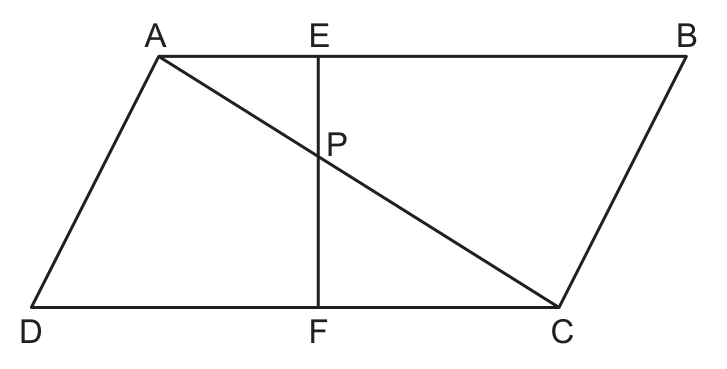
If \(m\angle BCP=84^\circ\) and \(m\angle CPF=56^\circ\), determine and state \(m\angle D\).
Answer
Answer: \(m\angle D=62^\circ\).
- Opposite sides of a parallelogram are parallel, so \(AB\parallel DC\). Because \(EF\perp AB\), it is also perpendicular to \(DC\); hence \(\angle PFC=90^\circ\).
- In triangle \(PCF\), \(m\angle PCF=180^\circ-90^\circ-56^\circ=34^\circ\).
- At \(C\), the full interior angle is split by \(CP\): \(m\angle BCD=84^\circ+34^\circ=118^\circ\).
- Adjacent parallelogram angles are supplementary, so \(m\angle D=180^\circ-118^\circ=62^\circ\).
SOMATH takeaway: Find the small right-triangle angle, combine the pieces at C, then use the parallelogram relationship.
Comparing population densitiesQuestion 26
The city of Buffalo, New York is approximately 40.5 square miles and has a population of 258,959 people. The city of Albany, New York is approximately 21.5 square miles and has a population of 98,424 people. (Data collected in 2013.)
Which city has the higher population density? Justify your answer.
Answer
Answer: Buffalo.
- Population density means people per square mile: divide population by area.
- Buffalo: \(258959/40.5\approx6394.05\) people per square mile.
- Albany: \(98424/21.5\approx4577.86\) people per square mile.
- Because 6,394.05 is greater than 4,577.86, Buffalo has the higher population density using the exam's supplied 2013 data.
SOMATH takeaway: A larger population alone is not a density comparison. Show both quotients and explicitly name the city.
Similar triangles and missing segmentsQuestion 27
In \(\triangle ABC\) below, points \(D\) and \(E\) are on \(\overline{AB}\) and \(\overline{AC}\), respectively, such that \(\overline{DE}\parallel\overline{BC}\).
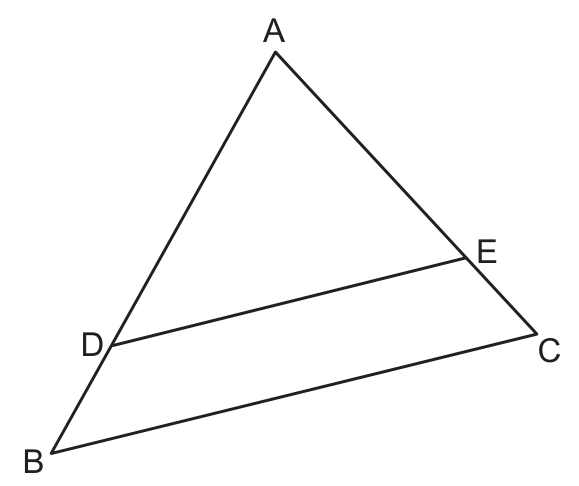
If \(AB=6.6\), \(DB=1.8\), and \(AE=4\), determine and state the length of \(\overline{EC}\).
Answer
Answer: \(EC=1.5\).
- Find the upper part of the left side: \(AD=AB-DB=6.6-1.8=4.8\).
- Parallel \(DE\) and \(BC\) create similar triangles \(ADE\) and \(ABC\). Therefore \(\frac{AD}{AB}=\frac{AE}{AC}\).
- Let \(EC=x\), so \(AC=4+x\). Write \(\frac{4.8}{6.6}=\frac4{4+x}\).
- Cross-multiply: \(4.8(4+x)=26.4\). Thus \(4.8x=7.2\), and \(x=1.5\).
SOMATH takeaway: Keep part-to-whole ratios aligned. The whole right side is 4+x, not x.
Angles formed by intersecting chordsQuestion 28
In circle \(A\) below, chords \(\overline{CN}\) and \(\overline{UL}\) intersect at \(H\).
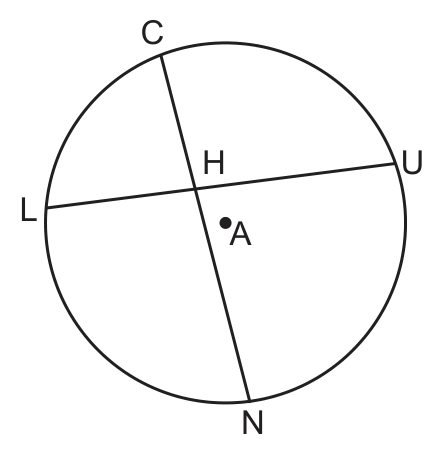
If \(m\widehat{LC}=64^\circ\) and \(m\widehat{NU}=108^\circ\), determine and state \(m\angle CHL\).
Answer
Answer: \(m\angle CHL=86^\circ\).
- Two chords intersect inside the circle. The angle equals half the sum of its intercepted arc and the arc intercepted by its vertical angle.
- For \(\angle CHL\), those arcs are \(\widehat{CL}\) and \(\widehat{NU}\).
- Compute \(m\angle CHL=\frac12(64^\circ+108^\circ)=86^\circ\).
SOMATH takeaway: Inside the circle: half the sum. Do not use the outside-secant half-difference rule.
Constructing an inscribed equilateral triangleQuestion 29
Use a compass and straightedge to construct an equilateral triangle inscribed in the circle below.
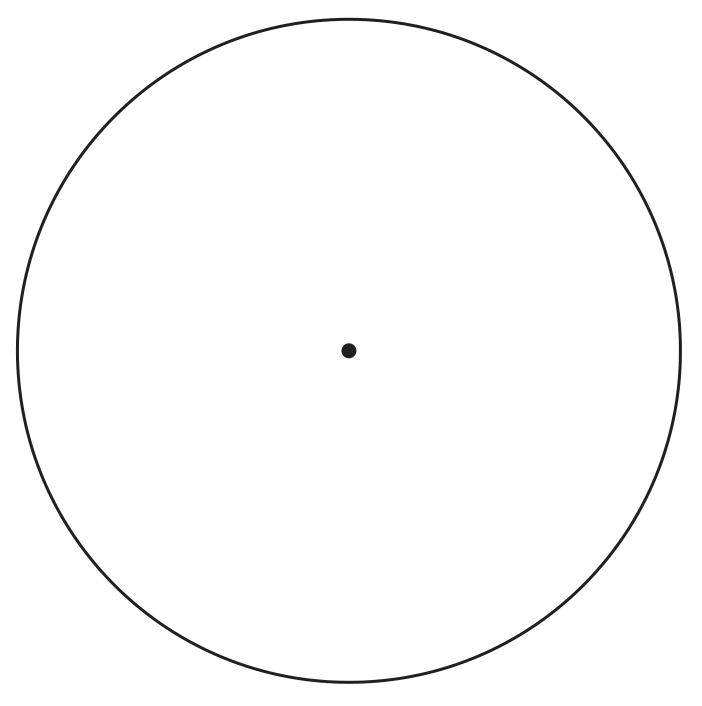
[Leave all construction marks.]
Answer
Answer: An inscribed equilateral triangle with visible compass arcs.
- Label the marked center \(O\). Choose a point \(A\) on the circle, and set the compass opening to \(OA\), the circle's radius.
- Without changing the compass opening, place the compass at \(A\) and mark the next intersection \(B\) with the circle.
- Move the compass to \(B\), then continue stepping the same radius around the circle to locate \(C,D,E,F\). Always take the next intersection, not the previous point.
- Use the straightedge to connect alternate points \(A,C,E\), completing triangle \(ACE\). Leave the compass arcs visible.
- Each radius-length chord forms an equilateral triangle with \(O\), creating a \(60^\circ\) central angle. Alternate vertices are separated by equal \(120^\circ\) arcs, so chords \(AC,CE,EA\) are equal.
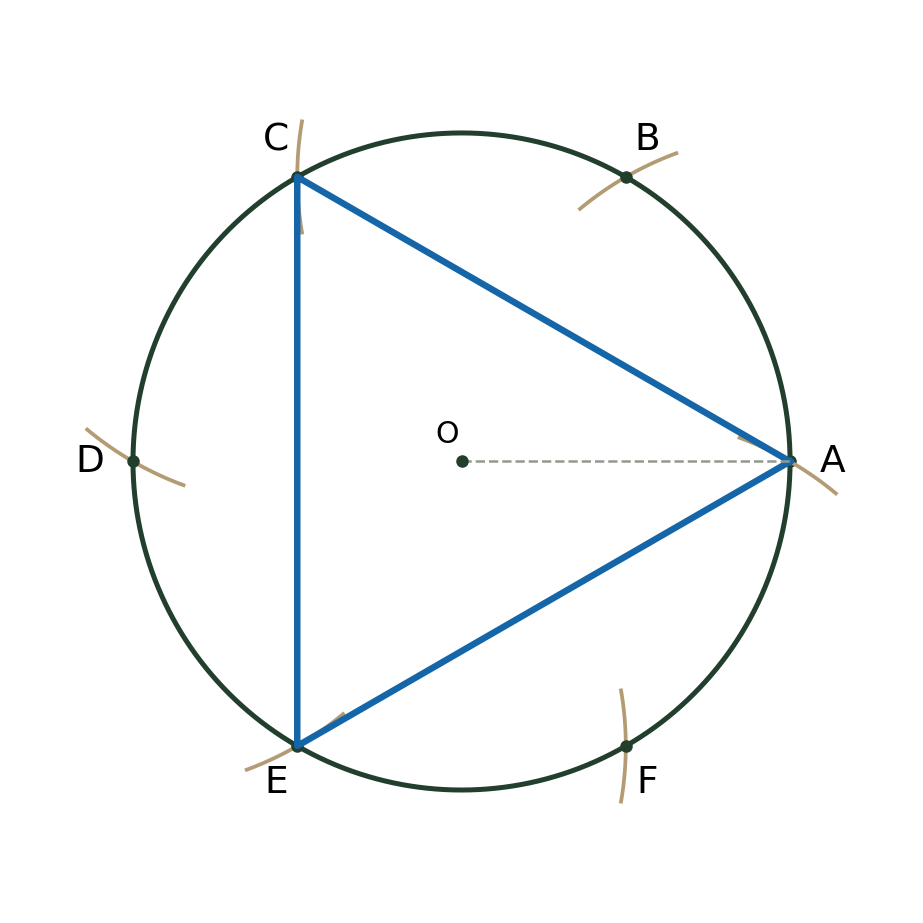
SOMATH takeaway: This is a construction, not a freehand sketch or a protractor measurement. The equal-radius arcs establish the equal spacing.
SSS similarityQuestion 30
In the diagram below, triangle I has side lengths of 8, 10, and 12, and triangle II has side lengths of 12, 15, and 18.
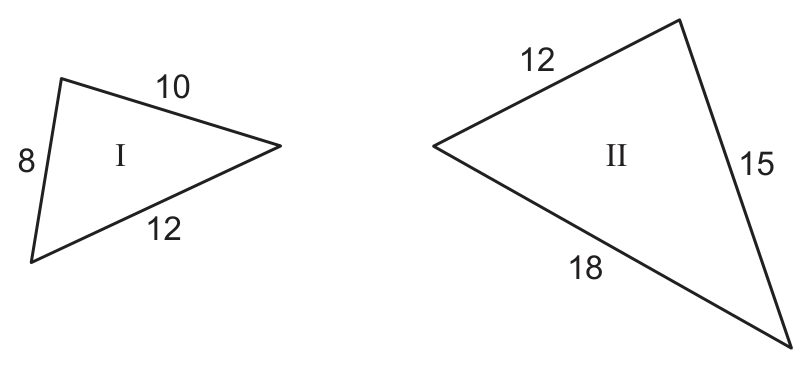
Explain why triangle I is similar to triangle II.
Answer
Answer: The triangles are similar by SSS similarity.
- Match shortest to shortest, middle to middle, and longest to longest: \(8\leftrightarrow12\), \(10\leftrightarrow15\), \(12\leftrightarrow18\).
- All three corresponding ratios are equal: \(\frac8{12}=\frac{10}{15}=\frac{12}{18}=\frac23\).
- Since all three pairs of corresponding sides are proportional, triangle I is similar to triangle II by the SSS similarity theorem.
SOMATH takeaway: State both the proportional sides and the theorem. A list of fractions without an explanation does not complete the response.
Sector area and parallel chordsQuestion 31
In circle \(P\) below, chords \(\overline{AB}\) and \(\overline{CD}\) are parallel, radii \(\overline{PB}\) and \(\overline{PD}\) are drawn, \(m\widehat{AB}=138^\circ\), and \(m\widehat{CD}=80^\circ\).
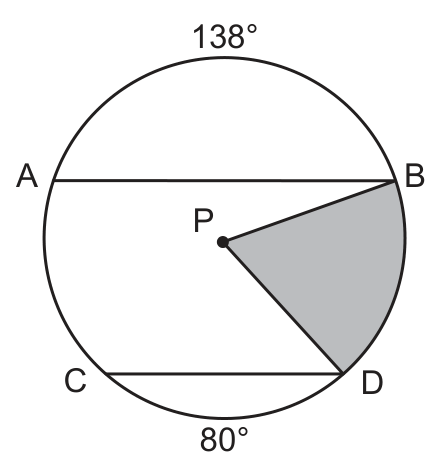
If \(PB=14\) inches, determine and state the area of shaded sector \(BPD\), to the nearest square inch.
Answer
Answer: 121 square inches.
- Parallel chords cut off congruent arcs between them, so \(\widehat{AC}\) and \(\widehat{BD}\) have the same measure.
- The two remaining arcs total \(360^\circ-138^\circ-80^\circ=142^\circ\). Each is \(142^\circ/2=71^\circ\).
- The central angle \(BPD\) therefore measures \(71^\circ\). Sector area is the same fraction of the whole circle: \(A=\frac{71}{360}\pi(14)^2\).
- This is approximately \(121.44\) square inches, which rounds to 121 square inches.
SOMATH takeaway: Find the sector's central angle first. The 138° label belongs to the top arc, not the shaded sector.
Answer key
Keep the key closed while you practice. Each question above includes the reasoning behind its answer.
Class review: what to remember
A complete short response is compact but justified. Write the relationship first, substitute values, calculate, and name the conclusion. In a construction, the visible compass arcs play the role of supporting work.
Watch the distinctions: population is not population density; a part of a side is not the whole side; equal side ratios establish similarity, not congruence. For a sector, find the central angle before calculating its share of the circle.
Quick questions and answers
Which questions are in Part II?
Part II contains Questions 25–31. Each is worth 2 credits, for a total of 14 credits. (NYSED scoring materials)
Is a numerical answer enough for full credit?
No. The exam requires supporting work. A correct numerical answer without work generally earns only 1 credit; explanation and construction questions require their requested justification or construction.
How do you construct an equilateral triangle inside a circle?
Use the circle's radius as a compass opening to mark six equally spaced points around the circumference, then join alternate points. Leave the construction arcs visible.
How do intersecting chords determine an angle?
For two chords intersecting inside a circle, the angle equals half the sum of the intercepted arcs of the angle and its vertical angle.
What makes a similarity explanation complete?
Identify corresponding sides, show a common ratio, and state the applicable similarity theorem, such as SSS similarity.