SOMATH Journal · Regents Algebra I · Part I
August 2026 Algebra 1 Regents: Part I
This August 2026 Algebra I Regents Part I walkthrough covers functions, equations, exponential models, polynomials, and statistics. Read the original questions and answer choices, then select the blue Answer control for a step-by-step SOMATH explanation: identify the idea, show the work, and check the result.
Try the problems on paper first. For guided preparation, book a free SOMATH evaluation at 226 W 79th St, Upper West Side, or call (646) 668-6151.
Questions, data, and original figures are reproduced from the August 18, 2026 Algebra I examination in the NYSED Algebra I archive, with mathematical notation and layout normalized for the web. The explanations are original SOMATH teaching solutions, not official NYSED explanations or scoring rubrics. Results were checked against the NYSED scoring key and rating guide.
Part I contains 24 questions at 2 credits each, with no partial credit. Select one answer for each question. See the official scoring key.
Download the original exam (PDF)
The unchanged exam booklet supplied for this lesson, including its reference sheet. No new workbook has been generated.
Recognizing exponential growthQuestion 1
The monarch butterfly population doubled every day during the month of June. Which kind of function best describes this situation?
- (1) linear
- (2) quadratic
- (3) exponential growth
- (4) exponential decay
Answer
Answer: (3), exponential growth.
- Doubling means multiplying by 2 each day, rather than adding a fixed number.
- If the initial population is \(P_0\), then after \(d\) days the model is \(P(d)=P_0(2)^d\). The variable appears in the exponent.
- Since the multiplying factor is greater than 1, this is exponential growth, not decay.
SOMATH takeaway: A constant added amount suggests a linear model; a constant multiplying factor suggests an exponential model.
Solving a decimal equationQuestion 2
The solution to \(3x-4=2.6x+8.2\) is
- (1) 30.5
- (2) 10.5
- (3) 21.5
- (4) 3.05
Answer
Answer: (1), \(30.5\).
- Subtract \(2.6x\) from both sides: \(0.4x-4=8.2\).
- Add 4: \(0.4x=12.2\). Divide by 0.4 to obtain \(x=30.5\).
- Check: \(3(30.5)-4=87.5\), and \(2.6(30.5)+8.2=87.5\). Both sides agree.
SOMATH takeaway: Keep decimal place value straight: 12.2 divided by 0.4 is the same as 122 divided by 4.
Substitution in a systemQuestion 3
Given: \[2x+y=6\qquad x=4y+12\]
When solving by substitution, which equation could be a step in solving this system?
- (1) \(2(4y+12)+y=6\)
- (2) \(2(-4y-12)+y=6\)
- (3) \(x=4(-6+2x)+12\)
- (4) \(x=4(6+2x)+12\)
Answer
Answer: (1), \(2(4y+12)+y=6\).
- The second equation already isolates \(x\): \(x=4y+12\).
- Replace the \(x\) in \(2x+y=6\) with the entire expression \(4y+12\). Parentheses show that the 2 multiplies all of it.
- This gives \(2(4y+12)+y=6\). If instead you isolate \(y\), the correct expression is \(y=6-2x\), not either expression in choices (3) and (4).
SOMATH takeaway: Substitute an equal expression for a variable without changing its signs.
Translating an inequalityQuestion 4
Which inequality represents 80 decreased by a number is less than 100?
- (1) \(80-n>100\)
- (2) \(80-n<100\)
- (3) \(n-80<100\)
- (4) \(n-80>100\)
Answer
Answer: (2), \(80-n<100\).
- “80 decreased by a number” means start at 80 and subtract the unknown number.
- Write that expression as \(80-n\). “Is less than 100” supplies \(<100\).
- The complete inequality is \(80-n<100\). Reversing the subtraction would describe a different statement.
SOMATH takeaway: Translate the order of subtraction before choosing the inequality sign.
Modeling depreciationQuestion 5
Dave bought a new car for $29,500. As soon as he drove it off the car lot, it began to depreciate in value. He was told that the car’s value would continue to decline at an average yearly rate of 17.5% for the first 5 years.
The function \(V(t)\) represents the value of Dave’s car in \(t\) years, where \(t\le5\). Which function correctly models this situation?
- (1) \(V(t)=29{,}500(1+1.75)^t\)
- (2) \(V(t)=29{,}500(1-1.75)^t\)
- (3) \(V(t)=29{,}500(1+0.175)^t\)
- (4) \(V(t)=29{,}500(1-0.175)^t\)
Answer
Answer: (4), \(V(t)=29{,}500(1-0.175)^t\).
- Convert the percent to a decimal: \(17.5\%=0.175\).
- Each year the car keeps \(1-0.175=0.825\), or 82.5%, of its previous value.
- Multiply the initial value by that remaining fraction once per year: \(V(t)=29{,}500(0.825)^t\). At \(t=0\), the formula gives the original $29,500.
SOMATH takeaway: For exponential decay, the base is the fraction remaining, not the percent lost.
Difference of squaresQuestion 6
Which expression is equivalent to \(400-x^2\)?
- (1) \((200-x)(200+x)\)
- (2) \((x-200)(x+200)\)
- (3) \((20-x)(20+x)\)
- (4) \((x-20)(x+20)\)
Answer
Answer: (3), \((20-x)(20+x)\).
- Recognize \(400=20^2\). Thus \(400-x^2=20^2-x^2\).
- Use \(a^2-b^2=(a-b)(a+b)\) with \(a=20\) and \(b=x\).
- The factors are \((20-x)(20+x)\). Choice (4) expands to \(x^2-400\), which has the opposite sign.
SOMATH takeaway: Identify the square roots of the two terms and preserve the order of subtraction.
Estimating from a scatter plotQuestion 7
The scatter plot below shows the relationship between the number of internet-connected devices and the number of members in a household.
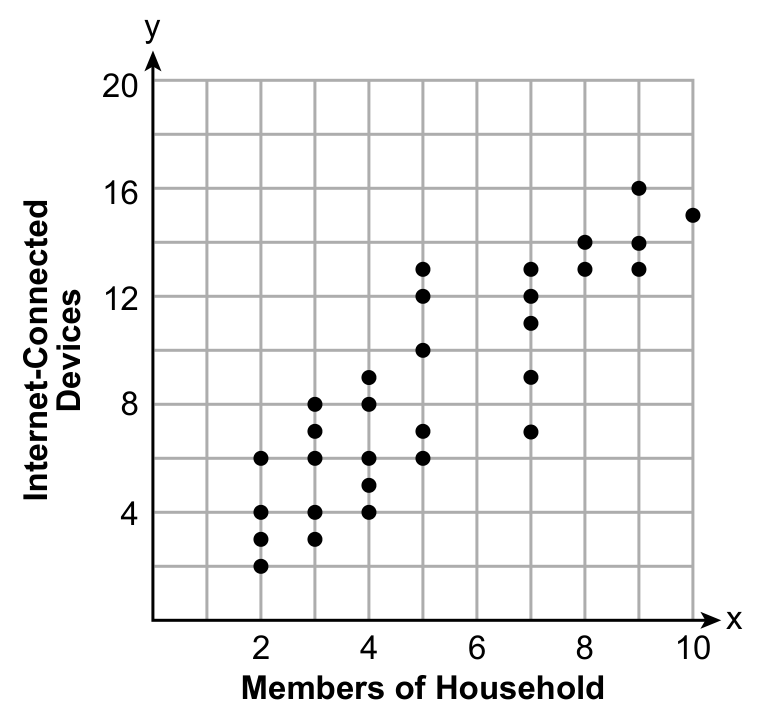
For a household that has six members, what would be the best estimate for the number of internet-connected devices?
- (1) 6
- (2) 10
- (3) 14
- (4) 18
Answer
Answer: (2), 10 devices.
- Read household members on the horizontal axis and internet-connected devices on the vertical axis.
- At six members, follow the overall upward pattern of the point cloud. A value near 10 devices falls through the middle of that pattern.
- The question asks for a trend-based estimate, not an exact observed household at x = 6. Among the choices, 10 is the most reasonable estimate.
SOMATH takeaway: A scatter-plot prediction follows the overall association, not the highest or lowest point.
Axis of symmetryQuestion 8
What is the equation of the axis of symmetry for \(y=-x^2+6x\)?
- (1) \(y=9\)
- (2) \(x=9\)
- (3) \(y=3\)
- (4) \(x=3\)
Answer
Answer: (4), \(x=3\).
- For \(y=ax^2+bx+c\), the axis is \(x=-\frac{b}{2a}\). Here \(a=-1\) and \(b=6\).
- Substitute: \(x=-6/[2(-1)]=3\).
- The vertex is \((3,9)\), but the axis is the vertical line \(x=3\), not \(y=9\).
SOMATH takeaway: The axis of symmetry is an equation for a vertical line, not just the vertex height.
Properties of equalityQuestion 9
The first step in solving a quadratic equation is shown below. \[x^2-2x+3=-12\] \[x^2-2x+15=0\]
Which property was used?
- (1) additive identity
- (2) addition property of equality
- (3) commutative property of addition
- (4) associative property of addition
Answer
Answer: (2), addition property of equality.
- Compare the two lines: the constant on the left rises from 3 to 15, and the right side rises from \(-12\) to 0.
- Both sides have had 12 added: \(x^2-2x+3+12=-12+12\).
- Adding the same number to both sides preserves equality. Reordering or regrouping terms is not the change shown here.
SOMATH takeaway: Name the operation actually performed on the equation.
Polynomial standard formQuestion 10
A fourth-degree polynomial with a leading coefficient of eight and a constant term of twelve written in standard form is
- (1) \(12+5x^2+8x^4\)
- (2) \(8x^4+5x^2+12\)
- (3) \(12+6x+5x^2+8x^3\)
- (4) \(8x^3+5x^2+6x+12\)
Answer
Answer: (2), \(8x^4+5x^2+12\).
- Fourth degree means the highest exponent is 4. A leading coefficient of 8 means the highest-degree term is \(8x^4\).
- Standard form lists terms in descending order of exponent, ending with the constant 12.
- Choice (2) meets all three requirements. Missing \(x^3\) and \(x\) terms simply have coefficient zero.
SOMATH takeaway: Check degree, leading coefficient, constant term, and ordering separately.
Evaluating a function at a negative inputQuestion 11
If \(g(x)=x^2-x\), then what is the value of \(g(-4)\)?
- (1) \(-20\)
- (2) \(-12\)
- (3) 12
- (4) 20
Answer
Answer: (4), 20.
- Replace every \(x\) with \(-4\), using parentheses: \(g(-4)=(-4)^2-(-4)\).
- The square is 16, and subtracting \(-4\) adds 4. Therefore \(g(-4)=16+4=20\).
- Do not confuse \((-4)^2=16\) with \(-4^2=-16\). The substitution requires the parentheses.
SOMATH takeaway: Negative inputs need parentheses, especially when powers or subtraction are involved.
Scaling a recipe and converting unitsQuestion 12
A cookie recipe requires \(1\frac34\) cups of flour to make 25 cookies. Using the same recipe, how many ounces of flour are needed to make 75 cookies? [1 cup = 8 ounces]
- (1) 10.72
- (2) 14
- (3) 32.16
- (4) 42
Answer
Answer: (4), 42 ounces.
- The number of cookies triples: \(75/25=3\). Multiply the flour by the same factor.
- The flour needed is \(3(1\frac34)=3(\frac74)=\frac{21}{4}=5.25\) cups.
- Use the conversion supplied by the exam: \(5.25\times8=42\) ounces.
SOMATH takeaway: Scale the recipe and then convert the units; do not apply the scale factor twice.
Products of radicalsQuestion 13
The product of \(3\sqrt7\) and \(\sqrt7\) is
- (1) rational, because the product is 21
- (2) rational, because the product of two irrational numbers is always rational
- (3) irrational, because the product of two irrational numbers is always irrational
- (4) irrational, because \(\sqrt7\) is a nonrepeating, nonterminating decimal
Answer
Answer: (1), rational, because the product is 21.
- Multiply: \((3\sqrt7)(\sqrt7)=3(\sqrt7\cdot\sqrt7)=3(7)=21\).
- Since \(21=21/1\), it is rational.
- The product of two irrational numbers is not always rational: for example, \(\sqrt2\sqrt3=\sqrt6\). So choice (2) reaches the right classification using a false general rule.
SOMATH takeaway: A multiple-choice justification must be true, not merely attached to the right conclusion.
Increasing functions across representationsQuestion 14
Three functions \(f(x)\), \(g(x)\), and \(h(x)\) are shown below.
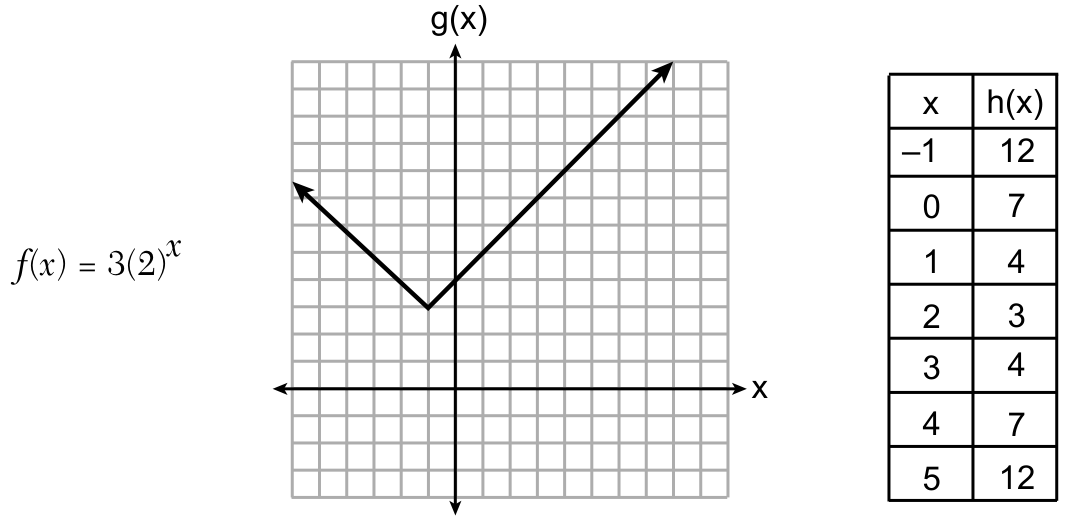
Which function or functions will always increase over the interval \(1\le x\le4\)?
- (1) \(g(x)\), only
- (2) \(h(x)\), only
- (3) \(f(x)\) and \(g(x)\)
- (4) \(f(x)\) and \(h(x)\)
Answer
Answer: (3), \(f(x)\) and \(g(x)\).
- The formula \(f(x)=3(2)^x\) increases as \(x\) increases because the positive base 2 is greater than 1.
- On the graph of \(g\), the entire interval from \(x=1\) to \(x=4\) lies on the rising right-hand branch.
- For \(h\), the listed values from \(x=1\) through 4 are 4, 3, 4, 7. The initial drop from 4 to 3 means it is not increasing throughout the interval.
SOMATH takeaway: Check the whole stated interval; an overall rise between endpoints is not enough.
Zeros from factored formQuestion 15
The zeros of \(f(x)=x(x+2)(x-4)\) are
- (1) \(\{2,-4\}\)
- (2) \(\{-2,4\}\)
- (3) \(\{0,2,-4\}\)
- (4) \(\{0,-2,4\}\)
Answer
Answer: (4), \(\{0,-2,4\}\).
- A zero is an input that makes the function equal 0. A product equals 0 when at least one factor equals 0.
- Solve \(x=0\), \(x+2=0\), and \(x-4=0\). The results are \(0,-2,4\).
- The initial factor \(x\) supplies the zero 0; do not overlook it.
SOMATH takeaway: Set each factor equal to zero, rather than copying the signs from inside the factors.
Equivalent exponential expressionsQuestion 16
Three expressions are shown below.
I. \(2^{x+6}\)
II. \(4^{x+3}\)
III. \(16\cdot2^{x+2}\)
Which of these expressions are equivalent for all values of \(x\)?
- (1) I and II, only
- (2) I and III, only
- (3) II and III, only
- (4) I, II, and III
Answer
Answer: (2), I and III, only.
- Rewrite III using base 2: \(16\cdot2^{x+2}=2^4\cdot2^{x+2}=2^{x+6}\). This is exactly I.
- Rewrite II: \(4^{x+3}=(2^2)^{x+3}=2^{2x+6}\). Its exponent is not \(x+6\) for every \(x\).
- At \(x=1\), I and III equal 128, but II equals 256. Agreement at a single input such as 0 would not prove equivalence.
SOMATH takeaway: Products with the same base add exponents; a power raised to a power multiplies exponents.
Completing the squareQuestion 17
When using the method of completing the square to solve \(x^2+4x-11=0\), which equation is a correct step in the process?
- (1) \((x+2)^2=-7\)
- (2) \((x-2)^2=-7\)
- (3) \((x+2)^2=15\)
- (4) \((x-2)^2=15\)
Answer
Answer: (3), \((x+2)^2=15\).
- Move the constant: \(x^2+4x=11\).
- Half of 4 is 2; its square is 4. Add 4 to both sides: \(x^2+4x+4=15\).
- The left side factors as \((x+2)^2\), giving \((x+2)^2=15\).
SOMATH takeaway: Whatever you add to complete the square must also be added to the other side.
Comparing mean and standard deviationQuestion 18
George and Henry are in a bowling league. Their top scores from each of the last nine weeks are listed below:
| Player | 1 | 2 | 3 | 4 | 5 | 6 | 7 | 8 | 9 |
|---|---|---|---|---|---|---|---|---|---|
| George | 198 | 101 | 167 | 202 | 185 | 103 | 192 | 200 | 198 |
| Henry | 210 | 126 | 194 | 200 | 172 | 98 | 215 | 114 | 202 |
Which statement correctly describes the relationship between George and Henry’s bowling scores?
- (1) The standard deviation for George’s bowling scores is less than Henry’s, but the mean for George’s bowling scores is greater than Henry’s.
- (2) The standard deviation for George’s bowling scores is greater than Henry’s, but the mean for George’s bowling scores is less than Henry’s.
- (3) The standard deviation and mean for George’s bowling scores are both less than Henry’s.
- (4) The standard deviation and mean for George’s bowling scores are both greater than Henry’s.
Answer
Answer: (1), George has the smaller standard deviation and the larger mean.
- Enter each player's nine scores in a separate calculator list and run one-variable statistics.
- George's mean is about \(171.78\), while Henry's is about \(170.11\). Thus George's mean is larger.
- The population standard deviations are approximately \(38.63\) for George and \(42.67\) for Henry. Thus George's scores have the smaller spread. Using sample standard deviations consistently gives the same ordering.
SOMATH takeaway: The mean compares center; standard deviation compares spread. Compare both before choosing.
Determining whether a relation is a functionQuestion 19
The mapping shown below demonstrates a relation.
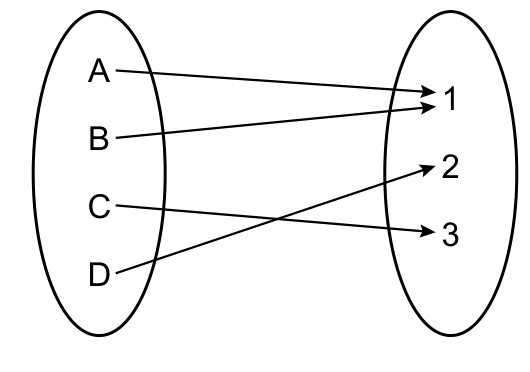
Which statement about this relation is true?
- (1) It is a function because each element of the domain maps onto only one element of the range.
- (2) It is a function because each element of the range maps onto only one element of the domain.
- (3) It is not a function because each element of the domain maps onto only one element of the range.
- (4) It is not a function because each element of the range maps onto only one element of the domain.
Answer
Answer: (1), each domain element maps to exactly one output.
- Read the arrows: A maps to 1, B maps to 1, C maps to 3, and D maps to 2.
- Each input has just one output, so the relation is a function.
- Different inputs may share an output. A and B both mapping to 1 does not violate the function rule.
SOMATH takeaway: A function restricts outputs per input, not inputs per output.
Horizontal shifts of an absolute-value functionQuestion 20
The function \(f(x)=|x+6|-5\) is shifted to the right 2 units to make the function \(g(x)\). Which function represents \(g(x)\)?
- (1) \(g(x)=|x+4|-5\)
- (2) \(g(x)=|x+8|-5\)
- (3) \(g(x)=|x+6|-3\)
- (4) \(g(x)=|x+6|-7\)
Answer
Answer: (1), \(g(x)=|x+4|-5\).
- A shift right by 2 replaces \(x\) with \(x-2\): \(g(x)=f(x-2)\).
- Substitute: \(g(x)=|(x-2)+6|-5=|x+4|-5\).
- Check the vertex: \((-6,-5)\) moves right to \((-4,-5)\). The vertical coordinate does not change.
SOMATH takeaway: For a horizontal shift, change the input inside the function.
Average rate of changeQuestion 21
The table below shows the average cost for one dozen large eggs over a period of years.
| Year | 2009 | 2010 | 2011 | 2012 | 2013 | 2014 | 2015 | 2016 |
|---|---|---|---|---|---|---|---|---|
| Cost ($) | 1.34 | 2.65 | 2.65 | 2.68 | 2.68 | 2.00 | 2.11 | 2.08 |
What is the average rate of change of the cost, in dollars per year, from 2009 to 2016 rounded to the nearest hundredth?
- (1) \(-0.11\)
- (2) \(-0.10\)
- (3) 0.10
- (4) 0.11
Answer
Answer: (4), $0.11 per year.
- Use the endpoint costs: $1.34 in 2009 and $2.08 in 2016.
- Average rate of change is \(\frac{2.08-1.34}{2016-2009}=\frac{0.74}{7}\approx0.105714\).
- Round to the nearest hundredth: $0.11 per year. There are seven elapsed years, even though the table lists eight calendar years.
SOMATH takeaway: Use change in output divided by change in input, not an average of the listed costs.
Testing a point on a quadraticQuestion 22
Which ordered pair represents a point on the graph of \(y=x^2-7x-10\)?
- (1) \((-10,0)\)
- (2) \((10,0)\)
- (3) \((3.5,-22.5)\)
- (4) \((3.5,-22.25)\)
Answer
Answer: (4), \((3.5,-22.25)\).
- Substitute the candidate x-coordinate 3.5: \(y=(3.5)^2-7(3.5)-10\).
- Compute carefully: \(12.25-24.5-10=-22.25\).
- Thus \((3.5,-22.25)\) lies on the graph. For comparison, \(x=10\) gives 20, and \(x=-10\) gives 160, so neither point with y-coordinate 0 works.
SOMATH takeaway: A point belongs to a graph only when its two coordinates satisfy the equation together.
Factoring completelyQuestion 23
When factored completely, \(x^4-5x^3-36x^2\) is
- (1) \(x(x^3-5x^2-36x)\)
- (2) \(x^2(x^2-5x-36)\)
- (3) \(x^2(x-9)(x+4)\)
- (4) \((x^2-9)(x^2+4)\)
Answer
Answer: (3), \(x^2(x-9)(x+4)\).
- First factor out the greatest common factor \(x^2\): \(x^2(x^2-5x-36)\).
- Find two numbers with product \(-36\) and sum \(-5\): \(-9\) and 4.
- The trinomial becomes \((x-9)(x+4)\). Keep the GCF to obtain \(x^2(x-9)(x+4)\).
SOMATH takeaway: Factoring out the GCF is the first step, not necessarily the final one.
Subtracting polynomialsQuestion 24
When \(3x^2-2x+1\) is subtracted from \(4x^2+5x-6\), the result is
- (1) \(-x^2+3x-5\)
- (2) \(-x^2-7x+7\)
- (3) \(x^2+3x-5\)
- (4) \(x^2+7x-7\)
Answer
Answer: (4), \(x^2+7x-7\).
- “A is subtracted from B” means \(B-A\). Write \((4x^2+5x-6)-(3x^2-2x+1)\).
- Distribute the subtraction to every term: \(4x^2+5x-6-3x^2+2x-1\).
- Combine like terms: \(x^2+7x-7\). In particular, \(5x-(-2x)=7x\).
SOMATH takeaway: Write parentheses before subtracting, then change every sign in the subtracted polynomial.
Answer key
Keep the key closed until you have tried the questions. Open the individual answers above for the full reasoning.
Show answer key
Q1: (3), exponential growth.
Q2: (1), \(30.5\).
Q3: (1), \(2(4y+12)+y=6\).
Q4: (2), \(80-n<100\).
Q5: (4), \(V(t)=29{,}500(1-0.175)^t\).
Q6: (3), \((20-x)(20+x)\).
Q7: (2), 10 devices.
Q8: (4), \(x=3\).
Q9: (2), addition property of equality.
Q10: (2), \(8x^4+5x^2+12\).
Q11: (4), 20.
Q12: (4), 42 ounces.
Q13: (1), rational, because the product is 21.
Q14: (3), \(f(x)\) and \(g(x)\).
Q15: (4), \(\{0,-2,4\}\).
Q16: (2), I and III, only.
Q17: (3), \((x+2)^2=15\).
Q18: (1), George has the smaller standard deviation and the larger mean.
Q19: (1), each domain element maps to exactly one output.
Q20: (1), \(g(x)=|x+4|-5\).
Q21: (4), $0.11 per year.
Q22: (4), \((3.5,-22.25)\).
Q23: (3), \(x^2(x-9)(x+4)\).
Q24: (4), \(x^2+7x-7\).
Class review: what to remember
Choose the structure before calculating. Constant multiplication suggests an exponential model; a factored product gives zeros; a change in two measured quantities calls for a rate. When a question includes an explanation in its answer choices, check the explanation as carefully as the number. Parentheses protect negative inputs and polynomial subtraction.
Quick questions and answers
What does Part I include?
Part I contains 24 multiple-choice questions, worth 2 credits each, for 48 credits. No partial credit is awarded. (NYSED scoring materials)
Why does Question 13 have a rational product?
Multiplying 3√7 by √7 gives 3×7=21, which is rational. This does not mean every product of irrational numbers is rational.
How do I compare the functions in Question 14?
Check whether each function increases throughout the entire interval from x=1 to x=4. The functions f and g increase; h first decreases from 4 to 3.
How do I avoid sign mistakes when subtracting polynomials?
Put the subtracted polynomial in parentheses, distribute the negative to every term, and then combine like terms.
Are these the official NYSED explanations?
No. The questions and original figures come from NYSED. The worked explanations are original SOMATH teaching solutions, checked against the official scoring materials.