SOMATH Journal · Regents Algebra I · Part III
August 2026 Algebra 1 Regents: Part III
This August 2026 Algebra I Regents Part III walkthrough covers linear regression, graphing inequalities, quadratic models, and systems. Read the original questions and answer choices, then select the blue Answer control for a step-by-step SOMATH explanation: identify the idea, show the work, and check the result.
Try the problems on paper first. For guided preparation, book a free SOMATH evaluation at 226 W 79th St, Upper West Side, or call (646) 668-6151.
Questions, data, and original figures are reproduced from the August 18, 2026 Algebra I examination in the NYSED Algebra I archive, with mathematical notation and layout normalized for the web. The explanations are original SOMATH teaching solutions, not official NYSED explanations or scoring rubrics. Results were checked against the NYSED scoring key and rating guide.
Show your work and answer every requested component. A correct numerical answer with no work receives only 1 credit. Use the required method when one is specified, and follow the question-specific rating criteria.
Download the original exam (PDF)
The unchanged exam booklet supplied for this lesson, including its reference sheet. No new workbook has been generated.
Linear regression and correlationQuestion 31
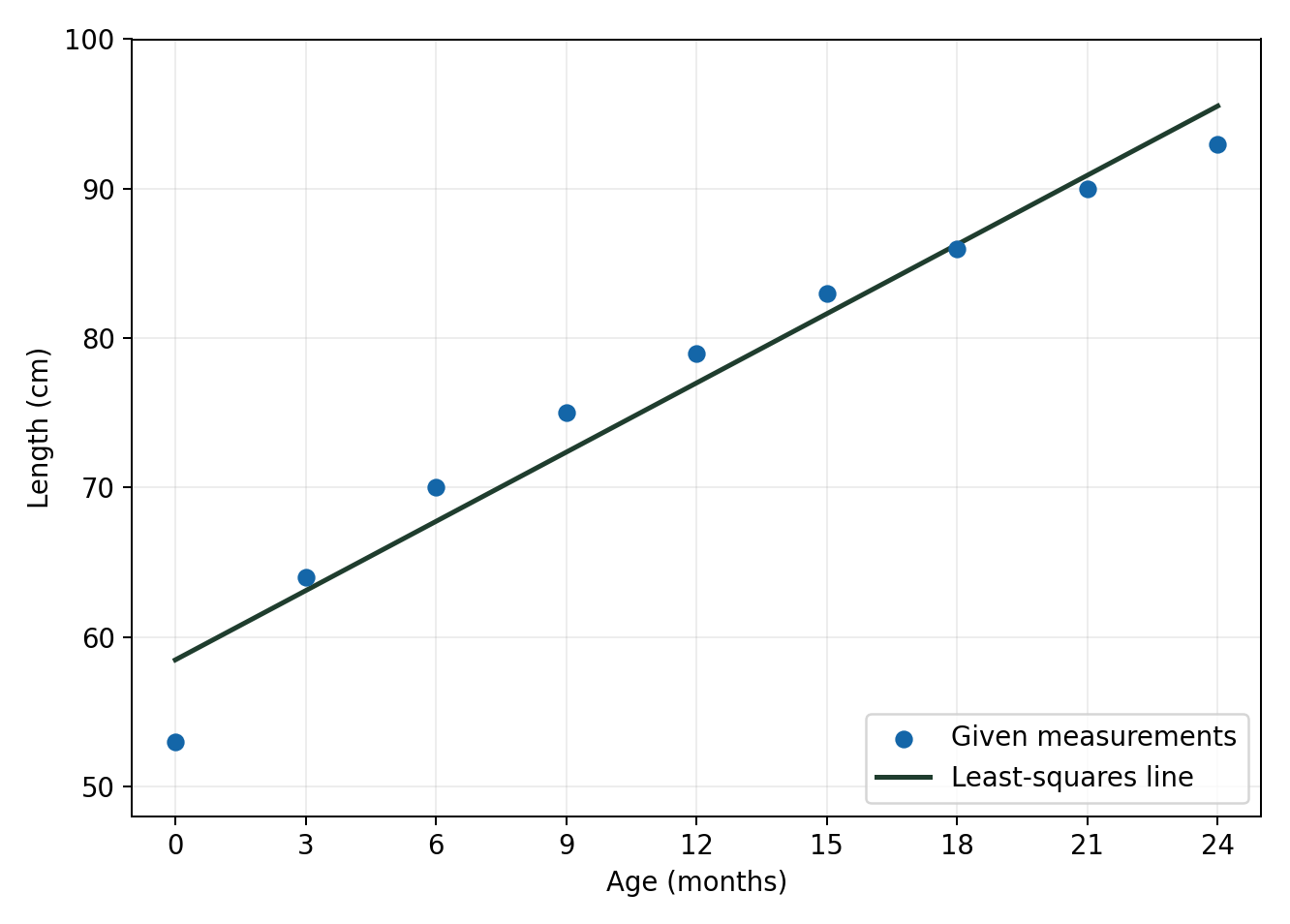
The following table shows the average length of a baby girl from birth to 24 months.
| Age (months), x | 0 | 3 | 6 | 9 | 12 | 15 | 18 | 21 | 24 |
|---|---|---|---|---|---|---|---|---|---|
| Length (cm), y | 53 | 64 | 70 | 75 | 79 | 83 | 86 | 90 | 93 |
Write a linear regression equation for this set of data. Round all values to the nearest hundredth.
State the correlation coefficient for this data set, rounded to the nearest hundredth.
State what the correlation coefficient indicates about the linear fit of the data.
Answer
Answer: \(y=1.54x+58.47\), \(r=0.98\); a strong positive linear fit.
- Enter the ages as the x-list and lengths as the y-list, keeping each pair in the same row. Run linear regression on all nine data pairs.
- The unrounded least-squares slope is approximately \(1.544444\), and the intercept is approximately \(58.466667\).
- Round the coefficients to hundredths and write an equation: \(y=1.54x+58.47\).
- The correlation coefficient is approximately \(0.978970\), so \(r=0.98\). Its closeness to \(+1\) indicates a strong positive linear relationship.
- The regression line need not pass through the birth measurement or every other point. Do not substitute a line through only the first and last measurements for the least-squares regression.
SOMATH takeaway: Report the equation, r, and an interpretation; r is not the same quantity as r².
Graphing a system of inequalitiesQuestion 32
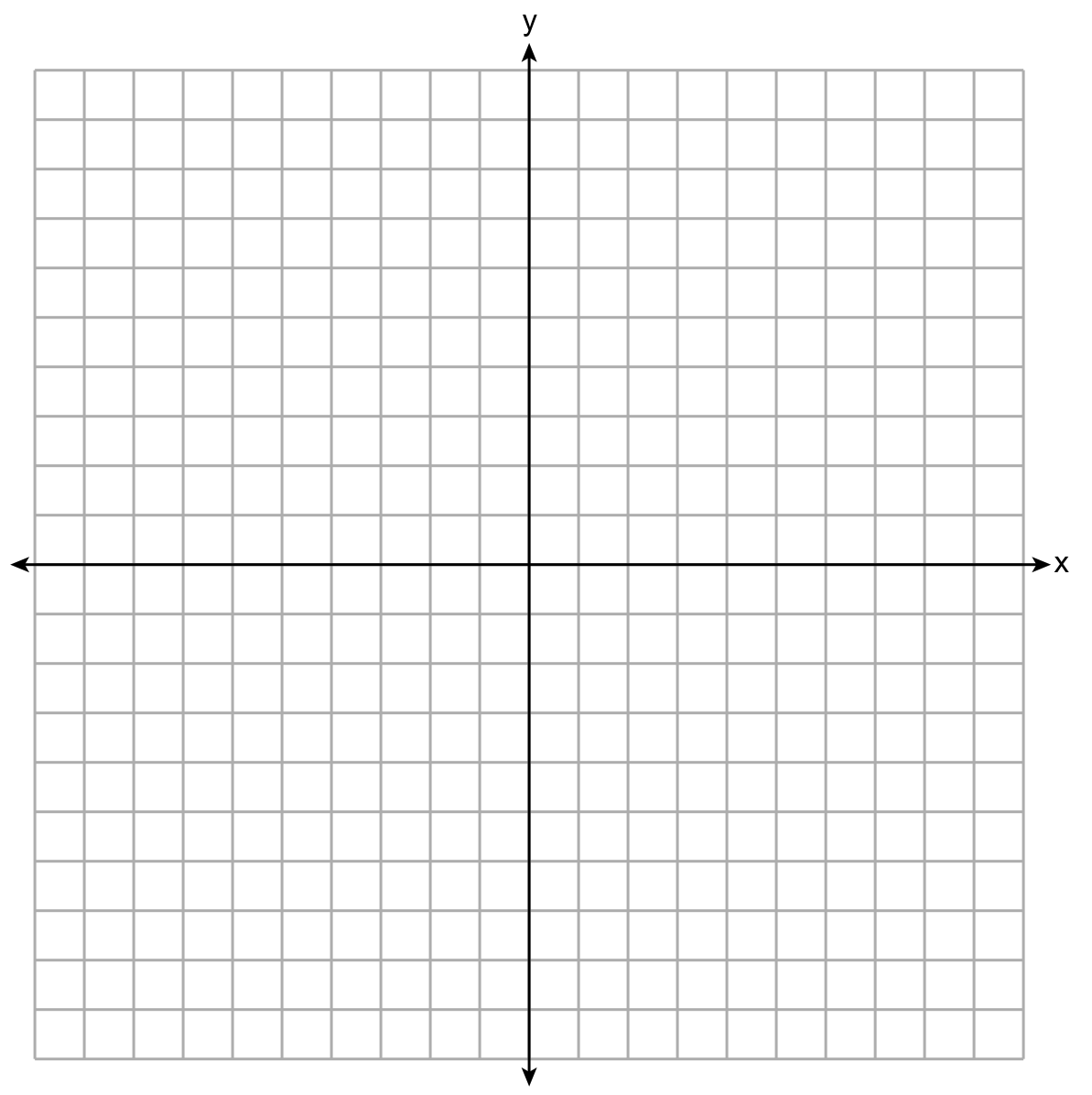
Solve this system of inequalities graphically, on the set of axes below.
Label the solution set \(S\). \[y+5>2x\qquad 3y\le2x+6\]
Is the point \((2,-1)\) a solution for this system of inequalities?
Justify your answer.
Answer
Answer: \(S=\{(x,y):2x-5<y\le\frac23x+2\}\); \((2,-1)\) is not a solution.
- Isolate \(y\): the inequalities become \(y>2x-5\) and \(y\le\frac23x+2\).
- Draw \(y=2x-5\) as a dashed line through \((0,-5)\) and \((3,1)\). Shade above it; the boundary is excluded.
- Draw \(y=\frac23x+2\) as a solid line through \((0,2)\) and \((3,4)\). Shade at or below it; this boundary is included.
- The overlap is the solution set \(S\). The lines meet at \((21/4,11/2)\); the overlap lies to the left of that point, between the two lines. The intersection itself is excluded because the first inequality is strict.
- Test \((2,-1)\) in the original first inequality: \(-1+5>2(2)\) would require \(4>4\), which is false. Although \(3(-1)\le2(2)+6\) is true, a solution must satisfy both.
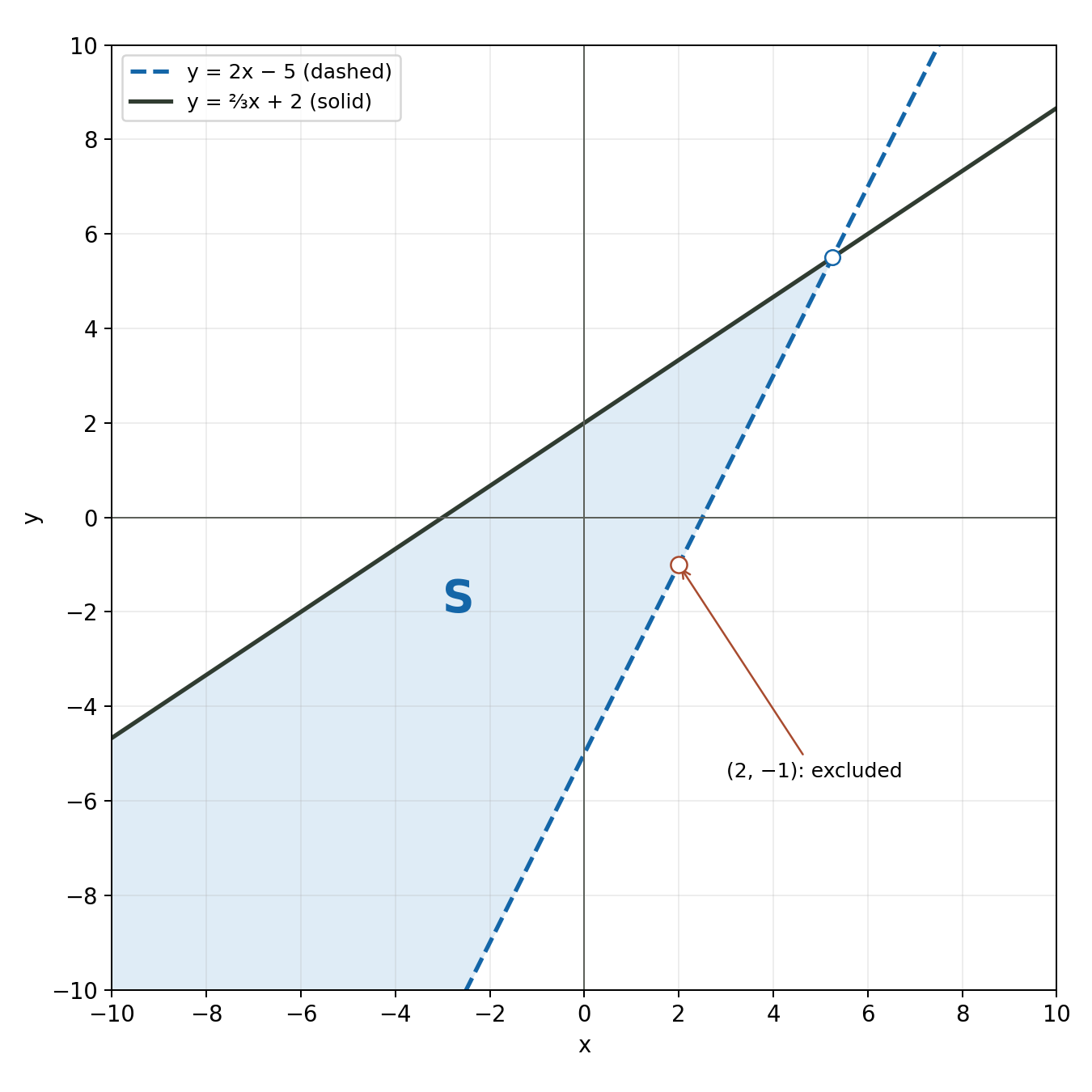
SOMATH takeaway: A point on a dashed boundary is excluded, even if it satisfies the other inequality.
A quadratic height modelQuestion 33
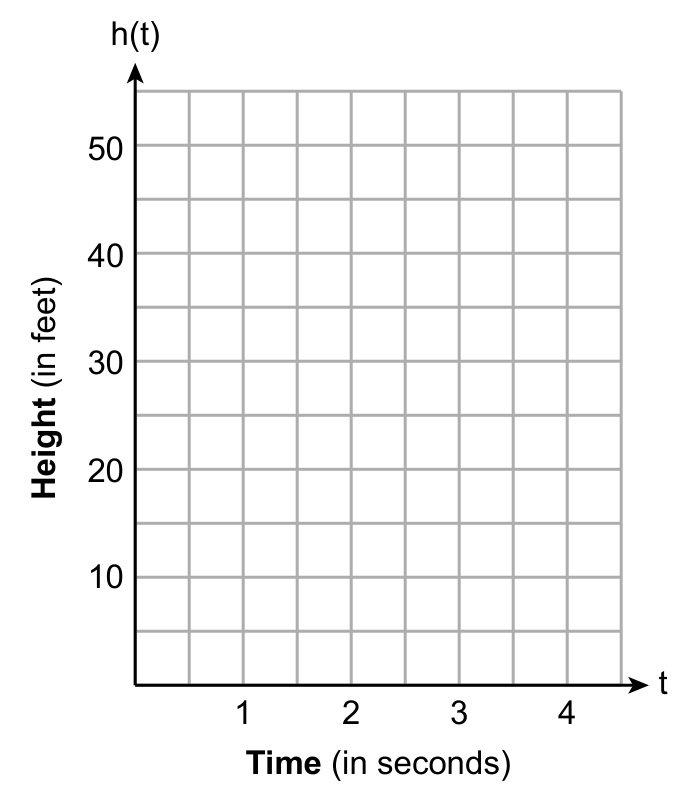
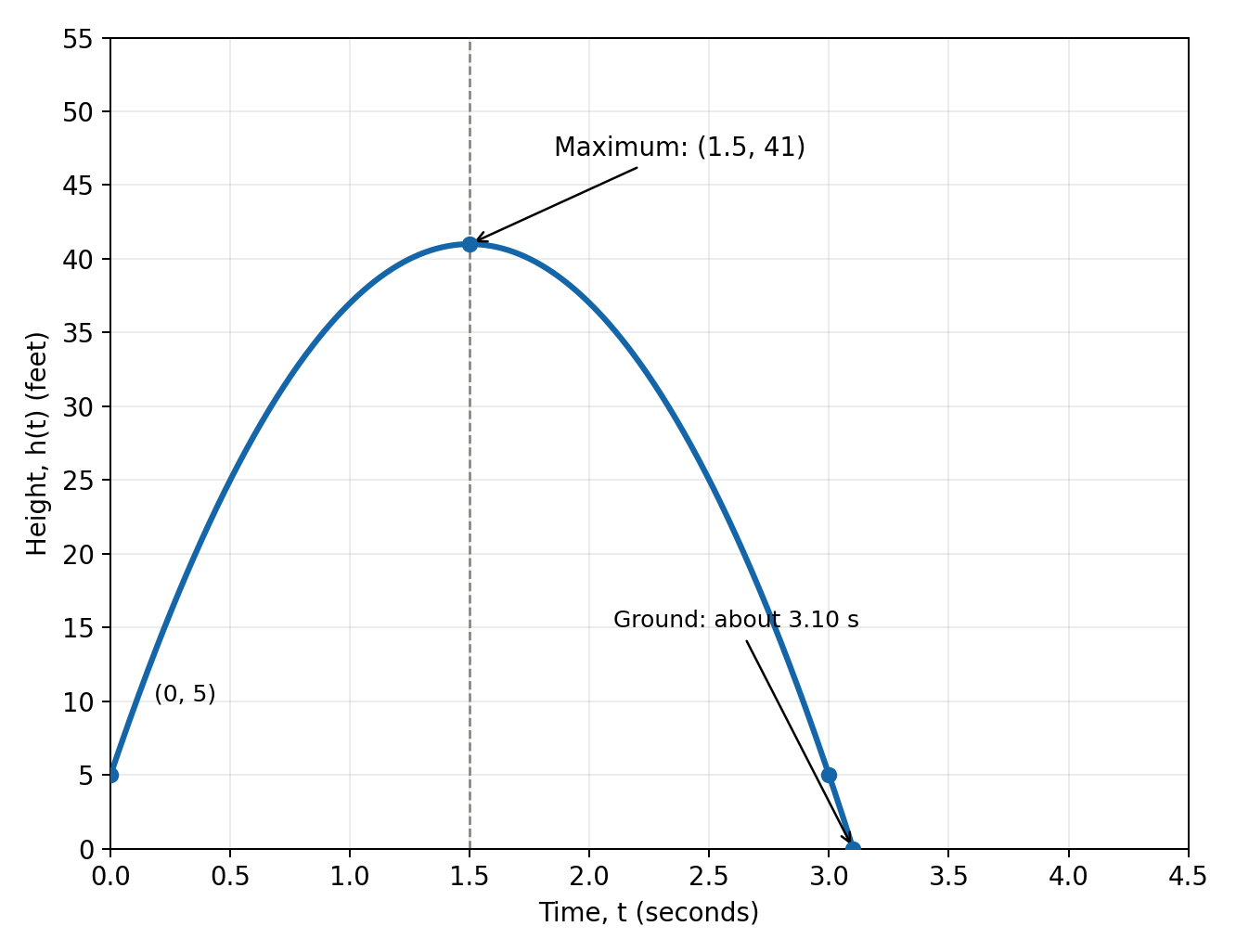
Joey threw a basketball into the air. The height of the basketball can be represented by the equation \(h(t)=-16t^2+48t+5\), where \(h\) is the height of the ball, in feet, and \(t\) is the time, in seconds, after the ball was thrown.
Sketch the graph of the equation on the set of axes below.
State the number of seconds it takes for the ball to reach its maximum height.
State the maximum height, in feet, the ball reaches.
Answer
Answer: 1.5 seconds; maximum height 41 feet.
- The coefficient of \(t^2\) is negative, so the parabola opens downward and its vertex is a maximum.
- The vertex time is \(t=-b/(2a)=-48/[2(-16)]=1.5\) seconds.
- Substitute that time: \(h(1.5)=-16(1.5)^2+48(1.5)+5=-36+72+5=41\) feet.
- For the sketch, plot \((0,5),(0.5,25),(1,37),(1.5,41),(2,37),(2.5,25),(3,5)\), then draw a smooth downward-opening curve.
- The physical flight ends at \(t=(6+\sqrt{41})/4\approx3.10\) seconds when the height reaches zero. This intercept helps finish the sketch, but the requested maximum is \((1.5,41)\).
SOMATH takeaway: The vertex gives two answers: its input is the time, and its output is the maximum height.
A linear-quadratic systemQuestion 34
Solve the following system of equations algebraically for all values of \(x\) and \(y\): \[y=x^2+4x-3\qquad y=2x+5\]
Answer
Answer: \((2,9)\) and \((-4,-3)\).
- Both expressions equal \(y\), so set them equal: \(x^2+4x-3=2x+5\).
- Move everything to one side: \(x^2+2x-8=0\). Factor to get \((x+4)(x-2)=0\).
- The possible x-values are \(-4\) and 2. Substitute each into \(y=2x+5\): \(y=-3\) for \(x=-4\), and \(y=9\) for \(x=2\).
- Check the quadratic: \(16-16-3=-3\), and \(4+8-3=9\). Both ordered pairs satisfy both equations.
SOMATH takeaway: A system's solutions are paired x- and y-values; do not stop after finding x.
Answer key
Keep the key closed until you have tried the questions. Open the individual answers above for the full reasoning.
Class review: what to remember
Complete every requested component. Regression asks for an equation, a correlation coefficient, and an interpretation. Graphing inequalities requires the correct boundaries, shading, labels, and a point check. A height model asks for both coordinates of its vertex. A nonlinear system asks for every ordered-pair solution.
Quick questions and answers
Which questions are in Part III?
Part III contains Questions 31–34, worth 4 credits each, for a total of 16 credits. (NYSED scoring materials)
What is the regression equation in Question 31?
Rounded to hundredths, y=1.54x+58.47 and r=0.98. The correlation indicates a strong positive linear fit.
Why is (2,−1) excluded in Question 32?
It gives 4>4 in y+5>2x, which is false. A point must satisfy both inequalities, and a dashed boundary is not included.
What is the maximum height in Question 33?
The ball reaches its maximum height of 41 feet after 1.5 seconds. These are the coordinates of the parabola's vertex.
What are the solutions to Question 34?
The two solutions are (2,9) and (−4,−3). The question requires algebraic work, not only a graph or a list of points.