August 2025 exam · Part I · 48 credits
August 2025 Geometry Regents: Part I answers
Part I covers transformations, similarity, circle geometry, coordinate geometry, trigonometry, and geometric measurement. This post reproduces Questions 1–24 and explains why each correct choice works.
Try each question first, then select the small blue Answer button for the full explanation. On a phone, use Question text for readable text or select the exam image to enlarge it. Need guided practice? Request a SOMATH evaluation.
About this exam and this guide
The August 20, 2025 NYSED Geometry Regents has 35 questions across four parts, totaling 80 raw credits. This page covers Questions 1–24, worth 48 credits.
Question source: New York State Education Department. Worked explanations: SOMATH — School of Math. The question images preserve the original wording, diagrams, and options; text versions normalize mathematical typography for web reading. SOMATH is not affiliated with or endorsed by NYSED.
Open the original exam PDF · Official answer key · Official rating guide
Jump to a question
Question 1
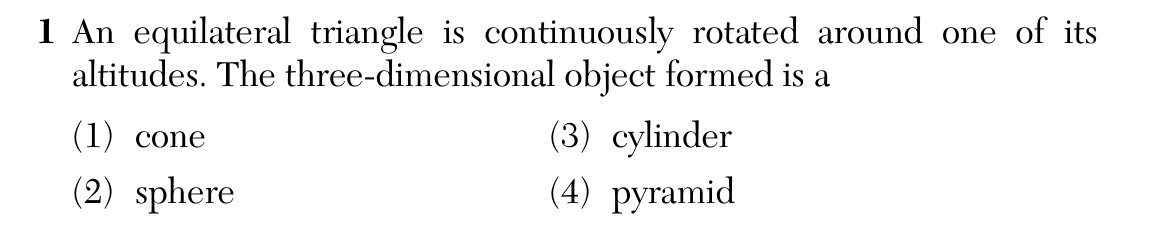
2 creditsSolid of revolution
Question text (accessible)
- cone
- sphere
- cylinder
- pyramid
Answer
Choice (1): cone.
Original SOMATH worked solution
- Use the altitude as the fixed axis. It runs from a vertex to the midpoint of the opposite side.
- As the triangle turns, the base sweeps out a circular disk and the sloping sides sweep out the curved surface of a cone.
Key idea: A solid of revolution is determined by the region being rotated and the location of its axis.
Avoid this mistake: A pyramid has flat triangular faces. Continuous rotation produces a circular base and curved surface, not a pyramid.
Question 2
2 creditsCorresponding sides under rigid motions
Question text (accessible)
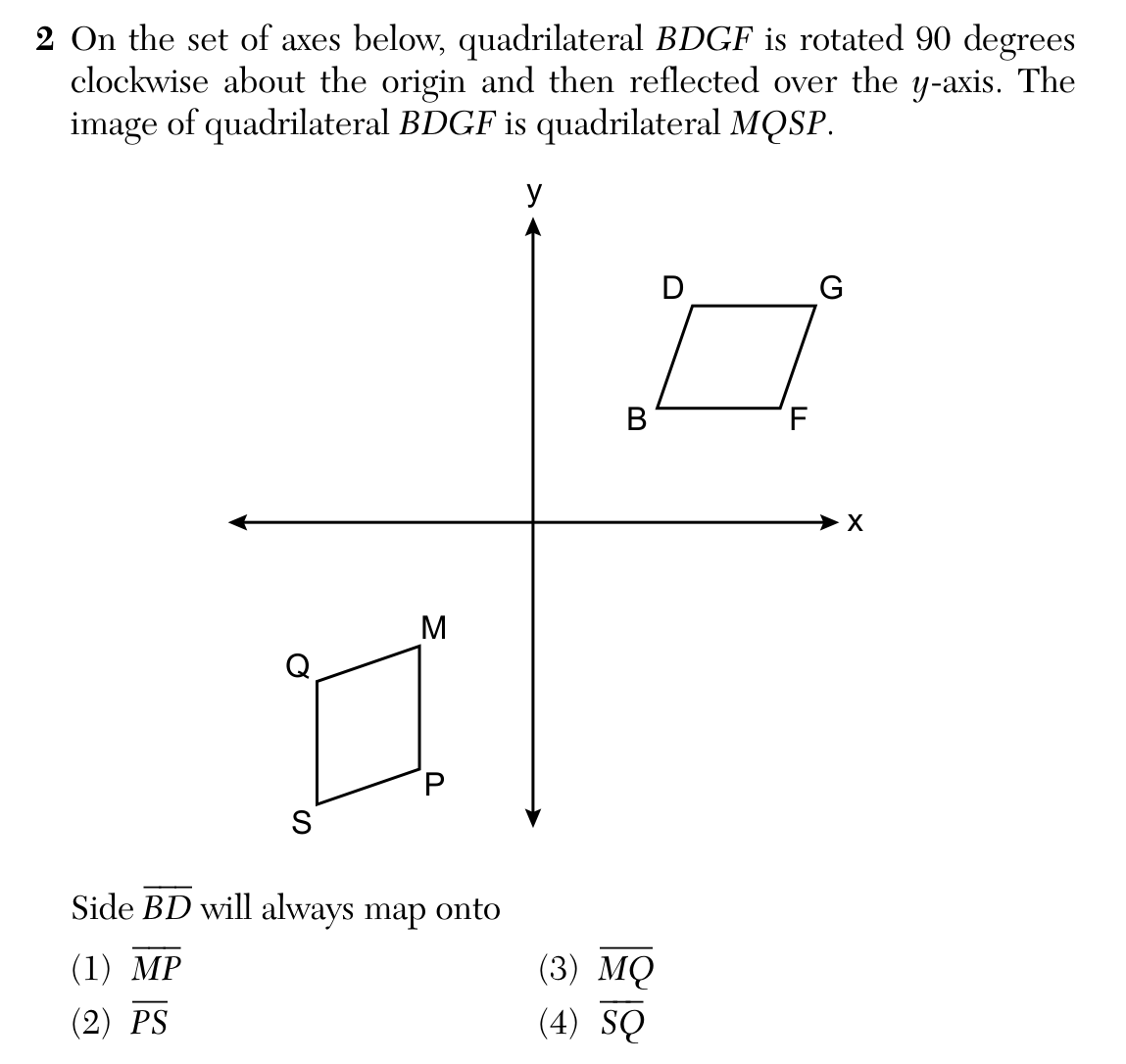
Side BD will always map onto
- MP
- PS
- MQ
- SQ
Diagram description: The original graph shows BDGF in the first quadrant and MQSP below and to the left of the origin.
Answer
Choice (3): MQ.
Original SOMATH worked solution
- Follow the vertex correspondence in the transformation: B → M, D → Q, G → S, and F → P.
- A segment maps to the segment joining the images of its endpoints. Therefore BD maps to MQ.
- As a coordinate check, the rotation sends (x, y) to (y, −x); reflecting that result across the y-axis gives (−y, −x).
Key idea: Rigid motions preserve lengths, and corresponding endpoints identify corresponding sides.
Avoid this mistake: Do not match sides only by how they look on the page. Track both endpoints.
Question 3
2 creditsCosine in a right triangle
Question text (accessible)
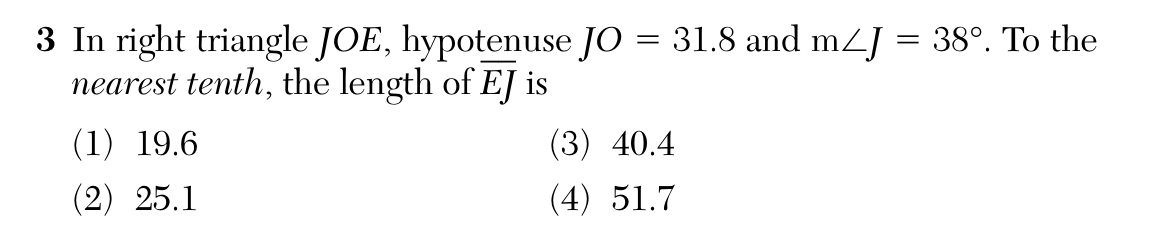
- 19.6
- 25.1
- 40.4
- 51.7
Answer
Choice (2): 25.1.
Original SOMATH worked solution
- EJ is the leg adjacent to angle J, while JO is the hypotenuse.
- cos 38° = EJ / 31.8, so EJ = 31.8 cos 38°.
- EJ ≈ 25.0587, which rounds to 25.1.
Key idea: Cosine is adjacent ÷ hypotenuse. Use degree mode when the angle is given in degrees.
Avoid this mistake: Sine would find the opposite leg, OE, rather than EJ.
Question 4
2 creditsVolume of a hemisphere
Question text (accessible)
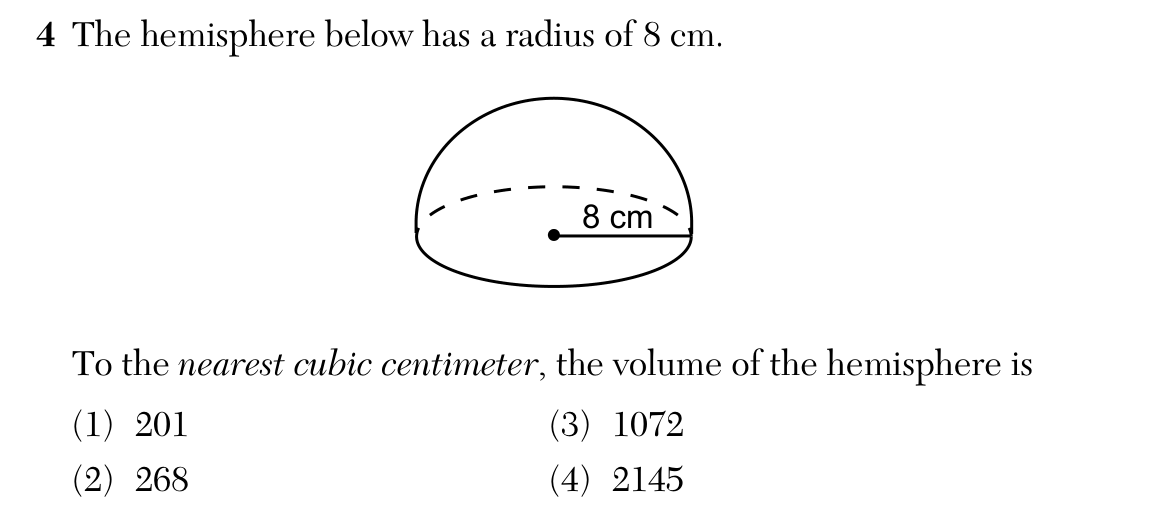
To the nearest cubic centimeter, the volume of the hemisphere is
- 201
- 268
- 1072
- 2145
Diagram description: A hemisphere is shown with a radius labeled 8 cm.
Answer
Choice (3): 1072 cm³.
Original SOMATH worked solution
- A hemisphere is half of a sphere, so V = ½(4πr³/3) = 2πr³/3.
- Substitute r = 8: V = (2/3)π(8³) = 1024π/3.
- V ≈ 1072.3303 cm³, so the requested volume is 1072 cm³.
Key idea: Volume uses cubic units and the cube of the radius.
Avoid this mistake: Using the full sphere formula produces approximately 2145 cm³, twice the needed volume.
Question 5
2 creditsA sufficient condition for a rhombus
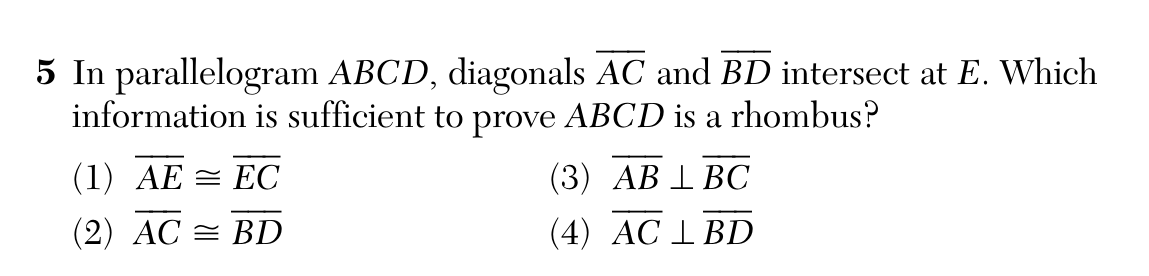
Question text (accessible)
- AE ≅ EC
- AC ≅ BD
- AB ⊥ BC
- AC ⊥ BD
Answer
Choice (4): AC ⊥ BD.
Original SOMATH worked solution
- The diagonals of every parallelogram bisect each other, so AE = EC and BE = ED.
- If the diagonals are also perpendicular, triangles AEB and CEB are right triangles with AE = EC and shared leg BE. They are congruent, so AB = BC.
- Opposite sides of a parallelogram are congruent. Since these adjacent sides are also congruent, all four sides are congruent and ABCD is a rhombus.
Key idea: A parallelogram with perpendicular diagonals is a rhombus.
Avoid this mistake: Congruent diagonals or perpendicular adjacent sides guarantee a rectangle, which need not be a rhombus.
Question 6
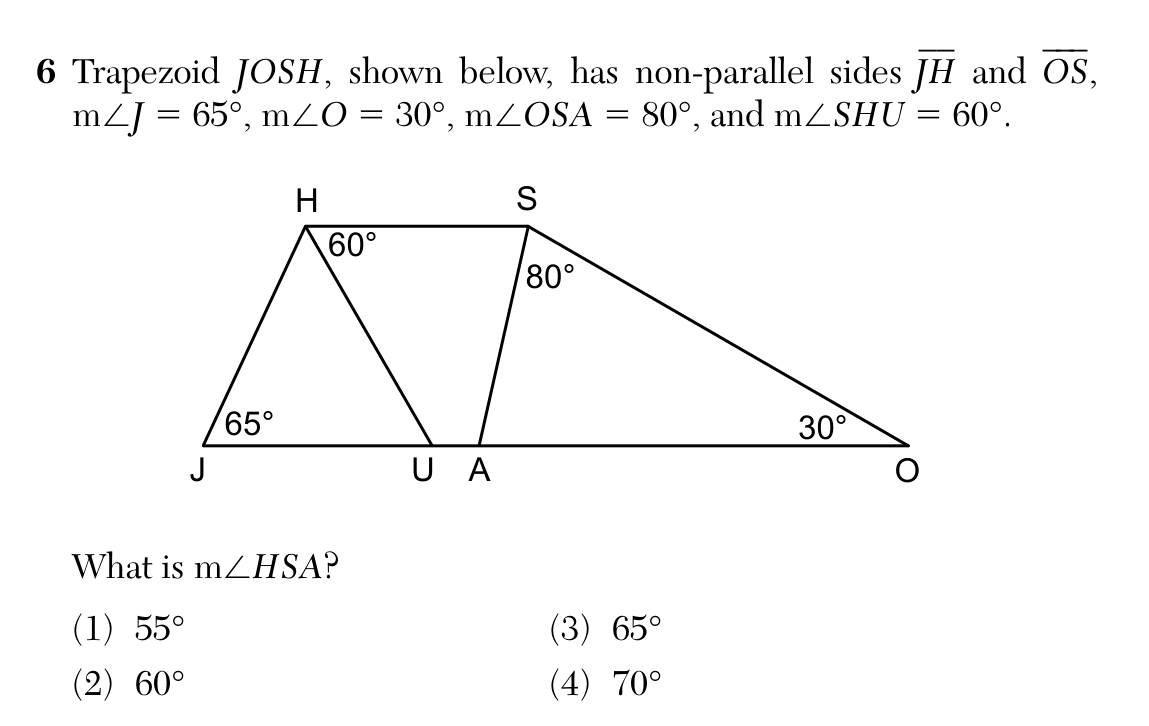
2 creditsAngles in a trapezoid
Question text (accessible)
What is m∠HSA?
- 55°
- 60°
- 65°
- 70°
Diagram description: The trapezoid has parallel bases HS and JO, with U and A on JO and segments HU and SA drawn.
Answer
Choice (4): 70°.
Original SOMATH worked solution
- The parallel bases are HS and JO. Along transversal SO, the same-side interior angles HSO and SOJ are supplementary.
- m∠HSO = 180° − 30° = 150°.
- Ray SA splits ∠HSO into ∠HSA and ∠ASO. Thus m∠HSA = 150° − 80° = 70°.
Key idea: Same-side interior angles formed by parallel lines add to 180°.
Avoid this mistake: The 65° and 60° labels are not needed. Do not force every given number into the calculation.
Question 7
2 creditsSimilarity with a parallel segment
Question text (accessible)
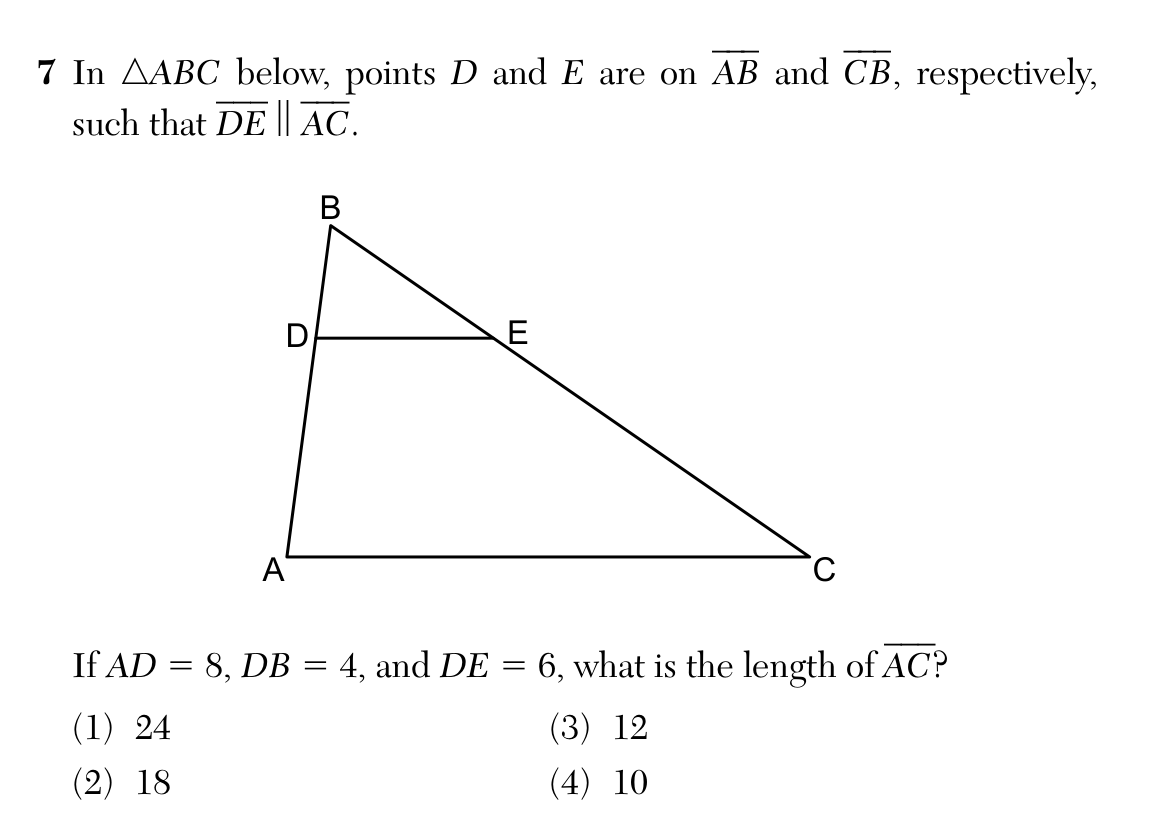
If AD = 8, DB = 4, and DE = 6, what is the length of AC?
- 24
- 18
- 12
- 10
Diagram description: D lies between A and B, E lies between C and B, and DE is parallel to AC.
Answer
Choice (2): 18.
Original SOMATH worked solution
- Because DE ∥ AC, corresponding angles are congruent and △BDE ∼ △BAC.
- The whole side BA = BD + DA = 4 + 8 = 12. The small-to-large scale factor is BD/BA = 4/12 = 1/3.
- DE/AC = 1/3, so 6/AC = 1/3 and AC = 18.
Key idea: In similar triangles, compare corresponding whole sides in the same order.
Avoid this mistake: AD is only the lower piece of AB. Using 4/8 instead of 4/12 gives the wrong scale factor.
Question 8
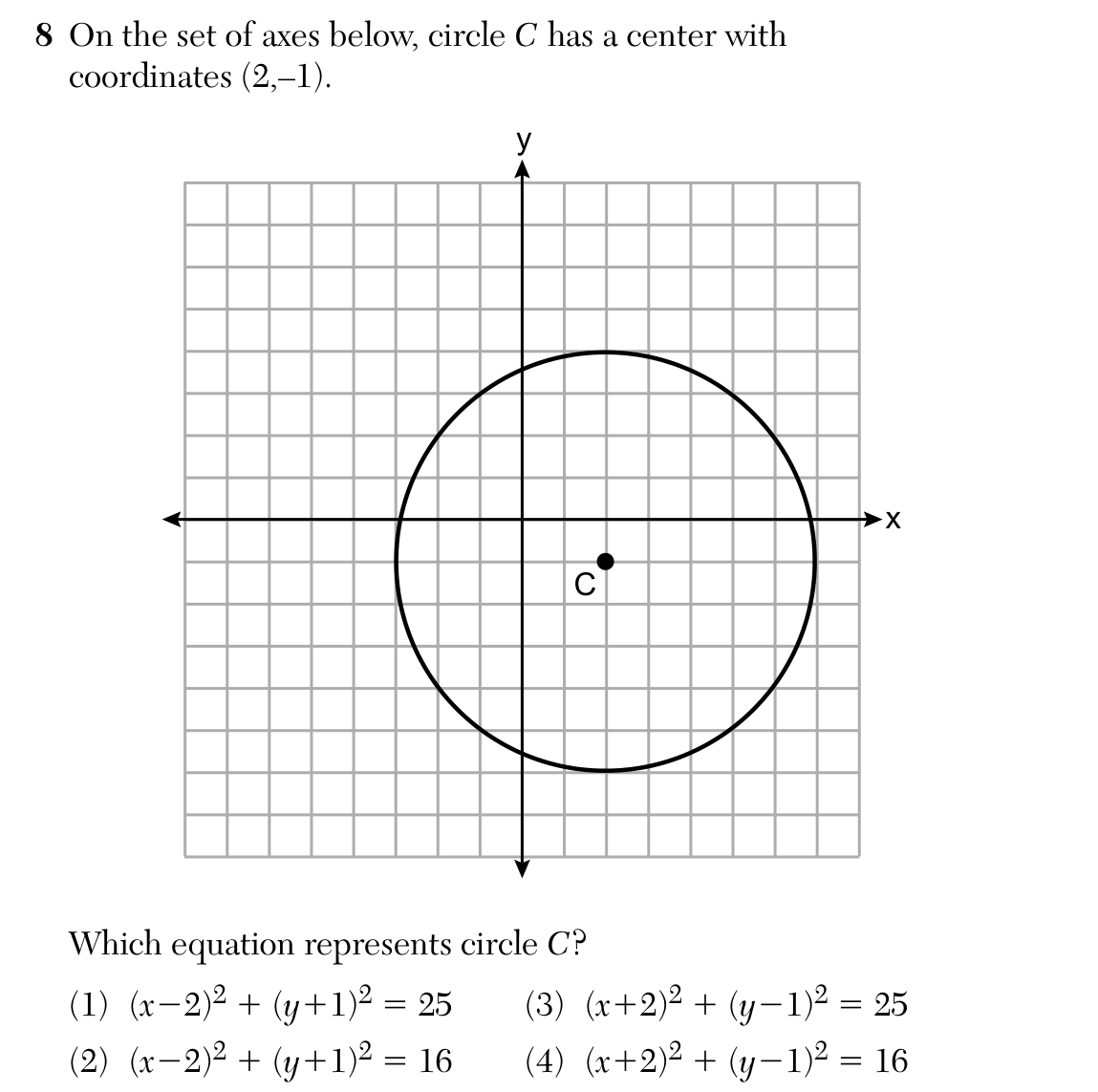
2 creditsEquation of a circle
Question text (accessible)
Which equation represents circle C?
- (x − 2)² + (y + 1)² = 25
- (x − 2)² + (y + 1)² = 16
- (x + 2)² + (y − 1)² = 25
- (x + 2)² + (y − 1)² = 16
Diagram description: Circle C has center (2, −1) and extends 5 grid units from its center.
Answer
Choice (1): (x − 2)² + (y + 1)² = 25.
Original SOMATH worked solution
- A circle with center (h, k) and radius r has equation (x − h)² + (y − k)² = r².
- Substitute the center (2, −1): (x − 2)² + (y + 1)² = r².
- Count 5 grid units from the center to the circle, so r = 5 and r² = 25.
Key idea: The right side of the circle equation is the radius squared.
Avoid this mistake: Subtracting the center's y-coordinate −1 gives y + 1, not y − 1.
Question 9
2 creditsPoint reflection through the origin
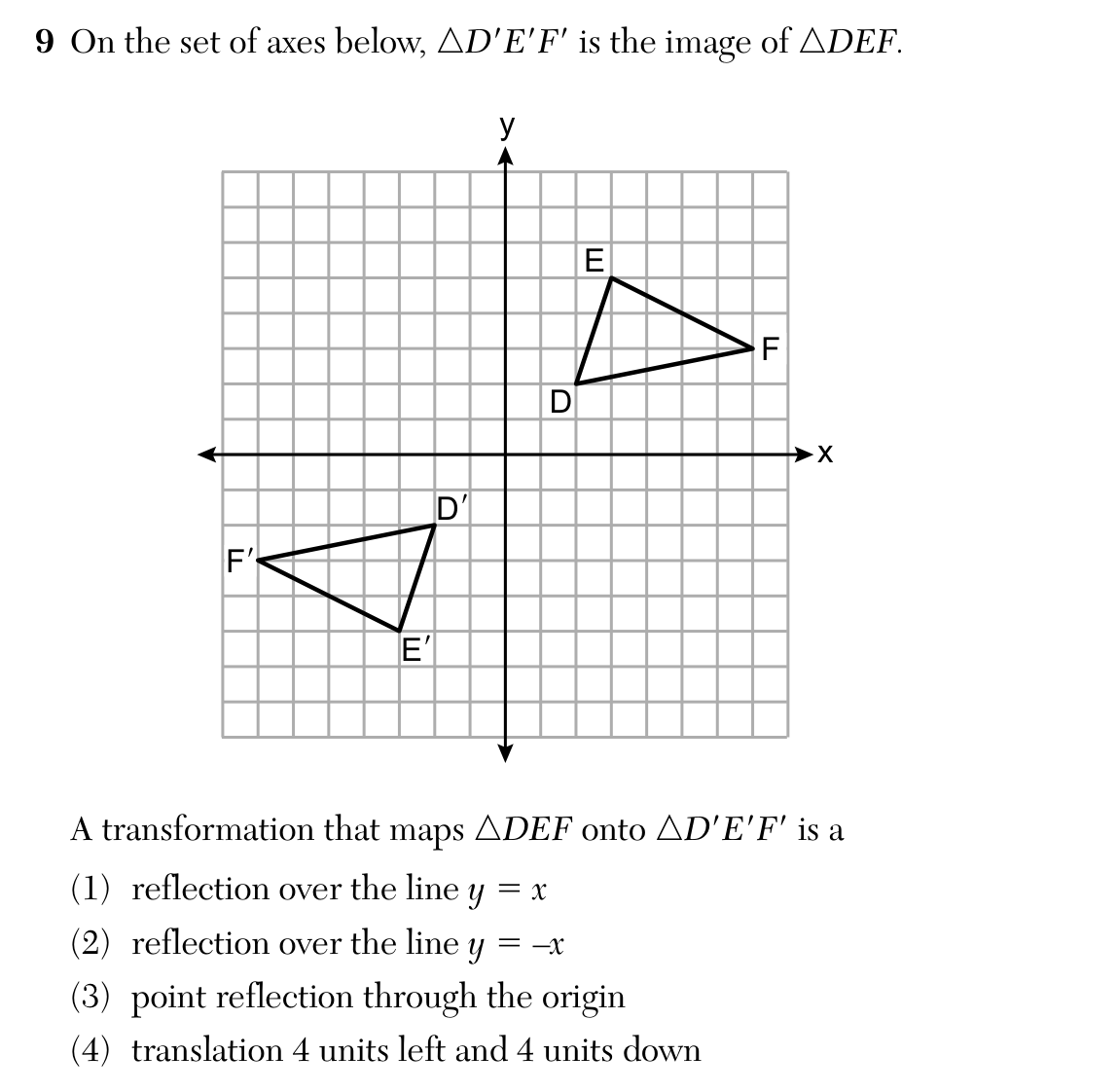
Question text (accessible)
A transformation that maps △DEF onto △D′E′F′ is a
- reflection over the line y = x
- reflection over the line y = –x
- point reflection through the origin
- translation 4 units left and 4 units down
Diagram description: The original graph shows DEF and D′E′F′ on opposite sides of the origin.
Answer
Choice (3): point reflection through the origin.
Original SOMATH worked solution
- Compare corresponding coordinates: D(2, 2) → D′(−2, −2), E(3, 5) → E′(−3, −5), and F(7, 3) → F′(−7, −3).
- Every image follows (x, y) → (−x, −y). That is a point reflection through the origin, equivalently a 180° rotation.
- For example, reflection over y = −x would send E(3, 5) to (−5, −3), not E′(−3, −5).
Key idea: Check the same rule on more than one point to distinguish transformations.
Avoid this mistake: The proposed translation fits D alone. It fails for E and F.
Question 10
2 creditsSecant-secant theorem
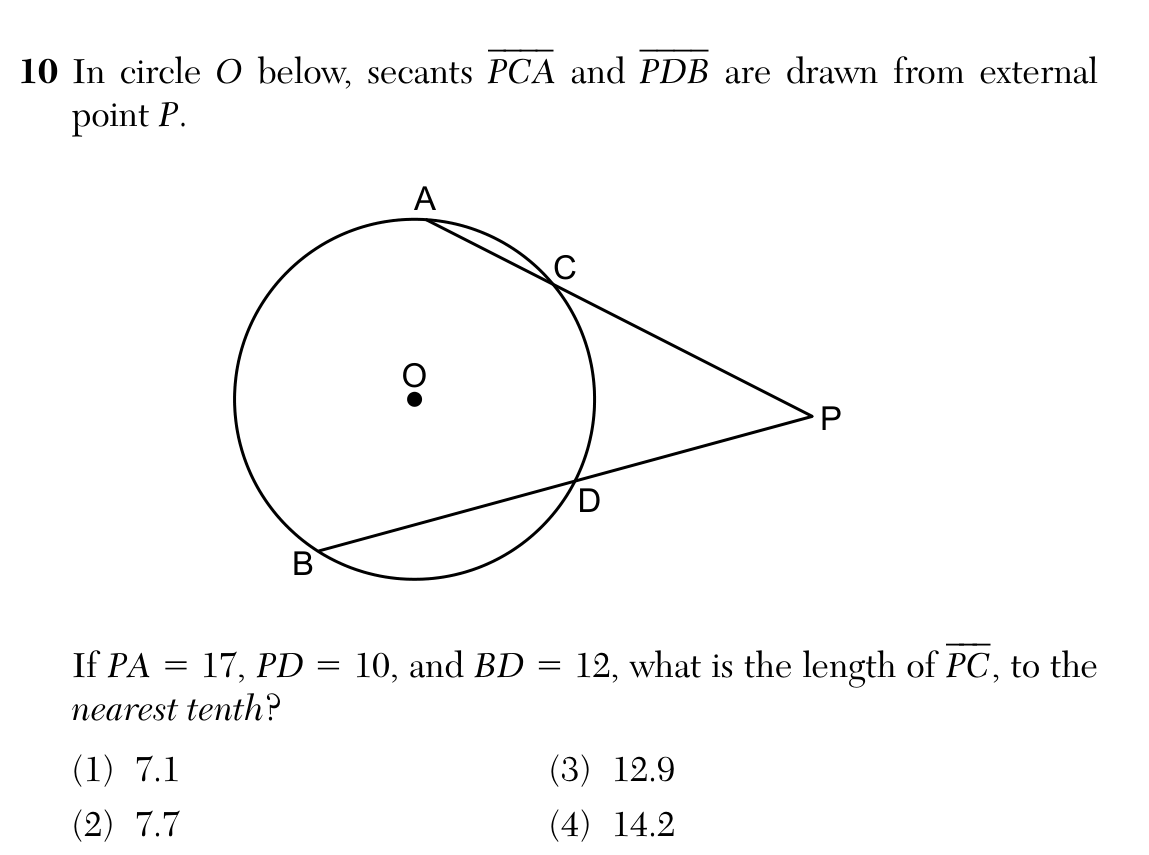
Question text (accessible)
If PA = 17, PD = 10, and BD = 12, what is the length of PC, to the nearest tenth?
- 7.1
- 7.7
- 12.9
- 14.2
Diagram description: The secants pass from P through C to A and from P through D to B.
Answer
Choice (3): 12.9.
Original SOMATH worked solution
- On the lower secant, PD is the external portion and DB is the internal portion. The whole secant PB = 10 + 12 = 22.
- Apply external × whole = external × whole: PC · PA = PD · PB.
- 17PC = 10(22) = 220, so PC = 220/17 ≈ 12.9412. To the nearest tenth, PC = 12.9.
Key idea: For two secants from one external point, the products of the external lengths and whole lengths are equal.
Avoid this mistake: Do not use BD = 12 as the entire lower secant. PB includes both PD and DB.
Question 11
2 creditsAngle bisectors and an isosceles triangle
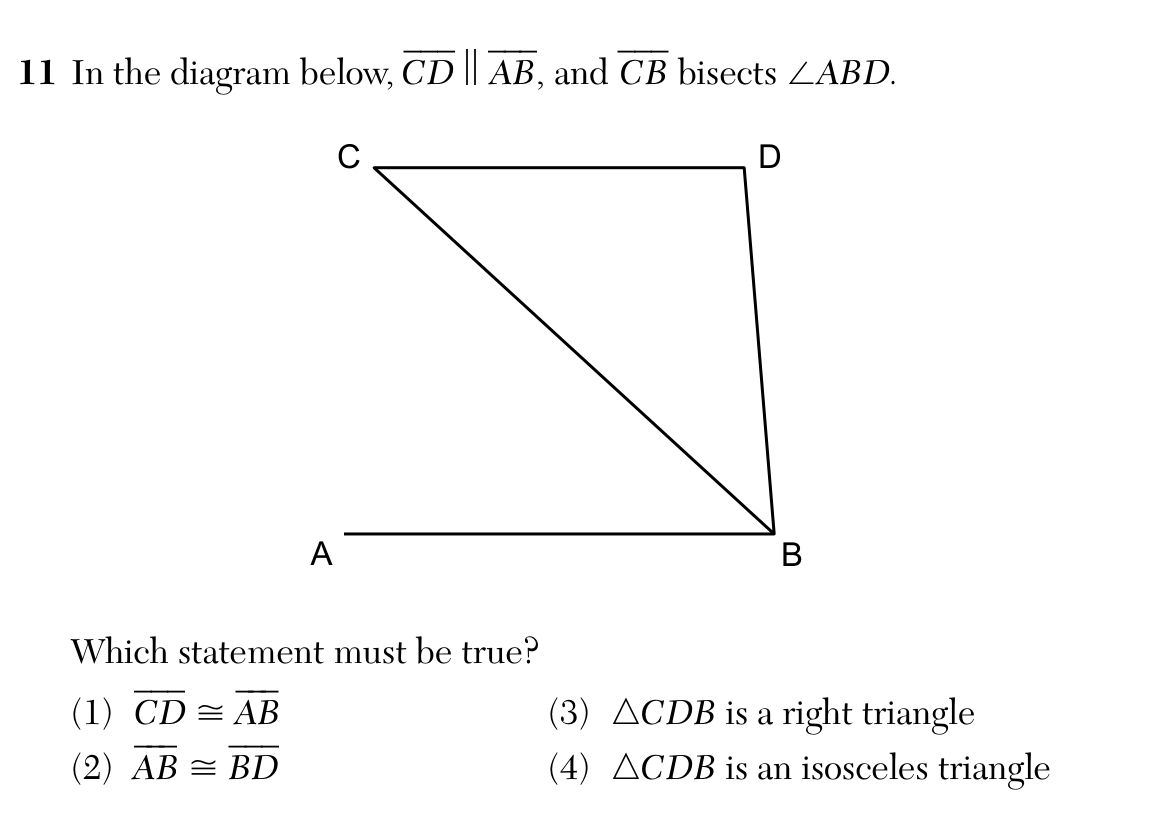
Question text (accessible)
Which statement must be true?
- CD ≅ AB
- AB ≅ BD
- △CDB is a right triangle
- △CDB is an isosceles triangle
Diagram description: CB divides ∠ABD; CD and AB are parallel.
Answer
Choice (4): △CDB is an isosceles triangle.
Original SOMATH worked solution
- Since CB bisects ∠ABD, ∠ABC ≅ ∠CBD.
- Since CD ∥ AB, alternate interior angles ∠ABC and ∠BCD are congruent.
- Therefore ∠CBD ≅ ∠BCD. The sides opposite these equal angles, CD and BD, are congruent, so △CDB is isosceles.
Key idea: The converse of the isosceles triangle theorem turns equal angles into equal opposite sides.
Avoid this mistake: The diagram does not establish a right angle. Use the stated parallel lines and angle bisector.
Question 12
2 creditsPerpendicular line through a point
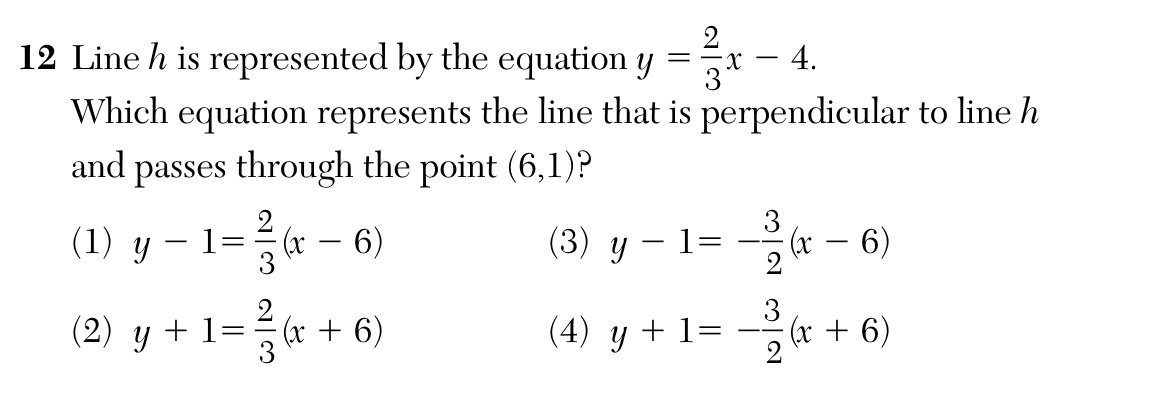
Question text (accessible)
Which equation represents the line that is perpendicular to line h and passes through the point (6,1)?
- y − 1 = ⅔(x − 6)
- y + 1 = ⅔(x + 6)
- y − 1 = −³⁄₂(x − 6)
- y + 1 = −³⁄₂(x + 6)
Answer
Choice (3): y − 1 = (−3/2)(x − 6).
Original SOMATH worked solution
- The slope of h is 2/3. A perpendicular line has slope −3/2, because (2/3)(−3/2) = −1.
- Use point-slope form y − y₁ = m(x − x₁) with (x₁, y₁) = (6, 1).
- This gives y − 1 = (−3/2)(x − 6). Substituting (6, 1) makes both sides zero.
Key idea: Nonvertical perpendicular lines have slopes that are negative reciprocals.
Avoid this mistake: Point-slope form subtracts the given coordinates. The plus signs in choice (4) do not pass through (6, 1).
Question 13
2 creditsPyramid volume and density
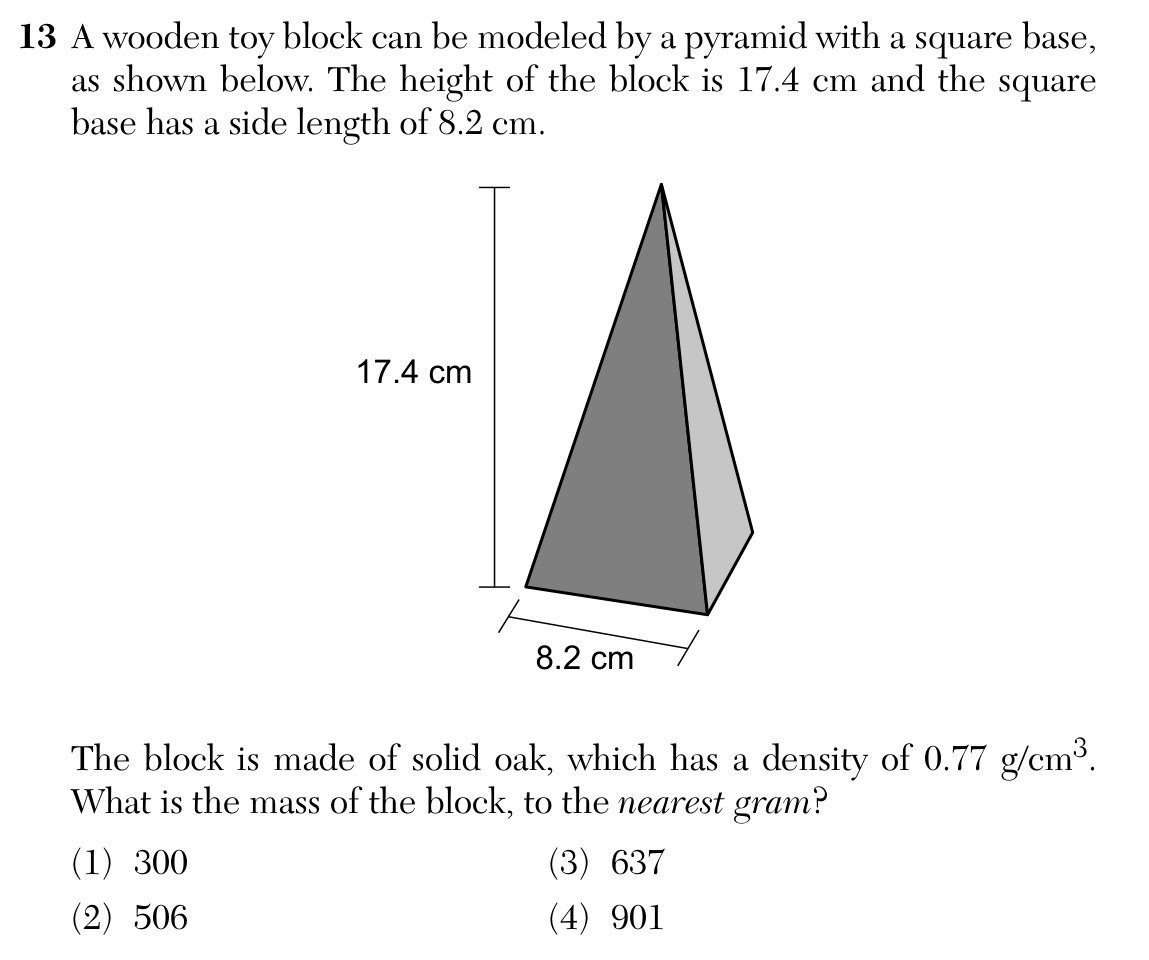
Question text (accessible)
The block is made of solid oak, which has a density of 0.77 g/cm³. What is the mass of the block, to the nearest gram?
- 300
- 506
- 637
- 901
Diagram description: The diagram labels the pyramid's perpendicular height 17.4 cm and a square-base edge 8.2 cm.
Answer
Choice (1): 300 grams.
Original SOMATH worked solution
- The square base area is B = 8.2² = 67.24 cm².
- The pyramid volume is V = Bh/3 = (67.24)(17.4)/3 = 389.992 cm³.
- Mass = density × volume = 0.77(389.992) = 300.29384 g. Rounded to the nearest gram, the mass is 300 g.
Key idea: First find the volume of the shape, then multiply by its density.
Avoid this mistake: Omitting the pyramid's factor of 1/3 treats the block as a prism and triples the mass.
Question 14
2 creditsTriangle midsegment theorem
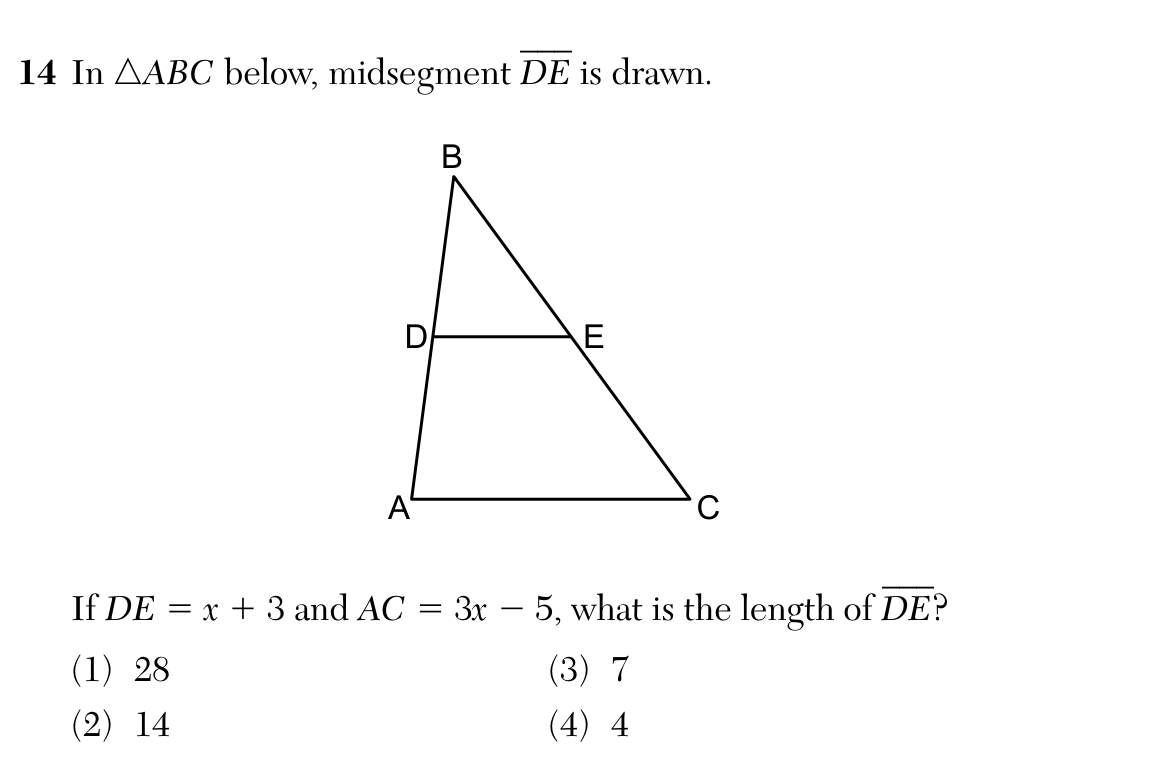
Question text (accessible)
If DE = x + 3 and AC = 3x − 5, what is the length of DE?
- 28
- 14
- 7
- 4
Diagram description: D and E are marked as midpoints of AB and BC.
Answer
Choice (2): 14.
Original SOMATH worked solution
- A triangle's midsegment is half as long as the parallel third side. Thus 2DE = AC.
- 2(x + 3) = 3x − 5. Expanding gives 2x + 6 = 3x − 5, so x = 11.
- The question asks for DE, not x: DE = 11 + 3 = 14. Check: AC = 3(11) − 5 = 28, twice 14.
Key idea: A midsegment joins two side midpoints and is parallel to, and half the length of, the third side.
Avoid this mistake: Solving for x is an intermediate step. Substitute back to obtain the requested segment.
Question 15
2 credits45-45-90 triangle
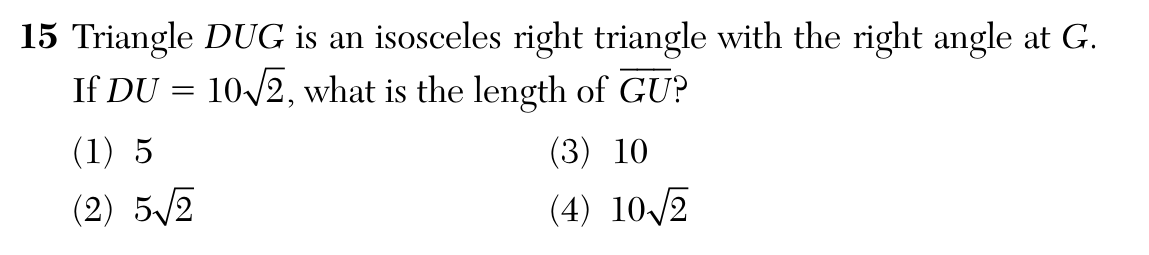
Question text (accessible)
- 5
- 5√2
- 10
- 10√2
Answer
Choice (3): 10.
Original SOMATH worked solution
- The side opposite the right angle, DU, is the hypotenuse.
- In an isosceles right triangle, hypotenuse = leg · √2.
- GU = (10√2)/√2 = 10.
Key idea: The side ratio in a 45-45-90 triangle is 1 : 1 : √2.
Avoid this mistake: The hypotenuse is longer than either leg. Do not assign 10√2 to a leg.
Question 16
2 creditsTriangle area with an included angle
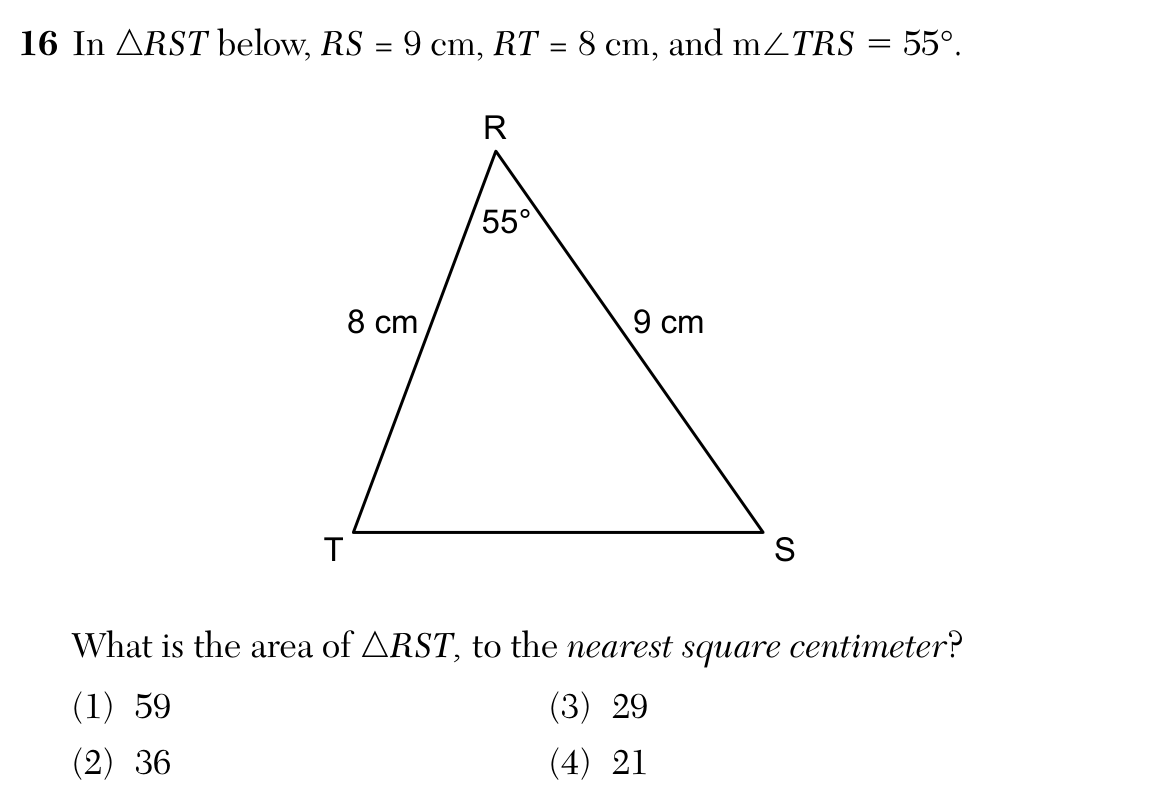
Question text (accessible)
What is the area of △RST, to the nearest square centimeter?
- 59
- 36
- 29
- 21
Diagram description: At vertex R, sides RT = 8 cm and RS = 9 cm enclose 55°.
Answer
Choice (3): 29 cm².
Original SOMATH worked solution
- The given angle lies between the two given sides, so use A = ½ab sin C.
- A = ½(9)(8) sin 55° = 36 sin 55° ≈ 29.4895 cm².
- Rounded to the nearest square centimeter, the area is 29 cm².
Key idea: The sine factor supplies the perpendicular height when the two sides are not perpendicular.
Avoid this mistake: ½(9)(8) = 36 would be correct only if the included angle were 90°.
Question 17
2 creditsFinding a dilation center
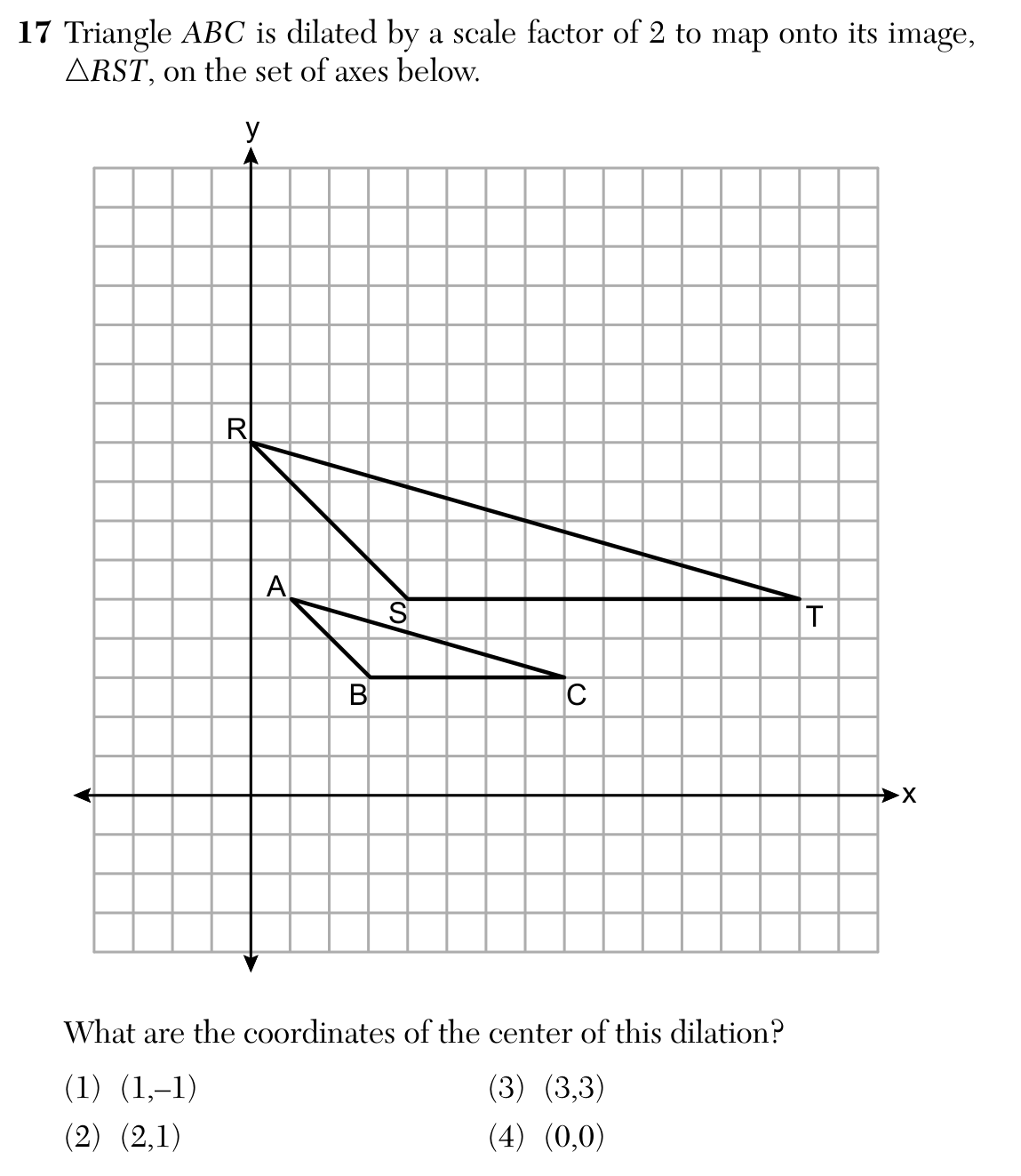
Question text (accessible)
What are the coordinates of the center of this dilation?
- (1,–1)
- (2,1)
- (3,3)
- (0,0)
Diagram description: The graph shows A(1,5), B(3,3), C(8,3), R(0,9), S(4,5), and T(14,5).
Answer
Choice (2): (2, 1).
Original SOMATH worked solution
- Read corresponding points from the graph, for example A(1, 5) and R(0, 9).
- For scale factor 2 with center O, R = O + 2(A − O) = 2A − O. Rearranging gives O = 2A − R.
- O = (2·1 − 0, 2·5 − 9) = (2, 1). Check with B(3, 3) and S(4, 5): 2B − S = (2, 1) again.
Key idea: A point, its image, and the dilation center lie on one line; the distances from the center scale by the dilation factor.
Avoid this mistake: Multiplying coordinates directly by 2 assumes the center is the origin, which it is not here.
Question 18
2 creditsPerimeter on the coordinate plane
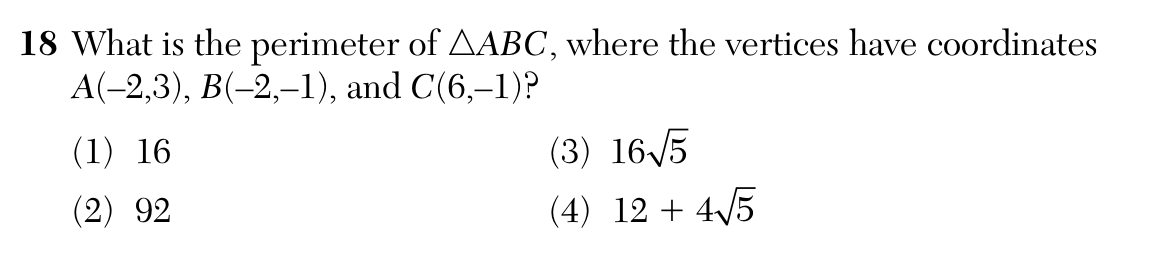
Question text (accessible)
- 16
- 92
- 16√5
- 12 + 4√5
Answer
Choice (4): 12 + 4√5.
Original SOMATH worked solution
- AB is vertical, so AB = |3 − (−1)| = 4. BC is horizontal, so BC = |6 − (−2)| = 8.
- AC = √[(6 − (−2))² + (−1 − 3)²] = √(64 + 16) = √80 = 4√5.
- The perimeter is AB + BC + AC = 4 + 8 + 4√5 = 12 + 4√5.
Key idea: Perimeter is the sum of actual side lengths; the distance formula includes a square root.
Avoid this mistake: Adding 4 + 8 + 80 gives 92, but 80 is AC², not AC.
Question 19
2 creditsCorresponding ratios in similar triangles
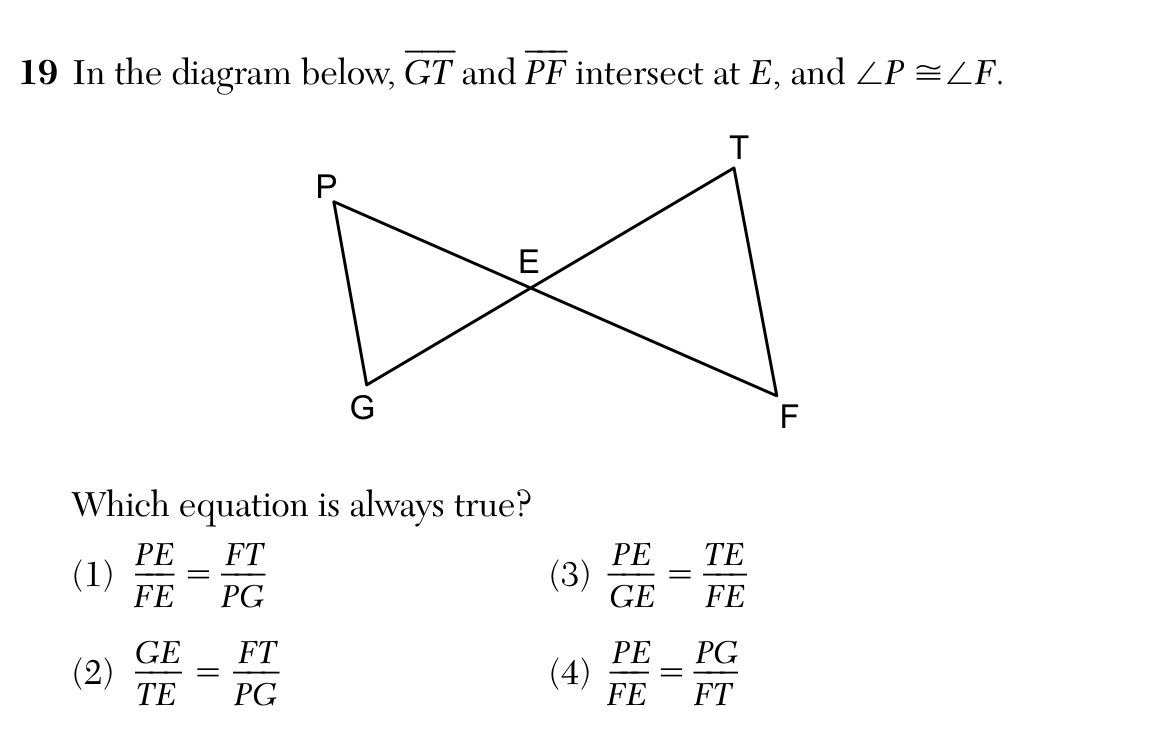
Question text (accessible)
Which equation is always true?
- PE/FE = FT/PG
- GE/TE = FT/PG
- PE/GE = TE/FE
- PE/FE = PG/FT
Diagram description: GT and PF cross at E, forming triangles PEG and FET.
Answer
Choice (4): PE/FE = PG/FT.
Original SOMATH worked solution
- ∠PEG and ∠FET are vertical angles, so they are congruent. Together with the given ∠P ≅ ∠F, this proves △PEG ∼ △FET by AA.
- The matching vertices are P ↔ F, E ↔ E, and G ↔ T.
- Thus PE corresponds to FE, PG corresponds to FT, and GE corresponds to ET. Keeping the same order gives PE/FE = PG/FT.
Key idea: Write the similarity correspondence before forming a proportion.
Avoid this mistake: Reversing only one fraction compares small-to-large on one side with large-to-small on the other.
Question 20
2 creditsConcrete volume and rounding up
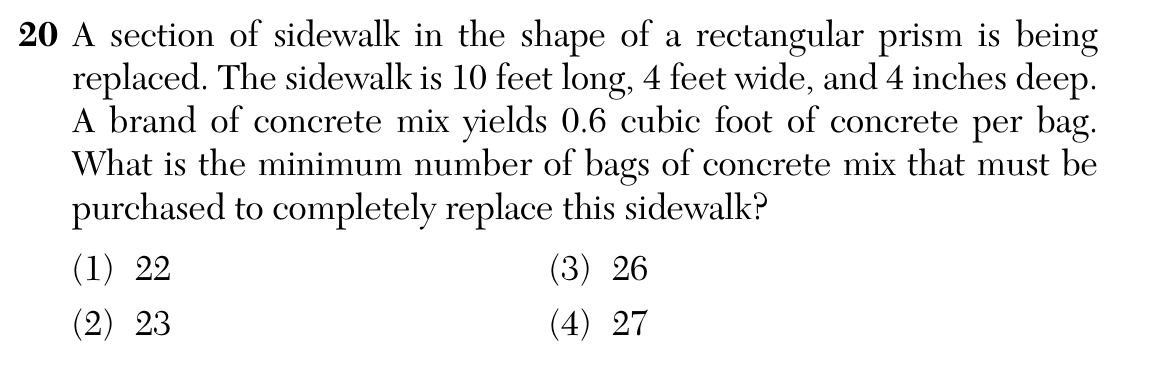
Question text (accessible)
- 22
- 23
- 26
- 27
Answer
Choice (2): 23 bags.
Original SOMATH worked solution
- Convert depth to feet: 4 inches = 4/12 foot = 1/3 foot.
- Volume = length × width × depth = 10·4·(1/3) = 40/3 cubic feet.
- Bags needed = (40/3)/0.6 = 200/9 ≈ 22.2222. Since 22 bags are insufficient, purchase 23 bags.
- Check: 22 bags yield 13.2 ft³, less than 13⅓ ft³; 23 bags yield 13.8 ft³, enough.
Key idea: Use consistent units before multiplying. A minimum whole-item purchase requires rounding up.
Avoid this mistake: Rounding to the nearest whole number would give 22 and leave part of the sidewalk unfilled.
Question 21
2 creditsDilating a line about the origin
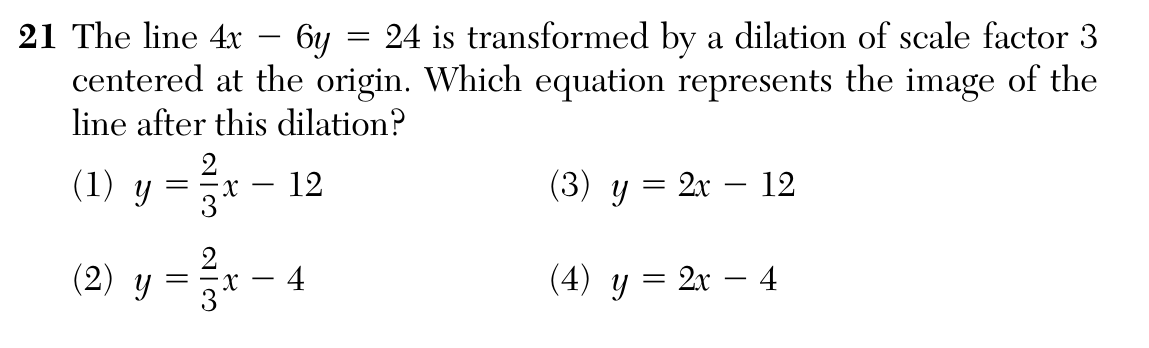
Question text (accessible)
- y = ⅔x − 12
- y = ⅔x − 4
- y = 2x − 12
- y = 2x − 4
Answer
Choice (1): y = (2/3)x − 12.
Original SOMATH worked solution
- Rewrite the original equation as y = (2/3)x − 4.
- Under the dilation, an original point (x, y) becomes (X, Y) = (3x, 3y). Substitute x = X/3 and y = Y/3.
- Y/3 = (2/3)(X/3) − 4. Multiply by 3: Y = (2/3)X − 12.
- The image has the same slope and a y-intercept three times as far from the origin.
Key idea: A dilation sends a line not through its center to a parallel line.
Avoid this mistake: The slope is a ratio of two lengths, both scaled equally. It does not become 2.
Question 22
2 creditsSymmetries of a rhombus
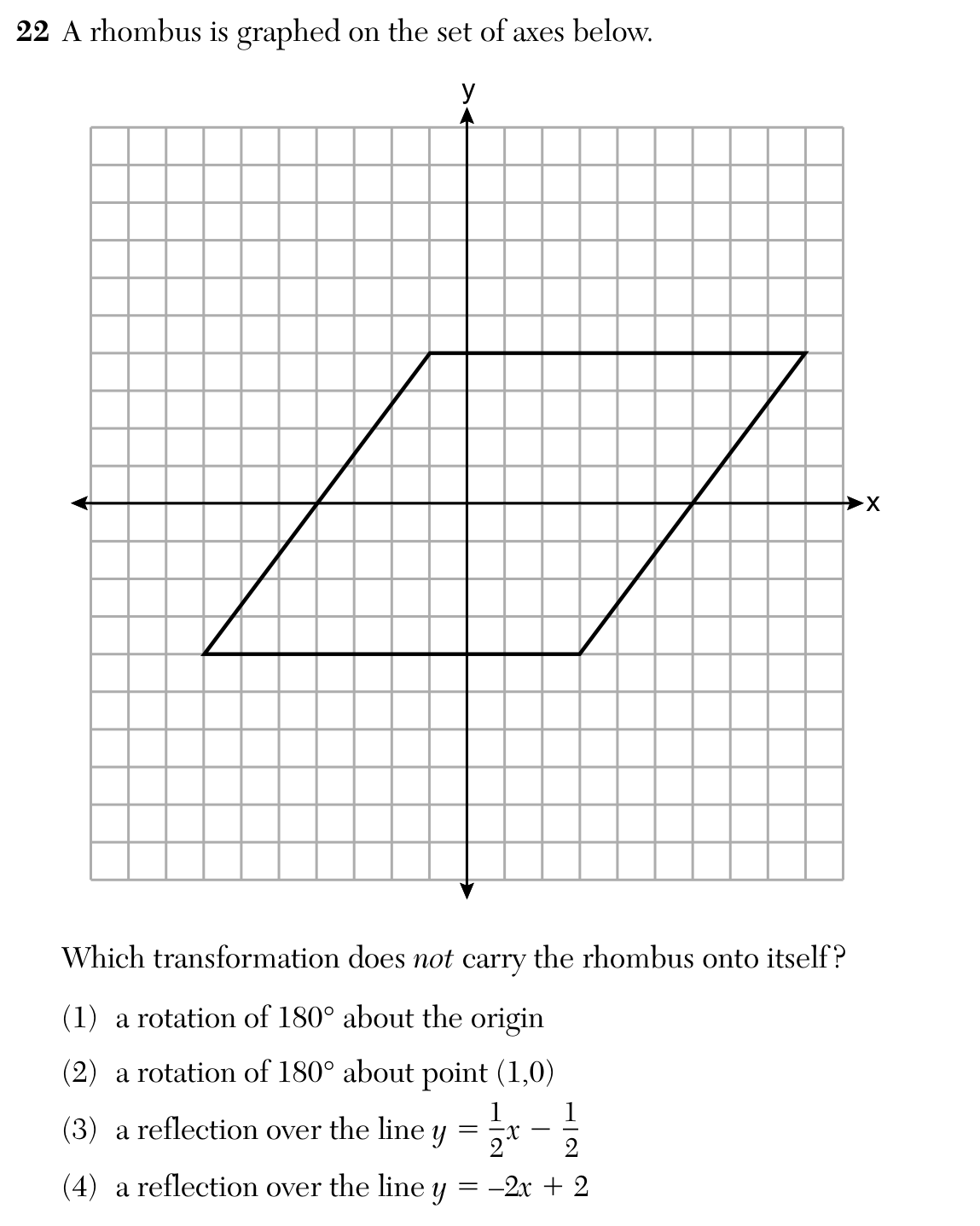
Question text (accessible)
Which transformation does not carry the rhombus onto itself?
- a rotation of 180° about the origin
- a rotation of 180° about point (1,0)
- a reflection over the line y = ½x − ½
- a reflection over the line y = –2x + 2
Diagram description: The rhombus is centered at (1,0); its diagonals lie on y = ½x − ½ and y = −2x + 2.
Answer
Choice (1): a rotation of 180° about the origin.
Original SOMATH worked solution
- The diagonals meet at (1, 0), the center of the rhombus. A half-turn about that point interchanges opposite vertices.
- The two diagonal lines are y = (1/2)x − 1/2 and y = −2x + 2. Each is an axis of reflection symmetry for the rhombus.
- A half-turn about the origin would move its center from (1, 0) to (−1, 0). Since the center changes, the rhombus cannot coincide with its original position.
Key idea: Every rhombus has half-turn symmetry about the intersection of its diagonals and reflection symmetry across each diagonal.
Avoid this mistake: This is a “does not” question. Three choices are valid symmetries; select the exception.
Question 23
2 creditsAltitude to a hypotenuse
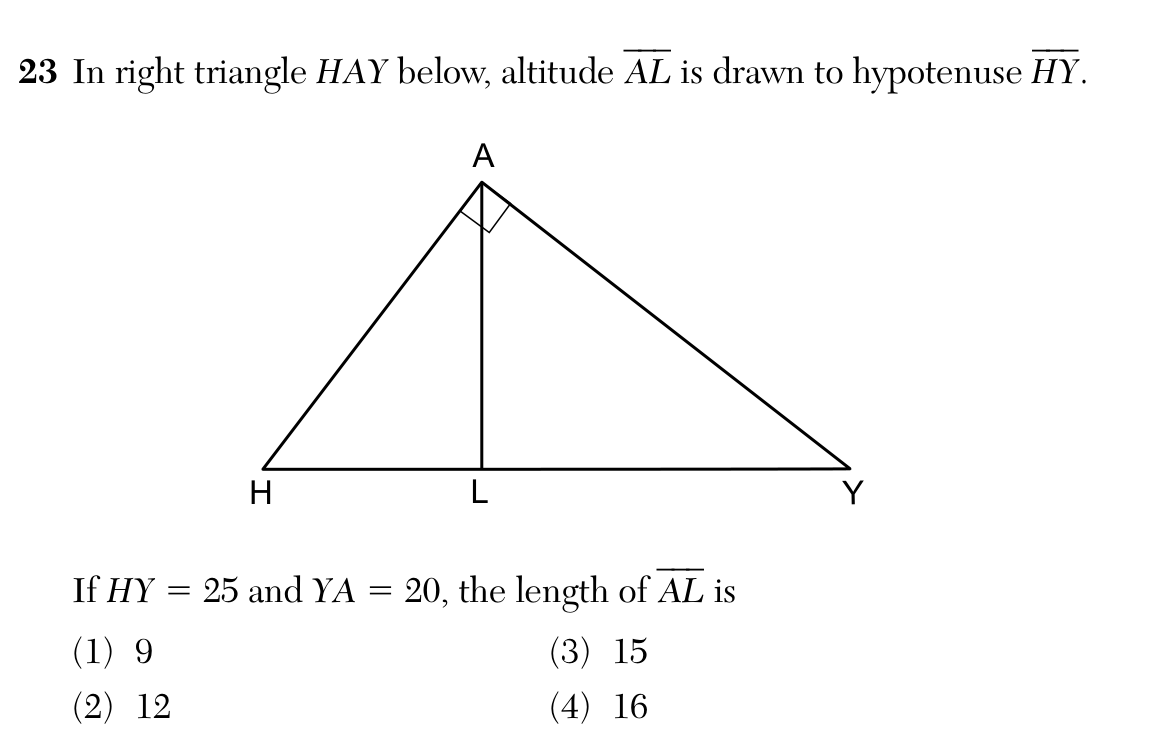
Question text (accessible)
If HY = 25 and YA = 20, the length of AL is
- 9
- 12
- 15
- 16
Diagram description: A is the right-angle vertex, L lies on HY, and AL is perpendicular to HY.
Answer
Choice (2): 12.
Original SOMATH worked solution
- First find the other leg: HA = √(25² − 20²) = √225 = 15.
- Compute the area using the two perpendicular legs: A = ½(15)(20) = 150.
- Using HY as the base gives the same area: 150 = ½(25)(AL). Therefore AL = 300/25 = 12.
Key idea: A triangle has the same area regardless of the base-altitude pair used.
Avoid this mistake: HA = 15 is a leg, not the altitude AL. Finish the second area calculation.
Question 24
2 creditsArea scale factor
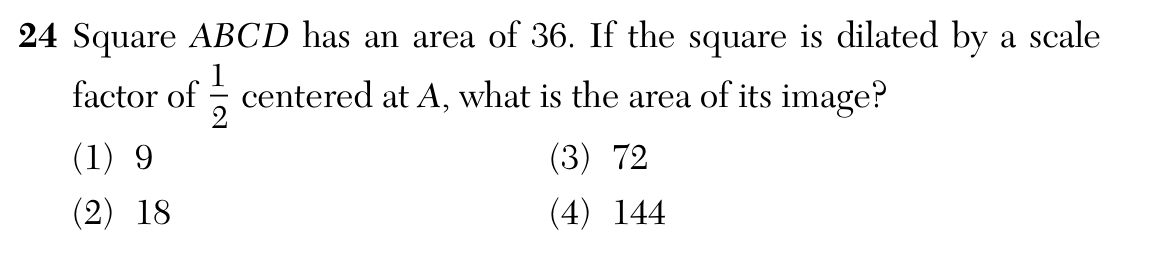
Question text (accessible)
- 9
- 18
- 72
- 144
Answer
Choice (1): 9.
Original SOMATH worked solution
- A dilation with linear scale factor k multiplies area by k².
- Image area = 36(1/2)² = 36/4 = 9.
- As a check, the original side length is 6; the image side is 3, so its area is 3² = 9.
Key idea: Lengths scale by k, areas by k², and volumes by k³.
Avoid this mistake: Halving area directly gives 18. Both dimensions shrink, so the area is quartered.
Check your Part I work
Attempt the questions before revealing answers. For each mistake, record the concept, the step that failed, and a corrected calculation; the explanation is more useful than memorizing a choice number.
Frequently asked questions
How many questions are in Part I of the August 2025 Geometry Regents?
Part I contains 24 multiple-choice questions worth 2 credits each, for 48 credits. NYSED does not award partial credit in this part.
Are the exam questions and diagrams changed?
No. The visible question images are lossless crops of the original NYSED exam, with all answer options and diagrams preserved. A selectable text version is also provided; the worked explanations are original SOMATH content.
Which topics should I review after Part I?
Use the theorem and common-mistake notes under each answer to classify your errors. This set includes rigid motions, dilation, right-triangle trigonometry, similarity, circle equations, secants, volume, density, and area.
Where can I get Geometry Regents help in NYC?
SOMATH offers Regents Geometry and Trigonometry preparation at 226 W 79th Street, 1st Floor, New York, NY 10024. Visit the course page or request an evaluation to discuss appropriate support.
Exam structure and scoring references: NYSED exam directions and rating guide. Mathematical explanations on this page are by SOMATH.
School of Math · Upper West Side, NYC
Turn a missed question into a learned skill.
SOMATH provides Regents Geometry and Trigonometry preparation at 226 W 79th Street, 1st Floor, New York, NY 10024. Bring the questions that challenged you so the next conversation can focus on your reasoning, not only your score.
Request a math evaluation · Explore the Geometry program · (646) 668-6151
When referencing this guide, credit SOMATH — School of Math for the worked explanations and NYSED for the original examination. The canonical page is August 2025 Geometry Regents: Part I answers. These study materials do not guarantee a score or replace official scoring guidance.