August 2025 exam · Part II · 14 credits
August 2025 Geometry Regents: Part II answers
Part II asks students to explain congruence, calculate density and coordinates, use trigonometry and sector area, and construct a reflection. Each solution models the reasoning behind the answer, not just a final number.
Try each question first, then select the small blue Answer button for the full explanation. On a phone, use Question text for readable text or select the exam image to enlarge it. Need guided practice? Request a SOMATH evaluation.
About this exam and this guide
The August 20, 2025 NYSED Geometry Regents has 35 questions across four parts, totaling 80 raw credits. This page covers Questions 25–31, worth 14 credits.
Question source: New York State Education Department. Worked explanations: SOMATH — School of Math. The question images preserve the original wording, diagrams, and options; text versions normalize mathematical typography for web reading. SOMATH is not affiliated with or endorsed by NYSED.
Open the original exam PDF · Official answer key · Official rating guide
Jump to a question
Question 25
2 creditsWhy translations preserve congruence

Question text (accessible)
Explain why △D′A′N′ must be congruent to △DAN.
Answer
△D′A′N′ ≅ △DAN because a translation is a rigid motion.
Original SOMATH worked solution
- A translation moves every point the same distance in the same direction.
- It preserves distances and angle measures. In particular, D′A′ = DA, A′N′ = AN, and D′N′ = DN.
- The corresponding sides are congruent, so the triangles are congruent by SSS. Equivalently, a rigid motion mapping one triangle onto another establishes congruence.
Key idea: Congruence describes figures with the same shape and size, even when their positions differ.
Avoid this mistake: “They look the same” is not a geometric explanation. Name the translation's distance-preserving property.
Question 26
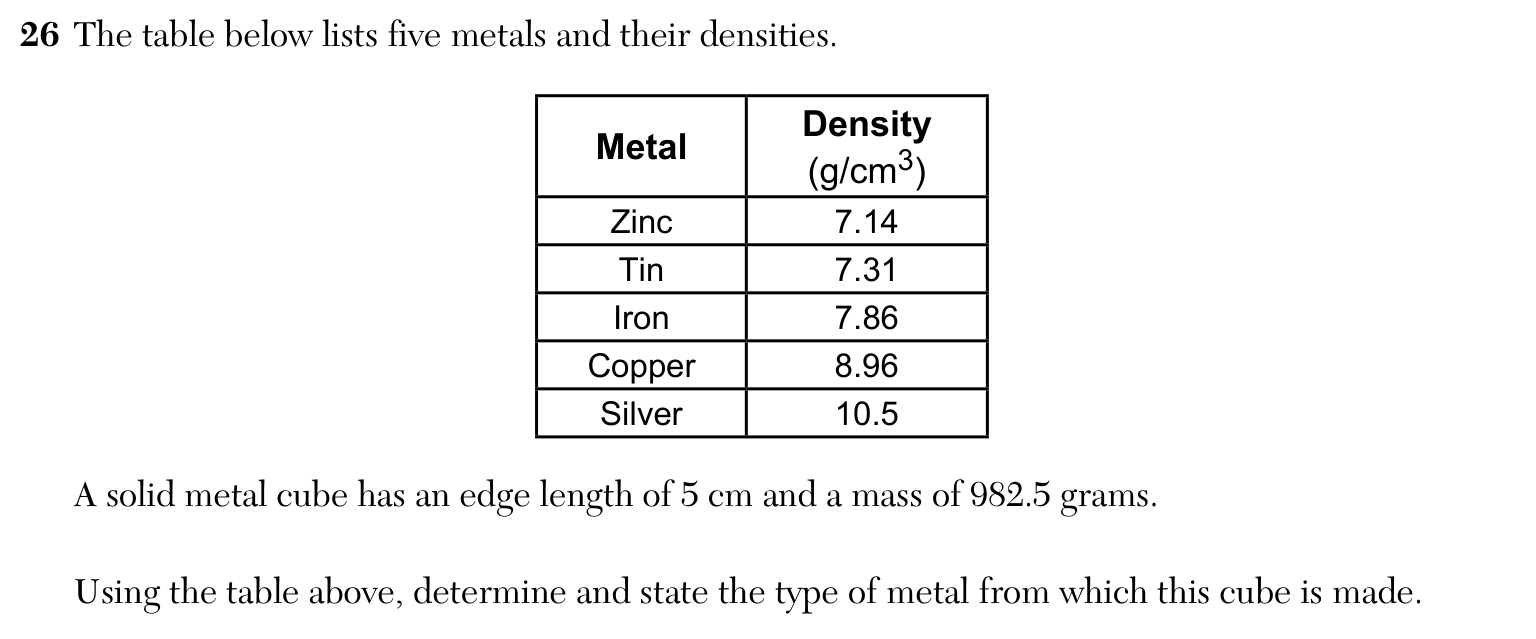
2 creditsIdentify a metal using density
Question text (accessible)
| Metal | Density (g/cm³) |
|---|---|
| Zinc | 7.14 |
| Tin | 7.31 |
| Iron | 7.86 |
| Copper | 8.96 |
| Silver | 10.5 |
A solid metal cube has an edge length of 5 cm and a mass of 982.5 grams.
Using the table above, determine and state the type of metal from which this cube is made.
Answer
Iron.
Original SOMATH worked solution
- A cube with edge length 5 cm has volume V = 5³ = 125 cm³.
- Density = mass / volume = 982.5/125 = 7.86 g/cm³.
- The table lists iron at 7.86 g/cm³, so the cube is made of iron.
Key idea: Density is mass per unit volume, not mass per unit length.
Avoid this mistake: Dividing by 5 or by 25 uses an edge length or face area instead of the cube's volume.
Question 27
2 creditsPartition a segment in a 3:2 ratio
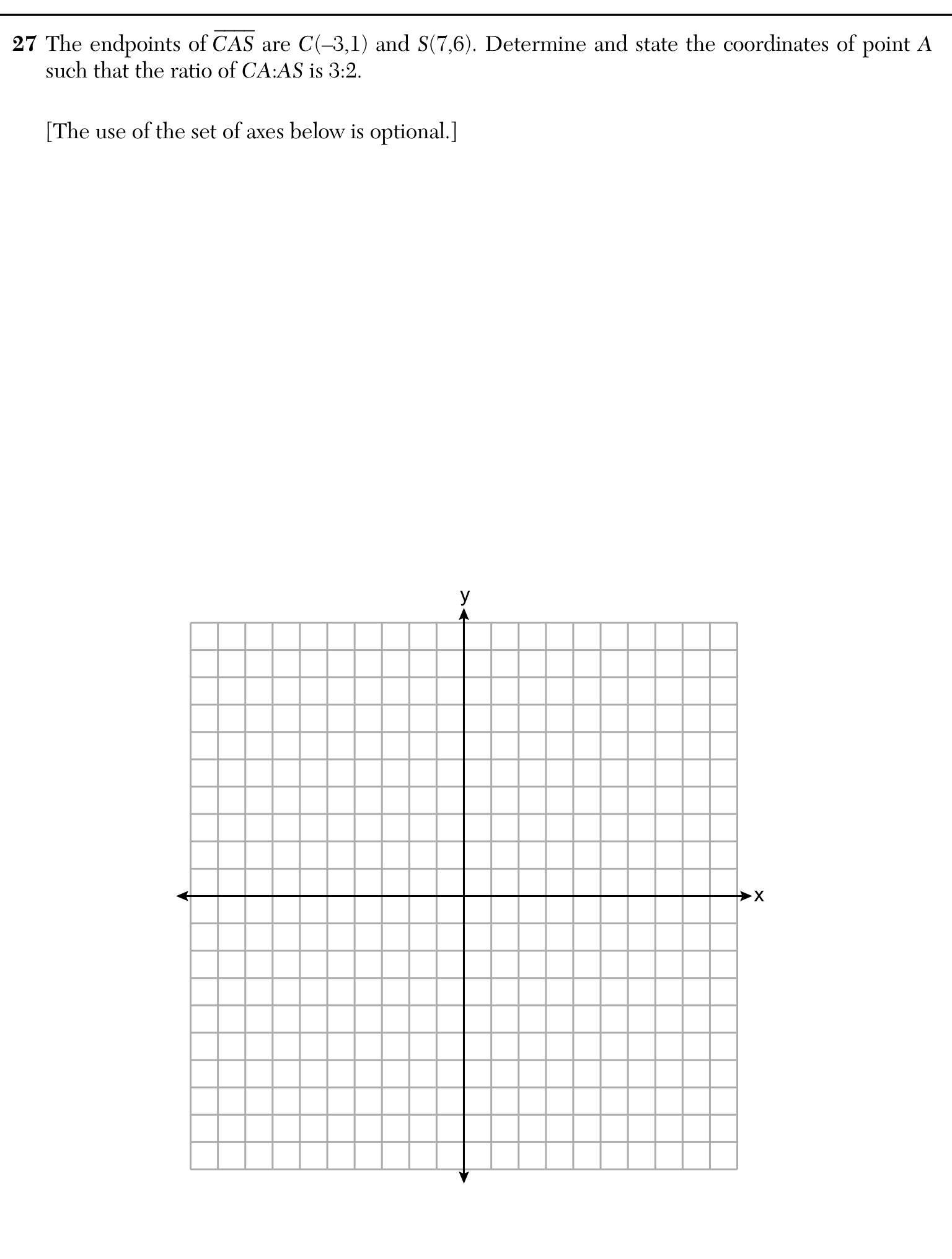
Question text (accessible)
[The use of the set of axes below is optional.]
Diagram description: The original question includes an optional blank coordinate grid.
Answer
A = (3, 4).
Original SOMATH worked solution
- The ratio 3:2 divides CS into 5 equal parts. A is 3/5 of the way from C toward S.
- The displacement from C to S is (7 − (−3), 6 − 1) = (10, 5). Three fifths of that displacement is (6, 3).
- Add it to C: A = (−3 + 6, 1 + 3) = (3, 4).
- Check: CA has displacement (6, 3) and AS has displacement (4, 2). Their lengths are 3√5 and 2√5, giving the required 3:2 ratio.
Key idea: For CA:AS = m:n, start at C and take m/(m + n) of the displacement toward S.
Avoid this mistake: The first number of the ratio measures the part from C to A. Starting from S without reversing the fraction gives the wrong point.
Question 28
2 creditsRamp length from an angle of elevation
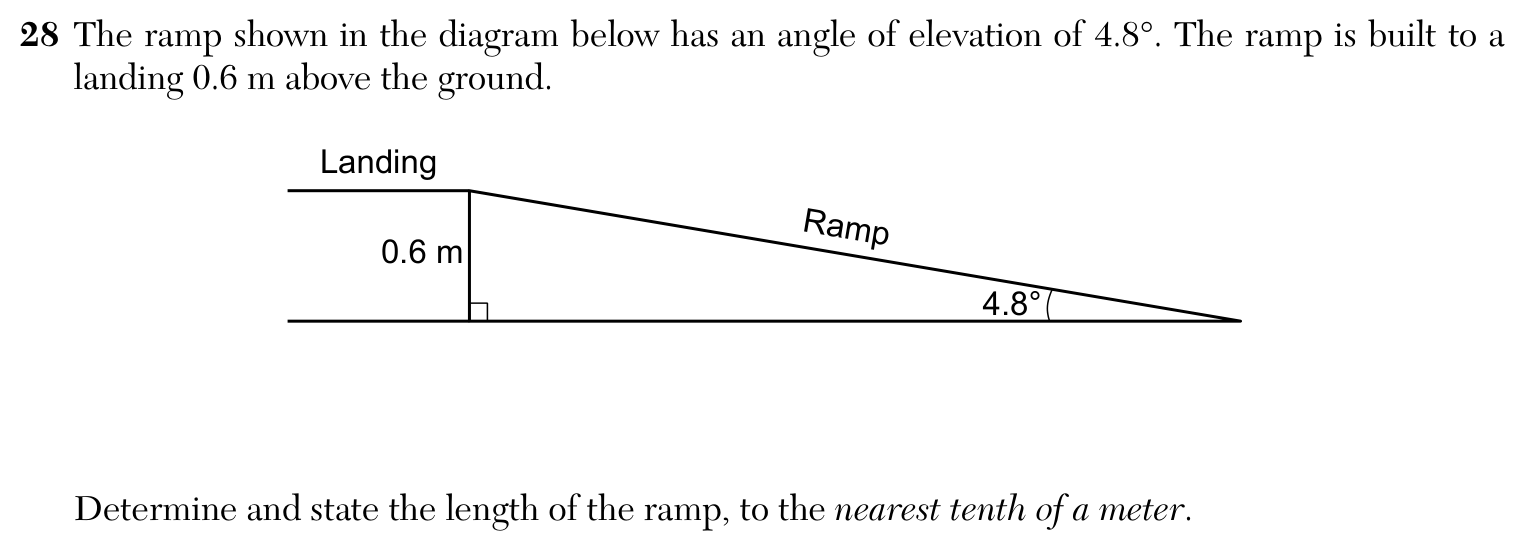
Question text (accessible)
Determine and state the length of the ramp, to the nearest tenth of a meter.
Diagram description: The ramp rises 0.6 m to a landing and makes a 4.8° angle with the horizontal ground.
Answer
7.2 meters.
Original SOMATH worked solution
- Let L be the ramp length. The vertical rise of 0.6 m is opposite the 4.8° angle, and the ramp is the hypotenuse.
- sin 4.8° = 0.6/L, so L = 0.6/sin 4.8°.
- In degree mode, L ≈ 7.17036 m. To the nearest tenth, the ramp is 7.2 m long.
Key idea: Use sine when the known side is opposite the angle and the unknown is the hypotenuse.
Avoid this mistake: Tangent would find the horizontal run, not the slanted ramp.
Question 29
2 creditsAn exterior angle of an isosceles triangle
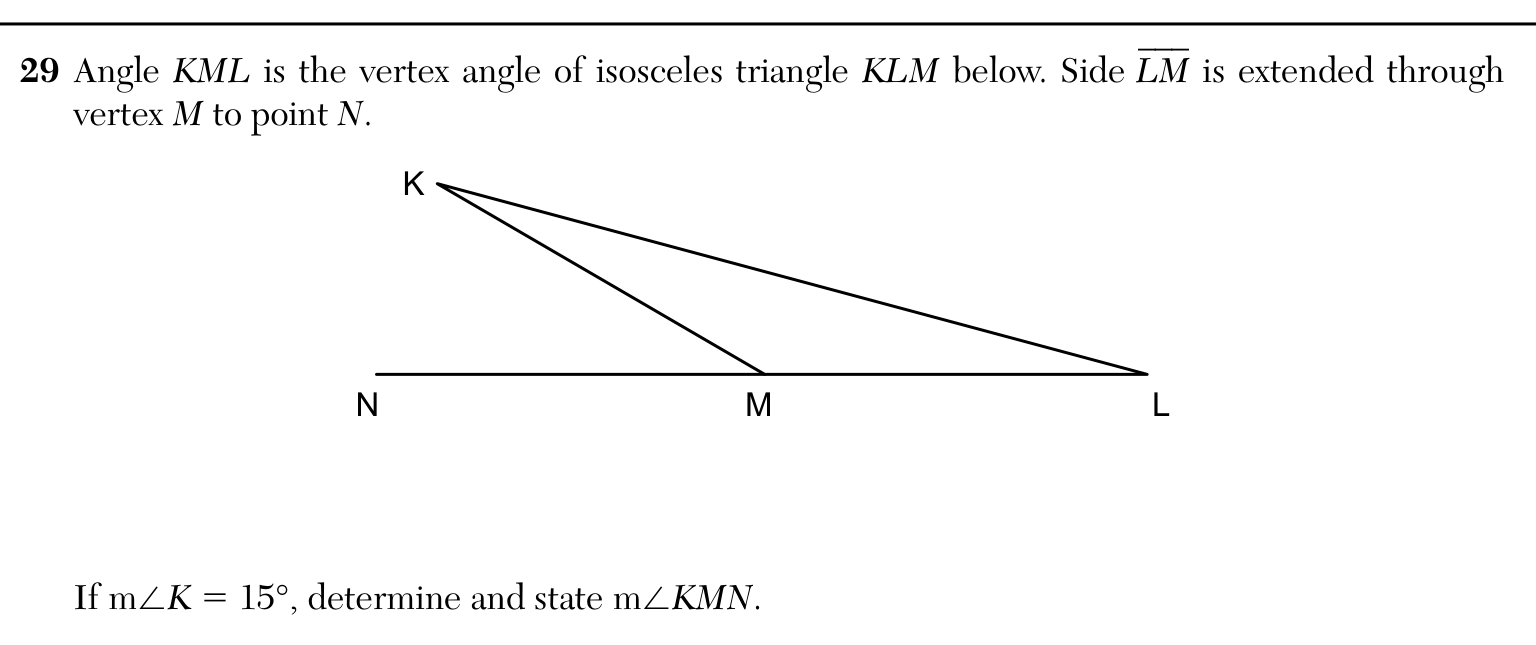
Question text (accessible)
If m∠K = 15°, determine and state m∠KMN.
Diagram description: N, M, and L are collinear, with M between N and L; K lies above the line.
Answer
m∠KMN = 30°.
Original SOMATH worked solution
- Because the vertex angle is at M, the base angles are at K and L. Thus m∠L = m∠K = 15°.
- The interior angle at M is 180° − 15° − 15° = 150°.
- Since MN extends ML in the opposite direction, ∠KMN and ∠KML form a linear pair. Therefore m∠KMN = 180° − 150° = 30°.
- A shorter check uses the exterior angle theorem: 15° + 15° = 30°.
Key idea: An exterior angle equals the sum of the two nonadjacent interior angles.
Avoid this mistake: The vertex angle is at M, so it is not one of the two equal base angles.
Question 30
2 creditsCentral angle from sector area
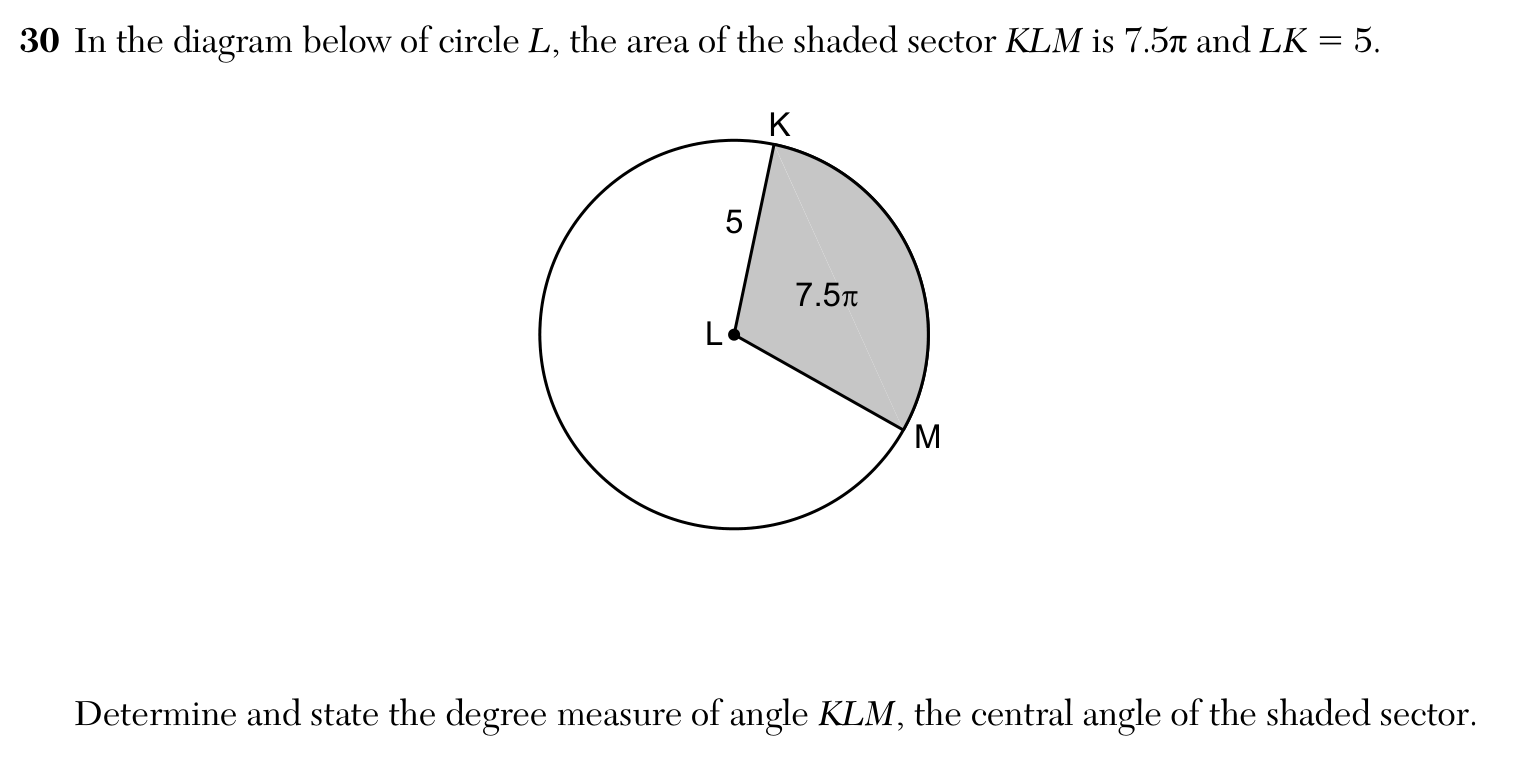
Question text (accessible)
Determine and state the degree measure of angle KLM, the central angle of the shaded sector.
Diagram description: The shaded sector between radii LK and LM is labeled 7.5π; LK is labeled 5.
Answer
m∠KLM = 108°.
Original SOMATH worked solution
- The entire circle has area πr² = π(5²) = 25π.
- The shaded sector is 7.5π/(25π) = 0.3 of the circle.
- Its central angle is the same fraction of a full turn: 0.3(360°) = 108°.
- Check: (108/360)π(5²) = 7.5π, the given sector area.
Key idea: Sector area / circle area = central angle / 360°.
Avoid this mistake: This is an area problem. Do not substitute the arc-length formula using 2πr.
Question 31
2 creditsReflect a point with compass and straightedge
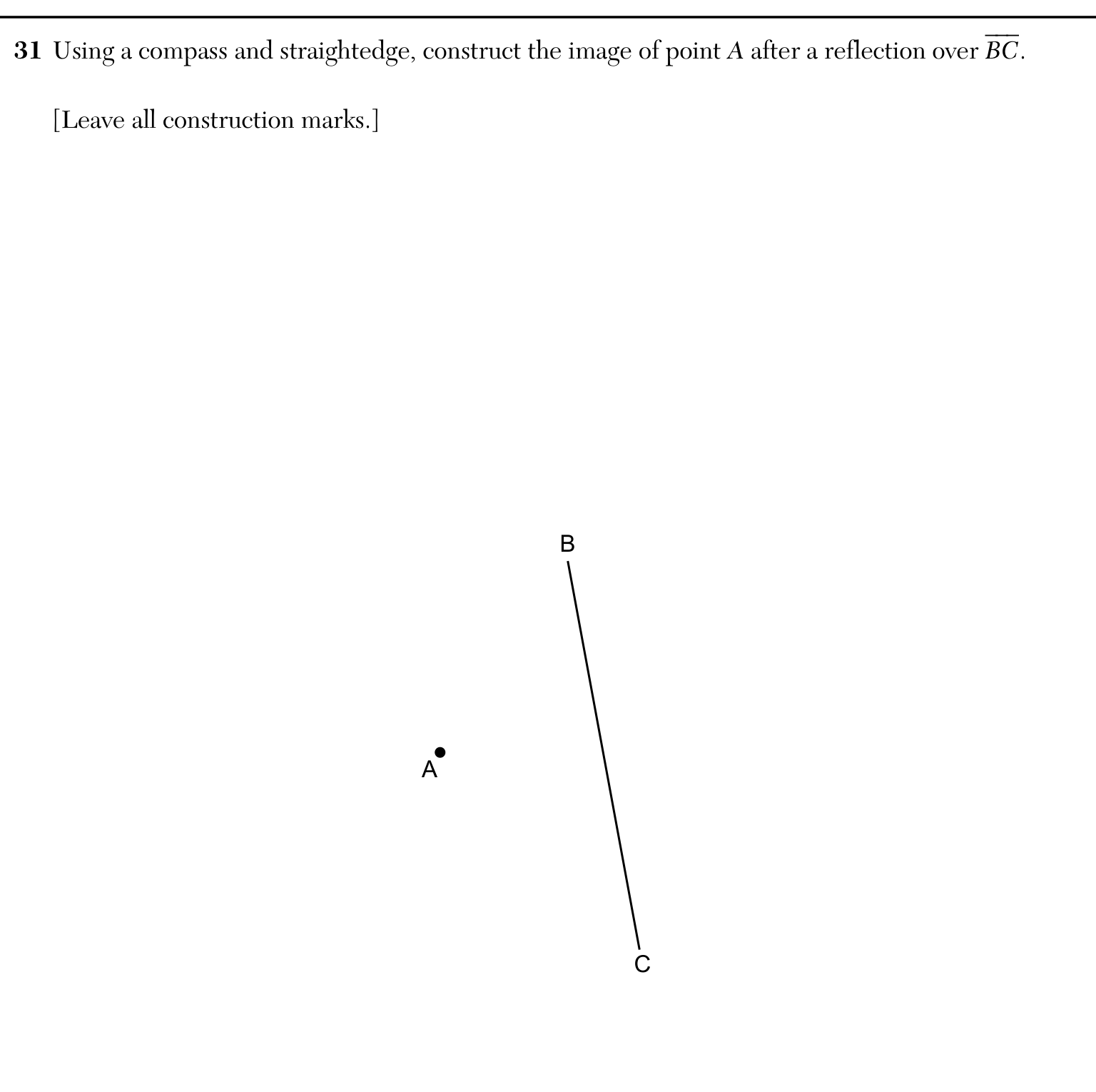
Question text (accessible)
[Leave all construction marks.]
Diagram description: The original diagram shows segment BC slanting downward to the right, with A to its left.
Answer
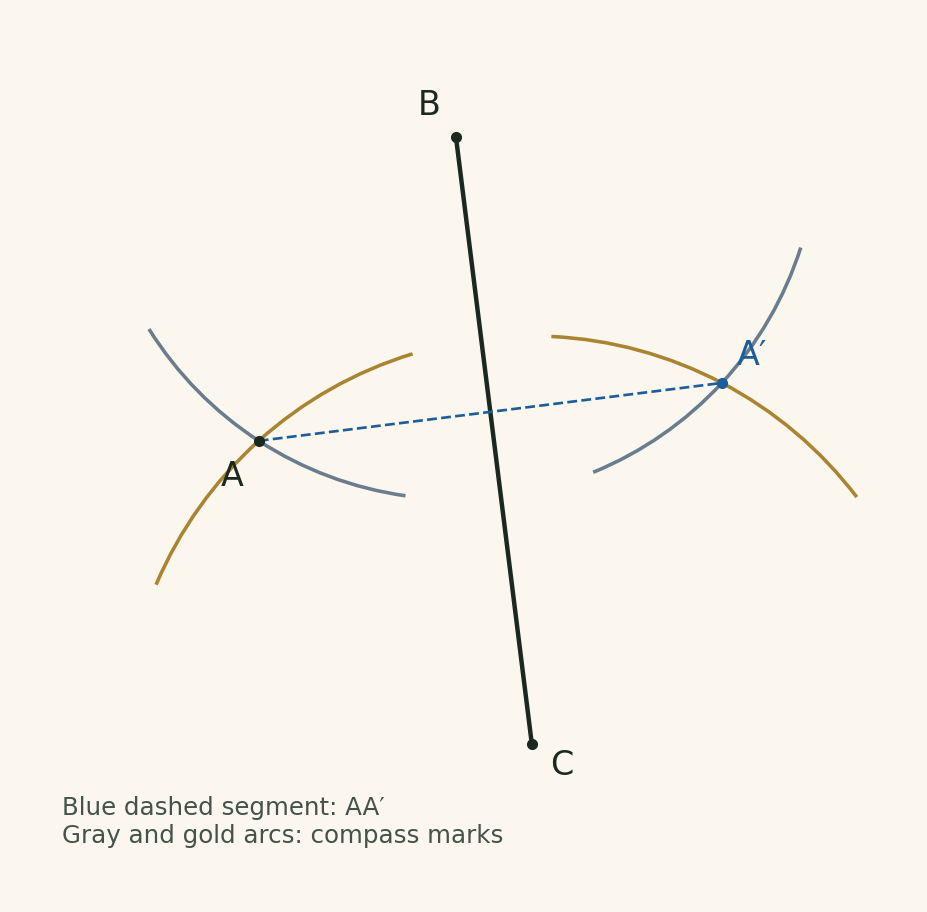
A′ is the second intersection of the two compass arcs, on the opposite side of BC from A.
Original SOMATH worked solution
- Place the compass point at B and open it to A. Without changing that opening, draw an arc on the other side of BC where the reflected point will lie.
- Place the compass point at C and open it to A. Draw a second arc on that same side of BC, crossing the first arc.
- Label their intersection A′. The two circles centered at B and C meet at A and A′; choose the intersection different from A.
- Leave both intersecting arcs visible. Use the straightedge to show AA′ if desired; do not erase the construction marks.
- Why it works: BA = BA′ and CA = CA′ are compass radii. Both B and C are equidistant from A and A′, so line BC is the perpendicular bisector of AA′. That is exactly the defining condition for reflection.
Key idea: Reflection across a line places a point and its image at equal perpendicular distances on opposite sides of that line.
Avoid this mistake: A point placed by eye, with no compass arcs, is not a compass-and-straightedge construction.
Show the method, not just the result
For calculations, identify the quantity, write the formula, substitute the given values, and finish with the requested units and rounding. For Question 25, name the rigid-motion property; for Question 31, show the actual compass arcs.
The NYSED rating guide requires a correct construction with appropriate arcs for full credit on Question 31. The illustrated SOMATH method is one way to achieve that result.
Frequently asked questions
What questions are in August 2025 Geometry Regents Part II?
Part II contains Questions 25–31: translation and congruence, density, a segment partition, ramp trigonometry, an exterior angle, sector area, and a reflection construction. There are 7 questions worth 2 credits each.
Can I write only the numerical answer in Part II?
The NYSED directions state that a correct numerical answer with no work shown receives only 1 credit. Show the formula, substitution, calculation, and any requested explanation or construction.
How do I construct the reflection in Question 31?
Draw arcs centered at B and C with radii BA and CA. Their other intersection is A′, on the opposite side of BC. Leave the intersecting compass arcs visible.
Are SOMATH’s construction steps the official NYSED solution?
No. The construction steps and explanatory diagram are an original SOMATH approach. The question itself is reproduced from NYSED; the official rating guide is linked for scoring reference.
Exam structure and scoring references: NYSED exam directions and rating guide. Mathematical explanations on this page are by SOMATH.
School of Math · Upper West Side, NYC
Turn a missed question into a learned skill.
SOMATH provides Regents Geometry and Trigonometry preparation at 226 W 79th Street, 1st Floor, New York, NY 10024. Bring the questions that challenged you so the next conversation can focus on your reasoning, not only your score.
Request a math evaluation · Explore the Geometry program · (646) 668-6151
When referencing this guide, credit SOMATH — School of Math for the worked explanations and NYSED for the original examination. The canonical page is August 2025 Geometry Regents: Part II answers. These study materials do not guarantee a score or replace official scoring guidance.