August 2025 exam · Part III · 12 credits
August 2025 Geometry Regents: Part III answers
Part III connects calculations to conclusions. The three responses below show when to round down, how to carry unrounded trigonometric values between steps, and how slopes establish that a quadrilateral is a rectangle.
Try each question first, then select the small blue Answer button for the full explanation. On a phone, use Question text for readable text or select the exam image to enlarge it. Need guided practice? Request a SOMATH evaluation.
About this exam and this guide
The August 20, 2025 NYSED Geometry Regents has 35 questions across four parts, totaling 80 raw credits. This page covers Questions 32–34, worth 12 credits.
Question source: New York State Education Department. Worked explanations: SOMATH — School of Math. The question images preserve the original wording, diagrams, and options; text versions normalize mathematical typography for web reading. SOMATH is not affiliated with or endorsed by NYSED.
Open the original exam PDF · Official answer key · Official rating guide
Jump to a question
Question 32
4 creditsWhole buckets before a tank overflows
Question text (accessible)
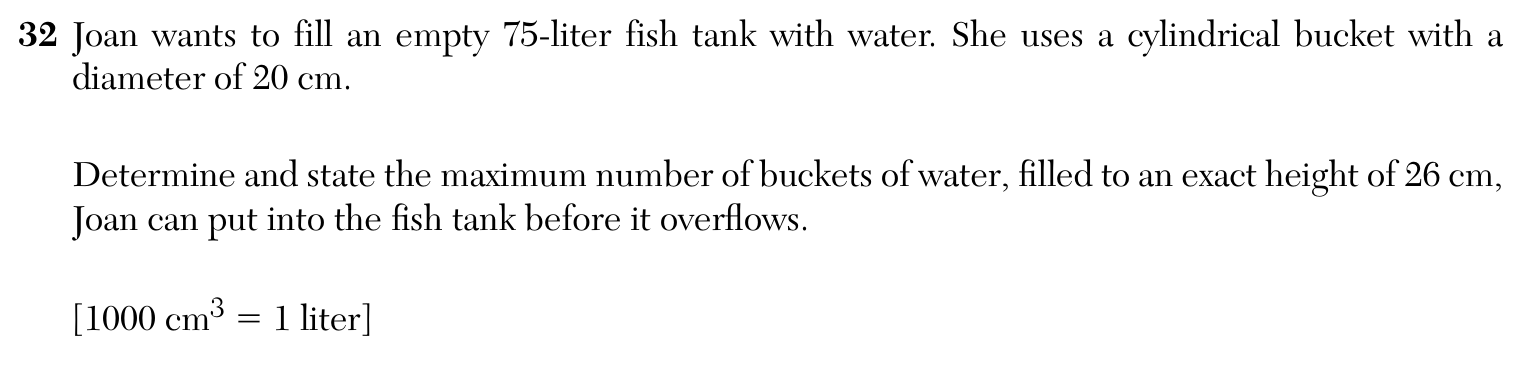
Determine and state the maximum number of buckets of water, filled to an exact height of 26 cm, Joan can put into the fish tank before it overflows.
[1000 cm³ = 1 liter]
Answer
9 full buckets.
Original SOMATH worked solution
- The bucket radius is half its diameter: r = 10 cm. Its filled height is h = 26 cm.
- The water volume in one bucket is V = πr²h = π(10²)(26) = 2600π cm³.
- Convert to liters: 2600π/1000 = 2.6π ≈ 8.16814 liters per bucket.
- 75/(2.6π) ≈ 9.18202. Only 9 complete buckets can be added without exceeding capacity.
- Check the boundary: 9 buckets hold 23.4π ≈ 73.5133 L; 10 hold 26π ≈ 81.6814 L. The ninth fits, but the tenth overflows.
Key idea: A maximum number of full containers that fit within a capacity requires rounding down.
Avoid this mistake: Do not use 20 cm as the radius or round up to 10. Both errors change the physical meaning of the calculation.
Question 33
4 creditsTwo cables and inverse tangent
Question text (accessible)
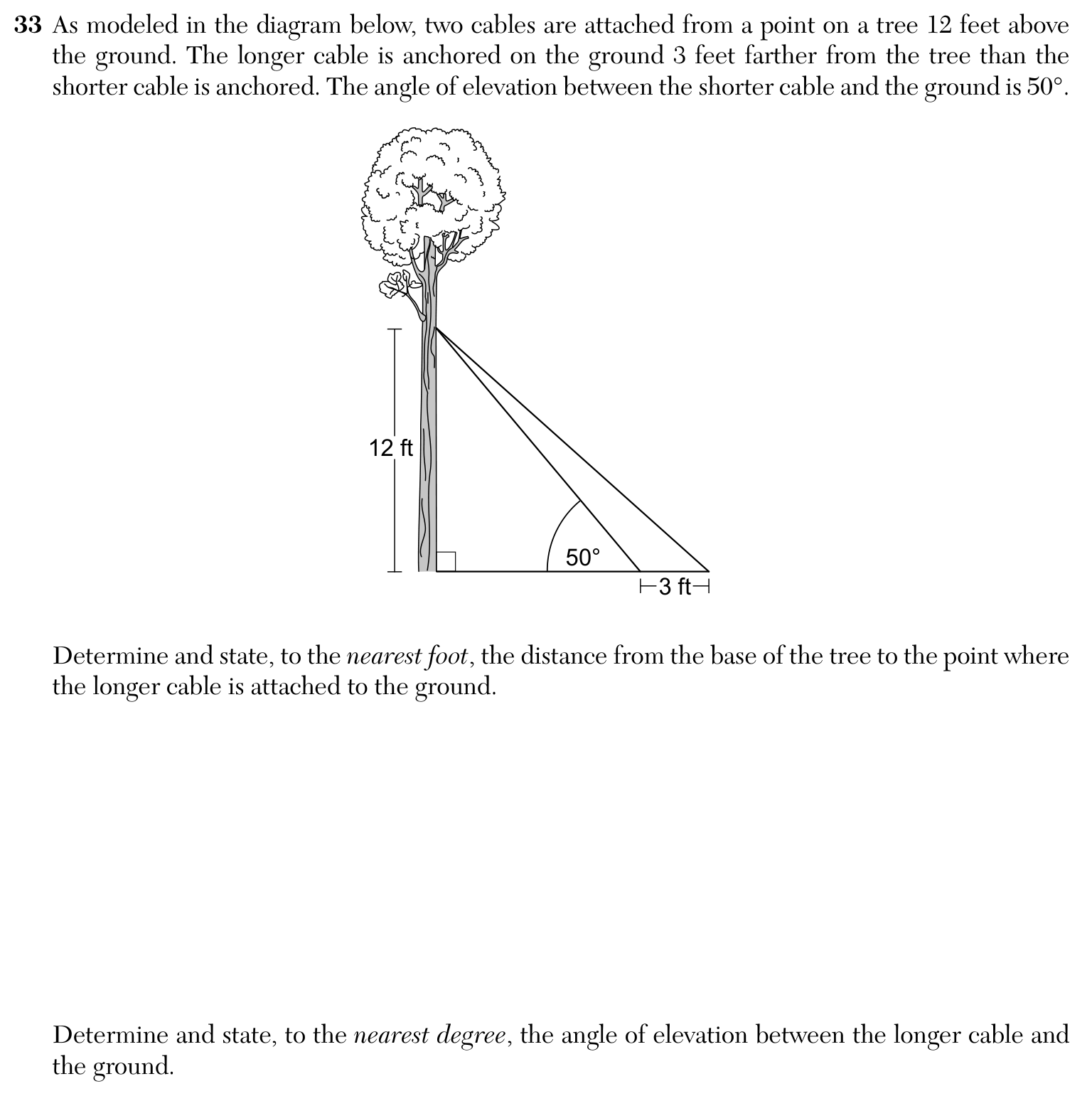
Determine and state, to the nearest foot, the distance from the base of the tree to the point where the longer cable is attached to the ground.
Determine and state, to the nearest degree, the angle of elevation between the longer cable and the ground.
Diagram description: Both cables meet the tree 12 ft above ground; their anchors are 3 ft apart and the shorter cable makes a 50° angle with the ground.
Answer
13 feet; 43°.
Original SOMATH worked solution
- Let x be the horizontal distance from the tree to the shorter cable's anchor. Since opposite/adjacent = tangent, tan 50° = 12/x.
- x = 12/tan 50° ≈ 10.06920 ft. The longer cable's anchor is 3 feet farther away, so d = x + 3 ≈ 13.06920 ft.
- The requested ground distance rounds to 13 feet.
- Let θ be the longer cable's angle of elevation. tan θ = 12/d, so θ = arctan[12/(12/tan 50° + 3)].
- Using the unrounded distance gives θ ≈ 42.55783°, which rounds to 43°.
Key idea: Tangent relates vertical rise to horizontal run. Inverse tangent recovers the angle from that ratio.
Avoid this mistake: The 3 feet is the difference between ground-anchor distances, not between cable lengths. Keep the unrounded distance for the second calculation.
Question 34
4 creditsCoordinate proof of a rectangle
Question text (accessible)
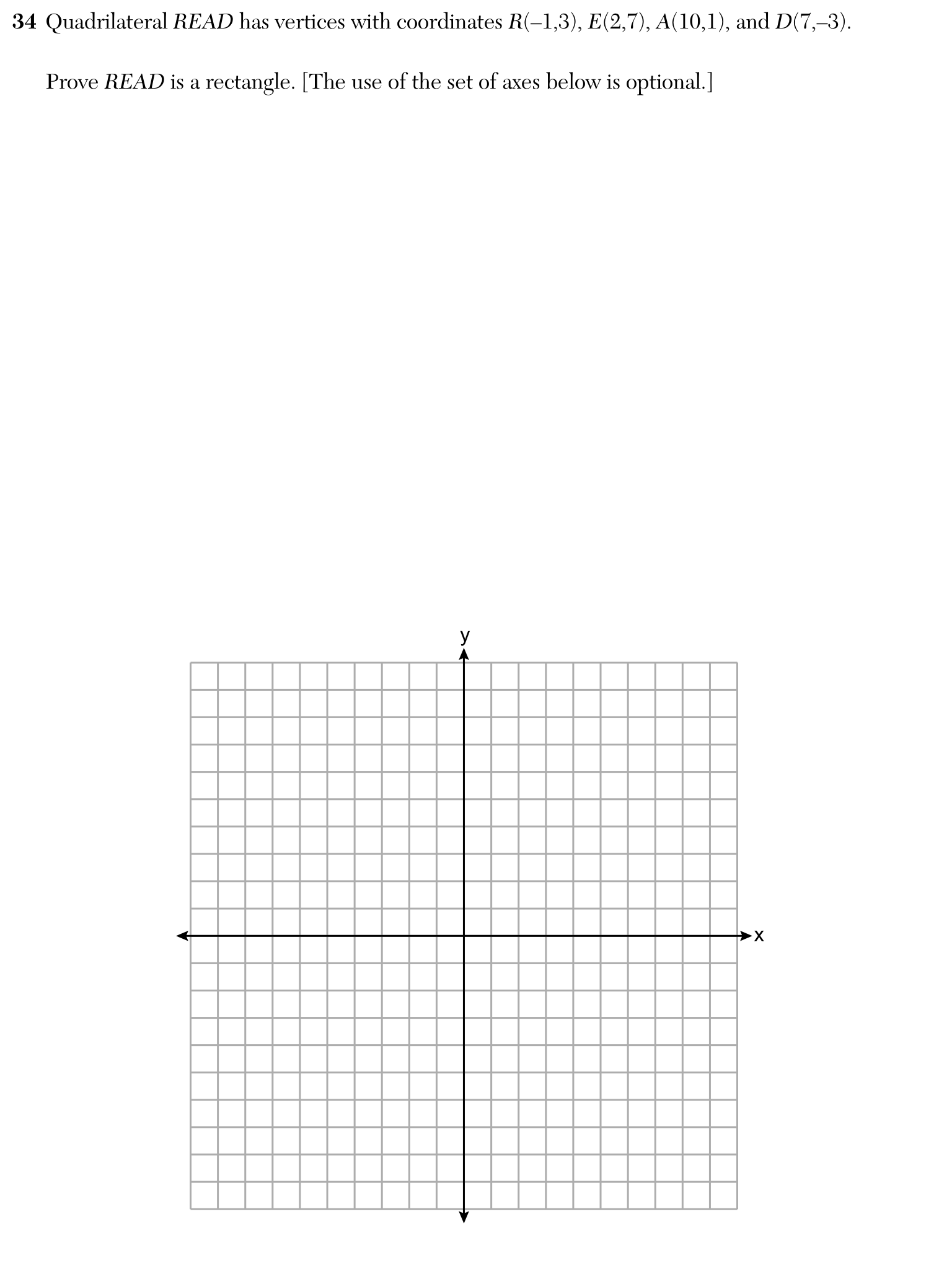
Prove READ is a rectangle. [The use of the set of axes below is optional.]
Diagram description: An optional blank coordinate grid follows the question.
Answer
READ is a rectangle: both pairs of opposite sides are parallel, and adjacent sides are perpendicular.
Original SOMATH worked solution
- Calculate mRE = (7 − 3)/(2 − (−1)) = 4/3.
- Calculate mEA = (1 − 7)/(10 − 2) = −6/8 = −3/4.
- Calculate mAD = (−3 − 1)/(7 − 10) = −4/(−3) = 4/3.
- Calculate mDR = (3 − (−3))/(−1 − 7) = 6/(−8) = −3/4.
- RE and AD have equal slopes, so RE ∥ AD. EA and DR have equal slopes, so EA ∥ DR. Therefore READ is a parallelogram.
- The slopes of RE and EA multiply to (4/3)(−3/4) = −1, so RE ⊥ EA and ∠REA is a right angle.
- A parallelogram with a right angle is a rectangle. Therefore READ is a rectangle.
Key idea: A coordinate proof needs both numerical evidence and the geometric conclusion that follows from it.
Avoid this mistake: Equal opposite slopes alone prove a parallelogram, not necessarily a rectangle. The perpendicular-side argument completes the proof.
Three habits for multi-step responses
- Interpret the whole number: Q32 rounds down because another complete bucket would overflow the tank.
- Keep calculator precision: Q33 uses the full horizontal distance when calculating the second angle.
- Finish the proof: Q34 connects slopes to parallel lines, perpendicular lines, and the rectangle theorem.
These are SOMATH study reminders, not an official allocation of scoring points. Use the linked NYSED guide for the exam’s scoring criteria.
Frequently asked questions
What are the answers to August 2025 Geometry Regents Questions 32 and 33?
Question 32 requires 9 full buckets. Question 33 requires a ground distance of 13 feet and an angle of elevation of 43°, rounded as requested. The derivations are provided under each Answer button.
Why does Question 32 round down to 9 buckets?
The tank must not overflow. Nine full buckets contain about 73.51 liters, while ten contain about 81.68 liters, exceeding the 75-liter capacity.
Why should I avoid rounding early in Question 33?
The second calculation depends on the horizontal distance found in the first. Retain its unrounded value until computing the angle, then round each final response in the unit requested.
What proves READ is a rectangle in Question 34?
The opposite-side slopes match, proving READ is a parallelogram. Adjacent slopes are 4/3 and −3/4, negative reciprocals, so the parallelogram has a right angle and is a rectangle.
Exam structure and scoring references: NYSED exam directions and rating guide. Mathematical explanations on this page are by SOMATH.
School of Math · Upper West Side, NYC
Turn a missed question into a learned skill.
SOMATH provides Regents Geometry and Trigonometry preparation at 226 W 79th Street, 1st Floor, New York, NY 10024. Bring the questions that challenged you so the next conversation can focus on your reasoning, not only your score.
Request a math evaluation · Explore the Geometry program · (646) 668-6151
When referencing this guide, credit SOMATH — School of Math for the worked explanations and NYSED for the original examination. The canonical page is August 2025 Geometry Regents: Part III answers. These study materials do not guarantee a score or replace official scoring guidance.