August 2025 exam · Part IV · 6 credits
August 2025 Geometry Regents: Part IV answers
The final question asks for a proof, not a measurement. SOMATH’s solution builds the argument from the bisected segments to congruent triangles, then proves that one pair of opposite sides of ABCD is both parallel and congruent.
Try each question first, then select the small blue Answer button for the full explanation. On a phone, use Question text for readable text or select the exam image to enlarge it. Need guided practice? Request a SOMATH evaluation.
About this exam and this guide
The August 20, 2025 NYSED Geometry Regents has 35 questions across four parts, totaling 80 raw credits. This page covers Question 35, worth 6 credits.
Question source: New York State Education Department. Worked explanations: SOMATH — School of Math. The question images preserve the original wording, diagrams, and options; text versions normalize mathematical typography for web reading. SOMATH is not affiliated with or endorsed by NYSED.
Open the original exam PDF · Official answer key · Official rating guide
Jump to a question
Question 35
6 creditsA parallelogram proof from bisected segments
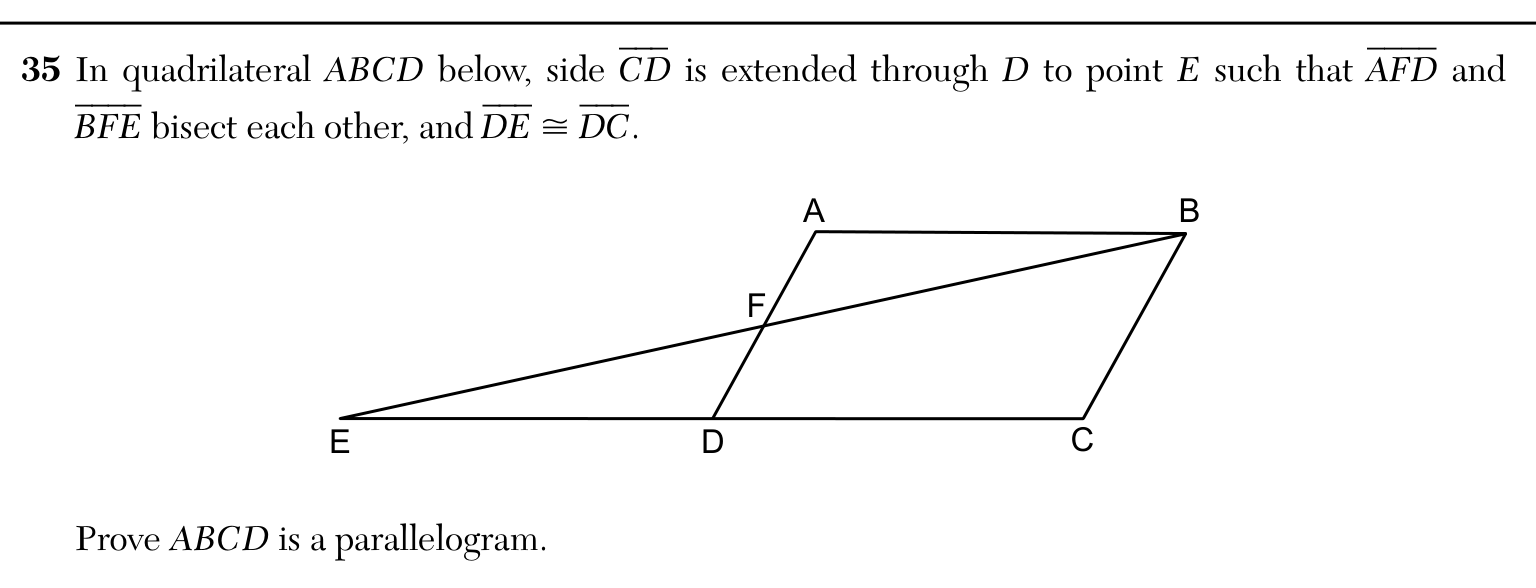
Question text (accessible)
Prove ABCD is a parallelogram.
Diagram description: A, F, D are collinear; B, F, E are collinear; E, D, C are collinear with D between E and C.
Answer
ABCD is a parallelogram because opposite sides AB and DC are both parallel and congruent.
Original SOMATH worked solution
- Since AFD and BFE bisect each other at F, AF ≅ FD and BF ≅ FE.
- ∠AFB ≅ ∠DFE because vertical angles are congruent.
- Therefore △AFB ≅ △DFE by SAS: AF ↔ DF, FB ↔ FE, and the included angles at F are congruent.
- By corresponding parts of congruent triangles, AB ≅ DE and ∠ABF ≅ ∠DEF.
- B, F, and E are collinear. Thus ∠ABF and ∠DEF are alternate interior angles for lines AB and DE cut by transversal BE. By the converse of the alternate interior angles theorem, AB ∥ DE.
- C, D, and E are collinear, so DC lies on the same line as DE. It follows that AB ∥ DC.
- AB ≅ DE was proved, and DE ≅ DC is given. By transitivity, AB ≅ DC.
- In quadrilateral ABCD, one pair of opposite sides, AB and DC, is both parallel and congruent. Therefore ABCD is a parallelogram.
A second valid route: use the auxiliary quadrilateral
In quadrilateral ABDE, the diagonals are AD and BE. Since they bisect each other, ABDE is a parallelogram. Its opposite sides AB and DE are therefore parallel and congruent. Because E, D, and C are collinear and DE ≅ DC, we obtain AB ∥ DC and AB ≅ DC. Therefore ABCD is a parallelogram by the one-pair theorem.
Why the extra segment matters
The first parallelogram is ABDE, not ABCD. The condition DE ≅ DC transfers the length of AB to the opposite side DC of the quadrilateral we actually need to prove.
Key idea: One pair of opposite sides that is both parallel and congruent is sufficient to prove a quadrilateral is a parallelogram.
Avoid this mistake: The given bisected segments are AD and BE, not the diagonals AC and BD of ABCD. Applying the diagonal-bisection theorem directly to ABCD would be invalid.
A proof-writing checklist
- Translate the givens: bisected segments yield two pairs of congruent smaller segments.
- Match the triangles: list vertices in corresponding order and justify SAS.
- Use both consequences: CPCTC supplies an equal side and an equal angle.
- Transfer to the target: collinearity connects DE to DC, and the given congruence connects their lengths.
- State the final theorem: identify AB and DC as the opposite sides that are both parallel and congruent.
This checklist explains the logic of a complete response; it is not a substitute for NYSED’s official scoring rubric.
Frequently asked questions
What is the goal of August 2025 Geometry Regents Question 35?
Prove ABCD is a parallelogram. One valid route is to prove AB is both parallel and congruent to DC.
Which triangles are congruent in Question 35?
Triangles AFB and DFE are congruent by SAS: AF = FD and BF = FE because the segments bisect each other, and the included angles at F are vertical angles.
Why is DE congruent to DC needed?
The congruent triangles establish AB = DE. The given DE = DC then lets us conclude AB = DC, supplying the equal-opposite-sides condition for ABCD.
Can the bisected-diagonals theorem be applied directly to ABCD?
No. The bisected segments are AD and BE, whereas the diagonals of ABCD are AC and BD. The theorem does apply first to quadrilateral ABDE; further reasoning is needed to prove ABCD is a parallelogram.
Exam structure and scoring references: NYSED exam directions and rating guide. Mathematical explanations on this page are by SOMATH.
School of Math · Upper West Side, NYC
Turn a missed question into a learned skill.
SOMATH provides Regents Geometry and Trigonometry preparation at 226 W 79th Street, 1st Floor, New York, NY 10024. Bring the questions that challenged you so the next conversation can focus on your reasoning, not only your score.
Request a math evaluation · Explore the Geometry program · (646) 668-6151
When referencing this guide, credit SOMATH — School of Math for the worked explanations and NYSED for the original examination. The canonical page is August 2025 Geometry Regents: Part IV answers. These study materials do not guarantee a score or replace official scoring guidance.