SOMATH Journal · The parent’s guide
What Is School of Math (SOMATH)? A Parent’s Guide
Old-School Math Classes. Infinite Aura. A closer look at the people, programs, and mathematical work behind School of Math on the Upper West Side.
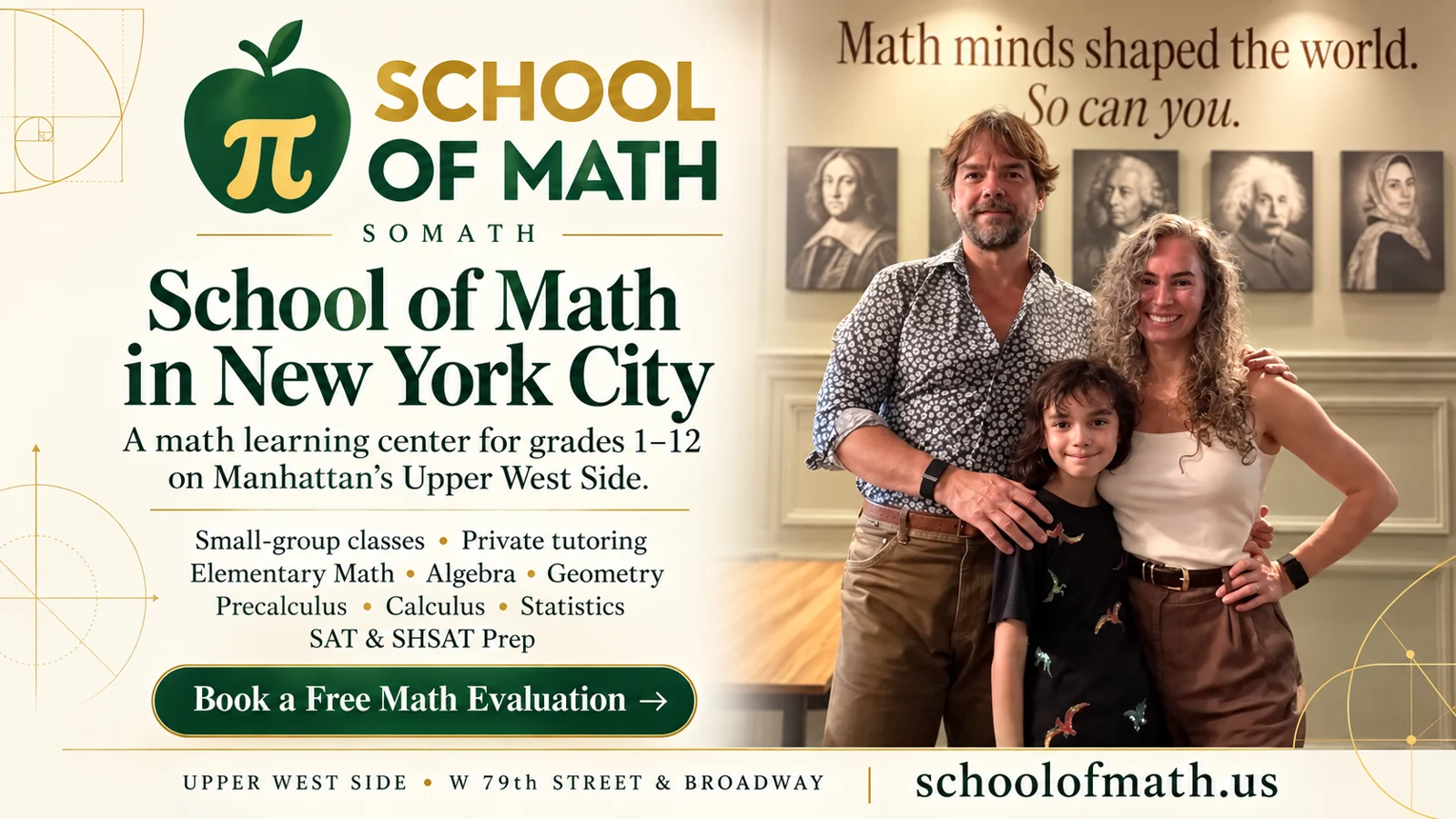
School of Math, known as SOMATH, is an in-person math-enrichment school for students in grades 1–12 on Manhattan’s Upper West Side, at 226 West 79th Street (SOMATH). Its course directory describes small groups of four to six students, with programs ranging from early number sense to algebra, geometry, and advanced high-school mathematics (courses). The starting point is a free, 30-minute evaluation designed to identify a student’s strengths, gaps, and appropriate next step (evaluation).
That is the short answer. The more useful answer is about the experience a family is choosing: a real classroom, a teacher who can look at a child’s reasoning, a sequence of mathematical ideas, and work that requires more than clicking the right option. This guide explains that choice in practical terms, from the first evaluation to the questions parents should ask before enrolling.
If you are searching for “What is SOMATH?”, “School of Math Upper West Side,” or “math classes near me,” you do not need to read the whole guide to take the next step. Book a free evaluation, explore the programs, or call (646) 668-6151 to discuss your child’s starting point (contact and location).
SOMATH at a glance
| Parent question | Short answer |
|---|---|
| What does SOMATH mean? | It is the school’s short name for School of Math (school website). |
| Where is the school? | 226 W 79th St, Upper West Side, New York, NY 10024 (visit SOMATH). |
| Who is it for? | Students in grades 1–12, with placement guided by readiness and the selected program (programs, evaluation). |
| How large are classes? | The course directory describes groups of four to six students (courses). |
| Is it online? | The membership classes are in person; the evaluation page also offers a Zoom option for the assessment (membership, evaluation). |
| Who founded it? | Vivianne Wright and Marcelo Ambrozio (meet the founders). |
| How do we start? | Book the free 30-minute evaluation and discuss placement before selecting a class (evaluation). |
The table is a starting point, not a substitute for placement. Two children in the same school grade may need very different work: one may calculate confidently but struggle to interpret a word problem, while another may reason well but need more reliable arithmetic. A useful conversation begins with what the child can actually do, not with the most advanced course title a parent can find.
What kind of math school is SOMATH?
SOMATH’s published model combines an in-house curriculum, small-cohort instruction, and an evaluation before placement (teaching approach). That places the central emphasis on a continuing mathematical education rather than on finding someone to finish tonight’s assignment. The distinction matters because a child can complete school homework without understanding the ideas that will make next month’s homework possible.
Think of three separate goals. The first is immediate assistance: resolving a confusing assignment or preparing for a test. The second is fluency: becoming accurate and dependable with skills that need practice. The third is mathematical development: connecting ideas, explaining why a method works, and recognizing when to use it. A family may need all three, but it helps to know which goal is driving enrollment.
A structured enrichment class should not simply run ahead through a textbook. Moving quickly is useful only when the student can carry understanding forward. If a child learns fraction procedures without understanding equal-sized parts, later algebra can become a collection of rules with no stable meaning. If a student learns factoring as pattern recognition alone, polynomial equations and rational expressions may feel like unrelated topics.
This is why the most revealing question is not “How far ahead will my child be?” It is “What will my child understand more deeply, and how will the teacher know?” Ask to see the sequence of topics, a sample explanation, and a problem that requires the student to make a decision. Those materials tell you more about a program than an ambitious label.
SOMATH makes topic-by-topic course information and substantial lesson material available through its course pages and Journal. Families can use those resources to examine the work before making a commitment.
Old-School Math Classes. Infinite Aura.
“Old-School Math Classes. Infinite Aura.” expresses the combination we want: serious mathematics without a joyless atmosphere. Old-school, in this sense, means that a student is expected to pay attention, attempt the work, write steps, correct an error, and return to a problem that did not yield immediately. It does not mean that a teacher should shame a child for being confused.
The “aura” comes from competence, not from pretending every task is a game. There is a particular satisfaction in solving a problem that initially looked impossible, spotting a pattern before it is explained, or being able to defend an answer at the board or on paper. The goal is to make that kind of confidence feel natural rather than exceptional.
Children do not need to choose between a warm classroom and meaningful expectations. A teacher can be encouraging while still asking, “Where did that number come from?” A student can enjoy a lesson while being asked to rewrite a careless line. A class can be lively without making entertainment the standard by which every minute is judged.
We also distinguish confidence from constant reassurance. “You are good at math” is less useful than a student discovering, “I know how to check this,” or “I can start by drawing the situation.” The latter statements give the learner something to do. They turn confidence into a habit of approaching work rather than a label that has to be protected.
This positioning is not an argument that modern tools have no value. It is a choice about what should remain central: the student’s reasoning, the teacher’s judgment, and the work itself. Technology can support those things, but it should not become a substitute for them.
Who founded School of Math?
SOMATH identifies Vivianne Wright and Marcelo Ambrozio as its co-founders, with Vivianne serving as Head of Education and Marcelo as Lead Math Teacher (founder biographies). The school’s published biographies describe Vivianne’s education background at Harvard and Marcelo’s applied-mathematics and MBA background with a Northwestern connection (about SOMATH).
The founders’ account of the school links their work with children to roughly two decades of experience preparing adult candidates for quantitative exams such as the GMAT and GRE (their story). That is professional background, not a promise that a child’s enrollment will lead to a particular college or test score.

Co-Founder & Head of Education

Co-Founder & Lead Math Teacher
Portraits and roles: SOMATH’s founder biographies.
Why does a founder’s teaching background matter to a parent? It can influence the questions a school asks. Someone who has seen older students struggle with quantitative reasoning may be especially alert to the difference between knowing a procedure and understanding when it applies. The valuable transfer is not to teach a seven-year-old like an MBA candidate. It is to recognize early foundations without losing sight of the child’s age.
Experience should still be evaluated through the classroom. A biography cannot tell a family whether an explanation will connect with its particular child. During an evaluation, notice how the teacher responds to an incomplete answer. Does the teacher identify the mathematical issue? Does the next question help reveal how the student is thinking? Does the parent receive a specific explanation rather than a generic sales pitch?
It is also reasonable to ask who will teach the actual class. Meet the school, understand the recommended group, and confirm the instructor arrangement for that group. The important relationship is the one the student will experience week after week, not just the one described in an advertisement.
What makes the small-group format important?
SOMATH’s course directory describes classes of four to six students, and individual course pages describe a maximum of six (courses, Algebra II). A small group creates the opportunity for a teacher to see more individual work, but the number alone is not proof of better instruction.
The useful questions are operational. Can the teacher notice that a student has copied a method without understanding it? Can a confident student explain a shortcut while another student works through a more explicit route? Is there enough space for everyone to attempt something before the quickest answer takes over the room? A small group is valuable when the teaching uses that proximity.
For example, imagine six students simplifying an expression. Five write the correct final answer, but two have made offsetting sign errors. A teacher who examines only final answers may miss the problem. A teacher who looks at the intermediate lines has a better basis for choosing the next explanation. The example is illustrative; it shows what parents should look for rather than claiming a measured SOMATH outcome.
Small-group instruction also preserves a social dimension. Hearing another student’s explanation can reveal a method that one child would not have invented alone. Explaining an idea to a peer can expose a missing step. The challenge is to make discussion mathematically useful instead of allowing the group to become an audience for one fast participant.
None of this means that individual tutoring is the wrong choice. A child with an urgent, narrow need may benefit from one-to-one attention. A student who needs a continuing sequence and a classroom rhythm may prefer a group. The right format follows the need; it should not be chosen only because one label sounds more prestigious.
Which programs does SOMATH offer?
The course directory organizes the school’s offerings from Little Newtons and Kid Einsteins through Young Fermats, high-school preparation, and AP subjects (program directory). The grade bands below are starting guides, not a claim that every child in a given grade belongs in the same group.
| Program family | Typical starting band | Main learning focus |
|---|---|---|
| Little Newtons | Grades 1–2 | Number sense and early arithmetic foundations (course directory). |
| Kid Einsteins | Grades 3–4 | Multiplication, division, fractions, decimals, and connected elementary reasoning (course directory). |
| Young Fermats Pre-Algebra | Grades 5–6 | Integers, expressions, equations, ratios, and readiness for algebra (course directory). |
| Young Fermats Algebra Ignite | Middle-school algebra readiness | Algebraic structure, equations, functions, and polynomial work (course directory). |
| Young Fermats Geometry | Middle-school geometry readiness | Geometric relationships, measurement, reasoning, and proof-oriented ideas (course directory). |
| Young Fermats Algebra II | High-school algebra readiness | Quadratics, polynomials, rational expressions, and other advanced algebra topics (Algebra II course). |
| SHSAT and SAT preparation | Exam-dependent | Preparation organized around the relevant admissions test (course directory). |
| Pre-Calculus, AP Calculus, and AP Statistics | High-school prerequisites | Subject-specific advanced mathematics and exam-related work (course directory). |
Program names are useful for navigation, but prerequisite knowledge is more useful for placement. A student moving toward algebra needs more than the ability to operate a calculator. Fractions, signed numbers, the meaning of equality, and the structure of expressions all matter. A student moving toward calculus needs functions and algebra to be dependable enough that they do not obscure the new ideas.
The same principle applies in the early years. A child who can recite a number sequence may still need work connecting a written numeral to a quantity. A child who can calculate a sum may not yet recognize an efficient decomposition. These are different observations, and an appropriate lesson should respond to the actual observation.
Parents should also separate a long-term direction from this week’s placement. It is entirely reasonable to aim eventually for advanced mathematics while beginning with a foundational topic. Filling a gap is not a demotion. It is often the most direct way to make later work less fragile.
How long are the classes?
The published course directory lists 60-minute weekly sessions for Little Newtons, 90-minute sessions for Kid Einsteins, and 120-minute sessions for Young Fermats and the listed advanced programs (course durations). The chart below shows those scheduled durations, not a recommended independent-study time or a claim about the amount of progress a child will make.
Published program durations, not student outcomes. Source: SOMATH course directory. Confirm your selected class at enrollment.
Longer is not automatically better. A useful session length depends on the student’s age, the topic, the rhythm of instruction, and the balance between explanation and active work. A sixty-minute early-elementary lesson should not simply be a compressed version of a high-school seminar. A two-hour algebra class should not be two hours of uninterrupted talking.
When you look at a sample lesson, ask how students move between listening, attempting, explaining, and reviewing. The school’s course pages provide sample class structures, including the Algebra II format. Treat those examples as a way to understand the teaching rhythm, and confirm the arrangement for the particular program you are considering.
There is a second practical question: can the family sustain the attendance routine? A demanding program that is repeatedly missed may be less useful than an appropriate class attended consistently. Consider the trip from school, the time needed to eat, and the work the child already has. The objective is a serious routine that the family can actually keep.
Use the current schedule to check available days rather than relying on a timetable copied into an older article. Class options can change, and the available seat in the right group matters more than a general description.
What happens in a SOMATH lesson?
SOMATH describes a structured teaching approach with guided problem-solving, independent attempts, and review, supported by curriculum written in-house (teaching method). Its published class materials let a parent inspect how explanations and questions are organized, rather than relying only on a description of the method (Journal).
One helpful way to understand a lesson is as a sequence of decisions. First, what is the central idea? Next, what representation makes it visible? Then, what question can the student attempt without simply copying the example? Finally, what does the student’s attempt tell the teacher about what should happen next?
Consider an introduction to equations. A picture of a balance may help communicate equality, but the picture is not the learning goal by itself. The student needs to connect the image to an equation, understand why the same operation is applied to both sides, and check the result by substitution. A useful practice problem changes the numbers or context so that the learner must apply the idea.
Or consider factoring. A teacher can demonstrate that multiplying two binomials produces a trinomial. The student then needs to travel in the reverse direction: identify a structure, select factors, and verify them by expanding. The question “How do you know?” is not an optional decoration. It connects an answer to a reason.
- UnderstandName the idea.
- AttemptTry new numbers.
- ExplainShow the reason.
- CheckTest the result.
- RevisitUse it again.
This diagram is a teaching framework, not a measured learning curve. It deliberately ends with “revisit,” because one correct attempt is not always enough to establish independent command. A student may need to encounter an idea again in a different form, after another topic, or inside a word problem.
Parents can use the same framework at home. Instead of immediately explaining a stalled problem, ask the child to identify the goal, show the step already attempted, and say where the uncertainty begins. That gives the teacher more useful information than an erased page or a final answer supplied by an adult.
Why written work still matters
A written solution is more than a record of the final answer. It can show how a student interpreted the question, selected an operation, managed a negative sign, or moved between representations. When a mistake occurs, the intermediate work gives the teacher and student something specific to examine.
For example, the answer to a word problem may be numerically correct while the equation is wrong. A student might reach the result by guessing a familiar combination of numbers. That is different from identifying the quantities, writing a relationship, solving it, and checking the units. Written work helps make the difference visible.
This does not mean every calculation needs an elaborate essay. Good mathematical communication is proportionate. A simple arithmetic fact may need no written explanation; an equation involving several transformations may need a clear line for each important change. The aim is not decorative neatness. It is a solution that another person, including the student tomorrow, can follow.
Nor should pencil-and-paper work become an excuse to ignore accessibility. A student may need a different way to record thinking, additional time, or another suitable support. Appropriate expectations and appropriate support are compatible. Families should discuss relevant learning needs directly with the school instead of assuming that one format will fit everyone.
The practical standard is straightforward: can the learner show enough reasoning to make the answer checkable? That expectation can coexist with mental math, diagrams, discussion, manipulatives, and thoughtfully chosen digital tools. It is the reasoning, not the stationery, that matters.
What do the public class materials show?
The current Algebra 2 sequence offers a concrete example. Class 11 contains twelve illustrated topics, sixty practice questions, and twenty homework questions; Class 12 and Class 13 each contain eight illustrated topics, forty practice questions, and twenty homework questions.
Counts from the linked class pages as reviewed September 29, 2026. These are resource counts, not learning results or a requirement to finish everything in one sitting.
These counts describe the published resources, not a requirement that every student complete every problem in a single sitting. They also do not measure quality by volume. A smaller set discussed carefully can be more revealing than a large set completed mechanically. The value of the public materials is that a parent can inspect the sequence, the wording of a question, and the worked explanation.
The three lessons also illustrate a meaningful connection. Factoring in Class 11 helps students recognize factors and use the Remainder and Factor Theorems. Class 12 develops zeros and graph behavior. Class 13 uses factors to simplify, multiply, and divide rational expressions while preserving excluded values (Class 11, Class 12, Class 13).
For a parent, that connection offers a better question than “How many pages are assigned?” Ask whether the student can explain why a factor that disappears during simplification may still leave a restriction. That kind of explanation reveals whether earlier work is becoming a usable foundation.
The online lessons have hidden worked answers and downloadable student workbooks, including the blue PDF button below the class menu in Class 11. The practical routine is to attempt first, reveal the explanation afterward, and compare the method rather than merely checking whether the last number matches.
How is SOMATH different from an app or online class?
SOMATH’s membership model is centered on in-person classes (membership). That does not make every online alternative inferior. It means that the family is choosing a different teaching environment, with different practical strengths and limitations.
An app can be convenient for short practice sessions and immediate response to selected answers. A live online teacher can explain and discuss mathematics from a distance. A recorded lesson can let a student pause and replay an explanation. Those are distinct formats, and treating all of them as “screen time” hides important differences.
The useful comparison is about the job you need done. Does the child need reminders to begin? Does the difficulty appear only when a question changes its wording? Is it important for a teacher to see the student’s scratch work? Does travel make in-person attendance unrealistic? Answer those questions before deciding which format should carry the main responsibility for instruction.
| Format | Useful question to ask | What to inspect before choosing |
|---|---|---|
| In-person small group | Will the teacher see how my child thinks while preserving a productive group pace? | Group size, level fit, actual work, and teacher feedback. |
| One-to-one tutoring | Is the goal a specific gap, an urgent deadline, or a longer sequence? | A plan beyond answering the next homework question. |
| Live online instruction | Can my child participate, show work, and ask for clarification reliably? | Interaction, class size, technology, and the work-sharing process. |
| Self-paced app or recorded material | Can my child use the feedback independently and return to difficult ideas? | Explanation quality, progression, and what happens after repeated mistakes. |
This is a decision framework, not a ranking table. A family might combine formats: a class for instruction, a short practice tool for fluency, and a teacher-selected resource for review. The important boundary is that completing an activity should not be mistaken for understanding the underlying mathematics.
Is SOMATH the same as Russian School of Mathematics?
No. SOMATH and Russian School of Mathematics, or RSM, are separate organizations, with their own founders and program descriptions (SOMATH founders, RSM about page). A parent searching for “What is RSM?” is often trying to understand a type of after-school math education; that is also a useful starting question for understanding SOMATH.
RSM describes its approach as inspired by elite mathematics schools in the former Soviet Union and adapted to the American educational environment (RSM FAQ). It describes a continuous K–12 curriculum, multiple levels per grade, and an average class size of twelve (RSM FAQ). SOMATH’s directory describes four-to-six-student groups and a program range serving grades 1–12 (SOMATH courses).
| Comparison point | SOMATH | RSM |
|---|---|---|
| Organization | School of Math, founded by Vivianne Wright and Marcelo Ambrozio (about). | Russian School of Mathematics, founded by Inessa Rifkin and Irina Khavinson (about). |
| Published group-size description | Four to six students; individual course pages describe a cap of six (courses). | Average class size of twelve, according to its FAQ (FAQ). |
| Delivery | Membership classes are in person on the Upper West Side (membership). | In-person branches and a separate live online offering (FAQ, RSM Online). |
| How to investigate fit | Evaluation, course syllabus, published lesson materials, and a discussion of the proposed group (evaluation, courses). | Consult the placement process and options described by the relevant branch or online program (FAQ). |
The figures describe different measures: SOMATH’s published range or cap and RSM’s reported average. They should not be converted into a claim that one program delivers twice the attention or twice the progress. Neither conclusion follows from class size alone.
Nor is it helpful to describe another school as universally boring, rigid, or unsuitable. Children differ, instructors differ, and a program’s fit cannot be established by a slogan. A fair comparison asks which curriculum, teacher relationship, group size, location, and schedule suit the particular learner.
SOMATH’s case should stand on its own: inspect the work, meet the school, understand the level, and decide whether the environment makes sense for your family. That is a stronger basis for enrollment than a caricature of a competitor.
Is it enrichment, tutoring, remediation, or acceleration?
These terms describe different purposes, and they are often mixed together in search results. Enrichment usually means extending the depth or range of a student’s mathematical experience. Tutoring usually describes additional instruction directed toward an individual need. Remediation focuses on repairing missing foundations. Acceleration changes the pace or sequence so a student studies material earlier.
The terms are not mutually exclusive. A student might need remediation in fraction arithmetic and enrichment in spatial reasoning. Another might be ready for acceleration in algebra but need more practice explaining solutions. A useful recommendation identifies the pattern instead of forcing the child into a single flattering or discouraging category.
| What a parent notices | A useful question | What the answer should help determine |
|---|---|---|
| “The schoolwork is easy.” | Can the child explain unfamiliar applications, not just familiar exercises? | Whether depth, a new topic, or a faster pace is appropriate. |
| “The child understands but makes errors.” | Where do the errors begin, and are they consistent? | Whether the issue is fluency, notation, interpretation, or something else. |
| “Homework takes forever.” | Which steps consume the time? | Whether prerequisite gaps, task structure, or other supports need attention. |
| “A test is coming soon.” | What is the deadline and what content is actually assessed? | Whether short-term preparation or a longer course is the immediate priority. |
| “The child says they hate math.” | What situations trigger that response? | Which experiences and starting tasks might make the next step manageable. |
This table is not a diagnosis. A math evaluation is a placement conversation, not a clinical assessment of attention, learning differences, or emotional health. If a child has an existing support plan or relevant professional recommendations, share them so the school can discuss what it can appropriately provide.
The goal is to make the next decision more precise. “Needs more confidence” is a broad statement. “Can solve a one-step equation but reverses the sign when subtracting a negative number” gives a teacher a specific starting point.
What happens during the free evaluation?
SOMATH’s evaluation page describes a free, thirty-minute assessment with a teacher, followed by a written diagnostic within forty-eight hours (evaluation details). It also says that there is no obligation to enroll and that the evaluation can take place in person or through Zoom (evaluation).
The most useful preparation is straightforward. Bring a clear description of the child’s current situation: school grade, recent topics, any upcoming exams, and a few examples of work that concern you. A report card may provide context, but an actual attempted problem can be more revealing than a broad grade.
Try not to rehearse a particular set of answers just to make the evaluation look strong. The purpose is to locate a productive starting point. A result that hides a gap may lead to a class that feels unnecessarily frustrating; a result that captures the gap gives the teacher something useful to address.
During the conversation, ask for distinctions. Which skills appear secure? Which errors may be procedural? Where does reasoning break down? What would a suitable first month focus on? The recommendation should connect the observations to a course rather than merely repeat that the child is “advanced” or “behind.”
| Before the evaluation | During the discussion | Before enrolling |
|---|---|---|
| Gather recent work and goals. | Ask what the student’s attempts show. | Confirm the recommended program and available group. |
| Note upcoming deadlines. | Ask which prerequisites need attention. | Review the current schedule and enrollment terms. |
| Share relevant learning supports. | Ask what progress would look like. | Understand the plan for practice and communication. |
An evaluation does not need to answer every question about a child’s education. It should produce a defensible next step and make clear what remains uncertain. If a teacher needs to observe the student over more than one lesson, that is different from pretending a brief assessment reveals everything.
What should parents look for after classes begin?
Look for evidence in the work, not only in a child’s immediate mood after class. A student may enjoy a lesson and still need more practice. Another may find a lesson demanding but later explain an idea more clearly. Neither reaction, by itself, proves success or failure.
Useful early observations include whether the child can start a related problem independently, explain a previously confusing step, or recognize an error without being told exactly where it is. Over time, ask whether ideas transfer to unfamiliar questions. A memorized solution to a familiar exercise is different from a method the student can select and adapt.
It is reasonable to ask the teacher for specific examples. “More confident” becomes more informative when accompanied by “now writes an equation before trying numbers,” or “can explain why the denominator cannot be zero.” The example anchors the general impression in something observable.
Avoid demanding a dramatic change after every session. Some mathematical ideas require repeated encounters. At the same time, “it takes time” should not become a permanent substitute for a plan. If the work remains inaccessible or unchallenging, ask how the teacher intends to adjust the starting point, explanation, or practice.
This guide does not present score-growth statistics, guaranteed grade changes, or school-admission outcomes. The charts describe published class formats and resource counts. Families should judge fit through assessment, instruction, and observable work rather than treating an attractive graph as evidence of results it does not measure.
How should homework fit into family life?
Homework is most useful when the student understands its purpose. Is this a short fluency exercise, a review of the class idea, or a problem that deliberately requires more thought? A child who knows the purpose has a better way to interpret difficulty than assuming every pause means failure.
The updated public class materials separate image-by-image practice from a twenty-question homework section, with a review question for each image and word problems completing the set (Class 11, Class 12, Class 13). The teacher can clarify which portions are appropriate for a particular student and when to complete them.
At home, establish a predictable place to work and a sensible stopping point. If the student is stuck, ask for the attempted first step and the exact source of confusion. Do not turn every problem into a contest between a parent’s remembered method and the teacher’s explanation.
An incomplete attempt can still be useful. A diagram, an equation that did not work, or a note saying “I do not know which quantity is the whole” gives the next lesson a starting point. A page filled in by an adult gives much less information about what the student understands.
Use hidden answers with intention. The best sequence is attempt, compare, explain, and retry. Reading a worked answer can create a feeling of familiarity that disappears when the solution is no longer visible. Ask the student to solve a related problem or explain the key decision without looking back.
What does enrollment cost, and what should families confirm?
SOMATH publishes membership information and program-specific prices on its membership page. Families should use that page and the actual enrollment flow for current amounts, because a general guide is not the right place to establish the terms of an individual membership.
Before paying, confirm the recurring amount, billing interval, first charge date, and any one-time fee. Also confirm the actual class duration and the number of sessions associated with the selected plan. “Monthly” and “every four weeks” are not interchangeable descriptions, so the checkout terms should make the applicable arrangement clear.
Ask how absences, makeups, pauses, and cancellations work for your selected plan. Read the current written policy rather than relying on a remembered conversation or an older blog post. If a family is arranging private tutoring or another custom setup, have the school confirm those terms separately.
Price comparisons should use like-for-like information. A monthly total, a per-session amount, and an hourly rate answer different questions. A larger total might include longer sessions or a different program; a smaller total might include fewer meetings. Decide first what service your child needs, then compare the relevant terms.
The same care applies to sibling enrollment. Confirm each child’s program, meeting time, and student name in the enrollment record. Two siblings can share a family account while needing different placements. Administrative clarity helps the teaching plan become an actual weekly routine.
Visiting SOMATH on the Upper West Side
SOMATH is located at 226 West 79th Street, New York, NY 10024, and its visit page provides location and transit information (visit SOMATH). The photographs in this guide include stills from the school’s existing website footage, alongside the founder portraits already used on its about page.
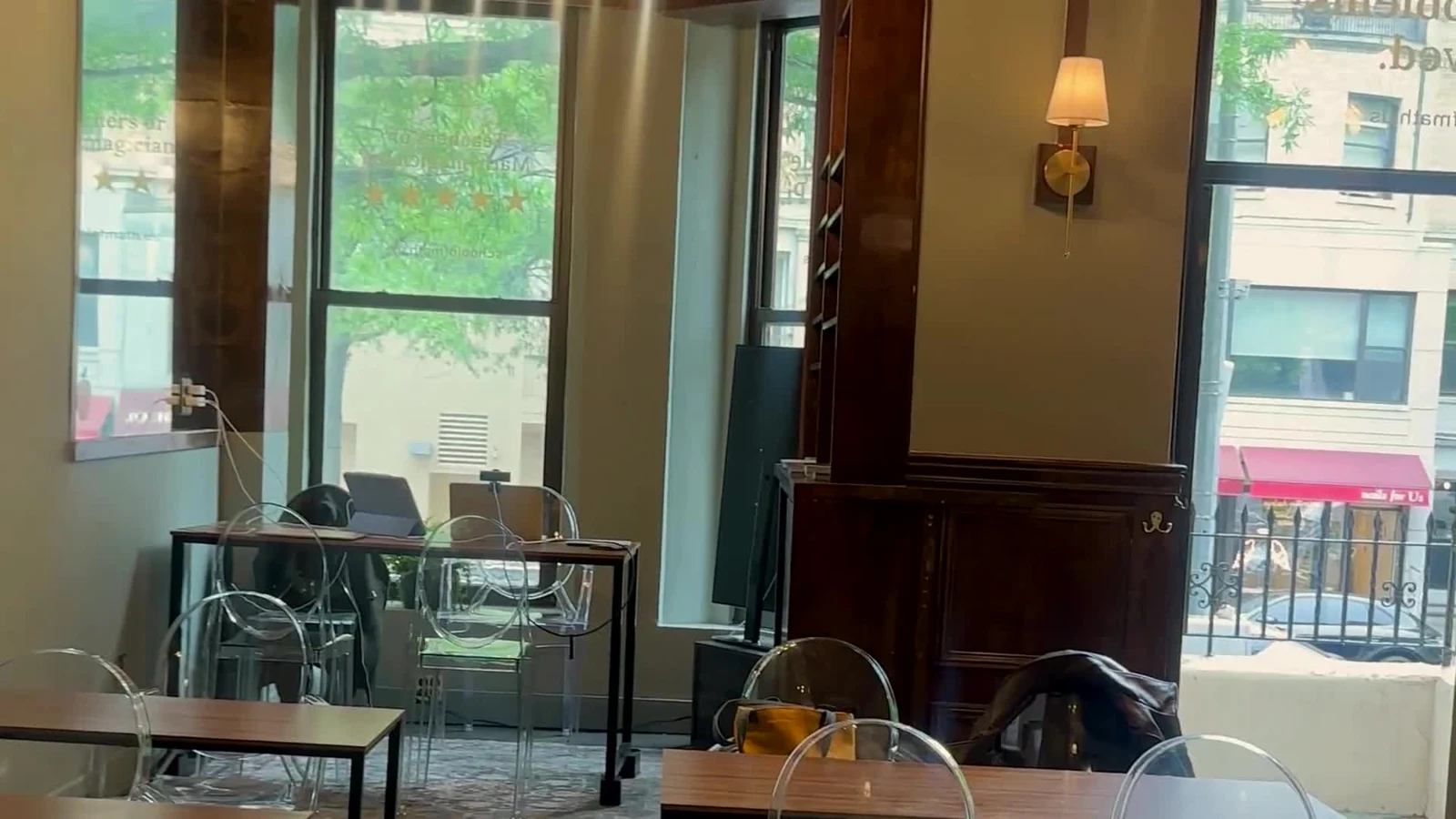
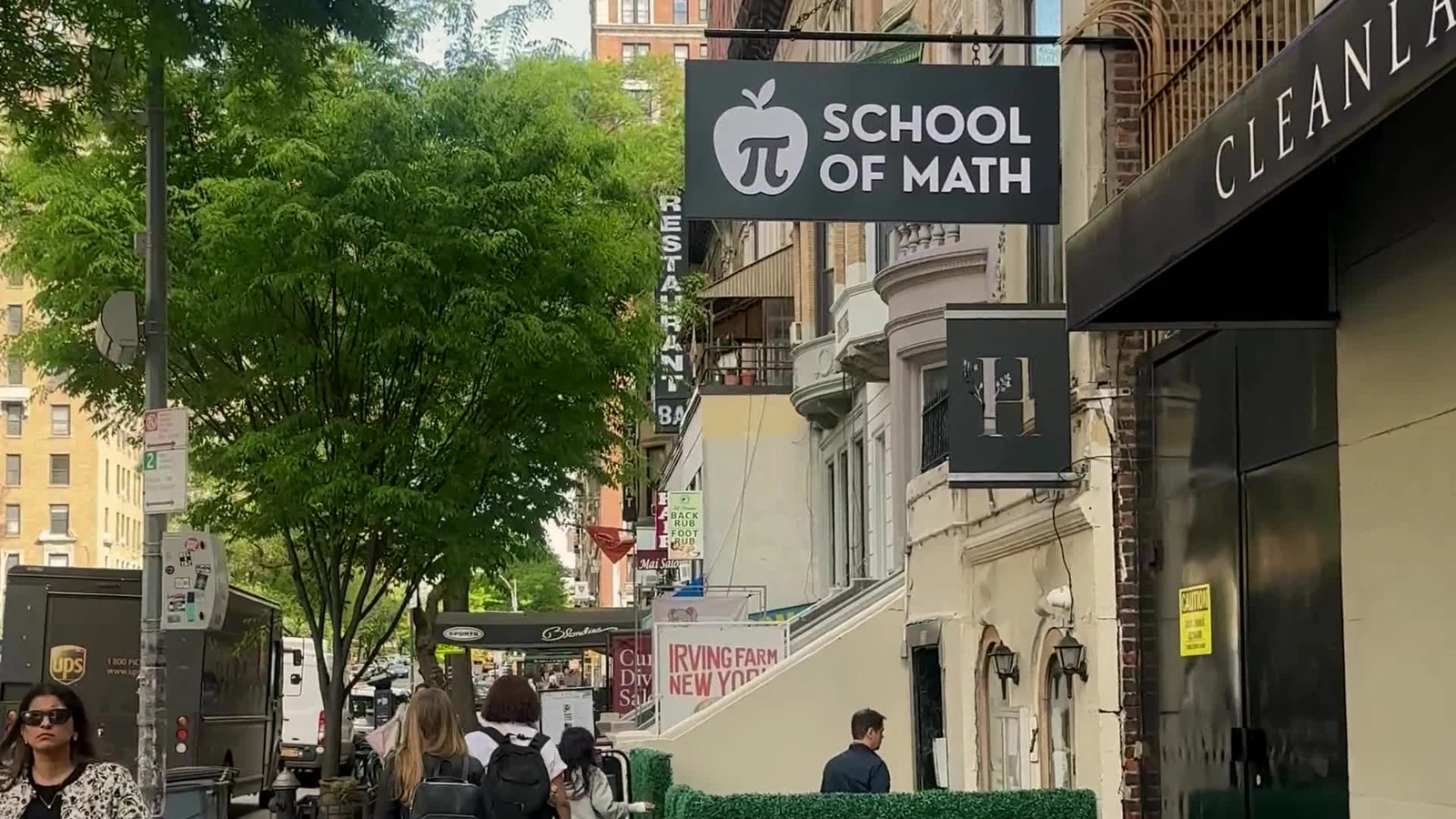
Both photographs are stills from SOMATH’s existing website footage.
A visit is an opportunity to evaluate the environment, not just the commute. Notice whether the room feels suitable for concentrated work, whether there is space for students to write, and whether the teaching setup matches the description you have read. Ask what the child should bring and how arrival and pickup work for the selected class.
For a young student, the transition into class can matter as much as the content of the first worksheet. Leave enough time to arrive without rushing. For an older student, clarify whether they will arrive independently and how the parent and school will stay informed about attendance.
Avoid choosing solely by distance. A nearby class at the wrong level may be less useful than a slightly longer trip to an appropriate group. But do not dismiss logistics either. A sustainable schedule is part of the educational decision, particularly when multiple children or after-school commitments are involved.
The simplest first visit begins with the evaluation booking. You can then discuss the recommended course and check the current timetable rather than guessing which class name is the right fit.
Questions parents often ask about SOMATH
What is SOMATH?
SOMATH is School of Math, an in-person math-enrichment school on the Upper West Side serving students in grades 1–12 (school website). Its course directory describes small groups of four to six students, with programs across elementary, middle-school, and advanced mathematics (courses).
Is SOMATH only for children who are already strong at math?
The evaluation page describes identifying both strengths and gaps before recommending a program (evaluation). A parent should therefore discuss the child’s actual starting point rather than assume that enrichment is only for students who already find every topic easy.
Can an advanced child be challenged without simply racing ahead?
Yes, that is a useful goal to discuss. Ask for problems that require explanation, unfamiliar applications, or connections between ideas. Advancement should mean more than encountering a new chapter title; it should involve understanding that remains available when the wording or context changes.
Does SOMATH offer online classes?
The published membership offering is in person, while the evaluation page also offers a Zoom assessment option (membership, evaluation). Online lesson pages and printable resources should not be confused with enrollment in a live online course.
How many students are in a class?
The course directory describes groups of four to six students, and the Algebra II course page describes a maximum of six (courses, Algebra II). Confirm the proposed group and its level during the placement discussion.
How long is the free evaluation?
The dedicated evaluation page specifies thirty minutes and describes a written diagnostic within forty-eight hours (evaluation). Bring questions about the child’s current work, goals, and any relevant learning supports so the conversation can lead to a useful recommendation.
Are School of Math and RSM affiliated?
They are separate organizations with different founders and their own program descriptions (SOMATH, RSM). Compare the actual placement, group, curriculum, and logistics rather than treating the names as interchangeable.
Does every program use the same class length?
No. The published course directory lists sixty minutes for Little Newtons, ninety minutes for Kid Einsteins, and one hundred twenty minutes for Young Fermats and the listed advanced programs (courses). Confirm the duration of the class you intend to join.
Can I see a real lesson before enrolling?
Yes. The Journal includes detailed class pages such as Algebra 2 Class 11, with illustrations, questions, hidden worked answers, and a printable workbook. Use a sample to inspect the approach, while remembering that it is not automatically the appropriate placement for your child.
Is a placement evaluation a diagnosis of a learning disorder?
No. A math placement evaluation is intended to guide an instructional recommendation; it should not be treated as a clinical diagnosis. Families with questions about a learning disorder, attention, or other health-related concerns should consult an appropriately qualified professional and share relevant recommendations with the school.
Where can I check the current schedule and membership terms?
Use the live schedule and membership page, then confirm the details in the enrollment flow. Availability and individual arrangements should not be inferred from a dated article or another family’s membership.
What is the next step?
Book the free evaluation and bring a clear question about your child’s math. You do not need to choose the most advanced-sounding program first; the purpose of the evaluation is to make the starting point more precise.
The best reason to choose a math school
The best reason is not a slogan, a fear of falling behind, or a promise that no responsible teacher can guarantee. It is a clear match between the student’s needs and the instruction the school can provide. You should understand what the child will work on, why that starting point makes sense, and how you will recognize a useful next step.
For SOMATH, the invitation is practical: look at the lessons, meet the school, and ask specific questions. Decide whether the small-group, in-person setting and the approach to mathematical work are right for your child. A good decision should leave the family with more clarity, not simply more urgency.
Old-school expectations and a lively classroom do not have to conflict. A student can be taken seriously, asked to persist, supported through confusion, and allowed to enjoy the achievement of understanding something difficult. That is the combination behind “Old-School Math Classes. Infinite Aura.”
Book a free math evaluation at SOMATH, explore the programs, or call (646) 668-6151. The school is at 226 W 79th St on the Upper West Side (visit details).